

Advancing alcohol research in low-income and middle-income countries: a global alcohol environment framework
Open accessThe DOI matches its Crossref record; 41 of the 41 references it cites were found in a registry or an index.
Abstract
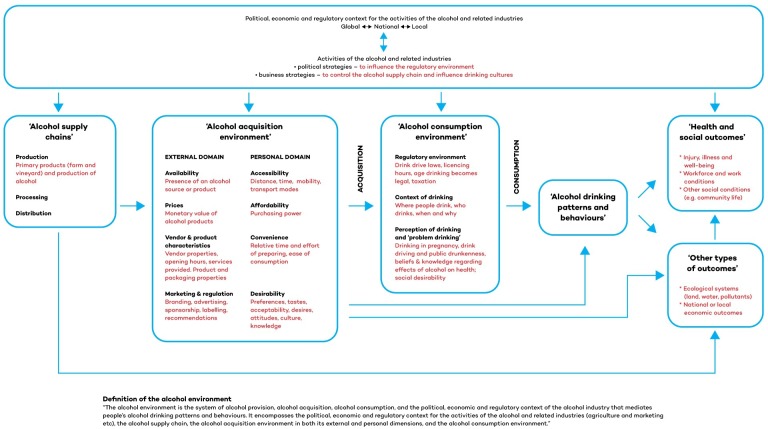
Alcohol-related harm has gained increased attention in high-income countries (HICs) in recent years which, alongside government regulation, has effected a reduction in alcohol consumption. The alcohol industry has turned its attention to low-income and middle-income country (LMIC) markets as a new source of growth and profit, prompting increased consumption in LMICS. Alcohol use in LMICs is also increasing. There is a need to understand particularly in LMICs the impact of industry strategy in shaping local contexts of alcohol use. We draw on conceptualisations from food systems research, and research on the commercial determinants of health, to develop a new approach for framing alcohol research and discuss implications for alcohol research, particularly in LMICs, focusing on South Africa as an illustrative example. We propose a conceptualisation of the ‘alcohol environment’ as the system of alcohol provision, acquisition and consumption—including, critically, industry advertising and marketing—along with the political, economic and regulatory context of the alcohol industry that mediates people’s alcohol drinking patterns and behaviours. While each country and region is different in terms of its context of alcohol use, we contrast several broadly distinct features of alcohol environments in LMICs and HICs. Improving understanding of the full spectrum of influences on drinking behaviour, particularly in LMICs, is vital to inform the design of interventions and policies to facilitate healthier environments and reduce the harms associated with alcohol consumption. Our framework for undertaking alcohol research may be used to structure mixed methods empirical research examining the role of the alcohol environment particularly in LMICs.
Overview
The claims and statistics of this paper haven’t been checked yet.
Free: it reads the open-access text and checks the first 5 claims that cite a source we can check. Create a free account to check every claim.
Integrity signals
Registry
Cites
Statistics
Figures
Verification
Claims the paper makes
The claims and statistics of this paper haven’t been checked yet.
Free: it reads the open-access text and checks the first 5 claims that cite a source we can check. Create a free account to check every claim.
Self-check
Percentages, sums and reported differences re-computed from the paper’s own numbers.
The self-check needs the paper’s full text.
Citations
Cites
The Many Meanings of Research Utilization
Weiss, C. H. (1979) · Public Administration Review · doi:10.2307/3109916 · Cited by 2,222
Alcohol: No Ordinary Commodity. Research and public policy
Babor, T. F., Caetano, R., Casswell, S., Edwards, G., Giesbrecht, N., Graham, K., Grube, J. W., Hill, L., Holder, H. D., Homel, R. J., et al. (2003) · Cited by 1,718
Moodie, R., Stuckler, D., Monteiro, C., Sheron, N., Neal, B., Thamarangsi, T., Lincoln, P., & Casswell, S. (2013) · The Lancet · doi:10.1016/s0140-6736(12)62089-3 · Cited by 1,663
Turner, C., Aggarwal, A., Walls, H., Herforth, A., Drewnowski, A., Coates, J., Kalamatianou, S., & Kadiyala, S. (2018) · Global Food Security · doi:10.1016/j.gfs.2018.08.003 · Cited by 626
Self-citationBuse, K., Mays, N., & Walt, G. (2005) · Cited by 409
Alcohol consumption as a risk factor for tuberculosis: meta-analyses and burden of disease
Imtiaz, S., Shield, K. D., Roerecke, M., Samokhvalov, A. V., Lönnroth, K., & Rehm, J. (2017) · European Respiratory Journal · doi:10.1183/13993003.00216-2017 · Cited by 308
Food Environment Research in Low- and Middle-Income Countries: A Systematic Scoping Review
Turner, C., Kalamatianou, S., Drewnowski, A., Kulkarni, B., Kinra, S., & Kadiyala, S. (2020) · Advances in Nutrition · doi:10.1093/advances/nmz031 · Cited by 302
Reducing harm from alcohol: call to action
Casswell, S., & Thamarangsi, T. (2009) · The Lancet · doi:10.1016/s0140-6736(09)60745-5 · Cited by 294
The Policy Dystopia Model: An Interpretive Analysis of Tobacco Industry Political Activity
Ulucanlar, S., Fooks, G. J., & Gilmore, A. B. (2016) · PLOS Medicine · doi:10.1371/journal.pmed.1002125 · Cited by 252
Alcohol industry involvement in policymaking: a systematic review
McCambridge, J., Mialon, M., & Hawkins, B. (2018) · Addiction · doi:10.1111/add.14216 · Cited by 237
Cited by
Causal mechanisms proposed for the alcohol harm paradox—a systematic review
Boyd, J., Sexton, O., Angus, C., Meier, P. S., Purshouse, R. C., & Holmes, J. (2021) · Addiction · doi:10.1111/add.15567 · Cited by 169
“greater availability of informally produced alcohol in low–middle-income countries [27].”
Wood, B., Williams, O., Nagarajan, V., & Sacks, G. (2021) · Globalization and Health · doi:10.1186/s12992-021-00667-7 · Cited by 152
Global Burden of Ischemic Stroke in Young Adults in 204 Countries and Territories
Zhang, R., Liu, H., Pu, L., Zhao, T., Zhang, S., Han, K., & Han, L. (2022) · Neurology · doi:10.1212/wnl.0000000000201467 · Cited by 140
“Studies on global alcohol consumption and health show that alcohol consumption has declined in high-income countries but is on the rise in low SDI regions.(34) Although the agestandardized rate of ischemic stroke attributed to a high ambient temperature in high SDI regions is currently low, as is that attributed to al…”
BackgroundMilsom, P., Smith, R., Baker, P., & Walls, H. (2020) · Health Policy and Planning · doi:10.1093/heapol/czaa148 · Cited by 85
“middle-income countries (LMICs) since they have become the focus for expansion by many THCCs ( Lawrence, 2011; Savell et al., 2015; Walls et al., 2020) but generally have limited capacity—finan-”
BackgroundSelf-citationWood, B., Baker, P., & Sacks, G. (2021) · International Journal of Health Policy and Management · doi:10.34172/ijhpm.2021.05 · Cited by 53
“…involvement in health policy: a primer No No The use of a non-market strategy perspective from business literature to explore commercial involvement in health policy Walls et al, 2020 Advancing alcohol research in low-income and middle-income countries: a global environment framework Yes No Use of…”
BackgroundConstantinides, S. V., Turner, C. J., Frongillo, E. A., Bhandari, S., Reyes, L. I., & Blake, C. E. (2021) · Global Food Security · doi:10.1016/j.gfs.2021.100511 · Cited by 84
Sun, X., Yon, D. K., Nguyen, T. T., Tanisawa, K., Son, K., Zhang, L., Shu, J., Peng, W. H., Yang, Y., Branca, F., et al. (2023) · The Lancet Regional Health - Western Pacific · doi:10.1016/j.lanwpc.2023.100842 · Cited by 81
Ghosh, A., Singh, P., Das, N., Pandit, P. M., Das, S., & Sarkar, S. (2022) · Addiction · doi:10.1111/add.15613 · Cited by 73
South Africa’s COVID-19 Alcohol Sales Ban: The Potential for Better Policy-Making
Matzopoulos, R., Walls, H., Cook, S., & London, L. (2020) · International Journal of Health Policy and Management · doi:10.34172/ijhpm.2020.93 · Cited by 68
Self-citationMaking the WHO European Region SAFER: developments in alcohol control policies, 2010–2019
WHO Regional Office for Europe (2021) · World Health Organization, Regional Office for Europe eBooks · doi:10.37426/9789289055048 · Cited by 67
Tinner, L., Palmer, J. C., Lloyd, E. C., Caldwell, D. M., MacArthur, G. J., Dias, K., Langford, R. M., Redmore, J., Wittkop, L., Watkins, S., et al. (2022) · BMC Public Health · doi:10.1186/s12889-022-13072-5 · Cited by 64
Nicholls, E. (2023) · International Journal of Drug Policy · doi:10.1016/j.drugpo.2023.104149 · Cited by 56
Health Taxes: Policy and Practice
Lauer, J. A., Sassi, F., Soucat, A. L. B., & Vigo, A. (2021) · WORLD SCIENTIFIC (EUROPE) eBooks · doi:10.1142/q0365 · Cited by 53
Georgescu, O. Ş., Martin, L., Târtea, G. C., Rotaru-Zăvăleanu, A. D., Dinescu, S. N., Vasile, R. C., Greșiță, A., Gheorman, V., Aldea, M., & Dinescu, V. C. (2024) · Life · doi:10.3390/life14091134 · Cited by 54
“Cultural/religious influences and economic development increase alcohol availability [43].”
BackgroundClosing the treatment gap for alcohol use disorders in low- and middle-income countries
Nadkarni, A., Gandhi, Y., Bhatia, U., & Velleman, R. (2023) · Cambridge Prisms: Global Mental Health · doi:10.1017/gmh.2022.57 · Cited by 46
“In South Africa, high-income earners had the highest drinking prevalence but lowincome earners consumedmore alcohol on average, spent a greater proportion of household income on alcohol and experienced a higher burden of alcohol-related harm (Walls et al., 2020).”
BackgroundMewton, L., Visontay, R., Hoy, N., Lipnicki, D. M., Sunderland, M., Lipton, R. B., Guerchet, M., Ritchie, K., Najar, J., Scarmeas, N., et al. (2023) · Addiction · doi:10.1111/add.16035 · Cited by 45
Danpanichkul, P., Suparan, K., Ng, C. H., Dejvajara, D., Kongarin, S., Panpradist, N., Chaiyakunapruk, N., Muthiah, M. D., Chen, V. L., Huang, D. Q., et al. (2024) · JHEP Reports · doi:10.1016/j.jhepr.2024.101020 · Cited by 37
“28 This discrepancy can be attributed to factors such as higher access to healthcare, increased health literacy, and fewer adjunctive risk factors for ALD and AUD.”
Danpanichkul, P., Chen, V. L., Chaiyakunapruk, N., Auttapracha, T., Kongarin, S., Ng, C. H., Duangsonk, K., Muthiah, M. D., Sukphutanan, B., Sim, B., et al. (2024) · Alimentary Pharmacology & Therapeutics · doi:10.1111/apt.18095 · Cited by 37
Beksinska, A., Nyariki, E., Kabuti, R., Kungu, M., Babu, H., Shah, P., Champions, T. M. F. S., Nyabuto, C., Okumu, M., Mahero, A., et al. (2022) · International Journal of Environmental Research and Public Health · doi:10.3390/ijerph19127294 · Cited by 36
“In recent years, alcohol use has been increasing in many lowand low-middle-income countries (LMICs) [3,4], with consumption and risks higher in certain key populations such as sex workers [5].”
BackgroundBeksinska, A., Karlsen, O., Gafos, M., & Beattie, T. (2023) · PLOS Global Public Health · doi:10.1371/journal.pgph.0001216 · Cited by 36
Alcohol and Periodontal Disease: A Narrative Review
Gandhi, U. H., Benjamin, A., Gajjar, S., Hirani, T., Desai, K., Suhagia, B. B., Ahmad, R., Sinha, S., Haque, M., & Kumar, S. (2024) · Cureus · doi:10.7759/cureus.62270 · Cited by 35
“For a considerable portion of the population globally, including in low-and-middle-income countries (LMICs), consistently consuming alcohol becomes one of the critical reasons for seriously damaged health [35,36].”
BackgroundGriffin, S. M., Karia, F. P., Zimmerman, A., Minnig, M. C., Swahn, M. H., Makelarski, J. A., Mmbaga, B. T., Vissoci, J. R. N., & Staton, C. A. (2020) · Alcoholism Clinical and Experimental Research · doi:10.1111/acer.14402 · Cited by 32
“From a broader perspective, perceived stigma in our setting appears to be much higher than perceived stigma in settings from HICs.”
BackgroundInfluentialSwahn, M. H., Culbreth, R. E., Masyn, K. E., Salazar, L. F., Wagman, J. A., & Kasirye, R. (2021) · AIDS and Behavior · doi:10.1007/s10461-021-03301-0 · Cited by 32
“Sub-Saharan Africa is considered to have the largest burden of HIV/AIDS globally [1].”
BackgroundInfluentialSmith, L., Sánchez, G. F. L., Pizzol, D., Oh, H. Y., Barnett, Y., Schuch, F. B., Butler, L. T., McDermott, D. T., Ball, G., Chandola‐Saklani, A., et al. (2023) · Journal of Adolescent Health · doi:10.1016/j.jadohealth.2023.10.007 · Cited by 32
Jong, M. D., George, A. S., & Jacobs, T. (2021) · Health Policy and Planning · doi:10.1093/heapol/czab101 · Cited by 23
“There has also been a purposeful targeting of low-and middle-income countries by global alcohol companies as key markets (Walls et al., 2020).”
BackgroundMatzopoulos, R., Cois, A., Probst, C., Parry, C. D. H., Vellios, N., Sorsdahl, K. R., Joubert, J. D., Wyk, V. P., Bradshaw, D., & Pacella, R. (2022) · South African Medical Journal · doi:10.7196/samj.2022.v112i8b.16487 · Cited by 22
Self-citationMilsom, P., Smith, R., Baker, P., & Walls, H. (2021) · Globalization and Health · doi:10.1186/s12992-021-00784-3 · Cited by 23
Self-citationMilsom, P., Smith, R., Modisenyane, S. M., & Walls, H. (2022) · Globalization and Health · doi:10.1186/s12992-022-00814-8 · Cited by 20
“For alcohol and food corporations neoliberal reform including trade and investment liberalization and the country’s regional and global connectedness, have promoted their investment into South Africa as a production hub for accessing new markets across Africa [6].”
BackgroundSelf-citationThe role of social group influences when intending to purchase premium alcohol
Cunningham, N. (2023) · Cogent Business & Management · doi:10.1080/23311975.2023.2174093 · Cited by 19
“…premium alcohol due to the quality (Calvo-Porral et al., 2018), and consumers choosing premium alcohol brands over standard alcohol brands (Calvo-Porral, 2019; Walls et al., 2020), research on the degree to which social groups influence the purchase intention of premium alcohol brands is needed.”
BackgroundMilsom, P., Smith, R., Modisenyane, S. M., & Walls, H. (2021) · Globalization and Health · doi:10.1186/s12992-021-00757-6 · Cited by 19
Self-citationPauley, A., Metcalf, M., Buono, M., Rent, S. M., Mikindo, M., Sawe, Y., Kilasara, J., MNS-FNP, A., Bosche, J., Staton, C. A., et al. (2024) · PLOS Global Public Health · doi:10.1371/journal.pgph.0002382 · Cited by 18
Feng, Y., Sun, D., Sun, X., Guo, Q., Zhang, J., & Li, Y. (2025) · BMC Medicine · doi:10.1186/s12916-025-04463-7 · Cited by 17
“…years, with widespread concerns about alcohol damage and government regulations leading to lower alcohol consumption in high-income countries [31], the alcohol industry has looked to the low-and middle-income country (LMIC) market to develop business strategies to promote alcohol consumption…”
WHO technical manual on alcohol tax policy and administration
Itziar Belausteguigoitia, D., Blecher, E., Bouw, A., Goodchild, M., Iglesias, R., Marten, R., McGrady, B. D., Neufeld, M., Paul, J., Perucic, A.-M., et al. (2023) · STM:n Hallinnonalan avoin julkaisuarkisto (Julkari) · Cited by 19
Ngqangashe, Y., Heenan, M., & Pescud, M. (2021) · International Journal of Environmental Research and Public Health · doi:10.3390/ijerph182111494 · Cited by 17
“The lack of comprehensive alcohol regulation in LMICs has previously been attributed to a lack of political will, aggressive industry strategies to increase the uptake of alcohol consumption, and perceived benefits of the alcohol industry to economies and jobs [3,6].”
BackgroundSwahn, M. H., Palmier, J. B., May, A., Dai, D., Braunstein, S., & Kasirye, R. (2022) · BMC Public Health · doi:10.1186/s12889-022-13350-2 · Cited by 15
“Currently there are exciting new conceptual developments to guide the advancement of alcohol research in low-income countries [53] as well as a renewed call to action [54] regarding the WHO global strategy to reduce alcohol harm [13], particularly in low-resource settings where the overall alcohol burden is the highes…”
BackgroundSuranga, M. A., Aminde, L. N., Weeratunga, G. U., Weerakoon, K., & Veerman, L. J. (2025) · Health Policy and Planning · doi:10.1093/heapol/czaf036 · Cited by 16
“Key challenges include political pressure from the alcohol industry, which opposes or weak-ens control measures through lobbying, campaign contributions, and industry-funded research (Walls et al. 2020).”
Critchlow, N., & Moodie, C. S. (2021) · Alcohol and Alcoholism · doi:10.1093/alcalc/agab028 · Cited by 13
Quadri, M. F. A., Lusher, J. M., Foláyan, M. O., Tantawi, M. E., Zúñiga, R. A. A., Brown, B. J., Aly, N. M., Okeibunor, J., Abeldaño, G. F., Jafer, M. A., et al. (2023) · Tobacco Induced Diseases · doi:10.18332/tid/157205 · Cited by 13
Theron, M., Swart, R., Londani, M., Parry, C. D. H., Williams, P. P., & Harker, N. (2023) · South African Journal of Science · doi:10.17159/sajs.2023/14543 · Cited by 12
“4,25 It has been well documented that early initiation of alcohol use is associated with risky or harmful alcohol use as an adult.”
BackgroundGreene, M. C., Kane, J., Alto, M., Giusto, A., Lovero, K., Stockton, M., McClendon, J., Nicholson, T., Wainberg, M. L., Johnson, R. M., et al. (2023) · Cochrane Database of Systematic Reviews · doi:10.1002/14651858.cd013350.pub2 · Cited by 11
Matenga, T. F. L., Zyambo, C. M., Phiri, M. M., Zulu, R., Mukupa, M., Mabanti, K., Hainze, A., Menda, D. M., Rizzo, A., Ogwell, A., et al. (2025) · Frontiers in Public Health · doi:10.3389/fpubh.2025.1444334 · Cited by 10
“Low-income individuals often seek cheaper alternatives, such as home-produced or illegally distilled spirits, due to affordability and availability in disadvantaged neighbourhoods (25).”
The Determinants of Household Spending on Alcohol and Tobacco in Tanzania
Mwaisakila, S. R., & Adrison, V. (2021) · East African Journal of Business and Economics · doi:10.37284/eajbe.3.1.419 · Cited by 10
“In addition, despite of having big corporations and industries producing alcohol and tobacco in low- and medium-income countries, traditional and local homemade alcohol has been among the suppliers of alcohol in low and medium income countries (Walls et al., 2020).”
BackgroundUmo, I., James, K., Didilemu, F., Sinen, B., Borchem, I., Inaido, D., & Ikasa, R. (2022) · The Lancet Regional Health - Western Pacific · doi:10.1016/j.lanwpc.2021.100379 · Cited by 10
Lesch, M., Golder, S., & McCambridge, J. (2024) · Substance Abuse Treatment Prevention and Policy · doi:10.1186/s13011-024-00611-z · Cited by 10
“Low-income countries and emerging markets are a key strategic focus for transnational alcohol producers [7, 11].”
BackgroundMcKevitt, S., White, M., Petticrew, M. P., Summerbell, C., Vasiljevic, M., Boyland, E. J., Cummins, S., Laverty, A. A., Junghans, C., Millett, C. J., et al. (2023) · BMJ Global Health · doi:10.1136/bmjgh-2022-010216 · Cited by 11
Stockton, M. A., Mazinyo, E. W., Mlanjeni, L., Ngcelwane, N., Nogemane, K., Nobatyi, P., Sweetland, A. C., Basaraba, C. N., Greene, M. C., Bezuidenhout, C., et al. (2025) · Drug and Alcohol Dependence · doi:10.1016/j.drugalcdep.2025.112559 · Cited by 9
Dhital, R., Yoeli, H., Adhikari, A., Luitel, N. P., Nadkarni, A., van Teijlingen, E., & Sin, J. (2023) · Perspectives in Public Health · doi:10.1177/17579139231180744 · Cited by 8
Walmisley, U., Jong, M. D., George, A. S., Okeyo, I., Späth, C., Siegfried, N., Harker, N., Tomlinson, M., & Doherty, T. (2024) · Global Public Health · doi:10.1080/17441692.2024.2357211 · Cited by 8
“Where analysis of multi-sectoral interventions is reported, we focus on studies in LMIC, which are a neglected area of study, where there is a need to better understand existing programming, and which are an area of focus for future market growth by the alcohol industry (Walls et al., 2020).”
InfluentialSocial determinants of hazardous alcohol use in a Ugandan population cohort
Ziegel, L., Sjöland, C. F., Nabunya, E., Bulamba, R., Kyasanku, E., Mugamba, S., Kigozi, G., Daama, A., Kigozi, G. N., Miller, A. P., et al. (2025) · Global Health Action · doi:10.1080/16549716.2025.2484870 · Cited by 8
“Most existing evidence derives from high-or upper middle-income settings, where higher socio-CONTACT economic groups typically consume more alcohol but experience fewer alcohol-related harms than lower socioeconomic groups [9,11–14].”
Alcohol consumption in low-and middle-income settings
Sørensen, J. B., Tayebi, S., Brokhattingen, A., & Gyawali, B. (2022) · Springer eBooks · doi:10.1007/978-3-030-67928-6_59-1 · Cited by 8
Alcohol Consumption in Low- and Middle-Income Settings
Sørensen, J. B., Tayebi, S., Brokhattingen, A., & Gyawali, B. (2022) · Springer eBooks · doi:10.1007/978-3-030-92392-1_59 · Cited by 8
Jaeger, L., Devi, T., Barbazza, E. S., Neufeld, M., Franz, C., Marten, R., & Tello, J. E. (2022) · BMJ Open · doi:10.1136/bmjopen-2022-063365 · Cited by 7
Hargovan, M., London, L., & Orgill, M. (2024) · Health Policy and Planning · doi:10.1093/heapol/czae055 · Cited by 7
“…of alcohol policy reform in SA and across other LMICs settings, in order to reduce the harms and costs of alcohol to public health and society (Ferreira-Borges et al ., 2017; Rabiee et al ., 2017; Bertscher et al ., 2018; Walls et al ., 2020; Matzopoulos et al ., 2020; Rehm et al ., 2020).”
BackgroundSelf-citationBhawani, S., Raj, A., Kumar, R. R., & Sharma, S. (2025) · Benchmarking An International Journal · doi:10.1108/bij-10-2024-0910 · Cited by 7
Liao, L., & Pinhu, L. (2020) · Alcoholism Clinical and Experimental Research · doi:10.1111/acer.14483 · Cited by 7
“Harmful use of alcohol not only damages the body, but also causes mental disorders and social harm (Walls et al., 2020).”
BackgroundHoe, C., Weiger, C. V., & Cohen, J. E. (2022) · BMJ Open · doi:10.1136/bmjopen-2021-054060 · Cited by 7
Yamaguchi, S., Lencucha, R., & Brown, T. G. (2021) · Globalization and Health · doi:10.1186/s12992-021-00758-5 · Cited by 7
“Today, the WHO/PAHO working group recognizes the alcohol industry as a key determinant of alcohol consumption and related harms in this region and globally [7].”
BackgroundInfluentialWhole-of-community interventions that address alcohol-related harms: protocol for a scoping review
Okeyo, I., Walmisley, U., Jong, M. D., Späth, C., Doherty, T., Siegfried, N., Harker, N., Tomlinson, M., & George, A. S. (2022) · BMJ Open · doi:10.1136/bmjopen-2021-059332 · Cited by 7
Chen, Y., Zhong, Y., Wang, M., Su, X., Li, Q., Wang, J., & Sun, L. (2024) · Child Abuse & Neglect · doi:10.1016/j.chiabu.2024.106818 · Cited by 6
Laslett, A., Cook, M., Ramsoomar, L., Morojele, N. K., & Waleewong, O. (2024) · The International Journal of Alcohol and Drug Research · doi:10.7895/ijadr.471 · Cited by 5
Haragirimana, E., Mitchell, G., & Uny, I. (2024) · The International Journal of Alcohol and Drug Research · doi:10.7895/ijadr.467 · Cited by 5
“…findings indicate that some low-income countries have made little progress in implementing policies to reduce alcohol consumption, partly due also to the influence of the alcohol environment on both policy and consumption (Ferreira-Borges et al., 2015b; Morojele et al., 2021; Walls et al., 2020).”
BackgroundGlobal Burden of Stroke: Insights and Trends from GBD 2021
Luu, B. M. T., & Truyen, T. T. T. T. (2025) · IntechOpen eBooks · doi:10.5772/intechopen.1012084 · Cited by 4
Uny, I., Magalasi, D., Orgill, M., Namanda, C., Mitchell, G., Tumwesigye, N. M., Bauld, L., Parry, C. D. H., Fitzgerald, N., & Kaneka, B. (2025) · International Journal of Drug Policy · doi:10.1016/j.drugpo.2025.104979 · Cited by 4
“Some studies point to targeted efforts by industry actors to increase the demand and the availability of alcohol in LMIC (Walls et al., 2020).”
InfluentialAlcohol use and internal migration in Nepal: a cross-sectional study
Ghimire, D. J., Cole, F., Hermosilla, S., Axinn, W. G., & Benjet, C. L. (2023) · Journal of Epidemiology & Community Health · doi:10.1136/jech-2022-220030 · Cited by 4
Pauley, A., Metcalf, M., Buono, M., West, K. P., Rent, S. M., Nkenguye, W., Sawe, Y., Mikindo, M., Trinitas, J. K., Mchome, B. L., et al. (2025) · PLoS ONE · doi:10.1371/journal.pone.0331490 · Cited by 4
Rehm, J. T., Correia, D., Amul, G. G. H., Ang, I. Y. H., Chaiyasong, S., Chhoun, P., Chong, C. L., Chua, A. M. R., Hairi, N. N., Hanafi, E., et al. (2026) · Journal of Global Health · doi:10.7189/jogh.16.04150 · Cited by 3
“…in purchasing power and the alcohol industry’s intense marketing efforts in low-and middle-income countries with high rates of economic growth [ 5 ], while latter results from improved over-all living conditions and a reduction in disease and perinatal and infectious causes of death [ 6 ].”
Hygiene and sanitation public health risks in illicit alcohol production and retail in Zambia
Mukupa, M., Zyambo, C. M., Phiri, M. M., Zulu, R., Matenga, T. F. L., Mabanti, K., Hainze, A., Ogwell, A., DeJong, W., Menda, D. M., et al. (2025) · Frontiers in Epidemiology · doi:10.3389/fepid.2025.1461874 · Cited by 3
“Illicit alcohol production typically occurs in informal settings characterized by low-income families, where hygiene and sanitation standards are often substandard or nonexistent (16 – 18).”
Enhancing Alcohol-Related Research in Africa: Possibility for a Continental-Wide Alliance
Agberotimi, S. F., & Adekunle, O. F. (2024) · Journal of Prevention · doi:10.1007/s10935-024-00794-y · Cited by 3
Danpanichkul, P., Suparan, K., Chaiyakunapruk, N., Auttapracha, T., Kongarin, S., Wattanachayakul, P., Ramadoss, V., Suenghataiphorn, T., Sukphutanan, B., Pang, Y., et al. (2024) · European Journal of Gastroenterology & Hepatology · doi:10.1097/meg.0000000000002882 · Cited by 3
“Additionally, most studies regarding alcohol have been conducted in developed countries [13].”
Silva, M. A. D., Alexander, E. C., Martins, S. S., Naidoo, S., Gruver, R. S., Desmond, C., & Davidson, L. L. (2022) · Child Psychiatry & Human Development · doi:10.1007/s10578-022-01342-7 · Cited by 3
Marketing practices to promote indigenous fermented alcoholic beverages in the tropics
Hlangwani, E., Doorsamy, W., & Adebo, O. A. (2023) · Elsevier eBooks · doi:10.1016/b978-0-323-98341-9.00036-0 · Cited by 3
Alcohol, Labor, and Agriculture
Murphy, D. M. A. (2026) · American Economic Journal Economic Policy · doi:10.1257/pol.20240361 · Cited by 3
Mahesarajah, S., & Pazoki, R. (2022) · medRxiv · doi:10.1101/2022.04.27.22274363 · Cited by 3
“In LICs data with geotagged information concerning suppliers and policy information may not be recorded (33).”
BackgroundHousing Eviction and Alcohol-Related Harms: A Review of the Literature
Dougherty, M., Baumann, S. E., Coulter, R. W. S., Pedersen, S. L., Ragavan, M. I., & Mair, C. (2025) · Substance Use & Misuse · doi:10.1080/10826084.2025.2508745 · Cited by 2
“Further research in this area is particularly important given recent increases in alcohol consumption and the growing influence of the alcohol industry in these countries (Walls et al., 2020).”
Surascape: Morphological patterns of the cultural landscape of community liquor production
Yodsurang, P., Kiatthanawat, A., Krasae-in, A., Puthpongsiriporn, T., & Dabbhodyan, O. (2025) · International Journal of Food Design · doi:10.1386/ijfd_00077_1 · Cited by 2
Yuan, Q., Chen, Z., Sun, B., Zheng, C., Kang, Y., Lou, Y., & Zheng, M. (2025) · Frontiers in Public Health · doi:10.3389/fpubh.2025.1675607 · Cited by 5
Ja, L. K., Soe, K. M., Thi, W. M., Htike, K. M., & Kumar, R. (2026) · Journal of Ethnicity in Substance Abuse · doi:10.1080/15332640.2025.2611119 · Cited by 2
Even, B., Abdulai, A., Ambikapathi, R., Béné, C., Kennedy, G. D., & Lundy, M. (2026) · Globalization and Health · doi:10.1186/s12992-026-01217-9 · Cited by 2
“…with prior epi‑ sodes where slower demand or stronger regulation in HICs prompted firms to seek volume growth in juris‑ dictions with weaker regulatory constraints and higher market potential [36, 42, 43], similar to long‑documented patterns in the tobacco [44, 45] and alcohol [46] indus‑ tries.”
Atusingwize, E., Nilsson, M., Sjölander, A. E., Tumwesigye, N. M., Musoke, D., & Landstedt, E. (2024) · Alcohol and Alcoholism · doi:10.1093/alcalc/agae081 · Cited by 2
“Increased government commitment is required to ensure that these measures are effective, especially given the alcohol companies’ focus on the region (Walls et al. 2020; Morojele et al. 2021; WHO 2024).”
InfluentialWalls, H., Hawkins, B. R., & Durrance‐Bagale, A. (2021) · International Journal of Health Policy and Management · doi:10.34172/ijhpm.2021.59 · Cited by 2
Self-citationChennapragada, L., Kandlur, R., Pushpanadh, S., Aragula, S., Kilby, D. J., & Richardson-Vejlgaard, R. (2023) · Journal of Ethnicity in Substance Abuse · doi:10.1080/15332640.2023.2248032 · Cited by 2
“It studies alcohol use and distribution within local (e.g., marketing and consumption) and broader (e.g., political and economic factors) contexts in low-and middle-income countries (LMICs) (Walls et al., 2020).”
Milsom, P. (2021) · LSHTM Research Online (London School of Hygiene and Tropical Medicine) · doi:10.17037/pubs.04662735 · Cited by 2
Yamaguchi, S., Lencucha, R., & Brown, T. G. (2021) · Research Square · doi:10.21203/rs.3.rs-149064/v1 · Cited by 2
The Influence Of The Availability Of Alcoholic Beverages On The Drinking Habits Of Adolescents
Zulkaidah, Z., Shaluhiyah, Z., & Mustafa, S. B. (2023) · GUIDENA Jurnal Ilmu Pendidikan Psikologi Bimbingan dan Konseling · doi:10.24127/gdn.v13i3.7986 · Cited by 1
Prevalence and Associated Effects of Substance Use among Adolescents in Burundi, East Africa
Elvis, M., & Dusabe, B. (2025) · Current Journal of Applied Science and Technology · doi:10.9734/cjast/2025/v44i44523 · Cited by 1
Kombo, B. K. (2025) · Mspace (University of Manitoba) · Cited by 1
Ramsoomar, L., Maker-Diedericks, A., Mtimkulu, M., Morris, N., Seocharan, I., & Chirwa, E. D. (2026) · The International Journal of Alcohol and Drug Research · doi:10.7895/ijadr.653 · Cited by 1
Keyes, C. A., Murray, S., & Gavin, J. (2026) · International Journal of Injury Control and Safety Promotion · doi:10.1080/17457300.2026.2690600 · Cited by 1
“…alcohol-related morbidity and mortality are most pronounced among populations affected by longstanding inequities within South Africa’s historical health and social systems (Probst et al., 2018; Walls et al., 2020), particularly the Black and Coloured populations represented in this study.”
Alcohol-related cirrhosis mortality, 1990-2021: temporal trends and development-level inequalities.
Farrokhpour, M., Looha, M. A., Fallahnia, A., Sohi, Y. H., Rastegar, R., Hondori, M. J., Moradi, M., & Khaneh, A. Z. S. (2026) · Gastroenterology and hepatology from bed to bench. · doi:10.22037/ghfbb.v19i01.3255 · Cited by 1
“In contrast, HI countries achieved the largest and most sustained reductions, particularly before 1999, reflecting effective alcohol-control policies, harm-reduction strategies, and advances in liver disease management (13, 27, 43-48).”
Lifetime and past‐month alcohol use and related factors among female sex workers in Iran
Rasouli, M. A., Zareie, B., Gouya, M. M., Hadavandsiri, F., Mahboobi, M., Moradi, Y., Moradi, R., & Moradi, G. (2023) · Brain and Behavior · doi:10.1002/brb3.3288 · Cited by 1
“This indicates that young FSWs should be a target for alcohol interventions to prevent long-term alcohol related harms (Bryden et al., 2012; Walls et al., 2020).”
BackgroundSørensen, J. B., Lee, K. S., Dawson, A. H., Dawson, A. J., Senarathna, L., Pushpakumara, P. H. G. J., Rajapakse, T. N., Konradsen, F., Glozier, N., Conigrave, K. M., et al. (2023) · Global Health Action · doi:10.1080/16549716.2023.2273625 · Cited by 1
“To thoroughly understand the environment in which this research is framed, we mapped the alcohol environment using the recommendations by Walls et al. (Appendix 1) [39].”
MethodHazardous alcohol consumption in slow- and fast-privatized Russian industrial towns
Gugushvili, A., Azarova, A., Irdam, D., & KING, L. P. (2024) · Scientific Reports · doi:10.1038/s41598-024-62077-0 · Cited by 1
THE RELATIONSHIP BETWEEN CHILDHOOD ADVERSITY AND MENTAL HEALTH IN OLDER ADULTS
Lian, J., Anstey, K. J., & Kiely, K. M. (2022) · Innovation in Aging · doi:10.1093/geroni/igac059.2698 · Cited by 1
Zyambo, C. M., Niwagaba, K., & Ng’ambi, W. F. (2026) · medRxiv · doi:10.64898/2026.01.16.26344252 · Cited by 1
Li, Z., Wang, Y., Duan, B., Han, D., & Chen, W. (2022) · Cardiology Discovery · doi:10.1097/cd9.0000000000000062
“8% of all deaths worldwide.[1] Alcohol abuse is partly associated with approximately 30% to 50% of all non-ischemic cardiomyopathies, which is also called alcoholic cardiomyopathy (ACM).”
BackgroundLiteracia e consumo de substâncias psicoativas na gestação
Dornelas, A. G. (2022) · Digital Library of Theses and Dissertations (Universidade de São Paulo) · doi:10.11606/d.17.2022.tde-08092022-161308
Kokole, D. (2023) · Research Publications (Maastricht University) · doi:10.26481/dis.20230502dk
Alcohol policy and advocacy in Low- and Middle-Income Countries: Recommendations and lessons learned
Swahn, M. H., Peña, S., Braaten, E., Laslett, A., Morojele, N. K., Francis, J. M., & Assanangkornchai, S. (2024) · The International Journal of Alcohol and Drug Research · doi:10.7895/ijadr.525
“…great momentum over the last couple of years with significant efforts, new tools, initiatives and resources to accelerate research and progress, particularly in low-and middle-income countries (LMICs; McCambridge, & Lesch, 2024; Parry & Fitzgerald, 2020; Swahn et al., 2022; Walls et al., 2020).”
BackgroundMapeo de la producción científica sobre la regulación económica y los sistemas de salud
Muñoz, N. C. C., & Mallama, O. M. L. (2025) · Revista Criterios · doi:10.31948/rc.v32i2.4700
Metadata
- Authors
- Walls, H., Cook, S., Matzopoulos, R., & London, L.
- Affiliations
- London School of Hygiene & Tropical Medicine (GB)
- UiT The Arctic University of Norway (NO)
- South African Medical Research Council (ZA)
- University of Cape Town (ZA)
- Corresponding author
- Cook, Sarah
- Venue
- BMJ Global Health
- Publisher
- BMJ
- Published
- 2020-04
- Volume
- 5
- Issue
- 4
- Pages
- e001958
- ISSN
- 2059-7908 (ISSN-L)
- PMC
- PMC7199708
- OpenAlex
- W3016742512
- Semantic Scholar
- c1278c96acd8989f348576f9af9e5d4f7ac5f3e1
- Cited by
- 117
- References
- 41
- Citations by year
- 2026: 13 · 2025: 15 · 2024: 16 · 2023: 17 · 2022: 30 · 2021: 22 · 2020: 4
- FWCI
- 3.93
- Type
- journal article
- Language
- en
- Open access
- gold
- doi.org
- Licence
- Locations
- BMJ Global Health (publishedVersion, cc-by-nc)
- PubMed Central (publishedVersion, cc-by-nc)
- PubMed (publishedVersion)
- LSHTM Research Online (London School of Hygiene and Tropical Medicine) (submittedVersion)
- DOAJ (DOAJ: Directory of Open Access Journals) (submittedVersion, cc-by-sa)
- NORA - Norwegian Open Research Archives (submittedVersion, other-oa)
- Topics
- Health Sciences › Medicine › Public Health, Environmental and Occupational Health › Global Public Health Policies and Epidemiology
- Health Sciences › Medicine › Epidemiology › Substance Abuse Treatment and Outcomes
- Health Sciences › Medicine › Pathology and Forensic Medicine › Alcohol Consumption and Health Effects
- Keywords
- alcohol environment, alcohol-related harm, low- and middle-income countries, commercial determinants of health, alcohol consumption, alcohol regulation, drinking behavior, South Africa
- MeSH terms
- Developing Countries, Humans, Income, Poverty, Government Regulation
About these checks
Registry, retraction, Cites and statistics results are computed, not judged, with one exception: a printed reference that no index lists is read once by a model before it counts as a citation error. Claims are extracted by a model and kept only when their quote appears verbatim in the text; each cited source is then checked, with a model’s help, for whether it says what the claim relies on. Those verdicts can be wrong — read the claim’s quote and the cited source before relying on one.
Statistics and arithmetic are recomputed, not judged.
Confidence bands are shown only for fields calibrated on our annotated test set. None is calibrated yet, so no band is shown.
What counts as a claim ›How we measure confidence ›How we check this ›
Are you an author, or do you see a problem with this page? Request a review
Data sources
Bibliographic data: Semantic Scholar, OpenAlex, Crossref.
Contains information from the Semantic Scholar Academic Graph Datasets, made available under the ODC Attribution License (ODC-BY 1.0).
Semantic Scholar’s data is described in: Kinney, R., et al. (2023). The Semantic Scholar Open Data Platform. arXiv:2301.10140.
