

The influence of distance and quality on utilisation of birthing services at health facilities in Eastern Region, Ghana
Open accessThe DOI matches its Crossref record; 30 of the 30 references it cites were found in a registry or an index.
Abstract
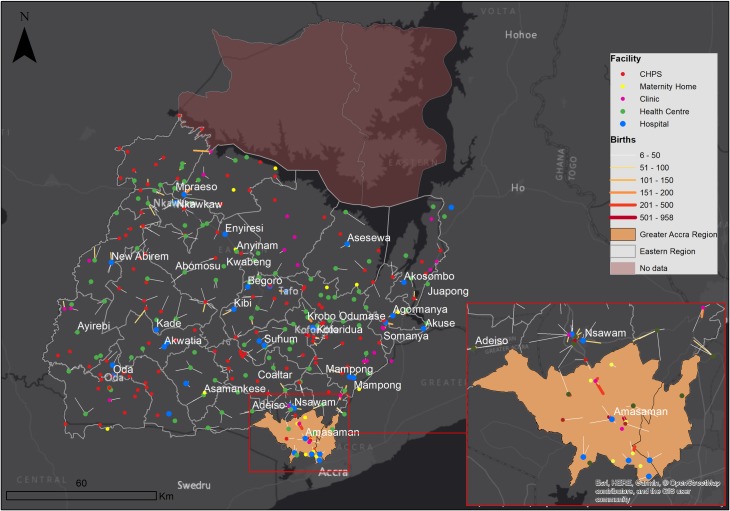
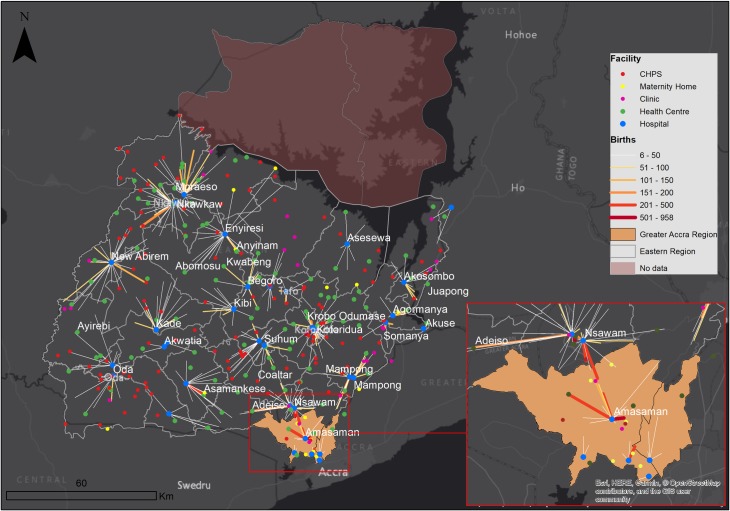
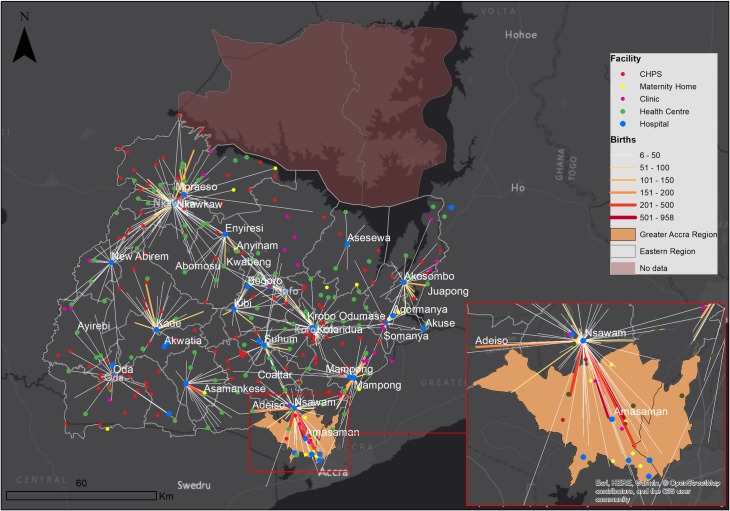
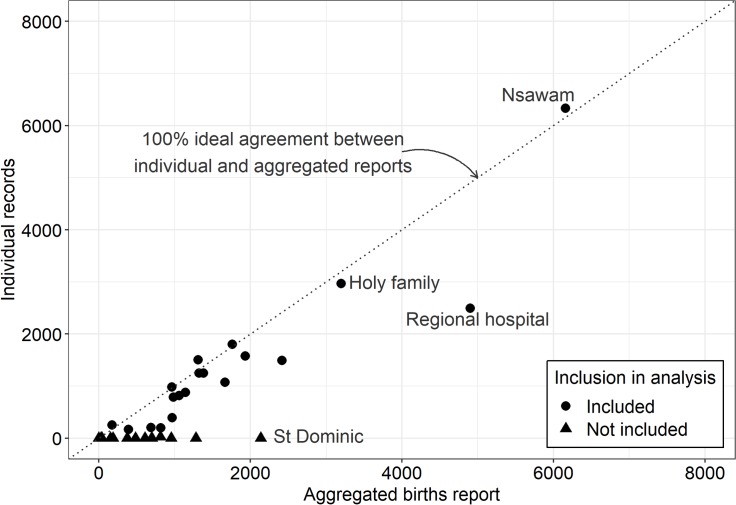
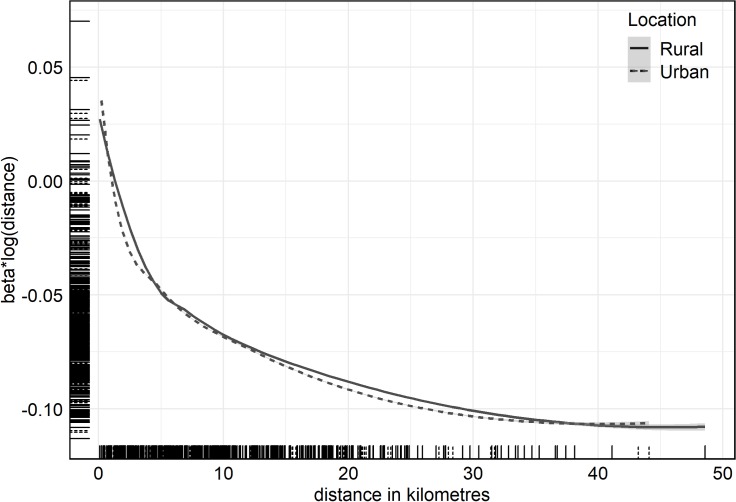
Objectives: Skilled birth attendance is the single most important intervention to reduce maternal mortality. However, studies have not used routinely collected health service birth data at named health facilities to understand the influence of distance and quality of care on childbirth service utilisation. Thus, this paper aims to quantify the influence of distance and quality of healthcare on utilisation of birthing services using routine health data in Eastern Region, Ghana. Methods: We used a spatial interaction model (a model that predicts movement from one place to another) drawing on routine birth data, emergency obstetric care surveys, gridded estimates of number of pregnancies and health facility location. We compared travel distances by sociodemographic characteristics and mapped movement patterns. Results: A kilometre increase in distance significantly reduced the prevalence rate of the number of women giving birth in health facilities by 6.7%. Although quality care increased the number of women giving birth in health facilities, its association was insignificant. Women travelled further than expected to give birth at facilities, on average journeying 4.7 km beyond the nearest facility with a recorded birth. Women in rural areas travelled 4 km more than urban women to reach a hospital. We also observed that 56% of women bypassed the nearest hospital to their community. Conclusion: This analysis provides substantial opportunities for health planners and managers to understand further patterns of skilled birth service utilisation, and demonstrates the value of routine health data. Also, it provides evidence-based information for improving maternal health service provision by targeting specific communities and health facilities.
Overview
The claims and statistics of this paper haven’t been checked yet.
Free: it reads the open-access text and checks the first 5 claims that cite a source we can check. Create a free account to check every claim.
Integrity signals
Registry
Cites
Statistics
Figures
Verification
Claims the paper makes
The claims and statistics of this paper haven’t been checked yet.
Free: it reads the open-access text and checks the first 5 claims that cite a source we can check. Create a free account to check every claim.
Claims other papers make about this one
Each is checked against this paper’s own text: does it say what the citing paper says it does?
The cited source says what the claim attributes to it.
In the citing paper
“Even a 1 km increase in travel distance has been shown to reduce use of skilled birth attendants [14].”
The cited source says what the claim attributes to it.
In the citing paper
“These results add to a growing body of literature, mainly gathered in low-income and resource-limited settings, that highlight how travel distance limits access to maternal healthcare in several ways.”
Self-check
Percentages, sums and reported differences re-computed from the paper’s own numbers.
The self-check needs the paper’s full text.
Citations
Cites
Alkema, L., Chou, D., Hogan, D., Zhang, S., Moller, A.-B., Gemmill, A., Fat, D. M., Boerma, T., Temmerman, M., Mathers, C., et al. (2016) · The Lancet · doi:10.1016/s0140-6736(15)00838-7 · Cited by 2,261
Strategies for reducing maternal mortality: getting on with what works
Campbell, O. M., & Graham, W. J. (2006) · The Lancet · doi:10.1016/s0140-6736(06)69381-1 · Cited by 1,785
Ghana Demographic and Health Survey 2008
Macro, I. (2009) · Cited by 1,593
Still too far to walk: Literature review of the determinants of delivery service use
Gabrysch, S., & Campbell, O. M. (2009) · BMC Pregnancy and Childbirth · doi:10.1186/1471-2393-9-34 · Cited by 1,255 · cited 1×
“8 There is evidence to support a link between distance to facility and health outcomes.”
Kassebaum, N. J., Barber, R. M., Bhutta, Z. A., Dandona, L., Gething, P. W., Hay, S. I., Kinfu, Y., Larson, H. J., Liang, X., Lim, S. S., et al. (2016) · The Lancet · doi:10.1016/s0140-6736(16)31470-2 · Cited by 1,162
Monitoring emergency obstetric care : a handbook
Disability (2009) · Cited by 986
Schneider, A., Friedl, M. A., & Potere, D. (2010) · Remote Sensing of Environment · doi:10.1016/j.rse.2010.03.003 · Cited by 726
Houweling, T. A., Ronsmans, C., Campbell, O. M., & Kunst, A. E. (2007) · Bulletin of the World Health Organization · doi:10.2471/blt.06.038588 · Cited by 388
A METHOD OF FITTING THE GRAVITY MODEL BASED ON THE POISSON DISTRIBUTION*
Flowerdew, R., & Aitkin, M. (1982) · Journal of Regional Science · doi:10.1111/j.1467-9787.1982.tb00744.x · Cited by 378
Gabrysch, S., Cousens, S., Cox, J., & Campbell, O. M. R. (2011) · PLoS Medicine · doi:10.1371/journal.pmed.1000394 · Cited by 353 · cited 2×
“11 13 Since our choice of indicators for the healthcare quality of care in this study shares similarities with a study in rural Zambia, in which quality of care was significant, 12 it was surprising we did not observe such an association.”
Research works printed but not linked: 1
- 27. Dennett A. Estimating flows between geographical locations:'get me started in'spatial interaction modelling. UCL working paper series 2012;181:1-24.
Cited by
Dotse-Gborgbortsi, W., Nilsen, K., Ofosu, A., Matthews, Z., Tejedor-Garavito, N., Wright, J., & Tatem, A. J. (2022) · BMC Pregnancy and Childbirth · doi:10.1186/s12884-022-04998-0 · Cited by 73
“Hence, modelling proximity to the nearest health facility can be problematic as some women might bypass the nearest facility and travel longer [52].”
BackgroundSelf-citationTanou, M., Kishida, T., & Kamiya, Y. (2021) · Reproductive Health · doi:10.1186/s12978-021-01249-x · Cited by 79
Banke-Thomas, A. O., Wong, K. L., Olubodun, T., Macharia, P. M., Sundararajan, N., Shah, Y. K., Prasad, G., Kansal, M., Vispute, S., Shekel, T., et al. (2024) · The Lancet Global Health · doi:10.1016/s2214-109x(24)00045-7 · Cited by 56
SoleimanvandiAzar, N., Kamal, S. H. M., Sajjadi, H., Harouni, G. G., Karimi, S. E., Djalalinia, S., & Forouzan, A. S. (2020) · PubMed Central · doi:10.30476/ijms.2020.85028.1481 · Cited by 86
Steinbrook, E., Min, M. C., Kajeechiwa, L., Wiladphaingern, J., Paw, M. K., Pimanpanarak, M. P. J., Hiranloetthanyakit, W., Min, A. M., Tun, N. W., Gilder, M. E., et al. (2021) · BMC Pregnancy and Childbirth · doi:10.1186/s12884-021-04276-5 · Cited by 46
Steinbrook, E., Min, M. C., Kajeechiwa, L., Wiladphaingern, J., Paw, M. K., Pimanpanarak, M., Hiranloetthanyakit, W., Min, A. M., Tun, N. W., Gilder, M. E., et al. (2020) · doi:10.1101/2020.11.13.20231464 · Cited by 43
Ameyaw, E. K., Dickson, K. S., & Adde, K. S. (2021) · BMC Pregnancy and Childbirth · doi:10.1186/s12884-021-03643-6 · Cited by 38
“Previous studies in Burkina Faso [38], Ghana [39], Nigeria [40], and Cambodia [41] observed that distance was a major barrier for women in accessing MCH services.”
BackgroundAlatinga, K. A., Affah, J., & Abiiro, G. A. (2021) · PLOS ONE · doi:10.1371/journal.pone.0261316 · Cited by 36
Implications for Tracking SDG Indicator Metrics with Gridded Population Data
Tuholske, C. P., Gaughan, A. E., Sorichetta, A., de Sherbinin, A., Bucherie, A., Hultquist, C., Stevens, F. R., Kruczkiewicz, A., Huyck, C. K., & Yetman, G. (2021) · Sustainability · doi:10.3390/su13137329 · Cited by 33
Wariri, O., Egwu, O., Alhassan, J. A. K., Dase, E., Jalo, I., Laima, C. H., Farouk, H. U., El-Nafaty, A. U., Okomo, U. A., & Dotse‐Gborgbortsi, W. (2021) · PLoS ONE · doi:10.1371/journal.pone.0245297 · Cited by 38
Self-citationAdedokun, S. T., Uthman, O. A., & Bisiriyu, L. A. (2023) · BMC Pregnancy and Childbirth · doi:10.1186/s12884-023-05712-4 · Cited by 30
Characterizing human mobility patterns in rural settings of sub-Saharan Africa
Meredith, H. R., Giles, J. R., Perez‐Saez, J., Mande, T., Rinaldo, A., Mutembo, S., Kabalo, E. N., Makungo, K., Buckee, C. O., Tatem, A. J., et al. (2021) · eLife · doi:10.7554/elife.68441 · Cited by 30
Self-citationGligorić, K., Kamath, C., Weiss, D. J., Bavadekar, S., Liu, Y., Shekel, T., Schulman, K. A., & Gabrilovich, E. (2023) · Communications Medicine · doi:10.1038/s43856-023-00384-9 · Cited by 37
Nilsen, K., Tejedor‐Garavito, N., Leasure, D. R., Utazi, C. E., Ruktanonchai, C. W., Wigley, A. S., Dooley, C., Matthews, Z., & Tatem, A. J. (2021) · BMC Health Services Research · doi:10.1186/s12913-021-06370-y · Cited by 33
Self-citationDotse‐Gborgbortsi, W., Tatem, A. J., Alegana, V. A., Utazi, C. E., Ruktanonchai, C. W., & Wright, J. (2020) · Tropical Medicine & International Health · doi:10.1111/tmi.13460 · Cited by 26
Self-citationKhan, M. N., Alam, M. B., Chowdhury, A. R., Kabir, M. A., & Khan, M. M. A. (2024) · BMC Health Services Research · doi:10.1186/s12913-024-10824-4 · Cited by 34
Appiah, F., Salihu, T., Fenteng, J. O. D., Darteh, A. O., Kannor, P., Ayerakwah, P. A., & Ameyaw, E. K. (2021) · BMC Pregnancy and Childbirth · doi:10.1186/s12884-020-03497-4 · Cited by 28
“Women in rural areas of Ghana travel 4 km more than urban women to reach a hospital [17].”
BackgroundDotse‐Gborgbortsi, W., Tatem, A. J., Matthews, Z., Alegana, V. A., Ofosu, A. A., & Wright, J. (2023) · BMJ Open · doi:10.1136/bmjopen-2022-066792 · Cited by 21
“Twitter Winfred Dotse-Gborgbortsi @dgwinfred”
InfluentialSelf-citationAlemu, S. M., Tura, A. K., do Amaral, G. S. G., Moughalian, C., Weitkamp, G., Stekelenburg, J., & Biesma, R. G. (2022) · Journal of Global Health · doi:10.7189/jogh.12.04066 · Cited by 25
Boateng, L. A., Adom, F., Angwaawie, P., Boateng, L. A., Danquah, E., Dotse, W.-G., Frimpong-Amenyo, R.-P., Head, M., Lamptey, R., Lartey, A., et al. (2020) · Transactions of the Royal Society of Tropical Medicine and Hygiene · doi:10.1093/trstmh/traa071 · Cited by 18
Hunduma, A., Debelew, G. T., & Dadi, L. S. (2021) · International Journal of Environmental Research and Public Health · doi:10.3390/ijerph181910467 · Cited by 18
Dotse‐Gborgbortsi, W., Dwomoh, D., Asamoah, M., Gyimah, F. T., Dzodzomenyo, M., Li, C., Akowuah, G., Ofosu, A. A., & Wright, J. (2022) · BMC Public Health · doi:10.1186/s12889-022-14568-w · Cited by 16
“In relating population exposure to flooding with facility-level outpatient data, we did not model by-passing of health facilities, which is widespread for mothers’ journeys to give birth elsewhere in Ghana [50].”
BackgroundSelf-citationBhowmik, J., Apputhurai, P., Williams, J. W., & Biswas, R. K. (2024) · Midwifery · doi:10.1016/j.midw.2024.104140 · Cited by 18
Impact of traffic congestion on spatial access to healthcare services in Nairobi
Mutono, N., Wright, J., Mutunga, M., Mutembei, H. M., & Thumbi, S. M. (2022) · Frontiers in Health Services · doi:10.3389/frhs.2022.788173 · Cited by 17
Self-citationDickson, K. S., Ayebeng, C., Adu‐Gyamfi, A. B., & Okyere, J. (2023) · BMC Pregnancy and Childbirth · doi:10.1186/s12884-023-05758-4 · Cited by 13
“Ayebeng C, Dickson KS, Seidu AA, Amo-Adjei J. Single motherhood in Ghana: analysis of trends and predictors using demographic and health survey data.”
BackgroundInfluentialImo, C. K., Ugwu, N. H., Ukoji, V. U., & Isiugo-Abanihe, U. C. (2022) · BMC Pregnancy and Childbirth · doi:10.1186/s12884-022-04989-1 · Cited by 9
Adam, A., Fusheini, A., & Sunyehzi, D. D. K. (2021) · IntechOpen eBooks · doi:10.5772/intechopen.97882 · Cited by 13
Alhassan, R. K., Owusu‐Agyei, S., Ansah, E., Gyapong, M., Ashinyo, A., Ashinyo, M. E., Nketiah‐Amponsah, E., Akorli-Adzimah, E., & Ekpor, E. (2020) · BMC Pregnancy and Childbirth · doi:10.1186/s12884-020-03195-1 · Cited by 12
Jafari, M., Tawfiq, E., Stanikzai, M. H., Currie, S., Arifi, F., Rab, F. A., Kazemi, H., Wasiq, A. W., & Turkmani, S. (2026) · Obstetrics and Gynecology International · doi:10.1155/ogi/1366466 · Cited by 7
Stierman, E. K., Shiferaw, S., Ahmed, S., Yihdego, M. G., Seme, A., Zimmerman, L. A., & Creanga, A. A. (2023) · Journal of Global Health Reports · doi:10.29392/001c.81640 · Cited by 9
Proximity to healthcare centres and service use: The case of Community Clinics in Bangladesh
Hasan, S. A., Akter, T., Jahan, M., & Dewan, A. M. (2023) · Economics of Transition and Institutional Change · doi:10.1111/ecot.12357 · Cited by 8
Sociodemographic and Maternal Determinants of Postnatal Care Utilization: A Cross-Sectional Study
Asumah, M. N., Abubakari, A., Abdulai, A.-M., Nukpezah, R. N., Adomako‐Boateng, F., Faridu, A.-W., Kubio, C., Padhi, B. K., & Kabir, R. (2023) · SAGE Open Nursing · doi:10.1177/23779608231206759 · Cited by 17
“This is partly due to the long distance to access PNC facilities (Dotse-Gborgbortsi et al., 2020) and the disproportionate distribution of health facilities and human resources between urban and rural areas in Ghana (Dickson et al., 2016).”
BackgroundDwomoh, D., Iddi, S., Afagbedzi, S. K., Tejedor‐Garavito, N., Dotse‐Gborgbortsi, W., Wright, J., Tatem, A. J., & Nilsen, K. (2023) · Journal of Urban Health · doi:10.1007/s11524-023-00812-0 · Cited by 8
“Sixth, the analysis does not control for “bypassing,” which refers to women living in non-slum districts accessing health services in slum districts and vice versa [29].”
Self-citationThe impact of Ghana’s national health insurance exemption policies on healthcare-seeking behaviour
Atakorah, Y. B., Arthur, E., Osei-Fosu, A. K., & Novignon, J. (2024) · SSM - Health Systems · doi:10.1016/j.ssmhs.2024.100035 · Cited by 10
Sebsibe, Y. B., & Kebede, T. T. (2024) · PeerJ · doi:10.7717/peerj.18128 · Cited by 6
Shen, C., Lai, S., Deng, Q., Dong, W., Cao, D., Zhao, D., Zhao, Y., Zhou, Z., & Chen, X. (2023) · Health & Social Care in the Community · doi:10.1155/2023/6131486 · Cited by 5
Kpolar, W. Y., Attafuah, P. Y. A., Tornu, E., Senoo-Dogbey, V. E., & Arhinful, D. K. (2025) · BMC Geriatrics · doi:10.1186/s12877-025-06651-9 · Cited by 4
“Physical access is also a challenge, as long distances to health facilities discourage utilisation, especially in peri-urban and rural areas where transportation may be unreliable or unaffordable [26, 27].”
Engidaw, M. T., Lee, P. J., & Ahmed, F. (2025) · Women s Health · doi:10.1177/17455057251317547 · Cited by 11
Beitze, D. E., Malengera, C. K., Kabesha, T. B., Frank, J., & Scherbaum, V. (2023) · Primary Health Care Research & Development · doi:10.1017/s1463423623000518 · Cited by 4
“In remote areas, the next health facility might be far away, contributing to lower usage (Kebede et al. , 2016; Dotse-Gborgbortsi et al. , 2020).”
BackgroundEstimates and determinants of health facility delivery in the Birhan cohort in Ethiopia
Hunegnaw, B. M., Goddard, F. G. B., Bekele, D., Haneuse, S., Pons‐Duran, C., Zeleke, M., Mohammed, Y., Bekele, C., & Chan, G. J. (2024) · PLoS ONE · doi:10.1371/journal.pone.0306581 · Cited by 3
Dotse‐Gborgbortsi, W., Tatem, A. J., Matthews, Z., Alegana, V. A., Ofosu, A. A., & Wright, J. (2022) · BMC Health Services Research · doi:10.1186/s12913-022-08125-9 · Cited by 4
Self-citationUtilisation of postnatal care services among maternal in Maeen District – Sana’a City, Yemen
Haza’a, A. A., Odhah, M. A., Al-Ahdal, S. A., Abol–Gaith, F. M., Ismail, N. A., Al-Awar, M. S., Al-Jaradi, A. S., Eidah, W. S., & Kaid, M. M. (2024) · BMC Pregnancy and Childbirth · doi:10.1186/s12884-024-06617-6 · Cited by 5
“In another study by Gborgbortsi et al. [44] in the Eastern Region, Ghana, the median expected travel distances to secondary and primary facilities were even nearer at 3 km. Additionally, most of the study participants perceived that they were given a friendly reception at the health facility they…”
BackgroundMomore, C. L., Saah, F. I., Amu, H., & Druye, A. A. (2025) · BMC Health Services Research · doi:10.1186/s12913-025-13124-7 · Cited by 2
Tiruye, G., Kejela, D., Dirar, A., Goshu, A. T., & Gultie, T. (2025) · Frontiers in Global Women s Health · doi:10.3389/fgwh.2025.1547599 · Cited by 2
Assessing the challenges in the referral system: a case study in the Hohoe Municipality
Leslie, A. Y., Yabila, S., Larbi-Sarpong, D. E., Mensah, C., & Kushitor, M. K. (2026) · Journal of Global Health Science · doi:10.35500/jghs.2026.8.e5 · Cited by 2
Azeze, G. A., Negash, B. T., Asgedom, Y. S., Amsalu, A. A., Kena, S. S., Gebrekidan, A. Y., Tsegaye, T. G., Kassie, G. A., & Haile, K. E. (2026) · Sexual & Reproductive Healthcare · doi:10.1016/j.srhc.2026.101202 · Cited by 3
The ‘golden hour’: a geospatial analysis of travel time to public emergency departments in Kenya
Surapaneni, T., Kinyua, N. G., & Wachira, B. W. (2026) · BMJ Global Health · doi:10.1136/bmjgh-2025-019789 · Cited by 3
Arero, C. B., Keraka, M. N., Yonge, S. A., Matoke, V. O., & Okari, G. M. (2021) · International Journal of Research and Innovation in Social Science · doi:10.47772/ijriss.2021.51215 · Cited by 2
Wariri, O., Utazi, C. E., Okomo, U. A., Dotse‐Gborgbortsi, W., Sogur, M., Fofana, S., Murray, K. A., Grundy, C., & Kampmann, B. (2024) · Vaccine · doi:10.1016/j.vaccine.2024.126500 · Cited by 2
Self-citationExamining Ghanaian Midwives’ Health Education Facebook Posts on Prenatal/Antenatal Care
Thompson, R., Agbaglo, E., Nutor, J. J., Thompson, T., & Johnson, J. K. (2024) · Advances in Public Health · doi:10.1155/adph/6646562 · Cited by 2
Cannings, L., Hutton, C. W., Nilsen, K., & Sorichetta, A. (2025) · Social Indicators Research · doi:10.1007/s11205-025-03524-x · Cited by 2
“This measurement is a frequently used methodology, where distance is assumed to capture information on healthcare access and health outcomes (Aboaba et al., 2023; Dotse-Gborgbortsi et al., 2020, 2022; Simeos & Almeida, 2014; Titus et al., 2015).”
Amankwaa, I. (2021) · Open Access Victoria University of Wellington | Te Herenga Waka (Figshare) · doi:10.26686/wgtn.14842896.v1 · Cited by 3
Assessing the Link between Maternal Transport Modes and Childhood Mortality in Nigeria
Addie, O., Seun-Addie, K. F., Adejoh, S. O., & Olorunlana, A. (2024) · Maternal and Child Health Journal · doi:10.1007/s10995-024-03963-x · Cited by 1
“Central to achieving the first and second targets of SDG Goal 3 in sub-Saharan Africa is improved access to health - care (Rajé, 2018 ; Dotse-Gborgbortsi et al., 2020; Wariri et al., 2021 ).”
BackgroundKrätzig, F., Mei, J., Rebaliha, M., Rampanjato, Z., Ranaivoson, R. M., Razafinjato, J., Neve, J. D., Franke, M. A., Müller, N., & Emmrich, J. (2024) · PLoS ONE · doi:10.1371/journal.pone.0311918 · Cited by 1
Adedini, S. A., Ibrahim, E. A., Ogunwemimo, H. S., Oladele, O. S., Abatan, S. M., & Adekola, P. O. (2025) · Scientific Reports · doi:10.1038/s41598-025-20365-3 · Cited by 5
Mbuthia, Z. W., Koros, H., Mukethe, T., Owino, A., Kihuha, J., Wangire, C., Gatimu, M., Kiamba, A., King, J., Hlongwana, K. W., et al. (2026) · BMC Health Services Research · doi:10.1186/s12913-025-13730-5 · Cited by 1
“Similarly, long distance to health facilities significantly reduced the proportion of women accessing skilled birth services in Ghana [11].”
Maleyo, A., Omoke, K. J., & Mo, J. M. (2023) · East African Journal of Science Technology and Innovation · doi:10.37425/eajsti.v4i2.588 · Cited by 1
Utilisation of Skilled Delivery in Ghana: A Systematic Review
Afrifa, A. D., Prah, J. K., & Nkrumah, K. S. (2021) · doi:10.21467/exr.1.1.4426 · Cited by 2
Author response: Characterizing human mobility patterns in rural settings of sub-Saharan Africa
Meredith, H. R., Giles, J. R., Perez‐Saez, J., Mande, T., Rinaldo, A., Mutembo, S., Kabalo, E. N., Makungo, K., Buckee, C. O., Tatem, A. J., et al. (2021) · eLife · doi:10.7554/elife.68441.sa2
Self-citationDescrpition The Low Utilization of Maternity Waiting Home
Mustasmara, R., Muhammad Ardian, C. L., & Frety, E. E. (2021) · International Journal of Research Publications · doi:10.47119/ijrp100921120222704
Maleyo, A., Omoke, K. J., & Moronge, J. M. (2022) · East African Journal of Science Technology and Innovation · doi:10.37425/eajsti.v3i4.505
“Geographical accessibility has been seen as a major factor that influences place of delivery in many sub-Saharan nations including Kenya (Gabrysch et al., 2011; Gborgbortsi et al., 2020; Nesbitt et al., 2016).”
BackgroundCan navigation applications facilitate equity in geographical access to emergency obstetric care?
Ezeanochie, M. C., & Jahonga, R. (2024) · The Lancet Global Health · doi:10.1016/s2214-109x(24)00087-1
Fostering Competence and Performance Development in the Nursing Profession in Ghana
Quartey, S. H. (2025) · International Journal of Training and Development · doi:10.1111/ijtd.12355
Choice of place of maternity care among women in a semi urban population
Ayamolowo, S. J. (2025) · Calabar Journal of Health Sciences · doi:10.25259/cjhs_1_2024 · Cited by 1
Zhang, W., Fang, W., Chamberlain, H. R., Liu, H., Liang, L., Dotse‐Gborgbortsi, W., Bondarenko, M., Dijkstra, L., Tatem, A. J., & Sorichetta, A. (2025) · Research Square · doi:10.21203/rs.3.rs-8225035/v1
Self-citationAppiah, F., Salihu, T., Fenteng, J. O. D., Darteh, A. O., Kannor, P., Ayerakwah, P. A., & Ameyaw, E. K. (2021) · Figshare · doi:10.6084/m9.figshare.13546006
Dotse‐Gborgbortsi, W., Nilsen, K., Ofosu, A. A., Matthews, Z., Tejedor-Garavito, N., Wright, J. A., & Tatem, A. J. (2022) · Figshare · doi:10.6084/m9.figshare.20762907
Self-citationKhan, M. N., Alam, M. B., Chowdhury, A. R., Kabir, M. A., & Khan, M. M. A. (2024) · Figshare · doi:10.6084/m9.figshare.25546951
Dotse‐Gborgbortsi, W., Nilsen, K., Ofosu, A. A., Matthews, Z., Tejedor-Garavito, N., Wright, J., & Tatem, A. J. (2022) · Figshare · doi:10.6084/m9.figshare.20762910
Self-citationSteinbrook, E., Min, M. C., Kajeechiwa, L., Wiladphaingern, J., Paw, M. K., Pimanpanarak, M. P. J., Hiranloetthanyakit, W., Min, A. M., Tun, N. W., Gilder, M. E., et al. (2021) · Figshare · doi:10.6084/m9.figshare.17120006
Appiah, F., Salihu, T., Fenteng, J. O. D., Darteh, A. O., Kannor, P., Ayerakwah, P. A., & Ameyaw, E. K. (2021) · Figshare · doi:10.6084/m9.figshare.13546003
Appiah, F., Salihu, T., Fenteng, J. O. D., Darteh, A. O., Kannor, P., Ayerakwah, P. A., & Ameyaw, E. K. (2021) · Figshare · doi:10.6084/m9.figshare.13544423
Dotse‐Gborgbortsi, W., Nilsen, K., Ofosu, A. A., Matthews, Z., Tejedor-Garavito, N., Wright, J. A., & Tatem, A. J. (2022) · Figshare · doi:10.6084/m9.figshare.20762904
Self-citationFang, W., Zhang, W., Woods, D., Chamberlain, H. R., Dotse‐Gborgbortsi, W., Olowe, I., Schiavina, M., Nosatiuk, B., Priyatikanto, R., Bondarenko, M., et al. (2026) · Journal of Urban Health · doi:10.1007/s11524-026-01077-z · Cited by 2
Self-citationAzeze, G. A., Negash, B. T., Asgedom, Y. S., Amsalu, A. A., Kena, S. S., Gebrekidan, A. Y., Tsegaye, T. G., Kassie, G. A., & Haile, K. E. (2026) · Sexual & Reproductive Healthcare · doi:10.1016/j.srhc.2026.101229 · Cited by 1
Mededji, D., Attanasso, M. O., & Senou, M. M. (2026) · Health Systems · doi:10.1080/20476965.2026.2684450
A harmonised framework for assessing geographic healthcare access across the rural-urban continuum
Zhang, W., Fang, W., Chamberlain, H., Liu, H., Liang, L., Dotse‐Gborgbortsi, W., Bondarenko, M., Dijkstra, L., Tatem, A. J., & Sorichetta, A. (2026) · Communications Health · doi:10.1038/s44528-026-00017-2 · Cited by 2
Self-citationHammond, J., Adjei-Gyamfi, S., Daniels, D. B., Sarpong, G. K., Aiga, H., & Aoki, T. (2026) · PLoS ONE · doi:10.1371/journal.pone.0359892
“All GPS coordinates collected from participants were processed in QGIS using the Euclidean distance method to calculate the distance from each respondent’s residence to the CHPS zones [36,37].”
Metadata
- Authors
- Dotse-Gborgbortsi, W., Dwomoh, D., Alegana, V., Hill, A., Tatem, A. J., & Wright, J.
- Affiliations
- School of Geography and Environmental Science, University of Southampton, Southampton, UK
- University of Ghana (GH)
- Kenya Medical Research Institute (KE)
- University of Southampton (GB)
- Venue
- BMJ Global Health
- Publisher
- BMJ
- Published
- 2020-02
- Volume
- 4
- Issue
- Suppl 5
- Pages
- e002020
- ISSN
- 2059-7908 (ISSN-L)
- PMC
- PMC7044703
- OpenAlex
- W3006610116
- Cited by
- 78
- References
- 30
- Citations by year
- 2026: 10 · 2025: 9 · 2024: 13 · 2023: 11 · 2022: 10 · 2021: 21 · 2020: 4
- Type
- conference abstract
- Language
- en
- Open access
- gold
- doi.org
- Locations
- BMJ Global Health (publishedVersion, cc-by)
- PubMed Central (publishedVersion, cc-by)
- PubMed (publishedVersion)
- ePrints Soton (University of Southampton) (submittedVersion, other-oa)
- DOAJ (DOAJ: Directory of Open Access Journals) (submittedVersion)
- Funders
- Commonwealth Scholarship Commission
- Economic and Social Research Council
- Wellcome Trust (204613/Z/16/Z, 211208)
- Topics
- Health Sciences › Medicine › Pediatrics, Perinatology and Child Health › Global Maternal and Child Health
- Health Sciences › Medicine › Obstetrics and Gynecology › Maternal and Perinatal Health Interventions
- Health Sciences › Medicine › Public Health, Environmental and Occupational Health › Reproductive Health and Contraception
- Keywords
- skilled birth attendance, distance to health facility, quality of care, travel distance, spatial interaction models, obstetric care, urban-rural differences, emergency obstetric care, health facility location, Eastern Region of Ghana
About these checks
Registry, retraction, Cites and statistics results are computed, not judged, with one exception: a printed reference that no index lists is read once by a model before it counts as a citation error. Claims are extracted by a model and kept only when their quote appears verbatim in the text; each cited source is then checked, with a model’s help, for whether it says what the claim relies on. Those verdicts can be wrong — read the claim’s quote and the cited source before relying on one.
Statistics and arithmetic are recomputed, not judged.
Confidence bands are shown only for fields calibrated on our annotated test set. None is calibrated yet, so no band is shown.
What counts as a claim ›How we measure confidence ›How we check this ›
Are you an author, or do you see a problem with this page? Request a review
Data sources
Bibliographic data: Semantic Scholar, OpenAlex, Crossref.
Contains information from the Semantic Scholar Academic Graph Datasets, made available under the ODC Attribution License (ODC-BY 1.0).
Semantic Scholar’s data is described in: Kinney, R., et al. (2023). The Semantic Scholar Open Data Platform. arXiv:2301.10140.
