

Electronic clinical decision support algorithms incorporating point-of-care diagnostic tests in low-resource settings: a target product profile
Open accessPublished version of a preprint
The DOI matches its Crossref record; 13 of the 13 references it cites were found in a registry or an index.
Abstract
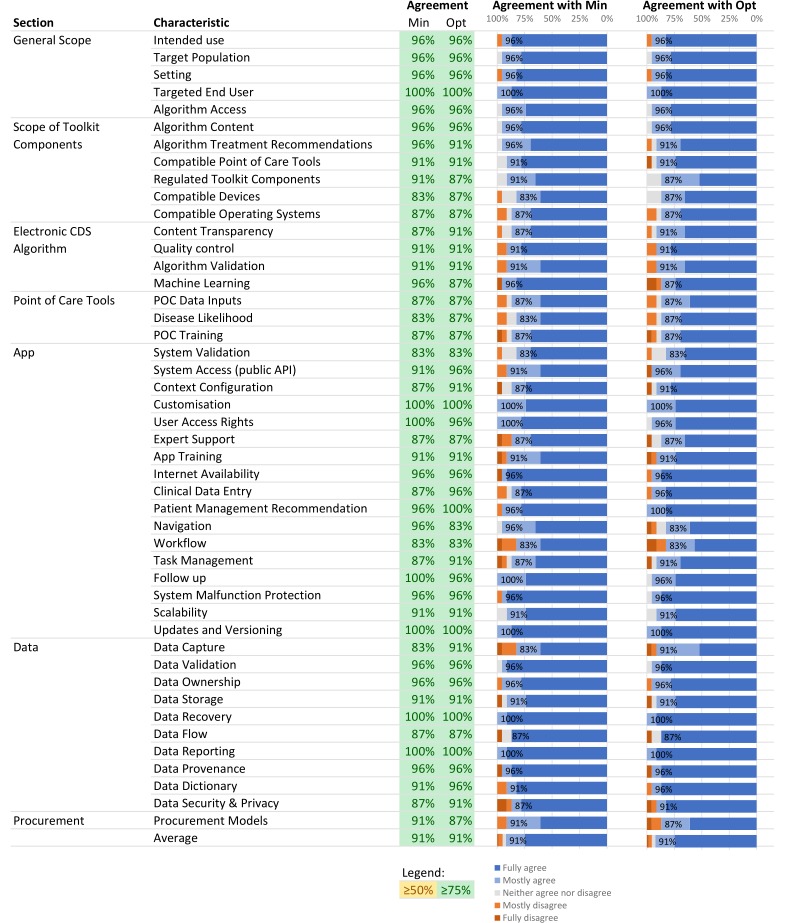
Health workers in low-resource settings often lack the support and tools to follow evidence-based clinical recommendations for diagnosing, treating and managing sick patients. Digital technologies, by combining patient health information and point-of-care diagnostics with evidence-based clinical protocols, can help improve the quality of care and the rational use of resources, and save patient lives. A growing number of electronic clinical decision support algorithms (CDSAs) on mobile devices are being developed and piloted without evidence of safety or impact. Here, we present a target product profile (TPP) for CDSAs aimed at guiding preventive or curative consultations in low-resource settings. This document will help align developer and implementer processes and product specifications with the needs of end users, in terms of quality, safety, performance and operational functionality. To identify the characteristics of CDSAs, a multidisciplinary group of experts (academia, industry and policy makers) with expertise in diagnostic and CDSA development and implementation in low-income and middle-income countries were convened to discuss a draft TPP. The TPP was finalised through a Delphi process to facilitate consensus building. An agreement greater than 75% was reached for all 40 TPP characteristics. In general, experts were in overwhelming agreement that, given that CDSAs provide patient management recommendations, the underlying clinical algorithms should be human-interpretable and evidence-based. Whenever possible, the algorithm’s patient management output should take into account pretest disease probabilities and likelihood ratios of clinical and diagnostic predictors. In addition, validation processes should at a minimum show that CDSAs are implementing faithfully the evidence they are based on, and ideally the impact on patient health outcomes. In terms of operational needs, CDSAs should be designed to fit within clinic workflows and function in connectivity-challenged and high-volume settings. Data collected through the tool should conform to local patient privacy regulations and international data standards.
Overview
The claims and statistics of this paper haven’t been checked yet.
Free: it reads the open-access text and checks the first 5 claims that cite a source we can check. Create a free account to check every claim.
Integrity signals
Registry
Cites
Statistics
Figures
Verification
Claims the paper makes
The claims and statistics of this paper haven’t been checked yet.
Free: it reads the open-access text and checks the first 5 claims that cite a source we can check. Create a free account to check every claim.
Claims other papers make about this one
Each is checked against this paper’s own text: does it say what the citing paper says it does?
The source backs part of the claim, not all of it — or backs it for a different population, condition or comparison.
In the citing paper
“This demonstrates how useful electronic instruments might be in rural or underdeveloped areas, particularly where there are few medical resources and a high population density (63).”
From Research on digital tool in cognitive assessment: a bibliometric analysis (2023) · cites this paper as [63]
Experimental — accuracy not yet measured
Self-check
Percentages, sums and reported differences re-computed from the paper’s own numbers.
The self-check needs the paper’s full text.
Citations
Cites
The Fourth Industrial Revolution: what it means, how to respond1
Schwab, K. (2024) · Handbook of Research on Strategic Leadership in the Fourth Industrial Revolution · doi:10.4337/9781802208818.00008 · Cited by 1,263
Quality of care for pregnant women and newborns—the WHO vision
Tunçalp, Ӧ., Were, W., MacLennan, C., Oladapo, O., Gülmezoglu, A., Bahl, R., Daelmans, B., Mathai, M., Say, L., Kristensen, F., et al. (2015) · BJOG: An International Journal of Obstetrics & Gynaecology · doi:10.1111/1471-0528.13451 · Cited by 1,101
General Data Protection Regulation (GDPR)
Deaves, M. (2017) · Cited by 815
Tanzania IMCI Multi-Country Evaluation Health Facility Survey Study Group (2004) · Health Policy and Planning · doi:10.1093/heapol/czh001 · Cited by 196
Mitchell, M., Hedt-Gauthier, B. L., Msellemu, D., Nkaka, M., & Lesh, N. (2013) · BMC Medical Informatics and Decision Making · doi:10.1186/1472-6947-13-95 · Cited by 148
99/01724 Leapfrog energy technologies
(1999) · Fuel and Energy Abstracts · doi:10.1016/s0140-6701(99)96905-9 · Cited by 146
Keitel, K., Kagoro, F., Samaka, J., Masimba, J., Said, Z., Temba, H., Mlaganile, T., Sangu, W., Rambaud-Althaus, C., Gervaix, A., et al. (2017) · PLOS Medicine · doi:10.1371/journal.pmed.1002411 · Cited by 142 · cited 1×
“16 17 This was demonstrated with IMCI-based CDSAs, and it is postulated that similar benefits on outcome and antimicrobial use could be awarded to other use cases.”
BackgroundSelf-citationThe Astana Declaration: the future of primary health care?
Lancet, T. (2018) · The Lancet · doi:10.1016/s0140-6736(18)32478-4 · Cited by 124
Shao, A. F., Rambaud-Althaus, C., Samaka, J., Faustine, A. F., Perri-Moore, S., Swai, N., Kahama-Maro, J., Mitchell, M., Genton, B., & D’Acremont, V. (2015) · PLOS ONE · doi:10.1371/journal.pone.0132316 · Cited by 109 · cited 1×
“16 17 This was demonstrated with IMCI-based CDSAs, and it is postulated that similar benefits on outcome and antimicrobial use could be awarded to other use cases.”
Self-citationRowe, A. K., Labadie, G., Jackson, D., Vivas-Torrealba, C., & Simon, J. (2018) · BMJ · doi:10.1136/bmj.k2813 · Cited by 79
Research works printed but not linked: 3
- WHO and TDR Dengue: guidelines for diagnosis, treatment, prevention and control: new edition. 2009 (WHO/HTM/NTD/DEN/2009.1). Available: https://www.who.int/tdr/publications/training-guideline-publications/dengue-diagnosis-treatment/en/ [Accessed May 2019]. 23762963
- World Health Organization World health organisation guideline: recommendations on digital interventions for health system strengthening. executive summary. Geneva: World Health Organization, 2019. 31162915
- FIND and WHO Electronic clinical decision support algorithms_ Workshop report, 2018 Available: https://www.finddx.org/mal-fev/ecdm-toolbox/
Cited by
Sell, K., Hommes, F., Fischer, F., & Arnold, L. (2022) · International Journal of Environmental Research and Public Health · doi:10.3390/ijerph191710902 · Cited by 102
“In doing so, interdisciplinary scientists are free to communicate with and coordinate the work of specialised scientists from disparate fields ([82] citing [139]) but may not integrate approaches from these fields in their own work [82].”
BackgroundTan, R., Kavishe, G. A., Luwanda, L. B., Kulinkina, A. V., Renggli, S., Mangu, C., Ashery, G., Jorram, M., Mtebene, I. E., Agrea, P., et al. (2023) · Nature Medicine · doi:10.1038/s41591-023-02633-9 · Cited by 53
“Electronic clinical decision support algorithms (CDSAs) are digital health or mobile health tools that guide health-care providers on what symptoms and signs to assess, advise on what tests to perform, and propose the appropriate diagnoses, treatments and management 18,19 .”
BackgroundSelf-citationThe Promise of Clinical Decision Support Systems Targetting Low-Resource Settings
Kiyasseh, D., Zhu, T., & Clifton, D. A. (2020) · IEEE Reviews in Biomedical Engineering · doi:10.1109/rbme.2020.3017868 · Cited by 39
“[128] convened 39 experts across a variety of domains in order to draft what is known as a target product profile (TPP).”
BackgroundMcDougall, A. R. A., Hastie, R. M., Goldstein, M., Tuttle, A., Tong, S., Ammerdorffer, A., Gülmezoglu, A. M., & Vogel, J. P. (2022) · BMC Medicine · doi:10.1186/s12916-022-02582-z · Cited by 29
McDougall, A. R. A., Hastie, R. M., Goldstein, M., Tuttle, A., Ammerdorffer, A., Gülmezoglu, A. M., & Vogel, J. P. (2023) · BMC Pregnancy and Childbirth · doi:10.1186/s12884-023-05842-9 · Cited by 27
Research on digital tool in cognitive assessment: a bibliometric analysis
Chen, L., Zhen, W., & Peng, D. (2023) · Frontiers in Psychiatry · doi:10.3389/fpsyt.2023.1227261 · Cited by 26
Tan, R., Cobuccio, L. G., Beynon, F., Levine, G. A., Vaezipour, N., Luwanda, L. B., Mangu, C., Vonlanthen, A., Santis, O. D., Salim, N., et al. (2023) · PLOS Digital Health · doi:10.1371/journal.pdig.0000170 · Cited by 25
Self-citationFacilitating the use of the target product profile in academic research: a systematic review
Ibnidris, A., Liaskos, N., Eldem, E., Gunn, A., Streffer, J., Gold, M., Rea, M., Teipel, S., Gardiol, A., & Boccardi, M. (2024) · Journal of Translational Medicine · doi:10.1186/s12967-024-05476-1 · Cited by 20
Beynon, F., Guérin, F., Lampariello, R., Schmitz, T., Tan, R., Ratanaprayul, N., Tamrat, T., Pellé, K. G., Catho, G., Keitel, K., et al. (2023) · Global Health Science and Practice · doi:10.9745/ghsp-d-22-00439 · Cited by 20
“Multisectoral experts have highlighted the particular importance of transparency of the clinical algorithms used in CDSSs to ensure stakeholders are able to understand if (and how) the decision logic reflects or differs from evidence-based recommendations in guidelines and peer-reviewed literature.(20) In recognition…”
Self-citationMawji, A., Li, E., Dunsmuir, D. T., Komugisha, C., Novakowski, S. K., Wiens, M. O., Tagoola, A., Kissoon, N. “., & Ansermino, J. M. (2022) · Frontiers in Pediatrics · doi:10.3389/fped.2022.976870 · Cited by 19
“Digital health interventions have the potential to support clinical decision making and improve the quality of care in resource limited settings (12).”
BackgroundEvans, M., Corden, M. H., Crehan, C., Fitzgerald, F., & Heys, M. (2021) · BMJ Open · doi:10.1136/bmjopen-2020-042124 · Cited by 17
Development of a target product profile for a point-of-care cardiometabolic device
Vetter, B., Beran, D., Boulle, P., Chua, A., de la Tour, R., Hattingh, L., Perel, P., Roglić, G., Sampath, R., Woodman, M., et al. (2021) · BMC Cardiovascular Disorders · doi:10.1186/s12872-021-02298-7 · Cited by 17
Self-citationSirimatayanant, M., Hein, P. S., Anderson, L., Montoya, L. F., Potter, R., Nghipumbwa, M., Ranaweera, P., Ngor, P., Phetsouvanh, R., & Maude, R. J. (2023) · Malaria Journal · doi:10.1186/s12936-023-04459-9 · Cited by 13
Trottet, C., Vogels, T., Keitel, K., Kulinkina, A. V., Tan, R., Cobuccio, L. G., Jaggi, M., & Hartley, M. (2023) · PLOS Digital Health · doi:10.1371/journal.pdig.0000108 · Cited by 13
McDougall, A. R. A., Tuttle, A., Goldstein, M., Ammerdorffer, A., Aboud, L., Gülmezoglu, A. M., & Vogel, J. P. (2022) · BJOG An International Journal of Obstetrics & Gynaecology · doi:10.1111/1471-0528.17314 · Cited by 12
“15,18,19,24 The protocol was approved by the Alfred Ethics Committee for Human Research (project no. 108/21), and informed consent was obtained from all participants prior to their participation.”
MethodDuffel, L. V., Yansouni, C. P., Jacobs, J. A., Esbroeck, M. V., Ramadan, K., Buyze, J., Tsoumanis, A., Barbé, B., Boelaert, M., Verdonck, K., et al. (2022) · Open Forum Infectious Diseases · doi:10.1093/ofid/ofac434 · Cited by 11
“If used with careful clinical consideration or integrated in validated diagnostic aid tools [41], inflammatory biomarkers might be of value to limit immediate antibiotic prescription in a rather large group of patients presenting with persistent fever, who are currently almost systematically treated with antibiotics i…”
MethodTarget product profiles for novel medicines to prevent and treat preeclampsia: An expert consensus
McDougall, A. R. A., Tuttle, A., Goldstein, M., Ammerdorffer, A., Gülmezoglu, A. M., & Vogel, J. P. (2022) · PLOS Global Public Health · doi:10.1371/journal.pgph.0001260 · Cited by 10
“Some previous TPP development studies have used two survey rounds to reach consensus with stakeholders on TPP domains [20,23], which can be a useful strategy when there is high disagreement for a large number of domains.”
BackgroundMethodAlbitres‐Flores, L., Pérez-León, S., Bernabé‐Ortiz, A., Tenorio‐Mucha, J., Cárdenas, M. K., Vetter, B., Safary, E., Gamboa, R., Cordova, V., Gupta, R., et al. (2024) · BMC Health Services Research · doi:10.1186/s12913-024-10809-3 · Cited by 9
“Multiparameter POCT devices allows for the process of different tests in a single machine, which can offer a more comprehensive view of the patient’s condition, saving time and resources by reducing the need for multiple separate laboratory tests or devices [10].”
BackgroundSafary, E., Lepeska, M., Beran, D., Ewen, M. A., Zhaparova, A., Rukare, J., Boulle, P., Perone, S. A., Makohliso, S. A., Pleus, S., et al. (2024) · PLoS ONE · doi:10.1371/journal.pone.0309062 · Cited by 7
Kulinkina, A. V., Rwandarwacu, V. P., Habakurama, J., Cobuccio, L. G., Norris, M., Kalisa, E., Havugimana, C., Ingabire, A., Levine, G. A., Tan, R., et al. (2026) · PLoS Medicine · doi:10.1371/journal.pmed.1004692 · Cited by 8
“Limitations of existing tools include restricted diagnostic scope [25], limited integration of point-of-care testing (e.g., for fever without source) [26], and poor uptake due to low digital literacy [27], lack of supervision, and inadequate clinical mentorship.”
Self-citationChew, R., Wynberg, E., Liverani, M., Huy, R., Nguon, C., Lek, D., Vanna, M., Callery, J. J., Mishra, A., Adhikari, B., et al. (2024) · BMJ Open · doi:10.1136/bmjopen-2024-089616 · Cited by 7
“16 This cluster-randomised trial aims to determine whether EDAM can improve routine clinical management of patients with AFI, primarily in terms of more appropriate antibiotic prescribing.”
Gannon, H., Larsson, L. S., Chimhuya, S., Mangiza, M., Wilson, E., Kesler, E., Chimhini, G., Fitzgerald, F., Zailani, G., Crehan, C., et al. (2024) · JMIR Formative Research · doi:10.2196/54274 · Cited by 6
“However, this has been challenging to effectively implement, particularly in low-resource settings [37,38].”
BackgroundExploring digital health literacy among Tanzanian primary care workers: A qualitative study
Mwogosi, A. (2025) · Digital Health · doi:10.1177/20552076251396986 · Cited by 6
“36,37 Their understanding and con fi dence in using digital health systems directly in fl uence the quality of data, continuity of care, and the effectiveness of patient education and referral systems.”
Tobin, M., Ferreyra, C., Piton, J., Cirino, C. K., Katz, Z., & Kadam, R. (2022) · Oxford Open Digital Health · doi:10.1093/oodh/oqac001 · Cited by 6
Self-citationTegenaw, G. S., Sori, D. A., Teklemariam, G. K., Verbeke, F., Cornelis, J. P., & Jansen, B. (2024) · JMIR Human Factors · doi:10.2196/47631 · Cited by 9
“Proper and coordinated implementation is beneficial to the enhancement of health care delivery [2,3].”
BackgroundMacdonald, T., Hogg, H. D. J., Dinnes, J., Verrinder, L., Maniatopoulos, G., Taylor‐Phillips, S., Shinkins, B., Dunbar, J. K., Solebo, A. L., Sutton, H., et al. (2025) · Frontiers in Health Services · doi:10.3389/frhs.2025.1537016 · Cited by 5
Macdonald, T., Dinnes, J., Maniatopoulos, G., Taylor‐Phillips, S., Shinkins, B., Hogg, H. D. J., Dunbar, J. K., Solebo, A. L., Sutton, H., Attwood, J., et al. (2024) · JMIR Research Protocols · doi:10.2196/50568 · Cited by 6
“TPPs have since been used by governments [32], health care providers [33], and nonprofit organizations [34] for drugs [35,36] and medical devices [37], particularly in the context of infectious diseases [38,39] and the developing world [40,41].”
BackgroundMethodTillekeratne, L. G., Soyza, W. D., Iglesias-Ussel, M. D., Olague, S., Palangasinghe, D. R., Nagahawatte, A., Wickramatunga, T., Gamage, J., Kurukulasooriya, R. M., Premamali, M., et al. (2024) · American Journal of Tropical Medicine and Hygiene · doi:10.4269/ajtmh.24-0126 · Cited by 4
Johannsen, B., Baumgartner, D., Karpíšek, M., Stejskal, D., Boillat‐Blanco, N., Knüsli, J., Panning, M., Paust, N., Zengerle, R., & Mitsakakis, K. (2023) · Biosensors · doi:10.3390/bios13121009 · Cited by 4
Liverani, M., Ahmed, S., Sen, A., Chew, R., Chandna, A., Islam, S., Maude, R. J., Islam, A., & Lubell, Y. (2025) · SSM - Health Systems · doi:10.1016/j.ssmhs.2025.100090 · Cited by 4
“Additionally, these tests could be integrated with electronic decision support tools, further assisting health workers in making consistent treatment and referral decisions (Pellé et al., 2020).”
Mitsakakis, K. (2021) · Expert Review of Molecular Diagnostics · doi:10.1080/14737159.2021.1920400 · Cited by 4
“For RTIs, clinical decision support algorithms [25] can co-assess results from molecular analyses (biomarkers, multiplexed PCR) and POC systems [26,27], and, together with the history and clinical symptoms of the patient, propose one or more treatment options [28].”
BackgroundFernández-Carballo, B. L., Atzeni, M., Escadafal, C., Vettoretti, M., Geis, S., Agnandji, S. T., Siqueira, A. M., Malava, J., Banda, L., Kabwende, A. L., et al. (2025) · BMJ Open · doi:10.1136/bmjopen-2024-086912 · Cited by 3
Self-citationWang, Y., Phasitthanaphak, N., Wiwatpanit, T., Fernández-Barceló, C., Liu, S., Chuanchaiyakul, T., Athibodee, T., & Teerawattananon, Y. (2026) · Health Policy and Technology · doi:10.1016/j.hlpt.2026.101245 · Cited by 2
Sugumar, R. (2025) · International Journal of Humanities and Information Technology · doi:10.21590/ijhit.07.01.10 · Cited by 2
Following Guidelines for Drug-Resistant Tuberculosis: “Yes, it’s a challenge”
Gray, A. T., Wood, C. E., Boyles, T. H., Luedtke, S., Birjovanu, G., Hughes, J. A., Kostkova, P., & Esmail, H. (2021) · Frontiers in Tropical Diseases · doi:10.3389/fitd.2021.645933 · Cited by 2
“Clinical decision support systems (CDSS) are a subset of digital health and one of the nine digital products the WHO has suggested should align with their END TB strategy (28) and a target product profile has been developed (29).”
BackgroundZoysa, W. D., Palangasinghe, D. R., Bodinayake, C. K., Nagahawatte, A., Gamage, J., Iglesias-Ussel, M. D., Olague, S., Galdieri, C., Kurukulasooriya, R. M., Weerasinghe, S., et al. (2025) · American Journal of Tropical Medicine and Hygiene · doi:10.4269/ajtmh.24-0576 · Cited by 1
“16,17 Meta-analyses suggest that point-of-care tests, combined with an evidence-based diagnostic algorithm, can reduce inappropriate use of antibacterials in LMICs without compromising clinical outcomes.”
Lu, C., Zhang, R., Jiang, H., Yu, Y., Zhang, S., Lin, Q., Wu, P., & Li, H. (2026) · Journal of Medical Internet Research · doi:10.2196/100442 · Cited by 1
Mandke, C., Agrawal, H. K., Bharti, B., Chansoria, M., Gupta, G., Rawat, S. K., Sarkar, N. K., Singh, A., Suji, P. S., & Walia, S. (2026) · medRxiv · doi:10.64898/2026.04.30.26351194 · Cited by 1
Jagnani, S., Baruah, A. K., & Chowdhury, A. (2025) · International Journal of Scientific Engineering and Research · doi:10.70729/se25512181736
“Multiparameter POCT devices can perform several tests simultaneously, allowing for a more comprehensive evaluation of a patient's health while conserving time and resources by reducing the need for multiple separate laboratory tests [10].”
Festschrift in honor of Dr. Jeffrey Hymes
Ketchersid, T. L., Chatoth, D. K., Kossmann, R. J., Mysayphonh, C., Kotanko, P., & Maddux, F. W. (2025) · Frontiers in Nephrology · doi:10.3389/fneph.2025.1585713
KABIR, E., Bhuiyan, M. N. H., Habib, M. Q. B., Modak, S., & Mahtab, A. S. (2025) · International Journal of Science and Research Archive · doi:10.30574/ijsra.2025.17.1.2930
Computer-Assisted Anamnesis (medical history) - the patient UI
Mendes, P. A. V. (2023) · Portuguese National Funding Agency for Science, Research and Technology (RCAAP Project by FCT) · doi:10.34626/8xyt-1719
Albitres‐Flores, L., Pérez-León, S., Bernabe-Ortiz, A., Tenorio‐Mucha, J., Cárdenas, M. K., Vetter, B., Safary, E., Gamboa, R., Cordova, V., Gupta, R., et al. (2024) · Figshare · doi:10.6084/m9.figshare.25511819
Vetter, B., Beran, D., Boulle, P., Chua, A., de la Tour, R., Hattingh, L., Perel, P., Roglić, G., Sampath, R., Woodman, M., et al. (2021) · Figshare · doi:10.6084/m9.figshare.16779607
Self-citationMcDougall, A. R. A., Hastie, R. M., Goldstein, M., Tuttle, A., Ammerdorffer, A., Gülmezoglu, A. M., & Vogel, J. P. (2023) · Figshare · doi:10.6084/m9.figshare.23706884
McDougall, A. R. A., Hastie, R. M., Goldstein, M., Tuttle, A., Tong, S., Ammerdorffer, A., Gülmezoglu, A. M., & Vogel, J. P. (2022) · Figshare · doi:10.6084/m9.figshare.21500511
Vetter, B., Beran, D., Boulle, P., Chua, A., de la Tour, R., Hattingh, L., Perel, P., Roglić, G., Sampath, R., Woodman, M., et al. (2021) · Figshare · doi:10.6084/m9.figshare.16779604
Self-citationMcDougall, A. R. A., Hastie, R. M., Goldstein, M., Tuttle, A., Ammerdorffer, A., Gülmezoglu, A. M., & Vogel, J. P. (2023) · Figshare · doi:10.6084/m9.figshare.23706881
McDougall, A. R. A., Hastie, R. M., Goldstein, M., Tuttle, A., Tong, S., Ammerdorffer, A., Gülmezoglu, A. M., & Vogel, J. P. (2022) · Figshare · doi:10.6084/m9.figshare.21500517
McDougall, A. R. A., Hastie, R. M., Goldstein, M., Tuttle, A., Tong, S., Ammerdorffer, A., Gülmezoglu, A. M., & Vogel, J. P. (2022) · Figshare · doi:10.6084/m9.figshare.21500514
Ladores, C. I., & Punzalan, J. K. (2025) · Digital Medicine · doi:10.1097/dm-2025-00001
Clinical Decision-Making for Pharmacists
Rajan, V., & Mahmoud, S. H. (2025) · Springer eBooks · doi:10.1007/978-3-032-10050-4_5
Digital Technology in Cognitive Decline: Bibliometric and Visualization Study
Huang, Y., Zhu, X., Yang, S., Zhang, Y. Y., Tan, Z., & Han, S. (2026) · Current Alzheimer Research · doi:10.2174/0115672050420571260126043841
Bawah, F. U., Abdulai, J., Baxter, W., & Porat, T. (2026) · CHI Conference Extended Abstracts on Human Factors in Computing Systems (CHI EA) · doi:10.1145/3772363.3798827
“HCPs must distinguish clinically similar conditions, reason under uncertainty, and interpret incomplete or ambiguous information, while sociocultural expectations, such as assumptions that fever requires antimalarial treatment, further influence diagnostic and prescribing decisions [24, 40].”
Muliokela, R. K., Nkangu, M., Banda, K., Hussen, A. M., Tsigie, S. T., Sikwibele, K., Asante, J., Mwiche, A., Batoum, E., Kalamatila, N., et al. (2026) · Oxford Open Digital Health · doi:10.1093/oodh/oqag013
Ahmed, M. M., Adebayo, U. O., Okesanya, O. J., & Lucero-Prisno, Z. K. O. A. D. E., III (2026) · IntechOpen eBooks · doi:10.5772/intechopen.1016952 · Cited by 1
Mawji, A., Li, E., Dunsmuir, D., Komugisha, C., Novakowski, S. K., Wiens, M. O., Vesuvius, T. A., Kissoon, N., & Ansermino, J. M. (2022) · doi:10.3389/fped.2022.976870.s004
Chen, L., Zhen, W., & Peng, D. (2023) · doi:10.3389/fpsyt.2023.1227261.s001
Metadata
- Authors
- Pellé, K. G., Rambaud-Althaus, C., D'Acremont, V., Moran, G., Sampath, R., Katz, Z., Moussy, F. G., Mehl, G. L., & Dittrich, S.
- Affiliations
- FIND (CH)
- Médecins Sans Frontières (CH)
- Swiss Tropical and Public Health Institute, University of Basel, Basel, Switzerland
- eHealth Africa (US)
- World Health Organization (CH)
- Corresponding author
- Pellé, Karell G
- ORCID
- Venue
- BMJ Global Health
- Publisher
- BMJ
- Published
- 2020-02
- Volume
- 5
- Issue
- 2
- Pages
- e002067
- ISSN
- 2059-7908 (ISSN-L)
- PMC
- PMC7050342
- OpenAlex
- W3007609101
- Cited by
- 51
- References
- 13
- Citations by year
- 2026: 7 · 2025: 8 · 2024: 8 · 2023: 10 · 2022: 11 · 2021: 6 · 2020: 1
- FWCI
- 6.13
- Type
- journal article
- Language
- en
- Open access
- gold
- doi.org
- Licence
- Locations
- BMJ Global Health (publishedVersion, cc-by-nc)
- medRxiv (acceptedVersion, cc-by-nc)
- Europe PMC (PubMed Central) (publishedVersion, cc-by-nc)
- PubMed Central (publishedVersion, cc-by-nc)
- PubMed (publishedVersion)
- edoc (University of Basel) (acceptedVersion)
- DOAJ (DOAJ: Directory of Open Access Journals) (submittedVersion, cc-by-sa)
- edoc (University of Basel)
- Funders
- UK aid (Global Antimicrobial Resistance Innovation Fund (G)
- Fondation Botnar
- Topics
- Health Sciences › Health Professions › Health Information Management › Electronic Health Records Systems
- Health Sciences › Medicine › Health Informatics › Artificial Intelligence in Healthcare and Education
- Health Sciences › Medicine › Public Health, Environmental and Occupational Health › Technology and Human Factors in Education and Health
- Keywords
- point-of-care testing, target product profile, resource-limited settings, mobile health, likelihood ratios, algorithm validation, clinical workflow integration, data privacy, Delphi consensus, expert consensus
- MeSH terms
- Point-of-Care Testing, Algorithms, Electronics, Humans, Income, Decision Support Systems, Clinical
About these checks
Registry, retraction, Cites and statistics results are computed, not judged, with one exception: a printed reference that no index lists is read once by a model before it counts as a citation error. Claims are extracted by a model and kept only when their quote appears verbatim in the text; each cited source is then checked, with a model’s help, for whether it says what the claim relies on. Those verdicts can be wrong — read the claim’s quote and the cited source before relying on one.
Statistics and arithmetic are recomputed, not judged.
Confidence bands are shown only for fields calibrated on our annotated test set. None is calibrated yet, so no band is shown.
What counts as a claim ›How we measure confidence ›How we check this ›
Are you an author, or do you see a problem with this page? Request a review
Data sources
Bibliographic data: Semantic Scholar, OpenAlex, Crossref.
Contains information from the Semantic Scholar Academic Graph Datasets, made available under the ODC Attribution License (ODC-BY 1.0).
Semantic Scholar’s data is described in: Kinney, R., et al. (2023). The Semantic Scholar Open Data Platform. arXiv:2301.10140.
