

The DOI matches its Crossref record; 28 of the 29 references it cites were found in a registry or an index.
Community engagement in outbreak response: lessons from the 2014–2016 Ebola outbreak in Sierra Leone
Open accessPublished version of a preprint
Abstract
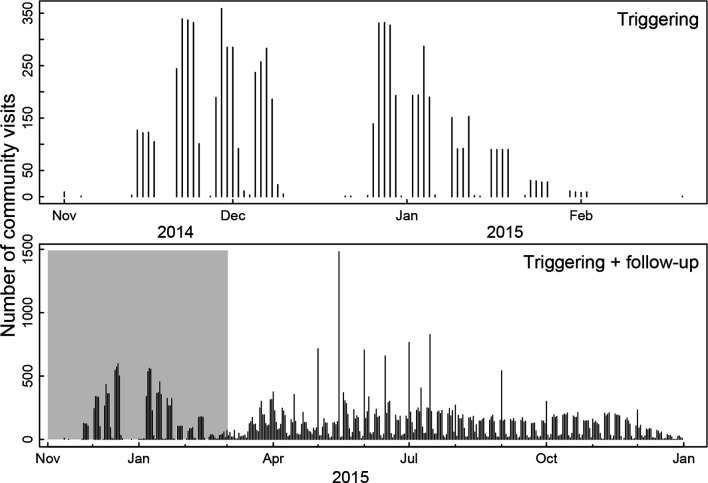
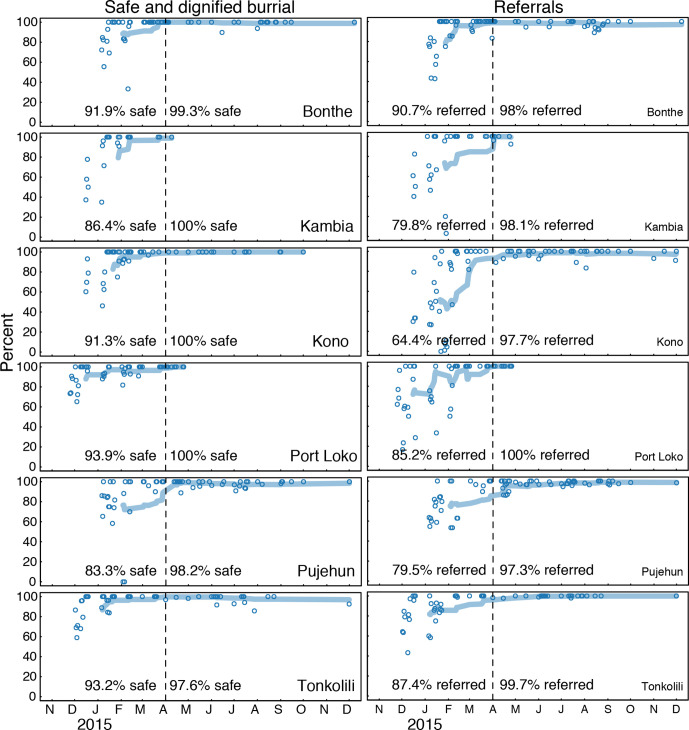
Documentation of structured community engagement initiatives and real-time monitoring of community engagement activities during large-scale epidemics is limited. To inform such initiatives, this paper analyses the Community Led Ebola Action (CLEA) approach implemented through the Social Mobilization Action Consortium (SMAC) during the 2014–2016 Ebola epidemic in Sierra Leone. The SMAC initiative consisted of a network of 2466 community mobilisers, >6000 religious leaders and 42 local radio stations across all 14 districts of Sierra Leone. Community mobilisers were active in nearly 70% of all communities across the country using the CLEA approach to facilitate community analysis, trigger collective action planning and maintain community action plans over time. CLEA was complemented by interactive radio programming and intensified religious leader engagement. Community mobilisers trained in the CLEA approach used participatory methods, comprised of an initial community ‘triggering’ event, action plan development and weekly follow-ups to monitor progress on identified action items. Mobilisers collected operational and behavioural data on a weekly basis as part of CLEA. We conducted a retrospective analysis of >50 000 weekly reports from approximately 12 000 communities from December 2014 to September 2015. The data showed that 100% of the communities that were engaged had one or more action plans in place. Out of the 63 110 cumulative action points monitored by community mobilisers, 92% were marked as ‘in-progress’ (85%) or ‘achieved’ (7%) within 9 months. A qualitative examination of action points revealed that the in-progress status was indicative of the long-term sustainability of most action points (eg, continuous monitoring of visitors into the community) versus one-off action items that were marked as achieved (eg, initial installation of handwashing station). Analysis of behavioural outcomes of the intervention indicate an increase over time in the fraction of reported safe burials and fraction of reported cases referred for medical care within 24 hours of symptom onset in the communities that were engaged. Through CLEA, we have demonstrated how large-scale, coordinated community engagement interventions can be achieved and monitored in real-time during future Ebola epidemics and other similar epidemics. The SMAC initiative provides a practical model for the design, implementation and monitoring of community engagement, integration and coordination of community engagement interventions with other health emergency response pillars, and adaptive strategies for large-scale community-based operational data collection.
Overview
The claims and statistics of this paper haven’t been checked yet.
Run the check — free, no account needed. It reads the open-access text and checks the sources it cites.
Integrity signals
Registry
Cites
Statistics
Figures
Verification
Claims the paper makes
The claims and statistics of this paper haven’t been checked yet.
Run the check — free, no account needed. It reads the open-access text and checks the sources it cites.
Claims other papers make about this one
Each is checked against this paper’s own text: does it say what the citing paper says it does?
The source backs part of the claim, not all of it — or backs it for a different population, condition or comparison.
In the citing paper
“Studies reported that this outbreak severely disrupted healthcare system’s operation and economic activities due to government-enforced measures such as lockdown or stay-at-home orders [33–35].”
From Financial barriers to healthcare access among reproductive-age women in Sierra Leone: evidence from demographic health surveys of 2008, 2013, and 2019 (2026) · cites this paper as [33]
Experimental — accuracy not yet measuredThe source backs part of the claim, not all of it — or backs it for a different population, condition or comparison.
In the citing paper
“A plausible reason for the unchanged proportion of reproductive-age women who faced financial barriers to access healthcare in 2013 and 2019 may be linked to the recurrent outbreaks in Sierra Leone over the past decade.”
From Financial barriers to healthcare access among reproductive-age women in Sierra Leone: evidence from demographic health surveys of 2008, 2013, and 2019 (2026) · cites this paper as [33]
Experimental — accuracy not yet measured
Self-check
Percentages, sums and reported differences re-computed from the paper’s own numbers.
The self-check needs the paper’s full text.
Citations
Cites
Putting People First: Sociological Variables in Rural Development.
Schulman, M., & Cernea, M. M. (1987) · Contemporary Sociology A Journal of Reviews · doi:10.2307/2070703 · Cited by 641
Moon, S., Sridhar, D., Pate, M. A., Jha, A. K., Clinton, C., Delaunay, S., Edwin, V., Fallah, M., Fidler, D. P., Garrett, L., et al. (2015) · The Lancet · doi:10.1016/s0140-6736(15)00946-0 · Cited by 629
The Ebola outbreak, 2013–2016: old lessons for new epidemics
Coltart, C. E. M., Lindsey, B. B., Ghinai, I., Johnson, A. M., & Heymann, D. L. (2017) · Philosophical Transactions of the Royal Society B Biological Sciences · doi:10.1098/rstb.2016.0297 · Cited by 509
The use of mobile phones as a data collection tool: A report from a household survey in South Africa
Tomlinson, M., Solomon, W., Singh, Y., Doherty, T., Chopra, M., Ijumba, P., Tsai, A. C., & Jackson, D. (2009) · BMC Medical Informatics and Decision Making · doi:10.1186/1472-6947-9-51 · Cited by 340
Handbook on Community-Led Total Sanitation
Chambers, R., & Kar, K. K. (2008) · Practical Action Publishing eBooks · doi:10.3362/9781835760376 · Cited by 321
Community-centered responses to Ebola in urban Liberia: the view from below
Abramowitz, S. A., McLean, K. E., McKune, S. L., Bardosh, K. L., Fallah, M., Monger, J., Tehoungue, K., & Omidian, P. A. (2015) · PLOS Neglected Tropical Diseases · doi:10.1371/journal.pntd.0003706 · Cited by 298
WHO Guideline on health policy and system support to optimize community health worker programmes
Porignon, D. (2018) · Cited by 197
Gillespie, A. M., Obregón, R., Asawi, R. E., Richey, C., Manoncourt, E., Joshi, K., Naqvi, S., Pouye, A., Safi, N., Chitnis, K., et al. (2016) · Global Health Science and Practice · doi:10.9745/ghsp-d-16-00226 · Cited by 185
Engaging ‘communities’: anthropological insights from the West African Ebola epidemic
Wilkinson, A., Parker, M., Martineau, F., & Leach, M. (2017) · Philosophical Transactions of the Royal Society B Biological Sciences · doi:10.1098/rstb.2016.0305 · Cited by 177
Social Pathways for Ebola Virus Disease in Rural Sierra Leone, and Some Implications for Containment
Richards, P. M., Amara, J., Ferme, M. C., Kamara, P., Mokuwa, E. Y., Sheriff, A. A., Suluku, R., & Voors, M. J. (2015) · PLoS neglected tropical diseases · doi:10.1371/journal.pntd.0003567 · Cited by 159
Research works printed but not linked: 1
- Restless Development . Ebola response mid-term review, 2015. Available: https://restlessdevelopment.org/file/ebola-response-mid-term-review-pdf [Accessed 4th Apr 2019].
Cited by
Sorted by citations
Community engagement for COVID-19 prevention and control: a rapid evidence synthesis
Gilmore, B., Ndejjo, R., Tchetchia, A., de Claro, V., Nyamupachitu-Mago, E., Diallo, A. A., Lopes, C. A., & Bhattacharyya, S. (2020) · BMJ Global Health · doi:10.1136/bmjgh-2020-003188 · Cited by 494
A review and agenda for integrated disease models including social and behavioural factors
Bedson, J., Skrip, L., Pedi, D., Abramowitz, S. A., Carter, S., Jalloh, M. F., Funk, S., Gobat, N., Giles‐Vernick, T., Chowell, G., et al. (2021) · Nature Human Behaviour · doi:10.1038/s41562-021-01136-2 · Cited by 224
Self-citationCase fatality rate for Ebola disease, 1976–2022: A meta-analysis of global data
Izudi, J., & Bajunirwe, F. (2023) · Journal of Infection and Public Health · doi:10.1016/j.jiph.2023.10.020 · Cited by 81
Corbin, J. H., Oyene, U. E., Manoncourt, E., Onya, H. E., Kwamboka, M., Amuyunzu–Nyamongo, M., Sørensen, K., Mweemba, O., Barry, M. M., Munodawafa, D., et al. (2021) · Health Promotion International · doi:10.1093/heapro/daab152 · Cited by 81
Nöstlinger, C., Landeghem, E. V., Vanhamel, J., Rotsaert, A., Manirankunda, L., Ddungu, C., Reyniers, T., Katsuva, D., Vercruyssen, J., Dielen, S., et al. (2022) · International Journal for Equity in Health · doi:10.1186/s12939-022-01672-x · Cited by 45
Metadata
- Authors
- Bedson, J., Jalloh, M. F., Pedi, D., Bah, S., Owen, K., Oniba, A., Sangarie, M., Fofanah, J. S., Jalloh, M. B., Sengeh, P., Skrip, L., Althouse, B. M., & Hébert-Dufresne, L.
- Affiliations
- Gates Foundation (US)
- FOCUS 1000, Freetown, Sierra Leone
- Restless Development Sierra Leone, Freetown, Sierra Leone
- GOAL, Freetown, Sierra Leone
- British Broadcasting Corporation (United Kingdom) (GB)
- Institute for Disease Modeling (US)
- New Mexico State University (US)
- Vermont Complex Systems Center, University of Vermont, Burlington, Vermont, USA
- Corresponding author
- Althouse, Benjamin M
- Venue
- BMJ Global Health
- Publisher
- BMJ
- Published
- 2020-08
- Volume
- 5
- Issue
- 8
- Pages
- e002145
- ISSN
- 2059-7908 (ISSN-L)
- PMC
- PMC7445350
- OpenAlex
- W3080271465
- Cited by
- 112
- References
- 29
- Citations by year
- 2026: 32 · 2025: 11 · 2024: 19 · 2023: 12 · 2022: 14 · 2021: 15 · 2020: 9
- FWCI
- 0.59
- Type
- journal article
- Language
- en
- Open access
- gold
- doi.org
- Locations
- BMJ Global Health (publishedVersion, cc-by)
- bioRxiv (Cold Spring Harbor Laboratory) (acceptedVersion, cc-by-nc-nd)
- PubMed Central (publishedVersion, cc-by)
- PubMed (publishedVersion)
- DOAJ (DOAJ: Directory of Open Access Journals) (submittedVersion, cc-by-sa)
- Funders
- National Institutes of Health (1P20 GM125498-01)
- Bill and Melinda Gates Foundation
- United Kingdom Department for International Development
- Bill and Melinda Gates through the Global Good Fund
- Age International
- UNICEF
- Topics
- Health Sciences › Medicine › Infectious Diseases › Viral Infections and Outbreaks Research
- Social Sciences › Communication › Public Relations and Crisis Communication
- Health Sciences › Medicine › Public Health, Environmental and Occupational Health › Community Health and Development
- Keywords
- community participation, Ebola outbreak response, Sierra Leone, community action plan, real-time monitoring, case referral, community-based data collection, health emergency response
- MeSH terms
- Disease Outbreaks, Humans, Retrospective Studies, Sierra Leone, Hemorrhagic Fever, Ebola, Epidemics
About these checks
Registry, retraction, Cites and statistics results are computed, not judged, with one exception: a printed reference that no index lists is read once by a model before it counts as a citation error. Claims are extracted by a model and kept only when their quote appears verbatim in the text; each cited source is then checked, with a model’s help, for whether it says what the claim relies on. Those verdicts can be wrong — read the claim’s quote and the cited source before relying on one.
Statistics and arithmetic are recomputed, not judged.
Confidence bands are shown only for fields calibrated on our annotated test set. None is calibrated yet, so no band is shown.
What counts as a claim ›How we measure confidence ›How we check this ›
Are you an author, or do you see a problem with this page? Request a review
