

Enhancing quality midwifery care in humanitarian and fragile settings: a systematic review of interventions, support systems and enabling environments
Open accessThe DOI matches its Crossref record; 49 of the 51 references it cites were found in a registry or an index.
Abstract
Introduction: Women and children bear a substantial burden of the impact of conflict and instability. The number of people living in humanitarian and fragile settings (HFS) has increased significantly over the last decade. The provision of essential maternal and newborn healthcare by midwives is crucial everywhere, especially in HFS. There is limited knowledge about the interventions, support systems and enabling environments that enhance midwifery care in these settings. The aim of this paper is to identify the factors affecting an enabling environment for midwives in HFS and to explore the availability and effectiveness of support systems for midwives. Methods: A structured systematic review was undertaken to identify peer-reviewed primary research articles published between 1995 and 2020. Results: In total, 24 papers were included from Afghanistan, Bangladesh, Nigeria, Democratic Republic of Congo, South Sudan and Sudan, Ethiopia, Pakistan, Uganda and Liberia. There were two broad themes: (1) the facilitators of, and barriers to, an enabling environment, and (2) the importance of effective support systems for midwives. Facilitators were: community involvement and engagement and an adequate salary, incentives or benefits. Barriers included: security and safety concerns, culture and gender norms and a lack of infrastructure and supplies. Support systems were: education, professional development, supportive supervision, mentorship and workforce planning. Conclusion: More efforts are needed to develop and implement quality midwifery services in HFS. There is an urgent need for more action and financing to ensure better outcomes and experiences for all women, girls and families living in these settings. PROSPERO registration number: CRD42021226323.
Overview
The claims and statistics of this paper haven’t been checked yet.
Free: it reads the open-access text and checks the first 5 claims that cite a source we can check. Create a free account to check every claim.
Integrity signals
Registry
Cites
Statistics
Figures
Verification
Claims the paper makes
The claims and statistics of this paper haven’t been checked yet.
Free: it reads the open-access text and checks the first 5 claims that cite a source we can check. Create a free account to check every claim.
Self-check
Percentages, sums and reported differences re-computed from the paper’s own numbers.
The self-check needs the paper’s full text.
Citations
Cites
The PRISMA 2020 statement: An updated guideline for reporting systematic reviews
Page, M. J., McKenzie, J. E., Bossuyt, P. M., Boutron, I., Hoffmann, T. C., Mulrow, C. D., Shamseer, L., Tetzlaff, J. M., Akl, E. A., Brennan, S. E., et al. (2021) · BMJ · doi:10.1136/bmj.n71 · Cited by 108,283
PRISMA-P Group, Moher, D., Shamseer, L., Clarke, M., Ghersi, D., Liberati, A., Petticrew, M., Shekelle, P., & Stewart, L. A. (2015) · Systematic Reviews · doi:10.1186/2046-4053-4-1 · Cited by 26,223 · cited 1×
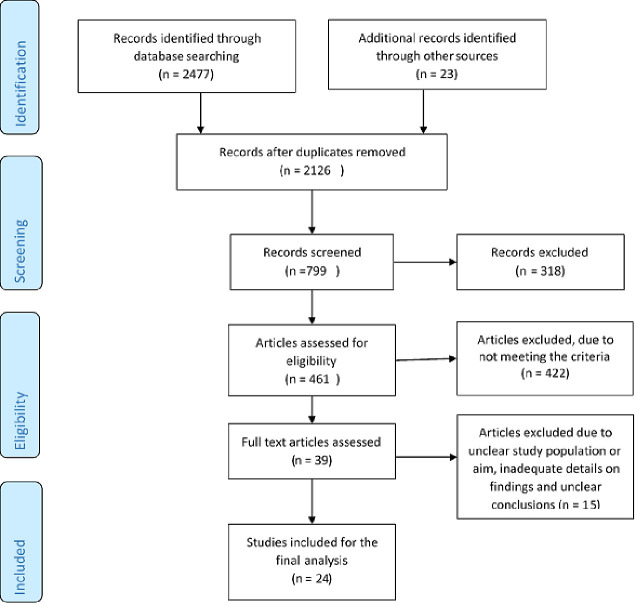
“18 36 After irrelevant and duplicate citations were removed, 461 potentially eligible papers were identified (figure 1).”
BackgroundThe Mixed Methods Appraisal Tool (MMAT) version 2018 for information professionals and researchers
Hong, Q. N., Fàbregues, S., Bartlett, G., Boardman, F., Cargo, M., Dagenais, P., Gagnon, M.-P., Griffiths, F., Nicolau, B., O’Cathain, A., et al. (2018) · Education for Information · doi:10.3233/efi-180221 · Cited by 4,737
Synthesising qualitative and quantitative evidence: A review of possible methods
Dixon-Woods, M., Agarwal, S., Jones, D., Young, B., & Sutton, A. (2005) · Journal of Health Services Research & Policy · doi:10.1177/135581960501000110 · Cited by 2,132
Renfrew, M. J., McFadden, A., Bastos, M. H., Campbell, J., Channon, A. A., Cheung, N. F., Silva, D. R. A. D., Downe, S., Kennedy, H. P., Malata, A., et al. (2014) · The Lancet · doi:10.1016/s0140-6736(14)60789-3 · Cited by 1,297
Improving the content validity of the mixed methods appraisal tool: a modified e-Delphi study
Hong, Q. N., Pluye, P., Fàbregues, S., Bartlett, G., Boardman, F., Cargo, M., Dagenais, P., Gagnon, M.-P., Griffiths, F., Nicolau, B., et al. (2019) · Journal of Clinical Epidemiology · doi:10.1016/j.jclinepi.2019.03.008 · Cited by 1,082 · cited 1×
“30 Patient and public involvement Patients and the public were not directly involved in this review.”
BackgroundHong, Q. N., Pluye, P., Bujold, M., & Wassef, M. (2017) · Systematic Reviews · doi:10.1186/s13643-017-0454-2 · Cited by 754 · cited 1×
“34 35 We did not undertake any assessment of meta-bias(es), such as publication bias across studies or selective reporting within studies.”
International Confederation of Midwives
WOODVILLE, L. (1964) · Bulletin of the American College of Nurse-Midwifery · doi:10.1111/j.1542-2011.1964.tb00484.x · Cited by 547
The effects of armed conflict on the health of women and children
Bendavid, E., Boerma, T., Akseer, N., Langer, A., Malembaka, E. B., Okiro, E. A., Wise, P. H., Heft-Neal, S., Black, R. E., Bhutta, Z. A., et al. (2021) · The Lancet · doi:10.1016/s0140-6736(21)00131-8 · Cited by 466
Nove, A., Friberg, I. K., de Bernis, L., McConville, F., Moran, A. C., Najjemba, M., ten Hoope-Bender, P., Tracy, S., & Homer, C. S. E. (2021) · The Lancet Global Health · doi:10.1016/s2214-109x(20)30397-1 · Cited by 393
Self-citation
Research works printed but not linked: 10
- OECD. States of fragility 2020, 2020. Available: https://www.oecd-ilibrary.org/content/publication/ba7c22e7-en [Accessed 09 Dec 2020].
- Inter-Agency Working Group on Reproductive Health in Crises. Inter-Agency manual on reproductive health in humanitarian settings. New York: Women’s Refugee Commission, 2019. 26203479
- WHO. Who recommendations on antenatal care for a positive pregnancy experience. Geneva: World Health Organization, 2016. 28079998
- Homer C, Turkmani S, Wilson A. A systematic review of interventions, support systems and enabling environments to enhance quality midwifery care in humanitarian and fragile settings (protocol). CRD42021226323: prospero, 2021. Available: https://www.crd.york.ac.uk/prospero/display_record.php?RecordID=226323 [Accessed 10 July 2021]. PMC8772423 35058304
- Langlois E, Daniels K, Akl E, eds. Evidence synthesis for health policy and systems: A methods guide. Geneva: World Health Organization, 2018. 33877749
- Inter-Agency Working Group on Reproductive Health in Crises (IAWG). Inter-Agency field manual on reproductive health in humanitarian settings. Available: https://resourcecentre.savethechildren.net/pdf/iafm_on_reproductive_health_in_hs_2018.pdf/2018 26203479
- Cochrane Effective Practice and Organisation of Care (EPOC). Epoc resources for review authors, 2017. Available: https://epoc.cochrane.org/sites/epoc.cochrane.org/files/public/uploads/Resources-for-authors2017/what_study_designs_should_be_included_in_an_epoc_review.pdf [Accessed 09 Nov 2020].
- Covidence systematic review software, veritas health innovation Melbourne, Australia. Available: www.covidence.org
- Baba A, Martineau T, Theobald S, et al. Developing strategies to attract, retain and support midwives in rural fragile settings: participatory workshops with health system stakeholders in Ituri Province, Democratic Republic of Congo. Health Res Policy Syst 2020; 18: 133. 10.1186/s12961-020-00631-8 33148279 PMC7609831 · DOI
- Bogren M, Erlandsson K, Byrskog U. What prevents midwifery quality care in Bangladesh? A focus group enquiry with midwifery students. BMC Health Serv Res 2018; 18: N.PAG-N.PAG. 10.1186/s12913-018-3447-5 PMC6094463 30111324 · DOI · Paper page
Cited by
Health system strengthening in fragile and conflict-affected states: A review of systematic reviews
Bogale, B., Scambler, S., Khairuddin, A. N. M., & Gallagher, J. E. (2024) · PLoS ONE · doi:10.1371/journal.pone.0305234 · Cited by 186
“Collaboration between the community and health system was also essential in providing a safe environment for healthcare workers [39].”
BackgroundInfluentialSangy, M. T., Duaso, M., Feeley, C., & Walker, S. (2023) · Midwifery · doi:10.1016/j.midw.2023.103696 · Cited by 50
Improving access to emergency obstetric care in low- and middle-income countries
Chauke, L. (2024) · Best Practice & Research Clinical Obstetrics & Gynaecology · doi:10.1016/j.bpobgyn.2024.102572 · Cited by 54
Mohiddin, A., Semrau, K. E. A., Simon, J. L., Langlois, É. V., Shiffman, J., Nabwera, H., Hofmeyr, G. J., Lawn, J. E., Black, R. E., Askari, S., et al. (2023) · The Lancet · doi:10.1016/s0140-6736(23)00721-3 · Cited by 21
Responding to Humanitarian Crises: Midwifery Care in Bangladesh
Purno, N. H., Biswas, A., Anderson, R., & Hoque, D. M. E. (2023) · Journal of Midwifery & Women s Health · doi:10.1111/jmwh.13524 · Cited by 19
Dey, T., Shah, M. G., Baba, A., Mugo, N. S., Thommesen, T., Vivilaki, V. G., Boniol, M., Alam, N., Dibley, M. J., Okoro, D., et al. (2024) · PLOS Global Public Health · doi:10.1371/journal.pgph.0003384 · Cited by 13
“…in HFS contexts, including physical (such as a threat to life, violence, and risk of infection during pandemics), psychosocial (trauma, fear, and stigma), and professional (lack of an enabling environment, support systems, quality education and professional development opportunities) [17, 18].”
BackgroundSelf-citationJacobsson, B., Requejo, J. H., Dey, T., Lavin, T., Mannah, M. T., Menon, R., Valencia, C. M. M., Sharma, G. K., Shennan, A. H., Shakibazadeh, E., et al. (2025) · Reproductive Health · doi:10.1186/s12978-025-02034-w · Cited by 23
“These same direct and indirect pathways also increase risks of preterm birth and stillbirths [2, 29, 30].”
Self-citationBorn Too Soon: Progress and priorities for respectful and rights-based preterm birth care
Kinney, M. V., Ateva, E., Cocoman, O., Schaaf, M., Wanduru, P., Khalil, M., Sacks, E., Tamés, R., Suguitani, D., Stahlhofer, M., et al. (2025) · Reproductive Health · doi:10.1186/s12978-025-02042-w · Cited by 10
“To do this respectfully, they need an enabling environment, including adequate sala-ries, professional development, good supervision, and safety and security [80].”
Temple, F., Lalloo, E. C., Berg, M., Berg, U., Alumeti, D. M., Nyakio, O., Mulunda, A., & Bogren, M. U. (2024) · Global Health Action · doi:10.1080/16549716.2024.2370097 · Cited by 6
“This emphasizes the urgency of addressing the global shortfall of midwives educated according to international standards, and which is crucial for achieving the Sustainable Development Goals [2–4].”
BackgroundJafari, M., Tawfiq, E., Stanikzai, M. H., Currie, S., Arifi, F., Rab, F. A., Kazemi, H., Wasiq, A. W., & Turkmani, S. (2026) · Obstetrics and Gynecology International · doi:10.1155/ogi/1366466 · Cited by 7
“Education informs health choices [10], and cultural norms infuence service use [11, 12].”
Self-citationMidwifery education in Bangladesh: An in-depth analysis through a systematic review
Fraser, R., Downer, T., & Oprescu, F. (2024) · Women and Birth · doi:10.1016/j.wombi.2024.101661 · Cited by 6
Perera, S. M., Isa, G. P., Sebushishe, A., Sundararaj, P., Piccirillo, M., Xia, S., Langaigne, A., Ali, J., & Casey, S. E. (2023) · Frontiers in Global Women s Health · doi:10.3389/fgwh.2023.1215405 · Cited by 7
Bourret, K., Kankolongo, M. C., Lobo, N., Banga, D., Maffioli, E. M., & Klingberg‐Allvin, M. (2024) · Midwifery · doi:10.1016/j.midw.2024.104238 · Cited by 5
Iwu, E., Elnakib, S., Abdullahi, H., Abimiku, R. H., Maina, C. P., Mohamud, A. M., Ayodeji, K. O., Odonye, G., Aimu, R. S., Ahmed, M. S., et al. (2025) · Human Resources for Health · doi:10.1186/s12960-025-00977-6 · Cited by 6
“Increases in coverage of interventions delivered by midwives have been shown to result in significant gains in averting maternal and neonatal deaths [2, 3].”
Szlendak, B., Baranowska, B. M., Nenko, I., Sahraoui, N., Tataj–Puzyna, U., Durka, A., & Węgrzynowska, M. (2025) · Midwifery · doi:10.1016/j.midw.2025.104464 · Cited by 4
Halim, A., Abdullah, A. S. M., Rahman, F., Bazirete, O., Turkmani, S., Hughes, K., Lopes, S. C., Nove, A., Forrester, M., Scarf, V., et al. (2024) · PLOS Global Public Health · doi:10.1371/journal.pgph.0004033 · Cited by 3
Self-citationBigirinama, R. N., Iwu, E., Mary, M., Abimiku, R. H., Chiribagula, C. Z., Israel-Isah, S., Ekambi, S., Mwene-Batu, P. L., Maina, C. P., Bisimwa, G. B., et al. (2026) · Global Public Health · doi:10.1080/17441692.2026.2640771 · Cited by 2
Midwives’ perceptions regarding clinical support by nursing managers in a Tshwane hospitalPreprint
Jantjies, N. D., Zenani, N. E., & Serapelwane, M. G. (2024) · Research Square · doi:10.21203/rs.3.rs-3994665/v1 · Cited by 2
Turkmani, S. (2024) · BMJ · doi:10.1136/bmj.q2798 · Cited by 3
Self-citationFeng, J., Huang, J., Wu, Q., Wei, K., & Bin, Q. (2025) · BMC Pregnancy and Childbirth · doi:10.1186/s12884-025-08443-w · Cited by 5
Ahmed, S. A. E., Mahimbo, A., & Dawson, A. J. (2025) · Conflict and Health · doi:10.1186/s13031-025-00738-1 · Cited by 2
“Based on existing literature, with adequate support, midwives can deliver care that matches physician-led models, even in settings with limited resources [34].”
InfluentialBirth in shelters: Midwives’ lived experiences in providing childbirth care amidst war in Gaza
Hassan, S., Baloushah, S., & Mortensen, B. M. (2026) · PLoS ONE · doi:10.1371/journal.pone.0339551 · Cited by 1
“Midwives have a critical role in providing sexual, reproductive, maternal, newborn, child, and adolescent health services in humanitarian settings and are included in the Minimum Initial Service Package for reproductive preparedness in crisis [1,2].”
Temple, F., Lalloo, E. C., Berg, M., Berg, U., Nyakio, O., Mulunda, A., & Bogren, M. U. (2025) · Nurse Education in Practice · doi:10.1016/j.nepr.2025.104439 · Cited by 1
Gardiwal, H., Saeedzai, A. S., Feroz, F., Knight, J., Ukasha, M. H. U., Durrani, N. A. D., & Sayedzai, S. S. (2024) · Research Square · doi:10.21203/rs.3.rs-5008241/v1 · Cited by 1
Enhancing Midwifery and lactation support for women in natural disasters and humanitarian crises
Adnani, Q. E. S., O’Connell, M. A., Chase, J., Mankani, N., Kaya, G. D., & Homer, C. (2025) · Women and Birth · doi:10.1016/j.wombi.2025.101884 · Cited by 1
Self-citationBogren, M. U., & Erlandsson, K. (2025) · Sexual & Reproductive Healthcare · doi:10.1016/j.srhc.2025.101117 · Cited by 1
Bourret, K., Hien, A., Larocque, S., HOGUE, C. J. R., Muray, K., Lukusa, A. T., & Ngabo, A. M. (2024) · European Scientific Journal ESJ · doi:10.19044/esipreprint.3.2024.p159
Bourret, K., Hien, A., Larocque, S., Hogue, C., Muray, K., Lukusa, A. T., & Ngabo, A. M. (2024) · European Scientific Journal ESJ · doi:10.19044/esj.2024.v20n12p1
A New Beginning in Health: Solutions for Somalia’s Emergency Health Services
Durmuş, U. (2025) · Akademisyen Kitabevi eBooks · doi:10.37609/akya.3488
Building a sustainable model for global maternal health
Tunçalp, Ö., Vogel, J. P., Kouanda, S., & Liabsuetrakul, T. (2025) · BMJ · doi:10.1136/bmj.r1011
Self-citationContraceptive use and decision-making in Guéra, Chad: a mixed-methods study
Allambademel, V. D. P., Abdelaziz, M., Andrasko, N., Goumbo, B., Madjigoto, R., Ngarmbatedjimal, A., Noubadjim, S., Tamira, S., Varelis, T., Vourbane, K., et al. (2025) · Frontiers in Global Women s Health · doi:10.3389/fgwh.2025.1516757
Das, S., Grønbæk, A., Rasmussen, J. S., Anilkumar, R., Kjærulff, K., Salad, J., Al-Gharabli, A. H., & Abra Pearl, C. T. (2025) · International Journal of Midwifery and Nursing Practice · doi:10.33545/26630427.2025.v8.i2a.203
Zaza, K., McFadden, A., Hassan, S., Ali-Masri, H., Blix, E., & Mortensen, B. M. (2025) · Research Square · doi:10.21203/rs.3.rs-5989286/v1
Üreme Sağlığı ve Aile Planlamasında Ebelerin Rolü
Ovezova, M., & Kılıç, K. N. (2025) · Özgür Yayınları eBooks · doi:10.58830/ozgur.pub1031.c4137
Ba, A., Asiedu, A., Théra, I., Acheampong, E., Hanson, F., Ba, H., Nanka-Bruce, P., Doggett, E., Terfa, M., Hyre, A., et al. (2026) · SSM - Health Systems · doi:10.1016/j.ssmhs.2026.100167 · Cited by 1
Madany, F. H., Dwekat, I. M. M., Abbas, E., Miqdadi, R., AbeedAllah, S., & Awwad, S. (2026) · Women and Birth · doi:10.1016/j.wombi.2026.102179
Larsson, L.-L. F., Hailemeskel, S., Lindgren, H., Byrskog, U., Wells, M. B., Blomgren, J., Cheptum, J. J., Ceesay, K., & Erlandsson, K. (2026) · African Journal of Primary Health Care & Family Medicine · doi:10.4102/phcfm.v18i1.5238
Dewi, S. K., Silawati, V., Widowati, R., & Rukmaini (2026) · Nursing and Health Sciences Journal (NHSJ) · doi:10.53713/nhsj.v6i1.598
“Healthcare is a fundamental necessity for society, and as social standards rise, so does the public demand for high-quality medical services (Homer et al., 2022).”
Moral distress and ethical challenges in midwifery experiences: A scoping review
Hasanzadeh, M., Zeinab, H., & Shahhosseini, Z. (2026) · Nursing Ethics · doi:10.1177/09697330251407219 · Cited by 1
“65 Stress in midwifery, as de fi ned in our conceptual framework, causes psychological distress due to environmental and internal pressures as well as workplace demands, and can both trigger and result from ethical tensions.”
Tappis, H., Iwu, E., Abdullahi, H., Maina, C. P., Mohammed, A., & Elnakib, S. (2026) · Women s Health · doi:10.1177/17455057261438787
Lu, X., Zhang, Y., Ren, Z., Chen, X., Bai, D., Gao, J., & Hou, C. (2026) · Journal of Nursing Management · doi:10.1155/jonm/4433124
“Previous studies have shown that DF can afect the cognitive ability of medical staf, reduce the quality of fnal medical decisions [10], potentially compromising patient safety [10, 11], and birth outcomes [12].”
Coverage without continuity: Midwifery-led care and newborn survival in fragile health systems
Ibrahim, I. O., Hassan, A. A., Mohamed, M. D., Sudi, L. A., & Abdullahi, Y. B. (2026) · Global Pediatrics · doi:10.1016/j.gpeds.2026.100350
Yu, C., Dong, S., Wang, X., Zhu, C., Min, H., Qian, X., & Gu, C. (2026) · BMC Pregnancy and Childbirth · doi:10.1186/s12884-026-09450-1 · Cited by 1
“These align with enabling factors identified globally, such as adequate infrastructure, skilled staff, and decisive leadership [9, 49].”
Casey, S. E., Isa, G. P., Sebushishe, A., Sundararaj, P., Piccirillo, M., Ali, J., & Perera, S. M. (2025) · Sexual and Reproductive Health Matters · doi:10.1080/26410397.2026.2694248
“15,35,36 Midwives, especially those in rural locations, may be the only midwives available, resulting in a lack of mentorship but also overwork.”
Adnani, Q. E. S., Chase, J., & O’Connell, M. A. (2026) · Women and Birth · doi:10.1016/j.wombi.2026.102379
Gardiwal, H., Saeedzai, S. A., Feroz, F., Knight, J., Ukasha, H., Durrani, N. A., & Sayedzai, S. S. (2026) · BMC Pregnancy and Childbirth · doi:10.1186/s12884-026-10103-6 · Cited by 1
“These include hemorrhage, obstructed labor, sepsis, and hypertensive disorders [7–9].”
Influential
Metadata
- Authors
- Homer, C. S., Turkmani, S., Wilson, A. N., Vogel, J. P., Shah, M. G., Fogstad, H., & Langlois, E. V.
- Affiliations
- Burnet Institute (AU)
- University of Technology Sydney (AU)
- World Health Organization (CH)
- Partnership for Maternal, Newborn & Child Health (PMNCH), World Health Organization (WHO), Geneva, Switzerland
- Corresponding author
- Homer, Caroline SE
- ORCID
- Venue
- BMJ Global Health
- Publisher
- BMJ
- Published
- 2022-01
- Volume
- 7
- Issue
- 1
- Pages
- e006872
- ISSN
- 2059-7908 (ISSN-L)
- PMC
- PMC8772423
- OpenAlex
- W4206782749
- Semantic Scholar
- 435ccfd18b070a82fe2d6c84ad2a0dd1923d33ef
- Cited by
- 48
- References
- 51
- Citations by year
- 2026: 14 · 2025: 16 · 2024: 13 · 2023: 4 · 2022: 1
- FWCI
- 2.18
- Type
- journal article
- Language
- en
- Open access
- gold
- doi.org
- Licence
- Locations
- BMJ Global Health (publishedVersion, cc-by-nc)
- PubMed Central (publishedVersion, cc-by-nc)
- PubMed (publishedVersion)
- DOAJ (DOAJ: Directory of Open Access Journals) (submittedVersion, cc-by-sa)
- Figshare (submittedVersion, cc-by-nc)
- Minerva Access (University of Melbourne) (submittedVersion, cc-by-nc)
- Funders
- Partnership for Maternal, Newborn and Child Health, WHO
- Topics
- Health Sciences › Medicine › Pediatrics, Perinatology and Child Health › Global Maternal and Child Health
- Health Sciences › Health Professions › General Health Professions › Health and Conflict Studies
- Health Sciences › Medicine › Public Health, Environmental and Occupational Health › Global Health Workforce Issues
- Keywords
- midwifery care, humanitarian settings, fragile settings, enabling environment, maternal and newborn health, conflict-affected settings, supportive supervision, mentoring, workforce planning, community participation, gender norms, safety and security
- MeSH terms
- Afghanistan, Bangladesh, Child, Ethiopia, Female, Humans, Infant, Newborn, Midwifery, Pregnancy, Quality of Health Care
About these checks
Registry, retraction, Cites and statistics results are computed, not judged, with one exception: a printed reference that no index lists is read once by a model before it counts as a citation error. Claims are extracted by a model and kept only when their quote appears verbatim in the text; each cited source is then checked, with a model’s help, for whether it says what the claim relies on. Those verdicts can be wrong — read the claim’s quote and the cited source before relying on one.
Statistics and arithmetic are recomputed, not judged.
Confidence bands are shown only for fields calibrated on our annotated test set. None is calibrated yet, so no band is shown.
What counts as a claim ›How we measure confidence ›How we check this ›
Are you an author, or do you see a problem with this page? Request a review
Data sources
Bibliographic data: Semantic Scholar, OpenAlex, Crossref.
Contains information from the Semantic Scholar Academic Graph Datasets, made available under the ODC Attribution License (ODC-BY 1.0).
Semantic Scholar’s data is described in: Kinney, R., et al. (2023). The Semantic Scholar Open Data Platform. arXiv:2301.10140.
