

Enhancing quality midwifery care in humanitarian and fragile settings: a systematic review of interventions, support systems and enabling environments
Open accessThe DOI matches its Crossref record; 49 of the 51 references it cites were found in a registry or an index.
Abstract
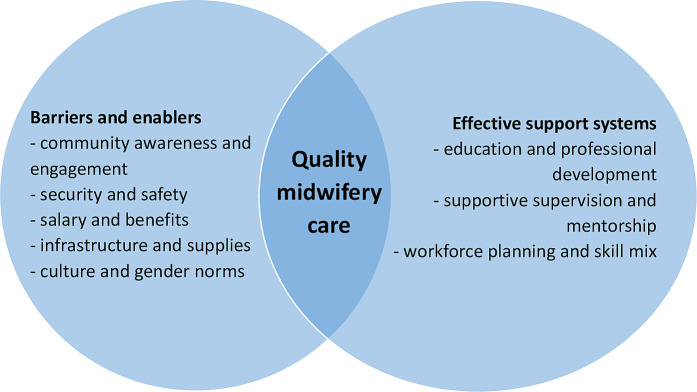
Introduction: Women and children bear a substantial burden of the impact of conflict and instability. The number of people living in humanitarian and fragile settings (HFS) has increased significantly over the last decade. The provision of essential maternal and newborn healthcare by midwives is crucial everywhere, especially in HFS. There is limited knowledge about the interventions, support systems and enabling environments that enhance midwifery care in these settings. The aim of this paper is to identify the factors affecting an enabling environment for midwives in HFS and to explore the availability and effectiveness of support systems for midwives. Methods: A structured systematic review was undertaken to identify peer-reviewed primary research articles published between 1995 and 2020. Results: In total, 24 papers were included from Afghanistan, Bangladesh, Nigeria, Democratic Republic of Congo, South Sudan and Sudan, Ethiopia, Pakistan, Uganda and Liberia. There were two broad themes: (1) the facilitators of, and barriers to, an enabling environment, and (2) the importance of effective support systems for midwives. Facilitators were: community involvement and engagement and an adequate salary, incentives or benefits. Barriers included: security and safety concerns, culture and gender norms and a lack of infrastructure and supplies. Support systems were: education, professional development, supportive supervision, mentorship and workforce planning. Conclusion: More efforts are needed to develop and implement quality midwifery services in HFS. There is an urgent need for more action and financing to ensure better outcomes and experiences for all women, girls and families living in these settings. PROSPERO registration number: CRD42021226323.
Overview
The claims and statistics of this paper haven’t been checked yet.
Free: it reads the open-access text and checks the first 5 claims that cite a source we can check. Create a free account to check every claim.
Integrity signals
Registry
Cites
Statistics
Figures
Verification
Claims the paper makes
The claims and statistics of this paper haven’t been checked yet.
Free: it reads the open-access text and checks the first 5 claims that cite a source we can check. Create a free account to check every claim.
Self-check
Percentages, sums and reported differences re-computed from the paper’s own numbers.
The self-check needs the paper’s full text.
Citations
Cites
The PRISMA 2020 statement: An updated guideline for reporting systematic reviews
Page, M. J., McKenzie, J. E., Bossuyt, P. M., Boutron, I., Hoffmann, T. C., Mulrow, C. D., Shamseer, L., Tetzlaff, J. M., Akl, E. A., Brennan, S. E., et al. (2021) · BMJ · doi:10.1136/bmj.n71 · Cited by 108,283
PRISMA-P Group, Moher, D., Shamseer, L., Clarke, M., Ghersi, D., Liberati, A., Petticrew, M., Shekelle, P., & Stewart, L. A. (2015) · Systematic Reviews · doi:10.1186/2046-4053-4-1 · Cited by 26,223 · cited 1×
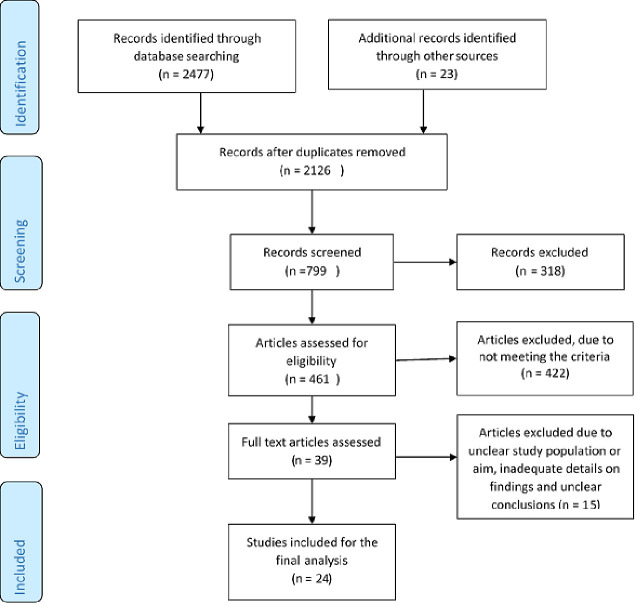
“18 36 After irrelevant and duplicate citations were removed, 461 potentially eligible papers were identified (figure 1).”
BackgroundThe Mixed Methods Appraisal Tool (MMAT) version 2018 for information professionals and researchers
Hong, Q. N., Fàbregues, S., Bartlett, G., Boardman, F., Cargo, M., Dagenais, P., Gagnon, M.-P., Griffiths, F., Nicolau, B., O’Cathain, A., et al. (2018) · Education for Information · doi:10.3233/efi-180221 · Cited by 4,737
Synthesising qualitative and quantitative evidence: A review of possible methods
Dixon-Woods, M., Agarwal, S., Jones, D., Young, B., & Sutton, A. (2005) · Journal of Health Services Research & Policy · doi:10.1177/135581960501000110 · Cited by 2,132
Renfrew, M. J., McFadden, A., Bastos, M. H., Campbell, J., Channon, A. A., Cheung, N. F., Silva, D. R. A. D., Downe, S., Kennedy, H. P., Malata, A., et al. (2014) · The Lancet · doi:10.1016/s0140-6736(14)60789-3 · Cited by 1,297
Improving the content validity of the mixed methods appraisal tool: a modified e-Delphi study
Hong, Q. N., Pluye, P., Fàbregues, S., Bartlett, G., Boardman, F., Cargo, M., Dagenais, P., Gagnon, M.-P., Griffiths, F., Nicolau, B., et al. (2019) · Journal of Clinical Epidemiology · doi:10.1016/j.jclinepi.2019.03.008 · Cited by 1,082 · cited 1×
“30 Patient and public involvement Patients and the public were not directly involved in this review.”
BackgroundHong, Q. N., Pluye, P., Bujold, M., & Wassef, M. (2017) · Systematic Reviews · doi:10.1186/s13643-017-0454-2 · Cited by 754 · cited 1×
“34 35 We did not undertake any assessment of meta-bias(es), such as publication bias across studies or selective reporting within studies.”
International Confederation of Midwives
WOODVILLE, L. (1964) · Bulletin of the American College of Nurse-Midwifery · doi:10.1111/j.1542-2011.1964.tb00484.x · Cited by 547
The effects of armed conflict on the health of women and children
Bendavid, E., Boerma, T., Akseer, N., Langer, A., Malembaka, E. B., Okiro, E. A., Wise, P. H., Heft-Neal, S., Black, R. E., Bhutta, Z. A., et al. (2021) · The Lancet · doi:10.1016/s0140-6736(21)00131-8 · Cited by 466
Nove, A., Friberg, I. K., de Bernis, L., McConville, F., Moran, A. C., Najjemba, M., ten Hoope-Bender, P., Tracy, S., & Homer, C. S. E. (2021) · The Lancet Global Health · doi:10.1016/s2214-109x(20)30397-1 · Cited by 393
Self-citationFilby, A., McConville, F., & Portela, A. (2016) · PLOS ONE · doi:10.1371/journal.pone.0153391 · Cited by 323
Promoting health equity in conflict-affected fragile states
Bornemisza, O., Ranson, M. K., Poletti, T., & Sondorp, E. (2009) · Social Science & Medicine · doi:10.1016/j.socscimed.2009.09.032 · Cited by 150
Wagner, Z., Heft-Neal, S., Wise, P. H., Black, R. E., Burke, M., Boerma, T., Bhutta, Z. A., & Bendavid, E. (2019) · The Lancet Global Health · doi:10.1016/s2214-109x(19)30407-3 · Cited by 116
Singh, N., Ataullahjan, A., Ndiaye, K., Das, J. K., Wise, P. H., Altare, C., Ahmed, Z., Sami, S., Akik, C., Tappis, H., et al. (2021) · The Lancet · doi:10.1016/s0140-6736(21)00132-x · Cited by 116
Frantzen, K. K., & Fetters, M. D. (2016) · Quality & Quantity · doi:10.1007/s11135-015-0261-6 · Cited by 91
Promoting access: The use of maternity waiting homes to achieve safe motherhood
Lori, J. R., Wadsworth, A. C., Munro, M. L., & Rominski, S. (2013) · Midwifery · doi:10.1016/j.midw.2013.07.020 · Cited by 89 · cited 2×
“57 In this study, the community understood the role and function of midwives and supported women’s access to services.”
BackgroundThe political and security dimensions of the humanitarian health response to violent conflict
Wise, P. H., Shiel, A., Southard, N., Bendavid, E., Welsh, J. M., Stedman, S. J., Fazal, T. M., Felbab‐Brown, V., Polatty, D. P., IV, Waldman, R. J., et al. (2021) · The Lancet · doi:10.1016/s0140-6736(21)00130-6 · Cited by 75
Turkmani, S., Currie, S., Mungia, J., Assefi, N., Javed Rahmanzai, A., Azfar, P., & Bartlett, L. (2013) · Midwifery · doi:10.1016/j.midw.2013.06.015 · Cited by 71
Self-citationJob satisfaction and retention of midwives in rural Nigeria
Adegoke, A. A., Atiyaye, F. B., Abubakar, A. S., Auta, A., & Aboda, A. (2015) · Midwifery · doi:10.1016/j.midw.2015.06.010 · Cited by 68
Approaches to protect and maintain health care services in armed conflict – meeting SDGs 3 and 16
Druce, P., Bogatyreva, E., Siem, F. F., Gates, S., Kaade, H., Sundby, J., Rostrup, M., Andersen, C. B., Rustad, S. A., Tchie, A. E. Y., et al. (2019) · Conflict and Health · doi:10.1186/s13031-019-0186-0 · Cited by 68
What prevents midwifery quality care in Bangladesh? A focus group enquiry with midwifery students
Rights, M. O. T. M. F. M. D. H. I. S. A. R. H. A., Bogren, M., Erlandsson, K., & Byrskog, U. (2018) · BMC Health Services Research · doi:10.1186/s12913-018-3447-5 · Cited by 58
Beek, K., McFadden, A., & Dawson, A. (2019) · Human Resources for Health · doi:10.1186/s12960-018-0341-5 · Cited by 58
Kim, Y. M., Ansari, N., Kols, A., Tappis, H., Currie, S., Zainullah, P., Bailey, P., Semba, R. D., Sun, K., van Roosmalen, J., et al. (2013) · BMC Pediatrics · doi:10.1186/1471-2431-13-140 · Cited by 56
Gaffey, M. F., Waldman, R. J., Blanchet, K., Amsalu, R., Capobianco, E., Ho, L. S., Khara, T., García, D. M., Aboubaker, S., Ashorn, P., et al. (2021) · The Lancet · doi:10.1016/s0140-6736(21)00133-1 · Cited by 50
Miyake, S., Speakman, E. M., Currie, S., & Howard, N. (2017) · Health Policy and Planning · doi:10.1093/heapol/czw093 · Cited by 46
Mugo, N. S., Dibley, M. J., Damundu, E. Y., & Alam, A. (2018) · Maternal and Child Health Journal · doi:10.1007/s10995-018-2555-5 · Cited by 44
Quality of Midwife-provided Intrapartum Care in Amhara Regional State, Ethiopia
Yigzaw, T., Eyowas, F. A., Belay, L., Assaye, Y., Misganaw, E., Kidane, A., Ademie, D., van Roosmalen, J., Stekelenburg, J., & Kim, Y. M. (2017) · BMC Pregnancy and Childbirth · doi:10.1186/s12884-017-1441-2 · Cited by 40
Zainullah, P., Ansari, N., Yari, K., Azimi, M., Turkmani, S., Azfar, P., LeFevre, A., Mungia, J., Gubin, R., Kim, Y.-M., et al. (2014) · Midwifery · doi:10.1016/j.midw.2013.10.026 · Cited by 37
Self-citationThommesen, T., Kismul, H., Kaplan, I., Safi, K., & den Bergh, G. V. (2020) · BMC Pregnancy and Childbirth · doi:10.1186/s12884-020-2818-1 · Cited by 34
Wood, M. E., Mansoor, G. F., Hashemy, P., Namey, E., Gohar, F., Ayoubi, S. F., & Todd, C. S. (2013) · Midwifery · doi:10.1016/j.midw.2013.07.004 · Cited by 32
Arnold, R., van Teijlingen, E., Ryan, K., & Holloway, I. (2019) · BMC Pregnancy and Childbirth · doi:10.1186/s12884-019-2420-6 · Cited by 30
Quality of midwifery care in Soroti District, Uganda
Kaye, D. K. (2009) · East African Medical Journal · doi:10.4314/eamj.v77i10.46712 · Cited by 29
Experiences of a new cadre of midwives in Bangladesh: findings from a mixed method study
Zaman, R. U., Adiba, K., Sabur, M. A., Islam, S., Ahmed, S., Varghese, J., Sherratt, D. R., & Witter, S. (2020) · Human Resources for Health · doi:10.1186/s12960-020-00505-8 · Cited by 29
Parallel worlds: An ethnography of care in an Afghan maternity hospital
Arnold, R., van Teijlingen, E., Ryan, K., & Holloway, I. (2018) · Social Science & Medicine · doi:10.1016/j.socscimed.2018.09.010 · Cited by 27
Bogren, M. U., Doraiswamy, S., Erlandsson, K., Akhter, H., Akter, D., Begum, M., Chowdhury, M., Das, L., Akter, R., Begum, S., et al. (2018) · Midwifery · doi:10.1016/j.midw.2018.02.021 · Cited by 27
Mansoor, G. F., Hill, P. S., & Barss, P. (2012) · Health Policy and Planning · doi:10.1093/heapol/czr005 · Cited by 26
Exley, J., Pitchforth, E., Okeke, E. N., Glick, P., Abubakar, I. S., Chari, A. V., Bashir, U., Gu, K., & Onwujekwe, O. E. (2016) · BMC Pregnancy and Childbirth · doi:10.1186/s12884-016-1026-5 · Cited by 25
Etiaba, E., Manzano, A., Agbawodikeizu, U. P., Ogu, U. U., Ebenso, B., Uzochukwu, B. S. C., Onwujekwe, O. E., Ezumah, N., & Mirzoev, T. N. (2020) · BMC Health Services Research · doi:10.1186/s12913-020-05747-9 · Cited by 25 · cited 1×
“51 57 One showed how an engaged community in Liberia positively influenced service provision by helping to construct a maternity waiting home: The community helps because to construct the building, the community provided sand, they provided bricks, and they provided gravel.”
BackgroundBogren, M. U., & Erlandsson, K. (2018) · Sexual & Reproductive Healthcare · doi:10.1016/j.srhc.2018.02.003 · Cited by 24 · cited 1×
“45 53 54 58 In the absence of communication, information sharing or trust building with the community, traditional birth attend-ants may guide women and girls away from midwives.”
BackgroundTowards a midwifery profession in Bangladesh – a systems approach for a complex world
Bogren, M. U., Wigert, H., Edgren, L., & Berg, M. (2015) · BMC Pregnancy and Childbirth · doi:10.1186/s12884-015-0740-8 · Cited by 23
Ahmed, J., Ur Rehman, S., & Shahab, M. (2017) · Midwifery · doi:10.1016/j.midw.2017.02.005 · Cited by 23 · cited 1×
“45 53 54 58 In the absence of communication, information sharing or trust building with the community, traditional birth attend-ants may guide women and girls away from midwives.”
BackgroundBaba, A., Martineau, T., Theobald, S., Sabuni, P., Nobabo, M. M., Alitimango, A., Katabuka, J. K., & Raven, J. (2020) · Health Research Policy and Systems · doi:10.1186/s12961-020-00631-8 · Cited by 23
Brault, M. A., Kennedy, S. B., Haley, C. A., Clarke, A., Duworko, M. C., Habimana, P., Vermund, S. H., Kipp, A. M., & Mwinga, K. (2018) · BMJ Open · doi:10.1136/bmjopen-2018-021879 · Cited by 17
Walton, M., Harrison, R., Burgess, A. W., & Foster, K. (2015) · Postgraduate Medical Journal · doi:10.1136/postgradmedj-2014-133130 · Cited by 16 · cited 2×
“33 We therefore under-took a narrative synthesis.”
BackgroundMugo, N. S., Dibley, M. J., Damundu, E. Y., & Alam, A. (2018) · Maternal and Child Health Journal · doi:10.1007/s10995-018-2574-2 · Cited by 16
Baba, A., Theobald, S., Martineau, T., Sabuni, P., Nobabo, M. M., Alitimango, A., & Raven, J. (2020) · Rural and Remote Health · doi:10.22605/rrh5677 · Cited by 15
Doing better for women and children in armed conflict settings
Bhutta, Z. A., Gaffey, M. F., Spiegel, P. B., Waldman, R. J., Wise, P. H., Blanchet, K., Boerma, T., Langer, A., & Black, R. E. (2021) · The Lancet · doi:10.1016/s0140-6736(21)00127-6 · Cited by 12
Exploring roles and capacity development of village midwives in Sudanese communities
Nakano, K., Nakamura, Y., Shimizu, A., & Alamer, S. (2018) · Rural and Remote Health · doi:10.22605/rrh4668 · Cited by 6
The spillover effect of midwife attrition from the Nigerian midwives service scheme
Erim, D., Offiong, H. E., Kim, C. S., Bello, F. A., Moulton, J. G., Wheeler, S. B., & Thirumurthy, H. (2018) · BMC Health Services Research · doi:10.1186/s12913-018-3106-x · Cited by 3
Research works printed but not linked: 10
- OECD. States of fragility 2020, 2020. Available: https://www.oecd-ilibrary.org/content/publication/ba7c22e7-en [Accessed 09 Dec 2020].
- Inter-Agency Working Group on Reproductive Health in Crises. Inter-Agency manual on reproductive health in humanitarian settings. New York: Women’s Refugee Commission, 2019. 26203479
- WHO. Who recommendations on antenatal care for a positive pregnancy experience. Geneva: World Health Organization, 2016. 28079998
- Homer C, Turkmani S, Wilson A. A systematic review of interventions, support systems and enabling environments to enhance quality midwifery care in humanitarian and fragile settings (protocol). CRD42021226323: prospero, 2021. Available: https://www.crd.york.ac.uk/prospero/display_record.php?RecordID=226323 [Accessed 10 July 2021]. PMC8772423 35058304
- Langlois E, Daniels K, Akl E, eds. Evidence synthesis for health policy and systems: A methods guide. Geneva: World Health Organization, 2018. 33877749
- Inter-Agency Working Group on Reproductive Health in Crises (IAWG). Inter-Agency field manual on reproductive health in humanitarian settings. Available: https://resourcecentre.savethechildren.net/pdf/iafm_on_reproductive_health_in_hs_2018.pdf/2018 26203479
- Cochrane Effective Practice and Organisation of Care (EPOC). Epoc resources for review authors, 2017. Available: https://epoc.cochrane.org/sites/epoc.cochrane.org/files/public/uploads/Resources-for-authors2017/what_study_designs_should_be_included_in_an_epoc_review.pdf [Accessed 09 Nov 2020].
- Covidence systematic review software, veritas health innovation Melbourne, Australia. Available: www.covidence.org
- Baba A, Martineau T, Theobald S, et al. Developing strategies to attract, retain and support midwives in rural fragile settings: participatory workshops with health system stakeholders in Ituri Province, Democratic Republic of Congo. Health Res Policy Syst 2020; 18: 133. 10.1186/s12961-020-00631-8 33148279 PMC7609831 · DOI
- Bogren M, Erlandsson K, Byrskog U. What prevents midwifery quality care in Bangladesh? A focus group enquiry with midwifery students. BMC Health Serv Res 2018; 18: N.PAG-N.PAG. 10.1186/s12913-018-3447-5 PMC6094463 30111324 · DOI · Paper page
Cited by
Health system strengthening in fragile and conflict-affected states: A review of systematic reviews
Bogale, B., Scambler, S., Khairuddin, A. N. M., & Gallagher, J. E. (2024) · PLoS ONE · doi:10.1371/journal.pone.0305234 · Cited by 186
“Collaboration between the community and health system was also essential in providing a safe environment for healthcare workers [39].”
BackgroundInfluentialSangy, M. T., Duaso, M., Feeley, C., & Walker, S. (2023) · Midwifery · doi:10.1016/j.midw.2023.103696 · Cited by 50
Improving access to emergency obstetric care in low- and middle-income countries
Chauke, L. (2024) · Best Practice & Research Clinical Obstetrics & Gynaecology · doi:10.1016/j.bpobgyn.2024.102572 · Cited by 54
Mohiddin, A., Semrau, K. E. A., Simon, J. L., Langlois, É. V., Shiffman, J., Nabwera, H., Hofmeyr, G. J., Lawn, J. E., Black, R. E., Askari, S., et al. (2023) · The Lancet · doi:10.1016/s0140-6736(23)00721-3 · Cited by 21
Responding to Humanitarian Crises: Midwifery Care in Bangladesh
Purno, N. H., Biswas, A., Anderson, R., & Hoque, D. M. E. (2023) · Journal of Midwifery & Women s Health · doi:10.1111/jmwh.13524 · Cited by 19
Metadata
- Authors
- Homer, C. S., Turkmani, S., Wilson, A. N., Vogel, J. P., Shah, M. G., Fogstad, H., & Langlois, E. V.
- Affiliations
- Burnet Institute (AU)
- University of Technology Sydney (AU)
- World Health Organization (CH)
- Partnership for Maternal, Newborn & Child Health (PMNCH), World Health Organization (WHO), Geneva, Switzerland
- Corresponding author
- Homer, Caroline SE
- ORCID
- Venue
- BMJ Global Health
- Publisher
- BMJ
- Published
- 2022-01
- Volume
- 7
- Issue
- 1
- Pages
- e006872
- ISSN
- 2059-7908 (ISSN-L)
- PMC
- PMC8772423
- OpenAlex
- W4206782749
- Semantic Scholar
- 435ccfd18b070a82fe2d6c84ad2a0dd1923d33ef
- Cited by
- 48
- References
- 51
- Citations by year
- 2026: 14 · 2025: 16 · 2024: 13 · 2023: 4 · 2022: 1
- FWCI
- 2.18
- Type
- journal article
- Language
- en
- Open access
- gold
- doi.org
- Licence
- Locations
- BMJ Global Health (publishedVersion, cc-by-nc)
- PubMed Central (publishedVersion, cc-by-nc)
- PubMed (publishedVersion)
- DOAJ (DOAJ: Directory of Open Access Journals) (submittedVersion, cc-by-sa)
- Figshare (submittedVersion, cc-by-nc)
- Minerva Access (University of Melbourne) (submittedVersion, cc-by-nc)
- Funders
- Partnership for Maternal, Newborn and Child Health, WHO
- Topics
- Health Sciences › Medicine › Pediatrics, Perinatology and Child Health › Global Maternal and Child Health
- Health Sciences › Health Professions › General Health Professions › Health and Conflict Studies
- Health Sciences › Medicine › Public Health, Environmental and Occupational Health › Global Health Workforce Issues
- Keywords
- midwifery care, humanitarian settings, fragile settings, enabling environment, maternal and newborn health, conflict-affected settings, supportive supervision, mentoring, workforce planning, community participation, gender norms, safety and security
- MeSH terms
- Afghanistan, Bangladesh, Child, Ethiopia, Female, Humans, Infant, Newborn, Midwifery, Pregnancy, Quality of Health Care
About these checks
Registry, retraction, Cites and statistics results are computed, not judged, with one exception: a printed reference that no index lists is read once by a model before it counts as a citation error. Claims are extracted by a model and kept only when their quote appears verbatim in the text; each cited source is then checked, with a model’s help, for whether it says what the claim relies on. Those verdicts can be wrong — read the claim’s quote and the cited source before relying on one.
Statistics and arithmetic are recomputed, not judged.
Confidence bands are shown only for fields calibrated on our annotated test set. None is calibrated yet, so no band is shown.
What counts as a claim ›How we measure confidence ›How we check this ›
Are you an author, or do you see a problem with this page? Request a review
Data sources
Bibliographic data: Semantic Scholar, OpenAlex, Crossref.
Contains information from the Semantic Scholar Academic Graph Datasets, made available under the ODC Attribution License (ODC-BY 1.0).
Semantic Scholar’s data is described in: Kinney, R., et al. (2023). The Semantic Scholar Open Data Platform. arXiv:2301.10140.
