

Prevalence and global estimates of unsafe listening practices in adolescents and young adults: a systematic review and meta-analysis
Open accessThe DOI matches its Crossref record; 60 of the 60 references it cites were found in a registry or an index.
Abstract
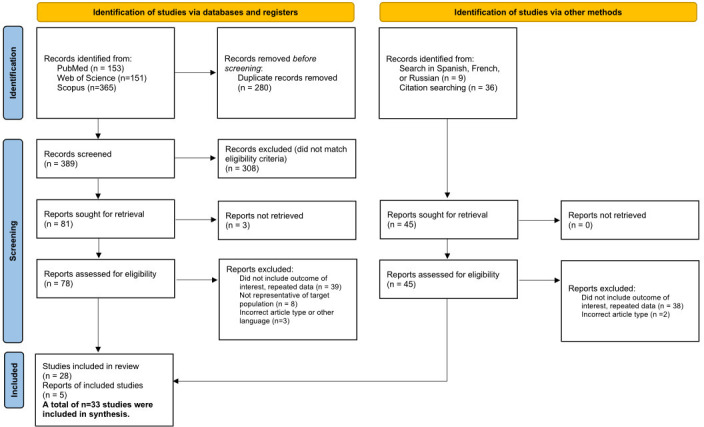
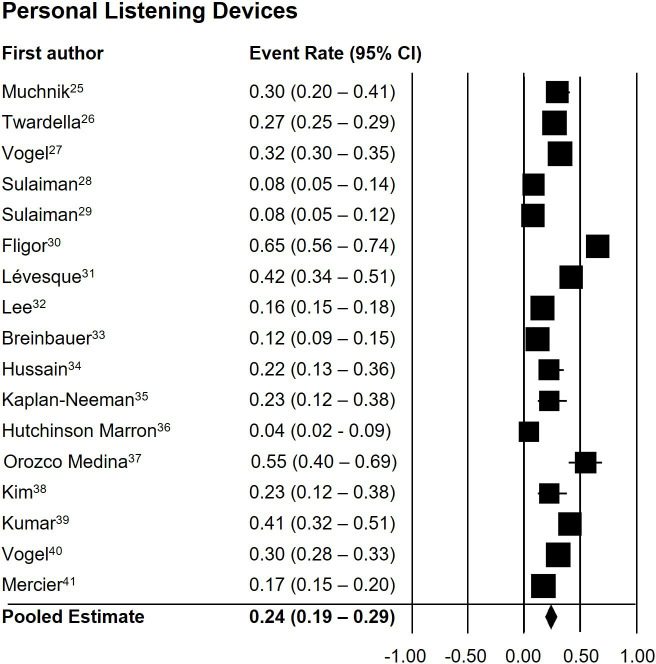
Introduction: This study aimed to determine the prevalence of unsafe listening practices from exposure to personal listening devices (PLDs) and loud entertainment venues in individuals aged 12–34 years, and to estimate the number of young people who could be at risk of hearing loss from unsafe listening worldwide. Methods: We conducted a systematic review and meta-analysis to estimate the prevalence of unsafe listening practices from PLDs and loud entertainment venues. We searched three databases for peer-reviewed articles published between 2000 and 2021 that reported unsafe listening practices in individuals aged 12–34 years. Pooled prevalence estimates (95% CI) of exposed populations were calculated using random effects models or ascertained from the systematic review. The number of young people who could be at risk of hearing loss worldwide was estimated from the estimated global population aged 12–34 years, and best estimates of exposure to unsafe listening ascertained from this review. Results: Thirty-three studies (corresponding to data from 35 records and 19 046 individuals) were included; 17 and 18 records focused on PLD use and loud entertainment venues, respectively. The pooled prevalence estimate of exposure to unsafe listening from PLDs was 23.81% (95% CI 18.99% to 29.42%). There was limited certainty (p>0.50) in our pooled prevalence estimate for loud entertainment venues. Thus, we fitted a model as a function of intensity thresholds and exposure duration to identify the prevalence estimate as 48.20%. The global estimated number of young people who could be at risk of hearing loss from exposure to unsafe listening practices ranged from 0.67 to 1.35 billion. Conclusions: Unsafe listening practices are highly prevalent worldwide and may place over 1 billion young people at risk of hearing loss. There is an urgent need to prioritise policy focused on safe listening. The World Health Organization provides comprehensive materials to aid in policy development and implementation.
Overview
The claims and statistics of this paper haven’t been checked yet.
Free: it reads the open-access text and checks the first 5 claims that cite a source we can check. Create a free account to check every claim.
Integrity signals
Registry
Cites
Statistics
Figures
Verification
Claims the paper makes
The claims and statistics of this paper haven’t been checked yet.
Free: it reads the open-access text and checks the first 5 claims that cite a source we can check. Create a free account to check every claim.
Claims other papers make about this one
Each is checked against this paper’s own text: does it say what the citing paper says it does?
The cited source doesn’t support the claim as written.
In the citing paper
“For example, acute changes in hearing often precede permanent damage, which can be cured when identified early.25”
From Next generation brain health: transforming global research and public health to promote prevention of dementia and reduce its risk in young adult populations (2024) · cites this paper as [25]
Checked by a reasoning model — may be wrong.
Experimental — accuracy not yet measuredIn the citing paper
“Up to one billion young adults (aged 18–34 years) globally are estimated to be at risk of permanent, avoidable hearing loss caused by exposure to loud noise and unsafe listening practices.25”
In the citing paper
“For example, acute changes in hearing often precede permanent damage, which can be cured when identified early.25”
Self-check
Percentages, sums and reported differences re-computed from the paper’s own numbers.
The self-check needs the paper’s full text.
Citations
Cites
The PRISMA 2020 Statement: An Updated Guideline for Reporting Systematic Reviews
Page, M. J., McKenzie, J. E., Bossuyt, P. M., Boutron, I., Hoffmann, T. C., Mulrow, C. D., Shamseer, L., Tetzlaff, J. M., Akl, E. A., Brennan, S. E., et al. (2021) · International Journal of Surgery · doi:10.1016/j.ijsu.2021.105906 · Cited by 11,748
Auditory and non-auditory effects of noise on health
Basner, M., Babisch, W., Davis, A., Brink, M., Clark, C., Janssen, S., & Stansfeld, S. (2014) · The Lancet · doi:10.1016/s0140-6736(13)61613-x · Cited by 2,473
Adding Insult to Injury: Cochlear Nerve Degeneration after “Temporary” Noise-Induced Hearing Loss
Kujawa, S. G., & Liberman, M. C. (2009) · The Journal of Neuroscience · doi:10.1523/jneurosci.2845-09.2009 · Cited by 2,456
Acceleration of Age-Related Hearing Loss by Early Noise Exposure: Evidence of a Misspent Youth
Kujawa, S. G., & Liberman, M. C. (2006) · The Journal of Neuroscience · doi:10.1523/jneurosci.4985-05.2006 · Cited by 697
The world report on hearing, 2021
Chadha, S., Kamenov, K., & Cieza, A. (2021) · Bulletin of the World Health Organization · doi:10.2471/blt.21.285643 · Cited by 563
Self-citationChange in Prevalence of Hearing Loss in US Adolescents
Shargorodsky, J. (2010) · JAMA · doi:10.1001/jama.2010.1124 · Cited by 494
Does noise affect learning? A short review on noise effects on cognitive performance in children
Klatte, M., Bergström, K., & Lachmann, T. (2013) · Frontiers in Psychology · doi:10.3389/fpsyg.2013.00578 · Cited by 446
Aging and Hearing Health: The Life-course Approach
Davis, A., McMahon, C. M., Pichora-Fuller, K. M., Russ, S., Lin, F., Olusanya, B. O., Chadha, S., & Tremblay, K. L. (2016) · The Gerontologist · doi:10.1093/geront/gnw033 · Cited by 402
Self-citationMechanisms of noise-induced hearing loss indicate multiple methods of prevention
Le Prell, C. G., Yamashita, D., Minami, S. B., Yamasoba, T., & Miller, J. M. (2007) · Hearing Research · doi:10.1016/j.heares.2006.10.006 · Cited by 369
Cellular mechanisms of noise-induced hearing loss
Kurabi, A., Keithley, E. M., Housley, G. D., Ryan, A. F., & Wong, A. C.-Y. (2017) · Hearing Research · doi:10.1016/j.heares.2016.11.013 · Cited by 360 · cited 1×
“63 66 These physiological changes likely result in progressive and incremental, yet permanent, changes to hearing thresholds and/or the onset of tinnitus.”
BackgroundEvaluation of Noise-Induced Hearing Loss in Young People Using a Web-Based Survey Technique
Chung, J. H., Des Roches, C. M., Meunier, J., & Eavey, R. D. (2005) · Pediatrics · doi:10.1542/peds.2004-0173 · Cited by 245
Longitudinal threshold changes in older men with audiometric notches
Gates, G. A., Schmid, P., Kujawa, S. G., Nam, B.-H., & D’Agostino, R. (2000) · Hearing Research · doi:10.1016/s0378-5955(99)00223-3 · Cited by 215
Understanding and preventing noise-induced hearing loss
Hong, O., Kerr, M. J., Poling, G. L., & Dhar, S. (2013) · Disease-a-Month · doi:10.1016/j.disamonth.2013.01.002 · Cited by 203
Śliwińska-Kowalska, M., & Zaborowski, K. (2017) · International Journal of Environmental Research and Public Health · doi:10.3390/ijerph14101139 · Cited by 203
Serra, M. R., Biassoni, E. C., Richter, U., Minoldo, G., Franco, G., Abraham, S., Carignani, J. A., Joekes, S., & Yacci, M. R. (2005) · International Journal of Audiology · doi:10.1080/14992020400030010 · Cited by 170
Self-reported tinnitus and noise sensitivity among adolescents in Sweden.
Widén, S., & Erlandsson, S. (2004) · PubMed · Cited by 152
The Impact of Tinnitus on Quality of Life in Older Adults
Nondahl, D. M., Cruickshanks, K. J., Dalton, D. S., Klein, B. E. K., Klein, R., Schubert, C. R., Tweed, T. S., & Wiley, T. L. (2007) · Journal of the American Academy of Audiology · doi:10.3766/jaaa.18.3.7 · Cited by 149
Grinn, S. K., Wiseman, K. B., Baker, J. A., & Prell, C. G. L. (2017) · Frontiers in Neuroscience · doi:10.3389/fnins.2017.00465 · Cited by 148
Wandering tales: evolutionary origins of mental time travel and language
Corballis, M. C. (2013) · Frontiers in Psychology · doi:10.3389/fpsyg.2013.00485 · Cited by 141
Hearing Threshold of Korean Adolescents Associated with the Use of Personal Music Players
Kim, M. G., Hong, S. M., Shim, H. J., Kim, Y. D., Il, C., & Yeo, S. G. (2009) · Yonsei Medical Journal · doi:10.3349/ymj.2009.50.6.771 · Cited by 131
Jiang, W., Zhao, F., Guderley, N., & Manchaiah, V. (2016) · International Journal of Audiology · doi:10.3109/14992027.2015.1122237 · Cited by 128
Tinnitus induced by occupational and leisure noise.
Axelsson, A., & Prasher, D. K. (2000) · PubMed · Cited by 115
Prell, C. G. L., Spankovich, C., Lobariñas, E., & Griffiths, S. K. (2013) · Journal of the American Academy of Audiology · doi:10.3766/jaaa.24.8.9 · Cited by 110
Prevalence of Leisure Noise-Induced Tinnitus and the Attitude Toward Noise in University Students
Gilles, A., De Ridder, D., Van Hal, G., Wouters, K., Kleine Punte, A., & Van de Heyning, P. (2012) · Otology & Neurotology · doi:10.1097/mao.0b013e31825d640a · Cited by 108
Loud Music and Leisure Noise Is a Common Cause of Chronic Hearing Loss, Tinnitus and Hyperacusis
Pienkowski, M. (2021) · International Journal of Environmental Research and Public Health · doi:10.3390/ijerph18084236 · Cited by 107
Hearing in young adults. Part II: The effects of recreational noise exposure
Keppler, H., Dhooge, I. J. M., & Vinck, B. (2015) · Noise and Health · doi:10.4103/1463-1741.165026 · Cited by 102
Slight-Mild Sensorineural Hearing Loss in Children: Audiometric, Clinical, and Risk Factor Profiles
Cone, B. K., Wake, M. A., Tobin, S., Poulakis, Z., & Rickards, F. (2010) · Ear and Hearing · doi:10.1097/aud.0b013e3181c62263 · Cited by 89 · cited 1×
“55 56 However, previous studies have reported inconclusive findings on associations between unsafe listening practices and permanent changes to hearing.”
BackgroundSulaiman, A. H., Seluakumaran, K., & Husain, R. (2013) · Public Health · doi:10.1016/j.puhe.2013.01.007 · Cited by 82
Young People’s Exposure to Loud Music
Vogel, I., Brug, J., van der Ploeg, C. P. B., & Raat, H. (2007) · American Journal of Preventive Medicine · doi:10.1016/j.amepre.2007.03.016 · Cited by 79
A Lancet Commission to address the global burden of hearing loss
Wilson, B. S., Tucci, D. L., O’Donoghue, G. M., MERSON, M. H., & Frankish, H. M. (2019) · The Lancet · doi:10.1016/s0140-6736(19)30484-2 · Cited by 79
Noise-induced hearing loss in children: A ‘less than silent’ environmental danger
Harrison, R. V. (2008) · Paediatrics & Child Health · doi:10.1093/pch/13.5.377 · Cited by 77
Estimating Adolescent Risk for Hearing Loss Based on Data From a Large School-Based Survey
Vogel, I., Verschuure, H., van der Ploeg, C. P. B., Brug, J., & Raat, H. (2010) · American Journal of Public Health · doi:10.2105/ajph.2009.168690 · Cited by 73
Is Electronically Amplified Music too Loud? What do Young People Think?
Mercier, V., & Hohmann, B. W. (2002) · PubMed · Cited by 62
Sulaiman, A. H., Husain, R., & Seluakumaran, K. (2015) · The Journal of International Advanced Otology · doi:10.5152/iao.2015.699 · Cited by 62
Noise exposure limit for children in recreational settings: Review of available evidence
Roberts, B., & Neitzel, R. L. (2019) · The Journal of the Acoustical Society of America · doi:10.1121/1.5132540 · Cited by 61
Muchnik, C., Amir, N., Shabtai, E., & Kaplan‐Neeman, R. (2011) · International Journal of Audiology · doi:10.3109/14992027.2011.631590 · Cited by 58
Prevalence and characteristics of tinnitus after leisure noise exposure in young adults
Degeest, S., Corthals, P., Vinck, B., & Keppler, H. (2014) · Noise and Health · doi:10.4103/1463-1741.127850 · Cited by 49
Johnson, O. R., Andrew, B., Walker, D., Morgan, S., & Aldren, A. (2014) · The Journal of Laryngology & Otology · doi:10.1017/s0022215113003241 · Cited by 48
Hearing and loud music exposure in 14-15 years old adolescents
Serra, M. R., Villalobo, J. A. P., Yacci, M. R., Abraham, M., Biassoni, E. C., Curet, C. A., Hinalaf, M., Joekes, S., Pavlik, M., & Righetti, A. (2014) · Noise and Health · doi:10.4103/1463-1741.140512 · Cited by 47
Vogel, I., van de Looij-Jansen, P. M., Mieloo, C. L., Burdorf, A., & de Waart, F. (2014) · PLoS ONE · doi:10.1371/journal.pone.0098912 · Cited by 46
Prell, C. G. L., Siburt, H. W., Lobariñas, E., Griffiths, S. K., & Spankovich, C. (2018) · Ear and Hearing · doi:10.1097/aud.0000000000000575 · Cited by 46
Twardella, D., Raab, U., Pérez-Àlvarez, C., Steffens, T., Bolte, G., & Fromme, H. (2016) · International Journal of Audiology · doi:10.1080/14992027.2016.1211762 · Cited by 40
Estimated leisure-time noise exposure and hearing symptoms in a finnish urban adult population.
Jokitulppo, J. S. (2003) · PubMed · Cited by 35
Fligor, B. J., Levey, S., & Levey, T. G. (2014) · Journal of Speech Language and Hearing Research · doi:10.1044/2014_jslhr-h-12-0420 · Cited by 34
Extended high frequency audiometry in users of personal listening devices
Kumar, P., Upadhyay, P., Kumar, A., Kumar, S., & Singh, G. B. (2016) · American Journal of Otolaryngology · doi:10.1016/j.amjoto.2016.12.002 · Cited by 33
Lee, G. J. C., Lim, M., Kuan, Y., Teo, H., Tan, H., & Low, W. (2014) · Singapore Medical Journal · doi:10.11622/smedj.2014018 · Cited by 31
Influence of leisure-time noise on outer hair cell activity in medical students
Rosanowski, F., Eysholdt, U., & Hoppe, U. (2006) · International Archives of Occupational and Environmental Health · doi:10.1007/s00420-006-0090-y · Cited by 31
Noise levels, noise annoyance, and hearing-related problems in a dental college
Ahmed, H. O., & Ali, W. J. (2016) · Archives of Environmental & Occupational Health · doi:10.1080/19338244.2016.1179169 · Cited by 30
Early Indication of Noise-Induced Hearing Loss in Young Adult Users of Personal Listening Devices
Hussain, T., Chou, C., Zettner, E. M., Torre, P., Hans, S., Gauer, J., Markgraf, M., & Nguyen, Q. T. (2018) · Annals of Otology Rhinology & Laryngology · doi:10.1177/0003489418790284 · Cited by 27
College students’ personal listening device usage and knowledge
Marron, K. H., Marchiondo, K. T., Stephenson, S., Wagner, S., Cramer, I. M., Wharton, T., Hughes, M., Sproat, B., & Alessio, H. M. (2014) · International Journal of Audiology · doi:10.3109/14992027.2014.986691 · Cited by 20
Kaplan‐Neeman, R., Muchnik, C., & Amir, N. (2017) · International Journal of Audiology · doi:10.1080/14992027.2017.1297541 · Cited by 19
Kim, J. (2018) · Central European Journal of Public Health · doi:10.21101/cejph.a4514 · Cited by 16
Weichbold, V. W., Holzer, A., Newesely, G., & Stephan, K. (2012) · International Journal of Audiology · doi:10.3109/14992027.2012.679747 · Cited by 14
Analysis of the Actual One-Month Usage of Portable Listening Devices in College Students
Kim, G., Shin, J., Song, C. G., & Han, W. (2021) · International Journal of Environmental Research and Public Health · doi:10.3390/ijerph18168550 · Cited by 10
University Marching Band Members’ Noise Dosages and Hearing Health-Related Knowledge
Washnik, N. J., Russell, J. A., Bhatt, I. S., Meier, R. S., Chuzie, O., Nadeau, N., Kirjava, S. A., & Goff, A. (2021) · International Journal of Environmental Research and Public Health · doi:10.3390/ijerph182111497 · Cited by 10 · cited 1×
“51 72 73 This notion is supported by pooled prevalence estimates of exposure to excessive noise from PLDs stratified by age group, which suggest that minors (vs adults) may be slightly more likely to be exposed to unsafe listening from PLDs.”
BackgroundSocial Noise Exposure in a Sample of Slovak University Students
Filová, A., Jurkovičová, J., Hirošová, K., Vondrová, D., Filová, B., Samohýl, M., Babjaková, J., Štofko, J., & Argalášová, Ľ. (2020) · International Journal of Environmental Research and Public Health · doi:10.3390/ijerph17010324 · Cited by 8
Hayo Breinbauer, K., José Luis Anabalón, B., Daniela Gutiérrez, C., & Jorge Caro, L. (2011) · Revista de otorrinolaringología y cirugía de cabeza y cuello · doi:10.4067/s0718-48162011000100005 · Cited by 3
Auditory risk behaviours and hearing problems among college students in Serbia.
Budimčić, M., Seke, K., Krsmanović, S., & Živić, L. (2014) · PubMed · Cited by 2
Relation between hearing loss and exposure to recreational noise
Hernández, E. D. D. F., & Sánchez, E. D. F. G. (2011) · Anales de Otorrinolaringología · Cited by 1
Research works printed but not linked: 2
- Lévesque B, Fiset R, Isabelle L. Le baladeur numérique: une technologie risque?. Bulletin d’information en Santé Environnementale, 2010.
- Kopke RD, Coleman JKM, Liu J. Mechanisms of noise-induced hearing loss and otoprotective strategies. In: Van De Water TR, Staecker H, eds. Otolaryngology: basic science and clinical review. New York: Thieme, 2006: 395– 408.
Cited by
Natarajan, N., Batts, S., & Stankovic, K. M. (2023) · Journal of Clinical Medicine · doi:10.3390/jcm12062347 · Cited by 254
“Clinical trials have been conducted to assess HBOT and corticosteroids as treatments for NIHL, primarily focusing on acute acoustic trauma (AAT) (Table 3).”
Farina, F. R., Bridgeman, K., Gregory, S., Crivelli, L., Foote, I. F., Jutila, O.-E. I., Kucikova, L., Mariano, L. I., Nguyen, K.-H., Thayanandan, T., et al. (2024) · The Lancet Healthy Longevity · doi:10.1016/j.lanhl.2024.100665 · Cited by 45
“25 Possible access points for interventions include primary care, sexual and reproductive health, mental health and substance abuse disorder, or wellness services.”
Nigg, J. T., Bruton, A. M., Kozlowski, M. B., Johnstone, J. M., & Karalunas, S. L. (2024) · Journal of the American Academy of Child & Adolescent Psychiatry · doi:10.1016/j.jaac.2023.12.014 · Cited by 41
Elmazoska, I., Mäki‐Torkko, E., Granberg, S., & Widén, S. (2024) · Journal of Speech Language and Hearing Research · doi:10.1044/2023_jslhr-23-00397 · Cited by 35
Young adult brain capital: a new opportunity for dementia prevention
Farina, F. R., Booi, L., Occhipinti, J.-A., Quoidbach, V., Destrebecq, F., Muniz-Terrera, G., & Eyre, H. A. (2023) · Journal of Alzheimer's Disease · doi:10.3233/jad-230260 · Cited by 17
Metadata
- Authors
- Dillard, L. K., Arunda, M. O., Lopez-Perez, L., Martinez, R. X., Jiménez, L., & Chadha, S.
- Affiliations
- Medical University of South Carolina (US)
- Lund University (SE)
- World Health Organization (CH)
- Octoma, Octoma, Mexico
- Corresponding author
- Dillard, Lauren K
- Venue
- BMJ Global Health
- Publisher
- BMJ
- Published
- 2022-11
- Volume
- 7
- Issue
- 11
- Pages
- e010501
- ISSN
- 2059-7908 (ISSN-L)
- PMC
- PMC9723884
- OpenAlex
- W4309191448
- Cited by
- 99
- References
- 60
- Citations by year
- 2026: 34 · 2025: 29 · 2024: 18 · 2023: 17 · 2022: 1
- FWCI
- 3.24
- Type
- journal article
- Language
- en
- Open access
- gold
- doi.org
- Licence
- Locations
- BMJ Global Health (publishedVersion, cc-by-nc)
- PubMed Central (publishedVersion, cc-by-nc)
- PubMed (publishedVersion)
- DOAJ (DOAJ: Directory of Open Access Journals) (submittedVersion, cc-by-sa)
- Lund University Publications (Lund University) (submittedVersion)
- Funders
- World Health Organization
- Topics
- Life Sciences › Neuroscience › Sensory Systems › Hearing, Cochlea, Tinnitus, Genetics
- Health Sciences › Health Professions › Speech and Hearing › Hearing Loss and Rehabilitation
- Physical Sciences › Physics and Astronomy › Acoustics and Ultrasonics › Noise Effects and Management
- Keywords
- personal listening devices, noise-induced hearing loss, adolescents, young adults, prevalence
- MeSH terms
- Adolescent, Humans, World Health Organization, Prevalence, Hearing Loss, Young Adult
About these checks
Registry, retraction, Cites and statistics results are computed, not judged, with one exception: a printed reference that no index lists is read once by a model before it counts as a citation error. Claims are extracted by a model and kept only when their quote appears verbatim in the text; each cited source is then checked, with a model’s help, for whether it says what the claim relies on. Those verdicts can be wrong — read the claim’s quote and the cited source before relying on one.
Statistics and arithmetic are recomputed, not judged.
Confidence bands are shown only for fields calibrated on our annotated test set. None is calibrated yet, so no band is shown.
What counts as a claim ›How we measure confidence ›How we check this ›
Are you an author, or do you see a problem with this page? Request a review
Data sources
Bibliographic data: Semantic Scholar, OpenAlex, Crossref.
Contains information from the Semantic Scholar Academic Graph Datasets, made available under the ODC Attribution License (ODC-BY 1.0).
Semantic Scholar’s data is described in: Kinney, R., et al. (2023). The Semantic Scholar Open Data Platform. arXiv:2301.10140.
