

Faster, higher, stronger – together? A bibliometric analysis of author distribution in top medical education journals
Open accessThe DOI matches its Crossref record; 85 of the 85 references it cites were found in a registry or an index.
Abstract
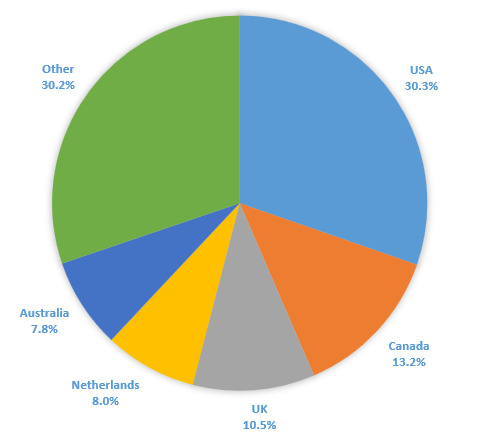
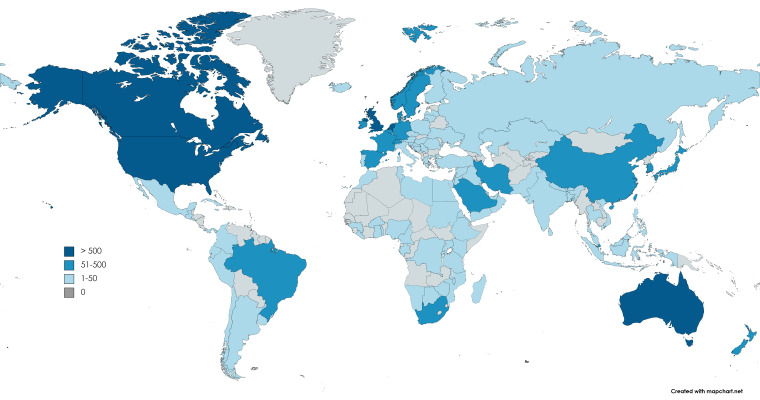
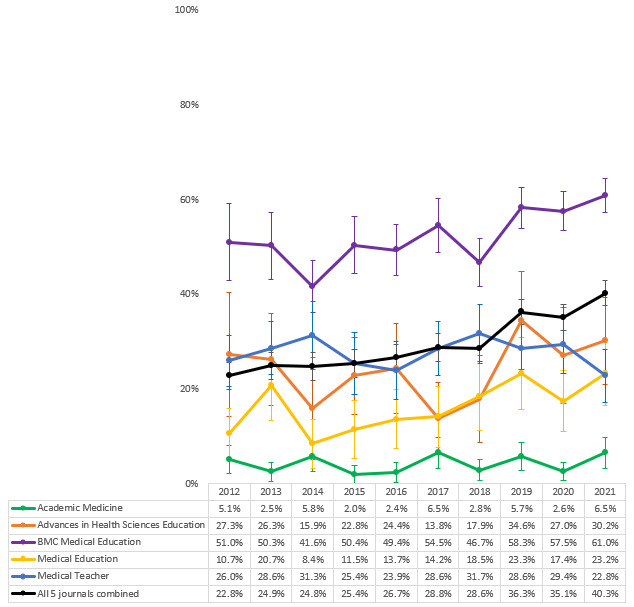
Introduction: Medical education and medical education research are growing industries that have become increasingly globalised. Recognition of the colonial foundations of medical education has led to a growing focus on issues of equity, absence and marginalisation. One area of absence that has been underexplored is that of published voices from low-income and middle-income countries. We undertook a bibliometric analysis of five top medical education journals to determine which countries were absent and which countries were represented in prestigious first and last authorship positions. Methods: Web of Science was searched for all articles and reviews published between 2012 and 2021 within Academic Medicine , Medical Education , Advances in Health Sciences Education , Medical Teacher , and BMC Medical Education . Country of origin was identified for first and last author of each publication, and the number of publications originating from each country was counted. Results: Our analysis revealed a dominance of first and last authors from five countries: USA, Canada, UK, Netherlands and Australia. Authors from these five countries had first or last authored 70% of publications. Of the 195 countries in the world, 43% (approximately 83) were not represented by a single publication. There was an increase in the percentage of publications from outside of these five countries from 23% in 2012 to 40% in 2021. Conclusion: The dominance of wealthy nations within spaces that claim to be international is a finding that requires attention. We draw on analogies from modern Olympic sport and our own collaborative research process to show how academic publishing continues to be a colonised space that advantages those from wealthy and English-speaking countries.
Overview
The claims and statistics of this paper haven’t been checked yet.
Free: it reads the open-access text and checks the first 5 claims that cite a source we can check. Create a free account to check every claim.
Integrity signals
Registry
Cites
Statistics
Figures
Verification
Claims the paper makes
The claims and statistics of this paper haven’t been checked yet.
Free: it reads the open-access text and checks the first 5 claims that cite a source we can check. Create a free account to check every claim.
Claims other papers make about this one
Each is checked against this paper’s own text: does it say what the citing paper says it does?
The source backs part of the claim, not all of it — or backs it for a different population, condition or comparison.
In the citing paper
“biomedical research is more typically concentrated across multiple leading countries rather than two alone32–35”
From A quantitative analysis of global AI medical studies: gaps in randomized controlled trials (2026) · cites this paper as [33]
Experimental — accuracy not yet measured
Self-check
Percentages, sums and reported differences re-computed from the paper’s own numbers.
The self-check needs the paper’s full text.
Citations
Cites
Frenk, J., Chen, L., Bhutta, Z. A., Cohen, J., Crisp, N., Evans, T., Fineberg, H., Garcia, P., Ke, Y., Kelley, P., et al. (2010) · The Lancet · doi:10.1016/s0140-6736(10)61854-5 · Cited by 5,960
Bourdieu, P. (1978) · Social Science Information · doi:10.1177/053901847801700603 · Cited by 902
Medical Education in the United States and Canada
Flexner, A. (1910) · Science · doi:10.1126/science.32.810.41 · Cited by 824
Impact factor: a valid measure of journal quality?
(2003) · Europe PMC (PubMed Central) · Cited by 584
Application of bibliometrics in medicine: a historical bibliometrics analysis
Kokol, P., Blažun Vošner, H., & Završnik, J. (2021) · Health Information & Libraries Journal · doi:10.1111/hir.12295 · Cited by 486
Lost Science in the Third World
Gibbs, W. W. (1995) · Scientific American · doi:10.1038/scientificamerican0895-92 · Cited by 471
The foreign gaze: authorship in academic global health
Abimbola, S. (2019) · BMJ Global Health · doi:10.1136/bmjgh-2019-002068 · Cited by 438
Hedt-Gauthier, B. L., Jeufack, H. M., Neufeld, N. H., Alem, A., Sauer, S., Odhiambo, J., Boum, Y., Shuchman, M., & Volmink, J. (2019) · BMJ Global Health · doi:10.1136/bmjgh-2019-001853 · Cited by 291
Epidemiologic Methods: Studying the Occurrence of Illness
Koepsell, T. D., & Weiss, N. S. (2014) · Cited by 258
Morton, B., Vercueil, A., Masekela, R., Heinz, E., Reimer, L., Saleh, S., Kalinga, C., Seekles, M., Biccard, B., Chakaya, J., et al. (2022) · Anaesthesia · doi:10.1111/anae.15597 · Cited by 212
Thinking the post‐colonial in medical education
Bleakley, A., Brice, J., & Bligh, J. (2008) · Medical Education · doi:10.1111/j.1365-2923.2007.02991.x · Cited by 209
Kapata, N., Ihekweazu, C., Ntoumi, F., Raji, T., Chanda-Kapata, P., Mwaba, P., Mukonka, V., Bates, M., Tembo, J., Corman, V., et al. (2020) · International Journal of Infectious Diseases · doi:10.1016/j.ijid.2020.02.049 · Cited by 195 · cited 1×
“Many LMIC countries spectacularly outshone HIC countries in effectively managing successive waves of the COVID pandemic [62, 63] with far fewer resources.”
BackgroundClosing the door on parachutes and parasites
Health, T. L. G. (2018) · The Lancet Global Health · doi:10.1016/s2214-109x(18)30239-0 · Cited by 188
Best Evidence Medical Education
Harden, R. M., Grant, J., Buckley, G., & Hart, I. R. (2000) · Advances in Health Sciences Education · doi:10.1023/a:1009896431203 · Cited by 186
Higher Education and the Modern/Colonial Global Imaginary
Stein, S. E., & Andreotti, V. (2016) · Culture Studies ↔ Critical Methodologies · doi:10.1177/1532708616672673 · Cited by 170
Paton, M., Naidu, T., Wyatt, T. R., Oni, O., Lorello, G. R., Najeeb, U., Feilchenfeld, Z., Waterman, S. J., Whitehead, C. R., & Kuper, A. (2020) · Advances in Health Sciences Education · doi:10.1007/s10459-020-10006-x · Cited by 166
Self-citationMedical graduate views on statistical learning needs for clinical practice: a comprehensive survey
MacDougall, M., Cameron, H. S., & Maxwell, S. R. J. (2020) · BMC Medical Education · doi:10.1186/s12909-019-1842-1 · Cited by 153
Mbaye, R., Gebeyehu, R., Hossmann, S., Mbarga, N., Bih-Neh, E., Eteki, L., Thelma, O.-A., Oyerinde, A., Kiti, G., Mburu, Y., et al. (2019) · BMJ Global Health · doi:10.1136/bmjgh-2019-001855 · Cited by 152
Castillo, E. G., Isom, J., DeBonis, K., Jordan, A., Braslow, J. T., & Rohrbaugh, R. M. (2020) · Academic Medicine · doi:10.1097/acm.0000000000003559 · Cited by 119
Bringing Pierre Bourdieu to Science and Technology Studies
Albert, M., & Kleinman, D. L. (2011) · Minerva · doi:10.1007/s11024-011-9174-2 · Cited by 118 · cited 3×
“Bourdieu also emphasized social spheres as spaces of conflict and struggle, including the field of science [51].”
BackgroundInfluentialLarkins, S., Michielsen, K., Iputo, J. E., Elsanousi, S., Mammen, M., Graves, L. E., Willems, S. J. T., Cristobal, F. L., Samson, R., Ellaway, R., et al. (2014) · Medical Education · doi:10.1111/medu.12518 · Cited by 113
Overview of the world's medical schools: an update
Duvivier, R. J., Boulet, J. R., Opalek, A., van Zanten, M., & Norcini, J. J. (2014) · Medical Education · doi:10.1111/medu.12499 · Cited by 105
Says who? Northern ventriloquism, or epistemic disobedience in global health scholarship
Naidu, T. (2021) · The Lancet Global Health · doi:10.1016/s2214-109x(21)00198-4 · Cited by 105
Southern exposure: levelling the Northern tilt in global medical and medical humanities education
Naidu, T. (2020) · Advances in Health Sciences Education · doi:10.1007/s10459-020-09976-9 · Cited by 82
Stockemer, D., & Wigginton, M. J. (2019) · Scientometrics · doi:10.1007/s11192-018-2987-0 · Cited by 80
Modern Medicine Is a Colonial Artifact: Introducing Decoloniality to Medical Education Research
Naidu, T. (2021) · Academic Medicine · doi:10.1097/acm.0000000000004339 · Cited by 79
The Origins of the Field of Medical Education Research
Kuper, A., Albert, M., & Hodges, B. D. (2010) · Academic Medicine · doi:10.1097/acm.0b013e3181dce9a7 · Cited by 74 · cited 1×
“MER first emerged as an academic field in the 1950s in North America at a time when there was an explosion of scientific medical knowledge, an influx of financial incentives to support research, and a mandate to demonstrate greater public accountability [2].”
BackgroundFostering Bibliodiversity in Scholarly Communications: A Call for Action
Shearer, K., Chan, L. K. W., Kuchma, I., & Mounier, P. (2020) · Lincoln (University of Nebraska) · doi:10.5281/zenodo.3752922 · Cited by 74
Bibliodiversity at the Centre: Decolonizing Open Access
Berger, M. (2021) · Development and Change · doi:10.1111/dech.12634 · Cited by 72 · cited 1×
“The concept of bibliodiversity (or diversity in scholarly publishing) [55, 56] has been adopted by Global South authors as a way of supporting the decolonization of Southern knowledge, [57] and multilingual publishing may be one way that bibliodiversity can be achieved [58].”
BackgroundSystematic analysis of authorship demographics in global surgery
Ravi, K., Bentounsi, Z., Tariq, A., Brazeal, A., Daudu, D., Back, F., Elhadi, M. K., Badwi, N. M., Shah, S. S. N. H., Bandyopadhyay, S., et al. (2021) · BMJ Global Health · doi:10.1136/bmjgh-2021-006672 · Cited by 72
Velásquez, E. R., & Hernández, R. D. (2016) · Cited by 69
Fostering Bibliodiversity in Scholarly Communications: A Call for Action
Shearer, K., Chan, L. K. W., Kuchma, I., et al. (2020) · Lincoln (University of Nebraska) · doi:10.5281/zenodo.3752923 · Cited by 66 · cited 1×
“The concept of bibliodiversity (or diversity in scholarly publishing) [55, 56] has been adopted by Global South authors as a way of supporting the decolonization of Southern knowledge, [57] and multilingual publishing may be one way that bibliodiversity can be achieved [58].”
BackgroundAn analysis of the global pharmacy workforce capacity trends from 2006 to 2012
Bates, I. P., John, C., Seegobin, P., & Bruno, A. (2018) · Human Resources for Health · doi:10.1186/s12960-018-0267-y · Cited by 64
Delineating the field of medical education: Bibliometric research approach(es)
Maggio, L. A., Ninkov, A., Frank, J. R., Costello, J. A., & Artino, A. R. (2021) · Medical Education · doi:10.1111/medu.14677 · Cited by 60 · cited 1×
“[35] outlined both the power and the complexities of conducting bibliometric analyses.”
BackgroundSampling Issues in Bibliometric Analysis
Williams, R., & Bornmann, L. (2016) · Journal of Informetrics · doi:10.1016/j.joi.2015.11.004 · Cited by 58
Global health education in high-income countries: confronting coloniality and power asymmetry
Sayegh, H. E., Harden, C., Khan, H., Pai, M., Eichbaum, Q. G., Ibingira, C., & Goba, G. K. (2022) · BMJ Global Health · doi:10.1136/bmjgh-2022-008501 · Cited by 55
The World Health Organization and the global standardization of medical training, a history
Weisz, G., & Nannestad, B. (2021) · Globalization and Health · doi:10.1186/s12992-021-00733-0 · Cited by 53
Using scientific authorship criteria as a tool for equitable inclusion in global health research
Sam-Agudu, N. A., & Abímbọ́lá, Ṣ. (2021) · BMJ Global Health · doi:10.1136/bmjgh-2021-007632 · Cited by 52 · cited 1×
“While well-established guidelines for defining what constitutes authorship exist and are endorsed by many medical journal editors [24, 38, 39], guidelines for how authorship position should be distributed across authors are underdeveloped.”
BackgroundGender bias in hospital leadership: a qualitative study on the experiences of women CEOs
Soklaridis, S., Kuper, A., Whitehead, C. R., Ferguson, G., Taylor, V. H., & Zahn, C. A. (2017) · Journal of Health Organization and Management · doi:10.1108/jhom-12-2016-0243 · Cited by 51
Self-citationDecolonising global health by decolonising academic publishing
Khan, S. A. (2022) · BMJ Global Health · doi:10.1136/bmjgh-2021-007811 · Cited by 50
The leaky pipeline of publications and knowledge generation in medical education
Kusurkar, R. A. (2022) · Perspectives on Medical Education · doi:10.1007/s40037-022-00700-4 · Cited by 48
Uijtdehaage, S., Mavis, B., & Durning, S. J. (2018) · Academic Medicine · doi:10.1097/acm.0000000000002144 · Cited by 46 · cited 1×
“While well-established guidelines for defining what constitutes authorship exist and are endorsed by many medical journal editors [24, 38, 39], guidelines for how authorship position should be distributed across authors are underdeveloped.”
BackgroundFactors Predicting the Scientific Wealth of Nations
Allïk, J., Lauk, K., & Realo, A. (2020) · Cross-Cultural Research · doi:10.1177/1069397120910982 · Cited by 43
Editorial diversity in medical education journals
Yip, S. W. L., & Rashid, A. (2021) · The Clinical Teacher · doi:10.1111/tct.13386 · Cited by 43
Country Comparisons of Human Stroke Research Since 2001: A Bibliometric Study
Asplund, K., Eriksson, M., & Persson, O. (2012) · Stroke · doi:10.1161/strokeaha.111.637249 · Cited by 42
The geographic and topical landscape of medical education research
Thomas, M. P. (2019) · BMC Medical Education · doi:10.1186/s12909-019-1639-2 · Cited by 41 · cited 7×
“While our research was not designed to identify how this dominance compared with other fields, Thomas57 previously found that there were greater geographic disparities within medical education research than within education, medicine and the biological sciences.”
BackgroundMethodInfluentialPaton, M., Kuper, A., Paradis, E., Feilchenfeld, Z., & Whitehead, C. R. (2020) · Advances in Health Sciences Education · doi:10.1007/s10459-020-09966-x · Cited by 40 · cited 2×
“Identifying absences in medical education research has been established as an effective way to consider what is included or excluded, and to determine who is heard or silenced [27].”
BackgroundSelf-citationPerspective: Private Schools of the Caribbean: Outsourcing Medical Education
Eckhert, N. L. (2010) · Academic Medicine · doi:10.1097/acm.0b013e3181d2aee1 · Cited by 38
Authorship equity guidelines in global health journals
Rees, C. A., Sirna, S. J., Manji, H. K., Kisenge, R. R., & Manji, K. P. (2022) · BMJ Global Health · doi:10.1136/bmjgh-2022-010421 · Cited by 37
Opportunities and challenges in the current era of global medical education
Rizwan, M., Rosson, N. J., Tackett, S. A., & Hassoun, H. T. (2018) · International Journal of Medical Education · doi:10.5116/ijme.5ad1.ce9a · Cited by 36
Lorello, G. R., Silver, J. K., Moineau, G., McCarthy, K., & Flexman, A. M. (2020) · JAMA Network Open · doi:10.1001/jamanetworkopen.2020.27938 · Cited by 36
Mulder, L., Wouters, A., Twisk, J. W. R., Koster, A. S., Akwiwu, E. U., Ravesloot, J. H., Croiset, G., & Kusurkar, R. A. (2022) · Medical Teacher · doi:10.1080/0142159x.2022.2041189 · Cited by 36
How medical education holds back health equity
Naidu, T., & Abímbọ́lá, Ṣ. (2022) · The Lancet · doi:10.1016/s0140-6736(22)01423-4 · Cited by 36
Sukhera, J. I., Goez, H., Brown, A. D., Haddara, W. M. R., & Razack, S. (2022) · Advances in Health Sciences Education · doi:10.1007/s10459-022-10090-1 · Cited by 33
Professional identity formation, intersectionality and equity in medical education
Crampton, P. E. S., & Afzali, Y. (2020) · Medical Education · doi:10.1111/medu.14415 · Cited by 31
Mu, E., & Pereyra-Rojas, M. (2015) · Latin American Research Review · doi:10.1353/lar.2015.0021 · Cited by 29 · cited 1×
“A related issue explored by others [53, 54] is how researchers from non-English speaking countries make choices about when to publish in “international” English-language journals vs reaching audiences in their own country and language.”
BackgroundFurther Incorporating Diversity, Equity, and Inclusion Into Medical Education Research
Fernández, A. (2019) · Academic Medicine · doi:10.1097/acm.0000000000002916 · Cited by 29
Bhandal, T. (2018) · Canadian Medical Education Journal · doi:10.36834/cmej.36914 · Cited by 29
Buffone, B., Djuana, I., Yang, K., Wilby, K. J., Hajj, M. S. E., & Wilbur, K. (2020) · BMJ Open · doi:10.1136/bmjopen-2020-043970 · Cited by 29 · cited 1×
“[25] similarly conducted a bibliometric analysis of publications within MER, categorizing lead author affiliations by UN region [37] and found that the majority were from North America, Northern Europe, Western Europe, or Australia.”
BackgroundMedicine, Race and Liberalism in British Bengal
Pande, I. (2009) · Routledge eBooks · doi:10.4324/9780203092194 · Cited by 29 · cited 1×
“Framing medical education in this way largely ignores traditional and Indigenous healing practices developed in many different global contexts over millennia [7].”
BackgroundMulder, L., Wouters, A., Twisk, J. W. R., et al. (2022) · Figshare · doi:10.6084/m9.figshare.19297590.v1 · Cited by 26
Mulder, L., Wouters, A., Twisk, J. W. R., Koster, A. S., Akwiwu, E. U., Ravesloot, J. H., Croiset, G., & Kusurkar, R. A. (2022) · Figshare · doi:10.6084/m9.figshare.19297590 · Cited by 26
Paradoxes and contestations of Olympism in the history of the modern Olympic Movement
Chatziefstathiou, D. (2011) · Sport in Society · doi:10.1080/17430437.2011.557269 · Cited by 23 · cited 1×
“20 Rather than being a recent phenomenon, modern Olympic history, especially after World War I, has been described as paradoxically espousing universal ideals and providing an opportunity for the colonized to participate and win against the colonizers, while simultaneously reinforcing exclusionary, elitist, and racist…”
BackgroundMaggio, L. A., Ninkov, A., Costello, J. A., Driessen, E. W., & Artino, A. R. (2021) · PLoS ONE · doi:10.1371/journal.pone.0258925 · Cited by 22 · cited 1×
“[36] specifically examined authorship of knowledge syntheses by country, with authors from highly ranked North American institutions being dominant.”
BackgroundLee, C. R., Gilliland, K. O., Dallaghan, G. L. B., & Rinehart, S. T. (2022) · BMC Medical Education · doi:10.1186/s12909-022-03665-4 · Cited by 20
Giuliani, M., Frambach, J., Broadhurst, M., Papadakos, J., Fazelzad, R., Driessen, E. W., & Martimianakis, M. A. (2020) · BMC Medical Education · doi:10.1186/s12909-020-1989-9 · Cited by 20
Franks, A. M., Calamur, N., Dobrian, A. D., Danielsen, M., Neumann, S. A., Cowan, E. A., & Weiler, T. (2022) · Academic Medicine · doi:10.1097/acm.0000000000004706 · Cited by 20
Martimianakis, M. A., Mylopoulos, M., & Woods, N. N. (2020) · Advances in Health Sciences Education · doi:10.1007/s10459-020-10014-x · Cited by 19 · cited 1×
“[52] drew attention to the need to consider the inevitable knowledge politics that inform discussions about research quality and rigour within MER.”
Background“The sins of our forefathers”: reimagining research in health professions education
Wyatt, T. R. (2022) · Advances in Health Sciences Education · doi:10.1007/s10459-022-10111-z · Cited by 19
Multilingualism within Scholarly Communication in SSH. A literature review
Balula, A., & Leão, D. F. (2021) · E-LIS Repository (University of Naples Federico II) · doi:10.4403/jlis.it-12672 · Cited by 15 · cited 4×
“The concept of bibliodiversity (or diversity in scholarly publishing) [55, 56] has been adopted by Global South authors as a way of supporting the decolonization of Southern knowledge, [57] and multilingual publishing may be one way that bibliodiversity can be achieved [58].”
BackgroundInfluentialBalon, R., Roberts, L. W., Coverdale, J., Louie, A. K., & Beresin, E. V. (2008) · Academic Psychiatry · doi:10.1176/appi.ap.32.2.151 · Cited by 14
Passing the microphone: broadening perspectives by amplifying underrepresented voices
Wondimagegn, D., Soklaridis, S., Yifter, H., Cartmill, C., Yeshak, M. Y., & Whitehead, C. R. (2020) · Advances in Health Sciences Education · doi:10.1007/s10459-020-10012-z · Cited by 14
Self-citationMoving Beyond Implicit Bias in Antiracist Academic Medicine Initiatives
Calhoun, A., Genao, I., Martin, A., & Windish, D. (2021) · Academic Medicine · doi:10.1097/acm.0000000000004562 · Cited by 14
Wondimagegn, D., Whitehead, C. R., Cartmill, C., et al. (2022) · medRxiv · doi:10.1101/2022.03.29.22273128 · Cited by 14
Self-citationPreparing for selection success: Socio‐demographic differences in opportunities and obstacles
Jackson, D., Ward, D. J., Agwu, J. C., & Spruce, A. E. (2022) · Medical Education · doi:10.1111/medu.14811 · Cited by 14
Charitas, P. (2015) · The International Journal of the History of Sport · doi:10.1080/09523367.2015.1027153 · Cited by 11 · cited 1×
“Sports with long colonial histories, such as football and athletics [48] continue to be included, as do sports with more recent histories that rely on extensive and expensive sporting infrastructure, such as velodrome cycling, bobsledding, and sailboat racing.”
BackgroundWhere we’ve come from, where we might go
Norman, G. R. (2020) · Advances in Health Sciences Education · doi:10.1007/s10459-020-10018-7 · Cited by 10 · cited 1×
“Geoff Norman [1] recently tracked the significant expansion in the field of MER over the past half-century in terms of numbers of publications, international conference attendance, and increasing diversity of professions, perspectives, disciplines, and theoretical approaches being recognized as advancing new knowledge.”
BackgroundIs medical education systemically racist?
Slavin, S. J. (2022) · Journal of the National Medical Association · doi:10.1016/j.jnma.2022.06.002 · Cited by 9
Norman, G. R., & Ellaway, R. (2020) · Advances in Health Sciences Education · doi:10.1007/s10459-020-09961-2 · Cited by 8
Academic Productivity of Equity-Deserving Physician Scholars During COVID-19: A Scoping Review
Soklaridis, S., Black, G., LeBlanc, C. H., MacKinnon, K. R., Holroyd-Leduc, J. M., Clement, F. M., Schrewe, B., Ross, H. J., Calleja, S., Stergiopoulos, V., et al. (2022) · Academic Medicine · doi:10.1097/acm.0000000000004971 · Cited by 7
Bridging health equity and quality improvement in medical education
Sukhera, J. (2022) · Medical Education · doi:10.1111/medu.14957 · Cited by 6
How can medical educators be good ancestors?
McKivett, A., & Paul, D. (2022) · Medical Education · doi:10.1111/medu.14886 · Cited by 5
Latin America and the Olympic Ideal of Progress: An Athlete's Perspective
Houghton, F. (2005) · The International Journal of the History of Sport · doi:10.1080/09523360500035719 · Cited by 4
Reaching out for scientific legacy: how to define authorship in academic publishing
Thatje, S. (2016) · Die Naturwissenschaften · doi:10.1007/s00114-016-1335-6 · Cited by 3 · cited 1×
“Thatje [40] provided rules of thumb for determining first and last authorship positions within the natural sciences, noting that disciplinary and national culture may play a role in how decisions are made.”
BackgroundCOVID-19 in Ethiopia: A contextual approach to explaining its slow growth
Wondimagegn, D., Petros, A., Asrat, Y., Aklilu, T., Estifanos, A. S., Addissie, A., Amogne, W., Gebremariam, T. H., Cartmill, C., Whitehead, C. R., et al. (2020) · Journal of Global Health · doi:10.7189/jogh.10.020369 · Cited by 3 · cited 1×
“Many LMIC countries spectacularly outshone HIC countries in effectively managing successive waves of the COVID pandemic [62, 63] with far fewer resources.”
BackgroundSelf-citation
Research works printed but not linked: 7
- 3. Nichols BL, Davis CR, Richardson DR, et al. Appendix J: International models of nursing. In: the future of nursing: leading change, advancing health [Internet]. Washington, DC, USA: National Academies Press; 2011. Available: https://www.ncbi.nlm.nih.gov/books/NBK209879/ [Accessed 24 Dec 2022].
- 18. Flexner A. Medical education in Europe: A report to the Carnegie foundation for the advancement of teaching. Boston, MA: DB Updike, The Merrymount Press, 1912.
- 19. Ludmerer KM. Time to heal: American medical education from the turn of the century to the era of managed care. Oxford, New York: Oxford University Press, 1999.
- 10.1097.ACM.0000000000004339
- 71. Costa MJ, Van Schalkwyk S, Ho M-J, et al. Equity in the global health sciences education community: levelling the playing fields. Association for Medical Education in Europe Annual Conference; Basel, Switzerland, August 2018.
- 77. International Committee of Medical Journal Editors (ICMJE). Defining the role of authors and contributors. 2022. Available: http://www.icmje.org/recommendations/browse/roles-and-responsibilities/defining-the-role-of-authors-and-contributors.html [Accessed 27 Sep 2022].
- 87. Englander K. The Globalized world of English scientific publishing: an Analytical proposal that Situates a Multilingual scholar. In: López-Bonilla G, Englander K, eds. Discourses and Identities in Contexts of Educational Change: Contributions from the United States and Mexico 387. Bern, Switzerland: Peter Lang AG, 2011: 209–28. Available: https://www.jstor.org/stable/42980952
Cited by
The voices of medical education scholarship: Describing the published landscape
Maggio, L. A., Costello, J. A., Ninkov, A., Frank, J. R., & Artino, A. R. (2022) · Medical Education · doi:10.1111/medu.14959 · Cited by 76
Shapeshifters: Global South scholars and their tensions in border-crossing to Global North journals
Naidu, T., Cartmill, C., Swanepoel, S., & Whitehead, C. R. (2024) · BMJ Global Health · doi:10.1136/bmjgh-2023-014420 · Cited by 44
Self-citationTransforming global health professions education for sustainability
Naidu, T., & Ramani, S. (2023) · Medical Education · doi:10.1111/medu.15149 · Cited by 39
“…showing how scholar-ship and knowledge generation in HPE are dominated by the GN voices with considerably less representation from the GS. 34,35 This trend needs to be acknowledged and addressed as narratives about social justice and sustainability increasingly emphasise inclusive…”
BackgroundAdopting a pedagogy of connection for medical education
Filho, C., & Hafferty, F. W. (2024) · Medical Education · doi:10.1111/medu.15486 · Cited by 29
Cintra, K. A., Borges, M. D. C., Panúncio-Pinto, M. P., Troncon, L. E. D. A., & Bóllela, V. R. (2023) · BMC Medical Education · doi:10.1186/s12909-023-04754-8 · Cited by 27
“…in Brazil, comprised mostly of private institutions, and the unofficial reports that the work overload in these new schools may be greater than in the more traditional institutions may increase in a national basis the challenge for Faculty members to dedicate time and attention to FD programs [8].”
Background
Metadata
- Authors
- Wondimagegn, D., Whitehead, C. R., Cartmill, C., Rodrigues, E., Correia, A., Salessi Lins, T., & Costa, M. J.
- Affiliations
- Addis Ababa University (ET)
- University Health Network (CA)
- University of Minho (PT)
- Corresponding author
- Costa, Manuel João
- ORCID
- Venue
- BMJ Global Health
- Publisher
- BMJ
- Published
- 2023-06
- Volume
- 8
- Issue
- 6
- Pages
- e011656
- ISSN
- 2059-7908 (ISSN-L)
- PMC
- PMC10367082
- OpenAlex
- W4380785993
- Cited by
- 66
- References
- 83
- Citations by year
- 2026: 19 · 2025: 16 · 2024: 19 · 2023: 10
- FWCI
- 11.85
- Type
- journal article
- Language
- en
- Open access
- gold
- doi.org
- Licence
- Locations
- BMJ Global Health (publishedVersion, cc-by-nc)
- medRxiv (acceptedVersion, other-oa)
- PubMed Central (publishedVersion, cc-by-nc)
- PubMed (publishedVersion)
- Portuguese National Funding Agency for Science, Research and Technology (RCAAP Project by FCT) (submittedVersion, other-oa)
- Portuguese National Funding Agency for Science, Research and Technology (RCAAP Project by FCT) (submittedVersion, cc-by-nc-nd)
- DOAJ (DOAJ: Directory of Open Access Journals) (submittedVersion, cc-by-sa)
- Funders
- BMO Financial Group Chair in Health Professions Education Research, University Health Network
- Topics
- Social Sciences › Library and Information Sciences › scientometrics and bibliometrics research
- Health Sciences › Medicine › Public Health, Environmental and Occupational Health › Global Health and Surgery
- Social Sciences › Gender Studies › Diversity and Career in Medicine
- Keywords
- authorship, country of origin, medical education research, research equity, low- and middle-income countries, colonialism in academia, internationalization of research, global health research
- MeSH terms
- Authorship, Education, Medical, Humans, Periodicals as Topic, Bibliometrics, Biomedical Research
About these checks
Registry, retraction, Cites and statistics results are computed, not judged, with one exception: a printed reference that no index lists is read once by a model before it counts as a citation error. Claims are extracted by a model and kept only when their quote appears verbatim in the text; each cited source is then checked, with a model’s help, for whether it says what the claim relies on. Those verdicts can be wrong — read the claim’s quote and the cited source before relying on one.
Statistics and arithmetic are recomputed, not judged.
Confidence bands are shown only for fields calibrated on our annotated test set. None is calibrated yet, so no band is shown.
What counts as a claim ›How we measure confidence ›How we check this ›
Are you an author, or do you see a problem with this page? Request a review
Data sources
Bibliographic data: Semantic Scholar, OpenAlex, Crossref.
Contains information from the Semantic Scholar Academic Graph Datasets, made available under the ODC Attribution License (ODC-BY 1.0).
Semantic Scholar’s data is described in: Kinney, R., et al. (2023). The Semantic Scholar Open Data Platform. arXiv:2301.10140.
