

Therapist-guided, Internet-based cognitive–behavioural therapy for body dysmorphic disorder (BDD-NET): a feasibility study
Open accessThe DOI matches its Crossref record; 74 of the 76 references it cites were found in a registry or an index.
Abstract
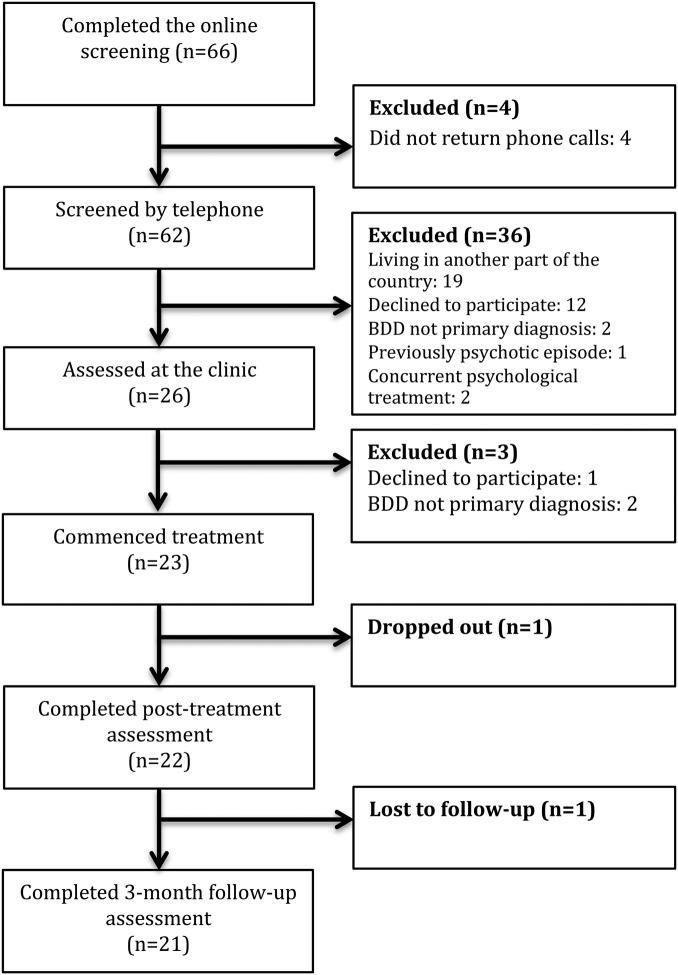
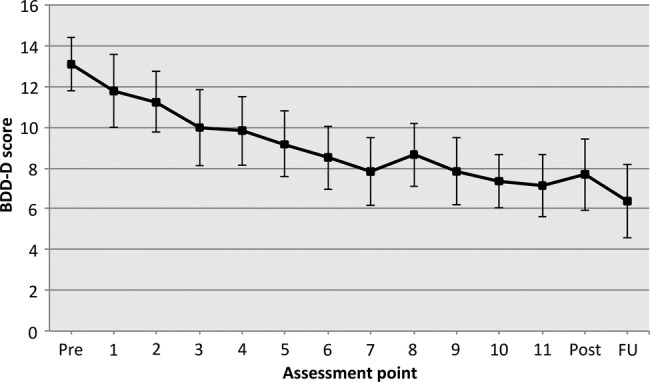
Objectives: Cognitive–behavioural therapy (CBT) is an effective treatment for body dysmorphic disorder (BDD). However, most sufferers do not have access to this treatment. One way to increase access to CBT is to administer treatment remotely via the Internet. This study piloted a novel therapist-supported, Internet-based CBT program for BDD (BDD-NET). Design: Uncontrolled clinical trial. Participants: Patients (N=23) were recruited through self-referral and assessed face to face at a clinic specialising in obsessive–compulsive and related disorders. Suitable patients were offered secure access to BDD-NET. Intervention: BDD-NET is a 12-week treatment program based on current psychological models of BDD that includes psychoeducation, functional analysis, cognitive restructuring, exposure and response prevention, and relapse prevention modules. A dedicated therapist provides active guidance and feedback throughout the entire process. Main outcome measure: The clinician-administered Yale-Brown Obsessive Compulsive Scale for BDD (BDD-YBOCS). Symptom severity was assessed pretreatment, post-treatment and at the 3-month follow-up. Results: BDD-NET was deemed highly acceptable by patients and led to significant improvements on the BDD-YBOCS (p=<0.001) with a large within-group effect size (Cohen's d=2.01, 95% CI 1.05 to 2.97). At post-treatment, 82% of the patients were classified as responders (defined as≥30% improvement on the BDD-YBOCS). These gains were maintained at the 3-month follow-up. Secondary outcome measures of depression, global functioning and quality of life also showed significant improvements with moderate to large effect sizes. On average, therapists spent 10 min per patient per week providing support. Conclusions: The results suggest that BDD-NET has the potential to greatly increase access to CBT, at least for low-risk individuals with moderately severe BDD symptoms and reasonably good insight. A randomised controlled trial of BDD-NET is warranted. Trial registration number: Clinicaltrials.gov registration ID NCT01850433 .
Overview
The claims and statistics of this paper haven’t been checked yet.
Free: it reads the open-access text and checks the first 5 claims that cite a source we can check. Create a free account to check every claim.
Integrity signals
Registry
Cites
Statistics
Figures
Verification
Claims the paper makes
The claims and statistics of this paper haven’t been checked yet.
Free: it reads the open-access text and checks the first 5 claims that cite a source we can check. Create a free account to check every claim.
Claims other papers make about this one
Each is checked against this paper’s own text: does it say what the citing paper says it does?
The source backs part of the claim, not all of it — or backs it for a different population, condition or comparison.
In the citing paper
“Additionally, therapist-guided internet-based CBT is effective in cases where access to in-person treatment is limited, with benefits comparable to traditional face-to-face therapy [123].”
From The Impact of Social Media & Technology on Child and Adolescent Mental Health (2025) · cites this paper as [123]
Experimental — accuracy not yet measured
Self-check
Percentages, sums and reported differences re-computed from the paper’s own numbers.
The self-check needs the paper’s full text.
Citations
Cites
Diagnostic and Statistical Manual of Mental Disorders
American Psychiatric Association (2013) · doi:10.1176/appi.books.9780890425596 · Cited by 116,369
Diagnostic and Statistical Manual of Mental Disorders
Williams, J. B. W., & First, M. (2013) · Encyclopedia of Social Work · doi:10.1093/acrefore/9780199975839.013.104 · Cited by 109,519
(1998) · The Journal of Clinical Psychiatry · Cited by 19,139
Borenstein, M., Hedges, L. V., Higgins, J. P. T., & Rothstein, H. R. (2009) · doi:10.1002/9780470743386 · Cited by 14,225
A new depression scale designed to be sensitive to change
Montgomery, S. A., & Åsberg, M. (1979) · British Journal of Psychiatry · doi:10.1192/bjp.134.4.382 · Cited by 13,962
SAUNDERS, J. B., AASLAND, O. G., BABOR, T. F., DE LA FUENTE, J. R., & GRANT, M. (1993) · Addiction · doi:10.1111/j.1360-0443.1993.tb02093.x · Cited by 13,597
(1998) · PubMed · Cited by 10,216
Borenstein, M., Hedges, L. V., Higgins, J. P. T., & Rothstein, H. R. (2021) · doi:10.1002/9781119558378 · Cited by 9,799
The mini international neuropsychiatric interview
Lecrubier, Y., Sheehan, D., Hergueta, T., & Weiller, E. (1998) · European Psychiatry · doi:10.1016/s0924-9338(99)80239-9 · Cited by 5,872
Diagnostic and Statistical Manual of Mental Disorders ( DSM ‐ IV ‐ TR )
Segal, D. L. (2010) · The Corsini Encyclopedia of Psychology · doi:10.1002/9780470479216.corpsy0271 · Cited by 4,666
Research works printed but not linked: 2
- Wilhelm S, Phillips KA, Steketee G A cognitive-behavioral treatment manual for body dysmorphic disorder. New York, NY: Guilford Press, 2013
- First MB, Gibbon M, Spitzer RL, et al Structured clinical interview for DSM-IV axis I disorders (SCID-I) (Swedish Version). Danderyd: Pilgrim Press, 1999
Cited by
Enander, J., Andersson, E., Mataix-Cols, D., Lichtenstein, L., Alström, K., Andersson, G., Ljótsson, B., & Rück, C. (2016) · BMJ · doi:10.1136/bmj.i241 · Cited by 129
Self-citationMataix-Cols, D., Fernández de la Cruz, L., Isomura, K., Anson, M., Turner, C., Monzani, B., Cadman, J., Bowyer, L., Heyman, I., Veale, D., et al. (2015) · Journal of the American Academy of Child & Adolescent Psychiatry · doi:10.1016/j.jaac.2015.08.011 · Cited by 110
Self-citationEnander, J., Ivanov, V. Z., Mataix-Cols, D., Kuja-Halkola, R., Ljótsson, B., Lundström, S., Pérez-Vigil, A., Monzani, B., Lichtenstein, P., & Rück, C. (2018) · Psychological Medicine · doi:10.1017/s0033291718000375 · Cited by 72
“Furthermore, we validated the DCQ using data from the current sample combined with cases fulfilling DSM-5 diagnostic criteria for BDD ascertained from three clinical samples (Monzani et al. 2013; Enander et al. 2014, 2016).”
Self-citationCastle, D., Beilharz, F., Phillips, K. A., Brakoulias, V., Drummond, L. M., Hollander, E., Ioannidis, K., Pallanti, S., Chamberlain, S. R., Rossell, S. L., et al. (2021) · International Clinical Psychopharmacology · doi:10.1097/yic.0000000000000342 · Cited by 72
Wilhelm, S., Weingarden, H., Greenberg, J. L., Hoeppner, S. S., Snorrason, I., Bernstein, E. E., McCoy, T. H., & Harrison, O. T. (2022) · Psychotherapy and Psychosomatics · doi:10.1159/000524628 · Cited by 72
“6%) [6] and the small pilots of BDD-NET (82%) [14] and Perspectives (90%) [15].”
Wilhelm, S., Weingarden, H., Greenberg, J. L., McCoy, T. H., Ladis, I., Summers, B. J., Matic, A., & Harrison, O. (2020) · Behavior Therapy · doi:10.1016/j.beth.2019.03.007 · Cited by 62
Flygare, O., Enander, J., Andersson, E., Ljótsson, B., Ivanov, V. Z., Mataix-Cols, D., & Rück, C. (2020) · BMC Psychiatry · doi:10.1186/s12888-020-02655-4 · Cited by 51
Self-citationThe Impact of Social Media & Technology on Child and Adolescent Mental Health
Masri-zada, T., Martirosyan, S., Abdou, A., Barbar, R., Kades, S., Makki, H., Haley, G., & K Agrawal, D. (2025) · Journal of Psychiatry and Psychiatric Disorders · doi:10.26502/jppd.2572-519x0242 · Cited by 45
“Additionally, therapist-guided internet-based CBT is effective in cases where access to in-person treatment is limited, with benefits comparable to traditional face-to-face therapy [123].”
Zhao, F., Guo, Z., Yan, B., Feng, L., & Zhao, J. (2024) · Journal of Affective Disorders · doi:10.1016/j.jad.2024.02.004 · Cited by 55
Acceptance-based exposure therapy for body dysmorphic disorder: A pilot study
Linde, J., Rück, C., Bjureberg, J., Ivanov, V. Z., Djurfeldt, D. R., & Ramnerö, J. (2015) · Behavior Therapy · doi:10.1016/j.beth.2015.05.002 · Cited by 41
“…using waitlist control groups, shows preliminary support for the effectiveness of cognitive behavioral therapy (CBT) for BDD, with effect sizes ranging from d = 1.01 to 2.18 (Enander et al., 2014; Ipser, Sander, & Stein, 2009; Wilhelm et al., 2013; Williams, Hadjistavropoulos, & Sharpe, 2006).”
InfluentialSelf-citationEnander, J., Ljótsson, B., Anderhell, L., Runeborg, M., Flygare, O., Cottman, O., Andersson, E., Dahlén, S., Lichtenstein, L., Ivanov, V. Z., et al. (2019) · BMJ Open · doi:10.1136/bmjopen-2018-024307 · Cited by 33
“With the aim to increase access to evidence-based care for BDD, we recently developed a therapist-guided internet-based CBT programme for BDD called BDD-NET.(23) In a RCT, BDD-NET was associated with significant improvements in BDD symptom severity, depression and other secondary outcomes in the short term.”
InfluentialSelf-citationLundström, L., Flygare, O., Ivanova, E., Mataix‐Cols, D., Enander, J., Djurfeldt, D. R., Chen, L. L., Andersson, E., & Rück, C. (2023) · Internet Interventions · doi:10.1016/j.invent.2023.100608 · Cited by 37
Self-citationGentile, A. J., Lima, C. N. L., Flygare, O., Enander, J., Wilhelm, S., Mataix‐Cols, D., & Rück, C. (2019) · BMJ Open · doi:10.1136/bmjopen-2018-024693 · Cited by 35
“Intervention BDD-NET, a 12-week internet-delivered CBT intervention for BDD, was evaluated in Sweden in a pilot study (n=23) and then in a randomised controlled trial (n=94), and showed sustained effects at 2-year follow-up.(15) 16 36 It was translated to English for the current study in order to reach an internationa…”
InfluentialSelf-citationAberrant Dynamic Connectivity for Fear Processing in Anorexia Nervosa and Body Dysmorphic Disorder
Rangaprakash, D., Bohon, C., Lawrence, K. E., Moody, T. D., Morfini, F., Khalsa, S. S., Strober, M. A., & Feusner, J. D. (2018) · Frontiers in Psychiatry · doi:10.3389/fpsyt.2018.00273 · Cited by 33
Karbasi, A., & Haratian, A. (2018) · Advanced Biomedical Research · doi:10.4103/abr.abr_203_16 · Cited by 24
Kuck, N., Dietel, F. A., Nohr, L., Vahrenhold, J., & Buhlmann, U. (2022) · Internet Interventions · doi:10.1016/j.invent.2022.100521 · Cited by 25
Görges, F., Oehler, C., von Hirschhausen, E., Hegerl, U., & Rummel‐Kluge, C. (2018) · Internet Interventions · doi:10.1016/j.invent.2018.03.001 · Cited by 23
Ander, M., Wikman, A., Ljótsson, B., Grönqvist, H., Ljungman, G., Woodford, J., Lindahl Norberg, A., & von Essen, L. (2017) · BMJ Open · doi:10.1136/bmjopen-2016-013906 · Cited by 13
Self-citationFlygare, O., Andersson, E., Glimsdal, G., Mataix‐Cols, D., Djurfeldt, D. R., Rück, C., & Enander, J. (2023) · Internet Interventions · doi:10.1016/j.invent.2023.100604 · Cited by 16
“The treatment was based on a validated CBT protocol for BDD (Enander et al., 2014), contained eight text-based modules accompanied by worksheets and homework assignments, and lasted 12 weeks.”
Self-citationBernstein, E. E., Weingarden, H. M., Greenberg, J. L., Williams, J., Hoeppner, S. S., Snorrason, Í., Phillips, K. A., Harrison, O., & Wilhelm, S. (2023) · Journal of Obsessive-Compulsive and Related Disorders · doi:10.1016/j.jocrd.2023.100781 · Cited by 17
Advancing Psychosocial Treatment for Body Dysmorphic Disorder: A State-of-the-Science Review
Jonathan, G., Armstrong, C. H., Miyares, P. E., Williams, J., & Wilhelm, S. (2024) · Behavior Therapy · doi:10.1016/j.beth.2024.04.002 · Cited by 15
Flygare, O., Chen, L. L., de la Cruz, L. F., Rück, C., Andersson, E., Enander, J., & Mataix‐Cols, D. (2020) · Behavior Therapy · doi:10.1016/j.beth.2020.10.006 · Cited by 12
Self-citationInternet-Based Treatment of Body Dysmorphic Disorder: Feasibility, Evaluation, and Self-Report Data
Schoenenberg, K., Bosbach, K., Baumeister, H., Küchler, A., Hartmann, A. S., Harrer, M., Ebert, D. D., & Martin, A. (2023) · The Journal of Nervous and Mental Disease · doi:10.1097/nmd.0000000000001693 · Cited by 12
Executive functioning in body dysmorphic disorder and obsessive–compulsive disorder
Chen, L. L., Flygare, O., Wallert, J., Enander, J., Ivanov, V. Z., Rück, C., & Djurfeldt, D. (2023) · CNS Spectrums · doi:10.1017/s1092852921000705 · Cited by 10
“Patients with BDD (n = 26) were participants in two studies on Internet-delivered cognitive behavior therapy for BDD, conducted at Karolinska Institutet.35,36 Inclusion criteria were a principal diagnosis of OCD or BDD according to the DSM-5.”
Self-citationRautio, D., Andrén, P., Gumpert, M., Jolstedt, M., Jassi, A. D., Krebs, G., Jansson‐Fröjmark, M., Lundgren, T., Serlachius, E., Mataix‐Cols, D., et al. (2023) · Internet Interventions · doi:10.1016/j.invent.2023.100688 · Cited by 13
“An ICBT program for adults with BDD, called BDD-NET, was successfully evaluated in a pilot study (Enander et al., 2014) and in a randomised controlled trial (RCT) (Enander et al., 2016), with response rates in line with traditional face-to-face CBT (Harrison et al., 2016) and sustained treatment…”
Self-citationSchmidt, M., Schoenenberg, K., Engelkamp, J. E., Staufenbiel, T., Martin, A., Ebert, D. D., & Hartmann, A. S. (2025) · BMC Psychiatry · doi:10.1186/s12888-025-06797-1 · Cited by 8
Psychometric properties of the body dysmorphic disorder‐dimensional scale
Macfarlane, F., Luo, A., Moses, K., Russell, A., Cheyne, J., de Bolger, A. D. P., & Wootton, B. M. (2020) · Clinical Psychologist · doi:10.1111/cp.12200 · Cited by 9
Sudden Gains in Internet-Based Cognitive Behavior Therapy for Body Dysmorphic Disorder
Bjureberg, J., Enander, J., Andersson, E., Ivanov, V. Z., Rück, C., & de la Cruz, L. F. (2019) · Behavior Therapy · doi:10.1016/j.beth.2019.11.002 · Cited by 10
Self-citationDrüge, M., Buhlmann, U., Dietel, F. A., Hansmeier, J., Jäger, A., Dworakowski, O., Rück, C., Enander, J., & Watzke, B. (2021) · Verhaltenstherapie · doi:10.1159/000520345 · Cited by 8
“Neben all diesen Einschränkungen zeigt sich die Studienlage als vielversprechend, dass EMental-Health-Angebote die KDS-Symptomatik signifikant und längerfristig senken können [Enander et al., 2014, 2016, 2019; Gentile et al., 2019].”
InfluentialSelf-citationBernstein, E. E., Greenberg, J. L., Weingarden, H. M., Snorrason, Í., Summers, B. J., Williams, J., Quist, R. E., Curtiss, J. E., Harrison, O., & Wilhelm, S. (2024) · Internet Interventions · doi:10.1016/j.invent.2024.100743 · Cited by 9
“To date, multiple internet-based CBT-BDD interventions (Enander et al., 2016; Gentile et al., 2019; Enander et al., 2014; Schoenenberg et al., 2023; Rautio et al., 2023; Hartmann et al., 2021) and one smartphone app-based CBT-BDD (Perspectives) have been developed (Wilhelm et al., 2020b; Wilhelm et…”
Transtorno Dismórfico Corporal: revisão da literatura
Bonfim, G. W., Nascimento, I. P. C., & Borges, N. B. (2016) · Contextos Clínicos · doi:10.4013/ctc.2016.92.09 · Cited by 14
Asplund, M., Lenhard, F., Rück, C., Andersson, E., Grimlund, T., Nilsson, M., Sarachu-Nilsson, M., Sundh, L., & Ivanov, V. Z. (2024) · Behavior Therapy · doi:10.1016/j.beth.2024.04.006 · Cited by 12
Self-citationTelephone-Administered Cognitive Behavioral Therapy for Body Dysmorphic Disorder: Case Series
Drüge, M., Roth, T., & Watzke, B. (2022) · International Journal of Environmental Research and Public Health · doi:10.3390/ijerph19127373 · Cited by 6
Watzke, B., Rufer, M., & Drüge, M. (2020) · Praxis · doi:10.1024/1661-8157/a003464 · Cited by 5
CBT for Body Dysmorphic Disorder by Proxy: A Case Study
Bouman, T. K., & Gofers, T. T. W. (2015) · Cognitive and Behavioral Practice · doi:10.1016/j.cbpra.2015.03.002 · Cited by 4
Rozental, A. (2016) · DiVA (Stockholm University) · Cited by 6
Jaroszewski, A. C., Bailen, N. H., Ipek, S. I., Greenberg, J. L., Hoeppner, S. S., Weingarden, H. M., Snorrason, Í., & Wilhelm, S. (2025) · JMIR Mental Health · doi:10.2196/63605 · Cited by 3
“…(n=5) of body dysmorphic disorder (BDD)–focused DMHI trials (excluding the presently discussed trial [12]), most used a past-STB– related exclusion criterion, too—specifically, either past-week or month active or acute suicidal ideation (n=2; [13, 14]) or past suicide attempt (n=2; [15, 16]).”
von Piekartz, H. J. M., Rocabado, M., & Jones, M. A. (2019) · Elsevier eBooks · doi:10.1016/b978-0-7020-5976-6.00024-3 · Cited by 2
Edwards, C., Mahoney, B., Richardson, E. V., & Lowe, B. (2024) · International Journal of Qualitative Studies on Health and Well-Being · doi:10.1080/17482631.2024.2374779 · Cited by 2
“Our critique of digital health modalities is therefore not that they do not have use, but that a reliance on these alone do not adequately serve all individuals with SAC (Enander et al., 2014; Türk & Jafferany, 2022).”
A clinician’s quick guide to evidence-based approaches: body dysmorphic disorder
Cadman, J., & Turner, C. M. (2024) · Clinical Psychologist · doi:10.1080/13284207.2024.2376036 · Cited by 2
Jabeen, M., Shahzadi, M., Hussain, A., Unbrin, A., & Ehsaan, S. (2024) · Journal of the Pakistan Medical Association · doi:10.47391/jpma.10974 · Cited by 3
Meier, M., Buhlmann, U., & Dietel, F. A. (2024) · CBT: science into practice · doi:10.1007/978-3-031-65339-1_4 · Cited by 1
Cognitive Behavioral Therapy for Body Dysmorphic Disorder
Bernstein, E. E., Szkutak, A., Fang, A., Blashill, A. J., Ragan, J. D., & Greenberg, J. L. (2023) · Current clinical psychiatry · doi:10.1007/978-3-031-29368-9_14 · Cited by 1
Loewen, Á., Peñuelas‐Calvo, I., Alacreu‐Crespo, A., Jiménez-Muñoz, L., Grijalba-Chiva, S., Mata-Iturralde, L., & Porras‐Segovia, A. (2026) · Current Psychiatry Reports · doi:10.1007/s11920-026-01688-y · Cited by 1
“Participants from two studies overlap [ 16, 17 ], so we include results from the manuscript reporting more participants [ 17 ].”
Mental health: Monsters in the mirror
Dolgin, E. (2015) · Nature · doi:10.1038/526s14a · Cited by 1
Hartmann, A. S., & Buhlmann, U. (2017) · Springer eBooks · doi:10.1007/978-3-319-57196-6_11 · Cited by 2
Computer‐Aided Interventions for Obsessive‐Compulsive Spectrum Disorders
Andersson, E., Mataix‐Cols, D., & Rück, C. (2017) · Wiley eBooks · doi:10.1002/9781118890233.ch37 · Cited by 1
Self-citationBehandlung der körperdysmorphen Störung – Stand der aktuellen Therapieforschung
Ritter, V., & Stangier, U. (2024) · Psychotherapie: Praxis · doi:10.1007/978-3-662-68379-8_5
Overview of Evidence-Based Treatment: Psychotherapy
Summers, B. J., & Wilhelm, S. (2024) · CBT: science into practice · doi:10.1007/978-3-031-65339-1_6
Adaptation of the Russian version of the Somatoform Dissociation Questionnaire-5 (SDQ-5)
Zolotareva, A. A., Викторовна, К. Е., Ulyanova, A. S., Владимирович, Ч. Н., & Kostyuk, G. P. (2026) · V M BEKHTEREV REVIEW OF PSYCHIATRY AND MEDICAL PSYCHOLOGY · doi:10.31363/2313-7053-2025-4-2-1116
Sung, J., Zainal, N. H., Greenberg, J. L., Curtiss, J. E., Jacoby, R. J., Weingarden, H. M., & Wilhelm, S. (2026) · Cognitive Therapy and Research · doi:10.1007/s10608-025-10706-x
LaCaria, C. M., Hanley, S. M., Bhullar, N., Moses, K., & Wootton, B. M. (2026) · Australian Psychologist · doi:10.1080/00050067.2026.2642044
“The BDD-D scale was found to be a useful instrument for monitoring therapy outcomes in an online CBT-based program for treating BDD, and was also found to be a reliable screening tool for predicting a later diagnosis of BDD (Enander et al., 2014).”
Metadata
- Authors
- Enander, J., Ivanov, V. Z., Andersson, E., Mataix-Cols, D., Ljótsson, B., & Rück, C.
- Affiliations
- Karolinska Institutet (SE)
- Corresponding author
- Enander, Jesper
- Venue
- BMJ Open
- Publisher
- BMJ
- Published
- 2014-09
- Volume
- 4
- Issue
- 9
- Pages
- e005923
- ISSN
- 2044-6055 (ISSN-L)
- PMC
- PMC4179584
- OpenAlex
- W2108825420
- Cited by
- 51
- References
- 76
- Citations by year
- 2026: 3 · 2025: 3 · 2024: 10 · 2023: 6 · 2022: 3 · 2021: 2 · 2020: 4 · 2019: 6 · 2018: 4 · 2017: 3 · 2016: 3 · 2015: 4
- FWCI
- 3.94
- Type
- journal article
- Language
- en
- Open access
- gold
- doi.org
- Licence
- cc-by-nc
- Locations
- BMJ Open (publishedVersion, cc-by-nc)
- Europe PMC (PubMed Central) (publishedVersion, cc-by-nc)
- PubMed Central (publishedVersion, cc-by-nc)
- PubMed (publishedVersion)
- HighWire Press Open Archive (submittedVersion)
- Funders
- Karolinska Institutet
- Stockholms Läns Landsting
- Vetenskapsrådet (K2013-61X-22168-01-3)
- Svenska Läkaresällskapet
- Topics
- Social Sciences › Psychology › Clinical Psychology › Body Image and Dysmorphia Studies
- Social Sciences › Psychology › Applied Psychology › Digital Mental Health Interventions
- Social Sciences › Psychology › Experimental and Cognitive Psychology › Anxiety, Depression, Psychometrics, Treatment, Cognitive Processes
- Keywords
- body dysmorphic disorder, internet-based cognitive behavioral therapy, exposure and response prevention, cognitive restructuring, psychoeducation, relapse prevention, treatment acceptability, depression, quality of life, Yale-Brown Obsessive Compulsive Scale
- MeSH terms
- Adult, Feasibility Studies, Female, Humans, Male, Cognitive Behavioral Therapy, Internet, Body Dysmorphic Disorders
About these checks
Registry, retraction, Cites and statistics results are computed, not judged, with one exception: a printed reference that no index lists is read once by a model before it counts as a citation error. Claims are extracted by a model and kept only when their quote appears verbatim in the text; each cited source is then checked, with a model’s help, for whether it says what the claim relies on. Those verdicts can be wrong — read the claim’s quote and the cited source before relying on one.
Statistics and arithmetic are recomputed, not judged.
Confidence bands are shown only for fields calibrated on our annotated test set. None is calibrated yet, so no band is shown.
What counts as a claim ›How we measure confidence ›How we check this ›
Are you an author, or do you see a problem with this page? Request a review
Data sources
Bibliographic data: Semantic Scholar, OpenAlex, Crossref.
Contains information from the Semantic Scholar Academic Graph Datasets, made available under the ODC Attribution License (ODC-BY 1.0).
Semantic Scholar’s data is described in: Kinney, R., et al. (2023). The Semantic Scholar Open Data Platform. arXiv:2301.10140.
