

Antibiotic prescribing in long-term care facilities: a qualitative, multidisciplinary investigation
Open accessThe DOI matches its Crossref record; 31 of the 32 references it cites were found in a registry or an index.
Abstract
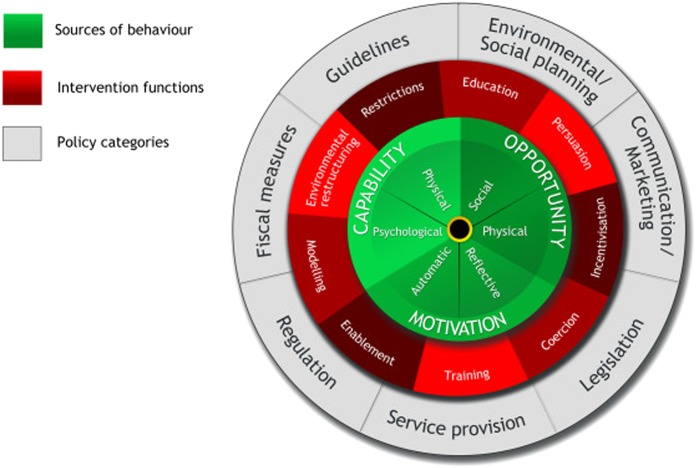
Objectives: To explore healthcare professionals’ views of antibiotic prescribing in long-term care facilities (LTCFs). To use the findings to recommend intervention strategies for antimicrobial stewardship in LTCFs. Design: Qualitative semistructured interviews were conducted. The data were analysed by thematic content analysis. After the interviews, the emerging findings were mapped to the theoretical domains framework (TDF), and the behaviour change wheel and behaviour change technique (BCT) taxonomy were used to recommend future intervention strategies. Participants: Interviews were conducted with 37 healthcare professionals who work in LTCFs (10 general practitioners, 4 consultants, 14 nurses, 9 pharmacists) between December 2012 and March 2013. Setting: Interviews were conducted in the greater Cork region. Results: The main domains from the TDF which emerged were: ‘Knowledge’, ‘Environmental context and resources’, ‘Social influences’, ‘Beliefs about consequences’, ‘Memory, attention and decision making’, with the findings identifying a need for ‘Behavioural regulation’. Many participants believed that antibiotic prescribing was satisfactory at their LTCF, despite the lack of surveillance activities. Conclusions: This study, using the TDF and BCT taxonomy, has found that antibiotic prescribing in LTCFs is influenced by many social and contextual factors. The challenges of the setting and patient population, the belief about consequences to the patient, and the lack of implementation of guidelines and knowledge regarding antibiotic prescribing patterns are significant challenges to address. On the basis of the study findings and the application of the TDF and BCT taxonomy, we suggest some practical intervention functions for antimicrobial stewardship in LTCFs.
Overview
The claims and statistics of this paper haven’t been checked yet.
Free: it reads the open-access text and checks the first 5 claims that cite a source we can check. Create a free account to check every claim.
Integrity signals
Registry
Cites
Statistics
Figures
Verification
Claims the paper makes
The claims and statistics of this paper haven’t been checked yet.
Free: it reads the open-access text and checks the first 5 claims that cite a source we can check. Create a free account to check every claim.
Claims other papers make about this one
Each is checked against this paper’s own text: does it say what the citing paper says it does?
The source backs part of the claim, not all of it — or backs it for a different population, condition or comparison.
In the citing paper
“Although evaluation frameworks may be considered in a category of their own, theories, models and frameworks from the other four categories can also be applied for evaluation purposes because they specify concepts and constructs that may be operationalized and measured.”
From Making sense of implementation theories, models and frameworks (2015) · cites this paper as [128]
Experimental — accuracy not yet measuredThe cited source says what the claim attributes to it.
In the citing paper
“For instance, Theoretical Domains Framework (e.g. [127,128]), and Normalization Process Theory [129] and COM-B (e.g. [130,131]) have all been widely used as evaluation frameworks.”
From Making sense of implementation theories, models and frameworks (2015) · cites this paper as [128]
Self-check
Percentages, sums and reported differences re-computed from the paper’s own numbers.
The self-check needs the paper’s full text.
Citations
Cites
Tong, A., Sainsbury, P., & Craig, J. (2007) · International Journal for Quality in Health Care · doi:10.1093/intqhc/mzm042 · Cited by 42,509
Michie, S., van Stralen, M. M., & West, R. (2011) · Implementation Science · doi:10.1186/1748-5908-6-42 · Cited by 13,697 · cited 1×
“1) has been developed in order to improve the design and implementation of interventions.(14) In the COM-B model, capability, motivation and opportunity interact to generate behaviour.”
BackgroundQualitative research practice: a guide for social science students and researchers
(2003) · Choice Reviews Online · doi:10.5860/choice.41-1319 · Cited by 10,543
Qualitative research in health care: Analysing qualitative data
Pope, C. (2000) · BMJ · doi:10.1136/bmj.320.7227.114 · Cited by 8,131
Michie, S., Richardson, M., Johnston, M., Abraham, C., Francis, J., Hardeman, W., Eccles, M. P., Cane, J., & Wood, C. E. (2013) · Annals of Behavioral Medicine · doi:10.1007/s12160-013-9486-6 · Cited by 7,629
Why Don't Physicians Follow Clinical Practice Guidelines?: A Framework for Improvement
Cabana, M. D., Rand, C. S., Powe, N. R., Wu, A. W., Wilson, M. H., Abboud, P.-A. C., & Rubin, H. R. (1999) · JAMA · doi:10.1001/jama.282.15.1458 · Cited by 6,677 · cited 1×
“34 The practicalities of interventions in the LTCF setting must be considered and local issues such as the time available for education and healthcare professional participation in antimicrobial stewardship must be addressed.”
BackgroundCane, J., O’Connor, D., & Michie, S. (2012) · Implementation Science · doi:10.1186/1748-5908-7-37 · Cited by 4,888 · cited 1×
“12 required.”
Sample size in qualitative research
Sandelowski, M. (1995) · Research in Nursing & Health · doi:10.1002/nur.4770180211 · Cited by 4,372 · cited 1×
“Interviews were conducted until data saturation was reached and two extra interviews per healthcare professional group were conducted to ensure that no new themes were emerging.(20) 21”
MethodQualitative Research in Health Care
(2006) · Wiley eBooks · doi:10.1002/9780470750841 · Cited by 2,712
(2014) · Cited by 2,276
Cited by
Items 101–120 of 120
Kolodko, J. (2026) · Warwick Research Archive Portal (University of Warwick) · doi:10.82444/warw.33795745
Exploring vaccine decision-making to identify and address barriers to vaccine uptake in Ireland
Marshall, S. M. (2020) · Cork Open Research Archive (University College Cork, Ireland)
Jones, L. F. (2020) · UWE Research Repository (UWE Bristol)
Leo, A. D., Bayes, S. J., Bloxsome, D., Butt, J., & Geraghty, S. (2020) · Research Square · doi:10.21203/rs.3.rs-37978/v1
Lohiniva, A., Elwali, E. S., Abuobaida, D., Abdulrahim, A., Bukuluki, P., & Talaat, M. (2020) · Research Square · doi:10.21203/rs.3.rs-71506/v1
“The framework consists of 14 domains that include knowledge, skills, social environment, professional role, memory and decision-making process, environmental factors, goals, intentions to change, optimism, reinforcement, behavior regulation, belief in capabilities, beliefs in consequences, and emotions (27-28).”
BackgroundAntimicrobial use in long-term care facilities: the participation of nurses
Jarina, N. V., Flausino, T. G. D. C., Orlandi, F. D. S., & de Figueiredo, R. M. (2024) · Geriatrics Gerontology and Aging · doi:10.53886/gga.e0000158_en
Ishara-Nshombo, E., Bridey, C., Pulcini, C., Thilly, N., & Bocquier, A. (2024) · JAC-Antimicrobial Resistance · doi:10.1093/jacamr/dlae189 · Cited by 1
Coenen, I., Lenie, S., Coteur, K., Hughes, C. M., & Foulon, V. (2025) · Antibiotics · doi:10.3390/antibiotics15010005
“Pharmacists, described as important AMS actors in NHs elsewhere [18,19], had a less visible role in Belgium, largely restricted to supplying antibiotics, underscoring the need for context-sensitive strategies.”
Carvalho, F. (2020) · Loughborough University Research Repository (Loughborough University) · doi:10.26174/thesis.lboro.12301880
Wong, E., Mavondo, F., Horvat, L., McKinlay, L., & Fisher, J. (2022) · Figshare · doi:10.6084/m9.figshare.19289920
Bocquier, A., Erkilic, B., Babinet, M., Pulcini, C., & Agrinier, N. (2024) · Figshare · doi:10.6084/m9.figshare.26689829
Bocquier, A., Erkilic, B., Babinet, M., Pulcini, C., & Agrinier, N. (2024) · Figshare · doi:10.6084/m9.figshare.25357911
Yager, R. C., Taylor, N., Stocker, S. L., Day, R. O., Baysari, M. T., & Carland, J. E. (2022) · Figshare · doi:10.6084/m9.figshare.19613972
Bocquier, A., Erkilic, B., Babinet, M., Pulcini, C., & Agrinier, N. (2024) · Figshare · doi:10.6084/m9.figshare.25357989
Llor, C., Morros, R., Mateos‐Nozal, J., Sáez, C. M. Z., Vaquero-Pinto, M. N., Jiménez, C. R., Béjar, C. S., Botaya, R. M., Matovelle, P., Sanmartín, A. N., et al. (2026) · Frontiers in Pharmacology · doi:10.3389/fphar.2025.1721689
Taghrid Chaaban, A. (2019) · theses.fr (ABES) · doi:10.70675/e5431154zeb63z4348za908z44661fcc720b · Cited by 1
Antimicrobial stewardship in Ireland (2010–2021): a scoping review
Barry, F., Murphy, O., Fitzgerald, A. P., O’Reilly, É. J., & Smiddy, M. P. (2026) · BMC Health Services Research · doi:10.1186/s12913-026-14498-y
“ECDC 2020 New diagnostic tools for AMR need further research focus [17]. iNAP2 2021 Antibiotic prescribing in LTCF is influenced by many social and contextual elements [62].”
Khan, M. E., Jamil, E., Abubakar, M., Javed, A., Abbas, D. R., Nawaz, E., Atiq, B., Razi, B. H., Saeed, A. R., Rasool, H., et al. (2026) · BMJ Open · doi:10.1136/bmjopen-2025-107828
Metadata
- Authors
- Fleming, A., Bradley, C., Cullinan, S., & Byrne, S.
- Affiliations
- University College Cork (IE)
- Corresponding author
- Fleming, Aoife
- Venue
- BMJ Open
- Publisher
- BMJ
- Published
- 2014-11
- Volume
- 4
- Issue
- 11
- Pages
- e006442
- ISSN
- 2044-6055 (ISSN-L)
- PMC
- PMC4225237
- OpenAlex
- W2148087591
- Cited by
- 117
- References
- 32
- Citations by year
- 2026: 5 · 2025: 7 · 2024: 13 · 2023: 5 · 2022: 17 · 2021: 14 · 2020: 22 · 2019: 14 · 2018: 9 · 2017: 1 · 2016: 5 · 2015: 5
- FWCI
- 3.07
- Type
- journal article
- Language
- en
- Open access
- gold
- doi.org
- Licence
- cc-by-nc
- Locations
- BMJ Open (publishedVersion, cc-by-nc)
- Europe PMC (PubMed Central) (publishedVersion, cc-by-nc)
- PubMed Central (publishedVersion, cc-by-nc)
- PubMed (publishedVersion)
- HighWire Press Open Archive (submittedVersion)
- Lenus, The Irish Health Repository (Dr Steevens Hospital Library) (submittedVersion)
- Funders
- Health Research Board (PHD/2007/16)
- University College London
- Topics
- Health Sciences › Medicine › Infectious Diseases › Antibiotic Use and Resistance
- Health Sciences › Medicine › Infectious Diseases › Infection Control in Healthcare
- Health Sciences › Health Professions › General Health Professions › Health Policy Implementation Science
- Keywords
- antibiotic prescribing, long-term care facilities, antimicrobial stewardship, healthcare professionals' perspectives, Theoretical Domains Framework, behaviour change techniques, Behaviour Change Wheel, prescribing guidelines, pharmacists, general practitioners, behavioral regulation, social influence
- MeSH terms
- Anti-Bacterial Agents, Evaluation Studies as Topic, Female, Health Personnel, Humans, Long-Term Care, Male, Drug Prescriptions, Skilled Nursing Facilities
About these checks
Registry, retraction, Cites and statistics results are computed, not judged, with one exception: a printed reference that no index lists is read once by a model before it counts as a citation error. Claims are extracted by a model and kept only when their quote appears verbatim in the text; each cited source is then checked, with a model’s help, for whether it says what the claim relies on. Those verdicts can be wrong — read the claim’s quote and the cited source before relying on one.
Statistics and arithmetic are recomputed, not judged.
Confidence bands are shown only for fields calibrated on our annotated test set. None is calibrated yet, so no band is shown.
What counts as a claim ›How we measure confidence ›How we check this ›
Are you an author, or do you see a problem with this page? Request a review
Data sources
Bibliographic data: Semantic Scholar, OpenAlex, Crossref.
Contains information from the Semantic Scholar Academic Graph Datasets, made available under the ODC Attribution License (ODC-BY 1.0).
Semantic Scholar’s data is described in: Kinney, R., et al. (2023). The Semantic Scholar Open Data Platform. arXiv:2301.10140.
