

The DOI matches its Crossref record; 85 of the 88 references it cites were found in a registry or an index.
Improving risk factor management for patients with poorly controlled type 2 diabetes: a systematic review of healthcare interventions in primary care and community settings
Open accessAbstract
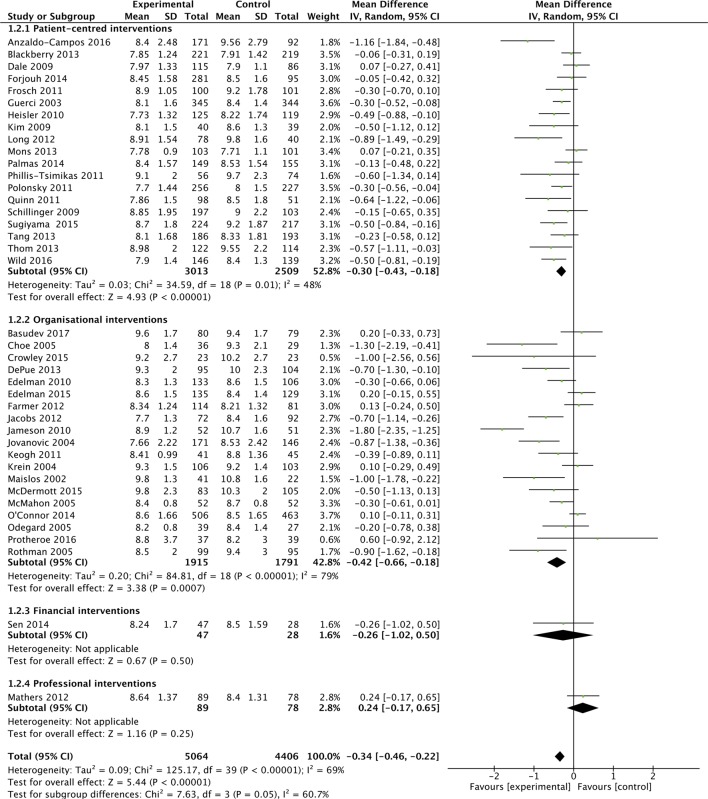
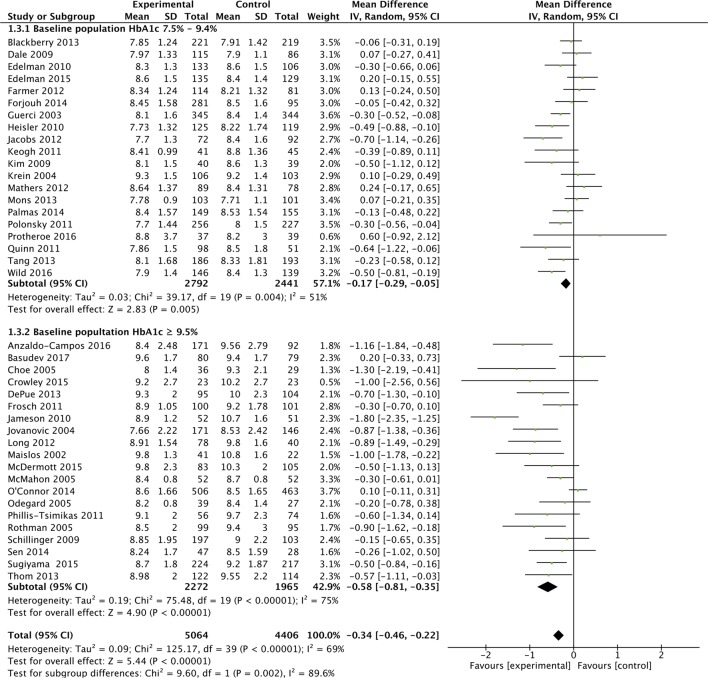
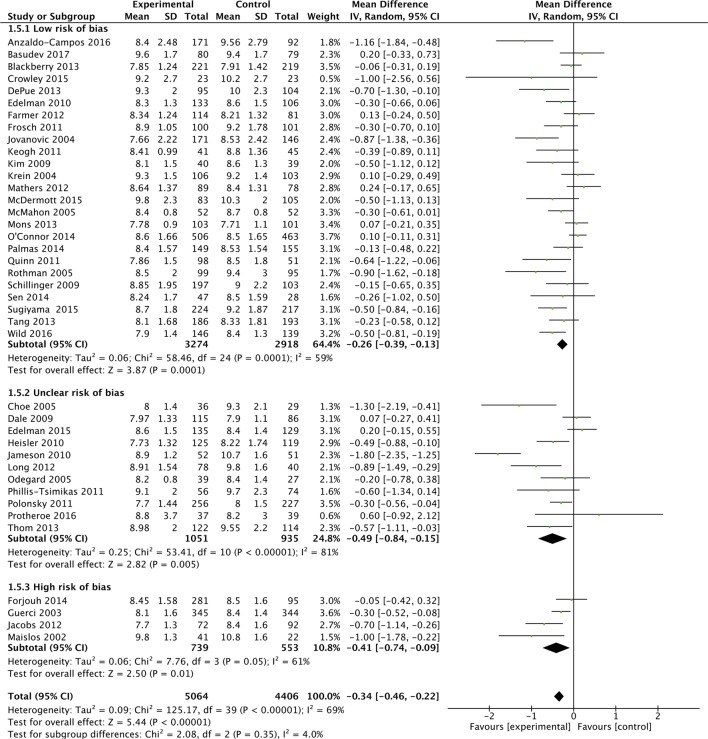
Objectives: Poorly controlled type 2 diabetes mellitus (T2DM) is a major international health problem. Our aim was to assess the effectiveness of healthcare interventions, specifically targeting patients with poorly controlled T2DM, which seek to improve glycaemic control and cardiovascular risk in primary care settings. Design: Systematic review. Setting: Primary care and community settings. Included studies: Randomised controlled trials (RCTs) targeting patients with poor glycaemic control were identified from Pubmed, Embase, Web of Science, Cochrane Library and SCOPUS. Poor glycaemic control was defined as HbA1c over 59 mmol/mol (7.5%). Interventions: Interventions were classified as organisational, patient-oriented, professional, financial or regulatory. Outcomes: Primary outcomes were HbA1c, blood pressure and lipid control. Two reviewers independently assessed studies for eligibility, extracted data and assessed study quality. Meta-analyses were undertaken where appropriate using random-effects models. Subgroup analysis explored the effects of intervention type, baseline HbA1c, study quality and study duration. Meta-regression analyses were undertaken to investigate identified heterogeneity. Results: Forty-two RCTs were identified, including 11 250 patients, with most undertaken in USA. In general, studies had low risk of bias. The main intervention types were patient-directed (48%) and organisational (48%). Overall, interventions reduced HbA1c by −0.34% (95% CI −0.46% to −0.22%), but meta-analyses had high statistical heterogeneity. Subgroup analyses suggested that organisational interventions and interventions on those with baseline HbA1c over 9.5% had better improvements in HbA1c. Meta-regression analyses suggested that only interventions on those with population HbA1c over 9.5% were more effective. Interventions had a modest improvement of blood pressure and lipids, although baseline levels of control were generally good. Conclusions: This review suggests that interventions for T2DM, in primary care, are better targeted at individuals with very poor glycaemic control and that organisational interventions may be more effective.
Overview
The claims and statistics of this paper haven’t been checked yet.
Free: it reads the open-access text and checks the first 5 claims that cite a source we can check. Create a free account to check every claim.
Integrity signals
Registry
Cites
Statistics
Figures


Verification
Claims the paper makes
The claims and statistics of this paper haven’t been checked yet.
Free: it reads the open-access text and checks the first 5 claims that cite a source we can check. Create a free account to check every claim.
Claims other papers make about this one
Each is checked against this paper’s own text: does it say what the citing paper says it does?
The source backs part of the claim, not all of it — or backs it for a different population, condition or comparison.
In the citing paper
“For example, the involvement of multidisciplinary teams that include nonphysician providers with authorization to prescribe (e.g., pharmacists, specialist nurses, and advanced practice providers) may reduce therapeutic inertia (69,70).”
From Management of Hyperglycemia in Type 2 Diabetes, 2022. A Consensus Report by the American Diabetes Association (ADA) and the European Association for the Study of Diabetes (EASD) (2022) · cites this paper as [70]
Experimental — accuracy not yet measured
Self-check
Percentages, sums and reported differences re-computed from the paper’s own numbers.
The self-check needs the paper’s full text.
Citations
Cites
Quantifying heterogeneity in a meta‐analysis
Higgins, J. P. T., & Thompson, S. G. (2002) · Statistics in Medicine · doi:10.1002/sim.1186 · Cited by 36,763
Wild, S., Roglic, G., Green, A., Sicree, R., & King, H. (2004) · Diabetes Care · doi:10.2337/diacare.27.5.1047 · Cited by 15,297
Stratton, I. M. (2000) · BMJ · doi:10.1136/bmj.321.7258.405 · Cited by 9,059 · cited 1×
“Poorly controlled T2DM—and its associated microvascular and macrovascular complications—is associated with higher morbidity, higher mortality, poorer quality of life and substantial economic burden.(4) Improving risk factor management for patients with poorly controlled type 2 diabetes: a systematic review of healthca…”
BackgroundEffects of Intensive Glucose Lowering in Type 2 Diabetes
(2008) · New England Journal of Medicine · doi:10.1056/nejmoa0802743 · Cited by 7,888
Intensive blood glucose control and vascular outcomes in patients with type 2 diabetes
(2008) · New England Journal of Medicine · doi:10.1056/nejmoa0802987 · Cited by 7,397
Glucose control and vascular complications in veterans with type 2 diabetes
Duckworth, W., Abraira, C., Moritz, T., Reda, D., Emanuele, N., Reaven, P. D., Zieve, F. J., Marks, J., Davis, S. N., Hayward, R., et al. (2009) · New England Journal of Medicine · doi:10.1056/nejmoa0808431 · Cited by 4,762
How should meta‐regression analyses be undertaken and interpreted?
Thompson, S. G., & Higgins, J. P. T. (2002) · Statistics in Medicine · doi:10.1002/sim.1187 · Cited by 3,026
A systematic review of adherence with medications for diabetes
Cramer, J. A. (2004) · Diabetes Care · doi:10.2337/diacare.27.5.1218 · Cited by 1,203
Intensive glucose control and macrovascular outcomes in type 2 diabetes
Turnbull, F. M., Abraira, C., Anderson, R. J., Byington, R. P., Chalmers, J. P., Duckworth, W. C., Evans, G. W., Gerstein, H. C., Holman, R. R., Moritz, T. E., et al. (2009) · Diabetologia · doi:10.1007/s00125-009-1470-0 · Cited by 1,189
Renders, C. M., Valk, G. D., Griffin, S. J., Wagner, E. H., Eijk van, J. T., & Assendelft, W. J. J. (2001) · Diabetes Care · doi:10.2337/diacare.24.10.1821 · Cited by 1,066
Research works printed but not linked: 3
- Murphy M , Galvin R , Fahey T , et al . Effectiveness of interventions in primary care to improve glycated haemoglobin (HbA1c) and cardiovascular risk factor levels in patients with poorly-controlled type 2 diabetes mellitus: a systematic review. PROSPERO 2014. CRD42014014442.
- Effective practice and Organisation of Care (EPOC). Summary assessments of the risk of Bias. EPOC Resources for review authors Oslo: Norwegian Knowledge Centre for the Health Services 20132016 http://epoc.cochrane.org/sites/epoc.cochrane.org/files/uploads/16.
- Crowley, 2015, Effectiveness of a scalable telemedicine intervention for veterans with persistent poor diabetes control, Diabetes, 64
Cited by
Davies, M. J., D’Alessio, D. A., Fradkin, J., Kernan, W. N., Mathieu, C., Mingrone, G., Rossing, P., Tsapas, A., Wexler, D. J., & Buse, J. B. (2018) · Diabetes Care · doi:10.2337/dci18-0033 · Cited by 3,518
Davies, M. J., Aroda, V. R., Collins, B. S., Gabbay, R. A., Green, J., Maruthur, N. M., Rosas, S. E., Del Prato, S., Mathieu, C., Mingrone, G., et al. (2022) · Diabetes Care · doi:10.2337/dci22-0034 · Cited by 2,104
Davies, M. J., D’Alessio, D. A., Fradkin, J., Kernan, W. N., Mathieu, C., Mingrone, G., Rossing, P., Tsapas, A., Wexler, D. J., & Buse, J. B. (2018) · Diabetologia · doi:10.1007/s00125-018-4729-5 · Cited by 1,455
Davies, M. J., Aroda, V. R., Collins, B. S., Gabbay, R. A., Green, J., Maruthur, N. M., Rosas, S. E., Del Prato, S., Mathieu, C., Mingrone, G., et al. (2022) · Diabetologia · doi:10.1007/s00125-022-05787-2 · Cited by 1,048
Gut microbiome and type 2 diabetes: where we are and where to go?
Sharma, S., & Tripathi, P. (2019) · The Journal of Nutritional Biochemistry · doi:10.1016/j.jnutbio.2018.10.003 · Cited by 428
Metadata
- Authors
- Murphy, M. E., Byrne, M., Galvin, R., Boland, F., Fahey, T., & Smith, S. M.
- Affiliations
- Royal College of Surgeons in Ireland (IE)
- University of Limerick (IE)
- Ollscoil na Gaillimhe – University of Galway (IE)
- Corresponding author
- Murphy, Mark E
- Venue
- BMJ Open
- Publisher
- BMJ
- Published
- 2017-08
- Volume
- 7
- Issue
- 8
- Pages
- e015135
- ISSN
- 2044-6055 (ISSN-L)
- PMC
- PMC5724222
- OpenAlex
- W2743048109
- Cited by
- 94
- References
- 88
- Citations by year
- 2026: 6 · 2025: 6 · 2024: 6 · 2023: 23 · 2022: 14 · 2021: 10 · 2020: 11 · 2019: 8 · 2018: 8 · 2017: 2
- FWCI
- 1.16
- Type
- journal article
- Language
- en
- Open access
- gold
- doi.org
- Licence
- cc-by-nc
- Locations
- BMJ Open (publishedVersion, cc-by-nc)
- Europe PMC (PubMed Central) (publishedVersion, cc-by-nc)
- PubMed Central (publishedVersion, cc-by-nc)
- PubMed (publishedVersion)
- University of Limerick Institutional Repository (University of Limerick) (acceptedVersion, other-oa)
- Arrow@dit (Dublin Institute of Technology) (submittedVersion, cc-by-nc-sa)
- Royal College of Surgeons in Ireland (submittedVersion, cc-by-nc)
- Figshare (submittedVersion, cc-by-nc)
- Figshare (submittedVersion, cc-by-nc-sa)
- Lenus, The Irish Health Repository (Dr Steevens Hospital Library) (submittedVersion)
- Funders
- Health Research Board (HRC-2014-1, RL/2013/8)
- Topics
- Health Sciences › Medicine › Endocrinology, Diabetes and Metabolism › Diabetes Management and Education
- Health Sciences › Medicine › Endocrinology, Diabetes and Metabolism › Diabetes Treatment and Management
- Health Sciences › Medicine › Endocrinology, Diabetes and Metabolism › Diabetes, Cardiovascular Risks, and Lipoproteins
- Keywords
- type 2 diabetes, poor glycaemic control, HbA1c, cardiovascular risk, primary care intervention, organizational interventions, blood pressure control, lipid control, healthcare quality improvement
- MeSH terms
- Blood Glucose, Cardiovascular Diseases, Community Health Services, Diabetes Mellitus, Type 2, Health Promotion, Glycated Hemoglobin, Humans, Primary Health Care, Risk Factors, Risk Management, Randomized Controlled Trials as Topic, Quality Improvement
About these checks
Registry, retraction, Cites and statistics results are computed, not judged, with one exception: a printed reference that no index lists is read once by a model before it counts as a citation error. Claims are extracted by a model and kept only when their quote appears verbatim in the text; each cited source is then checked, with a model’s help, for whether it says what the claim relies on. Those verdicts can be wrong — read the claim’s quote and the cited source before relying on one.
Statistics and arithmetic are recomputed, not judged.
Confidence bands are shown only for fields calibrated on our annotated test set. None is calibrated yet, so no band is shown.
What counts as a claim ›How we measure confidence ›How we check this ›
Are you an author, or do you see a problem with this page? Request a review
How to cite
Cite CoChat for the checks on this page, and the paper for its own findings.
- This page
- CoChat. (2026). Citation check: Improving risk factor management for patients with poorly controlled type 2 diabetes: a systematic review of healthcare interventions in primary care and community settings. https://app.cochat.ai/papers/10.1136/bmjopen-2016-015135
- The paper
- Murphy, M. E., Byrne, M., Galvin, R., Boland, F., Fahey, T., & Smith, S. M. (2017). Improving risk factor management for patients with poorly controlled type 2 diabetes: a systematic review of healthcare interventions in primary care and community settings. BMJ Open. https://doi.org/10.1136/bmjopen-2016-015135
Data sources
Bibliographic data: Semantic Scholar, OpenAlex, Crossref.
Contains information from the Semantic Scholar Academic Graph Datasets, made available under the ODC Attribution License (ODC-BY 1.0).
Semantic Scholar’s data is described in: Kinney, R., et al. (2023). The Semantic Scholar Open Data Platform. arXiv:2301.10140.
