

Interactive voice response interventions targeting behaviour change: a systematic literature review with meta-analysis and meta-regression
Open accessThe DOI matches its Crossref record; 51 of the 51 references it cites were found in a registry or an index.
Abstract
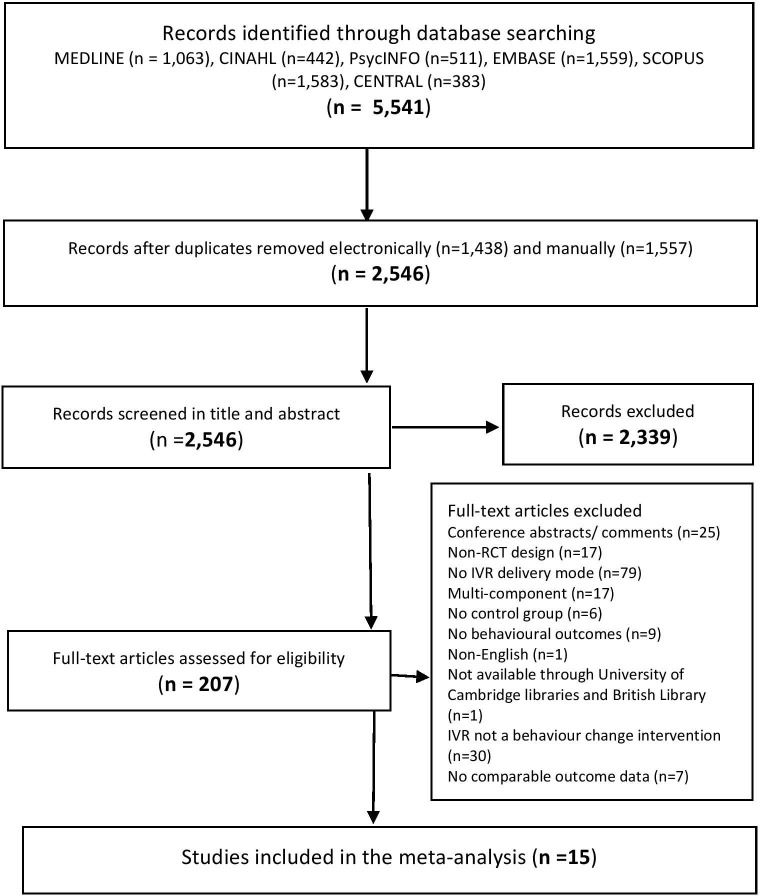
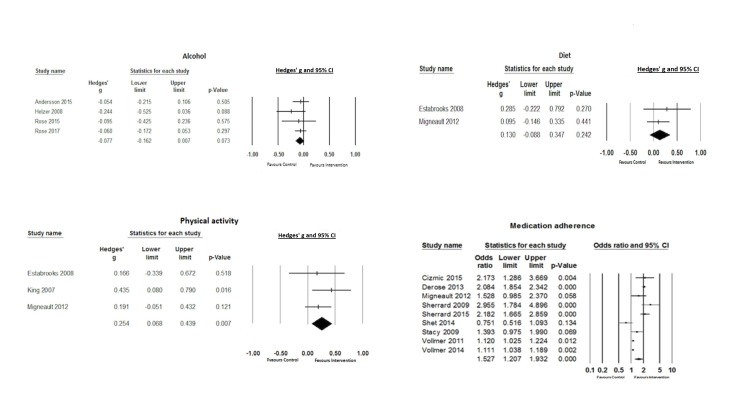
Objective: A number of promising automated behaviour change interventions have been developed using advanced phone technology. This paper reviewed the effectiveness of interactive voice response (IVR)-based interventions designed to promote changes in specific health behaviours. Methods: A systematic literature review of papers published between January 1990 and September 2017 in MEDLINE, CINAHL, Embase, PsycINFO, SCOPUS and the Cochrane Central Register of Controlled Trials (CENTRAL) was conducted. From the total of 2546 papers identified, 15 randomised control trials (RCTs) met the eligibility criteria and were included in a random effects meta-analysis. Meta-regression analysis was used to explore whether behaviour change techniques (BCTs) that were used in the interventions were associated with intervention effectiveness. Results: Meta-analysis of 15 RCTs showed that IVR-based interventions had small but significant effects on promoting medication adherence (OR=1.527, 95% CI 1.207 to 1.932, k=9, p=0.000) and physical activity (Hedges’ g=0.254, 95% CI 0.068 to 0.439, k=3, p=0.007). No effects were found for alcohol (Hedges’ g=−0.077, 95% CI −0.162 to 0.007, k=4, p=0.073) or diet (Hedges’ g=0.130, 95% CI −0.088 to 0.347, k=2, p=0.242). In the medication adherence studies, multivariable meta-regression including six BCTs explained 100% of the observed variance in effect size, but only the BCT ‘information about health consequences’ was significantly associated with effect size (β=0.690, SE=0.199, 95% CI 0.29 to 1.08, p=0.000). Conclusion: IVR-based interventions appear promising in changing specific health behaviours, such as medication adherence and physical activity. However, more studies are needed to elucidate further the combination of active components of IVR interventions that make them effective and test their feasibility and effectiveness using robust designs and objective outcome measures.
Overview
The claims and statistics of this paper haven’t been checked yet.
Free: it reads the open-access text and checks the first 5 claims that cite a source we can check. Create a free account to check every claim.
Integrity signals
Registry
Cites
Statistics
Figures
Verification
Claims the paper makes
The claims and statistics of this paper haven’t been checked yet.
Free: it reads the open-access text and checks the first 5 claims that cite a source we can check. Create a free account to check every claim.
Claims other papers make about this one
Each is checked against this paper’s own text: does it say what the citing paper says it does?
In the citing paper
“IVR-based behavior monitoring has been shown to be effective in driving behavior changes [81].”
In the citing paper
“has been shown to be effective in driving behavior changes [81].”
Self-check
Percentages, sums and reported differences re-computed from the paper’s own numbers.
The self-check needs the paper’s full text.
Citations
Cites
Measuring inconsistency in meta-analyses
Higgins, J. P. T., Thompson, S. G., Deeks, J. J., & Altman, D. G. (2003) · BMJ · doi:10.1136/bmj.327.7414.557 · Cited by 63,139 · cited 1×
“Assessment of heterogeneity The degree of heterogeneity was assessed using the I(2) statistic.(28) A value of I(2) of 25% was considered as indicating low heterogeneity, 50% moderate and 75% high heterogeneity.”
Bias in meta-analysis detected by a simple, graphical test
Egger, M., Smith, G. D., Schneider, M., & Minder, C. (1997) · BMJ · doi:10.1136/bmj.315.7109.629 · Cited by 56,722 · cited 1×
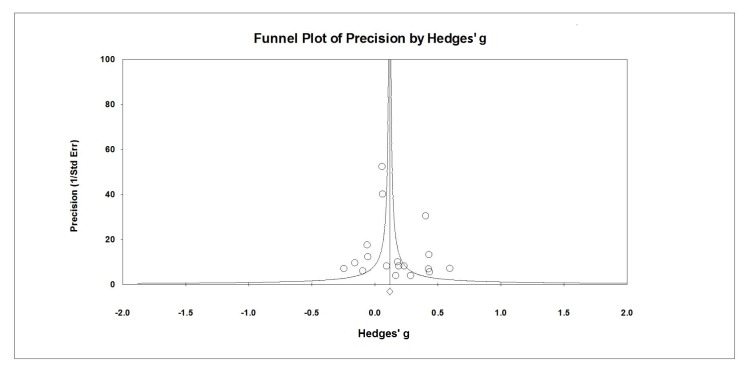
“Asymmetry in the overall pattern was assessed using Egger’s test by regressing the effect size on its standard error (SE).(29) Meta-regression analyses In addition, the following meta-regression analyses were conducted:”
Cochrane Handbook for Systematic Reviews of Interventions: Cochrane Book Series
(2008) · doi:10.1002/9780470712184 · Cited by 25,048 · cited 1×
“Two reviewers independently assessed risk of bias using an adapted version of the Cochrane Collaboration tool for assessing risk of bias 24 (online supplementary file 3).”
Michie, S., Richardson, M., Johnston, M., Abraham, C., Francis, J., Hardeman, W., Eccles, M. P., Cane, J., & Wood, C. E. (2013) · Annals of Behavioral Medicine · doi:10.1007/s12160-013-9486-6 · Cited by 7,629
Danaei, G., Ding, E. L., Mozaffarian, D., Taylor, B., Rehm, J., Murray, C. J. L., & Ezzati, M. (2009) · PLoS Medicine · doi:10.1371/journal.pmed.1000058 · Cited by 2,860 · cited 1×
“IntrOduCtIOn Health-related behaviours have enormous impact on some of the leading causes of mortality and morbidity.(1) 2 Evidence show that behaviours such as non-adherence to medications, lack of physical activity, smoking, high consumption of alcohol and poor diet can cause a number of health conditions.”
Effective techniques in healthy eating and physical activity interventions: A meta-regression.
Michie, S., Abraham, C., Whittington, C., McAteer, J., & Gupta, S. (2009) · Health Psychology · doi:10.1037/a0016136 · Cited by 2,229 · cited 1×
“…dietary and physical activity interventions, some of the coded BCTs have previously been associated with intervention effectiveness: ‘self-monitoring of behaviour’ and ‘action planning’ for both dietary and physical activity interventions 53 and ‘feedback on behaviour’ for alcohol interventions.”
Social support and patient adherence to medical treatment: a meta-analysis.
DiMatteo, M. R. (2004) · Health Psychology · doi:10.1037/0278-6133.23.2.207 · Cited by 2,107 · cited 1×
“This finding is in line with previous research that suggests that types of perceived social support are significantly associated with medication adherence.(52) It is also possible that IVR voice messages might increase the sense of social support, in comparison to other delivery modes, due their resemblance to ‘natura…”
Espinosa, J. C. (2004) · Cited by 939
Compliance with therapeutic regimens
Jay, S., Litt, I. F., & Durant, R. H. (1984) · Journal of Adolescent Health Care · doi:10.1016/s0197-0070(84)80012-1 · Cited by 666
Officer, C. M. (2013) · Cited by 624
Research works printed but not linked: 2
- Rigotti, 2013, Promoting smoking cessation after hospital discharge: the helping hand randomized controlled comparative effectiveness trial, J Gen Intern Med, 28, S160
- Pai, 2013, Using automated voice calls to improve adherence to iron supplements during pregnancy, Proc Sixth Int Conf Inf Commun Technol Dev Full Pap - ICTD’ 13, 1, 153
Cited by
Pouls, B. P. H., Vriezekolk, J. E., Bekker, C. L., Linn, A. J., van Onzenoort, H. A. W., Vervloet, M., van Dulmen, S., & van den Bemt, B. J. F. (2021) · Journal of Medical Internet Research · doi:10.2196/18901 · Cited by 123
“Our findings add robustness to the positive effect of eHealth interventions provided by previous systematic reviews and meta-analyses [46-51].”
BackgroundSezgin, E., Militello, L. K., Huang, Y., & Lin, S. (2020) · Translational Behavioral Medicine · doi:10.1093/tbm/ibz141 · Cited by 83
Ivers, N. M., Schwalm, J.-D., Bouck, Z., McCready, T., Taljaard, M., Grace, S. L., Cunningham, J., Bosiak, B., Presseau, J., Witteman, H. O., et al. (2020) · BMJ · doi:10.1136/bmj.m1731 · Cited by 76
Arnold, A., Kolody, S., Comeau, A., & Miguel Cruz, A. (2024) · Disability and Rehabilitation: Assistive Technology · doi:10.1080/17483107.2022.2065369 · Cited by 59
“We identified six relevant literature reviews that investigated voice assistant or conversational agent technology with health applications [27–35].”
BackgroundGold, N., Yau, A., Rigby, B., Dyke, C., Remfry, E. A., & Chadborn, T. (2021) · Journal of Medical Internet Research · doi:10.2196/19688 · Cited by 56
Son, Y., Lee, Y., & Lee, H.-J. (2020) · International Journal of Environmental Research and Public Health · doi:10.3390/ijerph17051749 · Cited by 63
“Moreover, users can also leave a recorded response for more extensive feedback [43].”
BackgroundUser Interaction Patterns and Breakdowns in Conversing with LLM-Powered Voice Assistants
Mahmood, A., Wang, J., Yao, B., Wang, D., & Huang, C.-M. (2025) · International Journal of Human-Computer Studies · doi:10.1016/j.ijhcs.2024.103406 · Cited by 51
A review of sensory interactions between autonomous vehicles and drivers
Lu, J., Peng, Z., Yang, S., Ma, Y., Wang, R., Pang, Z., Feng, X., Chen, Y., & Cao, Y. (2023) · Journal of Systems Architecture · doi:10.1016/j.sysarc.2023.102932 · Cited by 50
Usability Testing of a Social Media Chatbot for Increasing Physical Activity Behavior
Larbi, D., Denecke, K., & Gabarron, E. (2022) · Journal of Personalized Medicine · doi:10.3390/jpm12050828 · Cited by 36
Guerreiro, M. P., Strawbridge, J., Cavaco, A. M. D. N., Félix, I. B., Marques, M. M., & Cadogan, C. A. (2021) · BMC Medical Education · doi:10.1186/s12909-021-02720-w · Cited by 34
Kassavou, A., & Sutton, S. R. (2017) · BMJ Open · doi:10.1136/bmjopen-2016-015597 · Cited by 36
Self-citationKassavou, A., Houghton, V., Edwards, S., Brimicombe, J. D., & Sutton, S. R. (2019) · BMJ Open · doi:10.1136/bmjopen-2018-024121 · Cited by 26
“Information about the recruitment setting and patients’ characteristics at baseline, as well as uptake and retention rates, was extracted from the two systematic reviews of trials on medication adherence delivered by SMS and/ or IVR messages.(11) 12 Due to missing data about the characteristics of the targeted populat…”
Self-citationCan you pass that tool?: Implications of Indirect Speech in Physical Human-Robot Collaboration
Zhang, Y., Ratnayake, T. S., Sew, C., Knibbe, J., Gonçalves, J., & Johal, W. (2025) · CHI Conference on Human Factors in Computing Systems · doi:10.1145/3706598.3713780 · Cited by 28
“[4, 99].”
Raising Health Awareness in Rural Communities: A Randomized Experiment in Bangladesh and India
Siddique, A., Rahman, T., Pakrashi, D., Islam, A., & Ahmed, F. (2022) · The Review of Economics and Statistics · doi:10.1162/rest_a_01182 · Cited by 25
“However, personal calls are often more intimate and friendly and are likely to be more effective than automated calls, even in settings where digital literacy is higher (Tsoli et al., 2018).”
BackgroundEspírito‐Santo, M., Santos, S., & Estêvão, M. D. (2024) · Pharmacy · doi:10.3390/pharmacy12010020 · Cited by 19
“Interactive voice response (IVR) is also a potential tool that includes a technology based on the use of mobile phones, allowing the user to interact with the system using a keyboard as an interface [18].”
BackgroundKabukye, J. K., Ilozumba, O., Broerse, J. E. W., de Keizer, N. F., & Cornet, R. (2020) · JMIR mhealth and uhealth · doi:10.2196/22061 · Cited by 20
ODIN IVR-Interactive Solution for Emergency Calls Handling
Mocanu, B.-C., Filip, I.-D., Ungureanu, R.-D., Negru, C., Dascălu, M., Toma, Ș.-A., Bălan, T., Bica, I., & Pop, F. (2022) · Applied Sciences · doi:10.3390/app122110844 · Cited by 20
Social Media Chatbot for Increasing Physical Activity: Usability Study
Larbi, D., Gabarrón, E., & Denecke, K. (2021) · Studies in health technology and informatics · doi:10.3233/shti210604 · Cited by 16
“Digital technology interventions can successfully increase physical activity among adults [3-6].”
BackgroundIslam, A., Wang, L. C., & Hassan, H. (2022) · doi:10.53832/edtechhub.0070 · Cited by 15
Laranjo, L., Shaw, T. J., Trivedi, R., Thomas, S. P., Charlston, E., Klimis, H., Thiagalingam, A., Kumar, S., Tan, T. C., Nguyen, T. N., et al. (2022) · JMIR Research Protocols · doi:10.2196/34470 · Cited by 14
“…have been applied in different health domains such as mental health support and chronic disease management to enable a conversational interaction with patients and promote engagement with health interventions with the aim of increasing intervention acceptability, use, and effectiveness [22,25-28].”
BackgroundInfluentialGanjali, R., Taherzadeh, Z., Sabbagh, M. G., Nazemiyan, F., Mamdouhi, F., Tabesh, H., Aval, S. B., Golmakani, R., Mostafavi, S. M., & Eslami, S. (2019) · Medicine · doi:10.1097/md.0000000000014291 · Cited by 13
Moulaei, K., Bahaadinbeigy, K., & Sharifi, H. P. (2023) · Journal of Telemedicine and Telecare · doi:10.1177/1357633x231211355 · Cited by 17
Walker, R., Hillhouse, M. P., Perrochet, B., Sparenborg, S., Mooney, L. J., & Ling, W. W. (2019) · Journal of Addiction Medicine · doi:10.1097/adm.0000000000000509 · Cited by 11
Thirumalai, M., Brown, N. I., Niranjan, S. J., Townsend, S., Powell, M. A., Neal, W. N., Schleicher, E. A., Raparla, V., Oster, R. A., Demark‐Wahnefried, W., et al. (2022) · JMIR Human Factors · doi:10.2196/29494 · Cited by 8
Afoakwah, E., Carballo, F., Caro, A., D’Cunha, S., Dobrowolski, S., & Fallon, A. (2021) · doi:10.53832/edtechhub.0051 · Cited by 7
What do adults living with obesity want from a chatbot for physical activity? – a qualitative study
Larbi, D., Wynn, R., Trondsen, M. V., Årsand, E., Zanaboni, P., Denecke, K., & Gabarrón, E. (2024) · BMC Digital Health · doi:10.1186/s44247-024-00070-3 · Cited by 6
“Several studies have documented the effectiveness of goal setting to improve behaviour, including physical activity [3, 20, 23, 34, 35, 44–47].”
Cancer as a death sentence: developing an initial program theory for an IVR intervention
Ilozumba, O., Kabukye, J. K., de Keizer, N. F., Ronald Cornet, A., & Broerse, J. E. W. (2022) · Health Promotion International · doi:10.1093/heapro/daac070 · Cited by 6
“Reviews on IVRs have also found effects on medication adherence, physical activity, (Tsoli et al. , 2018) and cardio-metabolic medications (Kassavou and Sutton, 2018).”
Designing voice interfaces to support mindfulness-based pain management
Mendu, S., Fosco, S. L. D., Lanza, S. T., & Abdullah, S. (2023) · Digital Health · doi:10.1177/20552076231204418 · Cited by 5
“Voice interfaces offer several advantages, including convenience, simplicity and confidentiality (82).”
BackgroundFeasibility and acceptability of using an IVRS to assess decision making about sun protection
Holland, S. M., Shuk, E., Burkhalter, J. E., Shouery, M., Li, Y., & Hay, J. L. (2019) · Psycho-Oncology · doi:10.1002/pon.5231 · Cited by 5
“First, adherence can be a critical barrier to interpretation of IVRS data,(17) and actual engagement with IVRS is understudied and warrants specific attention.(18) Second, there are multiple aspects of study adherence, including study attrition, and adherence within and across telephone calls that relay important deta…”
BackgroundGanjali, R., Sabbagh, M. G., & Eslami, S. (2025) · Frontiers in Digital Health · doi:10.3389/fdgth.2024.1386012 · Cited by 4
Effect of telemedicine interventions on weight loss: A systematic review and meta-analysis
Moulaei, K., Moulaei, R., Bahaadinbeigy, K., & Bastaminejad, S. (2024) · Journal of Telemedicine and Telecare · doi:10.1177/1357633x241273991 · Cited by 3
A Study of Outbound Automated Call Preferences for DOTS Adherence in Rural India
Mathur, A., Bhowmick, S., & Sorathia, K. B. (2019) · Lecture notes in computer science · doi:10.1007/978-3-030-29387-1_2 · Cited by 3
Mehta, T., John, T., El Zein, A., Faught, V., Nawshin, T., Chilke, T. S., Cohen, C. W., Cherrington, A., & Thirumalai, M. (2025) · JMIR Research Protocols · doi:10.2196/70271 · Cited by 2
“IVR-based behavior monitoring has been shown to be effective in driving behavior changes [81].”
Santamaría, A., Maldonado, C. A., Sánchez-Quiñones, B., Vega, N. I., Gónzalez, P., & Carrasco, R. (2025) · Journal of Clinical Medicine · doi:10.3390/jcm14093023 · Cited by 2
Grinberg, A. S., Datre, O., Rogers, D. G., Clark, S. W., Takagishi, S. C., Ney, J. P., Seng, E. K., Fenton, B. T., & Sico, J. J. (2023) · Cephalalgia Reports · doi:10.1177/25158163231172418 · Cited by 2
“28,29 Delivery of cognitive-behavioral therapy via IVR technology was a non-inferior alternative to traditional in-person CBT delivery for patients with chronic low back pain.”
BackgroundHong, G. (2023) · Soft Computing · doi:10.1007/s00500-023-09117-5 · Cited by 2
RetractedO’Meara, L., Wellard, K., Nambooze, J., Ongora, P., Domínguez-Salas, P., & Ferguson, E. A. (2026) · Current Developments in Nutrition · doi:10.1016/j.cdnut.2026.107678 · Cited by 1
“…are that it reduces interviewer bias or error through consistent phrasing, pacing, and intonation of questions; it calls and records multiple participants simultaneously; it transcends low literacy levels; it can employ different languages; and process thousands of calls in a single day [26,27].”
Pekmezi, D., Thirumalai, M., Brown, N. I., Oster, R. A., Bowman, T., Baskin, M. L., Niranjan, S. J., Pisu, M., MacCarthy, S., Cole, W. W., et al. (2026) · American Journal of Preventive Medicine · doi:10.1016/j.amepre.2026.108440 · Cited by 1
Ley, C., Willis, L., Sanchez, M. D. L. L., & Parsonnet, J. (2019) · PLoS ONE · doi:10.1371/journal.pone.0226623 · Cited by 1
“Most IVR interventions to date, however, appear to focus on improving patient follow-up/reminders and medication adherence [45], rather than data collection over time as in our cohort.”
BackgroundUnger, S., Golden, S. E., Melzer, A. C., Tanner, N. T., Deepak, J., Delorit, M. A., Scott, J. Y., & Slatore, C. G. (2022) · Contemporary Clinical Trials · doi:10.1016/j.cct.2022.106908 · Cited by 1
Kassavou, A., Houghton, V., Edwards, S. J., Brimicombe, J. D., & Sutton, S. R. (2017) · doi:10.2196/preprints.9724 · Cited by 1
Self-citationFinding the right technology to help patients stick to their regimen
D’Arrigo, T. (2018) · Pharmacy Today · doi:10.1016/j.ptdy.2018.03.031
Mukami, V., Millham, R. C., Puckree, T., & Fong, S. J. (2021) · Lecture notes in networks and systems · doi:10.1007/978-981-33-4073-2_18
Tinelli, M., Jackson, A., Siddique, S., & Hamilton, B. (2021) · The International Journal of Health Planning and Management · doi:10.1002/hpm.3300
The promise of patient-directed decision support
Ancker, J. S., & Turchioe, M. R. (2023) · Elsevier eBooks · doi:10.1016/b978-0-323-91200-6.00004-8
Interactive voice response (IVR) for tobacco cessation: a systematic review
Khan, M., Memedovich, A., Eze, N., Asante, B. O., Adhikari, K., Dunn, R., & Clement, F. M. (2024) · BMJ Open · doi:10.1136/bmjopen-2023-081972
Cho, Y. (2022) · Deep Blue (University of Michigan) · doi:10.7302/6859
Guerreiro, M. P., Strawbridge, J., Cavaco, A. M. D. N., Félix, I. B., Marques, M. M., & Cadogan, C. A. (2021) · Figshare · doi:10.6084/m9.figshare.14634038
Guerreiro, M. P., Strawbridge, J., Cavaco, A. M. D. N., Félix, I. B., Marques, M. M., & Cadogan, C. A. (2021) · Figshare · doi:10.6084/m9.figshare.14634035
Guerreiro, M. P., Strawbridge, J., Cavaco, A. M. D. N., Félix, I. B., Marques, M. M., & Cadogan, C. A. (2021) · Figshare · doi:10.6084/m9.figshare.14634047
Guerreiro, M. P., Strawbridge, J., Cavaco, A. M. D. N., Félix, I. B., Marques, M. M., & Cadogan, C. A. (2021) · Figshare · doi:10.6084/m9.figshare.14634044
Guerreiro, M. P., Strawbridge, J., Cavaco, A. M. D. N., Félix, I. B., Marques, M. M., & Cadogan, C. A. (2021) · Figshare · doi:10.6084/m9.figshare.14634041
Rastogi, H., Sarkar, D., Rohilla, L., Kumar, S., Goyal, A. A., Rana, G. S., Singh, R., Goyal, A., Saini, S., Gupta, V., et al. (2026) · BMJ Open · doi:10.1136/bmjopen-2025-103354
Issaka, A., Maddison, R., Haintz, G. L., & Islam, S. M. S. (2026) · BMJ Open · doi:10.1136/bmjopen-2025-102059
“11 21 22 19 This systematic review and meta-analysis aims to address these gaps by evaluating the effectiveness of voice-assisted AI interventions in the self-management of CVD, with a specific emphasis on secondary prevention.”
Sevgi, M., Ong, A. Y., Lean, K., Rees, S., Lim, E., Merle, D., Day, A. C., Hussain, B., Keane, P., Higham, A., et al. (2026) · JMIR Formative Research · doi:10.2196/90809
“…with keypad or simple speech recognition and has shown that the voice channel can reach patients with limited literacy, engage basic-phone users, and produce modest but meaningful improvements in engagement and some health behaviors in diverse settings, including low-resource contexts [26,27].”
Technology and decent work in elderly care: a case study
Bregoli, I., Codini, A. P., & Bonera, M. (2026) · Journal of Services Marketing · doi:10.1108/jsm-01-2026-0050 · Cited by 1
Using Social Robots to Deliver Behaviour Change Interventions
Cooper, L. (2025) · PEARL (University of Plymouth)
Metadata
- Authors
- Tsoli, S., Sutton, S., & Kassavou, A.
- Affiliations
- University of Cambridge (GB)
- Corresponding author
- Tsoli, Stergiani
- Venue
- BMJ Open
- Publisher
- BMJ
- Published
- 2018-02
- Volume
- 8
- Issue
- 2
- Pages
- e018974
- ISSN
- 2044-6055 (ISSN-L)
- PMC
- PMC5855236
- OpenAlex
- W2792852025
- Cited by
- 55
- References
- 51
- Citations by year
- 2026: 5 · 2025: 4 · 2024: 5 · 2023: 6 · 2022: 10 · 2021: 12 · 2020: 3 · 2019: 7 · 2018: 1
- FWCI
- 1.05
- Type
- journal article
- Language
- en
- Open access
- gold
- doi.org
- Licence
- cc-by-nc
- Locations
- BMJ Open (publishedVersion, cc-by-nc)
- Europe PMC (PubMed Central) (publishedVersion, cc-by-nc)
- PubMed Central (publishedVersion, cc-by-nc)
- PubMed (publishedVersion)
- Apollo (University of Cambridge) (submittedVersion, cc-by-nc)
- Apollo
- Funders
- National Institute for Health and Care Research
- Medical Research Council
- Topics
- Health Sciences › Health Professions › General Health Professions › Mobile Health and mHealth Applications
- Social Sciences › Psychology › Applied Psychology › Behavioral Health and Interventions
- Social Sciences › Psychology › Applied Psychology › Digital Mental Health Interventions
- Keywords
- interactive voice response, health behavior change, medication adherence, physical activity, alcohol consumption, diet, behaviour change techniques, telephone-delivered intervention
- MeSH terms
- Diet, Healthy, Behavior Therapy, Health Promotion, Humans, Telephone, User-Computer Interface, Health Behavior, Exercise, Randomized Controlled Trials as Topic, Reminder Systems, Speech Recognition Software, Medication Adherence
About these checks
Registry, retraction, Cites and statistics results are computed, not judged, with one exception: a printed reference that no index lists is read once by a model before it counts as a citation error. Claims are extracted by a model and kept only when their quote appears verbatim in the text; each cited source is then checked, with a model’s help, for whether it says what the claim relies on. Those verdicts can be wrong — read the claim’s quote and the cited source before relying on one.
Statistics and arithmetic are recomputed, not judged.
Confidence bands are shown only for fields calibrated on our annotated test set. None is calibrated yet, so no band is shown.
What counts as a claim ›How we measure confidence ›How we check this ›
Are you an author, or do you see a problem with this page? Request a review
Data sources
Bibliographic data: Semantic Scholar, OpenAlex, Crossref.
Contains information from the Semantic Scholar Academic Graph Datasets, made available under the ODC Attribution License (ODC-BY 1.0).
Semantic Scholar’s data is described in: Kinney, R., et al. (2023). The Semantic Scholar Open Data Platform. arXiv:2301.10140.
