

The DOI matches its Crossref record; 52 of the 56 references it cites were found in a registry or an index; 11 of the 42 sources its claims cite were checked for support.
A study protocol for a non-randomised comparison trial evaluating the feasibility and effectiveness of a mobile cognitive-behavioural programme with integrated coaching for anxious adults in primary care
Open accessAbstract
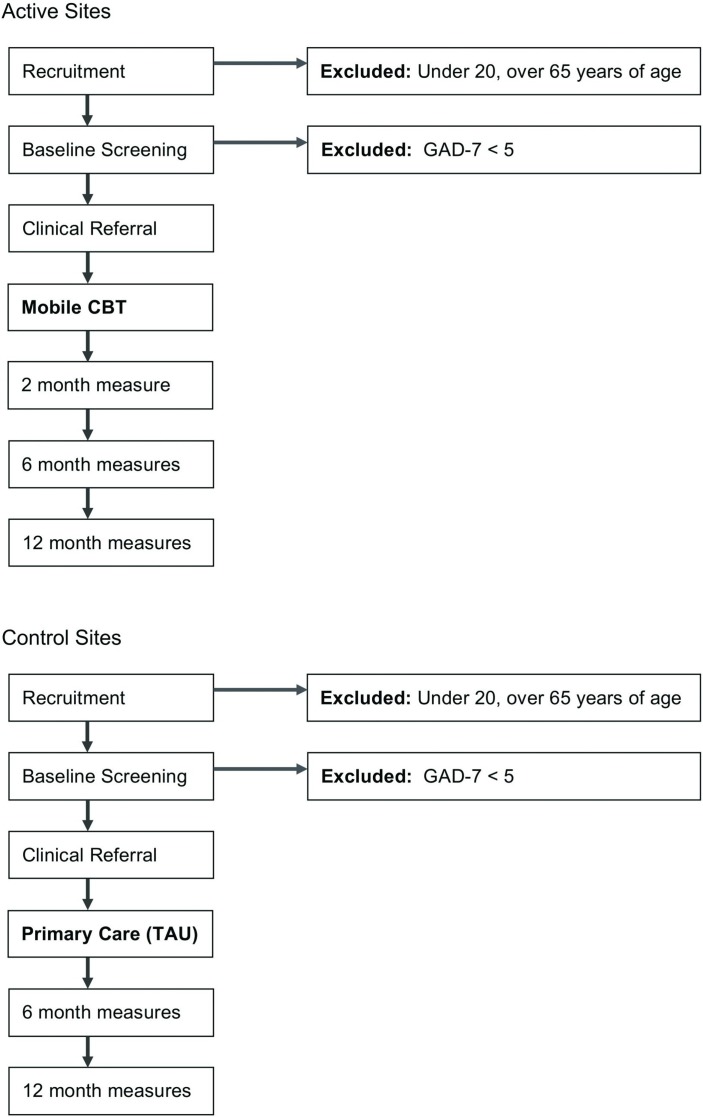
Introduction Generalised anxiety disorder (GAD) and subclinical GAD are highly prevalent in primary care. Unmanaged anxiety worsens quality of life in patients seen in primary care practices and leads to increased medical utilisation and costs. Programmes that teach patients cognitive-behavioural therapy (CBT) techniques have been shown to improve anxiety and to prevent the evolution of anxiety symptoms to disorders, but access and engagement have hampered integration of CBT into medical settings. Methods and analysis This pragmatic study takes place in University of Pittsburgh Medical Center primary care practices to evaluate a coach-supported mobile cognitive- behavioural programme (Lantern) on anxiety symptoms and quality of life. Clinics were non-randomly assigned to either enhanced treatment as usual or Lantern. All clinics provide electronic screening for anxiety and, within clinics assigned to Lantern, patients meeting a threshold level of mild anxiety (ie, >5 on Generalised Anxiety Disorder 7-Item Questionnaire (GAD-7)) are referred to Lantern. The first study phase is aimed at establishing feasibility, acceptability and effectiveness. The second phase focuses on long-term impact on psychosocial outcomes, healthcare utilisation and clinic/provider adoption/sustainable implementation using a propensity score matched parallel group study design. Primary outcomes are changes in anxiety symptoms (GAD-7) and quality of life (Short-Form Health Survey) between baseline and 6-month follow-ups, comparing control and intervention. Secondary outcomes include provider and patient satisfaction, patient engagement, durability of changes in anxiety symptoms and quality of life over 12 months and the impact of Lantern on healthcare utilisation over 12 months. Patients from control sites will be matched to the patients who use the mobile app. Ethics and dissemination Ethics and human subject research approval were obtained. A data safety monitoring board is overseeing trial data and ethics. Results will be communicated to participating primary care practices, published and presented at clinical and scientific conferences. Trial registration number NCT03035019. © Article author(s) (or their employer(s) unless otherwise stated in the text of the article) 2018. All rights reserved. No commercial use is permitted unless otherwise expressly granted.
Overview
CoChat Summary
TL;DR
This is a 2018 non-randomised pragmatic protocol evaluating Lantern, a coach-supported mobile CBT programme, versus enhanced treatment as usual for anxious adults in four primary care practices. The study aims to test feasibility/acceptability and whether Lantern improves GAD-7 anxiety scores and SF-12 quality of life over 6 months, with additional 12-month and implementation outcomes.
Key findings
- Not stated in the paper.
- The protocol sets feasibility criteria of: among the first 50 patients, at least 50% of eligible participants should accept participation, and at least 50% of participants who initiate Lantern should complete at least three techniques.
- The study is powered assuming 1,200 patients meet entry criteria, with approximately 50% attrition over 6 months (n=600 remaining); with n=1,200 and an intracluster correlation of 0.20, the authors expect 0.80 power to detect between-group differences of d=0.43 and 0.90 power for d=0.49.
- In the smaller 6-month follow-up sample (n=150 per site), they expect 0.80 power to detect d=0.45 and 0.90 power to detect d=0.52.
Methods
- Prospective pragmatic two-arm parallel comparison trial at four University of Pittsburgh Medical Center primary care sites; sites were non-randomly assigned to Lantern or enhanced treatment as usual.
- Patients aged 20–65 years were screened in routine care with GAD-7 and SF-12; those with GAD-7 ≥5 and smartphone/tablet access were eligible, and control-site patients were later propensity score matched to Lantern participants.
- Main analyses use mixed-effects models for repeated measures with intent-to-treat and per-protocol analyses; qualitative semistructured interviews with a subset of 24 Lantern-offered participants are thematically analyzed.
Limitations
- The paper states the design is non-randomised, so clinic setting and provider differences cannot be fully controlled by randomisation.
- The paper states there is limited standardisation in how primary care providers prescribe/recommend Lantern, and the study will have limited data to evaluate provider interaction effects.
- Evident from the protocol: missing data may be substantial because there are no participant reimbursements or recruitment incentives, and the authors explicitly expect about 50% attrition over 6 months.
Model-written summary. Check it against the paper before relying on it.
Integrity signals
Registry
Cites
Statistics
Figures
Verification
Claims the paper makes
8 Valid · 0 Not valid · 17 Not checked · 18 Own results and interpretations
The cited sources support only part of this claim — read each source’s verdict below.
In the paper
“Primary care and specialist medical providers are busy, do not have straightforward access to behavioural treatment for their patients and patients are often not compliant even if referred for behavioural health services.5”
§ A study protocol for a non-randomised comparison trial evaluating the feasibility and effectiveness of a mobile cognitive–behavioural programme with integrated coaching for anxious adults in primary care > Introduction
What the sources say
- Partly supportedcites [5] Kroenke, 2017, Closing the false divide: sustainable approaches to integrating mental health services into primary care, J Gen Intern Med sourceExperimental — accuracy not yet measured
The Primary Care Integration Rationale and Barriers section describes a shortage of mental health specialists and barriers that limit primary care providers’ ability to arrange or deliver mental health treatment. That supports the claim for primary care providers, but the cited passages do not establish the same lack of access for specialist medical providers. Page numbers are not available in our copy. (LLM, conf=0.84)
plain- Asserted: passes — The authors put it forward as true.
- Checkable: passes — It can be checked against evidence.
- Load-bearing: passes — The paper’s conclusions depend on it.
- Based: passes — The paper gives a reason why it holds.
- Partly supported
The cited sources support only part of this claim — read each source’s verdict below.
In the paper
“Primary care and specialist medical providers are busy, do not have straightforward access to behavioural treatment for their patients and patients are often not compliant even if referred for behavioural health services.5”
§ A study protocol for a non-randomised comparison trial evaluating the feasibility and effectiveness of a mobile cognitive–behavioural programme with integrated coaching for anxious adults in primary care > Introduction
What the sources say
- Partly supportedcites [5] Kroenke, 2017, Closing the false divide: sustainable approaches to integrating mental health services into primary care, J Gen Intern Med sourceExperimental — accuracy not yet measured
The ‘Primary Care Integration Rationale and Barriers’ section (page unavailable) describes some patients’ reluctance to accept a mental health referral. That supports a referral barrier, but it does not establish that patients are often noncompliant after being referred for behavioral health services. (LLM, conf=0.84)
plain- Asserted: passes — The authors put it forward as true.
- Checkable: passes — It can be checked against evidence.
- Load-bearing: passes — The paper’s conclusions depend on it.
- Based: passes — The paper gives a reason why it holds.
- Partly supported
The cited sources support only part of this claim — read each source’s verdict below.
In the paper
“Lantern is based on empirically supported cognitive–behavioural protocols for GAD,35–38 developed in partnership with academic investigators to target symptoms of stress and anxiety for the general population.”
§ A study protocol for a non-randomised comparison trial evaluating the feasibility and effectiveness of a mobile cognitive–behavioural programme with integrated coaching for anxious adults in primary care > Methods > Intervention
What the sources say
- Not checked — no full text of the sourcecites [35] source
- Partly supportedcites [36] sourceExperimental — accuracy not yet measured
The Therapy Conditions section describes a CBT protocol for GAD, and the Abstract reports results from a randomized trial of that treatment. The paper does not identify Lantern or say that Lantern was based on the protocol, so it supports the protocol’s empirical basis but not the claimed link to Lantern. (LLM, conf=0.84)
- Not checked — no full text of the sourcecites [37] Newman, 1995, Cognitive behavioral treatment of generalized anxiety disorder, Clin Psychol Rev source
- Not checked — no full text of the sourcecites [38] Newman M , disorder G . Hersen M MB , ed. Effective brief therapies: a clinician’s guide. San Diego, CA: Academic Press, 2000:157–78. source
plain- Asserted: passes — The authors put it forward as true.
- Checkable: passes — It can be checked against evidence.
- Load-bearing: passes — The paper’s conclusions depend on it.
- Based: passes — The paper gives a reason why it holds.
The cited sources support only part of this claim — read each source’s verdict below.
In the paper
“While outcomes are promising with small trial populations for anxiety and depression, existing digital programmes have struggled with engagement and adherence, making it difficult to scale to large populations effectively.25”
§ A study protocol for a non-randomised comparison trial evaluating the feasibility and effectiveness of a mobile cognitive–behavioural programme with integrated coaching for anxious adults in primary care > Introduction
What the sources say
- Partly supportedcites [25] sourceExperimental — accuracy not yet measured
The Introduction says many patients offered cCBT do not access it or make minimal use of it, and the Discussion (Comparison with other studies) reports low uptake despite telephone support. The paper’s large primary-care trial supports concern about engagement with cCBT for depression, but it does not establish that digital programmes generally—including those for anxiety—are difficult to scale to large populations. (LLM, conf=0.82)
plainstates a cause- Asserted: passes — The authors put it forward as true.
- Checkable: passes — It can be checked against evidence.
- Load-bearing: passes — The paper’s conclusions depend on it.
- Based: passes — The paper gives a reason why it holds.
- Partly supported
In the paper
“In fact, it is in the primary care setting that most mental health disorders are addressed and treated.4 5”
§ A study protocol for a non-randomised comparison trial evaluating the feasibility and effectiveness of a mobile cognitive–behavioural programme with integrated coaching for anxious adults in primary care > Introduction
What the sources say
- Not matchedcites 4 5
Couldn’t be matched to a paper in Crossref, so it can’t be checked.
plain- Asserted: passes — The authors put it forward as true.
- Checkable: passes — It can be checked against evidence.
- Load-bearing: unclear — It is unclear whether the paper’s conclusions depend on it.
- Based: passes — The paper gives a reason why it holds.
- Not matched
11 more claims
Create a free account to see all 43 claims and every source verdict.
- Probably not a substantial claim. 24
- It may state two separate claims as one. 8
Self-check
Percentages, sums and reported differences re-computed from the paper’s own numbers.
Each contradiction between two passages listed here was confirmed by an independent check.
Rated minor: it would not touch a result — a value no result rests on, a p-value that stays on the same side of the significance level, or a conflict that is clerical, resolved elsewhere in the paper, or outside its own findings.
In the paper
§ A study protocol for a non-randomised comparison trial evaluating the feasibility and effectiveness of a mobile cognitive–behavioural programme with integrated coaching for anxious adults in primary care > Methods > Intervention
“If any participant endorses ≥15 on the GAD-7 during follow-up study or clinic assessments, primary care clinic staff will be notified via an electronic medical record alert and will also be alerted by the PI.”
§ A study protocol for a non-randomised comparison trial evaluating the feasibility and effectiveness of a mobile cognitive–behavioural programme with integrated coaching for anxious adults in primary care > Methods > Safety
“For patients with significantly worsening anxiety (GAD-7 score >15), the PI will be notified and communicated with the clinical team.”
Citations
Cites
A Brief Measure for Assessing Generalized Anxiety Disorder: The GAD-7
Spitzer, R. L., Kroenke, K., Williams, J. B. W., & Löwe, B. (2006) · Archives of Internal Medicine · doi:10.1001/archinte.166.10.1092 · Cited by 31,765 · cited 1×
“Generalised anxiety symptom severity The GAD-7 is a 7-item validated self-report questionnaire used to identify probable cases of GAD and screening for the diagnosis of GAD according to Diagnostic and Statistical Manual of Mental Disorders, Fourth Edition (DSMIV) criteria.(39) The questionnaire asks respondents to rat…”
MethodAnxiety disorders in primary care: prevalence, impairment, comorbidity, and detection
Kroenke, K., Spitzer, R. L., Williams, J. B. W., Monahan, P. O., & Löwe, B. (2007) · Annals of Internal Medicine · doi:10.7326/0003-4819-146-5-200703060-00004 · Cited by 4,741 · cited 1×
“In primary care settings, this shortage is even greater.(11) 12 Most current behavioural treatment models involve faceto-face sessions and are delivered individually, making it difficult to scale them adequately to address increased demand.”
BackgroundCross-Validation of Item Selection and Scoring for the SF-12 Health Survey in Nine Countries
Gandek, B., Ware, J. E., Aaronson, N. K., Apolone, G., Bjorner, J. B., Brazier, J. E., Bullinger, M., Kaasa, S., Leplege, A., Prieto, L., et al. (1998) · Journal of Clinical Epidemiology · doi:10.1016/s0895-4356(98)00109-7 · Cited by 2,907
Assessment of client/patient satisfaction: development of a general scale
Larsen, D. L., Attkisson, C. C., Hargreaves, W. A., & Nguyen, T. D. (1979) · Evaluation and Program Planning · doi:10.1016/0149-7189(79)90094-6 · Cited by 2,887 · cited 2×
“It is adapted from the Client Satisfaction Questionnaire.”
MethodInternet-based cognitive behaviour therapy for symptoms of depression and anxiety: A meta-analysis
SPEK, V., CUIJPERS, P., NYKLÍČEK, I., RIPER, H., KEYZER, J., & POP, V. (2007) · Psychological Medicine · doi:10.1017/s0033291706008944 · Cited by 1,586
Computer-based psychological treatments for depression: A systematic review and meta-analysis
Richards, D., & Richardson, T. (2012) · Clinical Psychology Review · doi:10.1016/j.cpr.2012.02.004 · Cited by 1,442
Katon, W., Lin, E. H. B., & Kroenke, K. (2007) · General Hospital Psychiatry · doi:10.1016/j.genhosppsych.2006.11.005 · Cited by 965
The Descriptive Epidemiology of Commonly Occurring Mental Disorders in the United States
Kessler, R. C., & Wang, P. S. (2008) · Annual Review of Public Health · doi:10.1146/annurev.publhealth.29.020907.090847 · Cited by 888 · cited 1×
“4%.(1) Depression and anxiety disorders are the most common psychiatric disorders in the general population and major drivers of healthcare costs.”
BackgroundEhde, D. M., Dillworth, T. M., & Turner, J. A. (2014) · American Psychologist · doi:10.1037/a0035747 · Cited by 879
Edinger, J. D., Wohlgemuth, W. K., Radtke, R. A., Marsh, G. R., & Quillian, R. E. (2001) · JAMA · doi:10.1001/jama.285.14.1856 · Cited by 625
Cited by
Smartphone Apps for the Treatment of Mental Disorders: Systematic Review
Miralles, I., Granell, C., Díaz-Sanahuja, L., Van Woensel, W., Bretón-López, J., Mira, A., Castilla, D., & Casteleyn, S. (2020) · JMIR mHealth and uHealth · doi:10.2196/14897 · Cited by 188
“Agoraphobia Free; Stress Free [122], Ångesthjälpen [123], AnxietyCoach [124], CBT Assistant [125], Challenger [126], Lantern [127], PsychAssist [128], Public Speech Trainer (PST) [129], SmartCAT [130], GET.”
BackgroundHuman Support in App-Based Cognitive Behavioral Therapies for Emotional Disorders: Scoping Review
Bernstein, E. E., Weingarden, H. M., Wolfe, E. C., Hall, M. D., Snorrason, Í., & Wilhelm, S. (2022) · Journal of Medical Internet Research · doi:10.2196/33307 · Cited by 66
Leong, Q. Y., Sridhar, S., Blasiak, A., Tadeo, X., Yeo, G., Remus, A., & Ho, D. (2021) · Journal of Medical Internet Research · doi:10.2196/27388 · Cited by 40
“7% (145/8362) of articles (Multimedia Appendix 2 [22-166]).”
Silfee, V., Williams, K. R., Leber, B. D., Kogan, J. N., Nikolajski, C., Szigethy, E., & Serio, C. D. (2021) · JMIR Formative Research · doi:10.2196/28538 · Cited by 31
“By leveraging the unique position and commitment of an integrated payer-provider health system and its quality improvement efforts to enhance patient and provider experience, scale digital interventions, and ultimately improve health [33], we were able to illuminate key barriers and facilitators from the perspective o…”
BackgroundSelf-citationBai, P. (2023) · Journal of Cancer · doi:10.7150/jca.82632 · Cited by 25
“Alterations in emotion, behavior, and cognition following CBT/iCBT are connected to metabolic changes within associated brain regions[95].”
Background
Metadata
- Authors
- Szigethy, E., Solano, F., Wallace, M., Perry, D. L., Morrell, L., Scott, K., Bell, M. J., & Oser, M.
- Affiliations
- University of Pittsburgh (US)
- UPMC Health System (US)
- Lantern, San Francisco, California, USA
- Department of Psychiatry and Behavioral Sciences, Stanford University, Stanford, California, USA
- Harvard University (US)
- Corresponding author
- Oser, Megan
- Venue
- BMJ Open
- Publisher
- BMJ
- Published
- 2018-01
- Volume
- 8
- Issue
- 1
- Pages
- e019108
- ISSN
- 2044-6055 (ISSN-L)
- PMC
- PMC5781102
- OpenAlex
- W2784244387
- Cited by
- 10
- References
- 56
- Citations by year
- 2024: 1 · 2023: 1 · 2022: 1 · 2021: 2 · 2020: 1 · 2019: 1 · 2018: 3
- FWCI
- 2.21
- Type
- journal article
- Language
- en
- Open access
- gold
- doi.org
- Licence
- cc-by-nc
- Locations
- BMJ Open (publishedVersion, cc-by-nc)
- PubMed Central (publishedVersion, cc-by-nc)
- PubMed (publishedVersion)
- Funders
- UPMC Enterprises
- Topics
- Social Sciences › Psychology › Applied Psychology › Digital Mental Health Interventions
- Social Sciences › Psychology › Experimental and Cognitive Psychology › Anxiety, Depression, Psychometrics, Treatment, Cognitive Processes
- Health Sciences › Health Professions › General Health Professions › Mobile Health and mHealth Applications
- Keywords
- generalized anxiety disorder, subclinical anxiety, coaching, primary care, feasibility and acceptability, quality of life, health care utilization, implementation, electronic screening, GAD-7, patient engagement
- MeSH terms
- Activities of Daily Living, Adult, Aged, Anxiety, Anxiety Disorders, Cognition, Feasibility Studies, Female, Humans, Male, Middle Aged, Patient Acceptance of Health Care, Primary Health Care, Quality of Life, Surveys and Questionnaires, Research Design, Program Evaluation, Cognitive Behavioral Therapy, Treatment Outcome, Telemedicine, Young Adult
About these checks
Registry, retraction, Cites and statistics results are computed, not judged, with one exception: a printed reference that no index lists is read once by a model before it counts as a citation error. Claims are extracted by a model and kept only when their quote appears verbatim in the text; each cited source is then checked, with a model’s help, for whether it says what the claim relies on. Those verdicts can be wrong — read the claim’s quote and the cited source before relying on one.
The claim verdicts this report counts are experimental: their accuracy is not yet measured.
A language model drew the claims from the paper on 2026-10-11, under version 3 of the claim definition (model deepseek-v4.1-flash, prompt extract-v3).
A second model labelled each claim on 2026-10-11 (model jev-1.13-20260917, definition revision gold-guideline-v0.2).
Cited sources are checked with a language model’s help (gpt-6-sol).
Statistics and arithmetic are recomputed, not judged.
Confidence bands are shown only for fields calibrated on our annotated test set. None is calibrated yet, so no band is shown.
What counts as a claim ›How we measure confidence ›How we check this ›
Are you an author, or do you see a problem with this page? Request a review
How to cite
Cite CoChat for the checks on this page, and the paper for its own findings.
- This page
- CoChat. (2026). Citation check: A study protocol for a non-randomised comparison trial evaluating the feasibility and effectiveness of a mobile cognitive-behavioural programme with integrated coaching for anxious adults in primary care. https://app.cochat.ai/papers/10.1136/bmjopen-2017-019108
- The paper
- Szigethy, E., Solano, F., Wallace, M., Perry, D. L., Morrell, L., Scott, K., Bell, M. J., & Oser, M. (2018). A study protocol for a non-randomised comparison trial evaluating the feasibility and effectiveness of a mobile cognitive-behavioural programme with integrated coaching for anxious adults in primary care. BMJ Open. https://doi.org/10.1136/bmjopen-2017-019108
Data sources
Bibliographic data: Semantic Scholar, OpenAlex, Crossref.
Contains information from the Semantic Scholar Academic Graph Datasets, made available under the ODC Attribution License (ODC-BY 1.0).
Semantic Scholar’s data is described in: Kinney, R., et al. (2023). The Semantic Scholar Open Data Platform. arXiv:2301.10140.
