

Role of feasibility and pilot studies in randomised controlled trials: a cross-sectional study
Open accessThe DOI matches its Crossref record; 22 of the 23 references it cites were found in a registry or an index; 4 of the 40 sources its claims cite were checked for support.
Abstract
Objectives: To assess the value of pilot and feasibility studies to randomised controlled trials (RCTs) funded by the National Institute for Health Research (NIHR) Health Technology Assessment (HTA) programme. To explore the methodological components of pilot/feasibility studies and how they inform full RCTs. Study design: Cross-sectional study. Setting: Both groups included NIHR HTA programme funded studies in the period 1 January 2010–31 December 2014 (decision date). Group 1: stand-alone pilot/feasibility studies published in the HTA Journal or accepted for publication. Group 2: all funded RCT applications funded by the HTA programme, including reference to an internal and/or external pilot/feasibility study. The methodological components were assessed using an adapted framework from a previous study. Main outcome measures: The proportion of stand-alone pilot and feasibility studies which recommended proceeding to full trial and what study elements were assessed. The proportion of ‘HTA funded’ trials which used internal and external pilot and feasibility studies to inform the design of the trial. Results: Group 1 identified 15 stand-alone pilot/feasibility studies. Study elements most commonly assessed were testing recruitment (100% in both groups), feasibility (83%, 100%) and suggestions for further study/investigation (83%, 100%). Group 2 identified 161 ‘HTA funded’ applications: 59 cited an external pilot/feasibility study where testing recruitment (50%, 73%) and feasibility (42%, 73%) were the most commonly reported study elements: 92 reported an internal pilot/feasibility study where testing recruitment (93%, 100%) and feasibility (44%, 92%) were the most common study elements reported. Conclusions: ‘HTA funded’ research which includes pilot and feasibility studies assesses a variety of study elements. Pilot and feasibility studies serve an important role when determining the most appropriate trial design. However, how they are reported and in what context requires caution when interpreting the findings and delivering a definitive trial.
Overview
CoChat Summary
TL;DR
In a cross-sectional review of NIHR HTA-funded studies (2010–2014), pilot and feasibility studies commonly assessed testing recruitment and feasibility, with pilot studies assessing more design elements than feasibility studies. The authors conclude these studies help determine trial design, but inconsistent terminology and reporting limit interpretation and require caution when extrapolating to definitive trials.
Key findings
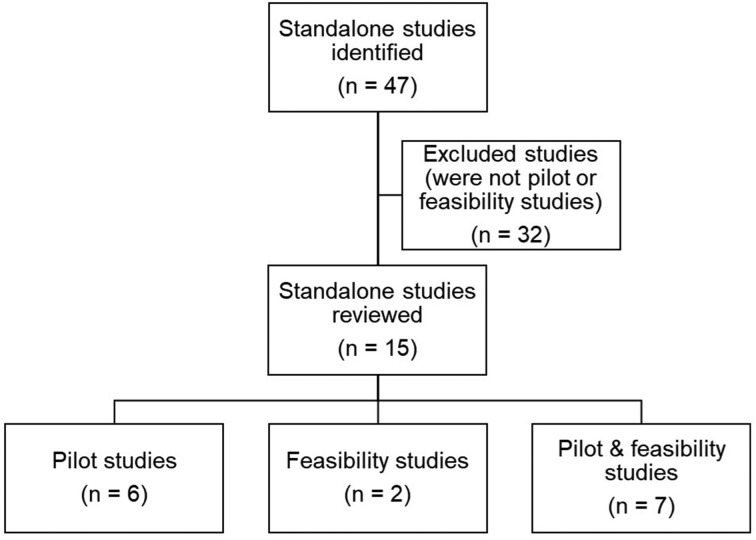
- Group 1 identified 15 stand-alone pilot/feasibility studies; testing recruitment was assessed in 100%, feasibility in 83%/100%, and suggestions for further study/investigation in 83%/100% (abstract). The median number of participants was 46.
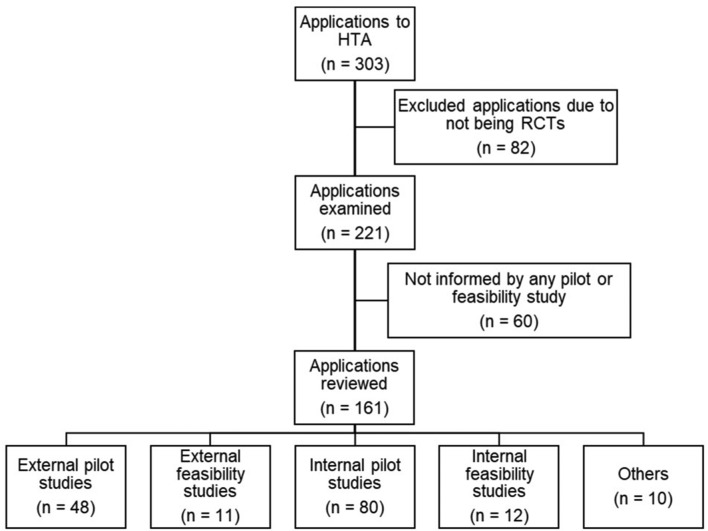
- Group 2 identified 161 HTA-funded applications: 59 cited an external pilot/feasibility study, where testing recruitment (50%, 73%) and feasibility (42%, 73%) were most commonly reported; 92 reported an internal pilot/feasibility study, where testing recruitment (93%, 100%) and feasibility (44%, 92%) were most common.
- Pilot studies assessed more study elements than feasibility studies: in group 1, 13 of 15 elements were assessed in stand-alone pilot studies versus 9 in feasibility studies; in group 2, external pilot studies assessed all 17 elements versus 13 for external feasibility studies, and internal pilot studies assessed 14 of 17 versus 10 for internal feasibility studies.
- Seven of the 15 stand-alone studies used the terms “pilot” and “feasibility” interchangeably, making it difficult to determine study type even with NIHR definitions.
Methods
- Retrospective cross-sectional study of the NIHR HTA Programme over a 5-year period (fund decision dates 1 January 2010–31 December 2014). Group 1 comprised stand-alone pilot/feasibility studies published in the HTA Journal or accepted for publication; group 2 comprised funded HTA RCT applications referencing an internal and/or external pilot/feasibility study.
- Data were extracted using an adapted framework from Arain et al (15 study elements in group 1; 17 in group 2), piloted on 10 studies, and analysed with descriptive statistics in SPSS; quality assurance included double extraction and consensus resolution of disagreements.
- There was no patient or public involvement, and no participant recruitment; all data came from published articles or HTA application forms.
Limitations
- The paper states that although data cover 5 years, the number of eligible studies is small and only reports from one NIHR programme are included; the adapted framework limits direct comparison with Arain et al; reliance on applicant reporting may have under-reported assessed elements and recommendations; internal pilot/feasibility outcomes were unavailable because the application form was the data source; and external pilot participant numbers were often missing and were not retrieved from original articles.
- Evident from the text: the cross-sectional design cannot determine whether pilot/feasibility recommendations influenced successful completion of definitive trials, and the authors note that without reviewing impact once the trial commences, there is no way to know whether preliminary work was instrumental in trial completion.
Model-written summary. Check it against the paper before relying on it.
Integrity signals
Registry
Cites
Statistics
Figures
Verification
Claims the paper makes
2 Valid · 1 Not valid · 28 Not checked · 52 Own results and interpretations
A result the paper reports from its own data — it cites no other source for it, so there is none to check. The quote shows it is in the paper.
In the paper
“Study elements most commonly assessed were testing recruitment (100% in both groups), feasibility (83%, 100%) and suggestions for further study/investigation (83%, 100%).”
plain- Asserted: passes — The authors put it forward as true.
- Checkable: passes — It can be checked against evidence.
- Load-bearing: unclear — It is unclear whether the paper’s conclusions depend on it.
- Based: passes — The paper gives a reason why it holds.
A result the paper reports from its own data — it cites no other source for it, so there is none to check. The quote shows it is in the paper.
In the paper
“The number of reported recommended changes based on the results of the external pilot or feasibility study was however minimal.”
plain- Asserted: passes — The authors put it forward as true.
- Checkable: passes — It can be checked against evidence.
- Load-bearing: unclear — It is unclear whether the paper’s conclusions depend on it.
- Based: passes — The paper gives a reason why it holds.
- Rests on an assumption not shown here.
A result the paper reports from its own data — it cites no other source for it, so there is none to check. The quote shows it is in the paper.
In the paper
“1. External pilot studies (n=48). 2. External feasibility studies (n=11). 3. Internal pilot studies (n=80). 4. Internal feasibility studies (n=12). 5. Other (n=10).”
plain- Asserted: passes — The authors put it forward as true.
- Checkable: passes — It can be checked against evidence.
- Load-bearing: unclear — It is unclear whether the paper’s conclusions depend on it.
- Based: passes — The paper gives a reason why it holds.
A result the paper reports from its own data — it cites no other source for it, so there is none to check. The quote shows it is in the paper.
In the paper
“We found that 13 of the 15 study elements included in the adapted framework were assessed in standalone pilot studies compared with nine study elements in feasibility studies.”
plainstates an association- Asserted: passes — The authors put it forward as true.
- Checkable: passes — It can be checked against evidence.
- Load-bearing: passes — The paper’s conclusions depend on it.
- Based: passes — The paper gives a reason why it holds.
A result the paper reports from its own data — it cites no other source for it, so there is none to check. The quote shows it is in the paper.
In the paper
“In both groups, we found pilot studies assessed more study elements than feasibility studies.”
- Also stated in: § Discussion · p. 7 · plain
“external and internal pilot studies were used to assess more study elements than feasibility studies.”
plain- Asserted: passes — The authors put it forward as true.
- Checkable: passes — It can be checked against evidence.
- Load-bearing: passes — The paper’s conclusions depend on it.
- Based: passes — The paper gives a reason why it holds.
- Also stated in: § Discussion · p. 7 · plain
23 more claims
Create a free account to see all 83 claims and to verify the 36 references still open.
- Probably not a substantial claim. 42
- It may state two separate claims as one. 26
Claims other papers make about this one
Each is checked against this paper’s own text: does it say what the citing paper says it does?
The source backs part of the claim, not all of it — or backs it for a different population, condition or comparison.
In the citing paper
“Feasibility trials are paramount to test recruitment strategies, acceptability of study design and viability of eligibility criteria, thus consequently informing the progression of large-scale definitive clinical trials [11].”
From Recruitment of low-income pregnant women into a dietary and dental care intervention: lessons from a feasibility trial (2020) · cites this paper as [11]
Experimental — accuracy not yet measuredThe source backs part of the claim, not all of it — or backs it for a different population, condition or comparison.
In the citing paper
“This tallies with the review by Blatch-Jones et al. [31] who reported that testing recruitment, determining the sample size and numbers available, and the intervention feasibility were the most commonly used targets of pilot evaluations.”
From Determining sample size for progression criteria for pragmatic pilot RCTs: the hypothesis test strikes back! (2021) · cites this paper as [31]
Experimental — accuracy not yet measured
Citations
Cites
Developing and evaluating complex interventions: the new Medical Research Council guidance
Craig, P., Dieppe, P., Macintyre, S., Michie, S., Nazareth, I., & Petticrew, M. (2008) · BMJ · doi:10.1136/bmj.a1655 · Cited by 10,995 · cited 1×
“However, the guidance did not attempt to explain or provide any definition for the terms ‘pilot’ and ‘feasibility’.(7) It was not until 2 years later that Thabane et al reviewed the key aspects of pilot studies and provided a detailed account of pilot studies which included a number of definitions.”
BackgroundCONSORT 2010 statement: extension to randomised pilot and feasibility trials.
Eldridge, S. M., Chan, C. L., Campbell, M. J., Bond, C. M., Hopewell, S., Thabane, L., & Lancaster, G. A. (2016) · BMJ · doi:10.1136/bmj.i5239 · Cited by 3,404
A tutorial on pilot studies: the what, why and how
Thabane, L., Ma, J., Chu, R., Cheng, J., Ismaila, A., Rios, L. P., Robson, R., Thabane, M., Giangregorio, L., & Goldsmith, C. H. (2010) · BMC Medical Research Methodology · doi:10.1186/1471-2288-10-1 · Cited by 3,384
CONSORT 2010 statement: extension to randomised pilot and feasibility trials
on behalf of the PAFS consensus group, Eldridge, S. M., Chan, C. L., Campbell, M. J., Bond, C. M., Hopewell, S., Thabane, L., & Lancaster, G. A. (2016) · Pilot and Feasibility Studies · doi:10.1186/s40814-016-0105-8 · Cited by 2,843
Design and analysis of pilot studies: recommendations for good practice
Lancaster, G. A., Dodd, S., & Williamson, P. R. (2004) · Journal of Evaluation in Clinical Practice · doi:10.1111/j..2002.384.doc.x · Cited by 2,572 · cited 1×
“Lancaster et al and Arain et al provided a methodological framework to assess how pilot studies are used to inform the conduct and reporting of pilot studies.(5) 10 Both described the challenges and complexities in the reporting of pilot studies.”
Avoidable waste in the production and reporting of research evidence
Chalmers, I., & Glasziou, P. (2009) · The Lancet · doi:10.1016/s0140-6736(09)60329-9 · Cited by 2,208
Whitehead, A. L., Julious, S. A., Cooper, C. L., & Campbell, M. J. (2016) · Statistical Methods in Medical Research · doi:10.1177/0962280215588241 · Cited by 1,936
Developing and evaluating complex interventions: the new Medical Research Council guidance
Craig, P., Dieppe, P., Macintyre, S., Michie, S., Nazareth, I., & Petticrew, M. (2013) · International Journal of Nursing Studies · doi:10.1016/j.ijnurstu.2012.09.010 · Cited by 1,658
Increasing value and reducing waste in research design, conduct, and analysis
Ioannidis, J. P. A., Greenland, S., Hlatky, M. A., Khoury, M. J., Macleod, M. R., Moher, D., Schulz, K. F., & Tibshirani, R. (2014) · The Lancet · doi:10.1016/s0140-6736(13)62227-8 · Cited by 1,597 · cited 1×
“For example, the Lancet series in 2014 did not make reference to the usefulness of pilot and feasibility studies in the context of increasing value and reducing waste in research design, conduct or analysis.(9) Lancaster et al and Arain et al provided a methodological framework to assess how pilot studies are used to…”
Eldridge, S. M., Lancaster, G. A., Campbell, M. J., Thabane, L., Hopewell, S., Coleman, C. L., & Bond, C. M. (2016) · PLOS ONE · doi:10.1371/journal.pone.0150205 · Cited by 1,581 · cited 3×
“However, it is important to note that the Eldridge et al conceptual framework is slightly different from that adopted by the NIHR.16 The clear lack of dichotomy between pilot and feasibility studies is an area for future consideration, not only for funders to encourage more conformity to the published definitions, but…”
ResultInfluential
Cited by
Items 101–143 of 143
Scannell, F., Esterhuizen, T. M., Naidoo, R., & Chetty, S. (2023) · Southern African Journal of Anaesthesia and Analgesia · doi:10.36303/sajaa.2858
(2023) · Scientific Papers of Silesian University of Technology Organization and Management Series · doi:10.29119/1641-3466.2023.175.9
Spacey, H. (2024) · Cronfa (Swansea University) · doi:10.23889/suthesis.67899
Sjöberg, V., Monnier, A., Tseli, E., LoMartire, R., Hagströmer, M., Björk, M., Äng, B. O., & Vixner, L. (2024) · Digital Health · doi:10.1177/20552076241299648
Optimizing the question: Balancing significance and feasibility
Ibrahim, M., & Alnajar, A. (2025) · Elsevier eBooks · doi:10.1016/b978-0-323-91790-2.00042-3
Prieto‐Moreno, R., Mora‐Traverso, M., Moreno-Ramírez, M. P., Ayuso, D. M. R., Martín‐Martín, L., & Ariza‐Vega, P. (2025) · BMC Medical Education · doi:10.1186/s12909-025-06963-9
“Feasibility studies play an important role when determining the most appropriate trial design [31].”
Ciello, H. D. V., & Santos, A. N. D. (2025) · Pediatric Physical Therapy · doi:10.1097/pep.0000000000001190
Akter, N., & Islam, G. M. N. (2025) · International Journal of Academic Research in Business and Social Sciences · doi:10.6007/ijarbss/v15-i4/25331
“Determining the feasibility of the research design could be approached by conducting a pilot study before starting (Blatch-Jones et al., 2018).”
Calderón, L. M. P., King, G. A., Labbé, A., Lui, T., Maltais, D. B., Mérette, C., Moffet, H., & McPherson, A. C. (2025) · Developmental Neurorehabilitation · doi:10.1080/17518423.2025.2541830
“33 34–37 A health promotion intervention was therefore designed that used SFC-peds for children with SB or CP to enhance their engagement in PA and/or healthy dietary intake: the Children and Teens in Charge of their Health (CATCH) program.”
Gaete, J., Núñez, D., Romo, V., Ramírez, S., Barrera, F. A., & Araya, R. (2025) · Research Square · doi:10.21203/rs.3.rs-5837565/v1
Feasibility and Pilot Studies—A Foundational First Step
Fisher, M. I. (2025) · Rehabilitation Oncology · doi:10.1097/01.reo.0000000000000400
Yang, Y., Green, K. L., Zhang, N., McGarrigle, L., & Todd, C. J. (2025) · Pilot and Feasibility Studies · doi:10.1186/s40814-025-01693-7 · Cited by 1
“A feasibility RCT ensures that a larger trial will be scientifically sound, ethically justified, and resource-efficient [50, 51].”
Young, A. N., Hunt, E., Blasi, Z. D., & Foley, S. (2025) · International Journal of Applied Positive Psychology · doi:10.1007/s41042-025-00262-w
“…in assessing intervention feasibility, acceptability, and procedural integrity prior to the commencement of large randomised controlled trials (Arain et al., 2010; Blatch-Jones et al., 2018; Eldridge et al., 2016; Thabane et al., 2010; National Institute for Health and Care Research [NIHR], 2021).”
Daud, M. H., Ramli, A. S., Abdul-Razak, S., Isa, M. R., Yusoff, F. H., Baharudin, N., Mohamed-Yassin, M. S., Badlishah-Sham, S. F., Nikmat, A. W., Jamil, N., et al. (2020) · Figshare · doi:10.6084/m9.figshare.12085353
Evans, H. E. L., Forbes, C. C., Galvão, D. A., Vandelanotte, C., Newton, R. U., Wittert, G., Chambers, S. K., Vincent, A. D., Kichenadasse, G., Brook, N. R., et al. (2021) · Figshare · doi:10.6084/m9.figshare.13558815
Greidanus, M. A., de Rijk, A. E., de Boer, A. G. E. M., Bos, M. E. M. M., Plaisier, P. W., Smeenk, R. M., Frings‐Dresen, M. H. W., & Tamminga, S. J. (2021) · Figshare · doi:10.6084/m9.figshare.15033382
Greidanus, M. A., de Rijk, A. E., de Boer, A. G. E. M., Bos, M. E. M. M., Plaisier, P. W., Smeenk, R. M., Frings‐Dresen, M. H. W., & Tamminga, S. J. (2021) · Figshare · doi:10.6084/m9.figshare.15033379
Aschbrenner, K. A., Kruse, G. R., Gallo, J. J., & Clark, V. P. (2022) · Figshare · doi:10.6084/m9.figshare.21211348
Ryan, D., Rio, E., O’Donoghue, G., & O'Sullivan, C. M. (2023) · Figshare · doi:10.6084/m9.figshare.22625726
Daud, M. H., Ramli, A. S., Abdul-Razak, S., Isa, M. R., Yusoff, F. H., Baharudin, N., Mohamed-Yassin, M. S., Badlishah-Sham, S. F., Nikmat, A. W., Jamil, N., et al. (2020) · Figshare · doi:10.6084/m9.figshare.12085350
Lewis, M., Bromley, K., Sutton, C., McCray, G., Myers, H. L., & Lancaster, G. A. (2021) · Figshare · doi:10.6084/m9.figshare.13710841
Dunleavy, L., Collingridge Moore, D., Korfage, I., Payne, S., Walshe, C., & Preston, N. J. (2021) · Figshare · doi:10.6084/m9.figshare.13620163
Daud, M. H., Ramli, A. S., Abdul-Razak, S., Isa, M. R., Yusoff, F. H., Baharudin, N., Mohamed-Yassin, M. S., Badlishah-Sham, S. F., Nikmat, A. W., Jamil, N., et al. (2020) · Figshare · doi:10.6084/m9.figshare.12085347
Evans, H. E. L., Forbes, C. C., Galvão, D. A., Vandelanotte, C., Newton, R. U., Wittert, G., Chambers, S. K., Vincent, A. D., Kichenadasse, G., Brook, N. R., et al. (2021) · Figshare · doi:10.6084/m9.figshare.13558812
Yamamoto, K., Kaido, T., Yokoi, T., Shimada, G., Taketa, T., & Nakayama, K. (2022) · Figshare · doi:10.6084/m9.figshare.21321487
Daud, M. H., Ramli, A. S., Abdul-Razak, S., Isa, M. R., Yusoff, F. H., Baharudin, N., Mohamed-Yassin, M. S., Badlishah-Sham, S. F., Nikmat, A. W., Jamil, N., et al. (2020) · Figshare · doi:10.6084/m9.figshare.12085344
Yamamoto, K., Kaido, T., Yokoi, T., Shimada, G., Taketa, T., & Nakayama, K. (2022) · Figshare · doi:10.6084/m9.figshare.21321484
Yamamoto, K., Kaido, T., Yokoi, T., Shimada, G., Taketa, T., & Nakayama, K. (2022) · Figshare · doi:10.6084/m9.figshare.21321490
Evans, H. E. L., Forbes, C. C., Galvão, D. A., Vandelanotte, C., Newton, R. U., Wittert, G., Chambers, S. K., Vincent, A. D., Kichenadasse, G., Brook, N. R., et al. (2021) · Figshare · doi:10.6084/m9.figshare.13558818
Hayama, J., Yamamoto, K., Hirai, K., Yamaguchi, K., Mochizuki, H., & Nakayama, K. (2026) · Journal of Participatory Medicine · doi:10.2196/77782 · Cited by 1
“This type of feasibility work commonly enrolls 10 ‐ 30 participants, which is an adequate range for identifying procedural issues and evaluating the initial signals of effect [20,21].”
Key Features of Contemporary Pilot and Feasibility Trials: Protocol for a Methodological Study
Tøgern, A., Møller, M. H., Perner, A., Kjær, M. N., Eck, R. J., Anthon, C. T., Barakji, J. A., & Granholm, A. (2026) · Acta Anaesthesiologica Scandinavica · doi:10.1111/aas.70228
Mohamed, N., Ramana, K., Digala, P., Prathap, S., Alagesan, J., & Manasa, T. (2026) · AIP conference proceedings · doi:10.1063/5.0312450
STOTZ, S. A., Hebert, L. E., Begay, K., Dennison, M., Shanks, C. B., Berkowitz, S. A., Jiang, L., Lafromboise, J., BEGICK, N., Cunningham, B. K., et al. (2026) · Journal of Nutrition Education and Behavior · doi:10.1016/j.jneb.2026.02.009 · Cited by 1
“33 In addition, approximately 70% of enrolled participants were female, which may limit generalizability to AI/AN men.”
InfluentialAdeola, R. S. (2026) · International Journal on Sustainable Industrial Revolution · doi:10.53982/ijsir.2026.0101.07-j
Chatfield, C., Lafarge, C., & Zannese, A. (2026) · Journal of Evaluation in Clinical Practice · doi:10.1111/jep.70474
Brendel, J. H., Andersen, L. W., Skaarup, S. H., Dissing, T. H., Nielsen, A., Milandt, N. F., Espelund, U. S., Irion, L. F., Mortensen, L. R., Larsen, K. M., et al. (2026) · Acta Anaesthesiologica Scandinavica · doi:10.1111/aas.70269 · Cited by 1
Large trials of psychosocial interventions: examples from individual placement and support
Metcalfe, J. D., Mueser, K. T., & Drake, R. E. (2026) · International Journal of Public Health · doi:10.3389/ijph.2026.1609143
Wami, S. D., Donnelly, C. A., Alemu, K., Tefera, E. A., & Miller, J. (2026) · Pilot and Feasibility Studies · doi:10.1186/s40814-026-01866-y
“Moreover, it addresses the key uncertainties recognized in the development work and feasibility of proceeding to the future definitive RCT [33, 91, 95].”
Behera, D., Jensen, M. P., Gopalakrishna, D. B., Patil, A., & Venkatesan, P. (2026) · International Journal of Clinical and Experimental Hypnosis · doi:10.1080/00207144.2026.2694420 · Cited by 2
O’Donnell, R., Mather, K., Henderson, T., Sinclair, L., Howell, R., McMeekin, N., & Semple, S. E. (2026) · medRxiv · doi:10.64898/2026.08.13.26360348
Tomescu‐Stachie, S., Kirby, S. E., Merwood, A., Sivyer, K., & Al‐Abbadey, M. (2026) · JMIR Research Protocols · doi:10.2196/91900
“Feasibility and pilot studies are also thought of as foundations for later randomized controlled trials, providing critical evidence on design optimization, resource needs, and recruitment strategies [47,48].”
Core concepts in statistics and research methods. Part 8: randomised trials
Hewson, D. W., & Neuman, M. D. (2026) · BJA Education · doi:10.1016/j.bjae.2026.07.001
Einarsson, S., Almståhl, A., Gyllensten, H., Sjöström, M., Mårell, L., Björ, O., Marklund, L., Farnebo, L., Laurell, G. F. E., & Ehrsson, Y. T. (2026) · BMC Cancer · doi:10.1186/s12885-026-16865-8
“The aim is to explore the feasibility and acceptability of the data collection procedures for primary and secondary outcome measures, as well as the intervention itself [33].”
Metadata
- Authors
- Blatch-Jones, A. J., Pek, W., Kirkpatrick, E., & Ashton-Key, M.
- Affiliations
- NIHR Evaluation Trials and Studies Coordinating Centre (GB)
- University of Southampton (GB)
- Corresponding author
- Blatch-Jones, Amanda Jane
- Venue
- BMJ Open
- Publisher
- BMJ
- Published
- 2018-09
- Volume
- 8
- Issue
- 9
- Pages
- e022233
- ISSN
- 2044-6055 (ISSN-L)
- PMC
- PMC6169762
- OpenAlex
- W2894197002
- Semantic Scholar
- 79598fdbecee4cd08d046398dbe63888eb2f6a30
- Cited by
- 139
- References
- 23
- Citations by year
- 2026: 14 · 2025: 15 · 2024: 14 · 2023: 12 · 2022: 18 · 2021: 21 · 2020: 39 · 2019: 6
- FWCI
- 13.69
- Type
- journal article
- Language
- en
- Open access
- gold
- doi.org
- Licence
- cc-by
- Locations
- BMJ Open (publishedVersion, cc-by)
- Europe PMC (PubMed Central) (publishedVersion, other-oa)
- PubMed Central (publishedVersion, cc-by)
- PubMed (publishedVersion)
- ePrints Soton (University of Southampton) (acceptedVersion)
- HighWire Press Open Archive (submittedVersion)
- Funders
- National Institute for Health and Care Research
- Health Technology Assessment Programme
- Topics
- Physical Sciences › Mathematics › Statistics and Probability › Statistical Methods in Clinical Trials
- Social Sciences › Decision Sciences › Statistics, Probability and Uncertainty › Meta-analysis and systematic reviews
- Health Sciences › Health Professions › General Health Professions › Health Policy Implementation Science
- Keywords
- pilot study, feasibility study, randomized controlled trials, trial design, recruitment feasibility, internal pilot study, health technology assessment, trial funding
- MeSH terms
- Feasibility Studies, Humans, Pilot Projects, Research Design, Technology Assessment, Biomedical, Program Evaluation, Randomized Controlled Trials as Topic, Program Development
About these checks
Registry, retraction, Cites and statistics results are computed, not judged, with one exception: a printed reference that no index lists is read once by a model before it counts as a citation error. Claims are extracted by a model and kept only when their quote appears verbatim in the text; each cited source is then checked, with a model’s help, for whether it says what the claim relies on. Those verdicts can be wrong — read the claim’s quote and the cited source before relying on one.
The claim verdicts this report counts are experimental: their accuracy is not yet measured.
A language model drew the claims from the paper on 2026-10-04, under version 3 of the claim definition (model deepseek-v4.1-flash, prompt extract-v3).
A second model labelled each claim on 2026-10-04 (model jev-1.13-20260917, definition revision gold-guideline-v0.2).
Statistics and arithmetic are recomputed, not judged.
Confidence bands are shown only for fields calibrated on our annotated test set. None is calibrated yet, so no band is shown.
What counts as a claim ›How we measure confidence ›How we check this ›
Are you an author, or do you see a problem with this page? Request a review
Data sources
Bibliographic data: Semantic Scholar, OpenAlex, Crossref.
Contains information from the Semantic Scholar Academic Graph Datasets, made available under the ODC Attribution License (ODC-BY 1.0).
Semantic Scholar’s data is described in: Kinney, R., et al. (2023). The Semantic Scholar Open Data Platform. arXiv:2301.10140.
