

Trends in gender and socioeconomic inequalities in mental health following the Great Recession and subsequent austerity policies: a repeat cross-sectional analysis of the Health Surveys for England
Open accessThe DOI matches its Crossref record; 39 of the 40 references it cites were found in a registry or an index.
Abstract
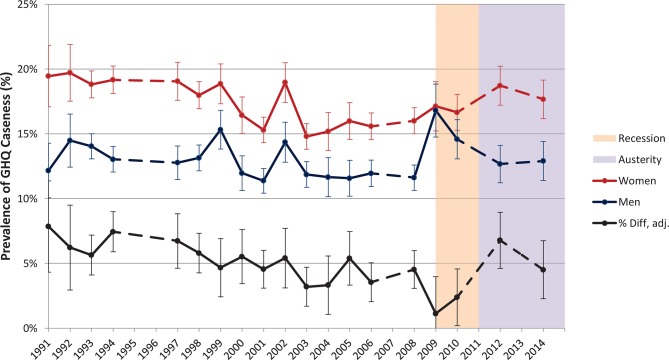
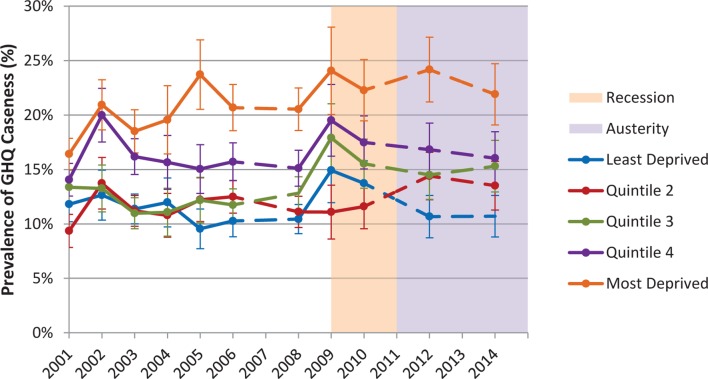
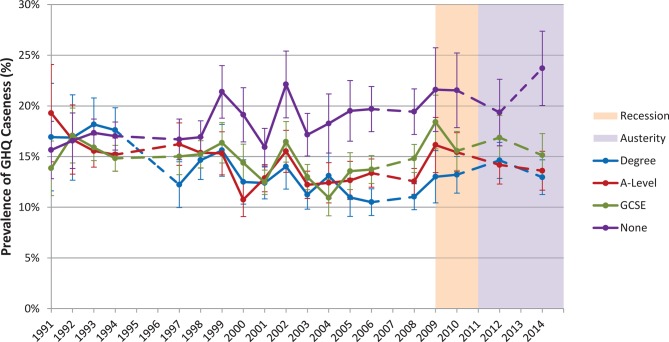
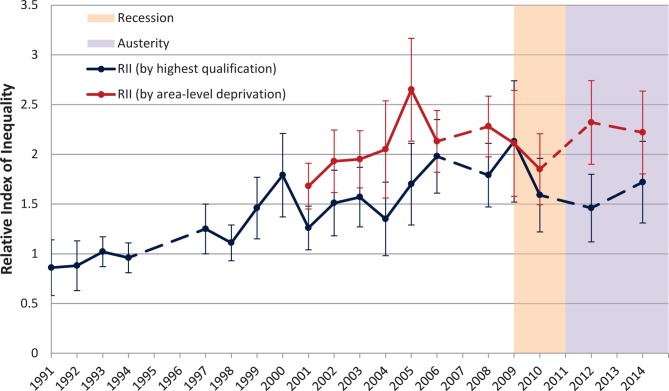
Objective: It is known that mental health deteriorated following the 2008 global financial crisis, and that subsequent UK austerity policies post-2010 disproportionately impacted women and those in deprived areas. We aimed to assess whether gender and socioeconomic inequalities in poor mental health have changed since the onset of austerity policies. Design: Repeat cross-sectional analysis of survey data. Setting: England. Participants: Nationally and regionally representative samples of the working-age population (25–64 years) from the Health Survey for England (1991–2014). Outcome measures: Population-level poor mental health was measured by General Health Questionnaire-12 (GHQ) caseness, stratified by gender and socioeconomic position (area-level deprivation and highest educational attainment). Results: The prevalence of age-adjusted male GHQ caseness increased by 5.9% (95% CI 3.2% to 8.5%, p<0.001) from 2008 to 2009 in the immediate postrecession period, but recovered to prerecession levels after 2010. In women, there was little change in 2009 or 2010, but an increase of 3.0% (95% CI 1.0% to 5.1%, p=0.004) in 2012 compared with 2008 following the onset of austerity. Estimates were largely unchanged after further adjustment for socioeconomic position, employment status and household income as potential mediators. Relative socioeconomic inequalities in GHQ caseness narrowed from 2008 to 2010 immediately following the recession, with Relative Index of Inequality falling from 2.28 (95% CI 1.89 to 2.76, p<0.001) to 1.85 (95% CI 1.43 to 2.38, p<0.001), but returned to prerecession levels during austerity. Conclusions: Gender inequalities in poor mental health narrowed following the Great Recession but widened during austerity, creating the widest gender gap since 1994. Socioeconomic inequalities in poor mental health narrowed immediately postrecession, but this trend may now be reversing. Austerity policies could contribute to widening mental health inequalities.
Overview
The claims and statistics of this paper haven’t been checked yet.
Free: it reads the open-access text and checks the first 5 claims that cite a source we can check. Create a free account to check every claim.
Integrity signals
Registry
Cites
Statistics
Figures
Verification
Claims the paper makes
The claims and statistics of this paper haven’t been checked yet.
Free: it reads the open-access text and checks the first 5 claims that cite a source we can check. Create a free account to check every claim.
Claims other papers make about this one
Each is checked against this paper’s own text: does it say what the citing paper says it does?
In the citing paper
“What we do know with more certainty is that times of crisis or periods of austerity are likely to disadvantage entire cohorts/generations [60], but that this will amplify prior forms of exclusion and marginalisation [3].”
Self-check
Percentages, sums and reported differences re-computed from the paper’s own numbers.
The self-check needs the paper’s full text.
Citations
Cites
The Validity of Two Versions of the GHQ in the WHO Study of Mental Illness in General Health Care
GOLDBERG, D. P., GATER, R., SARTORIUS, N., USTUN, T. B., PICCINELLI, M., GUREJE, O., & RUTTER, C. (1997) · Psychological Medicine · doi:10.1017/s0033291796004242 · Cited by 3,657 · cited 1×
“Outcome measurement Poor mental health was assessed using the General Health Questionnaire-12 (GHQ-12), a validated screening tool for common mental health problems used widely in epidemiological research, which scores self-reported symptoms of anxiety and depression.(24) The GHQ-12 formed part of the core questions i…”
MethodLogistic Regression: Why We Cannot Do What We Think We Can Do, and What We Can Do About It
Mood, C. (2010) · European Sociological Review · doi:10.1093/esr/jcp006 · Cited by 3,158
Gender differences in depression: Critical review
Piccinelli, M., & Wilkinson, G. (2000) · British Journal of Psychiatry · doi:10.1192/bjp.177.6.486 · Cited by 2,376
Stuckler, D., Basu, S., Suhrcke, M., Coutts, A., & McKee, M. (2009) · The Lancet · doi:10.1016/s0140-6736(09)61124-7 · Cited by 1,486 · cited 1×
“IntrODuCtIOn The health and social repercussions of the 2008 Great Recession are still being felt today.(1) 2 Much existing research has focused on the relationship between the economic downturn, rises in unemployment and worsening mental health outcomes.”
BackgroundFinancial crisis, austerity, and health in Europe
Karanikolos, M., Mladovsky, P., Cylus, J., Thomson, S., Basu, S., Stuckler, D., Mackenbach, J. P., & McKee, M. (2013) · The Lancet · doi:10.1016/s0140-6736(13)60102-6 · Cited by 1,387
Precarious Employment: Understanding an Emerging Social Determinant of Health
Benach, J., Vives, A., Amable, M., Vanroelen, C., Tarafa, G., & Muntaner, C. (2014) · Annual Review of Public Health · doi:10.1146/annurev-publhealth-032013-182500 · Cited by 1,354 · cited 1×
“31 The marked divergence for those with no formal qualifications by 2014 may support the hypothesis that those in low-skilled jobs (who are known to experience poorer health outcomes(37)) may be worst affected by reduced in-work financial support or worsening job conditions such as increased insecure work.(38) Their d…”
Background(2016) · City Research Online (City University London) · Cited by 747
Mental health outcomes in times of economic recession: a systematic literature review
Frasquilho, D., Matos, M. G., Salonna, F., Guerreiro, D., Storti, C. C., Gaspar, T., & Caldas-de-Almeida, J. M. (2015) · BMC Public Health · doi:10.1186/s12889-016-2720-y · Cited by 639
Craig, P., Katikireddi, S. V., Leyland, A., & Popham, F. (2017) · Annual Review of Public Health · doi:10.1146/annurev-publhealth-031816-044327 · Cited by 570 · cited 1×
“Cross-national comparisons would also be useful in determining whether observed trends are replicated elsewhere, and whether impacts are dependent on levels of austerity, and natural experiment approaches could strengthen causal inference.(43) Finally, it is clearly important to see whether the observed trajectories i…”
BackgroundSelf-citationWhy GHQ threshold varies from one place to another
GOLDBERG, D. P., OLDEHINKEL, T., & ORMEL, J. (1998) · Psychological Medicine · doi:10.1017/s0033291798006874 · Cited by 467
Cited by
Niedzwiedz, C. L., Green, M. J., Benzeval, M., Campbell, D., Craig, P., Demou, E., Leyland, A., Pearce, A., Thomson, R., Whitley, E., et al. (2021) · Journal of Epidemiology and Community Health · doi:10.1136/jech-2020-215060 · Cited by 525
Self-citationThomson, R. M., Igelström, E., Purba, A. K., Shimonovich, M., Thomson, H., McCartney, G., Reeves, A., Leyland, A., Pearce, A., & Katikireddi, S. V. (2022) · The Lancet Public Health · doi:10.1016/s2468-2667(22)00058-5 · Cited by 304
Self-citationvan der Velden, P. G., Contino, C., Das, M., van Loon, P., & Bosmans, M. W. G. (2020) · Journal of Affective Disorders · doi:10.1016/j.jad.2020.08.026 · Cited by 196
Garrett, J. K., Clitherow, T. J., White, M. P., Wheeler, B. W., & Fleming, L. E. (2019) · Health & Place · doi:10.1016/j.healthplace.2019.102200 · Cited by 175
Serrano‐Alarcón, M., Kentikelenis, A., Mckee, M., & Stuckler, D. (2022) · Health Economics · doi:10.1002/hec.4453 · Cited by 99
Davillas, A., & Jones, A. M. (2021) · Health Economics · doi:10.1002/hec.4275 · Cited by 90
Scott, S., McGowan, V. J., & Visram, S. (2021) · International Journal of Environmental Research and Public Health · doi:10.3390/ijerph18073837 · Cited by 64
Walsh, D., Dundas, R., McCartney, G., Gibson, M., & Seaman, R. (2022) · Journal of Epidemiology & Community Health · doi:10.1136/jech-2022-219645 · Cited by 144
A Longitudinal Nationwide Study of Psychological Distress During the COVID-19 Pandemic in Chile
Duarte, F., & Jiménez-Molina, Á. (2022) · Frontiers in Psychiatry · doi:10.3389/fpsyt.2022.744204 · Cited by 59
Thomson, R., & Katikireddi, S. V. (2018) · Social Science & Medicine · doi:10.1016/j.socscimed.2018.08.034 · Cited by 54
Self-citationKatikireddi, S. V., Hainey, K., & Beale, S. (2021) · The Journal of the Royal College of Physicians of Edinburgh · doi:10.4997/jrcpe.2021.240 · Cited by 46
Self-citationLópez-Atanes, M., Pijoán-Zubizarreta, J. I., González-Briceño, J. P., Leonés-Gil, E. M., Recio-Barbero, M., González-Pinto, A. M., Segarra, R., & Sáenz-Herrero, M. (2021) · Frontiers in Psychiatry · doi:10.3389/fpsyt.2021.692215 · Cited by 38
Williams, E. (2020) · Social Policy and Administration · doi:10.1111/spol.12628 · Cited by 32
Asper, M. M., Osika, W., Dalman, C., Pöllänen, E., Simonsson, O., Flodin, P., Sidorchuk, A., Marchetti, L., Awil, F., Castro, R., et al. (2022) · BJPsych Open · doi:10.1192/bjo.2022.587 · Cited by 43
Patel, N., Kalra, R., Bhargava, A., Arora, G., & Arora, P. K. (2019) · The American Journal of Medicine · doi:10.1016/j.amjmed.2019.06.004 · Cited by 31
Zhang, A., Gagné, T., Walsh, D., Ciancio, A., Proto, E., & McCartney, G. (2023) · Journal of Epidemiology & Community Health · doi:10.1136/jech-2022-219660 · Cited by 40
Inflation and health: a global scoping review
Movsisyan, A., Wendel, F., Bethel, A. C., Coenen, M., Krajewska, J., Littlecott, H., Stöckl, H., Voß, S., Wollmershäuser, T., & Rehfuess, E. A. (2024) · The Lancet Global Health · doi:10.1016/s2214-109x(24)00133-5 · Cited by 46
The social determinants of suicide: an umbrella review
Gallagher, K., Phillips, G., Corcoran, P. E., Platt, S. D., McClelland, H., Driscoll, M. O., & Griffin, E. (2025) · Epidemiologic Reviews · doi:10.1093/epirev/mxaf004 · Cited by 38
Inflation hardship, gender, and mental health
Louie, P., Wu, C., Shahidi, F. V., & Siddiqi, A. (2023) · SSM - Population Health · doi:10.1016/j.ssmph.2023.101452 · Cited by 39
Talamonti, D., Schneider, J., Gibson, B., & Forshaw, M. J. (2023) · Journal of Mental Health · doi:10.1080/09638237.2023.2278104 · Cited by 44
Bramajo, O. N. (2022) · European Journal of Population / Revue européenne de Démographie · doi:10.1007/s10680-022-09610-x · Cited by 28
Tweed, E., Miller, R. G., Schofield, J., Barnsdale, L. R., & Matheson, C. (2020) · Drugs Education Prevention and Policy · doi:10.1080/09687637.2020.1856786 · Cited by 20
Burke, L., John, M., & Hanna, P. (2022) · Children and Youth Services Review · doi:10.1016/j.childyouth.2022.106440 · Cited by 27
Najafi, F., Pasdar, Y., Matin, B. K., Rezaei, S., Karyani, A. K., Soltani, S., Soofi, M., Rezaeian, S., Zangeneh, A., Moradinazar, M., et al. (2020) · BMC Psychiatry · doi:10.1186/s12888-020-02596-y · Cited by 22
Gendering the crisis: austerity and the Covid-19 pandemic in Brazil
de Oliveira, A. L. M., & Alloatti, M. N. (2021) · Economia Politica · doi:10.1007/s40888-021-00243-7 · Cited by 17
Blaikie, K., Eisenberg‐Guyot, J., Andrea, S. B., Owens, S., Minh, A., Keil, A. P., & Hajat, A. (2023) · Epidemiology · doi:10.1097/ede.0000000000001629 · Cited by 17
36-year trends in educational inequalities in self-rated health among Finnish adults
Lahelma, E. T., Pietiläinen, O. P. H., Pentala-Nikulainen, O., Helakorpi, S., & Rahkonen, O. (2019) · SSM - Population Health · doi:10.1016/j.ssmph.2019.100504 · Cited by 20
Long-term inequalities in health among older Mexican adults: An outcome-wide analysis
Salinas‐Rodríguez, A., Rojas-Botero, M. L., Rivera‐Almaraz, A., Fernández-Niño, J. A., Montañez-Hernández, J. C., & Manrique-Espinoza, B. S. (2024) · SSM - Population Health · doi:10.1016/j.ssmph.2024.101684 · Cited by 17
Precarious work and the covid-19 pandemic: the need for a gender equality focus
King, T. L., Maheen, H., Taouk, Y., & LaMontagne, A. D. (2023) · BMJ · doi:10.1136/bmj-2022-072872 · Cited by 13
Thomson, R., Kopasker, D., Bronka, P., Richiardi, M. G., Khodygo, V., Baxter, A. J., Igelström, E., Pearce, A., Leyland, A. H., & Katikireddi, S. V. (2024) · PLoS Medicine · doi:10.1371/journal.pmed.1004358 · Cited by 14
Self-citationTrends in depressive symptoms in Germany’s adult population 2008–2023
Walther, L., Junker, S., Rattay, P., Kuhnert, R., Hölling, H., & Mauz, E. (2025) · Social Psychiatry and Psychiatric Epidemiology · doi:10.1007/s00127-025-02965-6 · Cited by 19
Socioeconomic inequalities in self-assessed health and mental health in Barcelona, 2001-2016
Bartoll, X., Palència, L., Gotsens, M., & Borrell, C. (2021) · Gaceta Sanitaria · doi:10.1016/j.gaceta.2021.02.009 · Cited by 16
Richardson, E. A., Taulbut, M., Robinson, M., Pulford, A., & McCartney, G. (2020) · Journal of Epidemiology & Community Health · doi:10.1136/jech-2020-214770 · Cited by 8
Oshio, T. (2019) · Journal of Epidemiology · doi:10.2188/jea.je20190121 · Cited by 12
Webb, E., Meads, D. M., & Gardiner, C. (2023) · Oxford Open Economics · doi:10.1093/ooec/odad085 · Cited by 6
Sun, X., Wu, Y., Miao, J., Wang, X., Ma, Y., & Zang, S. (2025) · BMC Public Health · doi:10.1186/s12889-025-21794-5 · Cited by 7
Webb, E. (2022) · Applied Health Economics and Health Policy · doi:10.1007/s40258-022-00767-4 · Cited by 5
Katikireddi, S. V., Kopasker, D., Pearce, A., Leyland, A. H., Rostila, M., & Richiardi, M. G. (2022) · BMJ Open · doi:10.1136/bmjopen-2022-062405 · Cited by 8
Self-citationThe social determinants of suicide: an umbrella reviewPreprint
Gallagher, K., Grace, P., Corcoran, P. E., Platt, S. D., Mcclelland, H., Michelle, O. D., & Griffin, E. (2024) · medRxiv · doi:10.1101/2024.08.09.24311718 · Cited by 4
Bruhn, L., Szabzon, F., Abarca, C., Cabrini, D., Miranda, E., & Andrade, L. H. (2022) · Frontiers in Psychiatry · doi:10.3389/fpsyt.2022.897276 · Cited by 6
Identifying the impact of the business cycle on drug-related harms in European countries
Casal, B., Iglesias, E. M., Rivera, B., Currais, L., & Storti, C. C. (2023) · International Journal of Drug Policy · doi:10.1016/j.drugpo.2023.104240 · Cited by 2
Heo, W., Moon, K., & Ahn, S. Y. (2024) · Journal of Financial Therapy · doi:10.4148/1944-9771.1382 · Cited by 3
Shaw, R. J., Baxter, A. J., & Katikireddi, S. V. (2025) · BMJ Public Health · doi:10.1136/bmjph-2024-001677 · Cited by 1
Self-citationMacroeconomic crisis and the gender gap in mental health: Evidence from the 2009 Great recessionPreprint
Deole, S. S. (2020) · SSRN Electronic Journal · doi:10.2139/ssrn.3508325
Marchant, A. L. (2020) · Cronfa (Swansea University) · doi:10.23889/suthesis.56821
Mental health and anticoagulant prescription in atrial fibrillation
Calvert, P. A. R., Lip, G. Y. H., & Lane, D. A. (2021) · European Heart Journal - Quality of Care and Clinical Outcomes · doi:10.1093/ehjqcco/qcab085
Bartoll, X., Marí-Dell’Olmo, M., Gotsens, M., Palència, L., Pérez, K., Díez, È., & Borrell, C. (2022) · Gaceta Sanitaria · doi:10.1016/j.gaceta.2022.03.007
Oliveira, B. D. (2023) · Housing Care and Support · doi:10.1108/hcs-10-2022-0027
Ronaldson, A., Chua, K., Hahn, J. S., & Henderson, C. (2025) · European Journal of Public Health · doi:10.1093/eurpub/ckaf020
Pinto, T. P., Monteiro, C. N., Goldbaum, M., César, C. L. G., & Menezes, P. R. (2025) · Epidemiologia e Serviços de Saúde · doi:10.1590/s2237-96222025v34.20240048.en · Cited by 2
Pinto, T. P., Monteiro, C. N., Goldbaum, M., César, C. L. G., & Menezes, P. R. (2025) · Epidemiologia e Serviços de Saúde · doi:10.1590/s2237-96222025v34.20240048.pt · Cited by 1
Adamopoulos, I., Eslahi, A. V., Karanikas, N., Syrou, N. F., Tsirkas, P., Dounias, G., & Younis, M. Z. (2026) · Research Square · doi:10.21203/rs.3.rs-8444991/v1
Nguyen, T., O’Neill, C., Akaraci, S., Tate, C., Wang, R., García, L., Kee, F., & Hunter, R. F. (2026) · medRxiv · doi:10.64898/2026.04.08.26350389
Taulbut, M., Rendall, G. C., Scobie, G., Greci, S., & Pulford, A. (2026) · International Journal of Social Determinants of Health and Health Services · doi:10.1177/27551938261464081
Nguyen, T., O’Neill, C., Akaraci, S., Tate, C., Wang, R., García, L., Kee, F., & Hunter, R. F. (2026) · Social Science & Medicine · doi:10.1016/j.socscimed.2026.119658
Metadata
- Authors
- Thomson, R. M., Niedzwiedz, C. L., & Katikireddi, S. V.
- Affiliations
- MRC/CSO Social & Public Health Sciences Unit, University of Glasgow, Glasgow, UK
- University of Glasgow (GB)
- MRC/CSO Social and Public Health Sciences Unit (GB)
- Venue
- BMJ Open
- Publisher
- BMJ
- Published
- 2018-08
- Volume
- 8
- Issue
- 8
- Pages
- e022924
- ISSN
- 2044-6055 (ISSN-L)
- PMC
- PMC6119415
- OpenAlex
- W2889491430
- Cited by
- 55
- References
- 39
- Citations by year
- 2026: 4 · 2025: 7 · 2024: 5 · 2023: 8 · 2022: 10 · 2021: 8 · 2020: 8 · 2019: 4 · 2018: 1
- FWCI
- 8.02
- Type
- journal article
- Language
- en
- Open access
- gold
- doi.org
- Licence
- cc-by
- Locations
- BMJ Open (publishedVersion, cc-by)
- Europe PMC (PubMed Central) (publishedVersion, cc-by)
- PubMed Central (publishedVersion, cc-by)
- PubMed (publishedVersion)
- ENLIGHTEN (Jurnal Bimbingan dan Konseling Islam) (acceptedVersion, cc-by-sa)
- HighWire Press Open Archive (submittedVersion)
- Funders
- Scottish Government Chief Scientist Office
- NRS Senior Clinical Fellowship
- Medical Research Council
- Topics
- Health Sciences › Medicine › Public Health, Environmental and Occupational Health › Employment and Welfare Studies
- Health Sciences › Medicine › Psychiatry and Mental health › Mental Health Treatment and Access
- Social Sciences › Health › Health disparities and outcomes
- Keywords
- mental health disparities, gender inequality, socioeconomic disparities, austerity, Great Recession, 2008 financial crisis, area deprivation, educational attainment, relative index of inequality, working-age population, Health Survey for England
- MeSH terms
- Adult, Mental Disorders, Cross-Sectional Studies, Economics, Employment, Female, United Kingdom, Health Surveys, Humans, Male, Mental Health, Middle Aged, Surveys and Questionnaires, Sex Factors, Socioeconomic Factors, Health Status Disparities, Economic Recession
About these checks
Registry, retraction, Cites and statistics results are computed, not judged, with one exception: a printed reference that no index lists is read once by a model before it counts as a citation error. Claims are extracted by a model and kept only when their quote appears verbatim in the text; each cited source is then checked, with a model’s help, for whether it says what the claim relies on. Those verdicts can be wrong — read the claim’s quote and the cited source before relying on one.
Statistics and arithmetic are recomputed, not judged.
Confidence bands are shown only for fields calibrated on our annotated test set. None is calibrated yet, so no band is shown.
What counts as a claim ›How we measure confidence ›How we check this ›
Are you an author, or do you see a problem with this page? Request a review
Data sources
Bibliographic data: Semantic Scholar, OpenAlex, Crossref.
Contains information from the Semantic Scholar Academic Graph Datasets, made available under the ODC Attribution License (ODC-BY 1.0).
Semantic Scholar’s data is described in: Kinney, R., et al. (2023). The Semantic Scholar Open Data Platform. arXiv:2301.10140.
