

The HARMONIC trial: Study protocol for a randomised controlled feasibility trial of Shaping Healthy Minds - A modular transdiagnostic intervention for mood, stressor-related and anxiety disorders in adults
Open accessThe DOI matches its Crossref record; 78 of the 83 references it cites were found in a registry or an index; 3 of the 19 sources its claims cite were checked for support.
Abstract
Introduction Anxiety, mood and trauma-related disorders are common, affecting up to 20% of adults. Many of these individuals will experience symptoms of more than one disorder as diagnostically defined. However, most psychological treatments focus on individual disorders and are less effective for those who experience comorbid disorders. The Healthy and Resilient Mind Programme: Building Blocks for Mental Wellbeing (HARMONIC) trial introduces a novel transdiagnostic intervention (Shaping Healthy Minds (SHM)), which synthesises several evidence-based treatment techniques to address the gap in effective interventions for people with complex and comorbid difficulties. This early phase trial aims to estimate the efficacy and feasibility of the transdiagnostic intervention in preparation for a later-phase randomised controlled trial, and to explore mechanisms of change. Methods/analysis We outline a patient-level two-arm randomised controlled trial (HARMONIC) that compares SHM to treatment-as-usual for individuals aged >18 years (n=50) with comorbid mood, anxiety, obsessive-compulsive or trauma/stressor disorders diagnoses, recruited from outpatient psychological services within the UK National Health Service (NHS). The co-primary outcomes will be 3-month follow-up scores on self-report measures of depressive symptoms, anxiety symptoms, and disability and functional impairment. Secondary outcomes include changes in symptoms linked to individual disorders. We will assess the feasibility and acceptability of SHM, the utility of proposed outcome measures, and refine the treatment manuals in preparation for a later-phase trial. Ethics and dissemination This trial protocol has been approved by the Health Research Authority of the NHS of the UK (East of England, Reference: 16/EE/0095). We anticipate that trial findings will inform future revisions of clinical guidelines for numerous forms of mood, anxiety and stressor-related disorders. Findings will be disseminated broadly via peer-reviewed empirical journal articles, conference presentations, clinical workshops and a trial website. Trial registration NCT03143634; Pre-results. © Author(s) (or their employer(s)) 2018. Re-use permitted under CC BY. Published by BMJ.
Overview
CoChat Summary
## TL;DR
This is a protocol for the HARMONIC feasibility RCT, testing the modular transdiagnostic intervention Shaping Healthy Minds (SHM) against treatment-as-usual (TAU) in 50 adults with comorbid common mental health problems. The study is designed to estimate feasibility, acceptability, and preliminary effects on depression, anxiety, disability, and disorder-specific symptoms, not to provide definitive efficacy evidence.
## Key findings
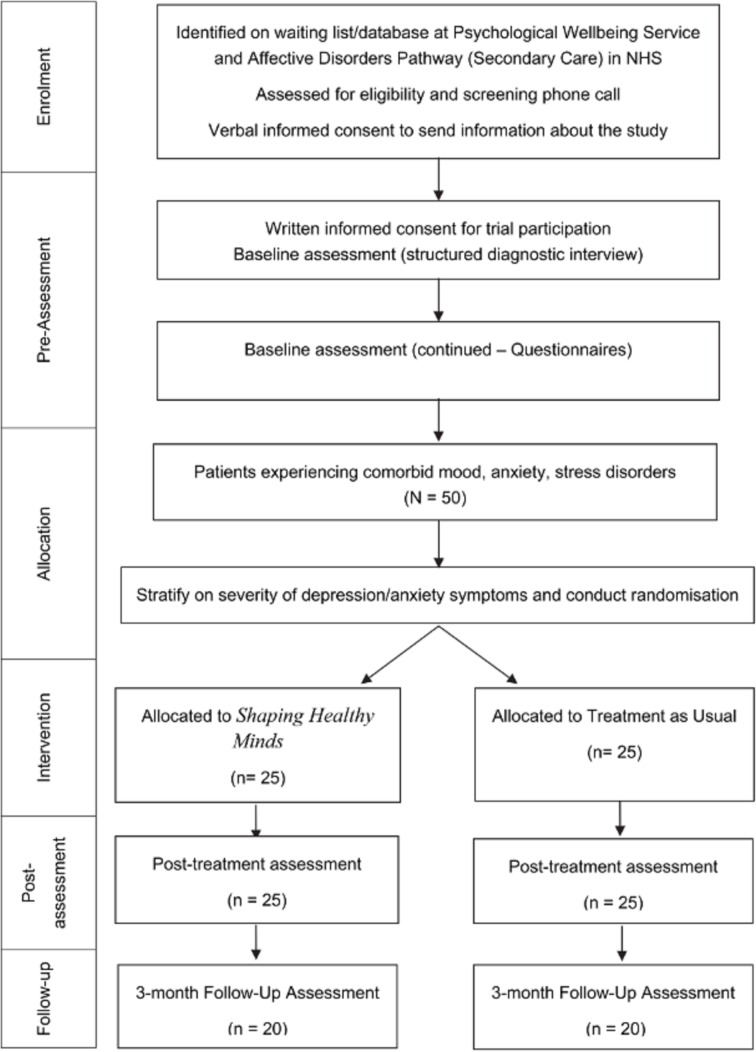
- The planned sample is 50 adults aged >18 years, randomized 25 to SHM and 25 to TAU; the trial is expected to yield 40 participants (20 per arm) at 3-month follow-up, assuming 20% attrition.
- SHM is a 10-module intervention lasting up to 20 sessions, delivered in weekly face-to-face 1-hour sessions.
- The trial’s co-primary outcomes are 3-month follow-up scores on PHQ-9, GAD-7, and the Work and Social Adjustment Scale.
- By the time of submission, 15 participants had met eligibility criteria and been randomized.
## Methods
- Design: A patient-level, parallel-arm randomized controlled feasibility trial comparing SHM vs TAU, with assessments at baseline, post-treatment, and 3-month follow-up.
- Sample/data: Adults aged 18+ with a primary unipolar mood, anxiety, obsessive-compulsive, or trauma/stressor-related disorder plus at least one additional comorbid diagnosis, recruited from UK NHS outpatient psychological services; eligibility is assessed with the SCID-5 and symptom cutoffs on PHQ-9 or GAD-7 (>10).
- Analysis: Outcomes will be analyzed on an intention-to-treat basis and then per protocol, using mixed-model analyses of variance with baseline covariates as appropriate; multiple imputation will address missing data, and exploratory moderation/mediation analyses will use the MacArthur approach.
## Limitations
- The paper explicitly notes that self-report questionnaires specific to each service user’s secondary diagnoses may limit the ability to draw group-based conclusions.
- Because this is a feasibility trial with n=50, the paper says the study is intended to provide only a point estimate of effect and a range of estimates for later powering, so it is not designed for definitive efficacy testing.
- Evident from the text: double blinding is not possible because this is a psychological intervention, so participants and therapists are not blinded to allocation.
Model-written summary. Check it against the paper before relying on it.
Integrity signals
Registry
Cites
Statistics
Figures
Verification
Claims the paper makes
3 Valid · 0 Not valid · 10 Not checked · 37 Own results and interpretations
Every source the paper cites for this claim was checked and supports it.
In the paper
“our systematic review and meta-analysis supported the overall efficacy of transdiagnostic treatments.10”
§ The HARMONIC trial: study protocol for a randomised controlled feasibility trial of Shaping Healthy Minds—a modular transdiagnostic intervention for mood, stressor-related and anxiety disorders in adults > Abstract > Trial registration
What the sources say
- Supportedcites [10] source
The Conclusions state that the review's results support the efficacy of transdiagnostic treatments in reducing depression and anxiety and improving quality of life. The authors also caution that RCT quality was low overall and heterogeneity was high, but this does not change the claim about overall efficacy. (LLM, conf=0.95)
plainstates a cause- Asserted: passes — The authors put it forward as true.
- Checkable: passes — It can be checked against evidence.
- Load-bearing: passes — The paper’s conclusions depend on it.
- Based: passes — The paper gives a reason why it holds.
- Supported
The cited sources support only part of this claim — read each source’s verdict below.
In the paper
“There is strong empirical and theoretical support for development of transdiagnostic treatment approaches, as many of the cognitive, emotional, behavioural and interpersonal factors which drive symptomatology are consistent across disorders.12 13”
§ The HARMONIC trial: study protocol for a randomised controlled feasibility trial of Shaping Healthy Minds—a modular transdiagnostic intervention for mood, stressor-related and anxiety disorders in adults > Abstract > Trial registration
What the sources say
- Partly supportedcites [12] sourceExperimental — accuracy not yet measured
The “Transdiagnostic treatment protocols” section (page unavailable) says research supports a unified approach to emotional disorders because they share features and therapeutic procedures. The discussion of the unified protocol identifies shared cognitive, emotional and behavioural targets, but our copy does not establish shared interpersonal factors or extend the argument beyond emotional disorders. (LLM, conf=0.85)
- Not checked — no full text of the sourcecites [13] Harvey A . G., et al., eds. Cognitive behavioural processes across psychological disorders: A transdiagnostic approach to research and treatment. Oxford: Oxford University Press, 2004. source
boostedstates an association- Asserted: passes — The authors put it forward as true.
- Checkable: passes — It can be checked against evidence.
- Load-bearing: passes — The paper’s conclusions depend on it.
- Based: passes — The paper gives a reason why it holds.
- Partly supported
In the paper
“Existing psychological treatments for CMHP share more similarities than differences.21”
§ The HARMONIC trial: study protocol for a randomised controlled feasibility trial of Shaping Healthy Minds—a modular transdiagnostic intervention for mood, stressor-related and anxiety disorders in adults > Abstract > Trial registration
What the sources say
- Not checked — no full text of the sourcecites [21] source
plain- Asserted: passes — The authors put it forward as true.
- Checkable: passes — It can be checked against evidence.
- Load-bearing: passes — The paper’s conclusions depend on it.
- Based: passes — The paper gives a reason why it holds.
In the paper
“most packages are inflexible ‘one-size-fits-all’ approaches, leaving patients with a wide range of problems and presentations receiving the same treatment package, regardless of their symptoms, goals and concerns.14”
§ The HARMONIC trial: study protocol for a randomised controlled feasibility trial of Shaping Healthy Minds—a modular transdiagnostic intervention for mood, stressor-related and anxiety disorders in adults > Abstract > Trial registration
What the sources say
- Not checked — no full text of the sourcecites [14] source
plainstates a cause- Asserted: passes — The authors put it forward as true.
- Checkable: passes — It can be checked against evidence.
- Load-bearing: passes — The paper’s conclusions depend on it.
- Based: passes — The paper gives a reason why it holds.
A conclusion the paper draws from its own results — it cites no other source for it, so there is none to check. The quote shows it is in the paper.
In the paper
“A transdiagnostic approach thereby has the potential to improve the efficacy and efficiency of treatment for people with anxiety, stress and depression.”
§ The HARMONIC trial: study protocol for a randomised controlled feasibility trial of Shaping Healthy Minds—a modular transdiagnostic intervention for mood, stressor-related and anxiety disorders in adults > Abstract > Trial registration
hedgedstates a possible cause- Asserted: passes — The authors put it forward as true.
- Checkable: passes — It can be checked against evidence.
- Load-bearing: passes — The paper’s conclusions depend on it.
- Based: passes — The paper gives a reason why it holds.
7 more claims
Create a free account to see all 50 claims and every source verdict.
- It may state two separate claims as one. 15
- Probably not a substantial claim. 35
Citations
Cites
Diagnostic and Statistical Manual of Mental Disorders
American Psychiatric Association (2013) · doi:10.1176/appi.books.9780890425596 · Cited by 116,369
The PHQ-9: Validity of a brief depression severity measure
Kroenke, K., Spitzer, R. L., & Williams, J. B. W. (2001) · Journal of General Internal Medicine · doi:10.1046/j.1525-1497.2001.016009606.x · Cited by 44,910 · cited 1×
“The co-primary outcome measures are self-reported symptoms of depression and anxiety, indexed by PHQ-9, 46 and GAD-7, 47 as well as levels of disability and functional impairment, indexed by the Work and Social Adjustment Scale.”
Method(1992) · PubMed · Cited by 33,716
A Brief Measure for Assessing Generalized Anxiety Disorder: The GAD-7
Spitzer, R. L., Kroenke, K., Williams, J. B. W., & Löwe, B. (2006) · Archives of Internal Medicine · doi:10.1001/archinte.166.10.1092 · Cited by 31,765 · cited 1×
“The co-primary outcome measures are self-reported symptoms of depression and anxiety, indexed by PHQ-9, 46 and GAD-7, 47 as well as levels of disability and functional impairment, indexed by the Work and Social Adjustment Scale.”
MethodThe MOS 36-ltem Short-Form Health Survey (SF-36): I. Conceptual Framework and Item Selection
Ware, J. E., & Sherbourne, C. D. (1992) · Medical Care · doi:10.1097/00005650-199206000-00002 · Cited by 30,033 · cited 2×
“63 For the health economic data, costs associated with service use will be calculated by attaching a unit cost to each instance of use, and data will be combined with QALYs 62 derived from the SF-36 to arrive at a preliminary estimate of the cost utility of the transdiagnostic intervention.”
MethodKessler, R. C., Berglund, P., Demler, O., Jin, R., Merikangas, K. R., & Walters, E. E. (2005) · Archives of General Psychiatry · doi:10.1001/archpsyc.62.6.593 · Cited by 20,391
Developing and evaluating complex interventions: the new Medical Research Council guidance
Craig, P., Dieppe, P., Macintyre, S., Michie, S., Nazareth, I., & Petticrew, M. (2008) · BMJ · doi:10.1136/bmj.a1655 · Cited by 10,995 · cited 1×
“27 In particular, we will gather data on the extent to which SHM performs comparably to treatment-as-usual (TAU) for a given service user's primary diagnosed problem 10 28 as well as for other significant additional, secondary and/or comorbid difficulties.”
MethodGratz, K. L., & Roemer, L. (2004) · Journal of Psychopathology and Behavioral Assessment · doi:10.1023/b:joba.0000007455.08539.94 · Cited by 8,942
Kessler, R. C., Berglund, P., Demler, O., Jin, R., Koretz, D., Merikangas, K. R., Rush, A. J., Walters, E. E., & Wang, P. S. (2003) · JAMA · doi:10.1001/jama.289.23.3095 · Cited by 7,988 · cited 1×
“Mood, stressor-related, obsessive-compulsive and anxiety disorders—the so-called common mental health problems (CMHP; National Institute for Health and Care Excellence (NICE), 2011)—are one of the largest causes of disability in the world, with 16%–20% of adults affected at any given time.(1) 2 Maximising our ability…”
Background(1993) · Cited by 7,136
Research works printed but not linked: 3
- Medical Research Council,. Review of mental health research: Report of the strategic review group. London: Medical Research Council, 2010.
- Martell CR , Dimidjian S , Ruth H-D . Behavioral Acitvation for Depression: A Clinician’s Guide. New York: Guilford Press, 2010.
- Norton PJ . Group Cognitive-Behavioural Therapy of Anxiety. New York: Guilford Press, 2012.
Cited by
Transdiagnostic approaches to mental health problems: Current status and future directions.
Dalgleish, T., Black, M., Johnston, D., & Bevan, A. (2020) · Journal of Consulting and Clinical Psychology · doi:10.1037/ccp0000482 · Cited by 883
“…for children (Chorpita, Daleiden, & Weisz, 2005b) and the Shaping Healthy Minds protocol targeting the same range of problems in adults (Black et al., 2018), comprise sets of evidence-based self-contained functional units (therapy modules) that can operate independently and be…”
BackgroundMethodSelf-citationWatson, D., Levin‐Aspenson, H. F., Waszczuk, M. A., Conway, C. C., Dalgleish, T., Dretsch, M. N., Eaton, N. R., Forbes, M. K., Forbush, K. T., Hobbs, K. A., et al. (2022) · World Psychiatry · doi:10.1002/wps.20943 · Cited by 265
Self-citationCBT at the crossroads: the rise of transdiagnostic treatments.
Schaeuffele, C., Schulz, A., Knaevelsrud, C., Renneberg, B., & Boettcher, J. (2021) · International Journal of Cognitive Therapy · doi:10.1007/s41811-020-00095-2 · Cited by 150
Transdiagnostic distortions in autobiographical memory recollection
Dalgleish, T., & Hitchcock, C. (2023) · Nature Reviews Psychology · doi:10.1038/s44159-023-00148-1 · Cited by 84
Self-citationWade, T. D., Shafran, R., & Cooper, Z. (2023) · International Journal of Eating Disorders · doi:10.1002/eat.24008 · Cited by 64
“Tackling the first part of these unknowns requires a multiplicity of available evidence-based modules that can be used flexibly and in a variety of combinations to suit needs and formulation, such as that currently being tested for depression and anxiety (Black et al., 2018).”
Metadata
- Authors
- Black, M., Hitchcock, C., Bevan, A., O Leary, C., Clarke, J., Elliott, R., Watson, P., LaFortune, L., Rae, S., Gilbody, S., Kuyken, W., Johnston, D., Newby, J. M., & Dalgleish, T.
- Affiliations
- National Health Service (GB)
- MRC Cognition and Brain Sciences Unit (GB)
- Medical Research Council Cognition and Brain Sciences Unit, University of Cambridge, Cambridge, UK
- University of Cambridge (GB)
- University of York (GB)
- University of Oxford (GB)
- UNSW Sydney (AU)
- Corresponding author
- Dalgleish, Tim
- ORCID
- Venue
- BMJ Open
- Publisher
- BMJ
- Published
- 2018-08
- Volume
- 8
- Issue
- 8
- Pages
- e024546
- ISSN
- 2044-6055 (ISSN-L)
- PMC
- PMC6078277
- OpenAlex
- W2887542967
- Cited by
- 24
- References
- 83
- Citations by year
- 2025: 2 · 2024: 4 · 2023: 7 · 2022: 5 · 2021: 2 · 2020: 2 · 2019: 2
- FWCI
- 1.96
- Type
- journal article
- Language
- en
- Open access
- gold
- doi.org
- Licence
- cc-by
- Locations
- BMJ Open (publishedVersion, cc-by)
- Europe PMC (PubMed Central) (publishedVersion, cc-by)
- PubMed Central (publishedVersion, cc-by)
- PubMed (publishedVersion)
- White Rose Research Online (University of Leeds, The University of Sheffield, University of York) (acceptedVersion, other-oa)
- HighWire Press Open Archive (acceptedVersion)
- UNSWorks (University of New South Wales, Sydney, Australia) (submittedVersion, cc-by-nc-nd)
- Minerva Access (University of Melbourne) (submittedVersion, cc-by)
- Funders
- National Institute for Health Research
- National Health and Medical Research Council
- Topics
- Social Sciences › Psychology › Experimental and Cognitive Psychology › Anxiety, Depression, Psychometrics, Treatment, Cognitive Processes
- Social Sciences › Psychology › Clinical Psychology › Psychotherapy Techniques and Applications
- Social Sciences › Psychology › Applied Psychology › Digital Mental Health Interventions
- Keywords
- transdiagnostic treatment, comorbidities, mood disorders, anxiety disorders, obsessive-compulsive disorder, trauma-related disorders, depressive symptoms, functional disability, mechanisms of change, treatment feasibility, acceptability, treatment manual
- MeSH terms
- Patient Reported Outcome Measures, Adult, Anxiety Disorders, Feasibility Studies, Humans, Obsessive-Compulsive Disorder, Patient Acceptance of Health Care, Research Design, Randomized Controlled Trials as Topic, Mood Disorders, Stress Disorders, Traumatic, Symptom Assessment
About these checks
Registry, retraction, Cites and statistics results are computed, not judged, with one exception: a printed reference that no index lists is read once by a model before it counts as a citation error. Claims are extracted by a model and kept only when their quote appears verbatim in the text; each cited source is then checked, with a model’s help, for whether it says what the claim relies on. Those verdicts can be wrong — read the claim’s quote and the cited source before relying on one.
The claim verdicts this report counts are experimental: their accuracy is not yet measured.
A language model drew the claims from the paper on 2026-10-11, under version 3 of the claim definition (model deepseek-v4.1-flash, prompt extract-v3).
A second model labelled each claim on 2026-10-11 (model jev-1.13-20260917, definition revision gold-guideline-v0.2).
Cited sources are checked with a language model’s help (gpt-6-sol).
Statistics and arithmetic are recomputed, not judged.
Confidence bands are shown only for fields calibrated on our annotated test set. None is calibrated yet, so no band is shown.
What counts as a claim ›How we measure confidence ›How we check this ›
Are you an author, or do you see a problem with this page? Request a review
How to cite
Cite CoChat for the checks on this page, and the paper for its own findings.
- This page
- CoChat. (2026). Citation check: The HARMONIC trial: Study protocol for a randomised controlled feasibility trial of Shaping Healthy Minds - A modular transdiagnostic intervention for mood, stressor-related and anxiety disorders in adults. https://app.cochat.ai/papers/10.1136/bmjopen-2018-024546
- The paper
- Black, M., Hitchcock, C., Bevan, A., O Leary, C., Clarke, J., Elliott, R., Watson, P., LaFortune, L., Rae, S., Gilbody, S., Kuyken, W., Johnston, D., Newby, J. M., & Dalgleish, T. (2018). The HARMONIC trial: Study protocol for a randomised controlled feasibility trial of Shaping Healthy Minds - A modular transdiagnostic intervention for mood, stressor-related and anxiety disorders in adults. BMJ Open. https://doi.org/10.1136/bmjopen-2018-024546
Data sources
Bibliographic data: Semantic Scholar, OpenAlex, Crossref.
Contains information from the Semantic Scholar Academic Graph Datasets, made available under the ODC Attribution License (ODC-BY 1.0).
Semantic Scholar’s data is described in: Kinney, R., et al. (2023). The Semantic Scholar Open Data Platform. arXiv:2301.10140.
