

The HARMONIC trial: Study protocol for a randomised controlled feasibility trial of Shaping Healthy Minds - A modular transdiagnostic intervention for mood, stressor-related and anxiety disorders in adults
Open accessThe DOI matches its Crossref record; 78 of the 83 references it cites were found in a registry or an index; 3 of the 19 sources its claims cite were checked for support.
Abstract
Introduction Anxiety, mood and trauma-related disorders are common, affecting up to 20% of adults. Many of these individuals will experience symptoms of more than one disorder as diagnostically defined. However, most psychological treatments focus on individual disorders and are less effective for those who experience comorbid disorders. The Healthy and Resilient Mind Programme: Building Blocks for Mental Wellbeing (HARMONIC) trial introduces a novel transdiagnostic intervention (Shaping Healthy Minds (SHM)), which synthesises several evidence-based treatment techniques to address the gap in effective interventions for people with complex and comorbid difficulties. This early phase trial aims to estimate the efficacy and feasibility of the transdiagnostic intervention in preparation for a later-phase randomised controlled trial, and to explore mechanisms of change. Methods/analysis We outline a patient-level two-arm randomised controlled trial (HARMONIC) that compares SHM to treatment-as-usual for individuals aged >18 years (n=50) with comorbid mood, anxiety, obsessive-compulsive or trauma/stressor disorders diagnoses, recruited from outpatient psychological services within the UK National Health Service (NHS). The co-primary outcomes will be 3-month follow-up scores on self-report measures of depressive symptoms, anxiety symptoms, and disability and functional impairment. Secondary outcomes include changes in symptoms linked to individual disorders. We will assess the feasibility and acceptability of SHM, the utility of proposed outcome measures, and refine the treatment manuals in preparation for a later-phase trial. Ethics and dissemination This trial protocol has been approved by the Health Research Authority of the NHS of the UK (East of England, Reference: 16/EE/0095). We anticipate that trial findings will inform future revisions of clinical guidelines for numerous forms of mood, anxiety and stressor-related disorders. Findings will be disseminated broadly via peer-reviewed empirical journal articles, conference presentations, clinical workshops and a trial website. Trial registration NCT03143634; Pre-results. © Author(s) (or their employer(s)) 2018. Re-use permitted under CC BY. Published by BMJ.
Overview
CoChat Summary
## TL;DR
This is a protocol for the HARMONIC feasibility RCT, testing the modular transdiagnostic intervention Shaping Healthy Minds (SHM) against treatment-as-usual (TAU) in 50 adults with comorbid common mental health problems. The study is designed to estimate feasibility, acceptability, and preliminary effects on depression, anxiety, disability, and disorder-specific symptoms, not to provide definitive efficacy evidence.
## Key findings
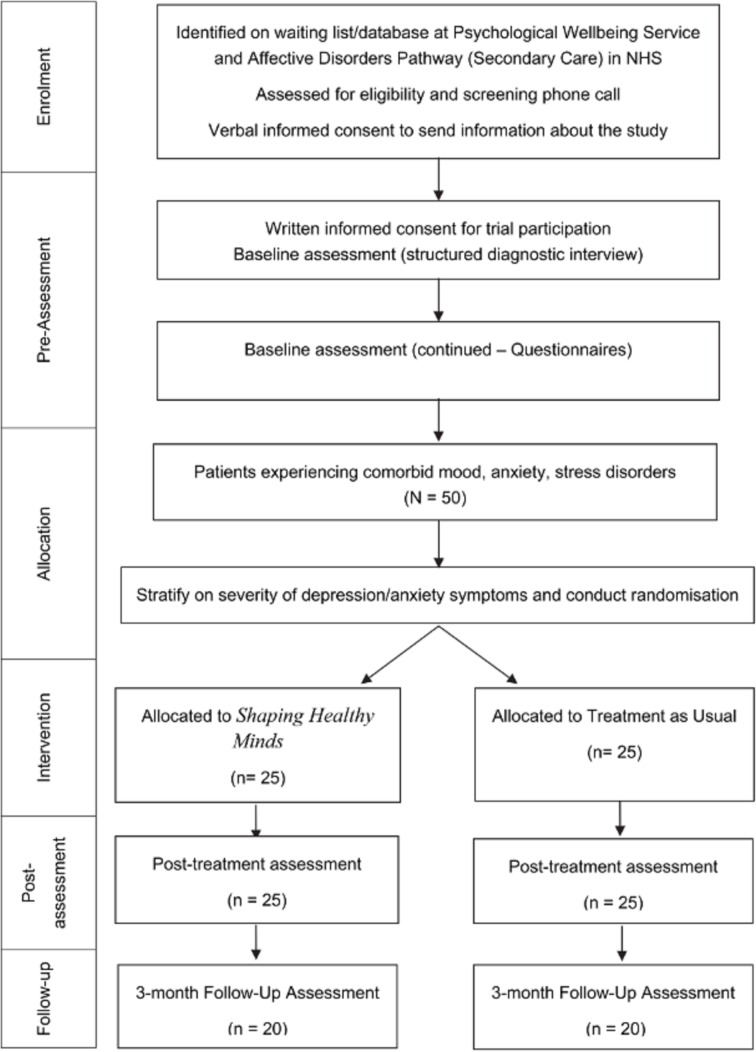
- The planned sample is 50 adults aged >18 years, randomized 25 to SHM and 25 to TAU; the trial is expected to yield 40 participants (20 per arm) at 3-month follow-up, assuming 20% attrition.
- SHM is a 10-module intervention lasting up to 20 sessions, delivered in weekly face-to-face 1-hour sessions.
- The trial’s co-primary outcomes are 3-month follow-up scores on PHQ-9, GAD-7, and the Work and Social Adjustment Scale.
- By the time of submission, 15 participants had met eligibility criteria and been randomized.
## Methods
- Design: A patient-level, parallel-arm randomized controlled feasibility trial comparing SHM vs TAU, with assessments at baseline, post-treatment, and 3-month follow-up.
- Sample/data: Adults aged 18+ with a primary unipolar mood, anxiety, obsessive-compulsive, or trauma/stressor-related disorder plus at least one additional comorbid diagnosis, recruited from UK NHS outpatient psychological services; eligibility is assessed with the SCID-5 and symptom cutoffs on PHQ-9 or GAD-7 (>10).
- Analysis: Outcomes will be analyzed on an intention-to-treat basis and then per protocol, using mixed-model analyses of variance with baseline covariates as appropriate; multiple imputation will address missing data, and exploratory moderation/mediation analyses will use the MacArthur approach.
## Limitations
- The paper explicitly notes that self-report questionnaires specific to each service user’s secondary diagnoses may limit the ability to draw group-based conclusions.
- Because this is a feasibility trial with n=50, the paper says the study is intended to provide only a point estimate of effect and a range of estimates for later powering, so it is not designed for definitive efficacy testing.
- Evident from the text: double blinding is not possible because this is a psychological intervention, so participants and therapists are not blinded to allocation.
Model-written summary. Check it against the paper before relying on it.
Integrity signals
Registry
Cites
Statistics
Figures
Verification
Claims the paper makes
3 Valid · 0 Not valid · 10 Not checked · 37 Own results and interpretations
Every source the paper cites for this claim was checked and supports it.
In the paper
“our systematic review and meta-analysis supported the overall efficacy of transdiagnostic treatments.10”
§ The HARMONIC trial: study protocol for a randomised controlled feasibility trial of Shaping Healthy Minds—a modular transdiagnostic intervention for mood, stressor-related and anxiety disorders in adults > Abstract > Trial registration
What the sources say
- Supportedcites [10] Newby JM, McKinnon A, Kuyken W, et al Systematic review and meta-analysis of transdiagnostic psychological treatments for anxiety and depressive disorders in adulthood. Clin Psychol Rev 2015; 40: 91– 110. 10.1016/j.cpr.2015.06.002 26094079 source
The Conclusions state that the review's results support the efficacy of transdiagnostic treatments in reducing depression and anxiety and improving quality of life. The authors also caution that RCT quality was low overall and heterogeneity was high, but this does not change the claim about overall efficacy. (LLM, conf=0.95)
plainstates a cause- Asserted: passes — The authors put it forward as true.
- Checkable: passes — It can be checked against evidence.
- Load-bearing: passes — The paper’s conclusions depend on it.
- Based: passes — The paper gives a reason why it holds.
- Supported
The cited sources support only part of this claim — read each source’s verdict below.
In the paper
“There is strong empirical and theoretical support for development of transdiagnostic treatment approaches, as many of the cognitive, emotional, behavioural and interpersonal factors which drive symptomatology are consistent across disorders.12 13”
§ The HARMONIC trial: study protocol for a randomised controlled feasibility trial of Shaping Healthy Minds—a modular transdiagnostic intervention for mood, stressor-related and anxiety disorders in adults > Abstract > Trial registration
What the sources say
- Partly supportedcites [12] Brown TA, Barlow DH A proposal for a dimensional classification system based on the shared features of the DSM-IV anxiety and mood disorders: implications for assessment and treatment. Psychol Assess 2009; 21: 256– 71. 10.1037/a0016608 19719339 PMC2845450 sourceExperimental — accuracy not yet measured
The “Transdiagnostic treatment protocols” section (page unavailable) says research supports a unified approach to emotional disorders because they share features and therapeutic procedures. The discussion of the unified protocol identifies shared cognitive, emotional and behavioural targets, but our copy does not establish shared interpersonal factors or extend the argument beyond emotional disorders. (LLM, conf=0.85)
- Not checked — no full text of the sourcecites [13] Harvey A G., et al., eds. Cognitive behavioural processes across psychological disorders: A transdiagnostic approach to research and treatment. Oxford: Oxford University Press, 2004. source
boostedstates an association- Asserted: passes — The authors put it forward as true.
- Checkable: passes — It can be checked against evidence.
- Load-bearing: passes — The paper’s conclusions depend on it.
- Based: passes — The paper gives a reason why it holds.
- Partly supported
In the paper
“Existing psychological treatments for CMHP share more similarities than differences.21”
§ The HARMONIC trial: study protocol for a randomised controlled feasibility trial of Shaping Healthy Minds—a modular transdiagnostic intervention for mood, stressor-related and anxiety disorders in adults > Abstract > Trial registration
What the sources say
- Not checked — no full text of the sourcecites [21] Chorpita BF, Daleiden EL Mapping evidence-based treatments for children and adolescents: application of the distillation and matching model to 615 treatments from 322 randomized trials. J Consult Clin Psychol 2009; 77: 566– 79. 10.1037/a0014565 19485596 source
plain- Asserted: passes — The authors put it forward as true.
- Checkable: passes — It can be checked against evidence.
- Load-bearing: passes — The paper’s conclusions depend on it.
- Based: passes — The paper gives a reason why it holds.
In the paper
“most packages are inflexible ‘one-size-fits-all’ approaches, leaving patients with a wide range of problems and presentations receiving the same treatment package, regardless of their symptoms, goals and concerns.14”
§ The HARMONIC trial: study protocol for a randomised controlled feasibility trial of Shaping Healthy Minds—a modular transdiagnostic intervention for mood, stressor-related and anxiety disorders in adults > Abstract > Trial registration
What the sources say
- Not checked — no full text of the sourcecites [14] Barlow DH, Allen LB, Choate ML Toward a unified treatment for emotional disorders. Behav Ther 2004; 35: 205– 30. 10.1016/S0005-7894(04)80036-4 27993336 source
plainstates a cause- Asserted: passes — The authors put it forward as true.
- Checkable: passes — It can be checked against evidence.
- Load-bearing: passes — The paper’s conclusions depend on it.
- Based: passes — The paper gives a reason why it holds.
A conclusion the paper draws from its own results — it cites no other source for it, so there is none to check. The quote shows it is in the paper.
In the paper
“A transdiagnostic approach thereby has the potential to improve the efficacy and efficiency of treatment for people with anxiety, stress and depression.”
§ The HARMONIC trial: study protocol for a randomised controlled feasibility trial of Shaping Healthy Minds—a modular transdiagnostic intervention for mood, stressor-related and anxiety disorders in adults > Abstract > Trial registration
hedgedstates a possible cause- Asserted: passes — The authors put it forward as true.
- Checkable: passes — It can be checked against evidence.
- Load-bearing: passes — The paper’s conclusions depend on it.
- Based: passes — The paper gives a reason why it holds.
7 more claims
Create a free account to see all 50 claims and every source verdict.
- It may state two separate claims as one. 15
- Probably not a substantial claim. 35
Citations
Cites
Diagnostic and Statistical Manual of Mental Disorders
American Psychiatric Association (2013) · doi:10.1176/appi.books.9780890425596 · Cited by 116,369
The PHQ-9: Validity of a brief depression severity measure
Kroenke, K., Spitzer, R. L., & Williams, J. B. W. (2001) · Journal of General Internal Medicine · doi:10.1046/j.1525-1497.2001.016009606.x · Cited by 44,910 · cited 1×
“The co-primary outcome measures are self-reported symptoms of depression and anxiety, indexed by PHQ-9, 46 and GAD-7, 47 as well as levels of disability and functional impairment, indexed by the Work and Social Adjustment Scale.”
Method(1992) · PubMed · Cited by 33,716
A Brief Measure for Assessing Generalized Anxiety Disorder: The GAD-7
Spitzer, R. L., Kroenke, K., Williams, J. B. W., & Löwe, B. (2006) · Archives of Internal Medicine · doi:10.1001/archinte.166.10.1092 · Cited by 31,765 · cited 1×
“The co-primary outcome measures are self-reported symptoms of depression and anxiety, indexed by PHQ-9, 46 and GAD-7, 47 as well as levels of disability and functional impairment, indexed by the Work and Social Adjustment Scale.”
MethodThe MOS 36-ltem Short-Form Health Survey (SF-36): I. Conceptual Framework and Item Selection
Ware, J. E., & Sherbourne, C. D. (1992) · Medical Care · doi:10.1097/00005650-199206000-00002 · Cited by 30,033 · cited 2×
“63 For the health economic data, costs associated with service use will be calculated by attaching a unit cost to each instance of use, and data will be combined with QALYs 62 derived from the SF-36 to arrive at a preliminary estimate of the cost utility of the transdiagnostic intervention.”
MethodKessler, R. C., Berglund, P., Demler, O., Jin, R., Merikangas, K. R., & Walters, E. E. (2005) · Archives of General Psychiatry · doi:10.1001/archpsyc.62.6.593 · Cited by 20,391
Developing and evaluating complex interventions: the new Medical Research Council guidance
Craig, P., Dieppe, P., Macintyre, S., Michie, S., Nazareth, I., & Petticrew, M. (2008) · BMJ · doi:10.1136/bmj.a1655 · Cited by 10,995 · cited 1×
“27 In particular, we will gather data on the extent to which SHM performs comparably to treatment-as-usual (TAU) for a given service user's primary diagnosed problem 10 28 as well as for other significant additional, secondary and/or comorbid difficulties.”
MethodGratz, K. L., & Roemer, L. (2004) · Journal of Psychopathology and Behavioral Assessment · doi:10.1023/b:joba.0000007455.08539.94 · Cited by 8,942
Kessler, R. C., Berglund, P., Demler, O., Jin, R., Koretz, D., Merikangas, K. R., Rush, A. J., Walters, E. E., & Wang, P. S. (2003) · JAMA · doi:10.1001/jama.289.23.3095 · Cited by 7,988 · cited 1×
“Mood, stressor-related, obsessive-compulsive and anxiety disorders—the so-called common mental health problems (CMHP; National Institute for Health and Care Excellence (NICE), 2011)—are one of the largest causes of disability in the world, with 16%–20% of adults affected at any given time.(1) 2 Maximising our ability…”
Background(1993) · Cited by 7,136
(1999) · Cited by 5,934
Development and validation of the Penn State Worry Questionnaire
Meyer, T. J., Miller, M. L., Metzger, R. L., & Borkovec, T. D. (1990) · Behaviour Research and Therapy · doi:10.1016/0005-7967(90)90135-6 · Cited by 5,099
Rumination reconsidered: a psychometric analysis.
Treynor, W., Gonzalez, R., & Nolen-Hoeksema, S. (2003) · Cognitive Therapy and Research · doi:10.1023/a:1023910315561 · Cited by 3,808
(2001) · Cited by 3,666
Anxiety, sensitivity, anxiety frequency, and the prediction of fearfulness
Reiss, S., Peterson, R. A., Gursky, D. M., & McNally, R. J. (1986) · Behaviour Research and Therapy · doi:10.1016/0005-7967(86)90143-9 · Cited by 3,169
The Impact of Event Scale: Revised
Weiss, D. S. (2007) · International and Cultural Psychology Series · doi:10.1007/978-0-387-70990-1_10 · Cited by 2,996
The Work and Social Adjustment Scale: a simple measure of impairment in functioning
Mundt, J. C., Marks, I. M., Shear, M. K., & Greist, J. M. (2002) · British Journal of Psychiatry · doi:10.1192/bjp.180.5.461 · Cited by 2,515 · cited 2×
“MEAsurEs Co-primary outcomes The co-primary outcome measures are self-reported symptoms of depression and anxiety, indexed by PHQ-9,(46) and GAD-7,(47) as well as levels of disability and functional impairment, indexed by the Work and Social Adjustment Scale.(48)”
Negative life events, cognitive emotion regulation and emotional problems
Garnefski, N., Kraaij, V, & Spinhoven, P. (2001) · Personality and Individual Differences · doi:10.1016/s0191-8869(00)00113-6 · Cited by 2,494
Assessment of Mindfulness by Self-Report: The Kentucky Inventory of Mindfulness Skills
Baer, R. A., Smith, G. T., & Allen, K. B. (2004) · Assessment · doi:10.1177/1073191104268029 · Cited by 2,298
Psychometric properties of the credibility/expectancy questionnaire
Devilly, G. J., & Borkovec, T. D. (2000) · Journal of Behavior Therapy and Experimental Psychiatry · doi:10.1016/s0005-7916(00)00012-4 · Cited by 2,295
(2011) · Cited by 2,032
Mindfulness-based therapy: a comprehensive meta-analysis
Khoury, B., Lecomte, T., Fortin, G., Masse, M., Therien, P., Bouchard, V., Chapleau, M.-A., Paquin, K., & Hofmann, S. G. (2013) · Clinical Psychology Review · doi:10.1016/j.cpr.2013.05.005 · Cited by 2,003 · cited 1×
“40 The elements of SHM were drawn from recent meta-analyses supporting the effectiveness of these treatment strategies 36 41–43 , and the manuals were written and reviewed by experienced clinical psychologists (TD, JMN, AB, CH and MB).”
MethodBrief standard self-rating for phobic patients
Marks, I. M., & Mathews, A. M. (1979) · Behaviour Research and Therapy · doi:10.1016/0005-7967(79)90041-x · Cited by 1,801
The Distress Tolerance Scale: Development and Validation of a Self-Report Measure
Simons, J. S., & Gaher, R. M. (2005) · Motivation and Emotion · doi:10.1007/s11031-005-7955-3 · Cited by 1,730
The Posttraumatic Cognitions Inventory (PTCI): development and validation
Foa, E. B., Ehlers, A., Clark, D. M., Tolin, D. F., & Orsillo, S. M. (1999) · Psychological Assessment · doi:10.1037/1040-3590.11.3.303 · Cited by 1,727
Psychometric properties of the Social Phobia Inventory (SPIN): New self-rating scale
Connor, K. M., Davidson, J. R. T., Churchill, L. E., Sherwood, A., Weisler, R. H., & Foa, E. (2000) · British Journal of Psychiatry · doi:10.1192/bjp.176.4.379 · Cited by 1,624
Brown, T. A., Campbell, L. A., Lehman, C. L., Grisham, J. R., & Mancill, R. B. (2001) · Journal of Abnormal Psychology · doi:10.1037//0021-843x.110.4.585 · Cited by 1,562 · cited 4×
“Between 40% and 80% of patients experiencing a CMHP also experience an additional comorbid CMHP.(4) 5 Even our best available psychological treatments only achieve clinical recovery for 40%–70% of patients, depending on their primary CMHP, with people suffering complex comorbid conditions faring significantly worse.”
BackgroundInfluentialToward a unified treatment for emotional disorders
Barlow, D. H., Allen, L. B., & Choate, M. L. (2004) · Behavior Therapy · doi:10.1016/s0005-7894(04)80036-4 · Cited by 1,430 · cited 1×
“Second, in the attempt to manualise treatments, most packages are inflexible ‘one-sizefits-all’ approaches, leaving patients with a wide range of problems and presentations receiving the same treatment package, regardless of their symptoms, goals and concerns.(14) Third, in practice, many clinicians already deliver ev…”
BackgroundSALKOVSKIS, P. M., RIMES, K. A., WARWICK, H. M. C., & CLARK, D. M. (2002) · Psychological Medicine · doi:10.1017/s0033291702005822 · Cited by 1,351 · cited 1×
“…Inventory, 52 the Revised Impact of Event Scale (post-traumatic stress), 53 the Agoraphobia-Mobility Inventory, 54 the Fear Questionnaire (specific phobias), 55 the Panic Disorder Severity Scale-self report version, 56 the Health Anxiety Inventory-short version 57 and the Sheehan Disability Scale.”
MethodMulticenter Collaborative Panic Disorder Severity Scale
Shear, M. K., Brown, T. A., Barlow, D. H., Money, R., Sholomskas, D. E., Woods, S. W., Gorman, J. M., & Papp, L. A. (1997) · American Journal of Psychiatry · doi:10.1176/ajp.154.11.1571 · Cited by 1,001
(2004) · Cited by 964
Sheehan, D. V. (1984) · Medical Entomology and Zoology · Cited by 883
Cognitive Behavioural Processes across Psychological Disorders (DRAFT)
Harvey, A., Watkins, E., Mansell, W., & Shafran, R. (2004) · doi:10.1093/med:psych/9780198528883.001.0001 · Cited by 869
Barlow, D. H., Farchione, T. J., Bullis, J. R., Gallagher, M. W., Murray-Latin, H., Sauer-Zavala, S., Bentley, K. H., Thompson-Hollands, J., Conklin, L. R., Boswell, J. F., et al. (2017) · JAMA Psychiatry · doi:10.1001/jamapsychiatry.2017.2164 · Cited by 853 · cited 1×
“23 Promising results have also been found for other transdiagnostic treatment protocols, including Norton’s Transdiagnostic Group Cognitive Behavioural Therapy for anxiety, 15 Gros’s Transdiagnostic Behaviour Therapy for affective disorders 24 and Schmidt’s False Safety Behaviour Elimination…”
BackgroundFresco, D. M., Moore, M. T., van Dulmen, M. H. M., Segal, Z. V., Ma, S. H., Teasdale, J. D., & Williams, J. M. G. (2007) · Behavior Therapy · doi:10.1016/j.beth.2006.08.003 · Cited by 810
How does mindfulness-based cognitive therapy work?
Kuyken, W., Watkins, E., Holden, E., White, K., Taylor, R. S., Byford, S., Evans, A., Radford, S., Teasdale, J. D., & Dalgleish, T. (2010) · Behaviour Research and Therapy · doi:10.1016/j.brat.2010.08.003 · Cited by 809 · cited 1×
“40 The elements of SHM were drawn from recent meta-analyses supporting the effectiveness of these treatment strategies 36 41–43 , and the manuals were written and reviewed by experienced clinical psychologists (TD, JMN, AB, CH and MB).”
MethodSelf-citationThe Mobility Inventory for Agoraphobia
Chambless, D. L., Caputo, G. C., Jasin, S. E., Gracely, E. J., & Williams, C. (1985) · Behaviour Research and Therapy · doi:10.1016/0005-7967(85)90140-8 · Cited by 775
Borkovec, T. D., & Costello, E. (1993) · Journal of Consulting and Clinical Psychology · doi:10.1037/0022-006x.61.4.611 · Cited by 756
The validation of a new obsessive–compulsive disorder scale: The Obsessive–Compulsive Inventory
Foa, E. B., Kozak, M. J., Salkovskis, P. M., Coles, M. E., & Amir, N. (1998) · Psychological Assessment · doi:10.1037/1040-3590.10.3.206 · Cited by 719
Chorpita, B. F., & Daleiden, E. L. (2009) · Journal of Consulting and Clinical Psychology · doi:10.1037/a0014565 · Cited by 687 · cited 1×
“21 Despite differences in the theoretical foundation underlying available psychological treatments, and the terms used to describe maintaining factors and treatment targets, there are many common elements.”
BackgroundBrown, T. A., & Barlow, D. H. (2009) · Psychological Assessment · doi:10.1037/a0016608 · Cited by 639 · cited 1×
“11 There is strong empirical and theoretical support for development of transdiagnostic treatment approaches, as many of the cognitive, emotional, behavioural and interpersonal factors which drive symptomatology are consistent across disorders.(12) 13 A transdiagnostic approach thereby has the potential to improve the…”
BackgroundStability of emotion experiences and their relations to traits of personality.
Izard, C. E., Libero, D. Z., Putnam, P., & Haynes, O. M. (1993) · Journal of Personality and Social Psychology · doi:10.1037//0022-3514.64.5.847 · Cited by 617
Clark, D. M., Ehlers, A., Hackmann, A., McManus, F., Fennell, M., Grey, N., Waddington, L., & Wild, J. (2006) · Journal of Consulting and Clinical Psychology · doi:10.1037/0022-006x.74.3.568 · Cited by 603 · cited 1×
“First, with the exception of a few existing programmes, 14 15 most evidence-based treatment protocols are single-disor-der-focused programmes (eg, depression, 16 generalised anxiety, 17 18 social anxiety 19 and post-traumatic stress disorder 20 ).”
BackgroundChmura Kraemer, H., Kiernan, M., Essex, M., & Kupfer, D. J. (2008) · Health Psychology · doi:10.1037/0278-6133.27.2(suppl.).s101 · Cited by 600 · cited 1×
“Exploratory moderation and mediation analyses to examine process variables will be conducted using the MacArthur approach.(63) For the health economic data, costs associated with service use will be calculated by attaching a unit cost to each instance of use, and data will be combined with QALYs(62) derived from the S…”
MethodRichards, D. A., Ekers, D., McMillan, D., Taylor, R. S., Byford, S., Warren, F. C., Barrett, B., Farrand, P. A., Gilbody, S., Kuyken, W., et al. (2016) · The Lancet · doi:10.1016/s0140-6736(16)31140-0 · Cited by 595
Self-citationResponse rates for CBT for anxiety disorders: need for standardized criteria
Loerinc, A. G., Meuret, A. E., Twohig, M. P., Rosenfield, D., Bluett, E. J., & Craske, M. G. (2015) · Clinical Psychology Review · doi:10.1016/j.cpr.2015.08.004 · Cited by 592
Cuijpers, P., Cristea, I. A., Karyotaki, E., Reijnders, M., & Huibers, M. J. H. (2016) · World Psychiatry · doi:10.1002/wps.20346 · Cited by 572
The revised cognitive therapy scale (CTS-R): psychometric properties.
Blackburn, I.-M., James, I. A., Milne, D. L., Baker, C., Standart, S., Garland, A., & Reichelt, F. K. (2001) · Behavioural and Cognitive Psychotherapy · doi:10.1017/s1352465801004040 · Cited by 568 · cited 1×
“application of cognitive therapy methods and the therapeutic alliance.(45) The CTS-R has 13 items that are”
MethodEkers, D., Webster, L., Van Straten, A., Cuijpers, P., Richards, D., & Gilbody, S. (2014) · PLoS ONE · doi:10.1371/journal.pone.0100100 · Cited by 565
Self-citationNewby, J. M., McKinnon, A., Kuyken, W., Gilbody, S., & Dalgleish, T. (2015) · Clinical Psychology Review · doi:10.1016/j.cpr.2015.06.002 · Cited by 545 · cited 5×
“…evaluation of whether a modular transdiagnostic treatment approach may be effective at reducing the distress and impairment associated with CMHP. 10 The trial will also provide an indication of the feasibility and acceptability of the transdiagnostic intervention to service users and clinicians…”
BackgroundMethodInfluentialSelf-citationToward a unified treatment for emotional disorders - republished Article
Barlow, D. H., Allen, L. B., & Choate, M. L. (2016) · Behavior Therapy · doi:10.1016/j.beth.2016.11.005 · Cited by 536
Gámez, W., Chmielewski, M., Kotov, R., Ruggero, C., & Watson, D. (2011) · Psychological Assessment · doi:10.1037/a0023242 · Cited by 524
Ellard, K. K., Fairholme, C. P., Boisseau, C. L., Farchione, T. J., & Barlow, D. H. (2010) · Cognitive and Behavioral Practice · doi:10.1016/j.cbpra.2009.06.002 · Cited by 523 · cited 2×
“8 A key challenge therefore is how we can build on and extend beyond the current psychological treatments for CMHP to increase efficacy, and sustained recovery, particularly for those with comorbid, recurrent and complex presentations.(9) Over the past decade, there has been a major shift in the conceptualisation of C…”
BackgroundMethodWatson, D., O’Hara, M. W., Naragon-Gainey, K., Koffel, E., Chmielewski, M., Kotov, R., Stasik, S. M., & Ruggero, C. J. (2012) · Assessment · doi:10.1177/1073191112449857 · Cited by 470 · cited 1×
“In addition to these disorder-specific measures, the Inventory of Depression and Anxiety Symptoms will capture both disorder-specific and transdiagnostic symptom dimensionality within a single measure.(59) Selection of these measures will be determined following completion of the structured clinical interview at the b…”
BackgroundOxford Guide to Behavioural Experiments in Cognitive Therapy
Rouf, K. (2004) · Oxford University Press eBooks · doi:10.1093/med:psych/9780198529163.001.0001 · Cited by 437
The D ysfunctional Att itude Scale: A Validation Study
Weissman, A. (1979) · ScholarlyCommons (University of Pennsylvania) · Cited by 413
Manual-based treatments: The clinical application of research findings
Wilson, G. T. (1996) · Behaviour Research and Therapy · doi:10.1016/0005-7967(95)00084-4 · Cited by 341 · cited 1×
“A key aim of the programme is to encompass the treatment techniques that skilled psychologists and mental health clinicians already implement in standard practice for depressed, stressed and anxious patients with complex presentations.(26) The intervention also builds on 8 M ay 2019 by gest.”
BackgroundDugas, M. J., Ladouceur, R., Léger, E., Freeston, M. H., Langolis, F., Provencher, M. D., & Boisvert, J.-M. (2003) · Journal of Consulting and Clinical Psychology · doi:10.1037/0022-006x.71.4.821 · Cited by 331
Bryant, R. A., Moulds, M. L., Guthrie, R. M., Dang, S. T., & Nixon, R. D. V. (2003) · Journal of Consulting and Clinical Psychology · doi:10.1037/0022-006x.71.4.706 · Cited by 325 · cited 1×
“First, with the exception of a few existing programmes, 14 15 most evidence-based treatment protocols are single-disor-der-focused programmes (eg, depression, 16 generalised anxiety, 17 18 social anxiety 19 and post-traumatic stress disorder 20 ).”
BackgroundBockting, C. L., Hollon, S. D., Jarrett, R. B., Kuyken, W., & Dobson, K. (2015) · Clinical Psychology Review · doi:10.1016/j.cpr.2015.02.003 · Cited by 295 · cited 1×
“For the majority of patients who receive treatment, there remains a significant risk of future relapse.(7) 8 A key challenge therefore is how we can build on and extend beyond the current psychological treatments for CMHP to increase efficacy, and sustained recovery, particularly for those with comorbid, recurrent and…”
BackgroundSelf-citationModularity in the design and application of therapeutic interventions
Chorpita, B. F., Daleiden, E. L., & Weisz, J. R. (2005) · Applied and Preventive Psychology · doi:10.1016/j.appsy.2005.05.002 · Cited by 295 · cited 3×
“The modular approach is standardised, yet can be flexibly delivered according to an individual’s concerns, problems and goals.(22) The treatment focuses both on alleviating negative symptoms and enhancing positive wellbeing, by teaching skills and techniques and enhancing positive emotions, harness and build on streng…”
BackgroundInfluentialBehavioural activation for depression
Veale, D. (2008) · Advances in Psychiatric Treatment · doi:10.1192/apt.bp.107.004051 · Cited by 282
Morey, L. C. (2017) · Psychological Assessment · doi:10.1037/pas0000450 · Cited by 279
(2008) · Medical Entomology and Zoology · Cited by 258
Self-citationTRANSDIAGNOSTIC TREATMENT FOR ANXIETY AND DEPRESSION: The Cutting Edge: Transdiagnostic Therapy
Craske, M. G. (2012) · Depression and Anxiety · doi:10.1002/da.21992 · Cited by 208
A new unified treatment approach for emotional disorders based on emotion science
Moses, E. B., & Barlow, D. H. (2006) · Current Directions in Psychological Science · doi:10.1111/j.0963-7214.2006.00425.x · Cited by 197
Reinholt, N., & Krogh, J. (2014) · Cognitive Behaviour Therapy · doi:10.1080/16506073.2014.897367 · Cited by 146
Dimidjian, S., Arch, J. J., Schneider, R. L., Desormeau, P., Felder, J. N., & Segal, Z. V. (2016) · Behavior Therapy · doi:10.1016/j.beth.2016.07.002 · Cited by 130
Salisbury, C., O'Cathain, A., Edwards, L., Thomas, C., Gaunt, D., Hollinghurst, S., Nicholl, J., Large, S., Yardley, L., Lewis, G., et al. (2016) · The Lancet Psychiatry · doi:10.1016/s2215-0366(16)00083-3 · Cited by 104
Effects of a transdiagnostic group treatment for anxiety on secondary depression
Norton, P. J., Hayes, S. A., & Hope, D. A. (2004) · Depression and Anxiety · doi:10.1002/da.20045 · Cited by 87 · cited 1×
“…also been found for other transdiagnostic treatment protocols, including Norton’s Transdiagnostic Group Cognitive Behavioural Therapy for anxiety, 15 Gros’s Transdiagnostic Behaviour Therapy for affective disorders 24 and Schmidt’s False Safety Behaviour Elimination Therapy for anxiety disorders.”
BackgroundDysfunctional Attitude Scale--Form A
Weissman, A. (1979) · PsycTESTS Dataset · doi:10.1037/t00091-000 · Cited by 85
Grös, D. F. (2014) · Psychiatry Research · doi:10.1016/j.psychres.2014.08.018 · Cited by 81 · cited 1×
“…also been found for other transdiagnostic treatment protocols, including Norton’s Transdiagnostic Group Cognitive Behavioural Therapy for anxiety, 15 Gros’s Transdiagnostic Behaviour Therapy for affective disorders 24 and Schmidt’s False Safety Behaviour Elimination Therapy for anxiety disorders.”
BackgroundSkills of Cognitive Therapy (SoCT): a new measure of patients' comprehension and use
Jarrett, R. B., Vittengl, J. R., Clark, L. A., & Thase, M. E. (2011) · Psychological Assessment · doi:10.1037/a0022485 · Cited by 79
Riccardi, C. J., Korte, K. J., & Schmidt, N. B. (2017) · Journal of Anxiety Disorders · doi:10.1016/j.janxdis.2016.06.003 · Cited by 55 · cited 1×
“25 In addition, our systematic review and meta-analysis supported the overall efficacy of transdiagnostic treatments.”
BackgroundIdentification and care pathways for common mental health disorders: summary of NICE guidance
Pilling, S., Whittington, C., Taylor, C., Kendrick, T., & on behalf of the Guideline Development Group (2011) · BMJ · doi:10.1136/bmj.d2868 · Cited by 39 · cited 1×
“Consequently, NICE recommends psychological treatment at various points in the care pathway to all those suffering from such problems, although there are not specific recommendations for individuals experiencing more than one problem.(3) Between 40% and 80% of patients experiencing a CMHP also experience an additional…”
BackgroundCognitive Behavior Therapy, Basics and Beyond, Second Edition
DAVIDSON, J. (2013) · Journal of Psychiatric Practice · doi:10.1097/01.pra.0000432605.83964.85 · Cited by 33
Dixon, P., Hollinghurst, S., Edwards, L., Thomas, C., Foster, A., Davies, B., Gaunt, D., Montgomery, A. A., & Salisbury, C. (2016) · BJPsych Open · doi:10.1192/bjpo.bp.116.002907 · Cited by 30
Oxford guide to behavioural experiments in cognitive therapy
Bennett–Levy, J. (2004) · Cited by 18
Research works printed but not linked: 3
- Medical Research Council. Review of mental health research: Report of the strategic review group. London: Medical Research Council, 2010.
- Martell CR, Dimidjian S, Ruth H-D Behavioral Acitvation for Depression: A Clinician’s Guide. New York: Guilford Press, 2010.
- Norton PJ Group Cognitive-Behavioural Therapy of Anxiety. New York: Guilford Press, 2012.
Cited by
Transdiagnostic approaches to mental health problems: Current status and future directions.
Dalgleish, T., Black, M., Johnston, D., & Bevan, A. (2020) · Journal of Consulting and Clinical Psychology · doi:10.1037/ccp0000482 · Cited by 883
“…for children (Chorpita, Daleiden, & Weisz, 2005b) and the Shaping Healthy Minds protocol targeting the same range of problems in adults (Black et al., 2018), comprise sets of evidence-based self-contained functional units (therapy modules) that can operate independently and be…”
BackgroundMethodSelf-citationWatson, D., Levin‐Aspenson, H. F., Waszczuk, M. A., Conway, C. C., Dalgleish, T., Dretsch, M. N., Eaton, N. R., Forbes, M. K., Forbush, K. T., Hobbs, K. A., et al. (2022) · World Psychiatry · doi:10.1002/wps.20943 · Cited by 265
Self-citationCBT at the crossroads: the rise of transdiagnostic treatments.
Schaeuffele, C., Schulz, A., Knaevelsrud, C., Renneberg, B., & Boettcher, J. (2021) · International Journal of Cognitive Therapy · doi:10.1007/s41811-020-00095-2 · Cited by 150
Transdiagnostic distortions in autobiographical memory recollection
Dalgleish, T., & Hitchcock, C. (2023) · Nature Reviews Psychology · doi:10.1038/s44159-023-00148-1 · Cited by 86
Self-citationWade, T. D., Shafran, R., & Cooper, Z. (2023) · International Journal of Eating Disorders · doi:10.1002/eat.24008 · Cited by 64
“Tackling the first part of these unknowns requires a multiplicity of available evidence-based modules that can be used flexibly and in a variety of combinations to suit needs and formulation, such as that currently being tested for depression and anxiety (Black et al., 2018).”
Metadata
- Authors
- Black, M., Hitchcock, C., Bevan, A., O Leary, C., Clarke, J., Elliott, R., Watson, P., LaFortune, L., Rae, S., Gilbody, S., Kuyken, W., Johnston, D., Newby, J. M., & Dalgleish, T.
- Affiliations
- National Health Service (GB)
- MRC Cognition and Brain Sciences Unit (GB)
- Medical Research Council Cognition and Brain Sciences Unit, University of Cambridge, Cambridge, UK
- University of Cambridge (GB)
- University of York (GB)
- University of Oxford (GB)
- UNSW Sydney (AU)
- Corresponding author
- Dalgleish, Tim
- ORCID
- Venue
- BMJ Open
- Publisher
- BMJ
- Published
- 2018-08
- Volume
- 8
- Issue
- 8
- Pages
- e024546
- ISSN
- 2044-6055 (ISSN-L)
- PMC
- PMC6078277
- OpenAlex
- W2887542967
- Cited by
- 24
- References
- 83
- Citations by year
- 2025: 2 · 2024: 4 · 2023: 7 · 2022: 5 · 2021: 2 · 2020: 2 · 2019: 2
- FWCI
- 1.96
- Type
- journal article
- Language
- en
- Open access
- gold
- doi.org
- Licence
- cc-by
- Locations
- BMJ Open (publishedVersion, cc-by)
- Europe PMC (PubMed Central) (publishedVersion, cc-by)
- PubMed Central (publishedVersion, cc-by)
- PubMed (publishedVersion)
- White Rose Research Online (University of Leeds, The University of Sheffield, University of York) (acceptedVersion, other-oa)
- HighWire Press Open Archive (acceptedVersion)
- UNSWorks (University of New South Wales, Sydney, Australia) (submittedVersion, cc-by-nc-nd)
- Minerva Access (University of Melbourne) (submittedVersion, cc-by)
- Funders
- National Institute for Health Research
- National Health and Medical Research Council
- Topics
- Social Sciences › Psychology › Experimental and Cognitive Psychology › Anxiety, Depression, Psychometrics, Treatment, Cognitive Processes
- Social Sciences › Psychology › Clinical Psychology › Psychotherapy Techniques and Applications
- Social Sciences › Psychology › Applied Psychology › Digital Mental Health Interventions
- Keywords
- transdiagnostic treatment, comorbidities, mood disorders, anxiety disorders, obsessive-compulsive disorder, trauma-related disorders, depressive symptoms, functional disability, mechanisms of change, treatment feasibility, acceptability, treatment manual
- MeSH terms
- Patient Reported Outcome Measures, Adult, Anxiety Disorders, Feasibility Studies, Humans, Obsessive-Compulsive Disorder, Patient Acceptance of Health Care, Research Design, Randomized Controlled Trials as Topic, Mood Disorders, Stress Disorders, Traumatic, Symptom Assessment
About these checks
Registry, retraction, Cites and statistics results are computed, not judged, with one exception: a printed reference that no index lists is read once by a model before it counts as a citation error. Claims are extracted by a model and kept only when their quote appears verbatim in the text; each cited source is then checked, with a model’s help, for whether it says what the claim relies on. Those verdicts can be wrong — read the claim’s quote and the cited source before relying on one.
The claim verdicts this report counts are experimental: their accuracy is not yet measured.
A language model drew the claims from the paper on 2026-10-11, under version 3 of the claim definition (model deepseek-v4.1-flash, prompt extract-v3).
A second model labelled each claim on 2026-10-11 (model jev-1.13-20260917, definition revision gold-guideline-v0.2).
Cited sources are checked with a language model’s help (gpt-6-sol).
Statistics and arithmetic are recomputed, not judged.
Confidence bands are shown only for fields calibrated on our annotated test set. None is calibrated yet, so no band is shown.
What counts as a claim ›How we measure confidence ›How we check this ›
Are you an author, or do you see a problem with this page? Request a review
Data sources
Bibliographic data: Semantic Scholar, OpenAlex, Crossref.
Contains information from the Semantic Scholar Academic Graph Datasets, made available under the ODC Attribution License (ODC-BY 1.0).
Semantic Scholar’s data is described in: Kinney, R., et al. (2023). The Semantic Scholar Open Data Platform. arXiv:2301.10140.
