

Guidance on how to develop complex interventions to improve health and healthcare
Open accessThe DOI matches its Crossref record; 18 of the 18 references it cites were found in a registry or an index; 1 of the 10 sources its claims cite were checked for support.
Abstract
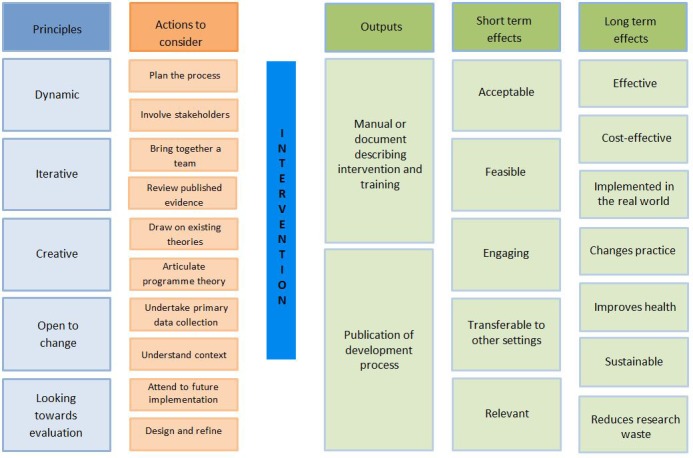
Objective: To provide researchers with guidance on actions to take during intervention development. Summary of key points: Based on a consensus exercise informed by reviews and qualitative interviews, we present key principles and actions for consideration when developing interventions to improve health. These include seeing intervention development as a dynamic iterative process, involving stakeholders, reviewing published research evidence, drawing on existing theories, articulating programme theory, undertaking primary data collection, understanding context, paying attention to future implementation in the real world and designing and refining an intervention using iterative cycles of development with stakeholder input throughout. Conclusion: Researchers should consider each action by addressing its relevance to a specific intervention in a specific context, both at the start and throughout the development process.
Overview
CoChat Summary
TL;DR
This paper offers consensus-based guidance on how to develop complex health interventions, framing development as a dynamic, iterative process rather than a fixed sequence. It argues that developers should continually judge which actions matter for a specific intervention and context, from the start through later refinement and implementation.
Key findings
- The guidance is based on a consensus exercise informed by reviews and qualitative interviews, and it recommends considering intervention development as “dynamic,” “iterative,” “creative,” “open to change,” and “forward looking.”
- The paper identifies a set of key actions for development, including involving stakeholders throughout, reviewing published research evidence, drawing on existing theories, articulating programme theory, undertaking primary data collection, understanding context, and planning for future implementation.
- The authors state there is “insufficient research evidence” to recommend that any particular published approach or set of actions is essential to produce a successful intervention.
- The paper emphasizes that iterative refinement should continue until later iterations produce “few changes,” using quantitative and qualitative methods to assess acceptability, feasibility, desirability, and potential unintended harms.
Methods
- The paper is a guidance article built from triangulation of three sources: reviews of published approaches to intervention development and primary research on intervention development, qualitative interviews, and consensus exercises.
- The consensus process included two simultaneous and identical e-Delphi studies for intervention developers and wider stakeholders, followed by a consensus workshop; participants rated 85 items on a five-point scale.
- An international expert panel with members from the UK, USA, and Europe guided the research and took part in the e-Delphi studies and workshop.
Limitations
- The paper explicitly states that the evidence base is sparse and that there is insufficient research evidence to identify a single best published approach or essential set of actions.
- It notes that some aspects of the guidance may not be relevant to some interventions or contexts, and that not all developers have large resources, so the guidance must be used flexibly.
- Evident from the text: the guidance is largely based on expert opinion and consensus rather than strong direct evidence that specific development actions improve intervention success.
Model-written summary. Check it against the paper before relying on it.
Integrity signals
Registry
Cites
Statistics
Figures
Verification
Claims the paper makes
1 Valid · 0 Not valid · 9 Not checked · 27 Own results and interpretations
In the paper
“a review of reviews shows that interventions developed with existing theory do not result in more effective interventions than those not using existing theory.10”
§ Guidance on how to develop complex interventions to improve health and healthcare > Framework for intervention development
What the sources say
- Not checked yetcites [10] Dalgetty R, Miller CB, Dombrowski SU Examining the theory‐effectiveness hypothesis: A systematic review of systematic reviews. Br J Health Psychol 2019; 24: 334– 56. 10.1111/bjhp.12356 30793445 source
plain- Asserted: passes — The authors put it forward as true.
- Checkable: passes — It can be checked against evidence.
- Load-bearing: passes — The paper’s conclusions depend on it.
- Based: passes — The paper gives a reason why it holds.
A conclusion the paper draws from its own results — it cites no other source for it, so there is none to check. The quote shows it is in the paper.
In the paper
“The rationale for understanding this context, and developing interventions which can operate within it, is to avoid developing interventions that fail during later evaluation because too few people deliver or use them.”
§ Guidance on how to develop complex interventions to improve health and healthcare > Framework for intervention development > Key actions of intervention development
plainstates a cause- Asserted: passes — The authors put it forward as true.
- Checkable: passes — It can be checked against evidence.
- Load-bearing: passes — The paper’s conclusions depend on it.
- Based: passes — The paper gives a reason why it holds.
A conclusion the paper draws from its own results — it cites no other source for it, so there is none to check. The quote shows it is in the paper.
In the paper
“There is insufficient research evidence to recommend that a particular published approach or set of actions is essential to produce a successful intervention.”
§ Guidance on how to develop complex interventions to improve health and healthcare > Conclusions
plain- Asserted: passes — The authors put it forward as true.
- Checkable: passes — It can be checked against evidence.
- Load-bearing: passes — The paper’s conclusions depend on it.
- Based: unclear — It is unclear why the paper says it holds.
In the paper
“We base this guidance on expert opinion because there is a research evidence gap about which actions are needed in intervention development to produce successful health interventions.”
- Also stated in: § Framework for intervention development · plain
“Unfortunately, this evidence base is sparse in the field of health, largely due to the difficulty of empirically addressing this question.8 9”
§ Guidance on how to develop complex interventions to improve health and healthcare > Framework for intervention development
What the sources say
- Not checked yetcites 8 9
plain- Asserted: passes — The authors put it forward as true.
- Checkable: passes — It can be checked against evidence.
- Load-bearing: passes — The paper’s conclusions depend on it.
- Based: passes — The paper gives a reason why it holds.
- Also stated in: § Framework for intervention development · plain
In the paper
“Many of these approaches share the same actions4 6 and simply place more emphasis on one or a subset of actions.”
§ Guidance on how to develop complex interventions to improve health and healthcare > Framework for intervention development > Key actions of intervention development
What the sources say
- Not checked yetcites 4 6
plain- Asserted: passes — The authors put it forward as true.
- Checkable: passes — It can be checked against evidence.
- Load-bearing: unclear — It is unclear whether the paper’s conclusions depend on it.
- Based: passes — The paper gives a reason why it holds.
9 references still to check
A free account verifies the references that are still open.
- Probably not a substantial claim. 30
- It may state two separate claims as one. 12
Claims other papers make about this one
Each is checked against this paper’s own text: does it say what the citing paper says it does?
The source backs part of the claim, not all of it — or backs it for a different population, condition or comparison.
In the citing paper
“Recent guidelines suggest that complex health interventions should be feasible, acceptable, engaging, transferable to other settings, and relevant [37].”
From Feasibility and Preliminary Efficacy of Web-Based and Mobile Interventions for Common Mental Health Problems in Working Adults: Multi-Arm Randomized Pilot Trial (2022) · cites this paper as [37]
Experimental — accuracy not yet measuredIn the citing paper
“Intervention developers create effective interventions, then seek to convince funders to pay for them [59].”
From Translating economic evaluations into financing strategies for implementing evidence-based practices (2021) · cites this paper as [59]
In the citing paper
“complex intervention research does not always begin with new or researcher led interventions.”
From A new framework for developing and evaluating complex interventions: update of Medical Research Council guidance (2021) · cites this paper as [4]
Citations
Cites
Developing and evaluating complex interventions: the new Medical Research Council guidance
Craig, P., Dieppe, P., Macintyre, S., Michie, S., Nazareth, I., & Petticrew, M. (2008) · BMJ · doi:10.1136/bmj.a1655 · Cited by 10,995 · cited 2×
“The UK Medical Research Council (MRC) published influential guidance on developing and evaluating complex interventions, presenting a framework of four phases: development, feasibility/piloting, evaluation and implementation.(1) The development phase is what happens between the idea for an intervention and formal pilo…”
BackgroundMethodHoffmann, T. C., Glasziou, P. P., Boutron, I., Milne, R., Perera, R., Moher, D., Altman, D. G., Barbour, V., Macdonald, H., Johnston, M., et al. (2014) · BMJ · doi:10.1136/bmj.g1687 · Cited by 10,548
Process evaluation of complex interventions: Medical Research Council guidance
Moore, G. F., Audrey, S., Barker, M., Bond, L., Bonell, C., Hardeman, W., Moore, L., O'Cathain, A., Tinati, T., Wight, D., et al. (2015) · BMJ · doi:10.1136/bmj.h1258 · Cited by 6,204 · cited 1×
“Indeed, they are advocated for use in process evaluations alongside outcome evaluations in the recent MRC Guidance on process evaluation.(15)”
MethodSelf-citationPlanning health promotion programs an intervention mapping approach
Bartholomew, L. K., Parcel, G. S., Kok, G., & Gottlieb, N. (2006) · Research Publications (Maastricht University) · Cited by 2,321
Using Programme Theory to Evaluate Complicated and Complex Aspects of Interventions
Rogers, P. J. (2008) · Evaluation · doi:10.1177/1356389007084674 · Cited by 999 · cited 1×
“A programme theory describes how a specific intervention is expected to lead to its effects and under what conditions.(14) It shows the causal pathways between the content of the intervention, intermediate outcomes and long-term goals and how these interact with contextual factors.”
BackgroundDemystifying theory and its use in improvement
Davidoff, F., Dixon-Woods, M., Leviton, L., & Michie, S. (2015) · BMJ Quality & Safety · doi:10.1136/bmjqs-2014-003627 · Cited by 714
A Description of Think Aloud Method and Protocol Analysis
Fonteyn, M. E., Kuipers, B., & Grobe, S. J. (1993) · Qualitative Health Research · doi:10.1177/104973239300300403 · Cited by 670
Taxonomy of approaches to developing interventions to improve health: a systematic methods overview
O’Cathain, A., Croot, L., Sworn, K., Duncan, E., Rousseau, N., Turner, K., Yardley, L., & Hoddinott, P. (2019) · Pilot and Feasibility Studies · doi:10.1186/s40814-019-0425-6 · Cited by 576
Self-citationMoore, G. F., Evans, R. E., Hawkins, J., Littlecott, H., Melendez-Torres, G. J., Bonell, C., & Murphy, S. (2019) · Evaluation · doi:10.1177/1356389018803219 · Cited by 471 · cited 1×
“Context also includes the wider complex health and social care, societal or political systems within which any intervention will operate.(18) Different approaches can be taken to understand context, including reviews of evidence, stakeholder engagement and primary data collection.”
BackgroundCraig, P., Di Ruggiero, E., Frohlich, K. L., Mykhalovskiy, E., White, M., on behalf of the Canadian Institutes of Health Research (CIHR)–National Institute for Health Research (NIHR) Context Guidance Authors Group (listed alphabetically), Campbell, R., Cummins, S., Edwards, N., Hunt, K., et al. (2018) · doi:10.3310/cihr-nihr-01 · Cited by 370 · cited 1×
“Recent guidance on context in population health intervention research identifies a breadth of features including those relating to population and individuals; physical location or geographical setting; social, economic, cultural and political influences and factors affecting implementation, for example, organisation,…”
Background
Cited by
Skivington, K., Matthews, L., Simpson, S. A., Craig, P., Baird, J., Blazeby, J. M., Boyd, K. A., Craig, N., French, D. P., McIntosh, E., et al. (2021) · BMJ · doi:10.1136/bmj.n2061 · Cited by 5,808
Sheldon, E., Simmonds-Buckley, M., Bone, C., Mascarenhas, T., Chan, N., Wincott, M., Gleeson, H., Sow, K., Hind, D., & Barkham, M. (2021) · Journal of Affective Disorders · doi:10.1016/j.jad.2021.03.054 · Cited by 644
Skivington, K., Matthews, L., Simpson, S. A., Craig, P., Baird, J., Blazeby, J. M., Boyd, K. A., Craig, N., French, D. P., McIntosh, E., et al. (2021) · Health Technology Assessment · doi:10.3310/hta25570 · Cited by 522
Adapting interventions to new contexts—The ADAPT guidance
Moore, G., Campbell, M., Copeland, L., Craig, P., Movsisyan, A., Hoddinott, P., Littlecott, H., O’Cathain, A., Pfadenhauer, L., Rehfuess, E., et al. (2021) · BMJ · doi:10.1136/bmj.n1679 · Cited by 511
Self-citationDuncan, E., O'Cathain, A., Rousseau, N., Croot, L., Sworn, K., Turner, K. M., Yardley, L., & Hoddinott, P. (2020) · BMJ Open · doi:10.1136/bmjopen-2019-033516 · Cited by 481
Self-citationThe Handbook of Behavior Change
(2020) · Cambridge University Press eBooks · doi:10.1017/9781108677318 · Cited by 407
Movsisyan, A., Arnold, L., Evans, R., Hallingberg, B., Moore, G., O’Cathain, A., Pfadenhauer, L. M., Segrott, J., & Rehfuess, E. (2019) · Implementation Science · doi:10.1186/s13012-019-0956-5 · Cited by 331
Self-citationAcceptability of digital health interventions: embracing the complexity
Perski, O., & Short, C. E. (2021) · Translational Behavioral Medicine · doi:10.1093/tbm/ibab048 · Cited by 300
Changing Behavior Using the Theory of Planned Behavior
Ajzen, I., & Schmidt, P. (2020) · The Handbook of Behavior Change · doi:10.1017/9781108677318.002 · Cited by 266
Maguire, R., McCann, L., Kotronoulas, G., Kearney, N., Ream, E., Armes, J., Patiraki, E., Furlong, E., Fox, P., Gaiger, A., et al. (2021) · BMJ · doi:10.1136/bmj.n1647 · Cited by 243
A new integrated behavioural intervention for knee osteoarthritis: development and pilot study
Preece, S. J., Brookes, N., Williams, A. E., Jones, R. K., Starbuck, C., Jones, A., & Walsh, N. E. (2021) · BMC Musculoskeletal Disorders · doi:10.1186/s12891-021-04389-0 · Cited by 238
Applying mixed methods to pilot feasibility studies to inform intervention trials
Aschbrenner, K. A., Kruse, G., Gallo, J. J., & Plano Clark, V. L. (2022) · Pilot and Feasibility Studies · doi:10.1186/s40814-022-01178-x · Cited by 175
Reardon, C. M., Damschroder, L. J., Ashcraft, L. E., Kerins, C., Bachrach, R. L., Nevedal, A. L., Domlyn, A. M., Dodge, J., Chinman, M., & Rogal, S. (2025) · Implementation Science · doi:10.1186/s13012-025-01450-7 · Cited by 172
Cowley, E. S., Watson, P. M., Foweather, L., Belton, S., Thompson, A., Thijssen, D. H. J., & Wagenmakers, A. J. M. (2021) · Children · doi:10.3390/children8010031 · Cited by 171
Lung-function trajectories: relevance and implementation in clinical practice
Melén, E., Faner, R., Allinson, J. P., Bui, D., Bush, A., Čustović, A., García‐Aymerich, J., Guerra, S., Breyer‐Kohansal, R., Hallberg, J., et al. (2024) · The Lancet · doi:10.1016/s0140-6736(24)00016-3 · Cited by 164
Skivington, K., Matthews, L., Simpson, S. A., Craig, P., Baird, J., Blazeby, J. M., Boyd, K. A., Craig, N., French, D. P., McIntosh, E., et al. (2024) · International Journal of Nursing Studies · doi:10.1016/j.ijnurstu.2024.104705 · Cited by 161
Changing Behavior Using the Model of Action Phases
Keller, L., Gollwitzer, P. M., & Sheeran, P. (2020) · The Handbook of Behavior Change · doi:10.1017/9781108677318.006 · Cited by 147
Designing for Emotion Regulation Interventions: An Agenda for HCI Theory and Research
Slovak, P., Antle, A., Theofanopoulou, N., Daudén Roquet, C., Gross, J., & Isbister, K. (2023) · ACM Transactions on Computer-Human Interaction · doi:10.1145/3569898 · Cited by 142
“To understand how this (lack of) good practice is present in the emotion regulation intervention space, we coded the level of detail or specificity that was provided about the assumed intervention mechanism and/or theory of change [34, 70].”
BackgroundChanging Behavior Using the Health Action Process Approach
Schwarzer, R., & Hamilton, K. (2020) · The Handbook of Behavior Change · doi:10.1017/9781108677318.007 · Cited by 102
Reeve, J. L., Maden, M., Hill, R. A., Turk, A., Mahtani, K. R., Wong, G., Lasserson, D. S., Krska, J., Mangin, D. A., Byng, R., et al. (2022) · Health Technology Assessment · doi:10.3310/aafo2475 · Cited by 134
Radcliffe, E., Servin, R., Cox, N. J., Lim, S. E. R., Tan, Q. Y., Howard, C., Sheikh, C., Rutter, P. M., Latter, S. M., Lown, M. T., et al. (2023) · BMC Geriatrics · doi:10.1186/s12877-023-04256-8 · Cited by 127
Robert, G., Locock, L., Williams, O., Cornwell, J., Donetto, S., & Goodrich, J. (2022) · doi:10.1017/9781009237024 · Cited by 92
Fylan, B., Tomlinson, J., Raynor, D. K., & Silcock, J. (2021) · Research in Social and Administrative Pharmacy · doi:10.1016/j.sapharm.2021.06.004 · Cited by 121
Gibson, J. L., Pritchard-Rowe, E., & de Lemos, C. (2021) · Autism & Developmental Language Impairments · doi:10.1177/23969415211015840 · Cited by 119
Salvador‐Carulla, L., Woods, C., de Miquel, C., & Lukersmith, S. (2024) · Heliyon · doi:10.1016/j.heliyon.2024.e29930 · Cited by 121
Post-traumatic growth after cancer: a scoping review of qualitative research
Menger, F., Halim, N. A. M., Rimmer, B., & Sharp, L. (2021) · Supportive Care in Cancer · doi:10.1007/s00520-021-06253-2 · Cited by 111
Changing Behavior Using Social Cognitive Theory
Łuszczyńska, A., & Schwarzer, R. (2020) · Cambridge University Press eBooks · doi:10.1017/9781108677318.003 · Cited by 106
Resilience in older persons: A systematic review of the conceptual literature
Angevaare, M. J., Roberts, J. R., van Hout, H. P. J., Joling, K. J., Smalbrugge, M., Schoonmade, L. J., Windle, G., & Hertogh, C. M. P. M. (2020) · Ageing Research Reviews · doi:10.1016/j.arr.2020.101144 · Cited by 97
Carter, M., Bennett, K. A., Embling, C. B., Hosegood, P. J., & Russell, D. J. F. (2016) · Movement Ecology · doi:10.1186/s40462-016-0090-9 · Cited by 96
Registered nurses’ approach to pressure injury prevention: A descriptive qualitative study
Li, Z., Marshall, A. P., Lin, F. F., Ding, Y., & Chaboyer, W. P. (2022) · Journal of Advanced Nursing · doi:10.1111/jan.15218 · Cited by 91
Day, S., Laver, K., Jeon, Y., Radford, K. A., & Low, L. (2023) · Dementia · doi:10.1177/14713012231192360 · Cited by 93
Changing Behavior Using Ecological Models
Salmon, J., Hesketh, K. D., Arundell, L., Downing, K. L., & Biddle, S. (2020) · Cambridge University Press eBooks · doi:10.1017/9781108677318.017 · Cited by 91
Changing Behavior Using Self-Determination Theory
Hagger, M. S., Hankonen, N. E., Chatzisarantis, N. L. D., & Ryan, R. M. (2020) · Cambridge University Press eBooks · doi:10.1017/9781108677318.008 · Cited by 90
Bergmann, F., Gray, R., Wachsmuth, S., & Höner, O. (2021) · Frontiers in Psychology · doi:10.3389/fpsyg.2021.772201 · Cited by 83
Gardner, B., Rebar, A. L., & Lally, P. J. (2020) · Cambridge University Press eBooks · doi:10.1017/9781108677318.041 · Cited by 85
A systematic review of flow interventions in sport and exercise
Goddard, S. G., Stevens, C. J., Jackman, P. C., & Swann, C. (2021) · International Review of Sport and Exercise Psychology · doi:10.1080/1750984x.2021.1923055 · Cited by 81
Lorito, C. D., Bosco, A., Rai, H., Craven, M. P., McNally, D. S., Todd, C. J., Booth, V., Cowley, A., Howe, L., & Harwood, R. (2022) · International Journal of Geriatric Psychiatry · doi:10.1002/gps.5730 · Cited by 81
Rousseau, N. S., Turner, K. M., Duncan, E., O’Cathain, A., Croot, L., Yardley, L., & Hoddinott, P. (2019) · PLoS ONE · doi:10.1371/journal.pone.0223615 · Cited by 79
Self-citationWarner, L. M., & French, D. (2020) · Cambridge University Press eBooks · doi:10.1017/9781108677318.032 · Cited by 79
Blackburn, N. E., Wilson, J. J., McMullan, I., Caserotti, P., Giné‐Garriga, M., Wirth, K., Coll‐Planas, L., Alias, S. B., Figuls, M. R. I., Deidda, M., et al. (2020) · International Journal of Behavioral Nutrition and Physical Activity · doi:10.1186/s12966-020-00957-0 · Cited by 76
Tanay, M. A., Armes, J., Moss-Morris, R. E., Rafferty, A. M., & Robert, G. (2021) · Journal of Cancer Survivorship · doi:10.1007/s11764-021-00997-w · Cited by 76
Edwards, J., Coward, M., & Carey, N. (2022) · BMJ Open · doi:10.1136/bmjopen-2021-052227 · Cited by 78
Yin, Y., Lyu, M., Chen, Y., Zhang, J., Li, H., Li, H., Xia, G., & Zhang, J. (2022) · Frontiers in Psychology · doi:10.3389/fpsyg.2022.953491 · Cited by 75
Livingstone, K. M., Love, P., Mathers, J. C., Kirkpatrick, S. I., & Olstad, D. L. (2023) · Proceedings of The Nutrition Society · doi:10.1017/s002966512300304x · Cited by 74
A meta-analysis of disordered eating and its association with self-criticism and self-compassion.
Paranjothy, S., & Wade, T. (2024) · International Journal of Eating Disorders · doi:10.1002/eat.24166 · Cited by 54
Consolidated guidance for behavioral intervention pilot and feasibility studies
Pfledderer, C. D., von Klinggraeff, L., Burkart, S. A., Bandeira, A. D. S., Lubans, D. R., Jago, R., Okely, A. D., van Sluijs, E. M. F., Ioannidis, J. P. A., Thrasher, J. F., et al. (2024) · Pilot and Feasibility Studies · doi:10.1186/s40814-024-01485-5 · Cited by 74
Executive Function Poststroke: Concepts, Recovery, and Interventions
Skidmore, E. R., Eskes, G. A., & Brodtmann, A. G. (2022) · Stroke · doi:10.1161/strokeaha.122.037946 · Cited by 73
Robb, K. A. (2021) · Preventive Medicine Reports · doi:10.1016/j.pmedr.2021.101427 · Cited by 70
Fridriksson, J., Basilakos, A., Boyle, M., Cherney, L. R., DeDe, G., Gordon, J., Harnish, S. M., Hoover, E., Hula, W. D., Pompon, R. H., et al. (2021) · Archives of Physical Medicine and Rehabilitation · doi:10.1016/j.apmr.2021.08.025 · Cited by 69
Jumbe, S. E., Nyali, J., Simbeye, M., Zakeyu, N., Motshewa, G., & Pulapa, S. R. (2022) · PLoS ONE · doi:10.1371/journal.pone.0265530 · Cited by 67
Leutenegger, V., Grylka‐Baeschlin, S., Wieber, F., Daly, D., & Pehlke‐Milde, J. (2022) · BMC Pregnancy and Childbirth · doi:10.1186/s12884-022-05178-w · Cited by 65
Evans, R., Moore, G. F., Movsisyan, A., & Rehfuess, E. A. (2020) · Journal of Epidemiology & Community Health · doi:10.1136/jech-2020-214468 · Cited by 65
Martins, M. V., Koert, E., Sylvest, R., Maeda, E., Moura‐Ramos, M., Hammarberg, K., & Harper, J. C. (2023) · Human Reproduction · doi:10.1093/humrep/dead253 · Cited by 63
Changing Behavior: A Theory- and Evidence-Based Approach
Hagger, M. S., Cameron, L. D., Hamilton, K., Hankonen, N. E., & Lintunen, T. (2020) · Cambridge University Press eBooks · doi:10.1017/9781108677318.001 · Cited by 63
Sagar-Ouriaghli, I., Godfrey, E. L., Graham, S., & Brown, J. S. L. (2020) · International Journal of Environmental Research and Public Health · doi:10.3390/ijerph17144965 · Cited by 63
Application of complexity theory in health and social care research: a scoping review
Carroll, Á. M., Collins, C., McKenzie, J., Stokes, D., & Darley, A. (2023) · BMJ Open · doi:10.1136/bmjopen-2022-069180 · Cited by 61
Stadtler, L., Seitanidi, M. M., Knight, H. H., Leigh, J. S. A., Clarke, A. C., Ber, M. J. L., Bogie, J., Brunese, P., Hustad, O., Krasonikolakis, I. G., et al. (2024) · Journal of Management Studies · doi:10.1111/joms.13053 · Cited by 64
Changing Behavior Using Habit Theory
Orbell, S., & Verplanken, B. (2020) · Cambridge University Press eBooks · doi:10.1017/9781108677318.013 · Cited by 64
Erhardsson, M., Murphy, M. A., & Sunnerhagen, K. S. (2020) · Journal of NeuroEngineering and Rehabilitation · doi:10.1186/s12984-020-00788-x · Cited by 61
Responding to Autism in Low and Middle Income Countries (Lmic): What to Do and What Not to Do
McConkey, R. (2022) · Brain Sciences · doi:10.3390/brainsci12111475 · Cited by 60
Furie, K. S., Park, A. L., & Wong, S. E. (2023) · Current Reviews in Musculoskeletal Medicine · doi:10.1007/s12178-023-09830-6 · Cited by 60
Ruiter, R. A. C., & Crutzen, R. (2020) · Frontiers in Public Health · doi:10.3389/fpubh.2020.00247 · Cited by 62
Attitudes and Persuasive Communication Interventions
Hamilton, K., & Johnson, B. T. (2020) · Cambridge University Press eBooks · doi:10.1017/9781108677318.031 · Cited by 61
Heffernan, E., Withanachchi, C. M., & Ferguson, M. (2022) · Age and Ageing · doi:10.1093/ageing/afac019 · Cited by 58
Evaluation of remote digital postoperative wound monitoring in routine surgical practice
McLean, K. A., Sgrò, A., Brown, L. R., Buijs, L. F., Daines, L., Potter, M. A., Bouamrane, M.-M., & Harrison, E. M. (2023) · npj Digital Medicine · doi:10.1038/s41746-023-00824-9 · Cited by 59
Coping with Emotional Distress via Self-Disclosure to Robots: An Intervention with Caregivers
Laban, G., Morrison, V., Kappas, A., & Cross, E. S. (2025) · International Journal of Social Robotics · doi:10.1007/s12369-024-01207-0 · Cited by 57
McLean, K. A., Knight, S. R., Diehl, T. M., Varghese, C., Ng, N., Potter, M. A., Zafar, S. N., Bouamrane, M.-M., & Harrison, E. M. (2023) · The Lancet Digital Health · doi:10.1016/s2589-7500(23)00026-2 · Cited by 58
O’Callaghan, G., Fahy, M. P., Murphy, P., Langhorne, P., Galvin, R., & Horgan, F. (2022) · BMC Health Services Research · doi:10.1186/s12913-022-08473-6 · Cited by 56
Martínez-Rubio, D., Navarrete, J., & Montero-Marin, J. (2021) · International Journal of Environmental Research and Public Health · doi:10.3390/ijerph19010154 · Cited by 41
Mielke, J., Leppla, L., Valenta, S., Zullig, L. L., Zúñiga, F., Staudacher, S., Teynor, A., & Geest, S. D. (2022) · Implementation Science Communications · doi:10.1186/s43058-022-00354-7 · Cited by 56
O’Dea, Á., Stanley, M. J., Coote, S. B., & Robinson, K. (2021) · PLoS ONE · doi:10.1371/journal.pone.0245738 · Cited by 53
Translating economic evaluations into financing strategies for implementing evidence-based practices
Dopp, A. R., Kerns, S. E. U., Panattoni, L., Ringel, J. S., Eisenberg, D., Powell, B. J., Low, R., & Raghavan, R. (2021) · Implementation Science · doi:10.1186/s13012-021-01137-9 · Cited by 52
“Intervention developers create effective interventions, then seek to convince funders to pay for them [59].”
BackgroundChanging Behavior Using Integrated Theories
Hagger, M. S., & Hamilton, K. (2020) · Cambridge University Press eBooks · doi:10.1017/9781108677318.015 · Cited by 51
Alias, S. B., Nadal, R. M., Moral, I., Figuls, M. R. I., Luque, X. R. I., & Coll‐Planas, L. (2021) · BMC Public Health · doi:10.1186/s12889-020-10094-9 · Cited by 51
Abraham, J., Hirt, J., Richter, C., Köpke, S., Meyer, G., & Möhler, R. (2022) · Cochrane Database of Systematic Reviews · doi:10.1002/14651858.cd012476.pub2 · Cited by 51
Irons, J. Y., Garip, G., Cross, A. J., Sheffield, D., & Bird, J. (2020) · PLoS ONE · doi:10.1371/journal.pone.0243461 · Cited by 50
Yu, X., Chau, J. P. C., Huo, L., Li, X., Wang, D., Wu, H., & Zhang, Y. (2022) · BMC Nursing · doi:10.1186/s12912-022-00970-7 · Cited by 50
Bekker, H., Winterbottom, A., Gavaruzzi, T., Finderup, J., & Mooney, A. F. (2023) · Clinical Kidney Journal · doi:10.1093/ckj/sfad172 · Cited by 49
Distracted driving prevention: an analysis of recent UK campaigns
Diegelmann, S., Ninaus, K., & Terlutter, R. (2020) · Journal of Social Marketing · doi:10.1108/jsocm-07-2019-0105 · Cited by 49
Planning and Implementation Intention Interventions
Rhodes, R. E., Grant, S. J., & de Bruijn, G. (2020) · Cambridge University Press eBooks · doi:10.1017/9781108677318.039 · Cited by 49
The role of emotions and injunctive norms in breastfeeding: a systematic review and meta-analysis
Russell, P. S., Smith, D. M., Birtel, M. D., Hart, K. H., & Golding, S. E. (2021) · Health Psychology Review · doi:10.1080/17437199.2021.1893783 · Cited by 49
Brenner, R., Witzig-Brändli, V., Vetsch, J., & Köhler, M. (2022) · International Journal of MS Care · doi:10.7224/1537-2073.2021-166 · Cited by 48
Alias, S. B., Cuevas-Lara, C., Martínez‐Velilla, N., Zambom-Ferraresi, F., Soto, M. E., Tavassoli, N., Mathieu, C., Heras, E., Garibaldi, P., Anglada, M., et al. (2021) · International Journal of Environmental Research and Public Health · doi:10.3390/ijerph18115979 · Cited by 48
Rutherford, M., Maciver, D., Johnston, L., Prior, S., & Forsyth, K. (2021) · Children · doi:10.3390/children8111033 · Cited by 49
Ramage, E. R., Burke, M., Galloway, M. E., Graham, I. D., Janssen, H., Marsden, D. L., Patterson, A. J., Pollack, M. R. P., Said, C. M., Lynch, E. A., et al. (2022) · Health Research Policy and Systems · doi:10.1186/s12961-021-00790-2 · Cited by 48
Devine, L. D., Gallagher, A. M., Briggs, S., & Hill, A. (2023) · Frontiers in Public Health · doi:10.3389/fpubh.2023.1227075 · Cited by 48
Roche, E., Richardson, N., Sweeney, J., & O’Donnell, S. (2024) · American Journal of Men s Health · doi:10.1177/15579883241236223 · Cited by 47
Etminani, K., Engström, A. T., Göransson, C., Sant’Anna, A., & Nowaczyk, S. (2020) · Journal of Medical Internet Research · doi:10.2196/17201 · Cited by 47
Yip, O., Huber, E., Stenz, S., Zullig, L. L., Zeller, A., Geest, S. D., & Deschodt, M. (2021) · International Journal of Integrated Care · doi:10.5334/ijic.5607 · Cited by 48
Borek, A., Santillo, M., Wanat, M., Butler, C., & Tonkin-Crine, S. K. (2022) · JAC-Antimicrobial Resistance · doi:10.1093/jacamr/dlac007 · Cited by 48
Edwards, D. J., Williams, J., Carrier, J., & Davies, J. L. (2022) · JBI Evidence Synthesis · doi:10.11124/jbies-21-00241 · Cited by 48
Managing Minds at Work: Development of a Digital Line Manager Training Program
Blake, H., Vaughan, B., Bartle, C., Yarker, J., Munir, F., Marwaha, S., Daly, G. B. J., Russell, S., Meyer, C., Hassard, J., et al. (2022) · International Journal of Environmental Research and Public Health · doi:10.3390/ijerph19138006 · Cited by 46
Maindal, H. T., Timm, A., Dahl‐Petersen, I. K., Davidsen, E., Hillersdal, L., Jensen, N. H., Thøgersen, M., Jensen, D. M., Ovesen, P., Damm, P., et al. (2021) · BMC Public Health · doi:10.1186/s12889-021-11655-2 · Cited by 46
Noonan, M., Jomeen, J., & Doody, O. (2021) · International Journal of Environmental Research and Public Health · doi:10.3390/ijerph18105396 · Cited by 47
Schättin, A., Häfliger, S., Meyer, A., Früh, B., Böckler, S., Hungerbühler, Y., de Bruin, E. D., Frese, S., Egli, R. S., Götz, U., et al. (2021) · JMIR Serious Games · doi:10.2196/22826 · Cited by 45
Gallant, A. J., Flowers, P., Deakin, K., Cogan, N. A., Rasmussen, S. A., Young, D., & Williams, L. (2021) · Psychology and Health · doi:10.1080/08870446.2021.1957104 · Cited by 45
Arden, M. A., Hutchings, M., Whelan, P., Drabble, S. J., Beever, D., Bradley, J. M., Hind, D., Ainsworth, J., Maguire, C., Cantrill, H., et al. (2021) · Pilot and Feasibility Studies · doi:10.1186/s40814-020-00739-2 · Cited by 44
Self-citationMurphy, C. L., Laine, C., Macaulay, M., Hislop, K., & Fader, M. J. (2020) · Age and Ageing · doi:10.1093/ageing/afaa262 · Cited by 44
Carr, C. E., Feldtkeller, B., French, J., Havsteen-Franklin, D., Huet, V., Karkou, V., Priebe, S., & Sandford, S. (2020) · The Arts in Psychotherapy · doi:10.1016/j.aip.2020.101747 · Cited by 45
Shared decision-making in advanced kidney disease: a scoping review
Engels, N., de Graav, G. N., van der Nat, P. B., van den Dorpel, M., Stiggelbout, A. M., & Bos, W. J. W. (2022) · BMJ Open · doi:10.1136/bmjopen-2021-055248 · Cited by 44
Metadata
- Authors
- O"Cathain, A., Croot, L., Duncan, E., Rousseau, N., Sworn, K., Turner, K. M., Yardley, L., & Hoddinott, P.
- Affiliations
- Medical Care Research Unit, School of Health and Related Research, University of Sheffield, Sheffield, UK
- University of Sheffield (GB)
- University of Stirling (GB)
- University of Bristol (GB)
- ORCID
- Venue
- BMJ Open
- Publisher
- BMJ
- Published
- 2019-08
- Volume
- 9
- Issue
- 8
- Pages
- e029954
- ISSN
- 2044-6055 (ISSN-L)
- PMC
- PMC6701588
- OpenAlex
- W2958481062
- Cited by
- 1,591
- References
- 18
- Citations by year
- 2026: 150 · 2025: 264 · 2024: 347 · 2023: 249 · 2022: 247 · 2021: 214 · 2020: 114 · 2019: 6
- FWCI
- 197.91
- Type
- journal article
- Language
- en
- Open access
- gold
- doi.org
- Licence
- cc-by
- Locations
- BMJ Open (publishedVersion, cc-by)
- Europe PMC (PubMed Central) (publishedVersion, cc-by)
- PubMed Central (publishedVersion, cc-by)
- PubMed (publishedVersion)
- White Rose Research Online (University of Leeds, The University of Sheffield, University of York) (acceptedVersion)
- ePrints Soton (University of Southampton) (acceptedVersion)
- Bristol Research (University of Bristol) (acceptedVersion, cc-by)
- DOAJ (DOAJ: Directory of Open Access Journals) (submittedVersion, cc-by-sa)
- Stirling Online Research Repository (University of Stirling) (submittedVersion, cc-by)
- HighWire Press Open Archive (submittedVersion)
- Funders
- Medical Research Council (MR/N015339/1)
- Topics
- Health Sciences › Health Professions › General Health Professions › Health Policy Implementation Science
- Social Sciences › Public Administration › Evaluation and Performance Assessment
- Social Sciences › Sociology and Political Science › Delphi Technique in Research
- Keywords
- complex interventions, intervention development, iterative development, stakeholder engagement, program theory, context, theory-based design, primary data collection, health service improvement
- MeSH terms
- Stakeholder Participation, Delivery of Health Care, Health Promotion, Humans, Research Design, Research Personnel, Consensus
About these checks
Registry, retraction, Cites and statistics results are computed, not judged, with one exception: a printed reference that no index lists is read once by a model before it counts as a citation error. Claims are extracted by a model and kept only when their quote appears verbatim in the text; each cited source is then checked, with a model’s help, for whether it says what the claim relies on. Those verdicts can be wrong — read the claim’s quote and the cited source before relying on one.
A language model drew the claims from the paper on 2026-10-11, under version 3 of the claim definition (model deepseek-v4.1-flash, prompt extract-v3).
A second model labelled each claim on 2026-10-11 (model jev-1.13-20260917, definition revision gold-guideline-v0.2).
Statistics and arithmetic are recomputed, not judged.
Confidence bands are shown only for fields calibrated on our annotated test set. None is calibrated yet, so no band is shown.
What counts as a claim ›How we measure confidence ›How we check this ›
Are you an author, or do you see a problem with this page? Request a review
Data sources
Bibliographic data: Semantic Scholar, OpenAlex, Crossref.
Contains information from the Semantic Scholar Academic Graph Datasets, made available under the ODC Attribution License (ODC-BY 1.0).
Semantic Scholar’s data is described in: Kinney, R., et al. (2023). The Semantic Scholar Open Data Platform. arXiv:2301.10140.
