

Guidance on how to develop complex interventions to improve health and healthcare
Open accessThe DOI matches its Crossref record; 18 of the 18 references it cites were found in a registry or an index; 1 of the 10 sources its claims cite were checked for support.
Abstract
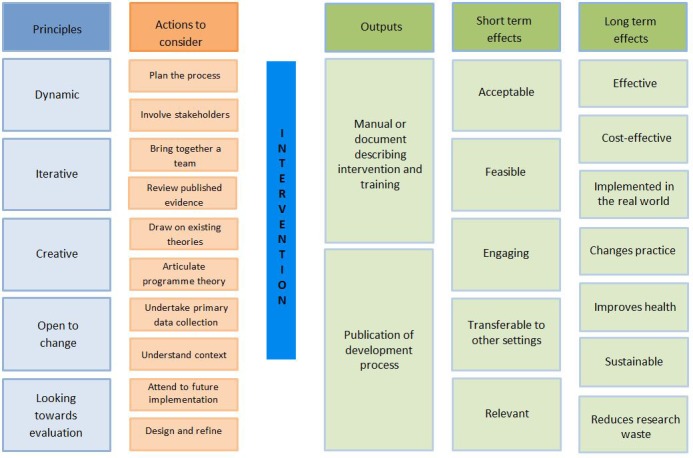
Objective: To provide researchers with guidance on actions to take during intervention development. Summary of key points: Based on a consensus exercise informed by reviews and qualitative interviews, we present key principles and actions for consideration when developing interventions to improve health. These include seeing intervention development as a dynamic iterative process, involving stakeholders, reviewing published research evidence, drawing on existing theories, articulating programme theory, undertaking primary data collection, understanding context, paying attention to future implementation in the real world and designing and refining an intervention using iterative cycles of development with stakeholder input throughout. Conclusion: Researchers should consider each action by addressing its relevance to a specific intervention in a specific context, both at the start and throughout the development process.
Overview
CoChat Summary
TL;DR
This paper offers consensus-based guidance on how to develop complex health interventions, framing development as a dynamic, iterative process rather than a fixed sequence. It argues that developers should continually judge which actions matter for a specific intervention and context, from the start through later refinement and implementation.
Key findings
- The guidance is based on a consensus exercise informed by reviews and qualitative interviews, and it recommends considering intervention development as “dynamic,” “iterative,” “creative,” “open to change,” and “forward looking.”
- The paper identifies a set of key actions for development, including involving stakeholders throughout, reviewing published research evidence, drawing on existing theories, articulating programme theory, undertaking primary data collection, understanding context, and planning for future implementation.
- The authors state there is “insufficient research evidence” to recommend that any particular published approach or set of actions is essential to produce a successful intervention.
- The paper emphasizes that iterative refinement should continue until later iterations produce “few changes,” using quantitative and qualitative methods to assess acceptability, feasibility, desirability, and potential unintended harms.
Methods
- The paper is a guidance article built from triangulation of three sources: reviews of published approaches to intervention development and primary research on intervention development, qualitative interviews, and consensus exercises.
- The consensus process included two simultaneous and identical e-Delphi studies for intervention developers and wider stakeholders, followed by a consensus workshop; participants rated 85 items on a five-point scale.
- An international expert panel with members from the UK, USA, and Europe guided the research and took part in the e-Delphi studies and workshop.
Limitations
- The paper explicitly states that the evidence base is sparse and that there is insufficient research evidence to identify a single best published approach or essential set of actions.
- It notes that some aspects of the guidance may not be relevant to some interventions or contexts, and that not all developers have large resources, so the guidance must be used flexibly.
- Evident from the text: the guidance is largely based on expert opinion and consensus rather than strong direct evidence that specific development actions improve intervention success.
Model-written summary. Check it against the paper before relying on it.
Integrity signals
Registry
Cites
Statistics
Figures
Verification
Claims the paper makes
1 Valid · 0 Not valid · 9 Not checked · 27 Own results and interpretations
In the paper
“a review of reviews shows that interventions developed with existing theory do not result in more effective interventions than those not using existing theory.10”
§ Guidance on how to develop complex interventions to improve health and healthcare > Framework for intervention development
What the sources say
- Not checked yetcites [10] Dalgetty R, Miller CB, Dombrowski SU Examining the theory‐effectiveness hypothesis: A systematic review of systematic reviews. Br J Health Psychol 2019; 24: 334– 56. 10.1111/bjhp.12356 30793445 source
plain- Asserted: passes — The authors put it forward as true.
- Checkable: passes — It can be checked against evidence.
- Load-bearing: passes — The paper’s conclusions depend on it.
- Based: passes — The paper gives a reason why it holds.
A conclusion the paper draws from its own results — it cites no other source for it, so there is none to check. The quote shows it is in the paper.
In the paper
“The rationale for understanding this context, and developing interventions which can operate within it, is to avoid developing interventions that fail during later evaluation because too few people deliver or use them.”
§ Guidance on how to develop complex interventions to improve health and healthcare > Framework for intervention development > Key actions of intervention development
plainstates a cause- Asserted: passes — The authors put it forward as true.
- Checkable: passes — It can be checked against evidence.
- Load-bearing: passes — The paper’s conclusions depend on it.
- Based: passes — The paper gives a reason why it holds.
A conclusion the paper draws from its own results — it cites no other source for it, so there is none to check. The quote shows it is in the paper.
In the paper
“There is insufficient research evidence to recommend that a particular published approach or set of actions is essential to produce a successful intervention.”
§ Guidance on how to develop complex interventions to improve health and healthcare > Conclusions
plain- Asserted: passes — The authors put it forward as true.
- Checkable: passes — It can be checked against evidence.
- Load-bearing: passes — The paper’s conclusions depend on it.
- Based: unclear — It is unclear why the paper says it holds.
In the paper
“We base this guidance on expert opinion because there is a research evidence gap about which actions are needed in intervention development to produce successful health interventions.”
- Also stated in: § Framework for intervention development · plain
“Unfortunately, this evidence base is sparse in the field of health, largely due to the difficulty of empirically addressing this question.8 9”
§ Guidance on how to develop complex interventions to improve health and healthcare > Framework for intervention development
What the sources say
- Not checked yetcites 8 9
plain- Asserted: passes — The authors put it forward as true.
- Checkable: passes — It can be checked against evidence.
- Load-bearing: passes — The paper’s conclusions depend on it.
- Based: passes — The paper gives a reason why it holds.
- Also stated in: § Framework for intervention development · plain
In the paper
“Many of these approaches share the same actions4 6 and simply place more emphasis on one or a subset of actions.”
§ Guidance on how to develop complex interventions to improve health and healthcare > Framework for intervention development > Key actions of intervention development
What the sources say
- Not checked yetcites 4 6
plain- Asserted: passes — The authors put it forward as true.
- Checkable: passes — It can be checked against evidence.
- Load-bearing: unclear — It is unclear whether the paper’s conclusions depend on it.
- Based: passes — The paper gives a reason why it holds.
9 references still to check
A free account verifies the references that are still open.
- Probably not a substantial claim. 30
- It may state two separate claims as one. 12
Claims other papers make about this one
Each is checked against this paper’s own text: does it say what the citing paper says it does?
The source backs part of the claim, not all of it — or backs it for a different population, condition or comparison.
In the citing paper
“Recent guidelines suggest that complex health interventions should be feasible, acceptable, engaging, transferable to other settings, and relevant [37].”
From Feasibility and Preliminary Efficacy of Web-Based and Mobile Interventions for Common Mental Health Problems in Working Adults: Multi-Arm Randomized Pilot Trial (2022) · cites this paper as [37]
Experimental — accuracy not yet measuredIn the citing paper
“Intervention developers create effective interventions, then seek to convince funders to pay for them [59].”
From Translating economic evaluations into financing strategies for implementing evidence-based practices (2021) · cites this paper as [59]
In the citing paper
“complex intervention research does not always begin with new or researcher led interventions.”
From A new framework for developing and evaluating complex interventions: update of Medical Research Council guidance (2021) · cites this paper as [4]
Citations
Cites
Developing and evaluating complex interventions: the new Medical Research Council guidance
Craig, P., Dieppe, P., Macintyre, S., Michie, S., Nazareth, I., & Petticrew, M. (2008) · BMJ · doi:10.1136/bmj.a1655 · Cited by 10,995 · cited 2×
“The UK Medical Research Council (MRC) published influential guidance on developing and evaluating complex interventions, presenting a framework of four phases: development, feasibility/piloting, evaluation and implementation.(1) The development phase is what happens between the idea for an intervention and formal pilo…”
BackgroundMethodHoffmann, T. C., Glasziou, P. P., Boutron, I., Milne, R., Perera, R., Moher, D., Altman, D. G., Barbour, V., Macdonald, H., Johnston, M., et al. (2014) · BMJ · doi:10.1136/bmj.g1687 · Cited by 10,548
Process evaluation of complex interventions: Medical Research Council guidance
Moore, G. F., Audrey, S., Barker, M., Bond, L., Bonell, C., Hardeman, W., Moore, L., O'Cathain, A., Tinati, T., Wight, D., et al. (2015) · BMJ · doi:10.1136/bmj.h1258 · Cited by 6,204 · cited 1×
“Indeed, they are advocated for use in process evaluations alongside outcome evaluations in the recent MRC Guidance on process evaluation.(15)”
MethodSelf-citationPlanning health promotion programs an intervention mapping approach
Bartholomew, L. K., Parcel, G. S., Kok, G., & Gottlieb, N. (2006) · Research Publications (Maastricht University) · Cited by 2,321
Using Programme Theory to Evaluate Complicated and Complex Aspects of Interventions
Rogers, P. J. (2008) · Evaluation · doi:10.1177/1356389007084674 · Cited by 999 · cited 1×
“A programme theory describes how a specific intervention is expected to lead to its effects and under what conditions.(14) It shows the causal pathways between the content of the intervention, intermediate outcomes and long-term goals and how these interact with contextual factors.”
BackgroundDemystifying theory and its use in improvement
Davidoff, F., Dixon-Woods, M., Leviton, L., & Michie, S. (2015) · BMJ Quality & Safety · doi:10.1136/bmjqs-2014-003627 · Cited by 714
A Description of Think Aloud Method and Protocol Analysis
Fonteyn, M. E., Kuipers, B., & Grobe, S. J. (1993) · Qualitative Health Research · doi:10.1177/104973239300300403 · Cited by 670
Taxonomy of approaches to developing interventions to improve health: a systematic methods overview
O’Cathain, A., Croot, L., Sworn, K., Duncan, E., Rousseau, N., Turner, K., Yardley, L., & Hoddinott, P. (2019) · Pilot and Feasibility Studies · doi:10.1186/s40814-019-0425-6 · Cited by 576
Self-citationMoore, G. F., Evans, R. E., Hawkins, J., Littlecott, H., Melendez-Torres, G. J., Bonell, C., & Murphy, S. (2019) · Evaluation · doi:10.1177/1356389018803219 · Cited by 471 · cited 1×
“Context also includes the wider complex health and social care, societal or political systems within which any intervention will operate.(18) Different approaches can be taken to understand context, including reviews of evidence, stakeholder engagement and primary data collection.”
BackgroundCraig, P., Di Ruggiero, E., Frohlich, K. L., Mykhalovskiy, E., White, M., on behalf of the Canadian Institutes of Health Research (CIHR)–National Institute for Health Research (NIHR) Context Guidance Authors Group (listed alphabetically), Campbell, R., Cummins, S., Edwards, N., Hunt, K., et al. (2018) · doi:10.3310/cihr-nihr-01 · Cited by 370 · cited 1×
“Recent guidance on context in population health intervention research identifies a breadth of features including those relating to population and individuals; physical location or geographical setting; social, economic, cultural and political influences and factors affecting implementation, for example, organisation,…”
Background
Cited by
Items 301–400 of 1,001
Shepherd, L. M., Schmidtke, K. A., Hazlehurst, J., Melson, E., Dretzke, J., Hawks, N., Arlt, W., Tahrani, A. A., Swift, A., & Carrick‐Sen, D. (2022) · European Journal of Endocrinology · doi:10.1530/eje-21-1248 · Cited by 18
Zordan, R., Lethborg, C. E., Forster, J., Mason, T., Walker, V., Mcbrearty, K., & Torcasio, C. (2022) · Nurse Education Today · doi:10.1016/j.nedt.2022.105460 · Cited by 18
Shannon, R., Baxter, R., Hardicre, N., Mills, T., Murray, J., Lawton, R., & O'Hara, J. K. (2022) · Health Expectations · doi:10.1111/hex.13560 · Cited by 18
Langballe, R., Dalton, S. O., Jakobsen, E. H., Karlsen, R. V., Iachina, M., Freund, K. M., LeClair, A. M., Nielsen, A. S., Andersen, E. W., Rosthøj, S., et al. (2022) · BMJ Open · doi:10.1136/bmjopen-2021-060242 · Cited by 19
Baxter, K. A., Kerr, J. T., Nambiar, S., Gallegos, D., Penny, R. A., Laws, R., & Byrne, R. (2024) · Health Expectations · doi:10.1111/hex.14051 · Cited by 19
Monteleone, A. M., Cardi, V., Ambwani, S., Cascino, G., Albano, G., Pellegrino, F., & Treasure, J. L. (2020) · Early Intervention in Psychiatry · doi:10.1111/eip.13064 · Cited by 18
Thayabaranathan, T., Immink, M. A., Hillier, S., Stolwyk, R., Andrew, N. E., Stevens, P., Kilkenny, M. F., Gee, E., Carey, L., Brodtmann, A., et al. (2021) · Neurology International · doi:10.3390/neurolint14010001 · Cited by 17
Pang, F., & Datu, J. A. D. (2025) · Educational Research Review · doi:10.1016/j.edurev.2025.100729 · Cited by 20
Seljelid, B., Varsi, C., Nes, L. S., Øystese, K. A., & Børøsund, E. (2022) · JMIR Formative Research · doi:10.2196/34738 · Cited by 17
Coumoundouros, C., Farrand, P. A., Sanderman, R., von Essén, L., & Woodford, J. (2024) · BMC Nephrology · doi:10.1186/s12882-023-03444-3 · Cited by 18
Manyara, A. M., Mwaniki, E., Gill, J. M. R., & Gray, C. M. (2024) · PLoS ONE · doi:10.1371/journal.pone.0297779 · Cited by 17
Pérez, B. D. D., das Nair, R., & Radford, K. (2024) · Clinical Rehabilitation · doi:10.1177/02692155241235956 · Cited by 17
Mental health in athletes: Does authentic leadership matter?
Kavussanu, M., Zhang, S., Tang, Q., Cumming, J., & Mackman, T. (2024) · Psychology of sport and exercise · doi:10.1016/j.psychsport.2024.102617 · Cited by 17
Swartling, M., Hamberg, A., Furebring, M., Tängdén, T., & Nielsen, E. I. (2024) · International Journal of Clinical Pharmacy · doi:10.1007/s11096-024-01822-x · Cited by 17
The person-based approach to intervention development: A scoping review of methods and applications
Holt, L., Denford, S., Bowers, H. M., Kuberka, P., Müller, I., Amlôt, R., & Yardley, L. (2025) · Digital Health · doi:10.1177/20552076241305934 · Cited by 19
Self-citationMétais, A., Omarjee, M., Valero, B., Gleich, A., Mekki, A., Henry, A., Duclos, A., Lilot, M., Rode, G., & Schlatter, S. (2025) · BMC Medical Education · doi:10.1186/s12909-024-06344-8 · Cited by 18
Butterworth, J. E., Goulding, R., McDonagh, S. T. J., Bower, P., Pitchforth, E., Richards, S. H., & Campbell, J. (2020) · Patient Education and Counseling · doi:10.1016/j.pec.2020.04.008 · Cited by 17
Webb, T. L., & de Bruin, M. (2020) · Cambridge University Press eBooks · doi:10.1017/9781108677318.037 · Cited by 17
Ansari, N., Wilson, C. M., Heneghan, M. B., Supiano, K. P., & Mooney, K. H. (2022) · Supportive Care in Cancer · doi:10.1007/s00520-022-07037-y · Cited by 17
Feneberg, A. C., & Nater, U. M. (2022) · Frontiers in Psychology · doi:10.3389/fpsyg.2022.927705 · Cited by 18
Walburn, J., Sainsbury, K., Foster, L., Weinman, J. A., Morgan, M., Norton, S., Canfield, M., Chadwick, P., Sarkany, B., & Araújo‐Soares, V. (2020) · Health Psychology and Behavioral Medicine · doi:10.1080/21642850.2020.1819287 · Cited by 17
Yao, L.-Q., Tan, J.-Y. B., Turner, C. T., & Wang, T. (2020) · Complementary Therapies in Medicine · doi:10.1016/j.ctim.2020.102634 · Cited by 17
Evans, R., MacDonald, S., Trubey, R., Noyes, J., Robling, M., Willis, S., Boffey, M., Wooders, C., Vinnicombe, S., & Meléndez‐Torres, G. J. (2025) · Journal of Social Work · doi:10.1177/14680173251336997 · Cited by 16
Parkes, S., Croak, B., Brooks, S. K., Stevelink, S. A. M., Leightley, D., Fear, N. T., Rafferty, L., & Greenberg, N. L. (2023) · JMIR Mental Health · doi:10.2196/46508 · Cited by 16
Sohanpal, R., Pinnock, H., Steed, L., Heslop-Marshall, K., Kelly, M. J., Chan, C. L., Wileman, V., Barradell, A. C., Dibao-Dina, C., Gilabert, P. F., et al. (2024) · Health Technology Assessment · doi:10.3310/pawa7221 · Cited by 16
Herz, M., Bösl, S., & Gebhard, D. (2024) · BMC Nursing · doi:10.1186/s12912-024-01855-7 · Cited by 16
Losciale, J. M., Truong, L. K., Zhang, K., Silvester-Lee, T., Miciak, M., Pajkic, A., Le, C. Y., Xie, H., Hoens, A. M., Mosewich, A. D., et al. (2024) · Osteoarthritis and Cartilage · doi:10.1016/j.joca.2024.04.003 · Cited by 16
Grant, V., & Litchfield, I. J. (2024) · Frontiers in Clinical Diabetes and Healthcare · doi:10.3389/fcdhc.2024.1306199 · Cited by 16
Nielsen, L., Bermejo‐Martins, E., Nelausen, M. K., Madsen, C. S., Riva, E., Koushede, V., & Meilstrup, C. B. (2024) · Frontiers in Public Health · doi:10.3389/fpubh.2024.1382393 · Cited by 17
Whale, K., Beasant, L., Wright, A. J., Yardley, L., WALLACE, L. M., Moody, L., & Joinson, C. J. (2021) · JMIR Pediatrics and Parenting · doi:10.2196/26212 · Cited by 16
Self-citationScoping Review: Suicide Specific Intervention Programmes for People Experiencing Homelessness
Murray, R. M., Conroy, É., Connolly, M., Stokes, D., Frazer, K., & Kroll, T. (2021) · International Journal of Environmental Research and Public Health · doi:10.3390/ijerph18136729 · Cited by 16
Online multidisciplinary interventions for paediatric chronic pain: A content analysis
Hurley-Wallace, A. L., Nowotny, E., Schoth, D. E., & Liossi, C. (2021) · European Journal of Pain · doi:10.1002/ejp.1827 · Cited by 16
Integrated Care Through the Lens of a Complex Adaptive System
Carroll, Á. M. (2021) · Springer eBooks · doi:10.1007/978-3-030-69262-9_35 · Cited by 16
Hunter, R. F., Cleland, C., Kee, F., Longo, A., Murtagh, B., Barry, J., McKeown, G. J., & García, L. (2021) · Systems · doi:10.3390/systems9030062 · Cited by 16
Brennan, C., O’Donoghue, G., Hall, A. M., Keogh, A., & Matthews, J. J. (2021) · Preventive Medicine · doi:10.1016/j.ypmed.2021.106764 · Cited by 16
Munson, M. R., Raghavan, R., Shimizu, R., Rodwin, A. H., & Jaccard, J. J. (2022) · Psychiatric Services · doi:10.1176/appi.ps.202100202 · Cited by 16
Amirova, A., Taylor, L. C., Volkmer, B., Ahmed, N., Chater, A., & Fteropoulli, T. (2022) · Health Psychology Review · doi:10.1080/17437199.2022.2090411 · Cited by 16
Implementation of research evidence in orthopaedics: a tale of three trials
Reeves, K., Chan, S., Marsh, A., Gallier, S., Wigley, C. H., Khunti, K., & Lilford, R. J. (2019) · BMJ Quality & Safety · doi:10.1136/bmjqs-2019-010056 · Cited by 17
Critical and Qualitative Approaches to Behavior Change
Chamberlain, K., & Lyons, A. C. (2020) · Cambridge University Press eBooks · doi:10.1017/9781108677318.030 · Cited by 16
Basinska, K., Künzler‐Heule, P., Guerbaaï, R.-A., Zúñiga, F., Simon, M., Wellens, N. I. H., Serdaly, C., & Nicca, D. (2021) · The Gerontologist · doi:10.1093/geront/gnab027 · Cited by 16
‘Weaving lifestyle habits’: Complex pathways to health for persons at risk for stroke
Mälstam, E., Asaba, E., Åkesson, E., Guidetti, S. G. E., & Patomella, A. (2021) · Scandinavian Journal of Occupational Therapy · doi:10.1080/11038128.2021.1903991 · Cited by 16
Lloyd, J., Bjornstad, G. J., Borek, A., Cuffe-Fuller, B., Fredlund, M., McDonald, A., Tarrant, M., Berry, V., Wilkinson, K., Mitchell, S. B., et al. (2021) · BMJ Open · doi:10.1136/bmjopen-2020-045570 · Cited by 16
Taylor, R. W., Male, R., Economides, M., Bolton, H., & Cavanagh, K. (2023) · JMIR Formative Research · doi:10.2196/41590 · Cited by 15
“This included feasibility outcomes identified as being important for evaluating complex interventions [45] but excluded factors such as intervention esthetics.”
Reale, S., Turner, R. R., Sutton, E., Taylor, S. J., Bourke, L., Morrissey, D., Brown, J. E., Rosario, D. J., Steed, L., & on behalf of the STAMINA co-investigators NA (2021) · BMC Health Services Research · doi:10.1186/s12913-021-06275-w · Cited by 15
Williams, V. W., & Finkelstein, J. B. (2023) · Journal of Pediatric Urology · doi:10.1016/j.jpurol.2023.08.017 · Cited by 15
The social return on investment of physical activity and nutrition interventions—a scoping review
Stielke, A., Ashton, K., Cotter-Roberts, A., & Dyakova, M. (2024) · Frontiers in Sports and Active Living · doi:10.3389/fspor.2023.1296407 · Cited by 15
Casaleiro, T., Martins, H. T., & Caldeira, S. (2024) · Healthcare · doi:10.3390/healthcare12131247 · Cited by 15
Silvester, L., Higo, A., Kearney, R. S., McWilliams, D. J., & Palmer, S. (2024) · Injury · doi:10.1016/j.injury.2024.111801 · Cited by 15
Hong, C., Tai, T. C., Zhou, J., Gao, C., Shi, J., Huang, J., Xu, X., Du, Y., Liu, G., Guan, B., et al. (2024) · BMJ Open · doi:10.1136/bmjopen-2023-081122 · Cited by 15
Research priorities on post‐traumatic growth: Where next for the benefit of cancer survivors?
Menger, F., Patterson, J. M., O’Hara, J., & Sharp, L. (2020) · Psycho-Oncology · doi:10.1002/pon.5490 · Cited by 15
Lam, S. K., Chau, J. P. C., Lo, S. H. S., Siow, E. K. C., Lee, V. W. Y., Shum, E. W. C., & Lau, A. Y. L. (2021) · Disability and Rehabilitation · doi:10.1080/09638288.2021.1955305 · Cited by 15
Brick, R. S., Turner, R. L., Bender, C. M., Douglas, M., Eilers, R., Ferguson, R. J., Leland, N. E., Lyons, K. D., Toto, P. E., & Skidmore, E. R. (2021) · Journal of Geriatric Oncology · doi:10.1016/j.jgo.2021.09.010 · Cited by 15
Kang, E., Gillespie, B. M., Tobiano, G., & Chaboyer, W. P. (2021) · Journal of Nursing Scholarship · doi:10.1111/jnu.12717 · Cited by 15
Rasmussen, L. G., Skjerning, H. T., & Burau, V. (2022) · International Journal of Sociology and Social Policy · doi:10.1108/ijssp-01-2022-0027 · Cited by 15
Crowe, S., Grieco, L., Monks, T., Keogh, B., Penn, M., Clancy, M., Elkhodair, S., Vindrola‐Padros, C., Fulop, N., & Utley, M. (2023) · Journal of the Operational Research Society · doi:10.1080/01605682.2023.2199094 · Cited by 15
Murray, J., Baxter, R., Lawton, R., Hardicre, N., Shannon, R., Langley, J., Partridge, R., Moore, S. G., & O'Hara, J. K. (2023) · Health Expectations · doi:10.1111/hex.13682 · Cited by 15
PACT : Developing and Evaluating a Digital Sexual Consent Program for Youth
Javidi, H., Widman, L. M., Maheux, A. J., McCrimmon, J., Evans-Paulson, R., & Becker, W. (2023) · The Journal of Sex Research · doi:10.1080/00224499.2023.2208560 · Cited by 15
Jaywant, A., Mautner, L., Waldman, R. N., O’Dell, M. W., Gunning, F. M., & Toglia, J. P. (2023) · International Journal of Environmental Research and Public Health · doi:10.3390/ijerph20095714 · Cited by 15
Stewart, S.-J., Slodkowska‐Barabasz, J., Hackshaw‐McGeagh, L., Moon, Z., Brett, J., Wells, M., Brown, M. C., Turner, M., Horne, R., Fenlon, D., et al. (2023) · The Breast · doi:10.1016/j.breast.2023.05.007 · Cited by 15
Autonomy-Supportive Interventions
Reeve, J., & Cheon, S. H. (2020) · Cambridge University Press eBooks · doi:10.1017/9781108677318.035 · Cited by 15
The Science of Behavior Change: The Road Ahead
Hagger, M. S., Cameron, L. D., Hamilton, K., Hankonen, N. E., & Lintunen, T. (2020) · Cambridge University Press eBooks · doi:10.1017/9781108677318.046 · Cited by 16
Boss, M., Saxby, N., Pritchard, D. A., Pérez‐Escamilla, R., & Clifford, R. M. (2021) · Maternal and Child Nutrition · doi:10.1111/mcn.13160 · Cited by 15
Fidelity in workplace mental health intervention research: A narrative review
Fikretoglu, D., Easterbrook, B., & Nazarov, A. (2021) · Work & Stress · doi:10.1080/02678373.2021.1936286 · Cited by 15
Grimshaw, S. L., Taylor, N. F., Conyers, R. K., & Shields, N. (2022) · Frontiers in Pediatrics · doi:10.3389/fped.2022.980890 · Cited by 15
Stakeholder perspectives around post-TB wellbeing and care in Kenya and Malawi
Karanja, S., Malenga, T., Mphande, J., Squire, S. B., Muhwa, J. C., Tomeny, E., Roșu, L., Mulupi, S., Wingfield, T., Zulu, E. M., et al. (2022) · PLOS Global Public Health · doi:10.1371/journal.pgph.0000510 · Cited by 14
Kooken, R. W. J., Tilburgs, B., ter Heine, R., Ramakers, B., van den Boogaard, M., on behalf of the PRAISE study group, Wiggelo-Lijbers, D., Klop-Riehl, M., Rettig, T. C. D., Wijnhoven, J., et al. (2023) · Trials · doi:10.1186/s13063-023-07807-x · Cited by 14
Tobacco-free university campus policies: A systematic review
Geindreau, D., Girault, A., & Gallopel‐Morvan, K. (2024) · Journal of American College Health · doi:10.1080/07448481.2024.2367999 · Cited by 14
Barry, E. S., Teunissen, P. W., Varpio, L., Vietor, R., & Kiger, M. E. (2024) · Academic Medicine · doi:10.1097/acm.0000000000005819 · Cited by 14
Uneno, Y., Kotera, Y., Kikuchi, K., Yamada, M., Sugitani, M., Terado, S., Maehara, H., Sakamoto, Y., Sugao, S., Tani, H., et al. (2024) · General Hospital Psychiatry · doi:10.1016/j.genhosppsych.2024.08.009 · Cited by 10
Roe, G. A. B., Sawczuk, T., Tooby, J., Hudson, S., White, R., Mackay, L., Owen, C., Starling, L. T., Cross, M., Falvey, É. C., et al. (2024) · Scandinavian Journal of Medicine and Science in Sports · doi:10.1111/sms.14744 · Cited by 14
Murray, J., Sánchez-Franco, S., Sarmiento, O. L., Kimbrough, E. O., Tate, C., Montgomery, S. C., Kumar, R., Dunne, L., Ramalingam, A., Krupka, E. L., et al. (2025) · Frontiers in Psychology · doi:10.3389/fpsyg.2025.1655761 · Cited by 14
Implementation Science and Translation in Behavior Change
Łuszczyńska, A., Łobczowska, K., & Horodyska, K. (2020) · Cambridge University Press eBooks · doi:10.1017/9781108677318.023 · Cited by 13
Dwyer, A. A., Hesse‐Biber, S., Flynn, B., & Remick, S. (2020) · Cancers · doi:10.3390/cancers12082316 · Cited by 14
Klingberg, S., van Sluijs, E. M. F., Jong, S. T., & Draper, C. E. (2021) · Pilot and Feasibility Studies · doi:10.1186/s40814-021-00802-6 · Cited by 14
Regauer, V., Seckler, E., Grill, E., Ippisch, R., Jahn, K., Bauer, P., & Müller, M. (2021) · BMC Family Practice · doi:10.1186/s12875-021-01441-9 · Cited by 14
Nicoll, A., Maxwell, M., & Williams, B. (2021) · Implementation Science Communications · doi:10.1186/s43058-021-00159-0 · Cited by 14
Sensory Stimulation of the Foot and Ankle Early Post-stroke: A Pilot and Feasibility Study
Aries, A., Pomeroy, V. M., Sim, J., Read, S. M., & Hunter, S. M. (2021) · Frontiers in Neurology · doi:10.3389/fneur.2021.675106 · Cited by 15
Visual Art Intervention for People With Stroke on Holistic Well-Being: A Critical Review
Pang, P. C. P., Cheung, D. S. K., & Chiang, C. L. V. (2021) · Journal of Holistic Nursing · doi:10.1177/08980101211032062 · Cited by 14
van Driessche, A., Vleminck, A. D., Gilissen, J., Kars, M. C., ten Bosch, J. V. D. W., Deliëns, L., Cohen, J., & Beernaert, K. (2021) · BMC Pediatrics · doi:10.1186/s12887-021-02841-7 · Cited by 14
Wildman, M. J., O’Cathain, A., Hind, D., Maguire, C., Arden, M. A., Hutchings, M., Bradley, J. M., Walters, S. J., Whelan, P., Ainsworth, J. D., et al. (2021) · Programme Grants for Applied Research · doi:10.3310/pgfar09110 · Cited by 14
Self-citationTaherian, Z., & Motamedi, N. (2022) · Advanced Biomedical Research · doi:10.4103/abr.abr_101_21 · Cited by 14
Leary, M., Pursey, K., Verdejo‐García, A., Skinner, J. A., Whatnall, M. C., Hay, P., Collins, C. E., Baker, A., & Burrows, T. L. (2022) · BMJ Open · doi:10.1136/bmjopen-2021-060196 · Cited by 14
Engagement of patient and family advisors in health system redesign in Canada
Sibbald, S. L., Kokorelias, K. M., Embuldeniya, G., & Wodchis, W. P. (2023) · Journal of Health Services Research & Policy · doi:10.1177/13558196221109056 · Cited by 10
The Apapacho Violence Prevention Parenting Program: Conceptual Foundations and Pathways to Scale
Cuartas, J. A., Baker‐Henningham, H., Cepeda, A., Rey‐Guerra, C., & Instituto Colombiano de Bienestar Familiar (ICBF) Early Childhood Team (2022) · International Journal of Environmental Research and Public Health · doi:10.3390/ijerph19148582 · Cited by 14
Tanay, M. A., Armes, J., Oakley, C. M., Bryson, L., Johnston, R., Moss-Morris, R. E., Rafferty, A. M., Roca, J., Sage, L., Tanner, D., et al. (2022) · European Journal of Cancer Care · doi:10.1111/ecc.13671 · Cited by 14
Tilburgs, B., Rood, P. J. T., Zegers, M., & van den Boogaard, M. (2022) · International Journal of Nursing Studies · doi:10.1016/j.ijnurstu.2022.104386 · Cited by 14
Lawrence, M., Davis, B., Amicis, L. D., Booth, J., Dickson, S., Dougall, N. J., Grealy, M., Jani, B., Maxwell, M., Parkinson, B., et al. (2023) · Healthcare · doi:10.3390/healthcare11030355 · Cited by 14
Lake, A. J., Williams, A., Neven, A. C. H., Boyle, J. A., Dunbar, J., Hendrieckx, C., Morrison, M., O'Reilly, S. L., Teede, H. J., & Speight, J. (2023) · Frontiers in Clinical Diabetes and Healthcare · doi:10.3389/fcdhc.2023.1086186 · Cited by 14
Ostojic, K., Paget, S., Martin, T., Dee-Price, B.-J. M., McIntyre, S. J., Smithers‐Sheedy, H., Mimmo, L., Burnett, H., Scott, T. R. D., Berg, A., et al. (2023) · BMJ Open · doi:10.1136/bmjopen-2022-066346 · Cited by 14
Boniface, G., Gandhi, V. V., Norris, M., Williamson, E. M., Kirtley, S., & O'Connell, N. E. (2020) · Rheumatology · doi:10.1093/rheumatology/keaa150 · Cited by 15
Galea Holmes, M. N., Wileman, V., Hassan, S., Denning, J., Critchley, D., Norton, S., McCracken, L. M., & Godfrey, E. (2022) · British Journal of Health Psychology · doi:10.1111/bjhp.12583 · Cited by 13
Changing Behavior Using Control Theory
Mansell, W. (2020) · Cambridge University Press eBooks · doi:10.1017/9781108677318.009 · Cited by 13
Fletcher, K., Wydera, S., Thorpe, N., Radford, K., das Nair, R., Booth, V., & on behalf of the NeRO Programme and Management Team (2023) · Neuropsychological Rehabilitation · doi:10.1080/09602011.2023.2273580 · Cited by 13
Evans, R., Trubey, R., MacDonald, S., Noyes, J., Robling, M. R., Willis, S., Boffey, M., Wooders, C., Vinnicombe, S., & Meléndez‐Torres, G. J. (2024) · Child and Adolescent Social Work Journal · doi:10.1007/s10560-023-00956-7 · Cited by 13
Health literacy interventions for informal caregivers: systematic review
Yuen, E. Y. N., Wilson, C. J., Adams, J., Kangutkar, T., Livingston, P. M., WHITE, V. M., Ockerby, C. M., & Hutchinson, A. M. (2024) · BMJ Supportive & Palliative Care · doi:10.1136/spcare-2023-004513 · Cited by 13
Brown, S., Shah, A., Czuber‐Dochan, W., Bench, S. D., & Stayt, L. C. (2024) · Intensive and Critical Care Nursing · doi:10.1016/j.iccn.2024.103659 · Cited by 13
Content of a wound care mobile application for newly graduated nurses: an e-Delphi study
Gagnon, J., Chartrand, J., Probst, S., & Lalonde, M. (2024) · BMC Nursing · doi:10.1186/s12912-024-02003-x · Cited by 15
Muir, C., Kedzior, S. G. E., Barrett, S., McGovern, R., Kaner, E., Wolfe, I., & Forman, J. (2024) · Research Involvement and Engagement · doi:10.1186/s40900-024-00584-0 · Cited by 13
Métais, A., Besnard, L., Valero, B., Henry, A., Schott, A., Rode, G., Haesebaert, J., Fassier, J., & Schlatter, S. (2025) · BMC Medical Education · doi:10.1186/s12909-025-07209-4 · Cited by 13
Maximizing User Engagement with Behavior Change Interventions
Yardley, L., Morrison, L. G., Müller, I., & Bradbury, K. J. (2020) · Cambridge University Press eBooks · doi:10.1017/9781108677318.025 · Cited by 13
Self-citation
Metadata
- Authors
- O"Cathain, A., Croot, L., Duncan, E., Rousseau, N., Sworn, K., Turner, K. M., Yardley, L., & Hoddinott, P.
- Affiliations
- Medical Care Research Unit, School of Health and Related Research, University of Sheffield, Sheffield, UK
- University of Sheffield (GB)
- University of Stirling (GB)
- University of Bristol (GB)
- ORCID
- Venue
- BMJ Open
- Publisher
- BMJ
- Published
- 2019-08
- Volume
- 9
- Issue
- 8
- Pages
- e029954
- ISSN
- 2044-6055 (ISSN-L)
- PMC
- PMC6701588
- OpenAlex
- W2958481062
- Cited by
- 1,591
- References
- 18
- Citations by year
- 2026: 150 · 2025: 264 · 2024: 347 · 2023: 249 · 2022: 247 · 2021: 214 · 2020: 114 · 2019: 6
- FWCI
- 197.91
- Type
- journal article
- Language
- en
- Open access
- gold
- doi.org
- Licence
- cc-by
- Locations
- BMJ Open (publishedVersion, cc-by)
- Europe PMC (PubMed Central) (publishedVersion, cc-by)
- PubMed Central (publishedVersion, cc-by)
- PubMed (publishedVersion)
- White Rose Research Online (University of Leeds, The University of Sheffield, University of York) (acceptedVersion)
- ePrints Soton (University of Southampton) (acceptedVersion)
- Bristol Research (University of Bristol) (acceptedVersion, cc-by)
- DOAJ (DOAJ: Directory of Open Access Journals) (submittedVersion, cc-by-sa)
- Stirling Online Research Repository (University of Stirling) (submittedVersion, cc-by)
- HighWire Press Open Archive (submittedVersion)
- Funders
- Medical Research Council (MR/N015339/1)
- Topics
- Health Sciences › Health Professions › General Health Professions › Health Policy Implementation Science
- Social Sciences › Public Administration › Evaluation and Performance Assessment
- Social Sciences › Sociology and Political Science › Delphi Technique in Research
- Keywords
- complex interventions, intervention development, iterative development, stakeholder engagement, program theory, context, theory-based design, primary data collection, health service improvement
- MeSH terms
- Stakeholder Participation, Delivery of Health Care, Health Promotion, Humans, Research Design, Research Personnel, Consensus
About these checks
Registry, retraction, Cites and statistics results are computed, not judged, with one exception: a printed reference that no index lists is read once by a model before it counts as a citation error. Claims are extracted by a model and kept only when their quote appears verbatim in the text; each cited source is then checked, with a model’s help, for whether it says what the claim relies on. Those verdicts can be wrong — read the claim’s quote and the cited source before relying on one.
A language model drew the claims from the paper on 2026-10-11, under version 3 of the claim definition (model deepseek-v4.1-flash, prompt extract-v3).
A second model labelled each claim on 2026-10-11 (model jev-1.13-20260917, definition revision gold-guideline-v0.2).
Statistics and arithmetic are recomputed, not judged.
Confidence bands are shown only for fields calibrated on our annotated test set. None is calibrated yet, so no band is shown.
What counts as a claim ›How we measure confidence ›How we check this ›
Are you an author, or do you see a problem with this page? Request a review
Data sources
Bibliographic data: Semantic Scholar, OpenAlex, Crossref.
Contains information from the Semantic Scholar Academic Graph Datasets, made available under the ODC Attribution License (ODC-BY 1.0).
Semantic Scholar’s data is described in: Kinney, R., et al. (2023). The Semantic Scholar Open Data Platform. arXiv:2301.10140.
