

The DOI matches its Crossref record; 37 of the 38 references it cites were found in a registry or an index.
Beyond exploratory: a tailored framework for designing and assessing qualitative health research
Open accessAbstract
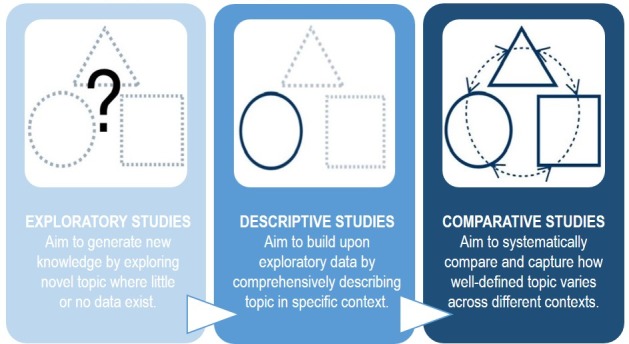
The objective of this commentary is to develop a framework for assessing the rigour of qualitative approaches that identifies and distinguishes between the diverse objectives of qualitative health research, guided by a narrative review of the published literature on qualitative guidelines and standards from peer-reviewed journals and national funding organisations that support health services research, patient-centered outcomes research and other applied health research fields. In this framework, we identify and distinguish three objectives of qualitative studies in applied health research: exploratory, descriptive and comparative. For each objective, we propose methodological standards that may be used to assess and improve rigour across all study phases—from design to reporting. Similar to hierarchies of quality of evidence within quantitative studies, we argue that standards for qualitative rigour differ, appropriately, for studies with different objectives and should be evaluated as such. Distinguishing between different objectives of qualitative health research improves the ability to appreciate variation in qualitative studies and to develop appropriate evaluations of the rigour and success of qualitative studies in meeting their stated objectives. Researchers, funders and journal editors should consider how further developing and adopting the framework for assessing qualitative rigour outlined here may advance the rigour and potential impact of this important mode of inquiry.
Overview
The claims and statistics of this paper haven’t been checked yet.
Run the check — free, no account needed. It reads the open-access text and checks the sources it cites.
Integrity signals
Registry
Cites
Statistics
Figures
Verification
Claims the paper makes
The claims and statistics of this paper haven’t been checked yet.
Run the check — free, no account needed. It reads the open-access text and checks the sources it cites.
Claims other papers make about this one
Each is checked against this paper’s own text: does it say what the citing paper says it does?
In the citing paper
“Consistent with best practices of the constant comparative method, 22,23 the study team cycled through multiple iterations of themes related to care setting, looking for unexpected and disconfirming evidence.”
From Care setting transitions for people with dementia: Qualitative perspectives of current and former care partners (2023) · cites this paper as [23]
Self-check
Percentages, sums and reported differences re-computed from the paper’s own numbers.
The self-check needs the paper’s full text.
Citations
Cites
Tong, A., Sainsbury, P., & Craig, J. (2007) · International Journal for Quality in Health Care · doi:10.1093/intqhc/mzm042 · Cited by 42,509
Designing and Conducting Mixed Methods Research
Robinson, P. M. (2007) · Australian and New Zealand Journal of Public Health · doi:10.1111/j.1753-6405.2007.00096.x · Cited by 23,362
GRADE: an emerging consensus on rating quality of evidence and strength of recommendations
Guyatt, G. H., Oxman, A. D., Vist, G. E., Kunz, R., Falck-Ytter, Y., Alonso-Coello, P., & Schünemann, H. J. (2008) · BMJ · doi:10.1136/bmj.39489.470347.ad · Cited by 23,305
Black Feminist Thought: Knowledge, Consciousness, and the Politics of Empowerment.
Brewer, R. M., & Collins, P. H. (1992) · Contemporary Sociology · doi:10.2307/2074808 · Cited by 19,445
Standards for Reporting Qualitative Research: A Synthesis of Recommendations
O’Brien, B. C., Harris, I. B., Beckman, T. J., Reed, D. A., & Cook, D. A. (2014) · Academic Medicine · doi:10.1097/acm.0000000000000388 · Cited by 12,211
(2013) · Cited by 12,072
Laboratory Life: The Construction of Scientific Facts
Latour, B. (1986) · DigitalGeorgetown (Georgetown University Library) · Cited by 7,491
Designing Social Inquiry: Scientific Inference in Qualitative Research
King, G., Keohane, R. O., & Verba, S. (1994) · Princeton University Press · doi:10.1515/9781400821211 · Cited by 7,225
(2006) · Cited by 7,081
Writing Culture: The Poetics and Politics of Ethnography
Clifford, J., & Marcus, G. E. (1986) · Cited by 6,160
Qualitative research in health care: Assessing quality in qualitative research
Mays, N. (2000) · BMJ · doi:10.1136/bmj.320.7226.50 · Cited by 3,742
Qualitative Data Analysis for Health Services Research: Developing Taxonomy, Themes, and Theory
Bradley, E. H., Curry, L. A., & Devers, K. J. (2007) · Health Services Research · doi:10.1111/j.1475-6773.2006.00684.x · Cited by 3,437
Checklists for improving rigour in qualitative research: a case of the tail wagging the dog?
Barbour, R. S. (2001) · BMJ · doi:10.1136/bmj.322.7294.1115 · Cited by 2,613
Best Practices for Mixed Methods Research in Health Sciences
Creswell, J. W., Klassen, A. C., Clark, V. L. P., & Smith, K. C. (2011) · PsycEXTRA Dataset · doi:10.1037/e566732013-001 · Cited by 1,578
Latour, B., & Woolgar, S. (1987) · Princeton University Press eBooks · doi:10.1515/9781400820412 · Cited by 1,083
Critically appraising qualitative research
Kuper, A., Lingard, L., & Levinson, W. (2008) · BMJ · doi:10.1136/bmj.a1035 · Cited by 784
Qualitative research methodologies: ethnography
Reeves, S., Kuper, A., & Hodges, B. D. (2008) · BMJ · doi:10.1136/bmj.a1020 · Cited by 782
Qualitative research in action
(2003) · Choice Reviews Online · doi:10.5860/choice.40-2862 · Cited by 733
Appraising the quality of qualitative research
Walsh, D., & Downe, S. (2006) · Midwifery · doi:10.1016/j.midw.2005.05.004 · Cited by 523
An introduction to reading and appraising qualitative research
Kuper, A., Reeves, S., & Levinson, W. (2008) · BMJ · doi:10.1136/bmj.a288 · Cited by 519
Why use theories in qualitative research?
Reeves, S., Albert, M., Kuper, A., & Hodges, B. D. (2008) · BMJ · doi:10.1136/bmj.a949 · Cited by 519
Using Qualitative Methods for Causal Explanation
Maxwell, J. A. (2004) · Field Methods · doi:10.1177/1525822x04266831 · Cited by 505
An open letter toThe BMJeditors on qualitative research
Greenhalgh, T., Annandale, E. C., Ashcroft, R. E., Barlow, J. G., Black, N. A., Bleakley, A., Boaden, R., Braithwaite, J., Britten, N., Carnevale, F. A., et al. (2016) · BMJ · doi:10.1136/bmj.i563 · Cited by 378
The SAGE Handbook of Qualitative Methods in Health Research
Bourgeault, I. L., Dingwall, R. W. J., & Vries, R. G. D. (2010) · SAGE Publications Ltd eBooks · doi:10.4135/9781446268247 · Cited by 345
The SAGE handbook of qualitative methods in health research
Bourgeault, I. L., Dingwall, R. W. J., & Vries, R. G. D. (2011) · Choice Reviews Online · doi:10.5860/choice.48-4837 · Cited by 266
Designing Social Inquiry: Scientific Inference in Qualitative Research
King, G. 1., Keohane, R. O. 1., & Verba, S. 1.-2. (1994) · Project Muse (Johns Hopkins University) · Cited by 252
Hodges, B. D., Kuper, A., & Reeves, S. (2008) · BMJ · doi:10.1136/bmj.a879 · Cited by 190
Workshop on Scientific Foundations of Qualitative Research
Ragin, C. C., & Nagel, J. (2004) · Cited by 183
Weiner, B. J., Amick, H. R., Lund, J. L., Lee, S.-Y. D., & Hoff, T. J. (2010) · Medical Care Research and Review · doi:10.1177/1077558710372810 · Cited by 89
Abramson, C. M., Joslyn, J., Rendle, K. A. S., Garrett, S. B., & Dohan, D. P. (2017) · Ethnography · doi:10.1177/1466138117725340 · Cited by 76
Self-citationQualitative research andThe BMJ
Loder, E., Groves, T., Schroter, S., Merino, J. G., & Weber, W. E. J. (2016) · BMJ · doi:10.1136/bmj.i641 · Cited by 53
Ethnographic process evaluation in primary care: explaining the complexity of implementation
Bunce, A., Gold, R. B., Davis, J. V., McMullen, C. K., Jaworski, V., Mercer, M., & Nelson, C. A. (2014) · BMC Health Services Research · doi:10.1186/s12913-014-0607-0 · Cited by 50
Exploring the Use of Qualitative Methods in Published Health Services and Management Research
Hoff, T. J., & Witt, L. C. (2000) · Medical Care Research and Review · doi:10.1177/107755870005700201 · Cited by 46
Integrating Mixed Methods in Health Services and Delivery System Research
Miller, W. L., Crabtree, B. F., Harrison, M. I., & Fennell, M. L. (2013) · Health Services Research · doi:10.1111/1475-6773.12123 · Cited by 46
Qualitative Methods in Patient-Centered Outcomes Research
Vandermause, R., Barg, F., Esmail, L., Edmundson, L., Girard, S., & Perfetti, A. (2017) · Qualitative Health Research · doi:10.1177/1049732316668298 · Cited by 29
Devers, K. J. (2011) · Medical Care Research and Review · doi:10.1177/1077558710384269 · Cited by 18
Thoughts On Qualitative Research Methods at NIH
Heurtin‐Roberts, S. (2002) · Qualitative Social Work · doi:10.1177/147332500200100310 · Cited by 5
Research works printed but not linked: 1
- Lamont M , White P . Workshop on Interdisciplinary Standards for Systematic Qualitative Research. Arlington, VA: National Science Foundation, 2008.
Cited by
Sorted by citations
Ghimire, A., & Qiu, Y. (2025) · Nurse Education in Practice · doi:10.1016/j.nepr.2025.104330 · Cited by 52
McDiarmid, S., Durbeej, N., Sarkadi, A., & Osman, F. (2021) · International Journal of Qualitative Studies on Health and Well-Being · doi:10.1080/17482631.2021.2007568 · Cited by 59
Shafir, A., Ritchie, C. S., Garrett, S. B., Bernstein Sideman, A., Naasan, G., Merrilees, J., Widera, E., Flint, L., & Harrison, K. L. (2022) · Journal of Alzheimer’s Disease · doi:10.3233/jad-215203 · Cited by 45
Self-citationMeulewaeter, F., Schauwer, E. D., Pauw, S. S. W. D., & Vanderplasschen, W. (2022) · Frontiers in Psychiatry · doi:10.3389/fpsyt.2022.768802 · Cited by 55
Bates, G., Gouais, A. L., Barnfield, A., Callway, R., Hasan, M. N., Koksal, C., Kwon, H. R., Montel, L., Peake-Jones, S., White, J., et al. (2023) · International Journal of Qualitative Methods · doi:10.1177/16094069221144594 · Cited by 45
Metadata
- Authors
- Rendle, K. A., Abramson, C. M., Garrett, S. B., Halley, M. C., & Dohan, D.
- Affiliations
- University of Pennsylvania (US)
- University of Arizona (US)
- University of California, San Francisco (US)
- Palo Alto Medical Foundation (US)
- Corresponding author
- Rendle, Katharine A
- Venue
- BMJ Open
- Publisher
- BMJ
- Published
- 2019-08
- Volume
- 9
- Issue
- 8
- Pages
- e030123
- ISSN
- 2044-6055 (ISSN-L)
- PMC
- PMC6720470
- OpenAlex
- W2970520008
- Cited by
- 195
- References
- 38
- Citations by year
- 2026: 27 · 2025: 46 · 2024: 38 · 2023: 36 · 2022: 35 · 2021: 9 · 2020: 4
- FWCI
- 32.40
- Type
- journal article
- Language
- en
- Open access
- gold
- doi.org
- Licence
- cc-by-nc
- Locations
- BMJ Open (publishedVersion, cc-by-nc)
- PubMed Central (publishedVersion, cc-by-nc)
- PubMed (publishedVersion)
- HighWire Press Open Archive (acceptedVersion)
- UA Campus Repository (The University of Arizona) (acceptedVersion, cc-by-nc)
- DOAJ (DOAJ: Directory of Open Access Journals) (submittedVersion, cc-by-sa)
- Funders
- Patient-Centered Outcomes Research Institute (ME-1409-22996)
- Topics
- Social Sciences › Education › Qualitative Research Methods and Applications
- Social Sciences › Sociology and Political Science › Qualitative Research Methods and Ethics
- Health Sciences › Health Professions › General Health Professions › Health Policy Implementation Science
- Keywords
- qualitative health research, scientific rigor, methodological standards, research objectives, exploratory research, descriptive research, comparative analysis, quality assessment framework, reporting guidelines, health services research, patient-centered outcomes research, research funding agencies, journal editorial guidelines
- MeSH terms
- Health Services Research, Humans, Research Design, Qualitative Research, Patient Outcome Assessment
About these checks
Registry, retraction, Cites and statistics results are computed, not judged, with one exception: a printed reference that no index lists is read once by a model before it counts as a citation error. Claims are extracted by a model and kept only when their quote appears verbatim in the text; each cited source is then checked, with a model’s help, for whether it says what the claim relies on. Those verdicts can be wrong — read the claim’s quote and the cited source before relying on one.
Statistics and arithmetic are recomputed, not judged.
Confidence bands are shown only for fields calibrated on our annotated test set. None is calibrated yet, so no band is shown.
What counts as a claim ›How we measure confidence ›How we check this ›
Are you an author, or do you see a problem with this page? Request a review
