

The DOI matches its Crossref record; 110 of the 110 references it cites were found in a registry or an index.
Do physical therapists follow evidence-based guidelines when managing musculoskeletal conditions? Systematic review
Open accessAbstract
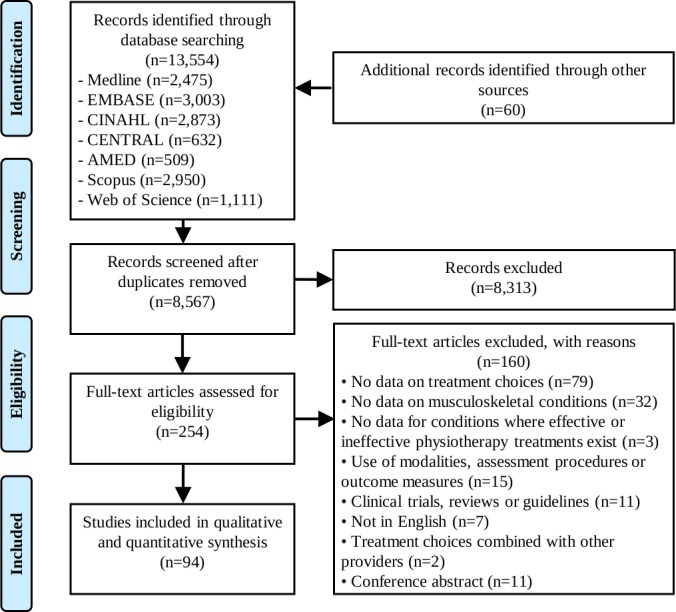
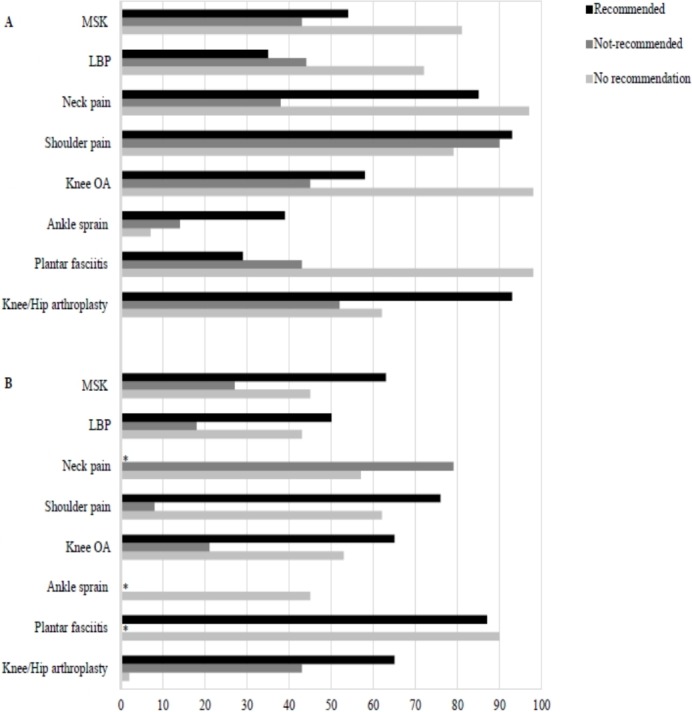
Objectives: Physicians often refer patients with musculoskeletal conditions to physical therapy. However, it is unclear to what extent physical therapists’ treatment choices align with the evidence. The aim of this systematic review was to determine what percentage of physical therapy treatment choices for musculoskeletal conditions agree with management recommendations in evidence-based guidelines and systematic reviews. Design: Systematic review. Setting: We performed searches in Medline, Embase, Cumulative Index to Nursing and Allied Health Literature, Cochrane Central Register of Controlled Trials, Allied and Complementary Medicine, Scopus and Web of Science combining terms synonymous with ‘practice patterns’ and ‘physical therapy’ from the earliest record to April 2018. Participants: Studies that quantified physical therapy treatment choices for musculoskeletal conditions through surveys of physical therapists, audits of clinical notes and other methods (eg, audits of billing codes, clinical observation) were eligible for inclusion. Primary and secondary outcomes: Using medians and IQRs, we summarised the percentage of physical therapists who chose treatments that were recommended, not recommended and had no recommendation, and summarised the percentage of physical therapy treatments provided for various musculoskeletal conditions within the categories of recommended, not recommended and no recommendation. Results were stratified by condition and how treatment choices were assessed (surveys of physical therapists vs audits of clinical notes). Results: We included 94 studies. For musculoskeletal conditions, the median percentage of physical therapists who chose recommended treatments was 54% (n=23 studies; surveys completed by physical therapists) and the median percentage of patients that received recommended physical therapy-delivered treatments was 63% (n=8 studies; audits of clinical notes). For treatments not recommended, these percentages were 43% (n=37; surveys) and 27% (n=20; audits). For treatments with no recommendation, these percentages were 81% (n=37; surveys) and 45% (n=31; audits). Conclusions: Many physical therapists seem not to follow evidence-based guidelines when managing musculoskeletal conditions. There is considerable scope to increase use of recommended treatments and reduce use of treatments that are not recommended. PROSPERO registration number: CRD42018094979.
Overview
The claims and statistics of this paper haven’t been checked yet.
Run the check — free, no account needed. It reads the open-access text and checks the sources it cites.
Integrity signals
Registry
Cites
Statistics
Figures
Verification
Claims the paper makes
The claims and statistics of this paper haven’t been checked yet.
Run the check — free, no account needed. It reads the open-access text and checks the sources it cites.
Claims other papers make about this one
Each is checked against this paper’s own text: does it say what the citing paper says it does?
The check wasn’t confident either way, so it gives no verdict — never disputed.
In the citing paper
“Barriers to practicing the evidence-based therapies include a lack of access to resources that contain such evidence [92,93] and limited usable formats of the evidence [94].”
From Development and usability testing of a web-based and therapist-assisted coping skills program for managing psychosocial problems in individuals with hand and upper limb injuries: Mixed methods study (2020) · cites this paper as [92]
Experimental — accuracy not yet measured
Self-check
Percentages, sums and reported differences re-computed from the paper’s own numbers.
The self-check needs the paper’s full text.
Citations
Cites
Preferred Reporting Items for Systematic Reviews and Meta-Analyses: the PRISMA statement
Moher, D., Liberati, A., Tetzlaff, J., Altman, D. G., & for the PRISMA Group (2009) · BMJ · doi:10.1136/bmj.b2535 · Cited by 83,823
Preferred reporting items for systematic reviews and meta-analyses: the PRISMA Statement.
(2009) · PubMed Central · Cited by 44,859
Preferred reporting items for systematic reviews and meta-analyses: The PRISMA statement
Moher, D., Liberati, A., Tetzlaff, J., Altman, D. G., & the PRISMA Group* (2009) · Annals of Internal Medicine · doi:10.7326/0003-4819-151-4-200908180-00135 · Cited by 37,554
Vos, T., Abajobir, A. A., Abate, K. H., Abbafati, C., Abbas, K. M., Abd-Allah, F., Abdulkader, R. S., Abdulle, A. M., Abebo, T. A., Abera, S. F., et al. (2017) · The Lancet · doi:10.1016/s0140-6736(17)32154-2 · Cited by 13,220
Downs, S. H., & Black, N. (1998) · Journal of Epidemiology and Community Health · doi:10.1136/jech.52.6.377 · Cited by 8,252
The quality of health care delivered to adults in the United States
McGlynn, E. A., Asch, S. M., Adams, J., Keesey, J., Hicks, J., DeCristofaro, A., & Kerr, E. A. (2003) · New England Journal of Medicine · doi:10.1056/nejmsa022615 · Cited by 5,079
THE ROYAL AUSTRALIAN COLLEGE OF GENERAL PRACTITIONERS
(1974) · The Medical Journal of Australia · doi:10.5694/j.1326-5377.1974.tb93279.x · Cited by 1,335
Evidence for overuse of medical services around the world
Brownlee, S., Chalkidou, K., Doust, J. A., Elshaug, A. G., Glasziou, P., Heath, I., Nagpal, S., Saini, V., Srivastava, D., Chalmers, K., et al. (2017) · The Lancet · doi:10.1016/s0140-6736(16)32585-5 · Cited by 1,154
Shoulder disorders in general practice: incidence, patient characteristics, and management.
van der Windt, D., Koes, B. W., de Jong, B. A., & Bouter, L. M. (1995) · Annals of the Rheumatic Diseases · doi:10.1136/ard.54.12.959 · Cited by 960
Clinical Guidelines for the Management of Low Back Pain in Primary Care
Koes, B. W., van Tulder, M. W., Ostelo, R., Burton, K. A., & Waddell, G. (2001) · Spine · doi:10.1097/00007632-200111150-00022 · Cited by 703
Research works printed but not linked: 2
- Ayanniyi, 2007, Management of low back pain: attitude and treatment preferences of physiotherapist in Nigeria, Afr J Biomed Res, 10, 41
- Reid, 2002, Use of a vignette to investigate the physiotherapy treatment of an acute episode of low back pain: report of a survey of New Zealand physiotherapists, New Zealand J Physiother, 30, 26
Cited by
Sorted by citations
George, S. Z., Fritz, J. M., Silfies, S. P., Schneider, M. J., Beneciuk, J. M., Lentz, T. A., Gilliam, J. R., Hendren, S., & Norman, K. S. (2021) · Journal of Orthopaedic & Sports Physical Therapy · doi:10.2519/jospt.2021.0304 · Cited by 607
Holopainen, R., Simpson, P., Piirainen, A., Karppinen, J., Schütze, R., Smith, A., O'Sullivan, P., & Kent, P. (2020) · Pain · doi:10.1097/j.pain.0000000000001809 · Cited by 180
“review was that many physiotherapists often do not follow guidelines for management of musculoskeletal pain.(73) For example, Stevenson et al.”
BackgroundMaestroni, L., Read, P. J., Bishop, C. J., Papadopoulos, K., Suchomel, T. J., Comfort, P., & Turner, A. N. (2020) · Sports Medicine · doi:10.1007/s40279-020-01309-5 · Cited by 219
Nguyen, A. T., Lee, P., Rodriguez, E. K., Chahal, K., Freedman, B. R., & Nazarian, A. (2025) · The Lancet Healthy Longevity · doi:10.1016/j.lanhl.2025.100707 · Cited by 106
Grooten, W. J. A., Boström, C., Dedering, Å., Halvorsen, M., Kuster, R. P., Nilsson-Wikmar, L. B., Olsson, C., Rovner, G., Tseli, E., & Rasmussen-Barr, E. (2022) · BMC Musculoskeletal Disorders · doi:10.1186/s12891-022-05722-x · Cited by 105
Metadata
- Authors
- Zadro, J., O’Keeffe, M., & Maher, C.
- Affiliations
- The University of Sydney (AU)
- Corresponding author
- Zadro, Joshua
- Venue
- BMJ Open
- Publisher
- BMJ
- Published
- 2019-10
- Volume
- 9
- Issue
- 10
- Pages
- e032329
- ISSN
- 2044-6055 (ISSN-L)
- PMC
- PMC6797428
- OpenAlex
- W2980198210
- Cited by
- 309
- References
- 110
- Citations by year
- 2026: 20 · 2025: 55 · 2024: 61 · 2023: 42 · 2022: 58 · 2021: 45 · 2020: 26 · 2019: 1
- FWCI
- 5.31
- Type
- journal article
- Language
- en
- Open access
- gold
- doi.org
- Licence
- cc-by-nc
- Locations
- BMJ Open (publishedVersion, cc-by-nc)
- PubMed Central (publishedVersion, cc-by-nc)
- PubMed (publishedVersion)
- DOAJ (DOAJ: Directory of Open Access Journals) (submittedVersion)
- HighWire Press Open Archive (submittedVersion)
- Zenodo (CERN European Organization for Nuclear Research) (submittedVersion, cc-by)
- Topics
- Health Sciences › Medicine › Public Health, Environmental and Occupational Health › Clinical practice guidelines implementation
- Health Sciences › Health Professions › Physical Therapy, Sports Therapy and Rehabilitation › Musculoskeletal pain and rehabilitation
- Health Sciences › Health Professions › General Health Professions › Health Sciences Research and Education
- Keywords
- physiotherapy, evidence-based practice, clinical practice patterns, musculoskeletal disorders, guideline adherence, physiotherapists, treatment guidelines
- MeSH terms
- Humans, Musculoskeletal Diseases, Practice Guidelines as Topic, Guideline Adherence, Physical Therapy Modalities, Evidence-Based Practice, Physical Therapists
About these checks
Registry, retraction, Cites and statistics results are computed, not judged, with one exception: a printed reference that no index lists is read once by a model before it counts as a citation error. Claims are extracted by a model and kept only when their quote appears verbatim in the text; each cited source is then checked, with a model’s help, for whether it says what the claim relies on. Those verdicts can be wrong — read the claim’s quote and the cited source before relying on one.
Statistics and arithmetic are recomputed, not judged.
Confidence bands are shown only for fields calibrated on our annotated test set. None is calibrated yet, so no band is shown.
What counts as a claim ›How we measure confidence ›How we check this ›
Are you an author, or do you see a problem with this page? Request a review
