

Raising awareness for dementia risk reduction through a public health campaign: a pre-post study
Open accessThe DOI matches its Crossref record; 30 of the 30 references it cites were found in a registry or an index.
Abstract
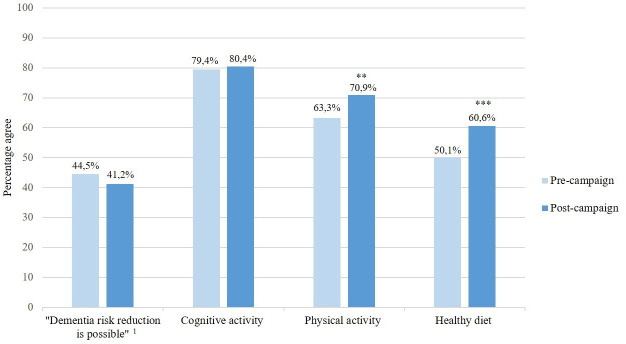
Objectives: Evaluate the effect of a health promotion campaign aimed at increasing awareness about dementia risk reduction in middle-aged community-dwelling individuals in the Netherlands. Design: A 10-month public health campaign using mass media and community participation, supported by eHealth. Population-level difference in awareness before and after the campaign, including variation between demographic groups, was assessed in two independent cross-sectional samples from the same target population. Setting: The public health campaign was launched in the Province of Limburg, the Netherlands, targeting all inhabitants aged 40–75 years old. Three specific districts within the Province were chosen for an additional community participation approach, in which local stakeholders were invited to support the campaign. Results: No pre- (n=590) post- (n=602) difference was observed in people agreeing to the statement that dementia risk reduction is possible (X 2 (1)=1.27, p=0.260). For the individual lifestyle factors, physical activity (7.6% increase (X 2 (1)=7.48, p=0.006)) and healthy diet (10.5% increase (X 2 (1)=12.37, p≤0.001)) were identified more often as being protective against dementia after the campaign. Of all risk/protective factors assessed, cognitive activity was identified most often at both preassessment (79.4%) and postassessment (80.4%), but there was no increase in awareness (X 2 (1)=0.17, p=0.677). Self-reported exposure to the campaign was associated with greater awareness and motivation for behavioural change (X 2 (1)=6.52, p=0.011). Compared with mass media only, the addition of community participation resulted in better recognition of campaign material and the eHealth platform. Conclusions: This study was not able to reach a population-level increase of awareness of dementia risk reduction. Two out of the three lifestyle factors that formed the foundation of the campaign were identified more often after the campaign. Those reported having been exposed to the campaign were more aware and more inclined towards behavioural change.
Overview
The claims and statistics of this paper haven’t been checked yet.
Free: it reads the open-access text and checks the first 5 claims that cite a source we can check. Create a free account to check every claim.
Integrity signals
Registry
Cites
Statistics
Figures
Verification
Claims the paper makes
The claims and statistics of this paper haven’t been checked yet.
Free: it reads the open-access text and checks the first 5 claims that cite a source we can check. Create a free account to check every claim.
Claims other papers make about this one
Each is checked against this paper’s own text: does it say what the citing paper says it does?
The cited source doesn’t support the claim as written.
In the citing paper
“The initiative was based on a successful awareness campaign previously developed and executed in the Netherlands (Heger et al., 2020).”
From Increasing knowledge on dementia risk reduction in the general population: Results of a public awareness campaign. (2021) · cites this paper as Heger et al., 2020
Checked by a reasoning model — may be wrong.
Experimental — accuracy not yet measuredThe source backs part of the claim, not all of it — or backs it for a different population, condition or comparison.
In the citing paper
“However, people who indicated having heard about the campaign through the media were more aware of DRR.”
From Increasing knowledge on dementia risk reduction in the general population: Results of a public awareness campaign. (2021) · cites this paper as Heger et al., 2020
Experimental — accuracy not yet measuredThe source backs part of the claim, not all of it — or backs it for a different population, condition or comparison.
In the citing paper
“The Dutch campaign also had to rely mainly on regional and local media channels while the Flemish campaign reached a number of large, national media outlets.”
From Increasing knowledge on dementia risk reduction in the general population: Results of a public awareness campaign. (2021) · cites this paper as Heger et al., 2020
Experimental — accuracy not yet measuredThe source backs part of the claim, not all of it — or backs it for a different population, condition or comparison.
In the citing paper
“The Dutch campaign succeeded in producing memorable campaign material (20% recognized the material during the post-campaign survey), but a population-level difference in knowledge was not observed.”
From Increasing knowledge on dementia risk reduction in the general population: Results of a public awareness campaign. (2021) · cites this paper as Heger et al., 2020
Experimental — accuracy not yet measuredThe source backs part of the claim, not all of it — or backs it for a different population, condition or comparison.
In the citing paper
“Knowledge about dementia risk reduction was examined via 13 statements (see Supplementary Material 2) which have been used previously [35–38].”
From Multidomain Dementia Risk Reduction in Primary Care is Feasible: A Proof-of-concept study (2024) · cites this paper as [36]
Experimental — accuracy not yet measured
6 more claims about this paper
Create a free account to see every claim other papers make about this one.
Self-check
Percentages, sums and reported differences re-computed from the paper’s own numbers.
The self-check needs the paper’s full text.
Citations
Cites
1 retracted
Dementia prevention, intervention, and care: 2020 report of the Lancet Commission
Livingston, G., Huntley, J., Sommerlad, A., Ames, D., Ballard, C., Banerjee, S., Brayne, C., Burns, A., Cohen-Mansfield, J., Cooper, C., et al. (2020) · The Lancet · doi:10.1016/s0140-6736(20)30367-6 · Cited by 10,430
RetractedDementia prevention, intervention, and care
Livingston, G., Sommerlad, A., Orgeta, V., Costafreda, S. G., Huntley, J., Ames, D., Ballard, C., Banerjee, S., Burns, A., Cohen-Mansfield, J., et al. (2017) · The Lancet · doi:10.1016/s0140-6736(17)31363-6 · Cited by 6,072
Ngandu, T., Lehtisalo, J., Solomon, A., Levälahti, E., Ahtiluoto, S., Antikainen, R., Bäckman, L., Hänninen, T., Jula, A., Laatikainen, T., et al. (2015) · The Lancet · doi:10.1016/s0140-6736(15)60461-5 · Cited by 3,689
Potential for primary prevention of Alzheimer's disease: an analysis of population-based data
Norton, S., Matthews, F. E., Barnes, D. E., Yaffe, K., & Brayne, C. (2014) · The Lancet Neurology · doi:10.1016/s1474-4422(14)70136-x · Cited by 2,466
Lifestyle interventions to prevent cognitive impairment, dementia and Alzheimer disease
Kivipelto, M., Mangialasche, F., & Ngandu, T. (2018) · Nature Reviews Neurology · doi:10.1038/s41582-018-0070-3 · Cited by 1,173
Kivipelto, M., Ngandu, T., Laatikainen, T., Winblad, B., Soininen, H., & Tuomilehto, J. (2006) · The Lancet Neurology · doi:10.1016/s1474-4422(06)70537-3 · Cited by 1,126
Incidence of dementia over three decades in the Framingham heart study
Satizabal, C. L., Beiser, A. S., Chouraki, V., Chêne, G., Dufouil, C., & Seshadri, S. (2016) · New England Journal of Medicine · doi:10.1056/nejmoa1504327 · Cited by 1,051
Recent global trends in the prevalence and incidence of dementia, and survival with dementia
Prince, M., Ali, G.-C., Guerchet, M., Prina, A. M., Albanese, E., & Wu, Y.-T. (2016) · Alzheimer's Research & Therapy · doi:10.1186/s13195-016-0188-8 · Cited by 876
Andrieu, S., Guyonnet, S., Coley, N., Cantet, C., Bonnefoy, M., Bordes, S., Bories, L., Cufi, M.-N., Dantoine, T., Dartigues, J.-F., et al. (2017) · The Lancet Neurology · doi:10.1016/s1474-4422(17)30040-6 · Cited by 838
van Charante, E. P. M., Richard, E., Eurelings, L. S., van Dalen, J.-W., Ligthart, S. A., van Bussel, E. F., Hoevenaar-Blom, M. P., Vermeulen, M., & van Gool, W. A. (2016) · The Lancet · doi:10.1016/s0140-6736(16)30950-3 · Cited by 611
Research works printed but not linked: 1
- World Health Organization Risk reduction of cognitive decline and dementia: WHO guidelines. Geneva, 2019. 31219687
Cited by
Van Asbroeck, S., van Boxtel, M. P. J., Steyaert, J., Köhler, S., Heger, I., de Vugt, M., Verhey, F., & Deckers, K. (2021) · Preventive Medicine · doi:10.1016/j.ypmed.2021.106522 · Cited by 102
Self-citationMcWilliams, A., Bibby, H., Steinbeis, N., David, A. S., & Fleming, S. M. (2023) · Cognition · doi:10.1016/j.cognition.2023.105389 · Cited by 73
“…environment or societal views about the aging brain, such as those promoted purposefully or inadvertently by public health campaigns (Commissaris, Verhey Jr, Ponds, Jolles, & Kok, 1994; Heger et al., 2020; Hertzog, Small, McFall, & Dixon, 2019; Kinzer & Suhr, 2016; Maxfield & Greenberg, 2021).”
BackgroundFarrow, M., Fair, H. L., Klekociuk, S. Z., & Vickers, J. C. (2022) · PLoS ONE · doi:10.1371/journal.pone.0267205 · Cited by 63
Bartlett, L., Bindoff, A. D., Doherty, K., Kim, S., Eccleston, C. E. A., Kitsos, A., Roccati, E., Alty, J., King, A. E., & Vickers, J. C. (2023) · BMC Public Health · doi:10.1186/s12889-023-16805-2 · Cited by 34
“The findings reported by Heger, Kohler [13] show no change in dementia risk knowledge was observed following a health promotion campaign that used mass media to disseminate information about brain health.”
BackgroundPublic knowledge about dementia risk reduction in Norway
Kjelvik, G., Rokstad, A. M. M., Stuebs, J., Thingstad, P., Deckers, K., Köhler, S., & Selbæk, G. (2022) · BMC Public Health · doi:10.1186/s12889-022-14433-w · Cited by 29
“Our findings indicate a high level of awareness in Norway, which is higher than a similar study of the Flemish (35%) and Dutch (44%) populations [11, 13, 19] and the international review by Cations [7].”
MethodResultSelf-citationPaauw, D., Heger, I., Bjerre, J. F., Ringgaard, M. F., Stensgård, V., Horstkötter, D., Köhler, S., & Deckers, K. (2024) · Preventive Medicine · doi:10.1016/j.ypmed.2024.107848 · Cited by 25
Self-citationHeger, I., Deckers, K., de Vugt, M., Verhey, F., Oenema, A., van Boxtel, M., & Köhler, S. (2023) · Journal of Alzheimer’s Disease · doi:10.3233/jad-230225 · Cited by 20
“Participants were sampled from responders of previous dementia risk awareness surveys [7, 19] who agreed to participate in future research.”
MethodSelf-citationWeiner‐Light, S., Dohan, D. P., Possin, K. L., Wolf, M. S., Rankin, K. P., Lanata, S., & Sideman, A. B. (2022) · Clinical Gerontologist · doi:10.1080/07317115.2022.2088324 · Cited by 18
“Shifting to utilizing a positive approach for health promotion, for instance by using the words ‘brain health’ instead of focusing on unhealthy behaviors that increase the risk of dementia, seems prudent to decrease the impact of stigma, increase acceptance of programs, and target primary prevention (Heger et al., 202…”
BackgroundMethodLinking Metabolic Syndrome to Neurodegeneration Mechanisms and Potential Treatments
Džidić-Krivić, A., Fajkić, A., Farhat, E. K., Lekić, L., Ejubović, A. J., Vukas, S. K., Ejubović, M., Lepara, O., & Sher, E. K. (2025) · Molecular Neurobiology · doi:10.1007/s12035-025-04947-w · Cited by 25
“The global prevalence of dementia is projected to triple from 50 million in 2018 to 152 million by 2050 [26].”
Multidomain Dementia Risk Reduction in Primary Care is Feasible: A Proof-of-concept study
Van Asbroeck, S., Köhler, S., Wimmers, S. C. P. M., Muris, J. W. M., van Boxtel, M. P. J., & Deckers, K. (2024) · Journal of Alzheimer’s Disease · doi:10.3233/jad-240229 · Cited by 17
Self-citationde Krom, F. J. W., Sivananthan, S., Alkhotany, F., Celen, M., Hol, I. E., Houben, K. J. G., Sivananthan, P., Koekebakker, H., & Deckers, K. (2021) · Journal of Public Health Research · doi:10.4081/jphr.2021.1961 · Cited by 16
Self-citationKnowledge, Attitudes, and Perceptions Toward Dementia Among Middle-Aged Singapore Residents
Siddiqui, F., Nistala, K. R. Y., Quek, C. W. N., Leong, V. S. Y., Tan, A. Y. S., Tan, C. Y. E., & Hilal, S. (2022) · Journal of Alzheimer s Disease · doi:10.3233/jad-215262 · Cited by 19
Lee, J., & Lim, J. M. (2022) · Journal of Medical Internet Research · doi:10.2196/31664 · Cited by 15
“Recent studies on middle-aged adults (40 to 75 years of age) showed that more than half of the respondents had insufficient dementia knowledge, 59.4% wanted information for cognitive health, and 70% had positive feelings for eHealth use to improve cognitive health [14,15].”
BackgroundInfluentialAmiri, S., Keffeler, J. I., Crain, D. R., Denney, J. T., & Buchwald, D. (2024) · Alzheimer s & Dementia · doi:10.1002/alz.13756 · Cited by 14
Godbee, K., Guccione, L., Palmer, V. J., Gunn, J., Lautenschlager, N., & Francis, J. J. (2022) · Journal of Alzheimer's Disease · doi:10.3233/jad-220382 · Cited by 13
Ali, M. F., Ja’afar, N. I. S., Krishnan, T. G., Zulkifle, M. A. M., Khaidzir, N. K., Jamil, T. R., Man, Z. C., & Aziz, A. F. A. (2023) · BMC Geriatrics · doi:10.1186/s12877-023-04230-4 · Cited by 17
“The number of individuals living with dementia world-wide is projected to triple from 50 million in 2018 to 152 million in 2050 as the world’s population ages [3].”
BackgroundSiette, J., Dodds, L., Deckers, K., Köhler, S., Heger, I., Strutt, P. A., Johnco, C. J., Wuthrich, V. M., & Armitage, C. J. (2024) · The Journal of Prevention of Alzheimer s Disease · doi:10.14283/jpad.2024.104 · Cited by 15
“Policy-level change combined with a more tailored approach, for example with local stakeholder support (18), personalised and co-created intervention-boxes that varied across risk scores, gender and educational level, might have improved engagement (20).”
BackgroundResultInfluentialSelf-citationNeter, E., & Chachashvili‐Bolotin, S. (2022) · International Journal of Environmental Research and Public Health · doi:10.3390/ijerph19159705 · Cited by 7
“Thus, we believe that public education about AD that takes cultural attitudes into account can increase public acceptance of people with AD [79], promote beliefs that dementia risk reduction is possible, and increase motivation for behavioral changes [80].”
BackgroundSiette, J., Dodds, L., Brooks, C., & Deckers, K. (2023) · Frontiers in Public Health · doi:10.3389/fpubh.2023.1205001 · Cited by 6
Self-citationChandler, C. R. A., Catanzaro, M., & Siette, J. (2024) · Archives of Gerontology and Geriatrics · doi:10.1016/j.archger.2024.105440 · Cited by 6
Acceptability and Feasibility of a Community Dementia Stigma Reduction Program in Kenya
Musyimi, C. W., Muyela, L. A., Ndetei, D. M., Evans-Lacko, S. E., & Farina, N. (2024) · Journal of Alzheimer s Disease · doi:10.3233/jad-240192 · Cited by 7
Alibudbud, R. C. (2023) · Issues in Mental Health Nursing · doi:10.1080/01612840.2023.2186697 · Cited by 7
“Those exposed to an information campaign incorporating online platforms also reported greater awareness and inclination toward behavioral change for dementia risk reduction (Heger et al., 2020).”
BackgroundZülke, A. E., Luppa, M., van Boxtel, M. P. J., Deckers, K., Heger, I., Köhler, S., & Riedel-Heller, S. G. (2023) · BMC Public Health · doi:10.1186/s12889-023-17247-6 · Cited by 7
“Evaluations revealed increased awareness for the protective factors physical activity and healthy nutrition in the Netherlands [25], and for dementia risk reduction by lifestyle change overall in Ireland [26].”
BackgroundSelf-citationWeiner‐Light, S., Sideman, A. B., VELA, A. M., & Wolf, M. S. (2024) · Patient Education and Counseling · doi:10.1016/j.pec.2024.108254 · Cited by 5
“Infographing” Dementia Prevention: A Co-Design Approach
Escobedo, I. M., Doherty, K., & Eccleston, C. E. A. (2024) · Health Communication · doi:10.1080/10410236.2024.2350257 · Cited by 8
“Several studies on dementia prevention have investigated individuals’ awareness and knowledge about this topic (Bartlett et al., 2023; Heger et al., 2020; Van Asbroeck et al., 2021) have rarely examined design elements that facilitate engagement with the intended message.”
Interpersonal communication may improve equity in dementia risk education
Fair, H. L., Klekociuk, S. Z., Eccleston, C. E. A., Doherty, K., & Farrow, M. (2022) · Health Promotion Journal of Australia · doi:10.1002/hpja.602 · Cited by 5
Ethical Issues of Primary and Secondary Dementia Prevention: A Narrative Literature Review
Schürmann, J. M., & Trachsel, M. (2023) · GeroPsych · doi:10.1024/1662-9647/a000321 · Cited by 5
Montague, L. A., Hespos, S. J., Mackenzie, E., & Siette, J. (2024) · Frontiers in Public Health · doi:10.3389/fpubh.2024.1383270 · Cited by 6
Asbroeck, S. V., Wimmers, S. C. P. M., van Boxtel, M. P. J., Zwaaftink, R. B. M. G., Otten, V., Bekkenkamp, D., Köhler, S., & Deckers, K. (2025) · Journal of Alzheimer s Disease · doi:10.1177/13872877241309112 · Cited by 6
“4,6,19,22,23 Individuals disagreeing or dis-agreeing strongly with the statement ‘ There is nothing anyone can do to reduce their risks of getting dementia ’ (on a 5-point Likert scale ranging from ‘ strongly disagree ’ to ‘ strongly agree ’ ) were considered to be aware of dementia risk reduction.”
Self-citationCoates, A., Fair, H. L., Lea, E. J., & Doherty, K. (2025) · International Journal for Equity in Health · doi:10.1186/s12939-025-02386-6 · Cited by 7
“However, few have implemented population-level risk reduction initiatives, and these tend to be limited to public awareness-raising campaigns – for instance in Belgium [23], Australia [24] and the Netherlands [25]—with mixed results.”
Low, L., Gresham, M. D., Phillipson, L., Jeon, Y., Hall, D. V., Tan, A. C. W., Wong, N., & Brodaty, H. (2023) · BMC Health Services Research · doi:10.1186/s12913-023-10347-4 · Cited by 9
“In addition, the Dutch campaign included community participation and activities such as workshops and lectures in three geographic regions – community participation resulted in better recognition of campaign material and the website [20].”
BackgroundAli, J., Singh, S., & Khan, W. (2022) · Journal of Public Affairs · doi:10.1002/pa.2819 · Cited by 7
“Earlier studies suggested that demographic variables such as gender, age, education and income are important determining variables of health behaviour (Goni et al., 2020; Heger et al., 2020).”
BackgroundPaauw, D., Heger, I., Horstkötter, D., Köhler, S., & Deckers, K. (2025) · Alzheimer's & Dementia · doi:10.1002/alz.70781 · Cited by 3
Self-citationBłaszkiewicz, M., Szcześniak, D. M., Ciułkowicz, M., Rymaszewska, J. E., Low, L., Brodaty, H., & Rymaszewska, J. (2024) · Frontiers in Public Health · doi:10.3389/fpubh.2024.1418867 · Cited by 3
“The increase in knowledge was observed only in better educated demographic strata (5).”
BackgroundSambou, M. L., Dobbe, J. H. M., Albers, E. A. C., Deckers, K., Arends, L. R., Ikram, M. A., Smets, E. M. A., Bramer, W. M., Labrecque, J. A., Visser, L. N. C., et al. (2026) · The Journal of Prevention of Alzheimer s Disease · doi:10.1016/j.tjpad.2026.100565 · Cited by 6
Self-citationPopulation-level interventions for dementia prevention: a systematic review
Stephan, B. C. M., Dunne, J., Brain, J., Greene, L., Sabatini, S., Eddy‐Lacey, A., MYERS, B. J., Buchanan, T., Ride, K., Vickers, J. C., et al. (2026) · The Lancet Healthy Longevity · doi:10.1016/j.lanhl.2026.100869 · Cited by 3
The Importance of Knowledge on Dementia Risk Factors in the General Public: A Cross-Sectional Study
Meng, X., Dong, Y., Gao, T., Su, J., Zhao, Y., Zhu, X., He, M., Zhang, T. G., & Sun, J. (2024) · The Journal of Nervous and Mental Disease · doi:10.1097/nmd.0000000000001785 · Cited by 4
Dementia Risk Reduction in Mid-Life: The Real Ethical Challenge
Horstkötter, D., Deckers, K., & Köhler, S. (2021) · AJOB Neuroscience · doi:10.1080/21507740.2021.1941401 · Cited by 3
“…reduction campaigns make use of this knowledge, try to raise awareness about the interrelationship between lifestyle factors and dementia risk, and focus on people’s motivation to change behavior, adapt their lifestyles and seek treatment for known cardiovascular conditions (Heger et al. 2020).”
BackgroundSelf-citationPaauw, D., Heger, I., Horstkötter, D., Janssen, N., Hajema, K., Kuiper, S., Loyen, A., Bouwmeester, J., Lens, A., Helmink, J. H. M., et al. (2025) · BMC Public Health · doi:10.1186/s12889-025-25676-8 · Cited by 2
“The lack of significant population-level changes in awareness mirrors findings from the initial rollout in Limburg [9] and could be attributed to several factors.”
InfluentialSelf-citationEdge-Aware Dual-Branch CNN Architecture for Alzheimer’s Disease Diagnosis
Li, M., Ang, M. C., Albadr, M. A. A., Chaw, J. K., Liu, J., Ng, K. W., & Hong, W. (2026) · Journal of Imaging Informatics in Medicine · doi:10.1007/s10278-025-01836-5 · Cited by 3
“Due to the ongoing trend of population aging, the World Health Organization (WHO) estimates that the prevalence of dementia is projected to rise markedly beyond the 5500 cases recorded in 2019 [3].”
Dookhy, J., McCague, Y., Hickson, J., Stokes, D., Kroll, T., & Frazer, K. (2026) · The Journal of Prevention of Alzheimer s Disease · doi:10.1016/j.tjpad.2026.100657 · Cited by 2
“‘Brain health ’ resonates with individuals across different age groups and fosters proactive engagement in long-term strategies, behavioural changes, and offers a more acceptable and empowering way to discuss prognosis and address risk factors [10 – 13].”
The Finding of a 19-years Old Patient with Probable Alzheimer’s Disease: What is the Implication?
Umar, T. P., & Tandarto, K. (2023) · Life Neuroscience · doi:10.58209/neurolife.2023.18 · Cited by 2
Albus, P., Folkerts, A.-K., Kessler, J., Köhler, S., & Kalbe, E. (2026) · The journal of prevention of Alzheimer's disease · doi:10.1016/j.tjpad.2026.100517 · Cited by 1
“Examples of such public health initiatives exist from the Netherlands [51], Belgium [52], and Denmark [26].”
Self-citationBerlekamp, M., Reifegerste, D., & Temmann, L. J. (2024) · Health Communication · doi:10.1080/10410236.2024.2307204 · Cited by 6
“In addition, there is a growing number of interventions and campaigns to increase the public awareness of modifiable risk factors of individual lifestyle (Fair et al., 2023; Farrow et al., 2022; Heger et al., 2020; van Asbroeck et al., 2021).”
Vilarinho, A. C., & Ferreira, R. G. N. (2024) · Value in Health Regional Issues · doi:10.1016/j.vhri.2024.101064 · Cited by 1
Yelton, B., Workman, L. M., Schaurer, L., Riccardi, N., McCollum, Q., Belza, B. L., Ory, M. G., Thorpe, R. J., Wheeler, S. B., Trinh‐Shevrin, C., et al. (2026) · The Gerontologist · doi:10.1093/geront/gnag056 · Cited by 1
Keep your brain healthy: development and evaluation of an e‐learning tool on dementia risk reduction
Asbroeck, S. V., Wimmers, S. C. P. M., van Boxtel, M. P. J., Köhler, S., & Deckers, K. (2023) · Alzheimer s & Dementia · doi:10.1002/alz.076371 · Cited by 1
Self-citationPublic Health Campaign to Prevent Dementia: An Unmet and Critical Need
Eddy‐Lacey, A., Miskovski, K., Petrovich, T., Moxey, A. J., Stephan, B. C. M., & Buchanan, T. (2025) · Health Promotion Journal of Australia · doi:10.1002/hpja.70068 · Cited by 2
Heger, I., Köhler, S., van Boxtel, M. P. J., de Vugt, M. E., Hajema, K., Verhey, F. R. J., & Deckers, K. (2021) · Tijdschrift voor Gerontologie en Geriatrie · doi:10.36613/tgg.1875-6832/2021.02.01 · Cited by 1
Self-citationHorstkötter, D. (2024) · Journal of Alzheimer s Disease · doi:10.1177/13872877241308299 · Cited by 1
“26 What ’ s more, for the initial campaign it seemed apparently challenging to get in contact with migrant communities and those who structurally struggle socially and economically.”
Heger, I. (2022) · Research Publications (Maastricht University) · doi:10.26481/dis.20220324ih · Cited by 1
Self-citationVerhey, F. R. J. (2022) · Research Publications (Maastricht University) · doi:10.26481/spe.20220513fv
Self-citationLow, L., Gresham, M. D., Phillipson, L., Jeon, Y., Hall, D. V., Tan, A. C. W., Wong, N., & Brodaty, H. (2023) · Research Square · doi:10.21203/rs.3.rs-2887624/v1
Asbroeck, S. V. (2024) · Research Publications (Maastricht University) · doi:10.26481/dis.20240618sa
Exploring the impact of public health education on mitigating emerging health crisis in Africa
Machuka, B., Makale, O., Nam, S., Gitau, H., Marial, M. R., Were, S. M., Gudu, E., Dan, O. R., & Kuol, P. P. (2025) · International Journal of Surgery Global Health · doi:10.1097/gh9.0000000000000553
Dookhy, J., Stokes, D., Kroll, T., & Frazer, K. (2025) · HRB Open Research · doi:10.12688/hrbopenres.14161.1
SOCIAL PROCESSES. SOCIAL DYNAMICS
Basheva, O. A., Chernikova, E. F., Ogannisyan, M. G., Геннадьевна, Д. Е., & Vedunova, M. V. (2025) · Sociologicheskaja nauka i social naja praktika · doi:10.19181/snsp.2025.13.2.5
Townsend, R. F., Shannon, O. M., Stevenson, E., Ritchie, C. W., Minihane, A. M., Devine, P., Casey, S., Fullerton, N., Leroi, I., LAWLOR, B. A., et al. (2025) · BMC Public Health · doi:10.1186/s12889-025-24175-0 · Cited by 3
Dookhy, J., Stokes, D., Kroll, T., & Frazer, K. (2025) · HRB Open Research · doi:10.12688/hrbopenres.14161.2
Bartlett, L., Bindoff, A. D., Doherty, K., Kim, S., Eccleston, C. E. A., Kitsos, A., Roccati, E., Alty, J., King, A. E., & Vickers, J. C. (2024) · Figshare · doi:10.6084/m9.figshare.26620963
Additional file 3 of Public knowledge about dementia risk reduction in Norway
Kjelvik, G., Rokstad, A. M. M., Stuebs, J., Thingstad, P., Deckers, K., Köhler, S., & Selbæk, G. (2022) · Figshare · doi:10.6084/m9.figshare.21523764
Self-citationAdditional file 2 of Public knowledge about dementia risk reduction in Norway
Kjelvik, G., Rokstad, A. M. M., Stuebs, J., Thingstad, P., Deckers, K., Köhler, S., & Selbæk, G. (2022) · Figshare · doi:10.6084/m9.figshare.21523761
Self-citationAdditional file 1 of Public knowledge about dementia risk reduction in Norway
Kjelvik, G., Rokstad, A. M. M., Stuebs, J., Thingstad, P., Deckers, K., Köhler, S., & Selbæk, G. (2022) · Figshare · doi:10.6084/m9.figshare.21523758
Self-citationShi, Z., Tan, N. J. Y., Lee, K. S., Cai, S., & Khoo, E. T. (2025) · International Conference on Information Technology for Social Good (GoodIT) · doi:10.1145/3748699.3749777
“Compared with traditional campaigns raising dementia awareness that often prioritize factual knowledge without emotional engagement [19], art installations allow audiences to gain multiple perspectives on complex issues[25], facilitating a deeper understanding of the subjective experience of PLWDs…”
Strengthening OHS Perspective through Asbestos Training in the Turkish Construction Industry
Tetik, Y. Ö., Kale, Ö. A., Özgür, A. G., Zümrüt, İ. B., Aşıkoğlu, Ö. L., & Baradan, S. (2025) · Turkish Journal of Civil Engineering · doi:10.18400/tjce.1798279
Prävention psychischer Störungen
Koschig, M., & Riedel-Heller, S. G. (2026) · Springer Reference Medizin · doi:10.1007/978-3-642-45028-0_160-1
Truin, L. S., Heger, I., Wimmers, S. C. P. M., Deckers, K., de Vugt, M. E., & Köhler, S. (2026) · Journal of Alzheimer s Disease · doi:10.1177/13872877261440958
Self-citation
Metadata
- Authors
- Heger, I., Köhler, S., van Boxtel, M., de Vugt, M., Hajema, K., Verhey, F., & Deckers, K.
- Affiliations
- Maastricht University (NL)
- GGD Zuid Limburg (NL)
- Corresponding author
- Heger, Irene
- Deckers, Kay
- Venue
- BMJ Open
- Publisher
- BMJ
- Published
- 2020-11
- Volume
- 10
- Issue
- 11
- Pages
- e041211
- ISSN
- 2044-6055 (ISSN-L)
- PMC
- PMC7651748
- OpenAlex
- W3095788668
- Semantic Scholar
- 6faad283ed43de48055e355589d74f98a37c03a4
- Cited by
- 68
- References
- 30
- Citations by year
- 2026: 9 · 2025: 13 · 2024: 16 · 2023: 12 · 2022: 14 · 2021: 4
- FWCI
- 5.47
- Type
- journal article
- Language
- en
- Open access
- gold
- doi.org
- Licence
- Locations
- BMJ Open (publishedVersion, cc-by-nc)
- PubMed Central (publishedVersion, cc-by-nc)
- PubMed (publishedVersion)
- Research Publications (Maastricht University) (submittedVersion, cc-by-nc)
- DOAJ (DOAJ: Directory of Open Access Journals) (submittedVersion, cc-by-sa)
- HighWire Press Open Archive (submittedVersion)
- Research Publications (Maastricht University) (submittedVersion, other-oa)
- Funders
- Health Foundation Limburg (Not applicable)
- Province of Limburg (SAS-2015-04931)
- Topics
- Health Sciences › Medicine › Psychiatry and Mental health › Dementia and Cognitive Impairment Research
- Social Sciences › Communication › Media Influence and Health
- Health Sciences › Medicine › Public Health, Environmental and Occupational Health › Health Promotion and Cardiovascular Prevention
- Keywords
- dementia risk reduction, public health campaigns, health promotion, dementia awareness, mass media, community participation, e-health, lifestyle factors, physical activity, healthy eating, cognitive activity, behavior change, middle-aged adults, community-dwelling population
- MeSH terms
- Adult, Aged, Awareness, Cross-Sectional Studies, Dementia, Health Promotion, Humans, Health Knowledge, Attitudes, Practice, Mass Media, Middle Aged, Netherlands, Risk Reduction Behavior
About these checks
Registry, retraction, Cites and statistics results are computed, not judged, with one exception: a printed reference that no index lists is read once by a model before it counts as a citation error. Claims are extracted by a model and kept only when their quote appears verbatim in the text; each cited source is then checked, with a model’s help, for whether it says what the claim relies on. Those verdicts can be wrong — read the claim’s quote and the cited source before relying on one.
Statistics and arithmetic are recomputed, not judged.
Confidence bands are shown only for fields calibrated on our annotated test set. None is calibrated yet, so no band is shown.
What counts as a claim ›How we measure confidence ›How we check this ›
Are you an author, or do you see a problem with this page? Request a review
Data sources
Bibliographic data: Semantic Scholar, OpenAlex, Crossref.
Contains information from the Semantic Scholar Academic Graph Datasets, made available under the ODC Attribution License (ODC-BY 1.0).
Semantic Scholar’s data is described in: Kinney, R., et al. (2023). The Semantic Scholar Open Data Platform. arXiv:2301.10140.
