

Raising awareness for dementia risk reduction through a public health campaign: a pre-post study
Open accessThe DOI matches its Crossref record; 30 of the 30 references it cites were found in a registry or an index.
Abstract
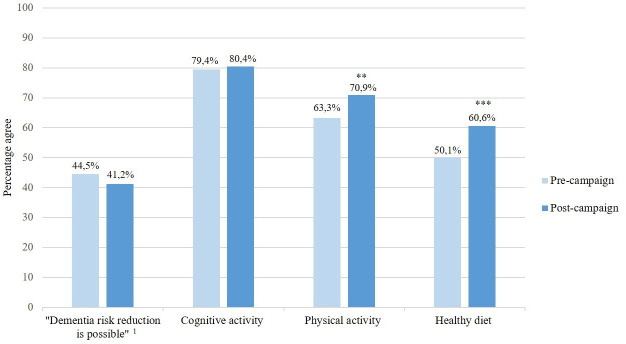
Objectives: Evaluate the effect of a health promotion campaign aimed at increasing awareness about dementia risk reduction in middle-aged community-dwelling individuals in the Netherlands. Design: A 10-month public health campaign using mass media and community participation, supported by eHealth. Population-level difference in awareness before and after the campaign, including variation between demographic groups, was assessed in two independent cross-sectional samples from the same target population. Setting: The public health campaign was launched in the Province of Limburg, the Netherlands, targeting all inhabitants aged 40–75 years old. Three specific districts within the Province were chosen for an additional community participation approach, in which local stakeholders were invited to support the campaign. Results: No pre- (n=590) post- (n=602) difference was observed in people agreeing to the statement that dementia risk reduction is possible (X 2 (1)=1.27, p=0.260). For the individual lifestyle factors, physical activity (7.6% increase (X 2 (1)=7.48, p=0.006)) and healthy diet (10.5% increase (X 2 (1)=12.37, p≤0.001)) were identified more often as being protective against dementia after the campaign. Of all risk/protective factors assessed, cognitive activity was identified most often at both preassessment (79.4%) and postassessment (80.4%), but there was no increase in awareness (X 2 (1)=0.17, p=0.677). Self-reported exposure to the campaign was associated with greater awareness and motivation for behavioural change (X 2 (1)=6.52, p=0.011). Compared with mass media only, the addition of community participation resulted in better recognition of campaign material and the eHealth platform. Conclusions: This study was not able to reach a population-level increase of awareness of dementia risk reduction. Two out of the three lifestyle factors that formed the foundation of the campaign were identified more often after the campaign. Those reported having been exposed to the campaign were more aware and more inclined towards behavioural change.
Overview
The claims and statistics of this paper haven’t been checked yet.
Free: it reads the open-access text and checks the first 5 claims that cite a source we can check. Create a free account to check every claim.
Integrity signals
Registry
Cites
Statistics
Figures
Verification
Claims the paper makes
The claims and statistics of this paper haven’t been checked yet.
Free: it reads the open-access text and checks the first 5 claims that cite a source we can check. Create a free account to check every claim.
Claims other papers make about this one
Each is checked against this paper’s own text: does it say what the citing paper says it does?
The cited source doesn’t support the claim as written.
In the citing paper
“The initiative was based on a successful awareness campaign previously developed and executed in the Netherlands (Heger et al., 2020).”
From Increasing knowledge on dementia risk reduction in the general population: Results of a public awareness campaign. (2021) · cites this paper as Heger et al., 2020
Checked by a reasoning model — may be wrong.
Experimental — accuracy not yet measuredThe source backs part of the claim, not all of it — or backs it for a different population, condition or comparison.
In the citing paper
“However, people who indicated having heard about the campaign through the media were more aware of DRR.”
From Increasing knowledge on dementia risk reduction in the general population: Results of a public awareness campaign. (2021) · cites this paper as Heger et al., 2020
Experimental — accuracy not yet measuredThe source backs part of the claim, not all of it — or backs it for a different population, condition or comparison.
In the citing paper
“The Dutch campaign also had to rely mainly on regional and local media channels while the Flemish campaign reached a number of large, national media outlets.”
From Increasing knowledge on dementia risk reduction in the general population: Results of a public awareness campaign. (2021) · cites this paper as Heger et al., 2020
Experimental — accuracy not yet measuredThe source backs part of the claim, not all of it — or backs it for a different population, condition or comparison.
In the citing paper
“The Dutch campaign succeeded in producing memorable campaign material (20% recognized the material during the post-campaign survey), but a population-level difference in knowledge was not observed.”
From Increasing knowledge on dementia risk reduction in the general population: Results of a public awareness campaign. (2021) · cites this paper as Heger et al., 2020
Experimental — accuracy not yet measuredThe source backs part of the claim, not all of it — or backs it for a different population, condition or comparison.
In the citing paper
“Knowledge about dementia risk reduction was examined via 13 statements (see Supplementary Material 2) which have been used previously [35–38].”
From Multidomain Dementia Risk Reduction in Primary Care is Feasible: A Proof-of-concept study (2024) · cites this paper as [36]
Experimental — accuracy not yet measured
6 more claims about this paper
Create a free account to see every claim other papers make about this one.
Self-check
Percentages, sums and reported differences re-computed from the paper’s own numbers.
The self-check needs the paper’s full text.
Citations
Cites
1 retracted
Dementia prevention, intervention, and care: 2020 report of the Lancet Commission
Livingston, G., Huntley, J., Sommerlad, A., Ames, D., Ballard, C., Banerjee, S., Brayne, C., Burns, A., Cohen-Mansfield, J., Cooper, C., et al. (2020) · The Lancet · doi:10.1016/s0140-6736(20)30367-6 · Cited by 10,430
RetractedDementia prevention, intervention, and care
Livingston, G., Sommerlad, A., Orgeta, V., Costafreda, S. G., Huntley, J., Ames, D., Ballard, C., Banerjee, S., Burns, A., Cohen-Mansfield, J., et al. (2017) · The Lancet · doi:10.1016/s0140-6736(17)31363-6 · Cited by 6,072
Ngandu, T., Lehtisalo, J., Solomon, A., Levälahti, E., Ahtiluoto, S., Antikainen, R., Bäckman, L., Hänninen, T., Jula, A., Laatikainen, T., et al. (2015) · The Lancet · doi:10.1016/s0140-6736(15)60461-5 · Cited by 3,689
Potential for primary prevention of Alzheimer's disease: an analysis of population-based data
Norton, S., Matthews, F. E., Barnes, D. E., Yaffe, K., & Brayne, C. (2014) · The Lancet Neurology · doi:10.1016/s1474-4422(14)70136-x · Cited by 2,466
Lifestyle interventions to prevent cognitive impairment, dementia and Alzheimer disease
Kivipelto, M., Mangialasche, F., & Ngandu, T. (2018) · Nature Reviews Neurology · doi:10.1038/s41582-018-0070-3 · Cited by 1,173
Kivipelto, M., Ngandu, T., Laatikainen, T., Winblad, B., Soininen, H., & Tuomilehto, J. (2006) · The Lancet Neurology · doi:10.1016/s1474-4422(06)70537-3 · Cited by 1,126
Incidence of dementia over three decades in the Framingham heart study
Satizabal, C. L., Beiser, A. S., Chouraki, V., Chêne, G., Dufouil, C., & Seshadri, S. (2016) · New England Journal of Medicine · doi:10.1056/nejmoa1504327 · Cited by 1,051
Recent global trends in the prevalence and incidence of dementia, and survival with dementia
Prince, M., Ali, G.-C., Guerchet, M., Prina, A. M., Albanese, E., & Wu, Y.-T. (2016) · Alzheimer's Research & Therapy · doi:10.1186/s13195-016-0188-8 · Cited by 876
Andrieu, S., Guyonnet, S., Coley, N., Cantet, C., Bonnefoy, M., Bordes, S., Bories, L., Cufi, M.-N., Dantoine, T., Dartigues, J.-F., et al. (2017) · The Lancet Neurology · doi:10.1016/s1474-4422(17)30040-6 · Cited by 838
van Charante, E. P. M., Richard, E., Eurelings, L. S., van Dalen, J.-W., Ligthart, S. A., van Bussel, E. F., Hoevenaar-Blom, M. P., Vermeulen, M., & van Gool, W. A. (2016) · The Lancet · doi:10.1016/s0140-6736(16)30950-3 · Cited by 611
Deckers, K., van Boxtel, M. P. J., Schiepers, O. J. G., de Vugt, M., Muñoz Sánchez, J. L., Anstey, K. J., Brayne, C., Dartigues, J.-F., Engedal, K., Kivipelto, M., et al. (2015) · International Journal of Geriatric Psychiatry · doi:10.1002/gps.4245 · Cited by 534
Self-citationRosenberg, A., Ngandu, T., Rusanen, M., Antikainen, R., Bäckman, L., Havulinna, S., Hänninen, T., Laatikainen, T., Lehtisalo, J., Levälahti, E., et al. (2018) · Alzheimer's & Dementia · doi:10.1016/j.jalz.2017.09.006 · Cited by 421
Patterson, C. (2018) · Cited by 311
Determinants of the intention to use e-Health by community dwelling older people
de Veer, A. J. E., Peeters, J. M., Brabers, A. E., Schellevis, F. G., Rademakers, J. J. J., & Francke, A. L. (2015) · BMC Health Services Research · doi:10.1186/s12913-015-0765-8 · Cited by 298
Cations, M., Radisic, G., Crotty, M., & Laver, K. E. (2018) · PLOS ONE · doi:10.1371/journal.pone.0196085 · Cited by 233
Vos, S. J. B., van Boxtel, M. P. J., Schiepers, O. J. G., Deckers, K., de Vugt, M., Carrière, I., Dartigues, J.-F., Peres, K., Artero, S., Ritchie, K., et al. (2017) · Journal of Alzheimer’s Disease · doi:10.3233/jad-161208 · Cited by 161
Self-citationEakin, E. G., Bull, S. S., Glasgow, R. E., & Mason, M. (2002) · Diabetes/Metabolism Research and Reviews · doi:10.1002/dmrr.266 · Cited by 140
Heger, I., Deckers, K., van Boxtel, M., de Vugt, M., Hajema, K., Verhey, F., & Köhler, S. (2019) · BMC Public Health · doi:10.1186/s12889-019-7010-z · Cited by 140
Self-citationIs dementia incidence declining in high-income countries? A systematic review and meta-analysis
Roehr, S., Pabst, A., Luck, T., & Riedel-Heller, S. (2018) · Clinical Epidemiology · doi:10.2147/clep.s163649 · Cited by 115
Public Knowledge about Dementia in China: A National WeChat-Based Survey
Liu, D., Cheng, G., An, L., Gan, X.-G., Wu, Y., Zhang, B., Hu, S. H., Zeng, Y., & Wu, L. (2019) · International Journal of Environmental Research and Public Health · doi:10.3390/ijerph16214231 · Cited by 83
The Blackfriars consensus on brain health and dementia
Lincoln, P., Fenton, K., Alessi, C., Prince, M., Brayne, C., Wortmann, M., Patel, K., Deanfield, J., & Mwatsama, M. (2014) · The Lancet · doi:10.1016/s0140-6736(14)60758-3 · Cited by 69
Compernolle, S., De Cocker, K., Lakerveld, J., Mackenbach, J. D., Nijpels, G., Oppert, J.-M., Rutter, H., Teixeira, P. J., Cardon, G., & De Bourdeaudhuij, I. (2014) · International Journal of Behavioral Nutrition and Physical Activity · doi:10.1186/s12966-014-0147-3 · Cited by 65
Deckers, K., Köhler, S., van Boxtel, M., Verhey, F., Brayne, C., & Fleming, J. (2018) · Aging & Mental Health · doi:10.1080/13607863.2017.1280767 · Cited by 64
Self-citationKim, S., Werner, P., Richardson, A., & Anstey, K. J. (2019) · Contemporary Clinical Trials Communications · doi:10.1016/j.conctc.2019.100351 · Cited by 55
Askari, N., Bilbrey, A. C., Ruiz, I. G., Humber, M. B., & Gallagher-Thompson, D. E. (2017) · Clinical Gerontologist · doi:10.1080/07317115.2017.1398799 · Cited by 50
User perceptions of a dementia risk reduction website and its promotion of behavior change
Farrow, M. (2013) · JMIR Research Protocols · doi:10.2196/resprot.2372 · Cited by 19
Werner, P., & Schiffman, I. K. (2017) · International Journal of Geriatric Psychiatry · doi:10.1002/gps.4814 · Cited by 18
The impact of a national public awareness campaign on dementia knowledge and help-seeking in Ireland
Hickey, D., Glynn, R. W., Shelley, E., & Lawlor, B. (2019) · European Journal of Public Health · doi:10.1093/eurpub/ckz185.637 · Cited by 13
Moorhouse, P., & Hamilton, L. M. (2014) · Canadian Geriatrics Journal · doi:10.5770/cgj.17.109 · Cited by 12
Luten, K. A., Dijkstra, A., de Winter, A. F., & Reijneveld, S. A. (2018) · Health Promotion International · doi:10.1093/heapro/day011 · Cited by 8
Research works printed but not linked: 1
- World Health Organization Risk reduction of cognitive decline and dementia: WHO guidelines. Geneva, 2019. 31219687
Cited by
Van Asbroeck, S., van Boxtel, M. P. J., Steyaert, J., Köhler, S., Heger, I., de Vugt, M., Verhey, F., & Deckers, K. (2021) · Preventive Medicine · doi:10.1016/j.ypmed.2021.106522 · Cited by 102
Self-citationMcWilliams, A., Bibby, H., Steinbeis, N., David, A. S., & Fleming, S. M. (2023) · Cognition · doi:10.1016/j.cognition.2023.105389 · Cited by 73
“…environment or societal views about the aging brain, such as those promoted purposefully or inadvertently by public health campaigns (Commissaris, Verhey Jr, Ponds, Jolles, & Kok, 1994; Heger et al., 2020; Hertzog, Small, McFall, & Dixon, 2019; Kinzer & Suhr, 2016; Maxfield & Greenberg, 2021).”
BackgroundFarrow, M., Fair, H. L., Klekociuk, S. Z., & Vickers, J. C. (2022) · PLoS ONE · doi:10.1371/journal.pone.0267205 · Cited by 63
Bartlett, L., Bindoff, A. D., Doherty, K., Kim, S., Eccleston, C. E. A., Kitsos, A., Roccati, E., Alty, J., King, A. E., & Vickers, J. C. (2023) · BMC Public Health · doi:10.1186/s12889-023-16805-2 · Cited by 34
“The findings reported by Heger, Kohler [13] show no change in dementia risk knowledge was observed following a health promotion campaign that used mass media to disseminate information about brain health.”
BackgroundPublic knowledge about dementia risk reduction in Norway
Kjelvik, G., Rokstad, A. M. M., Stuebs, J., Thingstad, P., Deckers, K., Köhler, S., & Selbæk, G. (2022) · BMC Public Health · doi:10.1186/s12889-022-14433-w · Cited by 29
“Our findings indicate a high level of awareness in Norway, which is higher than a similar study of the Flemish (35%) and Dutch (44%) populations [11, 13, 19] and the international review by Cations [7].”
MethodResultSelf-citation
Metadata
- Authors
- Heger, I., Köhler, S., van Boxtel, M., de Vugt, M., Hajema, K., Verhey, F., & Deckers, K.
- Affiliations
- Maastricht University (NL)
- GGD Zuid Limburg (NL)
- Corresponding author
- Heger, Irene
- Deckers, Kay
- Venue
- BMJ Open
- Publisher
- BMJ
- Published
- 2020-11
- Volume
- 10
- Issue
- 11
- Pages
- e041211
- ISSN
- 2044-6055 (ISSN-L)
- PMC
- PMC7651748
- OpenAlex
- W3095788668
- Semantic Scholar
- 6faad283ed43de48055e355589d74f98a37c03a4
- Cited by
- 68
- References
- 30
- Citations by year
- 2026: 9 · 2025: 13 · 2024: 16 · 2023: 12 · 2022: 14 · 2021: 4
- FWCI
- 5.47
- Type
- journal article
- Language
- en
- Open access
- gold
- doi.org
- Licence
- Locations
- BMJ Open (publishedVersion, cc-by-nc)
- PubMed Central (publishedVersion, cc-by-nc)
- PubMed (publishedVersion)
- Research Publications (Maastricht University) (submittedVersion, cc-by-nc)
- DOAJ (DOAJ: Directory of Open Access Journals) (submittedVersion, cc-by-sa)
- HighWire Press Open Archive (submittedVersion)
- Research Publications (Maastricht University) (submittedVersion, other-oa)
- Funders
- Health Foundation Limburg (Not applicable)
- Province of Limburg (SAS-2015-04931)
- Topics
- Health Sciences › Medicine › Psychiatry and Mental health › Dementia and Cognitive Impairment Research
- Social Sciences › Communication › Media Influence and Health
- Health Sciences › Medicine › Public Health, Environmental and Occupational Health › Health Promotion and Cardiovascular Prevention
- Keywords
- dementia risk reduction, public health campaigns, health promotion, dementia awareness, mass media, community participation, e-health, lifestyle factors, physical activity, healthy eating, cognitive activity, behavior change, middle-aged adults, community-dwelling population
- MeSH terms
- Adult, Aged, Awareness, Cross-Sectional Studies, Dementia, Health Promotion, Humans, Health Knowledge, Attitudes, Practice, Mass Media, Middle Aged, Netherlands, Risk Reduction Behavior
About these checks
Registry, retraction, Cites and statistics results are computed, not judged, with one exception: a printed reference that no index lists is read once by a model before it counts as a citation error. Claims are extracted by a model and kept only when their quote appears verbatim in the text; each cited source is then checked, with a model’s help, for whether it says what the claim relies on. Those verdicts can be wrong — read the claim’s quote and the cited source before relying on one.
Statistics and arithmetic are recomputed, not judged.
Confidence bands are shown only for fields calibrated on our annotated test set. None is calibrated yet, so no band is shown.
What counts as a claim ›How we measure confidence ›How we check this ›
Are you an author, or do you see a problem with this page? Request a review
Data sources
Bibliographic data: Semantic Scholar, OpenAlex, Crossref.
Contains information from the Semantic Scholar Academic Graph Datasets, made available under the ODC Attribution License (ODC-BY 1.0).
Semantic Scholar’s data is described in: Kinney, R., et al. (2023). The Semantic Scholar Open Data Platform. arXiv:2301.10140.
