

Processes of care and outcomes for homeless patients hospitalised for cardiovascular conditions at safety-net versus non-safety-net hospitals: cross-sectional study
The DOI matches its Crossref record; 8 of the 8 references it cites were found in a registry or an index.
Abstract
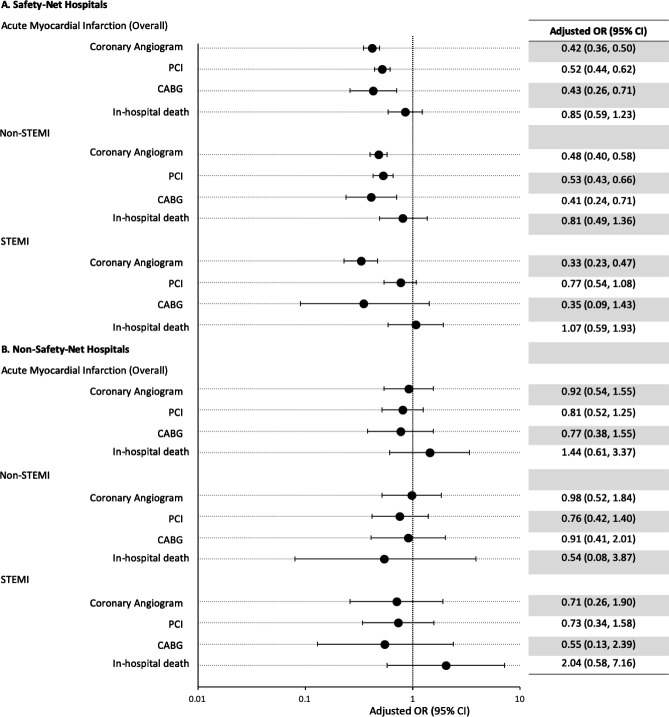
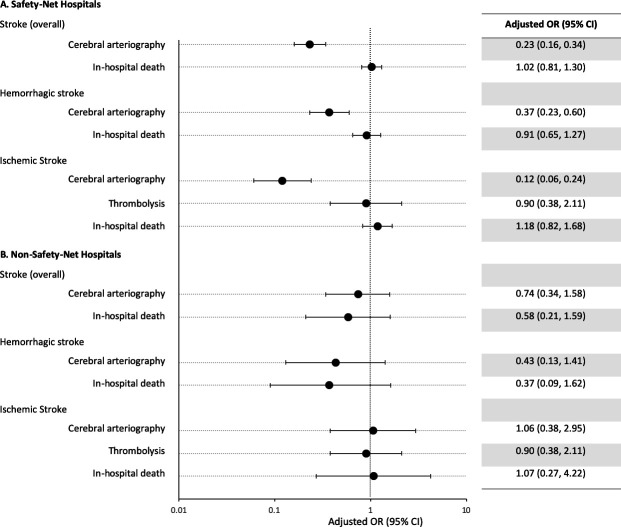
Objectives: Evidence suggests that homeless patients experience worse quality of care and poorer health outcomes across a range of medical conditions. It remains unclear, however, whether differences in care delivery at safety-net versus non-safety-net hospitals explain these disparities. We aimed to investigate whether homeless versus non-homeless adults hospitalised for cardiovascular conditions (acute myocardial infarction (AMI) and stroke) experience differences in care delivery and health outcomes at safety-net versus non-safety-net hospitals. Design: Cross-sectional study. Setting: Data including all hospital admissions in four states (Florida, Massachusetts, Maryland, and New York) in 2014. Participants: We analysed 167 105 adults aged 18 years or older hospitalised for cardiovascular conditions (age mean=64.5 years; 75 361 (45.1%) women; 2123 (1.3%) homeless hospitalisations) discharged from 348 hospitals. Outcome measures: Risk-adjusted diagnostic and therapeutic procedure and in-hospital mortality, after adjusting for patient characteristics and state and quarter fixed effects. Results: At safety-net hospitals, homeless adults hospitalised for AMI were less likely to receive coronary angiogram (adjusted OR (aOR), 0.42; 95% CI, 0.36 to 0.50; p<0.001), percutaneous coronary intervention (aOR, 0.52; 95% CI, 0.44 to 0.62; p<0.001) and coronary artery bypass graft (aOR, 0.43; 95% CI, 0.26 to 0.71; p<0.01) compared with non-homeless adults. Homeless patients treated for strokes at safety-net hospitals were less likely to receive cerebral arteriography (aOR, 0.23; 95% CI, 0.16 to 0.34; p<0.001), but were as likely to receive thrombolysis therapy. At non-safety-net hospitals, we found no evidence that the probability of receiving these procedures differed between homeless and non-homeless adults hospitalised for AMI or stroke. Finally, there were no differences in in-hospital mortality rates for homeless versus non-homeless patients at either safety-net or non-safety-net hospitals. Conclusion: Disparities in receipt of diagnostic and therapeutic procedures for homeless patients with cardiovascular conditions were observed only at safety-net hospitals. However, we found no evidence that these differences influenced in-hospital mortality markedly.
Overview
The claims and statistics of this paper haven’t been checked yet.
Free: it reads the open-access text and checks the first 5 claims that cite a source we can check. Create a free account to check every claim.
Integrity signals
Registry
Cites
Statistics
Figures
Verification
Claims the paper makes
The claims and statistics of this paper haven’t been checked yet.
Free: it reads the open-access text and checks the first 5 claims that cite a source we can check. Create a free account to check every claim.
Claims other papers make about this one
Each is checked against this paper’s own text: does it say what the citing paper says it does?
In the citing paper
“In 19 studies that were pooled, the prevalence of HF among older adults experiencing homelessness was 12.0% (95% confidence interval (CI) 7.3–19.1%, I2 = 99.9%) (Figure 2).(6,9,33–49)”
From Prevalence and Risk of Heart Failure Among Older Adults Experiencing Homelessness: A Systematic Review and Meta-Analysis (2026) · cites this paper as [39]
Self-check
Percentages, sums and reported differences re-computed from the paper’s own numbers.
The self-check needs the paper’s full text.
Citations
Cites
Fazel, S., Geddes, J. R., & Kushel, M. (2014) · The Lancet · doi:10.1016/s0140-6736(14)61132-6 · Cited by 1,568
Interventions to Reduce 30-Day Rehospitalization: A Systematic Review
Hansen, L. O., Young, R. S., Hinami, K., Leung, A., & Williams, M. V. (2011) · Annals of Internal Medicine · doi:10.7326/0003-4819-155-8-201110180-00008 · Cited by 1,182
Mortality Among Homeless Adults in Boston: Shifts in Causes of Death Over a 15-Year Period
Baggett, T. P., Hwang, S. W., O’Connell, J. J., Porneala, B. C., Stringfellow, E. J., Orav, E. J., Singer, D. E., & Rigotti, N. A. (2013) · JAMA Internal Medicine · doi:10.1001/jamainternmed.2013.1604 · Cited by 566
Mortality among men using homeless shelters in Toronto, Ontario
Hwang, S. W. (2000) · JAMA · doi:10.1001/jama.283.16.2152 · Cited by 398
Lebrun‐Harris, L. A., Baggett, T. P., Jenkins, D. M., Sripipatana, A., Sharma, R., Hayashi, A. S., Daly, C. A., & Ngo‐Metzger, Q. (2013) · Health Services Research · doi:10.1111/1475-6773.12009 · Cited by 216
Risk factors for cardiovascular disease in homeless adults
Lee, T. C., Hanlon, J. G., Ben-David, J., Booth, G. L., Cantor, W. J., Connelly, P. W., & Hwang, S. W. (2005) · Circulation · doi:10.1161/circulationaha.104.510826 · Cited by 191
Cigarette smoking and advice to quit in a national sample of homeless adults
Baggett, T. P., & Rigotti, N. A. (2010) · American Journal of Preventive Medicine · doi:10.1016/j.amepre.2010.03.024 · Cited by 180
Cardiovascular disease risk among the poor and homeless—what we know so far
Jones, C., Perera, A., Chow, M., Ho, I., Nguyen, J., & Davachi, S. (2009) · Current Cardiology Reviews · doi:10.2174/157340309787048086 · Cited by 94
Research works printed but not linked: 32
- Tsai J, Lifetime TJ. Lifetime and 1-year prevalence of homelessness in the US population: results from the National epidemiologic survey on alcohol and related Conditions-III. J Public Health 2018; 40: 65– 74. 10.1093/pubmed/fdx034 28335013 · DOI
- O’Connell JJ. Premature mortality in homeless populations: a review of literature. National Health Care for the Homeless Council 2005.
- Baggett TP, Liauw SS, Hwang SW. Cardiovascular Disease and Homelessness. J Am Coll Cardiol 2018; 71: 2585– 97. 10.1016/j.jacc.2018.02.077 29852981 · DOI · Paper page
- Seale JV, Fallaize R, Lovegrove JA. Nutrition and the homeless: the underestimated challenge. Nutr Res Rev 2016; 29: 143– 51. 10.1017/S0954422416000068 27350560 · DOI
- Greysen SR, Allen R, Lucas GI, et al. Understanding transitions in care from hospital to homeless shelter: a mixed-methods, community-based participatory approach. J Gen Intern Med 2012; 27: 1484– 91. 10.1007/s11606-012-2117-2 22707359 PMC3475815 · DOI
- 10.1059/0003-4819-155-8-201110180-00008 · doi:10.1059/0003-4819-155-8-201110180-00008
- Sadowski LS, Kee RA, VanderWeele TJ, et al. Effect of a housing and case management program on emergency department visits and hospitalizations among chronically ill homeless adults: a randomized trial. JAMA 2009; 301: 1771– 8. 10.1001/jama.2009.561 19417194 · DOI · Paper page
- Wadhera RK, Khatana SAM, Choi E, et al. Disparities in care and mortality among homeless adults hospitalized for cardiovascular conditions. JAMA Intern Med 2020; 180: 357– 66. 10.1001/jamainternmed.2019.6010 31738826 PMC6865320 · DOI
- Lukas CV, Holmes S, Harrison M. Can safety-net Hospital systems redesign themselves to achieve financial viability? Available: https://www.healthaffairs.org/do/10.1377/hblog20150316.045188/full/ [Accessed 30 Mar 2020]. · doi:10.1377/hblog20150316.045188/full/
- Bradley CJ, Dahman B, Shickle LM, et al. Surgery wait times and specialty services for insured and uninsured breast cancer patients: does Hospital safety net status matter? Health Serv Res 2012; 47: 677– 97. 10.1111/j.1475-6773.2011.01328.x 22092155 PMC3419883 · DOI
- Werner RM, Goldman LE, Dudley RA. Comparison of change in quality of care between safety-net and non-safety-net hospitals. JAMA 2008; 299: 2180– 7. 10.1001/jama.299.18.2180 18477785 · DOI · Paper page
- Acharya T, Salisbury AC, Spertus JA. In-hospital outcomes of percutaneous coronary intervention in america’s safety net. JACC: Cardiovascular Interventions 2017; 10: 1475– 85. 28797422
- Goldman LE, Vittinghoff E, Dudley RA. Quality of care in hospitals with a high percent of Medicaid patients. Med Care 2007; 45: 579– 83. 10.1097/MLR.0b013e318041f723 17515786 · DOI
- Jha AK, Orav EJ, Li Z, et al. Concentration and quality of hospitals that care for elderly black patients. Arch Intern Med 2007; 167: 1177. 10.1001/archinte.167.11.1177 17563027 · DOI · Paper page
- Ross JS, Bernheim SM, Lin Z, et al. Based on key measures, care quality for Medicare enrollees at safety-net and non-safety-net hospitals was almost equal. Health Aff 2012; 31: 1739– 48. 10.1377/hlthaff.2011.1028 PMC3527010 22869652 · DOI
- Ross JS, Cha SS, Epstein AJ, et al. Quality of care for acute myocardial infarction at urban safety-net hospitals. Health Aff 2007; 26: 238– 48. 10.1377/hlthaff.26.1.238 17211034 · doi:10.1377/hlthaff.26.1.238
- Andrews RM. Statewide hospital discharge data: collection, use, limitations, and improvements. Health Serv Res 2015; 50 Suppl 1: 1273– 99. 10.1111/1475-6773.12343 26150118 PMC4545332 · DOI
- Yamamoto A, Needleman J, Gelberg L, et al. Association between homelessness and opioid overdose and opioid-related Hospital admissions/emergency department visits. Soc Sci Med 2019; 242: 112585. 10.1016/j.socscimed.2019.112585 31634808 PMC7023863 · DOI · Paper page
- Karaca Z, Wong HS, Mutter RL. Characteristics of homeless and non-homeless individuals using inpatient and emergency department services, 2008. U.S. Agency for Healthcare Research and Quality 2013 https://www.ncbi.nlm.nih.gov/books/NBK137747/pdf/Bookshelf_NBK137747.pdf (accessed 1 Apr 2020). 23678514
- Sun R, Karaca Z, Wong HS. Characteristics of homeless individuals using emergency department services in 2014. U.S. agency for healthcare research and quality, 2017. Available: https://www.hcup-us.ahrq.gov/reports/statbriefs/sb229-Homeless-ED-Visits-2014.pdf [Accessed 1 Apr 2020]. 29400922
- Wadhera RK, Choi E, Shen C, et al. Trends, causes, and outcomes of hospitalizations for homeless individuals: a retrospective cohort study. Med Care 2019; 57: 21– 7. 10.1097/MLR.0000000000001015 30461584 PMC7131970 · DOI
- Popescu I, Fingar KR, Cutler E, et al. Comparison of 3 safety-net Hospital definitions and association with Hospital characteristics. JAMA Netw Open 2019; 2: e198577. 10.1001/jamanetworkopen.2019.8577 31390034 PMC6686776 · DOI
- Moore BJ, White S, Washington R, et al. Identifying increased risk of readmission and in-hospital mortality using Hospital administrative data. Med Care 2017; 55: 8: 703– 5. 10.1097/MLR.0000000000000735 28498196 · DOI · Paper page
- Wooldridge JM. Econometric Analysis of Cross Section and Panel Data. Cambridge, Mass: MIT Press, 2010.
- Williams R. Using the margins command to estimate and interpret adjusted predictions and marginal effects. Stata J 2012; 12: 308– 31. 10.1177/1536867X1201200209 · DOI · Paper page
- Brand CA, Barker AL, Morello RT, et al. A review of hospital characteristics associated with improved performance. Int J Qual Health Care 2012; 24: 483– 94. 10.1093/intqhc/mzs044 22871420 · DOI
- Figueroa JF, Joynt KE, Zhou X, et al. Safety-Net hospitals face more barriers yet use fewer strategies to reduce readmissions. Med Care 2017; 55: 229– 35. 10.1097/MLR.0000000000000687 28060053 PMC5309202 · DOI
- Jha AK, DesRoches CM, Shields AE, et al. Evidence of an emerging digital divide among hospitals that care for the poor. Health Aff 2009; 28: w1160– 70. 10.1377/hlthaff.28.6.w1160 19858142 · DOI
- Chatterjee P, Joynt KE, Orav EJ, et al. Patient experience in safety-net hospitals: implications for improving care and value-based purchasing. Arch Intern Med 2012; 172: 1204. 10.1001/archinternmed.2012.3158 22801941 · DOI · Paper page
- Miyawaki A, Hasegawa K, Figueroa JF, et al. Hospital readmission and emergency department revisits of homeless patients treated at homeless-serving hospitals in the USA: observational study. J Gen Intern Med 2020; 35: 2560– 8. 10.1007/s11606-020-06029-0 32666492 PMC7459070 · DOI · Paper page
- O’Gara PT, Kushner FG, Ascheim DD. ACCF/AHA guideline for the management of ST-elevation myocardial infarction. J Am Coll Cardiol 2013; 2013: e78: 138– 40. 23256914
- Powers WJ, Derdeyn CP, Biller J. American heart Association/American stroke association focused update of the 2013 guidelines for the early management of patients with acute ischemic stroke regarding endovascular treatment: a guideline for healthcare professionals from the American heart Association/American stroke association. Stroke 2015; 2015: 3020– 35. 26123479 · DOI · Paper page
Cited by
Hoang, P. M., Ding, J., Almsari, L., Seedu, J., Asgarali, R., Huang, Y. Q., De Castro, C., Rochon, P., Harris, M., & Kokorelias, K. M. (2026) · Canadian Geriatrics Journal · doi:10.5770/cgj.29.938
Metadata
- Authors
- Miyawaki, A., Khullar, D., & Tsugawa, Y.
- Affiliations
- Department of Public Health, Graduate School of Medicine, The University of Tokyo, Bunkyo-ku, Tokyo, Japan
- Department of Population Health Sciences, Weill Cornell Medicine, New York, New York, USA
- Division of General Internal Medicine and Health Services Research, University of California Los Angeles David Geffen School of Medicine, Los Angeles, California, USA
- Venue
- BMJ Open
- Publisher
- BMJ
- Published
- 2021-04
- Volume
- 11
- Issue
- 4
- Pages
- e046959
- ISSN
- 2044-6055
- PMC
- PMC8039275
- Cited by
- 7
- References
- 8
- Language
- en
- Funders
- St. Luke’s International University
About these checks
Registry, retraction, Cites and statistics results are computed, not judged, with one exception: a printed reference that no index lists is read once by a model before it counts as a citation error. Claims are extracted by a model and kept only when their quote appears verbatim in the text; each cited source is then checked, with a model’s help, for whether it says what the claim relies on. Those verdicts can be wrong — read the claim’s quote and the cited source before relying on one.
Statistics and arithmetic are recomputed, not judged.
Confidence bands are shown only for fields calibrated on our annotated test set. None is calibrated yet, so no band is shown.
What counts as a claim ›How we measure confidence ›How we check this ›
Are you an author, or do you see a problem with this page? Request a review
Data sources
Bibliographic data: Semantic Scholar, OpenAlex, Crossref.
Contains information from the Semantic Scholar Academic Graph Datasets, made available under the ODC Attribution License (ODC-BY 1.0).
Semantic Scholar’s data is described in: Kinney, R., et al. (2023). The Semantic Scholar Open Data Platform. arXiv:2301.10140.
