

The DOI matches its Crossref record; 2 of the 2 references it cites were found in a registry or an index.
Enablers and barriers to effective clinical supervision in the workplace: a rapid evidence review
Abstract
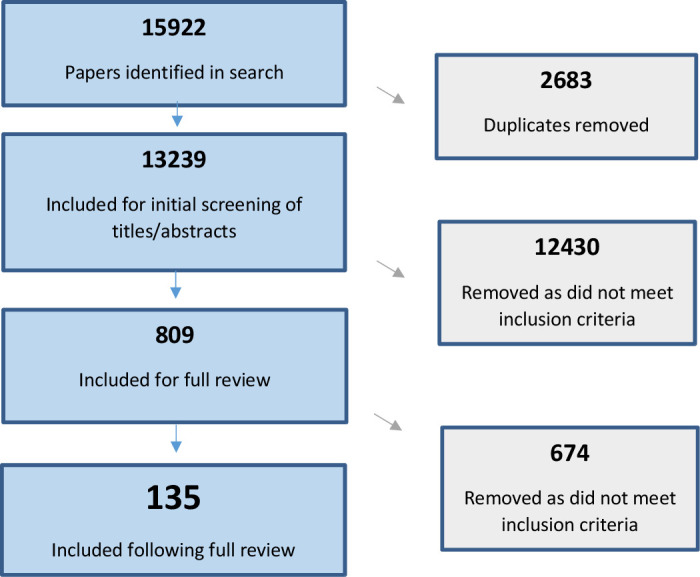
Objectives: We aimed to review the international literature to understand the enablers of and barriers to effective clinical supervision in the workplace and identify the benefits of effective clinical supervision. Design: A rapid evidence review. Data sources: Five databases (CINAHL, OVID Embase, OVID Medline, OVID PsycInfo and ProQuest) were searched to ensure inclusion and breadth of healthcare professionals. Eligibility criteria: Studies identifying enablers and barriers to effective clinical supervision across healthcare professionals in a Western context between 1 January 2009 and 12 March 2019. Data extraction and synthesis: An extraction framework with a detailed inclusion/exclusion criteria to ensure rigour was used to extract data. Data were analysed using a thematic qualitative synthesis. These themes were used to answer the research objectives. Results: The search identified 15 922 papers, reduced to 809 papers following the removal of duplicates and papers outside the inclusion criteria, with 135 papers being included in the full review. Enablers identified included regular supervision, occurs within protected time, in a private space and delivered flexibly. Additional enablers included supervisees being offered a choice of supervisor; supervision based on mutual trust and a positive relationship; a cultural understanding between supervisor and supervisee; a shared understanding of the purpose of supervision, based on individual needs, focused on enhancing knowledge and skills; training and feedback being provided for supervisors; and use of a mixed supervisor model, delivered by several supervisors, or by those trained to manage the overlapping (and potentially conflicting) needs of the individual and the service. Barriers included a lack of time, space and trust. A lack of shared understanding to the purpose of the supervision, and a lack of ongoing support and engagement from leadership and organisations were also found to be barriers to effective clinical supervision. Conclusions: This review identified several enablers of and barriers to effective clinical supervision and the subsequent benefits of effective clinical supervision in a healthcare setting.
Overview
The claims and statistics of this paper haven’t been checked yet.
Run the check — free, no account needed. It reads the open-access text and checks the sources it cites.
Integrity signals
Registry
Cites
Statistics
Figures
Verification
Claims the paper makes
The claims and statistics of this paper haven’t been checked yet.
Run the check — free, no account needed. It reads the open-access text and checks the sources it cites.
Claims other papers make about this one
Each is checked against this paper’s own text: does it say what the citing paper says it does?
In the citing paper
“Competency-based approaches emphasize accountability, risk management, and discrete skill acquisition, frequently treating culture as a single competency domain rather than a structural condition that shapes all aspects of training (Falender, 2018;Falender & Shafranske, 2023;Rothwell et al., 2021).”
From Caught between silence and truth: Graduate trainees' disclosures of microaggressions (2026) · cites this paper as Rothwell et al., 2021
Self-check
Percentages, sums and reported differences re-computed from the paper’s own numbers.
The self-check needs the paper’s full text.
Citations
Cites
Methods for the thematic synthesis of qualitative research in systematic reviews
Thomas, J., & Harden, A. (2008) · BMC Medical Research Methodology · doi:10.1186/1471-2288-8-45 · Cited by 9,312
The critical role of supervision in retaining staff in obstetric services: a three country study
McAuliffe, E., Daly, M., Kamwendo, F., Masanja, H., Sidat, M., & de Pinho, H. (2013) · PLoS ONE · doi:10.1371/journal.pone.0058415 · Cited by 78
Research works printed but not linked: 127
- 10.1080/0312407X.2011.591187 · DOI
- Nancarrow, 2014, Connecting practice: a practitioner centred model of supervision, Clinical Governance: An International Journal, 19, 235, 10.1108/CGIJ-03-2014-0010 · DOI
- Proctor B . Group supervision: a guide to creative practice. Thousand Oaks: Sage, 2008. · DOI
- Binnie, 2011, Structured reflection on the clinical supervision of supervisees with and without a core mental health professional background, Issues Ment Health Nurs, 32, 584, 10.3109/01612840.2011.576325 · DOI
- 10.1046/j.1365-2923.2000.00758.x · DOI · Paper page
- Bernard JM , Goodyear RK , Bernard JM . Fundamentals of clinical supervision. 3rd edition. Massachusetts, USA: Allyn & Bacon, 1992. ISBN: 9780205388738.
- 10.1186/s12961-016-0155-7 · DOI
- 10.1093/bjsw/bcq018 · DOI
- Beddoe, 2012, Interprofessional supervision in social work and psychology: mandates and (inter) professional relationships, Clin Superv, 31, 178, 10.1080/07325223.2013.730471 · DOI
- Love, 2017, “Unscrambling what’s in your head”: a mixed method evaluation of clinical supervision for midwives, Women and Birth, 30, 271, 10.1016/j.wombi.2016.11.002 · DOI
- Dawber, 2013, Reflective practice groups for nurses: a consultation liaison psychiatry nursing initiative: part 2--the evaluation, Int J Ment Health Nurs, 22, 241, 10.1111/j.1447-0349.2012.00841.x · DOI
- 10.1093/bjsw/bct115 · DOI
- Morgan, 2014, Supervising the highly performing general practice registrar, Clin Teach, 11, 53, 10.1111/tct.12061 · DOI
- 10.1016/j.ienj.2011.04.001 · DOI
- Davis, 2012, The effectiveness of clinical supervision for a group of ward managers based in a district general Hospital: an evaluative study, J Nurs Manag, 20, 782, 10.1111/j.1365-2834.2011.01277.x · DOI
- Cross, 2010, Clinical supervision of general nurses in a busy medical ward of a teaching hospital, Contemp Nurse, 35, 245, 10.5172/conu.2010.35.2.245 · DOI
- Greenway, 2013, Health visitor professional education and post-qualification clinical supervision: how well does it equip practitioners for dealing with ethical tensions associated with promoting the public health agenda to individual clients?, Prim Health Care Res Dev, 14, 90, 10.1017/S1463423612000278 · DOI
- Rouzaud-Laborde, 2016, Mentoring and supervising clinical pharmacist students at patients' bedside: which benefits?, J Eval Clin Pract, 22, 4, 10.1111/jep.12444 · DOI
- Paulin, 2010, Professional supervision in dietetics: A focus group study investigating New Zealand dietitians’ understanding and experience of professional supervision and their perception of its value in dietetic practice, Nutrition Dietetics, 67, 106, 10.1111/j.1747-0080.2010.01428.x · DOI
- Samuel, 2018, Critical reflection: a general practice support group experience, Aust J Prim Health, 24, 204, 10.1071/PY17092 · DOI
- Koivu, 2011, Stress relief or practice development: varied reasons for attending clinical supervision, J Nurs Manag, 19, 644, 10.1111/j.1365-2834.2011.01232.x · DOI
- Koivu, 2012, Who benefits from clinical supervision and how? the association between clinical supervision and the work-related well-being of female Hospital nurses, J Clin Nurs, 21, 2567, 10.1111/j.1365-2702.2011.04041.x · DOI
- Bondas, 2010, Nursing leadership from the perspective of clinical group supervision: a paradoxical practice, J Nurs Manag, 18, 477, 10.1111/j.1365-2834.2010.01085.x · DOI
- 10.1071/AH14020 · DOI
- Snowdon, 2017, Does clinical supervision of healthcare professionals improve effectiveness of care and patient experience? A systematic review, BMC Health Serv Res, 17, 10.1186/s12913-017-2739-5 · DOI
- McMahon, 2014, From new vistas to life lines: psychologists' satisfaction with supervision and confidence in supervising, Clin Psychol Psychother, 21, 264, 10.1002/cpp.1835 · DOI
- Sexton, 2013, A model for peer experiential and reciprocal supervision (peers) for genetic Counselors: development and preliminary evaluation within clinical practice, J Genet Couns, 22, 175, 10.1007/s10897-012-9540-8 · DOI
- Shea, 2016, A community mental health professional development model for the expansion of reflective practice and supervision: evaluation of a pilot training series for infant mental health professionals, Infant Ment Health J, 37, 653, 10.1002/imhj.21611 · DOI
- Redpath, 2015, Public sector physiotherapists believe that staff supervision should be broad ranging, individualised, structured, and based on needs and goals: a qualitative study, J Physiother, 61, 210, 10.1016/j.jphys.2015.08.002 · DOI
- 10.1177/1468017314539082 · DOI
- Wilson, 2016, Trainee therapists' experiences of supervision during training: a Meta-synthesis, Clin Psychol Psychother, 23, 340, 10.1002/cpp.1957 · DOI
- Spackman, 2017, Trainee experiences of intellectual disability psychiatry and an innovative leaderless support group: a qualitative study, BJPsych Bull, 41, 228, 10.1192/pb.bp.114.047373 · DOI
- Kutzsche, 2014, What do paediatric trainees require from their clinical supervisors?, Acta Paediatr, 103, e169, 10.1111/apa.12534 · DOI
- Dawson, 2012, Effective clinical supervision for regional allied health professionals - the supervisee's perspective, Aust Health Rev, 36, 92, 10.1071/AH11006 · DOI
- Wallbank, 2010, Effectiveness of individual clinical supervision for midwives and doctors in stress reduction: findings from a pilot study, Evidence Based Midwifery, 8, 65
- Phillips, 2012, An evaluation study of a clinical supervision programme, Dental Nursing, 8, 794, 10.12968/denn.2012.8.12.794 · DOI
- Milne, 2010, Can we enhance the training of clinical supervisors? a national pilot study of an evidence-based approach, Clin Psychol Psychother, 17, 321, 10.1002/cpp.657 · DOI
- 10.1186/s12913-014-0652-8 · DOI · Paper page
- Cox, 2009, The experience of therapy supervision within a UK multi-centre randomized controlled trial, Learning in Health Social Care, 8, 301, 10.1111/j.1473-6861.2009.00218.x · DOI
- 10.1002/chp.20056 · DOI
- Martin, 2014, Twelve tips for effective clinical supervision based on a narrative literature review and expert opinion, Med Teach, 36, 201, 10.3109/0142159X.2013.852166 · DOI
- Brown, 2018, The supervisory encounter and the senior GP trainee: managing for, through and with, Med Educ, 52, 192, 10.1111/medu.13468 · DOI
- Palmer-Olsen, 2011, Supervising emotionally focused therapists: a systematic research-based model, J Marital Fam Ther, 37, 411, 10.1111/j.1752-0606.2011.00253.x · DOI
- 10.1177/0011000013508656 · DOI
- Annan, 2013, Networks of professional supervision, Sch Psychol Q, 28, 170, 10.1037/spq0000015 · DOI
- West, 2010, Supervising counsellors and psychotherapists who work with trauma: a Delphi study, Br J Guid Counc, 38, 409, 10.1080/03069885.2010.503696 · DOI
- Lalani, 2018, Mentorship experiences of early-career academic radiation oncologists in North America, Int J Radiat Oncol Biol Phys, 101, 732, 10.1016/j.ijrobp.2018.03.035 · DOI
- McLaren, 2013, GP trainers' experience of managing a trainee in difficulty: a qualitative study, Educ Prim Care, 24, 363, 10.1080/14739879.2013.11494201 · DOI
- Daveson, 2011, Reflections regarding Australian music therapy supervision: guidance and recommendations for establishing internal and external supervisory arrangements aided by cross-national reflection, Australian Journal of Music Therapy, 22, 24
- 10.1186/1472-6920-10-74 · DOI
- Rodwell, 2017, The impact of characteristics of nurses' relationships with their supervisor, engagement and trust, on performance behaviours and intent to quit, J Adv Nurs, 73, 190, 10.1111/jan.13102 · DOI
- Ostergren, 2012, A survey of speech-language pathology assistants (SLPAs) in California: current trends in demographics, employment, supervision, and training, CICSD, 39, 121, 10.1044/cicsd_39_F_121 · DOI
- 10.1186/s13104-015-1649-z · DOI
- Bomba, 2011, Psychotherapy supervision as viewed from psychodynamic standpoint, Psychoterapia, 4, 45
- Gonge, 2010, Individual and workplace factors that influence psychiatric nursing staff's participation in clinical supervision: a survey study and prospective longitudinal registration, Issues Ment Health Nurs, 31, 345, 10.3109/01612840903427849 · DOI
- Dilworth, 2013, Finding a way forward: a literature review on the current debates around clinical supervision, Contemp Nurse, 45, 22, 10.5172/conu.2013.45.1.22 · DOI
- Saxby, 2015, Can clinical supervision sustain our workforce in the current healthcare landscape? findings from a Queensland study of allied health professionals, Aust Health Rev, 39, 476, 10.1071/AH14183 · DOI
- 10.1002/chp.20110 · DOI
- Kenny, 2013, Implementing clinical supervision for Australian rural nurses, Nurse Educ Pract, 13, 165, 10.1016/j.nepr.2012.08.009 · DOI
- 10.1080/0312407X.2011.625036 · DOI
- 10.1177/0969733010368747 · DOI
- 10.1007/s10803-009-0709-4 · DOI
- 10.1177/0193945911406908 · DOI
- 10.1017/S1041610212001883 · DOI
- Brunetto, 2011, Supervisor-subordinate communication relationships, role ambiguity, autonomy and affective commitment for nurses, Contemp Nurse, 39, 227, 10.5172/conu.2011.39.2.227 · DOI
- Brunetto, 2011, The impact of supervisor-subordinate relationships on nurses' ability to solve workplace problems: implications for their commitment to the organization, Adv Health Care Manag, 10, 215, 10.1108/S1474-8231(2011)0000010019 · DOI
- 10.1016/j.apnr.2016.10.004 · DOI
- Bethell, 2018, Supportive supervision and staff intent to turn over in long-term care homes, Gerontologist, 58, 953, 10.1093/geront/gnx008 · DOI
- Brunetto, 2013, The importance of supervisor-nurse relationships, teamwork, wellbeing, affective commitment and retention of North American nurses, J Nurs Manag, 21, 827, 10.1111/jonm.12111 · DOI
- Dunsmuir, 2015, Current trends in educational psychology supervision in the UK, Educational and Child Psychology, 32, 8, 10.53841/bpsecp.2015.32.3.8 · DOI
- Pack, 2012, Two sides to every story: a phenomenological exploration of the meanings of clinical supervision from supervisee and supervisor perspectives, J Soc Work Pract, 26, 163, 10.1080/02650533.2011.611302 · DOI
- O'Connor, 2012, Developing 'home-grown' supervisors, Kai Tiaki Nursing New Zealand, 18, 30
- 10.1177/0898264308328641 · DOI
- Gonge, 2015, Is it possible to strengthen psychiatric nursing staff's clinical supervision? RCT of a meta-supervision intervention, J Adv Nurs, 71, 909, 10.1111/jan.12569 · DOI
- da Silva Pinheiro, 2014, Collaborative supervision and professional development in nursing, Revista de Enfermagem Referência, 4, 101
- 10.1093/bjsw/bcu069 · DOI
- Beddoe, 2014, ‘Never trust anybody who says “i don’t need supervision”’: practitioners’ beliefs about social worker resilience, Practice, 26, 113, 10.1080/09503153.2014.896888 · DOI
- Rodwell, 2014, Abusive supervision and links to nurse intentions to quit, J Nurs Scholarsh, 46, 357, 10.1111/jnu.12089 · DOI
- Carless, 2012, Successful postgraduate placement experiences: what is the influence of job and supervisor characteristics?, Aust Psychol, 47, 156, 10.1111/j.1742-9544.2012.00085.x · DOI
- 10.1016/j.surg.2011.07.078 · DOI
- Farnan, 2010, Strategies for effective on-call supervision for internal medicine residents: the superb/safety model, J Grad Med Educ, 2, 10.4300/JGME-D-09-00015.1 · DOI
- Bryant, 2015, Development and implementation of a peer mentoring program for early career gerontological faculty, J Nurs Scholarsh, 47, 258, 10.1111/jnu.12135 · DOI
- Bulman, 2016, The development of peer reflective supervision amongst nurse educator colleagues: an action research project, Nurse Educ Today, 45, 148, 10.1016/j.nedt.2016.07.010 · DOI
- Bucky, 2010, Supervision characteristics related to the supervisory working alliance as rated by doctoral-level supervisees, Clin Superv, 29, 149, 10.1080/07325223.2010.519270 · DOI
- Davies, 2016, A qualitative exploration of the factors influencing the job satisfaction and career development of physiotherapists in private practice, Man Ther, 25, 56, 10.1016/j.math.2016.06.001 · DOI
- Danielsson, 2009, Norwegian and Swedish preceptors' views of their role before and after taking part in a group supervision program, Nurs Health Sci, 11, 107, 10.1111/j.1442-2018.2009.00455.x · DOI
- Artinian, 2014, Peer mentorship during pediatric residency: a pilot study, Journal of Investigative Medicine, 62, 248
- Brody, 2016, Evaluation of a peer mentoring program for early career gerontological nursing faculty and its potential for application to other fields in nursing and health sciences, Nurs Outlook, 64, 332, 10.1016/j.outlook.2016.03.004 · DOI
- Griggs, 2012, Mentoring community-based trainee assistant practitioners: a case study, Br J Community Nurs, 17, 328, 10.12968/bjcn.2012.17.7.328 · DOI
- 10.1080/01421590802650134 · DOI
- Szabo, 2019, 'Having a mentor helped me with difficult times': a trainee-run mentoring project, Australas Psychiatry, 27, 230, 10.1177/1039856218822735 · DOI
- 10.1136/postgradmedj-2014-132673 · DOI
- Simpson-Southward, 2017, How do we know what makes for "best practice" in clinical supervision for psychological therapists? A content analysis of supervisory models and approaches, Clin Psychol Psychother, 24, 1228, 10.1002/cpp.2084 · DOI
- Gonge, 2016, Exploring organizational barriers to strengthening clinical supervision of psychiatric nursing staff: a longitudinal controlled intervention study, Issues Ment Health Nurs, 37, 332, 10.3109/01612840.2016.1154119 · DOI
- McBride, 2017, Building a mentoring network, Nurs Outlook, 65, 305, 10.1016/j.outlook.2016.12.001 · DOI
- 10.4276/030802210X12734991664228 · DOI
- Henderson, 2011, Facilitating learning in clinical practice: evaluation of a trial of a supervisor of clinical education role, Nurse Educ Pract, 11, 288, 10.1016/j.nepr.2011.01.003 · DOI
- Laschober, 2012, Clinical supervisor and counselor perceptions of clinical supervision in addiction treatment, J Addict Dis, 31, 382, 10.1080/10550887.2012.735599 · DOI
- Goldszmidt, 2015, Attending physician variability: a model of four supervisory styles, Acad Med, 90, 1541, 10.1097/ACM.0000000000000735 · DOI
- 10.1111/j.1447-0349.2009.00612.x · DOI
- Akhigbe, 2017, Mentoring models in neurosurgical training: review of literature, Journal of Clinical Neuroscience, 45, 40, 10.1016/j.jocn.2017.07.025 · DOI
- Koivu, 2011, Who attends clinical supervision? the uptake of clinical supervision by hospital nurses, J Nurs Manag, 19, 69, 10.1111/j.1365-2834.2010.01185.x · DOI
- Harrison, 2009, An educational evaluation of supervisor and mentor experiences when supporting primary care graduate mental health workers, J Psychiatr Ment Health Nurs, 16, 416, 10.1111/j.1365-2850.2009.01392.x · DOI
- Iwanicki, 2017, An exploratory study examining current assessment Supervisory practices in professional psychology, J Pers Assess, 99, 165, 10.1080/00223891.2016.1228068 · DOI
- Elfering, 2017, Exploring Supervisor-Related job resources as mediators between supervisor conflict and job attitudes in hospital employees, Saf Health Work, 8, 19, 10.1016/j.shaw.2016.06.003 · DOI
- Cheung, 2017, Supervision: 'a random bag of arrangements'? Perspectives from psychiatrists on how to improve clinical teaching, Australas Psychiatry, 25, 510, 10.1177/1039856217716291 · DOI
- Lewis, 2017, The dynamics of a genetic counseling peer supervision group, J Genet Couns, 26, 532, 10.1007/s10897-016-0013-3 · DOI
- Henderson, 2015, 'What matters to graduates™: an evaluation of a structured clinical support program for newly graduated nurses, Nurse Educ Pract, 15, 225, 10.1016/j.nepr.2015.01.009 · DOI
- Churchill, 2017, Supervision of urological surgical trainees: what are the issues and how can we improve?, BJU International, 119
- Kilbertus, 2018, P079: transition to practice: evaluating the need for formal training in supervision and assessment techniques among senior emergency medicine residents and new to practice emergency physicians, CJEM, 20, S84, 10.1017/cem.2018.277 · DOI
- 10.2146/ajhp090498 · DOI
- Davys, 2009, Interprofessional learning for supervision: 'taking the blinkers off', Learning in Health & Social Care, 8, 58, 10.1111/j.1473-6861.2008.00197.x · DOI
- Jarrett, 2014, Clinical supervision in the provision of intensive home visiting by health visitors, Community Practitioner, 87, 32
- 10.1080/01421590701881699 · DOI
- Dawber, 2013, Reflective practice groups for nurses: a consultation liaison psychiatry nursing initiative: part 1 - the model reflective practice groups for nurses: a consultation liaison psychiatry nursing initiative: Part 1 - the model, International Journal of Mental Health Nursing, 22, 135, 10.1111/j.1447-0349.2012.00839.x · DOI
- 10.1037/a0030000 · DOI
- Fellows, 2014, G264 Mentoring for Paediatricians - need and support for a National Framework, Arch Dis Child, 99, 10.1136/archdischild-2014-306237.261 · DOI
- Taylor, 2013, Receiving group clinical supervision: a phenomenological study, Br J Nurs, 22, 861, 10.12968/bjon.2013.22.15.861 · DOI
- Milne, 2012, A rationale for evidence-based clinical supervision, J Contemp Psychother, 42, 139, 10.1007/s10879-011-9199-8 · DOI
- O'Connor, 2012, Developing'home-grown’supervisors, Kai Tiaki: Nursing New Zealand, 18, 30
- Love, 2011, Beyond the horizon—clinical supervision—a journey through reflection, Women and Birth, 24, S40, 10.1016/j.wombi.2011.07.130 · DOI
- Cross, 2012, Implementing clinical supervision for ICU outreach nurses: a case study of their journey, Australian Critical Care, 25, 263, 10.1016/j.aucc.2012.01.004 · DOI
- McMahon, 2014, Four guiding principles for the supervisory relationship, Reflective Practice, 15, 333, 10.1080/14623943.2014.900010 · DOI
- 10.1177/0261018314538799 · DOI
- O'Donoghue, 2012, Windows on the Supervisee experience: an exploration of Supervisees’ supervision histories, Australian Social Work, 65, 214, 10.1080/0312407X.2012.667816 · DOI
- Buus, 2011, Psychiatric nursing staff members’ reflections on participating in group-based clinical supervision: A semistructured interview study, Int J Ment Health Nurs, 20, 95, 10.1111/j.1447-0349.2010.00709.x · DOI
- 10.1186/s12913-020-06001-y · DOI
Cited by
Sorted by citations
Caught between silence and truth: Graduate trainees' disclosures of microaggressions
Concepción Cabán, L. D., Goins, R. E., Osman, F. A., Banks, B. M., Jackson, T. M., Flint, A. N., Hynes, K., & Peterson, K. R. (2026) · Journal of School Psychology · doi:10.1016/j.jsp.2026.101593
Metadata
- Authors
- Rothwell, C., Kehoe, A., Farook, S. F., & Illing, J.
- Affiliations
- School of Medical Education, Newcastle University, Newcastle upon Tyne, UK
- Health Professions Education Unit, Hull York Medical School, York, UK
- Emergency Medicine, Newcastle upon Tyne Hospitals NHS Trust, Newcastle upon Tyne, UK
- Health Professions Education Centre, Royal College of Surgeons in Ireland, Dublin, Ireland
- Venue
- BMJ Open
- Publisher
- BMJ
- Published
- 2021-09
- Volume
- 11
- Issue
- 9
- Pages
- e052929
- ISSN
- 2044-6055
- PMC
- PMC8479981
- Cited by
- 186
- References
- 2
- Language
- en
- Funders
- The Health & Care Professions Council (N/A)
About these checks
Registry, retraction, Cites and statistics results are computed, not judged, with one exception: a printed reference that no index lists is read once by a model before it counts as a citation error. Claims are extracted by a model and kept only when their quote appears verbatim in the text; each cited source is then checked, with a model’s help, for whether it says what the claim relies on. Those verdicts can be wrong — read the claim’s quote and the cited source before relying on one.
Statistics and arithmetic are recomputed, not judged.
Confidence bands are shown only for fields calibrated on our annotated test set. None is calibrated yet, so no band is shown.
What counts as a claim ›How we measure confidence ›How we check this ›
Are you an author, or do you see a problem with this page? Request a review
