

Determinants of accessing healthcare in Sub-Saharan Africa: a mixed-effect analysis of recent Demographic and Health Surveys from 36 countries
Open accessThe DOI matches its Crossref record; 45 of the 45 references it cites were found in a registry or an index.
Abstract
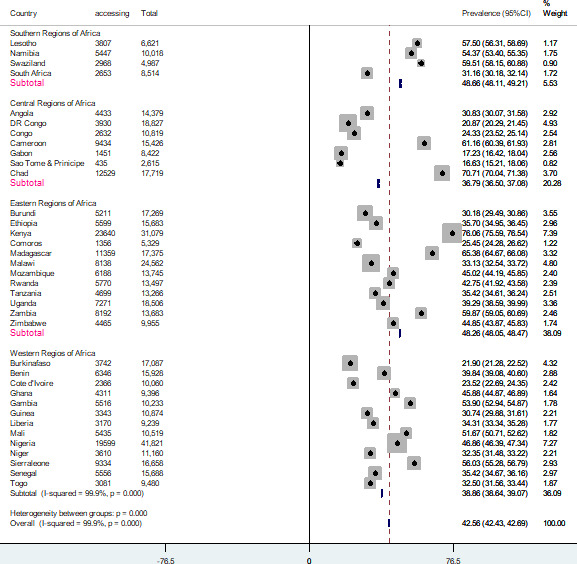
Objective: This study aimed to assess the determinants of accessing healthcare among reproductive-age women in Sub-Saharan Africa (SSA). Design, setting and analysis: Cross-sectional data were sourced from recent Demographic and Health Surveys in 36 SSA countries. We employed mixed-effect analysis to identify the determinants of accessing healthcare in SSA. OR and its 95% CI were reported for determinants associated with accessing healthcare. Outcome: The outcome for this study was whether accessing healthcare was a ‘big problem’ or ‘not a big problem’. Responses to these questions were categorised as a big problem and not a big problem. Participants: A total weighted sample of 500 439 reproductive-age (15–49 years) women from each country’s recent Demographic and Health Surveys from 2006 to 2018 were included in this study. Results: The pooled prevalence of healthcare access among reproductive-age women in SSA was 42.56% (95% CI 42.43% to 42.69%). The results of the mixed-effect analysis revealed that the determinants of accessing healthcare were urban residence (adjusted OR (AOR)=1.25, 95% CI 1.34 to 1.73), ability to read and write (AOR=1.15, 95% CI 1.22 to 1.28), primary education (AOR=1.08, 95% CI 1.07 to 1.12), secondary education and above (AOR=1.12, 95% CI 1.10 to 1.14), husband with primary education (AOR=1.06, 95% CI 1.07 to 1.1.12), husband with secondary education and above (AOR=1.22, 95% CI 1.18 to 1.27), middle wealth index (AOR=1.43, 95% CI 1.40 to 1.47), rich wealth index (AOR=2.19, 95% CI 2.13 to 2.24) and wanted pregnancy (AOR=1.27, 95% CI 1.19 to 1.29). Conclusion: Healthcare access in SSA was found at 42.56%, which is very low even if Sustainable Development Goal 3.8 targeted universal health coverage for everyone so they can obtain the health services they need. The major determinants of healthcare access among reproductive-age women in SSA were urban residence, higher educational level, higher wealth index and wanted pregnancy. The findings of this study suggest and recommend strengthening and improving healthcare access for women who reside in the countryside, women with low level of education and women of low socioeconomic status.
Overview
The claims and statistics of this paper haven’t been checked yet.
Free: it reads the open-access text and checks the first 5 claims that cite a source we can check. Create a free account to check every claim.
Integrity signals
Registry
Cites
Statistics
Figures
Verification
Claims the paper makes
The claims and statistics of this paper haven’t been checked yet.
Free: it reads the open-access text and checks the first 5 claims that cite a source we can check. Create a free account to check every claim.
Claims other papers make about this one
Each is checked against this paper’s own text: does it say what the citing paper says it does?
The source backs part of the claim, not all of it — or backs it for a different population, condition or comparison.
In the citing paper
“this study found that women in wealth quintile 5 faced the least financial barriers to access healthcare compared to their counterparts in other groups.”
From Financial barriers to healthcare access among reproductive-age women in Sierra Leone: evidence from demographic health surveys of 2008, 2013, and 2019 (2026) · cites this paper as [39]
Experimental — accuracy not yet measured
Self-check
Percentages, sums and reported differences re-computed from the paper’s own numbers.
The self-check needs the paper’s full text.
Citations
Cites
The role of telehealth during COVID-19 outbreak: a systematic review based on current evidence
Monaghesh, E., & Hajizadeh, A. (2020) · BMC Public Health · doi:10.1186/s12889-020-09301-4 · Cited by 1,941
What does 'access to health care' mean?
Gulliford, M., Figueroa-Munoz, J., Morgan, M., Hughes, D., Gibson, B., Beech, R., & Hudson, M. (2002) · Journal of Health Services Research & Policy · doi:10.1258/135581902760082517 · Cited by 1,130
Randhawa, G. S., Soltysiak, M. P. M., El Roz, H., de Souza, C. P. E., Hill, K. A., & Kari, L. (2020) · PLOS ONE · doi:10.1371/journal.pone.0232391 · Cited by 1,023
Ladds, E., Rushforth, A., Wieringa, S., Taylor, S., Rayner, C., Husain, L., & Greenhalgh, T. (2020) · BMC Health Services Research · doi:10.1186/s12913-020-06001-y · Cited by 669
Mahmud, R., Rahman, M. M., Rassel, M. A., Monayem, F. B., Sayeed, S. K. J. B., Islam, M. S., & Islam, M. M. (2021) · PLOS ONE · doi:10.1371/journal.pone.0249644 · Cited by 571
Gender equality in science, medicine, and global health: where are we at and why does it matter?
Shannon, G., Jansen, M., Williams, K., Cáceres, C., Motta, A., Odhiambo, A., Eleveld, A., & Mannell, J. (2019) · The Lancet · doi:10.1016/s0140-6736(18)33135-0 · Cited by 534
Gender inequity in health: why it exists and how we can change it
Sen, G., & Östlin, P. (2008) · Global Public Health · doi:10.1080/17441690801900795 · Cited by 455
Steenbeek, R., Schellart, A. J., Mulders, H., Anema, J. R., Kroneman, H., & Besseling, J. (2011) · BMC Public Health · doi:10.1186/1471-2458-11-1 · Cited by 420
Igbinosa, E. O., Odjadjare, E. E., Chigor, V. N., Igbinosa, I. H., Emoghene, A. O., Ekhaise, F. O., Igiehon, N. O., & Idemudia, O. G. (2013) · The Scientific World Journal · doi:10.1155/2013/460215 · Cited by 346
Profit and loss analysis for an intensive care unit (ICU) in Japan: a tool for strategic management
Cao, P., Toyabe, S.-I., Abe, T., & Akazawa, K. (2006) · BMC Health Services Research · doi:10.1186/1472-6963-6-1 · Cited by 320
Research works printed but not linked: 2
- Cho. HHS public access. Physiol Behav 2016; 176: 100– 6. · doi:10.1002/bdr2.1435.maternal
- National Academies of Sciences E, Medicine. Health-care utilization as a proxy in disability determination, 2018. 29782136
Cited by
Items 101–135 of 135
Coulibaly, K., Niangaly, H., Robin, J., Coulibaly, A., Kanté, K., Traoré, S., Téréra, I., Sagara, I., Larmarange, J., & Schantz, C. (2026) · Research Square · doi:10.21203/rs.3.rs-8854057/v1
Tadesse, S., Tesfau, Y. B., Berhe, A. K., Ayele, A., & Wodessa, G. (2026) · The Journal of Medicine Access · doi:10.1177/27550834261458635
Mededji, D., Attanasso, M. O., & Senou, M. M. (2026) · Health Systems · doi:10.1080/20476965.2026.2684450
The Determinants of Transition Between Levels of Access to Health Services in Türkiye
SİPAHİ, B. B., Çavmak, D., & Söyler, S. (2026) · World Medical & Health Policy · doi:10.1002/wmh3.70077
editors:, M.-V. A., Müller, S., Boso, N., Dey, P., Hietschold, N., Gurtner, S., order:, A. O. R. E. I. A., Bellwald, N., Dembetembe, G. G., Gallant, N. D. D., et al. (2026) · Africa Journal of Management · doi:10.1080/23322373.2026.2633092
Afolabi, A. D., & Ilesanmi, O. (2026) · Frontiers in Global Women s Health · doi:10.3389/fgwh.2026.1807793
“Empirical evidence from DHS-based multi-country analyses in sub-Saharan Africa (47, 48) similarly demonstrates that women’s decision-making autonomy is not uniformly protective against IPV.”
Prevalence and risk factors of home delivery among rural women: evidence from 28 African countries
Armah‐Ansah, E. K., Okeke-Obayemi, D. O., Okeke, S. R., Budu, E., Omenka, C. O., & Ameyaw, E. K. (2026) · Reproductive Health · doi:10.1186/s12978-026-02386-x
“Women who reported at least one of these as a ‘big problem’ were classified as having poor access to healthcare, whereas those who reported ‘not a big problem’ were classified as having good access to healthcare [42].”
Tafere, T. Z., Abebe, M. T., Zelelew, A. M., Adal, G. M., & Tsehay, C. T. (2026) · Archives of Public Health · doi:10.1186/s13690-026-01999-9
“[50], East African Countries (57.09”
InfluentialKebede, F. B., & Mengistu, A. K. (2026) · AJOG Global Reports · doi:10.1016/j.xagr.2026.100668
Mwansa, A. B., & Mudenda, S. (2026) · Open Journal of Business and Management · doi:10.4236/ojbm.2026.144107
Impact of Poor Patient Safety Culture on Mother and Child Health in Sub-Saharan Africa - A Review
Odu, J. O., & Sorunke, A. (2026) · The Ulutaş medical journal/The ulutas medical journal · doi:10.5455/umj.20260417110004
Libert, E. E. E., Osvalde, A. N., Tabita, E. N. M., Halidou, A., Enstelle, N. A. F., Valerie, E. M. J., Mohamadou, H., Aicha, N., Danielle, K. A., Nkounkou, R. B. B., et al. (2026) · Research Square · doi:10.21203/rs.3.rs-9967392/v1
Haque, H., Knettel, B. A., Mwobobia, J. M., Huchko, M. J., Madundo, K., Serventi, F., Mmbaga, B. T., Schroeder, K., & Osazuwa‐Peters, N. (2026) · Cambridge Prisms Global Mental Health · doi:10.1017/gmh.2026.10252
“…people affected by cancer in sub-Saharan Africa face a complex and interrelated set of challenges in a unique sociocultural environment, specifically in low-resource settings marked by inadequate infrastructure and lack of availability of high-quality cancer care (Tessema et al., 2022).”
Yenit, M. K., Gyawali, P., & Kolbe-Alexander, T. L. (2026) · African Journal of Primary Health Care & Family Medicine · doi:10.4102/phcfm.v18i1.5326
“8 These include a predominantly rural population, limited healthcare infrastructure in remote areas, workforce shortages, 9 socioeconomic disparities, and a growing epidemiological transition from communicable to NCDs. 10,11 In addition, population growth and increasing urbanisation further strain…”
Mangimela-Mulundano, A., Zablotska, I., Simbao, C., Kankasa, C., Kasonka, L., & Black, K. I. (2026) · Pan African Medical Journal · doi:10.11604/pamj.2026.54.56.50787
Barriers to healthcare access and associated factors among pregnant women in Tanzania
Mtoro, M. J., Stephano, E. E., Lumbe, A. G., Yoyo, G., Materu, P. A., & Mwalingo, T. P. (2026) · Discover Public Health · doi:10.1186/s12982-026-02690-8
“Access to healthcare services in SSA among women of reproductive age are very low, at 42.56% [4].”
InfluentialHeterogeneity in women’s public and private agency across sub-Saharan Africa
Tan, J., & Yu, S.-T. (2026) · Demographic Research · doi:10.4054/demres.2026.55.7
Demehin, M. O., Isiugo-Abanihe, U. C., & Olusegun, O. V. (2026) · Zenodo (CERN European Organization for Nuclear Research) · doi:10.58612/hs4111
Kagaigai, A., Tungu, M., Bihemo, N. J., Adam, J., Anaeli, A., & Luoga, P. (2026) · Frontiers in Health Services · doi:10.3389/frhs.2026.1896869
Ntibabara, E. S., Mbuligwe, G. F., Mitungo, L. J., Mlala, M. A., Mpogo, A. H., Mushi, A. S., Mwakilima, J. L., Mduma, G. Y., Moshi, P. A., Mwombeki, E. H., et al. (2026) · Research Square · doi:10.21203/rs.3.rs-10515811/v1
Poda, G. G., & Poda, P. (2026) · HEALTH SCIENCES AND DISEASE · doi:10.67260/hsd.v27i8.7836
Factors influencing access to healthcare for the indigent in Senegal
Thiam, H., Kane, B., Ridde, V., Allegri, M. D., & Faye, A. (2026) · Discover Public Health · doi:10.1186/s12982-026-02882-2
“Evidence from multi-country analyses in sub-Saharan Africa suggests that socioeconomic status is generally associated with improved access to care [45], but this relationship may be context-specific and influenced by local health system factors.”
Determinants of preoperative care timelines in emergency abdominal surgery in Tanzania
Kitua, D. W., Shabani, S. M., Kivuyo, N. E., Mwanga, A. H., Misidai, M., Arda, F., Haule, G. M., Medarakini, H. G., Ringo, Y., & Akoko, L. (2026) · Surgery Open Digestive Advance · doi:10.1016/j.soda.2026.100261
Mushi, L., & Ogweyo, N. O. (2026) · Journal of Pharmaceutical Policy and Practice · doi:10.1080/20523211.2026.2725474
“…access basic and essential healthcare, with severe effect in the SSA where up to 90% of populations rely on out-of-pocket payments to obtain medicines, exposing households to significant financial hardship (Ndomba & Maluka, 2025; Sisay et al., 2021; Tessema et al., 2022; WHO and World Bank, 2017).”
Libert, E. E. E., Osvalde, A. N., Tabita, E. N. M., Halidou, A., Enstelle, N. A. F., Valerie, E. M. J., Mohamadou, H., Aicha, N., Danielle, K. A., Nkounkou, R. B. B., et al. (2026) · Research Square · doi:10.21203/rs.3.rs-10664191/v1
Mlenge, G. P., Bilame, O., & Mwinuka, L. (2026) · PLOS mental health. · doi:10.1371/journal.pmen.0000644
Epidemiology of the hepatitis delta virus (HDV) in West Africa: a systematic review
Issahaku, A., Abdul-Karim, A., Kumi, J., Gafaru, Y. A., Nantogma, A. R., Takyi-Attobrah, D., Michael, O., Tetteh, N. E., Musah, R., Dodoo, D. N. D., et al. (2026) · Discover Public Health · doi:10.1186/s12982-026-02996-7
“Environmental pollution and climate-related disruptions further strain fragile health systems and may indirectly increase vulnerability to blood-borne infections by limiting access to preventive services [71, 72].”
Sabet, N., Nabeemeeah, F., Otwombe, K. N., Hlongwane, K. E., Mlambo, L. M., Moloantoa, T., Wong, M., Mangena, P., Abraham, P., Swanepoel, F., et al. (2026) · Open Forum Infectious Diseases · doi:10.1093/ofid/ofag594
“However, hospitalizations due to CAP are associated with high inpatient and postdischarge mortality [7], contributing to longevity differences when people without HIV (PWoH) are compared with those with HIV [8, 9].”
Xu, D., & Zhang, Y. (2026) · Journal of Transport Geography · doi:10.1016/j.jtrangeo.2026.104849
Choeu, M. M. (2025) · University of the Witwatersrand, Johannesburg Institutional Repository on DSpace (University of the Witwatersrand, Johannesburg)
Kelkay, J. M., Aschalew, A. Y., Teshale, G., Jejaw, M., Demissie, K. A., Tadele, A., Tiruneh, M. G., Tafere, T. Z., Hagos, A., & Baykemagn, N. D. (2026) · JMIR Medical Informatics · doi:10.2196/85695
“Health care accessibility is known to be influenced by a wide range of factors, such as patient acceptance of treatments [10], physician preferences [11], place of residence [12], religious beliefs, and the empowerment of women [13].”
Nwankwo, G. I., Obiora, R. U., Agbi, D. M., Olubiyi, B., Mumba, D., Kazonda, H. T., Isiko, I., Mwebesa, E., & Natuhamya, C. (2026) · PLoS ONE · doi:10.1371/journal.pone.0359946
Lin, X., Yang, C., Lin, X., Zhao, C., Wang, X., Wang, X., Ou, Y., Zhang, Y., Zeng, F., Liang, D., et al. (2026) · Endocrine · doi:10.1007/s12020-026-04774-6
“…regional patterns may reflect broader health-sys - tem constraints and inequities in access to essential health services, including limited coverage and variable quality of care, particularly in rural/remote areas, as well as chal - lenges in workforce capacity and clinical standards [ 30 , 31].”
Chauke, S., Sagbo, I. J., Ateba, C. N., & Ndhlovu, P. T. (2026) · Next research. · doi:10.1016/j.nexres.2026.102584
Navaratnam, A. M. D., Nkwain, C., Leoni, M., Kaindama, L., Dar, O. A., Mohamed-Ahmed, O., & Payne, S. (2026) · Critical Public Health · doi:10.1080/09581596.2026.2713957
Metadata
- Authors
- Tessema, Z. T., Worku, M. G., Tesema, G. A., Alamneh, T. S., Teshale, A. B., Yeshaw, Y., Alem, A. Z., Ayalew, H. G., & Liyew, A. M.
- Affiliations
- University of Gondar (ET)
- Wollo University (ET)
- Corresponding author
- Tessema, Zemenu Tadesse
- ORCID
- Venue
- BMJ Open
- Publisher
- BMJ
- Published
- 2022-01
- Volume
- 12
- Issue
- 1
- Pages
- e054397
- ISSN
- 2044-6055 (ISSN-L)
- PMC
- PMC8804632
- OpenAlex
- W4210525134
- Cited by
- 129
- References
- 45
- Citations by year
- 2026: 53 · 2025: 35 · 2024: 29 · 2023: 8 · 2022: 4
- FWCI
- 13.92
- Type
- journal article
- Language
- en
- Open access
- gold
- doi.org
- Licence
- Locations
- BMJ Open (publishedVersion, cc-by-nc)
- PubMed Central (publishedVersion, cc-by-nc)
- PubMed (publishedVersion)
- DOAJ (DOAJ: Directory of Open Access Journals) (submittedVersion, cc-by-sa)
- Topics
- Health Sciences › Medicine › Public Health, Environmental and Occupational Health › Healthcare Systems and Reforms
- Health Sciences › Medicine › Pediatrics, Perinatology and Child Health › Global Maternal and Child Health
- Social Sciences › Health › Public Health and Social Inequalities
- Keywords
- health care access, women of reproductive age, sub-Saharan Africa, urban residence, literacy, household wealth, spousal education, pregnancy intention, barriers to care, maternal health, Demographic and Health Surveys, wealth index, urban-rural differences, fertility intentions, maternal morbidity, maternal health service utilization, maternal health policy
- MeSH terms
- Adolescent, Adult, Cross-Sectional Studies, Female, Health Services Accessibility, Health Surveys, Humans, Middle Aged, Pregnancy, Prevalence, Africa South of the Sahara, Young Adult
About these checks
Registry, retraction, Cites and statistics results are computed, not judged, with one exception: a printed reference that no index lists is read once by a model before it counts as a citation error. Claims are extracted by a model and kept only when their quote appears verbatim in the text; each cited source is then checked, with a model’s help, for whether it says what the claim relies on. Those verdicts can be wrong — read the claim’s quote and the cited source before relying on one.
Statistics and arithmetic are recomputed, not judged.
Confidence bands are shown only for fields calibrated on our annotated test set. None is calibrated yet, so no band is shown.
What counts as a claim ›How we measure confidence ›How we check this ›
Are you an author, or do you see a problem with this page? Request a review
Data sources
Bibliographic data: Semantic Scholar, OpenAlex, Crossref.
Contains information from the Semantic Scholar Academic Graph Datasets, made available under the ODC Attribution License (ODC-BY 1.0).
Semantic Scholar’s data is described in: Kinney, R., et al. (2023). The Semantic Scholar Open Data Platform. arXiv:2301.10140.
