

Epicardial injection of allogeneic human-induced-pluripotent stem cell-derived cardiomyocytes in patients with advanced heart failure: protocol for a phase I/IIa dose-escalation clinical trial
Open accessThe DOI matches its Crossref record; 27 of the 27 references it cites were found in a registry or an index.
Abstract
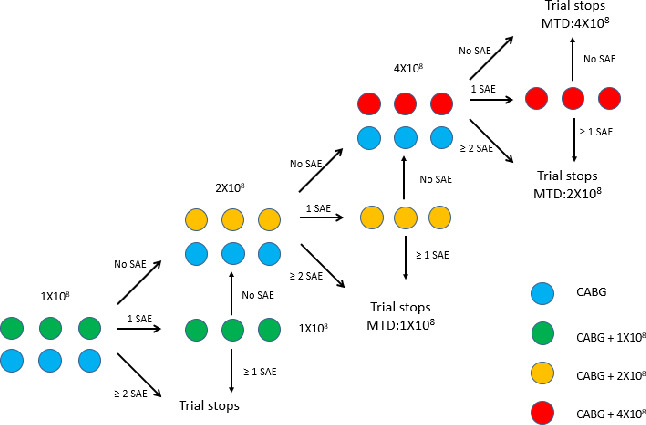
INTRODUCTION: Heart failure (HF) is a growing global public health burden. However, due to the very limited regenerative capacity of mature cardiomyocytes in the adult mammalian heart, conventional treatments can only improve the symptoms of HF but fail to restore cardiac function. Heart transplantation is limited by a severe shortage of donors. Cell-based transplantation for the treatment of HF has become a promising strategy. Human-induced-pluripotent stem cell-derived cardiomyocytes (hiPSC-CMs) have been tested in animal models to assess safety and efficacy. This study aims at evaluating the safety and efficacy of epicardial injection of hiPSC-CMs in patients with advanced HF during coronary artery bypass grafting (CABG) surgery. METHODS: cells, sequentially). Patients with advanced heart failure will be enrolled and randomly allocated to receive epicardial injection of hiPSC-CMs during CABG surgery or CABG surgery alone, followed by a 12-month follow-up investigation. The primary endpoint is to assess the safety of hiPSC-CMs transplantation, including haemodynamic compromised sustained ventricular arrhythmias and newly formed tumours during 6 months postoperatively. The secondary endpoint is to evaluate the efficacy of epicardial injection of hiPSC-CMs and CABG surgery combination by comparison with CABG surgery alone. ETHICS AND DISSEMINATION: The study protocol has been approved by the Institutional Ethical Committee of Nanjing Drum Tower Hospital (No. SC202000102) and approved by National Health Commission of the PRC (MR-32-21-014649). Findings will be disseminated to the academic community through peer-reviewed publications and presentation at national and international meetings. TRIAL REGISTRATION NUMBER: NCT03763136.
Overview
The claims and statistics of this paper haven’t been checked yet.
Free: it reads the open-access text and checks the first 5 claims that cite a source we can check. Create a free account to check every claim.
Integrity signals
Registry
Cites
Statistics
Figures
Verification
Claims the paper makes
The claims and statistics of this paper haven’t been checked yet.
Free: it reads the open-access text and checks the first 5 claims that cite a source we can check. Create a free account to check every claim.
Claims other papers make about this one
Each is checked against this paper’s own text: does it say what the citing paper says it does?
The cited source says what the claim attributes to it.
In the citing paper
“Another group in China, at Help Therapeutics, proposed using iPSC-derived cardiomyocytes to treat ischemic heart failures [78].”
From Utility of iPSC-Derived Cells for Disease Modeling, Drug Development, and Cell Therapy (2022) · cites this paper as [78]
Self-check
Percentages, sums and reported differences re-computed from the paper’s own numbers.
The self-check needs the paper’s full text.
Citations
Cites
Induction of Pluripotent Stem Cells from Adult Human Fibroblasts by Defined Factors
Takahashi, K., Tanabe, K., Ohnuki, M., Narita, M., Ichisaka, T., Tomoda, K., & Yamanaka, S. (2007) · Cell · doi:10.1016/j.cell.2007.11.019 · Cited by 20,221
Induced Pluripotent Stem Cell Lines Derived from Human Somatic Cells
Yu, J., Vodyanik, M. A., Smuga-Otto, K., Antosiewicz-Bourget, J., Frane, J. L., Tian, S., Nie, J., Jonsdottir, G. A., Ruotti, V., Stewart, R., et al. (2007) · Science · doi:10.1126/science.1151526 · Cited by 10,310
SPIRIT 2013 Statement: Defining Standard Protocol Items for Clinical Trials
Chan, A.-W., Tetzlaff, J. M., Altman, D. G., Laupacis, A., Gøtzsche, P. C., Krleža-Jerić, K., Hróbjartsson, A., Mann, H., Dickersin, K., Berlin, J. A., et al. (2013) · Annals of Internal Medicine · doi:10.7326/0003-4819-158-3-201302050-00583 · Cited by 7,363
Epidemiology and aetiology of heart failure
Ziaeian, B., & Fonarow, G. C. (2016) · Nature Reviews Cardiology · doi:10.1038/nrcardio.2016.25 · Cited by 1,878
Chemically defined generation of human cardiomyocytes
Burridge, P. W., Matsa, E., Shukla, P., Lin, Z. C., Churko, J. M., Ebert, A. D., Lan, F., Diecke, S., Huber, B., Mordwinkin, N. M., et al. (2014) · Nature Methods · doi:10.1038/nmeth.2999 · Cited by 1,606
Allogeneic transplantation of iPS cell-derived cardiomyocytes regenerates primate hearts
Shiba, Y., Gomibuchi, T., Seto, T., Wada, Y., Ichimura, H., Tanaka, Y., Ogasawara, T., Okada, K., Shiba, N., Sakamoto, K., et al. (2016) · Nature · doi:10.1038/nature19815 · Cited by 840
Myocardial Interstitial Fibrosis in Heart Failure
González, A., Schelbert, E. B., Díez, J., & Butler, J. (2018) · Journal of the American College of Cardiology · doi:10.1016/j.jacc.2018.02.021 · Cited by 660
Liu, Y.-W., Chen, B., Yang, X., Fugate, J. A., Kalucki, F. A., Futakuchi-Tsuchida, A., Couture, L., Vogel, K. W., Astley, C. A., Baldessari, A., et al. (2018) · Nature Biotechnology · doi:10.1038/nbt.4162 · Cited by 617
Kawamura, M., Miyagawa, S., Miki, K., Saito, A., Fukushima, S., Higuchi, T., Kawamura, T., Kuratani, T., Daimon, T., Shimizu, T., et al. (2012) · Circulation · doi:10.1161/circulationaha.111.084343 · Cited by 495
Menasché, P., Vanneaux, V., Hagège, A., Bel, A., Cholley, B., Parouchev, A., Cacciapuoti, I., Al-Daccak, R., Benhamouda, N., Blons, H., et al. (2018) · Journal of the American College of Cardiology · doi:10.1016/j.jacc.2017.11.047 · Cited by 456
Cited by
Pluripotent stem-cell-derived therapies in clinical trial: A 2025 update
Kirkeby, A., Main, H., & Carpenter, M. (2025) · Cell Stem Cell · doi:10.1016/j.stem.2024.12.005 · Cited by 196
Utility of iPSC-Derived Cells for Disease Modeling, Drug Development, and Cell Therapy
Nicholson, M. W., Ting, C.-Y., Chan, D. Z. H., Cheng, Y.-C., Lee, Y.-C., Hsu, C.-C., Huang, C.-Y., & Hsieh, P. C. H. (2022) · Cells · doi:10.3390/cells11111853 · Cited by 65
Trials and tribulations of cell therapy for heart failure: an update on ongoing trials
Zhang, J. J., Pogwizd, S. M., Fukuda, K., Zimmermann, W., Fan, C., Hare, J. M., Bolli, R., & Menasché, P. (2024) · Nature Reviews Cardiology · doi:10.1038/s41569-024-01098-8 · Cited by 59
Csöbönyeiová, M., Beerová, N., Klein, M., Čeháková, M., & Danišovič, Ľ. (2022) · International Journal of Molecular Sciences · doi:10.3390/ijms231810314 · Cited by 43
Current Status of Cardiac Regenerative Therapy Using Induced Pluripotent Stem Cells
Sugiura, T., Shahannaz, D. C., & Ferrell, B. E. (2024) · International Journal of Molecular Sciences · doi:10.3390/ijms25115772 · Cited by 35
Advances in 3D Organoid Models for Stem Cell-Based Cardiac Regeneration
Martin, M., Gähwiler, E. K. N., Generali, M., Hoerstrup, S. P., & Emmert, M. Y. (2023) · International Journal of Molecular Sciences · doi:10.3390/ijms24065188 · Cited by 21
“A study of iPSC-derived CM spheroids in patients with heart failure (LAPiS Study) Recruiting Phase 1 and 2 interventional: iPSC-CM spheroids as a therapy Heartseed Inc. Completion: 31 March 2024; no results posted NCT04945018 [21] Treating heart failure with hiPSC-CMs (HEAL-CHF) Not yet recruiting Phase 1 and 2 interv…”
BackgroundPluripotent stem cell-based cardiac regenerative therapy for heart failure
Soma, Y., Tani, H., Morita-Umei, Y., Kishino, Y., Fukuda, K., & Tohyama, S. (2024) · Journal of Molecular and Cellular Cardiology · doi:10.1016/j.yjmcc.2023.12.001 · Cited by 20
Dobruskin, M., Toner, G., & Kander, R. (2024) · Biotechnology Progress · doi:10.1002/btpr.3504 · Cited by 15
Kishino, Y., & Fukuda, K. (2023) · Biomedicines · doi:10.3390/biomedicines11030915 · Cited by 16
“NCT03763136 HEAL-CHF [133] China Phase 1/2 Randomized double-blind 20 patients with chronic LV dysfunction (LVEF ≥ 20% and ≤ 45%) Allogeneic hPSC-CM 12 months 200 × 106 cells in 2.”
MethodTran, T.-T.-H., Tran, T.-L., Nguyen, H., Luong, T.-H., Dang, T.-M.-A., Pham, T.-A. N., & Nguyen, T.-N. (2025) · Regenerative Therapy · doi:10.1016/j.reth.2025.09.009 · Cited by 12
“The phase I/IIa, placebo-controlled, dose-escalation design, included three dosage levels of 1 × 10 8 , 2 × 10 8 , and 4 × 10 8 cells in patient with LVEF from 20 % to 45 % [54].”
Human pluripotent stem cell-based cardiac repair: Lessons learned and challenges ahead
Montague, E. C., Ozcan, B., Sefton, E., Wulkan, F., Alibhai, F. J., & Laflamme, M. A. (2025) · Advanced Drug Delivery Reviews · doi:10.1016/j.addr.2025.115594 · Cited by 12
Hu, X., Tediashvili, G., Gravina, A., Stoddard, J., McGill, T. J., Connolly, A. J., Deuse, T., & Schrepfer, S. (2025) · Nature Communications · doi:10.1038/s41467-025-58774-7 · Cited by 12
“However, clinical islet transplantation is usually performed ABO-compatible 28 , some clinical trials with fetal brain neural stem cells performed ABO matching 29 , while trials for cardiomyocyte transplantation did not require ABO compatibility 30,31 .”
Role of Cx43 in iPSC-CM Damage Induced by Microwave Radiation
Yin, Y., Xu, X., Li, D., Yao, B., Wang, H., Zhao, L., Wang, H., Dong, J., Zhang, J., & Ruiyun, P. (2023) · International Journal of Molecular Sciences · doi:10.3390/ijms241612533 · Cited by 9
“In recent years, with the rapid development of regenerative medicine, iPSC-CMs have made a new breakthrough in the treatment of clinical heart diseases [8,9].”
BackgroundCells and Materials for Cardiac Repair and Regeneration
Al-Hijailan, R. S., Garoffolo, G., Raveendran, V. V., & Pesce, M. (2023) · Journal of Clinical Medicine · doi:10.3390/jcm12103398 · Cited by 8
Raval, A. N., Schmuck, E. G., Leonov, V., Roy, S., Saito, Y., Zhou, T., Jang, H. J., Wilker, K., Conklin, J., Hacker, T. A., et al. (2026) · Journal of the American Heart Association · doi:10.1161/jaha.125.050517 · Cited by 6
WITHDRAWN: Cell based dATP delivery as a therapy for chronic heart failurePreprint
Mhatre, K. N., Mathieu, J., Martinson, A., Flint, G. V., Blakley, L. P., Tabesh, A., Reinecke, H., Yang, X., Guan, X., Murali, E., et al. (2023) · bioRxiv (Cold Spring Harbor Laboratory) · doi:10.1101/2023.04.24.538108 · Cited by 6
Yun, J., So, J., Jeong, S., Jang, J., Han, S., Jeon, J., Lee, K., Jang, H. R., & Lee, J. (2024) · Cellular and Molecular Life Sciences · doi:10.1007/s00018-024-05493-9 · Cited by 5
Dobruskin, M., Toner, G., & Kander, R. (2025) · Biotechnology Progress · doi:10.1002/btpr.70031 · Cited by 5
Liu, B., Zhang, L., Guan, X., Liu, J., Shou, W., Chen, X., Li, X., & Cao, D. (2025) · Journal of Translational Medicine · doi:10.1186/s12967-025-06603-2 · Cited by 5
“Some research teams have obtained permission for clinical trials of cell therapy for MI [8].”
Le, D. C. P., Bui, H. T., Vu, Y. T. H., & Vo, Q. D. (2024) · Regenerative Medicine · doi:10.1080/17460751.2024.2393558 · Cited by 5
Soczyńska, J., Gawełczyk, W., Majcherczyk, K., Rydzek, J., Muzyka, A., Żołyniak, M., & Woźniak, S. (2025) · Cells · doi:10.3390/cells14211674 · Cited by 4
Sun, J., Yates, C. G., Dingwall, S., Ongtengco, C. F. J., Power, D., Gray, P. P., & Prowse, A. B. J. (2024) · Cytotherapy · doi:10.1016/j.jcyt.2024.05.019 · Cited by 4
“A recent dose-escalation clinical trial of PSC-CM aimed to test engrafting number of PSC-CM ranging from 100 to 400 million [25].”
Biologics for cardiovascular diseases: from bench to bedside
Sun, X., Wang, X., Jia, R., Tang, J., Zeng, X. Y., Zhao, F., Zeng, F., Huang, N., Li, J., & Cui, K. (2026) · Signal Transduction and Targeted Therapy · doi:10.1038/s41392-026-02673-w · Cited by 4
“Currently, eight clinical trials are actively recruiting participants with heart failure with a reduced ejection fraction (HFrEF) to evaluate the ef fi cacy and safety of hPSC-CMs transplantation 48,49 (NCT04945018, NCT04396899, NCT05647213, NCT05068674, NCT05566600, NCT03763136, and NCT05223894).”
Induced pluripotent stem cells from discovery to translation
Lee, J., Herron, T. J., Studer, L., Mummery, C. L., & Wu, J. C. (2026) · Nature Medicine · doi:10.1038/s41591-026-04584-3 · Cited by 3
“…is less directly attributable to a single mechanism. iPSC-derived cardiomyocyte sheets or patches are being advanced for ischemic cardiomyopathy and severe heart failure, but these approaches must contend with electromechanical coupling, arrhythmia risk and tissue-scale integration 136–139 .”
Akiyama, H., Katayama, Y., Shimizu, K., & Honda, H. (2025) · Stem Cell Research & Therapy · doi:10.1186/s13287-025-04408-0 · Cited by 3
Kuroda, Y., Iida, J., Murata, K., Hori, Y., Kobiki, J., Minatoya, K., & Masumoto, H. (2025) · JTCVS Open · doi:10.1016/j.xjon.2025.03.006 · Cited by 3
“6,7 However, in order to achieve effective regenerative medicine, optimal grafts should have a morphology and structure that is close to the living heart, maintaining viability and achieving electrical and mechanical synchronization with the host heart.”
Pluripotent stem cell-derived cardiomyocyte transplantation: marching from bench to bedside
Yi, H., Liu, J., Wang, W., Li, H., Kong, W., Li, X., Zhang, W., Pahlavan, S., Tang, Y., Wang, X., et al. (2025) · Science China Life Sciences · doi:10.1007/s11427-024-2801-x · Cited by 2
“Immune rejection levels will be assessed via donor-specific antibody (DSA) testing and serological testing for anti-human leukocyte antigen (anti-HLA) antibodies/panel reactive antibodies (PRA) (NCT03763136).”
Gibbs, C. E., & Boyle, P. M. (2026) · The Journal of Precision Medicine Health and Disease · doi:10.1016/j.premed.2026.100035 · Cited by 2
Fehse, B., Schickl, H., Bartfeld, S., & Zenke, M. (2023) · Springer eBooks · doi:10.1007/978-3-662-67908-1 · Cited by 3
Lin, Y., Yan, Y., Qu, C., Li, X., Abdulwahid, A.-H. R. R., & Shu, M. (2026) · BMC Plastic and Reconstructive Surgery · doi:10.1186/s44452-026-00016-w · Cited by 1
“iPSCs are being actively explored for translational applications across multiple disease areas, including cardio-myopathy [120], coronary artery disease [121], autism spectrum disorder [122], cystic fibrosis [123], and cancer [124].”
Biomaterials for clinical therapy utilizing cells differentiated from human pluripotent stem cells
Higuchi, A., Wang, T., Kang, X., Tian, Z., Sung, T., & Umezawa, A. (2026) · Materials Today Advances · doi:10.1016/j.mtadv.2026.100860 · Cited by 1
Zelltypen aus menschlichen pluripotenten Zellen und deren Anwendung in Zelltherapien
Zimmermann, W., Ader, M., Besser, D., Kronstein‐Wiedemann, R., Lickert, H., Schlüssel, E., Thiel, J., & Tonn, T. (2023) · Springer eBooks · doi:10.1007/978-3-662-67908-1_13 · Cited by 1
Herbal medicine: a potent booster for stem cell therapy in cardiovascular diseases
Kheirkhah, A. H., Kavianpour, M., & Ababzadeh, S. (2024) · Oriental Pharmacy and Experimental Medicine · doi:10.1007/s13596-024-00793-8 · Cited by 1
“Recently, in a dose-escalation phase I/IIa clinical trial, cardiomyocytes produced from human allogeneic pluripotent stem cells are being studied to determine the effects of epicardial infusion during coronary artery bypass grafting (CABG) in patients with severe heart failure (Zhang et al. 2022).”
Aging and rejuvenation of engineered cardiovascular tissues: from research to clinical application
Liu, C. X., Guo, J., Zhang, Y., Hu, M., Hao, T., Crețoiu, D., Li, G., & Xiao, J. (2024) · The Journal of Cardiovascular Aging · doi:10.20517/jca.2024.11 · Cited by 1
Follin, B., Caluori, G., Dobrolińska, M. M., Stachura, J., Muzzamil, H., Wojakowski, W., Qayyum, A. A., & Jadczyk, T. (2023) · Springer eBooks · doi:10.1007/978-981-99-0722-9_3
“Heart Cells” Derived from Pluripotent Stem Cells and Therapeutic Applications
Roy, S., Schmuck, E. G., & Raval, A. N. (2023) · Springer eBooks · doi:10.1007/978-981-99-0722-9_4
Pluripotent Stem Cells in Myocardial Tissue Engineering and Heart Regeneration
Yusof, N. A. N. M., Esa, E., & Tan, J. J. (2024) · Elsevier eBooks · doi:10.1016/b978-0-443-15717-2.00084-6
Exploring the therapeutic effect of Qijia Wuling soupon cardiomyocyte mast cells
Ma, C., & Liqin, Z. (2024) · MEDS Chinese Medicine · doi:10.23977/medcm.2024.060206
“Other drugs, such as vasodilators and cardiomyocyte nutrition, are also widely used in the clinic[22].”
BackgroundHeart Regeneration With Stem Cell Therapies
Clavellina, D., Marasigan, N., Balkan, W., & Hare, J. M. (2025) · Elsevier eBooks · doi:10.1016/b978-0-443-15734-9.00056-x
Callender, K., & Smith, G. L. (2026) · Journal of Cardiovascular Development and Disease · doi:10.3390/jcdd13010042 · Cited by 1
“Most notably, one trial [66] showed improvements in NT-proBNP (a biomarker used to assess the degree of ventricular stretch), which is widely used in clinical practice https://doi.org/10.3390/jcdd13010042 to monitor progression and pharmacological response of HF.”
InfluentialClinical landscape of human pluripotent stem cell-derived cardiomyocyte therapy
Mui, B. W. H., Neofytou, E. A., & Wu, J. C. (2026) · Cell Reports Medicine · doi:10.1016/j.xcrm.2026.102962
Clinical trials and translational advances targeting cardiac aging
Khan, Y., Khan, A., Khan, H., Eltaib, L., & Hussain, M. S. (2026) · Elsevier eBooks · doi:10.1016/b978-0-443-45811-8.00016-7
Koskulu, B., Ali, T., Tetik‐Altintop, I., Villanueva, C., Gomola, M., & McConnell, B. K. (2026) · Journal of the American Heart Association · doi:10.1161/jaha.126.050981
ブタ心筋障害モデルにおけるヒトiPS細胞由来血管化心臓マイクロ組織移植による電気伝導障害の改善
Kuroda, Y. (2026) · Institutional Repositories DataBase (IRDB) · doi:10.14989/doctor.k26577
van der Walle, C. F. (2026) · Elsevier eBooks · doi:10.1016/b978-0-443-45791-3.00006-8
Metadata
- Authors
- Zhang, H., Xue, Y., Pan, T., Zhu, X., Chong, H., Xu, C., Fan, F., Cao, H., Zhang, B., Pan, J., Zhou, Q., Yang, G., Wang, J., & Wang, D.-J.
- Affiliations
- Chinese Academy of Medical Sciences & Peking Union Medical College (CN)
- Nanjing Drum Tower Hospital (CN)
- Department of Cardiothoracic Surgery, Nanjing University Medical School Affiliated Nanjing Drum Tower Hospital, Nanjing, Jiangsu, China
- HELP Therapeutics (China) (CN)
- Corresponding author
- Wang, Jiaxian
- ORCID
- Venue
- BMJ Open
- Publisher
- BMJ
- Published
- 2022-05
- Volume
- 12
- Issue
- 5
- Pages
- e056264
- ISSN
- 2044-6055 (ISSN-L)
- PMC
- PMC9083430
- OpenAlex
- W4229069980
- Cited by
- 44
- References
- 27
- Citations by year
- 2026: 9 · 2025: 12 · 2024: 11 · 2023: 9 · 2022: 3
- FWCI
- 2.86
- Type
- journal article
- Language
- en
- Open access
- gold
- doi.org
- Licence
- Locations
- BMJ Open (publishedVersion, cc-by-nc)
- PubMed Central (publishedVersion, cc-by-nc)
- PubMed (publishedVersion)
- DOAJ (DOAJ: Directory of Open Access Journals) (acceptedVersion)
- Funders
- Help Therapeutics (NA)
- Topics
- Life Sciences › Biochemistry, Genetics and Molecular Biology › Molecular Biology › Pluripotent Stem Cells Research
- Life Sciences › Biochemistry, Genetics and Molecular Biology › Cell Biology › Mesenchymal stem cell research
- Health Sciences › Medicine › Surgery › Tissue Engineering and Regenerative Medicine
- Keywords
- advanced heart failure, human induced pluripotent stem cell-derived cardiomyocytes, coronary artery bypass grafting, allogeneic cell transplantation, cell transplantation safety, ventricular arrhythmias, tumor formation
- MeSH terms
- Coronary Artery Bypass, Heart Failure, Humans, Randomized Controlled Trials as Topic, Clinical Trials, Phase I as Topic, Clinical Trials, Phase II as Topic, Hematopoietic Stem Cell Transplantation, Myocytes, Cardiac, Induced Pluripotent Stem Cells
About these checks
Registry, retraction, Cites and statistics results are computed, not judged, with one exception: a printed reference that no index lists is read once by a model before it counts as a citation error. Claims are extracted by a model and kept only when their quote appears verbatim in the text; each cited source is then checked, with a model’s help, for whether it says what the claim relies on. Those verdicts can be wrong — read the claim’s quote and the cited source before relying on one.
Statistics and arithmetic are recomputed, not judged.
Confidence bands are shown only for fields calibrated on our annotated test set. None is calibrated yet, so no band is shown.
What counts as a claim ›How we measure confidence ›How we check this ›
Are you an author, or do you see a problem with this page? Request a review
Data sources
Bibliographic data: Semantic Scholar, OpenAlex, Crossref.
Contains information from the Semantic Scholar Academic Graph Datasets, made available under the ODC Attribution License (ODC-BY 1.0).
Semantic Scholar’s data is described in: Kinney, R., et al. (2023). The Semantic Scholar Open Data Platform. arXiv:2301.10140.
