

What are the treatment remission, response and extent of improvement rates after up to four trials of antidepressant therapies in real-world depressed patients? A reanalysis of the STAR*D study’s patient-level data with fidelity to the original research protocol
Open accessThe DOI matches its Crossref record; 37 of the 37 references it cites were found in a registry or an index.
Abstract
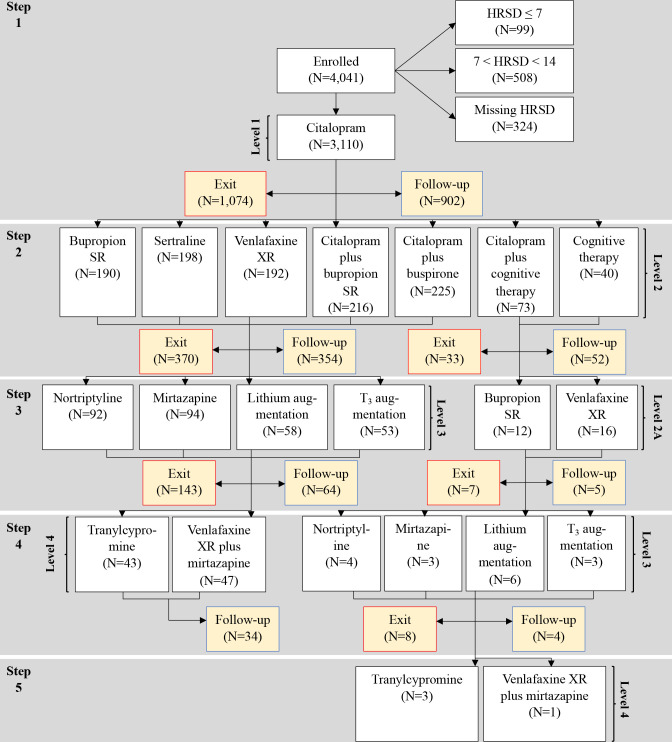
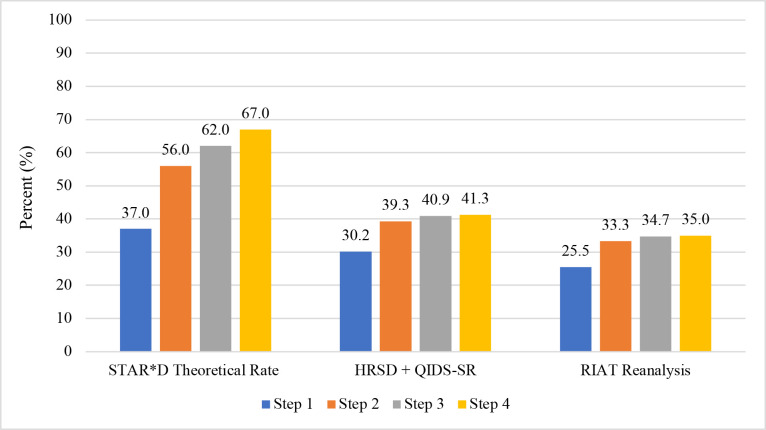
Objective: Reanalyse the patient-level data set of the Sequenced Treatment Alternatives to Relieve Depression (STAR*D) study with fidelity to the original research protocol and related publications. Design: The study was open label and semirandomised examining the effectiveness of up to four optimised and increasingly aggressive, antidepressant therapies in depressed adults. Patients who failed to gain adequate relief from their level 1 trial on the SSRI citalopram could receive up to three additional treatment trials in levels 2–4. Setting: 41 North American psychiatry and primary care treatment centres. Participants: 4041 adults screened positive for major depressive disorder. In contrast to most clinical trials, STAR*D enrolled patients seeking care (vs recruited) and included patients with a wide range of common comorbid medical and psychiatric conditions to enhance the generalisability of findings to real-world clinical practice. Interventions: STAR*D evaluated the relative effectiveness of 13 antidepressants therapies in treatment levels 2–4 for depressed patients who failed to gain adequate benefit from their level 1 medication trial. Main outcome measures: According to the STAR*D protocol, the primary outcome was remission, defined as a score <8 on the blinded Hamilton Rating Scale for Depression (HRSD). Response was a secondary outcome defined as ≥50% reduction in HRSD scores. STAR*D’s protocol specifically excluded all non-blinded clinic-administered assessments from use as research outcome measures. Results: STAR*D investigators did not use the protocol-stipulated HRSD to report cumulative remission and response rates in their summary article and instead used a non-blinded clinic-administered assessment. This inflated their report of outcomes, as did their inclusion of 99 patients who scored as remitted on the HRSD at study outset as well as 125 who scored as remitted when initiating their next-level treatment. These patients should have been excluded from data analysis. In contrast to the STAR*D-reported 67% cumulative remission rate after up to four antidepressant treatment trials, the rate was 35.0% when using the protocol-stipulated HRSD and inclusion in data analysis criteria. Conclusion: STAR*D’s cumulative remission rate was approximately half of that reported.
Overview
The claims and statistics of this paper haven’t been checked yet.
Free: it reads the open-access text and checks the first 5 claims that cite a source we can check. Create a free account to check every claim.
Integrity signals
Registry
Cites
Statistics
Figures
Verification
Claims the paper makes
The claims and statistics of this paper haven’t been checked yet.
Free: it reads the open-access text and checks the first 5 claims that cite a source we can check. Create a free account to check every claim.
Self-check
Percentages, sums and reported differences re-computed from the paper’s own numbers.
The self-check needs the paper’s full text.
Citations
Cites
Rush, A. J., Trivedi, M. H., Wisniewski, S. R., Nierenberg, A. A., Stewart, J. W., Warden, D., Niederehe, G., Thase, M. E., Lavori, P. W., Lebowitz, B. D., et al. (2006) · American Journal of Psychiatry · doi:10.1176/ajp.2006.163.11.1905 · Cited by 5,643
Trivedi, M. H., Rush, A. J., Wisniewski, S. R., Nierenberg, A. A., Warden, D., Ritz, L., Norquist, G., Howland, R. H., Lebowitz, B., McGrath, P. J., et al. (2006) · American Journal of Psychiatry · doi:10.1176/appi.ajp.163.1.28 · Cited by 3,879
Rush, A. J., Trivedi, M. H., Ibrahim, H. M., Carmody, T. J., Arnow, B., Klein, D. N., Markowitz, J. C., Ninan, P. T., Kornstein, S., Manber, R., et al. (2003) · Biological Psychiatry · doi:10.1016/s0006-3223(02)01866-8 · Cited by 3,829 · cited 1×
“Objective Reanalyse the patient-level data set of the Sequenced Treatment Alternatives to Relieve Depression (STAR*D) study with fidelity to the original research protocol and related publications.”
MethodSequenced treatment alternatives to relieve depression (STAR*D): Rationale and design
Rush, A. J., Fava, M., Wisniewski, S. R., Lavori, P. W., Trivedi, M. H., Sackeim, H. A., Thase, M. E., Nierenberg, A. A., Quitkin, F. M., Kashner, T. M., et al. (2004) · Controlled Clinical Trials · doi:10.1016/s0197-2456(03)00112-0 · Cited by 1,076
Bupropion-SR, Sertraline, or Venlafaxine-XR after Failure of SSRIs for Depression
Rush, A. J., Trivedi, M. H., Wisniewski, S. R., Stewart, J. W., Nierenberg, A. A., Thase, M. E., Ritz, L., Biggs, M. M., Warden, D., Luther, J. F., et al. (2006) · New England Journal of Medicine · doi:10.1056/nejmoa052963 · Cited by 1,033
Medication Augmentation after the Failure of SSRIs for Depression
Trivedi, M. H., Fava, M., Wisniewski, S. R., Thase, M. E., Quitkin, F., Warden, D., Ritz, L., Nierenberg, A. A., Lebowitz, B. D., Biggs, M. M., et al. (2006) · New England Journal of Medicine · doi:10.1056/nejmoa052964 · Cited by 1,002
Rush, A. J. (2006) · American Journal of Psychiatry · doi:10.1176/appi.ajp.163.11.1905 · Cited by 870
Nierenberg, A. A., Fava, M., Trivedi, M. H., Wisniewski, S. R., Thase, M. E., McGrath, P. J., Alpert, J. E., Warden, D., Luther, J. F., Niederehe, G., et al. (2006) · American Journal of Psychiatry · doi:10.1176/ajp.2006.163.9.1519 · Cited by 559
Fava, M., Rush, A. J., Trivedi, M. H., Nierenberg, A. A., Thase, M. E., Sackeim, H. A., Quitkin, F. M., Wisniewski, S., Lavori, P. W., Rosenbaum, J. F., et al. (2003) · Psychiatric Clinics of North America · doi:10.1016/s0193-953x(02)00107-7 · Cited by 519
Rush, A. J., Bernstein, I. H., Trivedi, M. H., Carmody, T. J., Wisniewski, S., Mundt, J. C., Shores-Wilson, K., Biggs, M. M., Woo, A., Nierenberg, A. A., et al. (2006) · Biological Psychiatry · doi:10.1016/j.biopsych.2005.08.022 · Cited by 385
Research works printed but not linked: 1
- 18. Pigott HE, Dubin W, Kirsch I, et al. Call to action: RIAT Reanalysis of the sequenced treatment alternatives to relieve depression (STAR*D) study. BMJ March 6, 2019. Available: https://www.bmj.com/content/346/bmj.f2865/rr-10
Cited by
Items 101–118 of 118
Song, M., Xu, P., Shang, J., Guo, Y., Chen, Y., Lv, X., He, W., Zhai, Z., & Zhang, J. (2026) · Progress in Neuro-Psychopharmacology and Biological Psychiatry · doi:10.1016/j.pnpbp.2026.111896
Beer, C., Rae, F., Watt, M., Semmler, A., & Voisey, J. (2026) · International Journal of Molecular Sciences · doi:10.3390/ijms27167329
“…to Relieve Depression (STAR*D study), frequently cited as the definitive real-world effectiveness trial, required four sequential treatment steps to achieve a 67% cumulative remission rate; each switch was accompanied by progressively lower response probabilities and higher dropout from ADRs [10].”
D-cycloserine-augmented SAINT for treatment-resistant depression: A case series
Weber, E. M. M., Nejad, R., Tran, I., Kratter, I. H., Ahmed, M., & Bentzley, B. S. (2026) · Transcranial magnetic stimulation . · doi:10.1016/j.transm.2026.100334
Beyond enrichment: pharmacogenetic heterogeneity in treatment-resistant depression
Roberts, B., Miljevic, A., Hennessy, L. A., Boax, C. A., Hoath, K., Bousman, C., Hood, S. D., & Rodger, J. (2026) · Pharmacogenetics and Genomics · doi:10.1097/fpc.0000000000000621
Roberts, B. (2026) · UWA Profiles and Research Repository (UWA) · doi:10.26182/2sk7-0w50
Constantino, J. L., Jager, J. E. D., Nuninga, J. O., Kamphuis, J., Schoevers, R. A., & van Dalfsen, J. H. (2026) · Psychiatry Research Neuroimaging · doi:10.1016/j.pscychresns.2026.112333
Marchiș, M., Iorga, M., Mihăianu, I.-G., & Apostol, M.-M. (2026) · Brain Sciences · doi:10.3390/brainsci16101004
Syed, O. A., Petranker, R., Nestor, S. M., Husain, M. I., Lipsman, N., Alam, F., Giacobbe, P., Lake, S., & Lucas, P. (2026) · Journal of Psychoactive Drugs · doi:10.1080/02791072.2026.2730550
Analytic Methods for SMART Designs Incorporating Patient Treatment Preferences
Ferlito, S. (2026) · Deep Blue (University of Michigan) · doi:10.7302/dspace/30608
Пойдашева, А. Г., Бакулин, И. С., Супонева, Н. А., & Пирадов, М. А. (2024) · Современная терапия психических расстройств
Beyond reasonable doubt: antidepressants and the limits of scientific critique
Goulder, J. (2026) · Medical History · doi:10.1017/mdh.2026.10090
Murthy, M. K., & Samal, D. (2026) · Journal of Neuroimmune Pharmacology · doi:10.1007/s11481-026-10323-9
Severtson, S. G., Boskovic, D. H., Marci, C. D., Eisenberg, D. F., Abdrabboh, A., & Ardic, F. C. (2026) · Neurology and Therapy · doi:10.1007/s40120-026-01029-4 · Cited by 1
Różne oblicza leków przeciwdepresyjnych
Rybakowski, J. (2026) · Nauka · doi:10.24425/nauka.2026.7494
Rahangdale, A., Ferraro, L., Wood, G., Wadsworth, C., & Venable, E. (2026) · Brain and Behavior · doi:10.1002/brb3.71876
Likić, R., Radanović, I., Rkman, D., Brnić, S., Jacobs, G. E., & Groeneveld, G. J. (2026) · CNS Drugs · doi:10.1007/s40263-026-01346-0
Cunha, M. P., Akhtar, A. S., & Ramos-Hryb, A. B. (2026) · Current Issues in Molecular Biology · doi:10.3390/cimb48111174
Kim, S.-H., & Lee, J. (2026) · European Journal of Integrative Medicine · doi:10.1016/j.eujim.2026.102791
Metadata
- Authors
- Pigott, H. E., Kim, T., Xu, C., Kirsch, I., & Amsterdam, J.
- Affiliations
- None, Wakefield, Rhode Island, USA
- University of Pennsylvania (US)
- Harvard University (US)
- Corresponding author
- Pigott, H Edmund
- Venue
- BMJ Open
- Publisher
- BMJ
- Published
- 2023-07
- Volume
- 13
- Issue
- 7
- Pages
- e063095
- ISSN
- 2044-6055 (ISSN-L)
- PMC
- PMC10373710
- OpenAlex
- W4385257581
- Cited by
- 93
- References
- 35
- Citations by year
- 2026: 35 · 2025: 37 · 2024: 19 · 2023: 2
- FWCI
- 14.64
- Type
- journal article
- Language
- en
- Open access
- gold
- doi.org
- Licence
- Locations
- BMJ Open (publishedVersion, cc-by-nc)
- PubMed Central (publishedVersion, cc-by-nc)
- PubMed (publishedVersion)
- DOAJ (DOAJ: Directory of Open Access Journals) (submittedVersion, cc-by-sa)
- HighWire Press Open Archive (submittedVersion)
- Funders
- The RIAT Support Center (N/A)
- Topics
- Health Sciences › Medicine › Pharmacology (medical) › Treatment of Major Depression
- Health Sciences › Medicine › Psychiatry and Mental health › Mental Health Treatment and Access
- Social Sciences › Psychology › Experimental and Cognitive Psychology › Anxiety, Depression, Psychometrics, Treatment, Cognitive Processes
- Keywords
- major depressive disorder, antidepressant treatment, treatment remission, treatment response, Hamilton Depression Rating Scale, protocol fidelity, selective reporting, citalopram, antidepressant trials, real-world clinical practice
- MeSH terms
- Adult, Antidepressive Agents, Major Depressive Disorder, Depressive Disorder, Major, Humans, Psychotherapy, Citalopram, Treatment Outcome
About these checks
Registry, retraction, Cites and statistics results are computed, not judged, with one exception: a printed reference that no index lists is read once by a model before it counts as a citation error. Claims are extracted by a model and kept only when their quote appears verbatim in the text; each cited source is then checked, with a model’s help, for whether it says what the claim relies on. Those verdicts can be wrong — read the claim’s quote and the cited source before relying on one.
Statistics and arithmetic are recomputed, not judged.
Confidence bands are shown only for fields calibrated on our annotated test set. None is calibrated yet, so no band is shown.
What counts as a claim ›How we measure confidence ›How we check this ›
Are you an author, or do you see a problem with this page? Request a review
Data sources
Bibliographic data: Semantic Scholar, OpenAlex, Crossref.
Contains information from the Semantic Scholar Academic Graph Datasets, made available under the ODC Attribution License (ODC-BY 1.0).
Semantic Scholar’s data is described in: Kinney, R., et al. (2023). The Semantic Scholar Open Data Platform. arXiv:2301.10140.
