

Implemented machine learning tools to inform decision-making for patient care in hospital settings: a scoping review
Open accessThe DOI matches its Crossref record; 37 of the 37 references it cites were found in a registry or an index.
Abstract
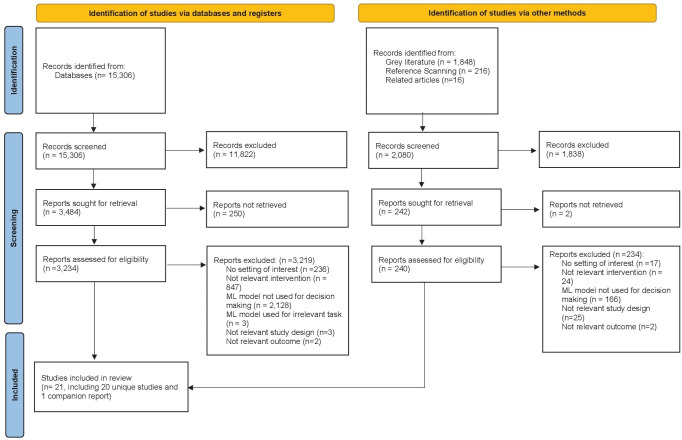
Objectives: To identify ML tools in hospital settings and how they were implemented to inform decision-making for patient care through a scoping review. We investigated the following research questions: What ML interventions have been used to inform decision-making for patient care in hospital settings? What strategies have been used to implement these ML interventions? Design: A scoping review was undertaken. MEDLINE, Embase, Cochrane Central Register of Controlled Trials (CENTRAL) and the Cochrane Database of Systematic Reviews (CDSR) were searched from 2009 until June 2021. Two reviewers screened titles and abstracts, full-text articles, and charted data independently. Conflicts were resolved by another reviewer. Data were summarised descriptively using simple content analysis. Setting: Hospital setting. Participant: Any type of clinician caring for any type of patient. Intervention: Machine learning tools used by clinicians to inform decision-making for patient care, such as AI-based computerised decision support systems or “‘model-based’” decision support systems. Primary and secondary outcome measures: Patient and study characteristics, as well as intervention characteristics including the type of machine learning tool, implementation strategies, target population. Equity issues were examined with PROGRESS-PLUS criteria. Results: After screening 17 386 citations and 3474 full-text articles, 20 unique studies and 1 companion report were included. The included articles totalled 82 656 patients and 915 clinicians. Seven studies reported gender and four studies reported PROGRESS-PLUS criteria (race, health insurance, rural/urban). Common implementation strategies for the tools were clinician reminders that integrated ML predictions (44.4%), facilitated relay of clinical information (17.8%) and staff education (15.6%). Common barriers to successful implementation of ML tools were time (11.1%) and reliability (11.1%), and common facilitators were time/efficiency (13.6%) and perceived usefulness (13.6%). Conclusions: We found limited evidence related to the implementation of ML tools to assist clinicians with patient healthcare decisions in hospital settings. Future research should examine other approaches to integrating ML into hospital clinician decisions related to patient care, and report on PROGRESS-PLUS items. Funding: Canadian Institutes of Health Research (CIHR) Foundation grant awarded to SES and the CIHR Strategy for Patient Oriented-Research Initiative (GSR-154442). Scoping review registration: https://osf.io/e2mna .
Overview
The claims and statistics of this paper haven’t been checked yet.
Free: it reads the open-access text and checks the first 5 claims that cite a source we can check. Create a free account to check every claim.
Integrity signals
Registry
Cites
Statistics
Figures
Verification
Claims the paper makes
The claims and statistics of this paper haven’t been checked yet.
Free: it reads the open-access text and checks the first 5 claims that cite a source we can check. Create a free account to check every claim.
Self-check
Percentages, sums and reported differences re-computed from the paper’s own numbers.
The self-check needs the paper’s full text.
Citations
Cites
The PRISMA 2020 statement: An updated guideline for reporting systematic reviews
Page, M. J., McKenzie, J. E., Bossuyt, P. M., Boutron, I., Hoffmann, T. C., Mulrow, C. D., Shamseer, L., Tetzlaff, J. M., Akl, E. A., Brennan, S. E., et al. (2021) · BMJ · doi:10.1136/bmj.n71 · Cited by 108,283
Self-citationPRISMA Extension for Scoping Reviews (PRISMA-ScR): Checklist and Explanation
Tricco, A. C., Lillie, E., Zarin, W., O'Brien, K. K., Colquhoun, H., Levac, D., Moher, D., Peters, M. D. J., Horsley, T., Weeks, L., et al. (2018) · Annals of Internal Medicine · doi:10.7326/m18-0850 · Cited by 43,565
Self-citationShamseer, L., Moher, D., Clarke, M., Ghersi, D., Liberati, A., Petticrew, M., Shekelle, P., Stewart, L. A., & the PRISMA-P Group (2015) · BMJ · doi:10.1136/bmj.g7647 · Cited by 13,120
Updated methodological guidance for the conduct of scoping reviews
Peters, M. D. J., Marnie, C., Tricco, A. C., Pollock, D., Munn, Z., Alexander, L., McInerney, P., Godfrey, C. M., & Khalil, H. (2020) · JBI Evidence Synthesis · doi:10.11124/jbies-20-00167 · Cited by 9,046
Self-citationDissecting racial bias in an algorithm used to manage the health of populations
Obermeyer, Z., Powers, B., Vogeli, C., & Mullainathan, S. (2019) · Science · doi:10.1126/science.aax2342 · Cited by 7,137 · cited 1×
“It is important to note that the European Union has proposed an Artificial Intelligence Act, 41 which will likely regulate sociotechnical system, and may have implications on AI implementation in health-care settings.”
PRESS Peer Review of Electronic Search Strategies: 2015 Guideline Statement
McGowan, J., Sampson, M., Salzwedel, D. M., Cogo, E., Foerster, V., & Lefebvre, C. (2016) · Journal of Clinical Epidemiology · doi:10.1016/j.jclinepi.2016.01.021 · Cited by 5,700
Self-citationAudit and feedback: effects on professional practice and healthcare outcomes
Ivers, N., Jamtvedt, G., Flottorp, S., Young, J. M., Odgaard-Jensen, J., French, S. D., O'Brien, M. A., Johansen, M., Grimshaw, J., & Oxman, A. D. (2012) · Cochrane Database of Systematic Reviews · doi:10.1002/14651858.cd000259.pub3 · Cited by 5,485 · cited 1×
“It is important to note that the European Union has proposed an Artificial Intelligence Act, 41 which will likely regulate sociotechnical system, and may have implications on AI implementation in health-care settings.”
Lost in knowledge translation: Time for a map?
Graham, I. D., Logan, J., Harrison, M. B., Straus, S. E., Tetroe, J., Caswell, W., & Robinson, N. (2006) · Journal of Continuing Education in the Health Professions · doi:10.1002/chp.47 · Cited by 4,705 · cited 1×
“Implementation science and practice ensures that research results are transferred and used by key knowledge users 11 and has the potential to reduce research waste.”
Self-citationBarocas, S., & Selbst, A. D. (2014) · doi:10.2139/ssrn.2477899 · Cited by 3,048
Updated methodological guidance for the conduct of scoping reviews
Peters, M. D. J., Marnie, C., Tricco, A. C., Pollock, D., Munn, Z., Alexander, L., McInerney, P., Godfrey, C. M., & Khalil, H. (2021) · JBI Evidence Implementation · doi:10.1097/xeb.0000000000000277 · Cited by 1,461
Self-citationIncreasing value and reducing waste: addressing inaccessible research
Chan, A.-W., Song, F., Vickers, A., Jefferson, T., Dickersin, K., Gøtzsche, P. C., Krumholz, H. M., Ghersi, D., & van der Worp, H. B. (2014) · The Lancet · doi:10.1016/s0140-6736(13)62296-5 · Cited by 887
A taxonomy has been developed for outcomes in medical research to help improve knowledge discovery
Dodd, S., Clarke, M., Becker, L., Mavergames, C., Fish, R., & Williamson, P. R. (2018) · Journal of Clinical Epidemiology · doi:10.1016/j.jclinepi.2017.12.020 · Cited by 625 · cited 1×
“23 For patient, clinician and system-level outcomes, a pre-existing framework 24 25 was also used by one reviewer (VN).”
Wijnberge, M., Geerts, B. F., Hol, L., Lemmers, N., Mulder, M. P., Berge, P., Schenk, J., Terwindt, L. E., Hollmann, M. W., Vlaar, A. P., et al. (2020) · JAMA · doi:10.1001/jama.2020.0592 · Cited by 586
How to Read Articles That Use Machine Learning: Users’ Guides to the Medical Literature
Liu, Y., Chen, P.-H. C., Krause, J., & Peng, L. (2019) · JAMA · doi:10.1001/jama.2019.16489 · Cited by 516
Machine learning and neurosurgical outcome prediction: a systematic review
Senders, J. T., Staples, P. C., Karhade, A. V., Zaki, M. M., Gormley, W. B., Broekman, M. L. D., Smith, T. R., & Arnaout, O. (2018) · World Neurosurgery · doi:10.1016/j.wneu.2017.09.149 · Cited by 486 · cited 1×
“To code the implementation strategies, the modified Effective Practice and Organisation of Care (EPOC) classification was used 22 ; descriptions of categories can be found in online supplemental appendix 6.”
Yao, X., Rushlow, D. R., Inselman, J. W., McCoy, R. G., Thacher, T. D., Behnken, E. M., Bernard, M. E., Rosas, S. L., Akfaly, A., Misra, A., et al. (2021) · Nature Medicine · doi:10.1038/s41591-021-01335-4 · Cited by 424
Artificial intelligence and the implementation challenge
Shaw, J., Rudzicz, F., Jamieson, T., & Goldfarb, A. (2019) · Journal of Medical Internet Research · doi:10.2196/13659 · Cited by 389
Artificial intelligence and colonoscopy experience: lessons from two randomised trials
Repici, A., Spadaccini, M., Antonelli, G., Correale, L., Maselli, R., Galtieri, P. A., Pellegatta, G., Capogreco, A., Milluzzo, S. M., Lollo, G., et al. (2022) · Gut · doi:10.1136/gutjnl-2021-324471 · Cited by 248
Whitelaw, S., Pellegrini, D. M., Mamas, M. A., Cowie, M., & Van Spall, H. G. C. (2021) · European Heart Journal - Digital Health · doi:10.1093/ehjdh/ztab005 · Cited by 241 · cited 1×
“23 For patient, clinician and system-level outcomes, a pre-existing framework 24 25 was also used by one reviewer (VN).”
Implementing machine learning in medicine
Verma, A. A., Murray, J., Greiner, R., Cohen, J. P., Shojania, K. G., Ghassemi, M., Straus, S. E., Pou-Prom, C., & Mamdani, M. (2021) · Canadian Medical Association Journal · doi:10.1503/cmaj.202434 · Cited by 136 · cited 1×
“23 For patient, clinician and system-level outcomes, a pre-existing framework 24 25 was also used by one reviewer (VN).”
Self-citationCresswell, K., Callaghan, M., Khan, S., Sheikh, Z., Mozaffar, H., & Sheikh, A. (2020) · Health Informatics Journal · doi:10.1177/1460458219900452 · Cited by 87
Schwartz, J. M., Moy, A. J., Rossetti, S. C., Elhadad, N., & Cato, K. D. (2021) · Journal of the American Medical Informatics Association · doi:10.1093/jamia/ocaa296 · Cited by 83 · cited 1×
“9 This is imperative, as the successful translation of machine learning into hospital systems practice may help to improve the performance of clinical decisions related to diagnosis, prognostics and management, while saving time and improving patient outcomes.”
Burdick, H., Pino, E., Gabel-Comeau, D., McCoy, A., Gu, C., Roberts, J., Le, S., Slote, J., Pellegrini, E., Green-Saxena, A., et al. (2020) · BMJ Health & Care Informatics · doi:10.1136/bmjhci-2019-100109 · Cited by 80
Suri, J. S., Paul, S., Maindarkar, M. A., Puvvula, A., Saxena, S., Saba, L., Turk, M., Laird, J. R., Khanna, N. N., Višković, K., et al. (2022) · Metabolites · doi:10.3390/metabo12040312 · Cited by 66
Jauk, S., Kramer, D., Avian, A., Berghold, A., Leodolter, W., & Schulz, S. (2021) · Journal of Medical Systems · doi:10.1007/s10916-021-01727-6 · Cited by 59
Machine Learning Approach for Preterm Birth Prediction Using Health Records: Systematic Review
Sharifi-Heris, Z., Laitala, J., Airola, A., Rahmani, A. M., & Bender, M. (2022) · JMIR Medical Informatics · doi:10.2196/33875 · Cited by 58
Dexheimer, J. W., Abramo, T. J., Arnold, D. H., Johnson, K. B., Shyr, Y., Ye, F., Fan, K.-H., Patel, N., & Aronsky, D. (2014) · International Journal of Medical Informatics · doi:10.1016/j.ijmedinf.2014.07.008 · Cited by 56
Girolami, I., Pantanowitz, L., Marletta, S., Hermsen, M., van der Laak, J., Munari, E., Furian, L., Vistoli, F., Zaza, G., Cardillo, M., et al. (2022) · Journal of Nephrology · doi:10.1007/s40620-022-01327-8 · Cited by 47 · cited 1×
“The full screening criteria for level 1 and level 2 screening are provided in online supplemental appendices 3 and 4.”
Tricco, A. C., Thomas, S. M., Veroniki, A. A., Hamid, J. S., Cogo, E., Strifler, L., Khan, P. A., Sibley, K. M., Robson, R. C., MacDonald, H. R., et al. (2018) · Age and Ageing · doi:10.1093/ageing/afy219 · Cited by 46
Self-citationYang, X., Mu, D., Peng, H., Li, H., Wang, Y., Wang, P., Wang, Y., & Han, S. (2022) · JMIR Medical Informatics · doi:10.2196/33799 · Cited by 42 · cited 1×
“The full screening criteria for level 1 and level 2 screening are provided in online supplemental appendices 3 and 4.”
Filipow, N., Main, E., Sebire, N. J., Booth, J., Taylor, A. M., Davies, G., & Stanojevic, S. (2022) · BMJ Open Respiratory Research · doi:10.1136/bmjresp-2021-001165 · Cited by 29
Kofoed, K., Falborg, A. Z., Andersen, O., Lisby, G., Paul, M., Leibovici, L., & Andreassen, S. (2008) · Journal of Antimicrobial Chemotherapy · doi:10.1093/jac/dkn504 · Cited by 26
Burdick, H., Pino, E., Gabel-Comeau, D., Gu, C., Huang, H., Lynn-Palevsky, A., & Das, R. (2017) · doi:10.1101/224014 · Cited by 20
Tohidinezhad, F., Perri, D. D., Zegers, C. M. L., Dijkstra, J. B., Anten, M. H. M. E., Dekker, A. L. A. J., van Elmpt, W., Eekers, D. B. P., & Traverso, A. (2022) · Frontiers in Psychology · doi:10.3389/fpsyg.2022.853472 · Cited by 18
Arboe, B., Laub, R. R., Kronborg, G., & Knudsen, J. D. (2014) · International Journal of Infectious Diseases · doi:10.1016/j.ijid.2014.08.019 · Cited by 16
Hassan, A. E., Ringheanu, V. M., Preston, L., & Tekle, W. G. (2021) · Stroke · doi:10.1161/str.52.suppl_1.p248 · Cited by 3 · cited 1×
“It is important to note that the European Union has proposed an Artificial Intelligence Act, 41 which will likely regulate sociotechnical system, and may have implications on AI implementation in health-care settings.”
Tohidinezhad, F., Perri, D. D., Zegers, C. M. L., et al. (2021) · Research Square · doi:10.21203/rs.3.rs-1151996/v1 · Cited by 2
Cited by
Khosravi, M., Zare, Z., Mojtabaeian, S. M., & Izadi, R. (2024) · Health Services Research and Managerial Epidemiology · doi:10.1177/23333928241234863 · Cited by 265
Nair, M., Svedberg, P., Larsson, I., & Nygren, J. M. (2024) · PLOS ONE · doi:10.1371/journal.pone.0305949 · Cited by 179
Sokol, K., Fackler, J., & Vogt, J. E. (2025) · npj Digital Medicine · doi:10.1038/s41746-025-01725-9 · Cited by 105
Preti, L. M., Ardito, V., Compagni, A., Petracca, F., & Cappellaro, G. (2024) · Journal of Medical Internet Research · doi:10.2196/55897 · Cited by 62
“Active involvement of HCPs and frequent communications to raise awareness have been unambiguously identified among the most common enablers of trust in previous reviews on the implementation of ML applications [21,22,74,84].”
Colacci, M., Huang, Y. Q., Postill, G., Zhelnov, P., Fennelly, O., Verma, A. A., Straus, S. E., & Tricco, A. C. (2024) · Journal of Clinical Epidemiology · doi:10.1016/j.jclinepi.2024.111606 · Cited by 72
Self-citation
Metadata
- Authors
- Tricco, A. C., Hezam, A., Parker, A., Nincic, V., Harris, C., Fennelly, O., Thomas, S. M., Ghassemi, M., McGowan, J., Paprica, P. A., & Straus, S. E.
- Affiliations
- St. Michael's Hospital (CA)
- Ollscoil na Gaillimhe – University of Galway (IE)
- University of Ottawa (CA)
- University of Toronto (CA)
- Corresponding author
- Tricco, Andrea C
- ORCID
- Venue
- BMJ Open
- Publisher
- BMJ
- Published
- 2023-02
- Volume
- 13
- Issue
- 2
- Pages
- e065845
- ISSN
- 2044-6055 (ISSN-L)
- PMC
- PMC9906263
- OpenAlex
- W4319344964
- Cited by
- 32
- References
- 37
- Citations by year
- 2026: 11 · 2025: 12 · 2024: 7 · 2023: 2
- FWCI
- 1.26
- Type
- journal article
- Language
- en
- Open access
- gold
- doi.org
- Licence
- Locations
- BMJ Open (publishedVersion, cc-by-nc)
- PubMed Central (publishedVersion, cc-by-nc)
- PubMed (publishedVersion)
- DOAJ (DOAJ: Directory of Open Access Journals) (submittedVersion, cc-by-sa)
- Lenus, The Irish Health Repository (Dr Steevens Hospital Library) (submittedVersion, cc-by-nc)
- Funders
- HSC Public Health Agency (CBES-2018-001)
- Health Research Board (Not Available)
- Canadian Institutes of Health Research (GSR-154442, Not Available)
- Tier 2 Canada Research Chair in Knowledge Synthesis (17-0126-AWA)
- Tier 1 Canada Research Chair in Knowledge Translation (17-0245-SUB)
- Topics
- Health Sciences › Medicine › Health Informatics › Artificial Intelligence in Healthcare and Education
- Health Sciences › Health Professions › Health Information Management › Artificial Intelligence in Healthcare
- Health Sciences › Health Professions › Health Information Management › Electronic Health Records Systems
- Keywords
- machine learning, artificial intelligence, clinical decision support systems, model-based decision support, implementation strategies, implementation barriers and facilitators, health equity, hospital patient care
- MeSH terms
- Canada, Patient Care, Hospitals, Humans, Reproducibility of Results
About these checks
Registry, retraction, Cites and statistics results are computed, not judged, with one exception: a printed reference that no index lists is read once by a model before it counts as a citation error. Claims are extracted by a model and kept only when their quote appears verbatim in the text; each cited source is then checked, with a model’s help, for whether it says what the claim relies on. Those verdicts can be wrong — read the claim’s quote and the cited source before relying on one.
Statistics and arithmetic are recomputed, not judged.
Confidence bands are shown only for fields calibrated on our annotated test set. None is calibrated yet, so no band is shown.
What counts as a claim ›How we measure confidence ›How we check this ›
Are you an author, or do you see a problem with this page? Request a review
Data sources
Bibliographic data: Semantic Scholar, OpenAlex, Crossref.
Contains information from the Semantic Scholar Academic Graph Datasets, made available under the ODC Attribution License (ODC-BY 1.0).
Semantic Scholar’s data is described in: Kinney, R., et al. (2023). The Semantic Scholar Open Data Platform. arXiv:2301.10140.
