

Trajectory, healthcare utilisation and recovery in 3590 individuals with long covid: a 4-year prospective cohort analysis
Open accessThe DOI matches its Crossref record; 41 of the 41 references it cites were found in a registry or an index; none of the 32 sources its claims cite is checked for support yet.
Abstract
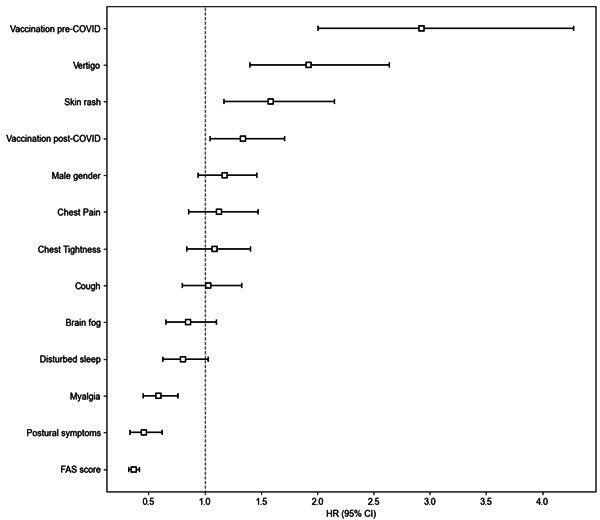
Objective: To characterise long-term trajectory of recovery in individuals with long covid. Design: Prospective cohort. Setting: Single-centre, specialist post-COVID service (London, UK). Participants: Individuals aged ≥18 years with long covid (hospitalised and non-hospitalised) from April 2020 to March 2024. Main outcome measures: Routine, prospectively collected data on symptoms, quality of life (including Fatigue Assessment Scale (FAS) and EuroQol 5 Dimensions (EQ-5D), return to work status and healthcare utilisation (investigations, outpatient and emergency attendances). The primary outcome was recovery by self-reported >75% of ‘best health’ (EQ-5D Visual Analogue Scale) and was assessed using Cox proportional hazards regression models over 4 years. Linked National Health Service England registry data provided secondary care healthcare utilisation and expenditure. Results: We included 3590 individuals (63.3% female, 73.5% non-hospitalised, median age 50.0 years, 71.9% with ≥2 doses of COVID-19 vaccination), who were followed up for a median of 136 (0–346) days since first assessment and 502 (251–825) days since symptom onset. At first assessment, 33.2% of employed individuals were unable to work. Dominant symptoms were fatigue (78.7%), breathlessness (68.1%) and brain fog (53.5%). 33.4% of individuals recovered to >75% of best health prior to clinic discharge (recovery occurred median 202 (94–468) days from symptom onset). Vaccinated individuals were more likely to recover faster (pre: HR 2.93 (2.00–4.28) and post: HR 1.34 (1.05–1.71) COVID-19 infection), whereas recovery hazard was inversely associated with FAS (HR 0.37 (0.33–0.42)), myalgia (HR 0.59 (0.45–0.76)) and dysautonomic symptoms (HR 0.46 (0.34–0.62)). There was high secondary care healthcare utilisation (both emergency and outpatient care). Annual inpatient and outpatient expenditure was significantly lower in hospitalised individuals while under the service. When compared with the prereferral period, emergency department attendances were reduced in non-hospitalised patients with long covid, but outpatient costs increased. Conclusions: In the largest long covid cohort from a single specialist post-COVID service to date, only one-third of individuals under follow-up achieved satisfactory recovery. Fatigue severity and COVID-19 vaccination at presentation, even after initial COVID-19 infection, was associated with long covid recovery. Ongoing service provision for this and other post-viral conditions is necessary to support care, progress treatment options and provide capacity for future pandemic preparedness. Research and clinical services should emphasise these factors as the strongest predictors of non-recovery.
Overview
CoChat Summary
TL;DR
In a 4-year prospective single-centre cohort of 3590 adults with long covid, only 33.4% recovered to >75% of best health, with fatigue severity and dysautonomia/myalgia inversely associated with recovery and COVID-19 vaccination associated with faster recovery. Healthcare utilisation was high, with reduced emergency department attendances in non-hospitalised patients after service access but increased outpatient costs.
Key findings
- Of 3590 individuals (63.3% female, 73.5% non-hospitalised, median age 50.0 years), 33.4% recovered to >75% of best health prior to clinic discharge; median time from symptom onset to recovery was 202 (94–468) days. Recovery was 47.0% in post-hospitalised vs 28.4% in non-hospitalised individuals.
- At first assessment, 33.2% of employed individuals were unable to work; dominant symptoms were fatigue (78.7%), breathlessness (68.1%) and brain fog (53.5%).
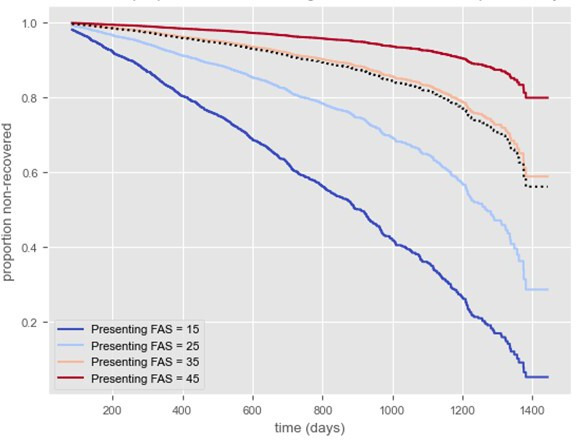
- Vaccination before COVID-19 infection (HR 2.93, 95% CI 2.00–4.28) and after infection (HR 1.34, 95% CI 1.05–1.71) were associated with faster recovery; higher FAS (HR 0.37, 95% CI 0.33–0.42), myalgia (HR 0.59, 95% CI 0.45–0.76) and postural/dysautonomic symptoms (HR 0.46, 95% CI 0.34–0.62) were inversely associated with recovery.
- After long covid service access, emergency department attendances fell by 0.44 per year (p<0.001), saving £64 per person, while outpatient attendances rose by 0.95 (p<0.001) with increased cost of £187 (p<0.001); in post-hospitalised individuals annual inpatient cost fell by £675 (p=0.028) and outpatient cost by £195 (p=0.002).
Methods
- Prospective longitudinal cohort at the University College London Hospitals specialist post-COVID service, London, UK; adults aged ≥18 years with long covid (hospitalised and non-hospitalised) presenting from 1 April 2020 to 31 March 2024; routine electronic health record and patient questionnaire data, with linked NHS England long covid registry data for secondary care healthcare utilisation.
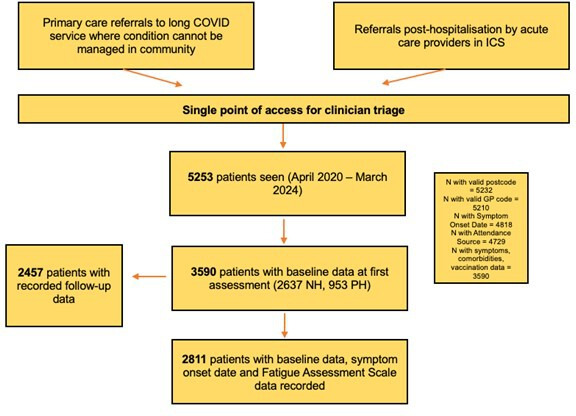
- Primary outcome was self-reported >75% of best health on the EQ-5D Visual Analogue Scale; Cox proportional hazards models stratified by hospitalisation status and age group (18–44, 45–64, 65+) were used in 2811 individuals with valid FAS score and symptom onset date. Healthcare utilisation was analysed with Wilcoxon signed-rank tests and multiple linear regression, standardised to the pre-COVID period.
Limitations
- Stated: single-centre cohort with severe long covid requiring specialist care may affect generalisability, with possible framing effect; unable to fully exclude bias toward greater illness severity with longer follow-up and bias against those recovering before initial assessment; no matched comparison with patients with other diseases; considerable missingness in key follow-up parameters limited more sophisticated statistical techniques.
- Evident from the text: observational routine-care design without a control group, so causal effects of vaccination or service access cannot be established; healthcare utilisation analyses had limited sociodemographic explanatory variables available.
Model-written summary. Check it against the paper before relying on it.
Integrity signals
Registry
Cites
Statistics
Figures
Verification
Claims the paper makes
0 Valid · 0 Not valid · 24 Not checked · 77 Own results and interpretations
A result the paper reports from its own data — it cites no other source for it, so there is none to check. The quote shows it is in the paper.
In the paper
“Median symptom onset to recovery (defined as self-reported ≥75% of best health) was 202 (94–468) days: higher in NH than PH (p<0.001)(table 3).”
§ Trajectory, healthcare utilisation and recovery in 3590 individuals with long covid: a 4-year prospective cohort analysis > RESULTS > Functional recovery
plain- Asserted: passes — The authors put it forward as true.
- Checkable: passes — It can be checked against evidence.
- Load-bearing: passes — The paper’s conclusions depend on it.
- Based: passes — The paper gives a reason why it holds.
A result the paper reports from its own data — it cites no other source for it, so there is none to check. The quote shows it is in the paper.
In the paper
“77.6% reported <75% of ‘best health’ (mean ‘best health’: PH 65.0% vs NH 50.0%).”
§ Trajectory, healthcare utilisation and recovery in 3590 individuals with long covid: a 4-year prospective cohort analysis > RESULTS > Symptom burden
plain- Asserted: passes — The authors put it forward as true.
- Checkable: passes — It can be checked against evidence.
- Load-bearing: unclear — It is unclear whether the paper’s conclusions depend on it.
- Based: passes — The paper gives a reason why it holds.
A result the paper reports from its own data — it cites no other source for it, so there is none to check. The quote shows it is in the paper.
In the paper
“Initial symptom frequency was similar across variants (online supplemental figure S2 and S3).”
§ Trajectory, healthcare utilisation and recovery in 3590 individuals with long covid: a 4-year prospective cohort analysis > RESULTS > Symptom burden
plain- Asserted: passes — The authors put it forward as true.
- Checkable: passes — It can be checked against evidence.
- Load-bearing: unclear — It is unclear whether the paper’s conclusions depend on it.
- Based: passes — The paper gives a reason why it holds.
A result the paper reports from its own data — it cites no other source for it, so there is none to check. The quote shows it is in the paper.
In the paper
“Median symptom onset to recovery (defined as self-reported ≥75% of best health) was 202 (94–468) days: higher in NH than PH (p<0.001)(table 3).”
§ Trajectory, healthcare utilisation and recovery in 3590 individuals with long covid: a 4-year prospective cohort analysis > RESULTS > Functional recovery
plainstates an association- Asserted: passes — The authors put it forward as true.
- Checkable: passes — It can be checked against evidence.
- Load-bearing: passes — The paper’s conclusions depend on it.
- Based: passes — The paper gives a reason why it holds.
A result the paper reports from its own data — it cites no other source for it, so there is none to check. The quote shows it is in the paper.
In the paper
“Overall, median reported FAS was 33 (25–39) at first appointment, compared with 31 (24–39) at the last assessment.”
§ Trajectory, healthcare utilisation and recovery in 3590 individuals with long covid: a 4-year prospective cohort analysis > RESULTS > Functional recovery
plainn = 2,266- Asserted: passes — The authors put it forward as true.
- Checkable: passes — It can be checked against evidence.
- Load-bearing: unclear — It is unclear whether the paper’s conclusions depend on it.
- Based: passes — The paper gives a reason why it holds.
35 more claims
Create a free account to see all 101 claims and to verify the 32 references still open.
- It may state two separate claims as one. 42
- Probably not a substantial claim. 29
- The quote only partly states this claim. 1
Claims other papers make about this one
Each is checked against this paper’s own text: does it say what the citing paper says it does?
In the citing paper
“Usual care was NHS guideline-based specialist LC care, including clinical assessment and investigations, self-management, multidisciplinary rehabilitation for support with symptoms and pacing and ongoing community support44–46.”
From Integrated care pathway in individuals with Long COVID: STIMULATE-ICP, a cluster-randomized, phase 3 trial (2026) · cites this paper as [45]
In the citing paper
“Prior COVID-19 hospitalization was an exclusion, to focus on nonhospitalized individuals (that is, those individuals who were not hospitalized with their initial COVID-19 illness) with higher burden and healthcare utilization44,45.”
From Integrated care pathway in individuals with Long COVID: STIMULATE-ICP, a cluster-randomized, phase 3 trial (2026) · cites this paper as [45]
Self-check
Percentages, sums and reported differences re-computed from the paper’s own numbers.
Each contradiction between two passages listed here was confirmed by an independent check.
Rated minor: it would not touch a result — a value no result rests on, a p-value that stays on the same side of the significance level, or a conflict that is clerical, resolved elsewhere in the paper, or outside its own findings.
In the paper
“| Black | 240 (6.7%) | 125 (13.1%) | 115 (4.4%) | <0.001 | | White | 1626 (45.3%) | 386 (40.5%) | 1240 (47.0%) | 0.010 | | Asian | 306 (8.5%) | 119 (12.5%) | 187 (7.1%) | <0.001 | | Other | 233 (6.5%) | 87 (9.1%) | 146 (5.5%) | <0.001 | | Mixed | 98 (2.7%) | 23 (2.4%) | 75 (2.8%) | 0.490 | | Unknown | 1025 (28.6%)”
§ Trajectory, healthcare utilisation and recovery in 3590 individuals with long covid: a 4-year prospective cohort analysis > METHODS > Data sources
Reported 3590 · recomputed 3528
Rated minor: it would not touch a result — a value no result rests on, a p-value that stays on the same side of the significance level, or a conflict that is clerical, resolved elsewhere in the paper, or outside its own findings.
In the paper
§ Trajectory, healthcare utilisation and recovery in 3590 individuals with long covid: a 4-year prospective cohort analysis > RESULTS > Functional recovery
“increased median best health (n=2456; 50.0% (30.0%–65.0%) to 57.0% (36.0%–75.0%), Cohen’s d=0.219) from first to last assessment in followed-up individuals”
§ Trajectory, healthcare utilisation and recovery in 3590 individuals with long covid: a 4-year prospective cohort analysis > RESULTS > Functional recovery
“| Completeness | 2637 (100.0) | 1877 (71.2) | | 953 (100.0) | 559 (58.7) | | 3590 (100.0) | 2436 (67.9) | |”
Citations
Cites
EQ-SD: a measure of health status from the EuroQol Group
Rabin, R., & Charro, F. D. (2001) · Annals of Medicine · doi:10.3109/07853890109002087 · Cited by 5,613
Long COVID: major findings, mechanisms and recommendations
Davis, H. E., McCorkell, L., Vogel, J. M., & Topol, E. J. (2023) · Nature Reviews Microbiology · doi:10.1038/s41579-022-00846-2 · Cited by 4,153
Characterising long COVID: a living systematic review
Michelen, M., Manoharan, L., Elkheir, N., Cheng, V., Dagens, A., Hastie, C., O'Hara, M., Suett, J., Dahmash, D., Bugaeva, P., et al. (2021) · BMJ Global Health · doi:10.1136/bmjgh-2021-005427 · Cited by 960
Long COVID after breakthrough SARS-CoV-2 infection
Al-Aly, Z., Bowe, B., & Xie, Y. (2022) · Nature Medicine · doi:10.1038/s41591-022-01840-0 · Cited by 866
Psychometric qualities of a brief self-rated fatigue measure
Michielsen, H. J., De Vries, J., & Van Heck, G. L. (2003) · Journal of Psychosomatic Research · doi:10.1016/s0022-3999(02)00392-6 · Cited by 860
Long COVID burden and risk factors in 10 UK longitudinal studies and electronic health records
Thompson, E. J., Williams, D. M., Walker, A. J., Mitchell, R. E., Niedzwiedz, C. L., Yang, T. C., Huggins, C. F., Kwong, A. S. F., Silverwood, R. J., Di Gessa, G., et al. (2022) · Nature Communications · doi:10.1038/s41467-022-30836-0 · Cited by 600
Risks and burdens of incident diabetes in long COVID: a cohort study
Xie, Y., & Al-Aly, Z. (2022) · The Lancet Diabetes & Endocrinology · doi:10.1016/s2213-8587(22)00044-4 · Cited by 564
Effect of covid-19 vaccination on long covid: systematic review
Byambasuren, O., Stehlik, P., Clark, J., Alcorn, K., & Glasziou, P. (2023) · BMJ Medicine · doi:10.1136/bmjmed-2022-000385 · Cited by 338
Nolan, C. M., Longworth, L., Lord, J., Canavan, J. L., Jones, S. E., Kon, S. S. C., & Man, W. D.-C. (2016) · Thorax · doi:10.1136/thoraxjnl-2015-207782 · Cited by 300
Knight, R., Walker, V., Ip, S., Cooper, J. A., Bolton, T., Keene, S., Denholm, R., Akbari, A., Abbasizanjani, H., Torabi, F., et al. (2022) · Circulation · doi:10.1161/circulationaha.122.060785 · Cited by 292
Three-year outcomes of post-acute sequelae of COVID-19
Cai, M., Xie, Y., Topol, E. J., & Al-Aly, Z. (2024) · Nature Medicine · doi:10.1038/s41591-024-02987-8 · Cited by 254
Hou, Y., Gu, T., Ni, Z., Shi, X., Ranney, M. L., & Mukherjee, B. (2025) · Open Forum Infectious Diseases · doi:10.1093/ofid/ofaf533 · Cited by 211
Interventions for the management of long covid (post-covid condition): living systematic review
Zeraatkar, D., Ling, M., Kirsh, S., Jassal, T., Shahab, M., Movahed, H., Talukdar, J. R., Walch, A., Chakraborty, S., Turner, T., et al. (2024) · BMJ · doi:10.1136/bmj-2024-081318 · Cited by 148
Walker, S., Goodfellow, H., Pookarnjanamorakot, P., Murray, E., Bindman, J., Blandford, A., Bradbury, K., Cooper, B., Hamilton, F. L., Hurst, J. R., et al. (2023) · BMJ Open · doi:10.1136/bmjopen-2022-069217 · Cited by 129
Parker, M., Sawant, H. B., Flannery, T., Tarrant, R., Shardha, J., Bannister, R., Ross, D. H., Halpin, S. J., Greenwood, D. C., & Sivan, M. (2022) · Journal of Medical Virology · doi:10.1002/jmv.28373 · Cited by 118
Heightman, M., Prashar, J., Hillman, T. E., Marks, M., Livingston, R., Ridsdale, H. A., Roy, K., Bell, R., Zandi, M., McNamara, P., et al. (2021) · BMJ Open Respiratory Research · doi:10.1136/bmjresp-2021-001041 · Cited by 110
Self-citationTaquet, M., Skorniewska, Z., Hampshire, A., Chalmers, J. D., Ho, L.-P., Horsley, A., Marks, M., Poinasamy, K., Raman, B., Leavy, O. C., et al. (2023) · Nature Medicine · doi:10.1038/s41591-023-02525-y · Cited by 94
Sivan, M., Preston, N., Parkin, A., Makower, S., Gee, J., Ross, D., Tarrant, R., Davison, J., Halpin, S., O'Connor, R. J., et al. (2022) · Journal of Medical Virology · doi:10.1002/jmv.27878 · Cited by 94
Scott, H. R., Stevelink, S. A. M., Gafoor, R., Lamb, D., Carr, E., Bakolis, I., Bhundia, R., Docherty, M. J., Dorrington, S., Gnanapragasam, S., et al. (2023) · The Lancet Psychiatry · doi:10.1016/s2215-0366(22)00375-3 · Cited by 82
Mateu, L., Tebe, C., Loste, C., Santos, J. R., Lladós, G., López, C., España-Cueto, S., Toledo, R., Font, M., Chamorro, A., et al. (2023) · The Lancet Regional Health - Europe · doi:10.1016/j.lanepe.2023.100724 · Cited by 82
Gorst, S. L., Seylanova, N., Dodd, S. R., Harman, N. L., O'Hara, M., Terwee, C. B., Williamson, P. R., Needham, D. M., Munblit, D., Nicholson, T. R., et al. (2023) · The Lancet Respiratory Medicine · doi:10.1016/s2213-2600(23)00370-3 · Cited by 65
Possible long COVID healthcare pathways: a scoping review
Wolf, S., Zechmeister‐Koss, I., & Erdös, J. (2022) · BMC Health Services Research · doi:10.1186/s12913-022-08384-6 · Cited by 64
Data to knowledge to improvement: creating the learning health system
McDonald, P. L., Foley, T. J., Verheij, R., Braithwaite, J., Rubin, J., Harwood, K., Phillips, J., Gilman, S., & van der Wees, P. J. (2024) · BMJ · doi:10.1136/bmj-2023-076175 · Cited by 59
Vyas, J., Muirhead, N., Singh, R., Ephgrave, R., & Finlay, A. Y. (2022) · BMJ Open · doi:10.1136/bmjopen-2021-058128 · Cited by 59
Effectiveness of COVID-19 vaccines to prevent long COVID: data from Norway
Trinh, N. T., Jödicke, A. M., Català, M., Mercadé-Besora, N., Hayati, S., Lupattelli, A., Prieto-Alhambra, D., & Nordeng, H. M. (2024) · The Lancet Respiratory Medicine · doi:10.1016/s2213-2600(24)00082-1 · Cited by 58
Healthcare utilisation in people with long COVID: an OpenSAFELY cohort study
Lin, L.-Y., Henderson, A. D., Carlile, O., Dillingham, I., Butler-Cole, B. F. C., Marks, M., Briggs, A. H., Jit, M., Tomlinson, L. A., Bates, C., et al. (2024) · BMC Medicine · doi:10.1186/s12916-024-03477-x · Cited by 52
Multidisciplinary Center Care for Long COVID Syndrome-A Retrospective Cohort Study
Bailey, J., Lavelle, B., Miller, J., Jimenez, M., Lim, P. H., Orban, Z. S., Clark, J. R., Tomar, R., Ludwig, A., Ali, S. T., et al. (2025) · The American Journal of Medicine · doi:10.1016/j.amjmed.2023.05.002 · Cited by 44
Changing health related quality of life and outcomes in heart failure by age, sex and subtype
Lawson, C. A., Benson, L., Squire, I., Zaccardi, F., Ali, M., Hand, S., Kadam, U., Tay, W. T., Dahlstrom, U., Lund, L. H., et al. (2023) · eClinicalMedicine · doi:10.1016/j.eclinm.2023.102217 · Cited by 40
Mechanisms of Pulmonary Vasculopathy in Acute and Long-Term COVID-19: A Review
Riou, M., Coste, F., Meyer, A., Enache, I., Talha, S., Charloux, A., Reboul, C., & Geny, B. (2024) · International Journal of Molecular Sciences · doi:10.3390/ijms25094941 · Cited by 33
Mu, Y., Dashtban, A., Mizani, M. A., Tomlinson, C., Mohamed, M., Ashworth, M. J., Mamas, M. A., Priedon, R., Petersen, S. E., Kontopantelis, E., et al. (2024) · Journal of the Royal Society of Medicine · doi:10.1177/01410768241288345 · Cited by 30
Self-citationBlankestijn, J. M., Abdel‐Aziz, M. I., Baalbaki, N., Bazdar, S., Beekers, I., Beijers, R. J. H. C. G., Bloemsma, L. D., Cornelissen, M. E. B., Gach, D., Houweling, L., et al. (2024) · BMJ Open Respiratory Research · doi:10.1136/bmjresp-2023-001907 · Cited by 23
What is current care for people with Long COVID in England? A qualitative interview study
Sunkersing, D., Ramasawmy, M., Alwan, N. A., Clutterbuck, D., Mu, Y., Horstmanshof, K., Banerjee, A., & Heightman, M. (2024) · BMJ Open · doi:10.1136/bmjopen-2023-080967 · Cited by 23
Self-citationResendez, S., Brown, S. H., Ruiz Ayala, H. S., Rangan, P., Nebeker, J., Montella, D., & Elkin, P. L. (2024) · JMIR Public Health and Surveillance · doi:10.2196/49841 · Cited by 13
Ramasawmy, M., Mu, Y., Clutterbuck, D., Pantelic, M., Lip, G. Y. H., van der Feltz-Cornelis, C., Wootton, D., Williams, N. H., Montgomery, H., Mallinson Cookson, R., et al. (2022) · PLOS ONE · doi:10.1371/journal.pone.0271978 · Cited by 12
Self-citationDarbyshire, J., Greenhalgh, T., Bakerly, N. D., Balasundaram, K., Baley, S., Ball, M., Bullock, E., Cooper, R., Davies, H., De Kock, J. H., et al. (2024) · Clinical Medicine · doi:10.1016/j.clinme.2024.100237 · Cited by 12
The Alfred Health post‐COVID‐19 service, Melbourne, 2020–2022: an observational cohort study
Holland, A. E., Fineberg, D., Marceau, T., Chong, M., Beaman, J., Wilson, L., Buchanan, J., Uren, J., Dal Corso, S., Lannin, N. A., et al. (2024) · Medical Journal of Australia · doi:10.5694/mja2.52192 · Cited by 11
Post-COVID care delivery: The experience from an Irish tertiary centre’s post-COVID clinic
Heeney, A., Connolly, S. P., Dillon, R. I., O’Donnell, A. T., McSweeney, T., O’Kelly, B., Cotter, A. G., Sheehan, G., Lambert, J. S., Muldoon, E. G., et al. (2023) · PLoS ONE · doi:10.1371/journal.pone.0289245 · Cited by 9
Research across multiple disciplines to respond to health shocks
Banerjee, A., Coulter, A., Goenka, S., Hollis, A., & Majeed, A. (2024) · BMJ · doi:10.1136/bmj-2023-078445 · Cited by 7
Self-citationCollins, E., Galipeau, Y., Arnold, C. R., Bhéreur, A., Booth, R. A., Buchan, A. C., Cooper, C., Crawley, A. M., McCluskie, P. S., McGuinty, M., et al. (2024) · Frontiers in Public Health · doi:10.3389/fpubh.2024.1276391 · Cited by 6
A New Professional Society for Post-COVID Condition and Other Post-Viral Conditions
Sivan, M., & Heightman, M. (2024) · Advances in Rehabilitation Science and Practice · doi:10.1177/27536351241231351 · Cited by 3
Self-citation
Cited by
Wall, E. C., Prescott, G., Dehbi, H., Scott, J., Evans, R. A., Horstmanshof, K., Watkins, C. L., Heightman, M., Banerjee, A., Adams-Heath, C., et al. (2026) · The Lancet Infectious Diseases · doi:10.1016/s1473-3099(26)00242-2 · Cited by 7
Self-citationBian, C., Shen, Q., Liu, X.-X., Zhou, M., Ren, Z., Dong, Z., Jin, X., Song, B., & Li, B. (2026) · American Journal of Cardiovascular Drugs · doi:10.1007/s40256-026-00794-9 · Cited by 2
Physiotherapy management of long COVID in adults
Nygren‐Bonnier, M., & Holland, A. E. (2026) · Journal of physiotherapy · doi:10.1016/j.jphys.2026.03.001 · Cited by 1
Sweetman, J., & STIMULATE-ICP Consortium (2026) · White Rose Research Online (University of Leeds, The University of Sheffield, University of York) · Cited by 1
STIMULATE-ICP Consortium, Writing Group, Banerjee, A., Prescott, G., Wall, E., Watkins, C. L., Heightman, M., Consortium, Gibbon, A., Butt, A.-T., et al. (2026) · Nature Medicine · doi:10.1038/s41591-026-04552-x
Self-citation
Metadata
- Authors
- Prashar, J., Hillman, T., Wall, E. C., Sarna, A., Mi, E., Bell, R., Sahota, J., Zandi, M., McNamara, P., Livingston, R., Gore, R., Lunken, C., Bax, E., Nyam, R., Rafie Manzelat, A. M., Hishmeh, L., Attree, E., Cone, S., Banerjee, A., & Heightman, M.
- Affiliations
- University College London Hospitals NHS Foundation Trust (GB)
- University of Oxford (GB)
- UCL Queen Square Institute of Neurology (GB)
- University College London Hospitals NHS Foundation Trust, London, England, UK
- Long Covid SOS, London, UK
- Ridgmount Practice, London, UK
- Corresponding author
- Banerjee, Amitava
- ORCID
- Venue
- BMJ Open
- Publisher
- BMJ
- Published
- 2026-01
- Volume
- 16
- Issue
- 1
- Pages
- e103884
- ISSN
- 2044-6055 (ISSN-L)
- PMC
- PMC12815175
- OpenAlex
- W7124217711
- Cited by
- 10
- References
- 40
- Citations by year
- 2026: 10
- FWCI
- 24.05
- Type
- journal article
- Language
- en
- Open access
- gold
- doi.org
- Locations
- BMJ Open (publishedVersion, cc-by)
- PubMed Central (publishedVersion, cc-by)
- Oxford University Research Archive (ORA) (University of Oxford) (publishedVersion)
- PubMed (publishedVersion)
- DOAJ (DOAJ: Directory of Open Access Journals) (submittedVersion)
- Funders
- UCLH Biomedical Research Centre
- UCL Hospitals Charitable Foundation
- Programme Grants for Applied Research (COV-LT2-0043)
- Topics
- Health Sciences › Medicine › Clinical Neurology › Long-Term Effects of COVID-19
- Health Sciences › Medicine › Infectious Diseases › COVID-19 Clinical Research Studies
- Health Sciences › Medicine › Clinical Neurology › Traumatic Brain Injury Research
- Keywords
- long COVID, health care utilization, return to work, fatigue, quality of life, COVID-19 vaccination, health care expenditure, myalgia, brain fog, dyspnea
- MeSH terms
- COVID-19, SARS-CoV-2, Post-Acute COVID-19 Syndrome, Adult, Aged, Fatigue, Female, Hospitalization, Humans, London, Male, Middle Aged, Patient Acceptance of Health Care, Prospective Studies, Quality of Life, Return to Work
About these checks
Registry, retraction, Cites and statistics results are computed, not judged, with one exception: a printed reference that no index lists is read once by a model before it counts as a citation error. Claims are extracted by a model and kept only when their quote appears verbatim in the text; each cited source is then checked, with a model’s help, for whether it says what the claim relies on. Those verdicts can be wrong — read the claim’s quote and the cited source before relying on one.
A language model drew the claims from the paper on 2026-11-28, under version 3 of the claim definition (model deepseek-v4.1-flash, prompt extract-v3).
A second model labelled each claim on 2026-11-28 (model jev-1.13-20260917, definition revision gold-guideline-v0.2).
Statistics and arithmetic are recomputed, not judged.
Confidence bands are shown only for fields calibrated on our annotated test set. None is calibrated yet, so no band is shown.
What counts as a claim ›How we measure confidence ›How we check this ›
Are you an author, or do you see a problem with this page? Request a review
Data sources
Bibliographic data: Semantic Scholar, OpenAlex, Crossref.
Contains information from the Semantic Scholar Academic Graph Datasets, made available under the ODC Attribution License (ODC-BY 1.0).
Semantic Scholar’s data is described in: Kinney, R., et al. (2023). The Semantic Scholar Open Data Platform. arXiv:2301.10140.
