

Improving care collaboration for NICU patients to decrease length of stay and readmission rate
Open accessThe DOI matches its Crossref record; 17 of the 17 references it cites were found in a registry or an index.
Abstract
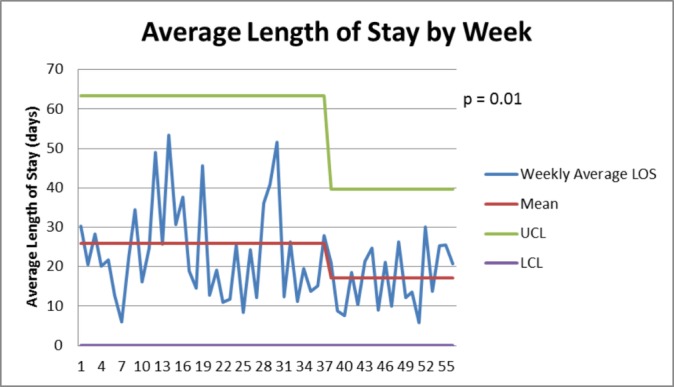
Background: Medically complex patients in neonatal intensive care units (NICUs) typically require long hospitalisations and care from multiple subspecialists. Scheduled multidisciplinary discussions could improve collaboration and continuity of care and thereby improve patient outcomes. The specific aims of the project were to decrease the average length of hospitalisation by at least 1 day and improve parent satisfaction ratings on a standard questionnaire by the end of our project’s first year, and to maintain a stable (or decreased) cause-related (30-day) readmission rate. Methods: We designed a quality improvement project to enhance collaboration and continuity of care for medically complex infants cared for in the NICU of Brenner Children’s Hospital. Weekly multidisciplinary team meetings were held to discuss the long-term plan for patients who met specific criteria. Attendees included attending neonatologists, paediatric surgeons, a physical therapist, an occupational therapist, a speech therapist, a social worker, a nurse coordinator for palliative care, a family support coordinator, the NICU Nurse Manager, a hospital chaplain, mid-level providers, bedside nurses, a nurse quality improvement leader and the leaders and database manager for the quality improvement project. When needed for specific patients, a bioethicist was included. Results: One year after implementing the project, the average duration of hospitalisation had decreased by 6.5 days. Cause-related readmission rates decreased from 3.33% to 0.95%. Parent satisfaction scores did not change significantly. Conclusions: Weekly multidisciplinary meetings to coordinate and provide continuity of care for medically complex neonates in our NICU was associated with improved patient outcomes.
Overview
The claims and statistics of this paper haven’t been checked yet.
Free: it reads the open-access text and checks the first 5 claims that cite a source we can check. Create a free account to check every claim.
Integrity signals
Registry
Cites
Statistics
Figures
Verification
Claims the paper makes
The claims and statistics of this paper haven’t been checked yet.
Free: it reads the open-access text and checks the first 5 claims that cite a source we can check. Create a free account to check every claim.
Claims other papers make about this one
Each is checked against this paper’s own text: does it say what the citing paper says it does?
The source backs part of the claim, not all of it — or backs it for a different population, condition or comparison.
In the citing paper
“A lack of continuity of care post-discharge can negatively impact patient outcomes and parent well-being.20”
From Coached, Coordinated, Enhanced Neonatal Transition (CCENT): Protocol for a multicentre pragmatic randomised controlled trial of transition-to-home support for parents of high-risk infants (2021) · cites this paper as [20]
Experimental — accuracy not yet measured
Self-check
Percentages, sums and reported differences re-computed from the paper’s own numbers.
The self-check needs the paper’s full text.
Citations
Cites
Leonard, M. (2004) · BMJ Quality & Safety · doi:10.1136/qhc.13.suppl_1.i85 · Cited by 2,322
Zwarenstein, M., Goldman, J., & Reeves, S. (2009) · Cochrane Database of Systematic Reviews · doi:10.1002/14651858.cd000072.pub2 · Cited by 1,177 · cited 3×
“Intervention The primary component of the intervention is a weekly 1-hour multidisciplinary meeting of health professionals at which medically complex neonates are discussed throughout their hospital course with the purpose of (1) identifying and removing barriers to progression of care and discharge and (2) arranging…”
BackgroundIncreasing Prevalence of Medically Complex Children in US Hospitals
Burns, K. H., Casey, P. H., Lyle, R. E., Bird, T. M., Fussell, J. J., & Robbins, J. M. (2010) · Pediatrics · doi:10.1542/peds.2009-1658 · Cited by 421
Gordon, J. B., Colby, H. H., Bartelt, T., Jablonski, D., Krauthoefer, M. L., & Havens, P. (2007) · Archives of Pediatrics & Adolescent Medicine · doi:10.1001/archpedi.161.10.937 · Cited by 221
Berry, J. G., Agrawal, R., Kuo, D. Z., Cohen, E., Risko, W., Hall, M., Casey, P., Gordon, J., & Srivastava, R. (2011) · The Journal of Pediatrics · doi:10.1016/j.jpeds.2011.02.002 · Cited by 220
Hospital Discharge of the High-Risk Neonate—Proposed Guidelines
Committee on Fetus and Newborn (1998) · Pediatrics · doi:10.1542/peds.102.2.411 · Cited by 162
Smith, V. C., Hwang, S. S., Dukhovny, D., Young, S., & Pursley, D. M. (2013) · Journal of Perinatology · doi:10.1038/jp.2013.23 · Cited by 141
How to facilitate parents and their premature infant for the transition home
Brødsgaard, A., & Wagner, L. (2005) · International Nursing Review · doi:10.1111/j.1466-7657.2005.00414.x · Cited by 133
NIC/Q 2000: Establishing Habits for Improvement in Neonatal Intensive Care Units
Horbar, J. D., Plsek, P. E., & Leahy, K. (2003) · PEDIATRICS · doi:10.1542/peds.111.se1.e397 · Cited by 133
Are Hospital Characteristics Associated With Parental Views of Pediatric Inpatient Care Quality?
Co, J. P. T., Ferris, T. G., Marino, B. L., Homer, C. J., & Perrin, J. M. (2003) · Pediatrics · doi:10.1542/peds.111.2.308 · Cited by 92
Research works printed but not linked: 1
- 10.1136/qshc.2004.010033 · DOI · Paper page
Cited by
Kourouma, K. R., Agbré-Yacé, M. L., Doukouré, D., Cissé, L., Some-Méazieu, C., Ouattara, J., Tano-Kamelan, A., & Kouakou, V. K. (2021) · BMC Health Services Research · doi:10.1186/s12913-021-07086-9 · Cited by 46
“In a study conducted in the United States, weekly multidisciplinary meetings to coordinate and provide continuity of care for medically complex neonates in a NICU was associated with improved patient outcomes [45].”
BackgroundSafety climate, safety climate strength, and length of stay in the NICU
Tawfik, D. S., Thomas, E. J., Vogus, T. J., Liu, J. B., Sharek, P. J., Nisbet, C. C., Lee, H. C., Sexton, J. B., & Profit, J. (2019) · BMC Health Services Research · doi:10.1186/s12913-019-4592-1 · Cited by 30
Decision-maker roles in healthcare quality improvement projects: a scoping review
Gagnon, J., Breton, M., & Gaboury, I. (2024) · BMJ Open Quality · doi:10.1136/bmjoq-2023-002522 · Cited by 41
Pediatric continuity care intensivist: A randomized controlled trial
Madrigal, V., Walter, J. K., Sachs, E., Himebauch, A. S., Kubis, S., & Feudtner, C. (2018) · Contemporary Clinical Trials · doi:10.1016/j.cct.2018.11.011 · Cited by 28
The Child With Severe Chronic Illness in the ICU: A Concise Review
Edwards, J. D., & Goodman, D. M. (2022) · Critical Care Medicine · doi:10.1097/ccm.0000000000005512 · Cited by 23
Metadata
- Authors
- Welch, C. D., Check, J., & O’Shea, T. M.
- Affiliations
- Atrium Health Wake Forest Baptist (US)
- University of North Carolina at Chapel Hill (US)
- Corresponding author
- Check, Jennifer
- Venue
- BMJ Open Quality
- Publisher
- BMJ
- Published
- 2017-10
- Volume
- 6
- Issue
- 2
- Pages
- e000130
- ISSN
- 2399-6641 (ISSN-L)
- PMC
- PMC5699126
- OpenAlex
- W2766771457
- Cited by
- 34
- References
- 17
- Citations by year
- 2026: 2 · 2025: 3 · 2024: 3 · 2023: 5 · 2022: 6 · 2021: 9 · 2020: 1 · 2019: 4 · 2018: 1
- FWCI
- 1.79
- Type
- journal article
- Language
- en
- Open access
- gold
- doi.org
- Licence
- cc-by-nc
- Locations
- BMJ Open Quality (publishedVersion, cc-by-nc)
- Europe PMC (PubMed Central) (publishedVersion, cc-by-nc)
- PubMed Central (publishedVersion, cc-by-nc)
- PubMed (publishedVersion)
- Topics
- Health Sciences › Medicine › Pediatrics, Perinatology and Child Health › Infant Development and Preterm Care
- Health Sciences › Health Professions › General Health Professions › Interprofessional Education and Collaboration
- Health Sciences › Nursing › Leadership and Management › Hospital Admissions and Outcomes
- Keywords
- neonatal intensive care, multidisciplinary team meetings, continuity of care, length of hospital stay, 30-day readmission, parental satisfaction, care coordination, quality improvement
About these checks
Registry, retraction, Cites and statistics results are computed, not judged, with one exception: a printed reference that no index lists is read once by a model before it counts as a citation error. Claims are extracted by a model and kept only when their quote appears verbatim in the text; each cited source is then checked, with a model’s help, for whether it says what the claim relies on. Those verdicts can be wrong — read the claim’s quote and the cited source before relying on one.
Statistics and arithmetic are recomputed, not judged.
Confidence bands are shown only for fields calibrated on our annotated test set. None is calibrated yet, so no band is shown.
What counts as a claim ›How we measure confidence ›How we check this ›
Are you an author, or do you see a problem with this page? Request a review
How to cite
Cite CoChat for the checks on this page, and the paper for its own findings.
- This page
- CoChat. (2026). Citation check: Improving care collaboration for NICU patients to decrease length of stay and readmission rate. https://app.cochat.ai/papers/10.1136/bmjoq-2017-000130
- The paper
- Welch, C. D., Check, J., & O’Shea, T. M. (2017). Improving care collaboration for NICU patients to decrease length of stay and readmission rate. BMJ Open Quality. https://doi.org/10.1136/bmjoq-2017-000130
Data sources
Bibliographic data: Semantic Scholar, OpenAlex, Crossref.
Contains information from the Semantic Scholar Academic Graph Datasets, made available under the ODC Attribution License (ODC-BY 1.0).
Semantic Scholar’s data is described in: Kinney, R., et al. (2023). The Semantic Scholar Open Data Platform. arXiv:2301.10140.
