

Scoping review of balanced scorecards for use in healthcare settings: development and implementation
Open accessThe DOI matches its Crossref record; 61 of the 61 references it cites were found in a registry or an index.
Abstract
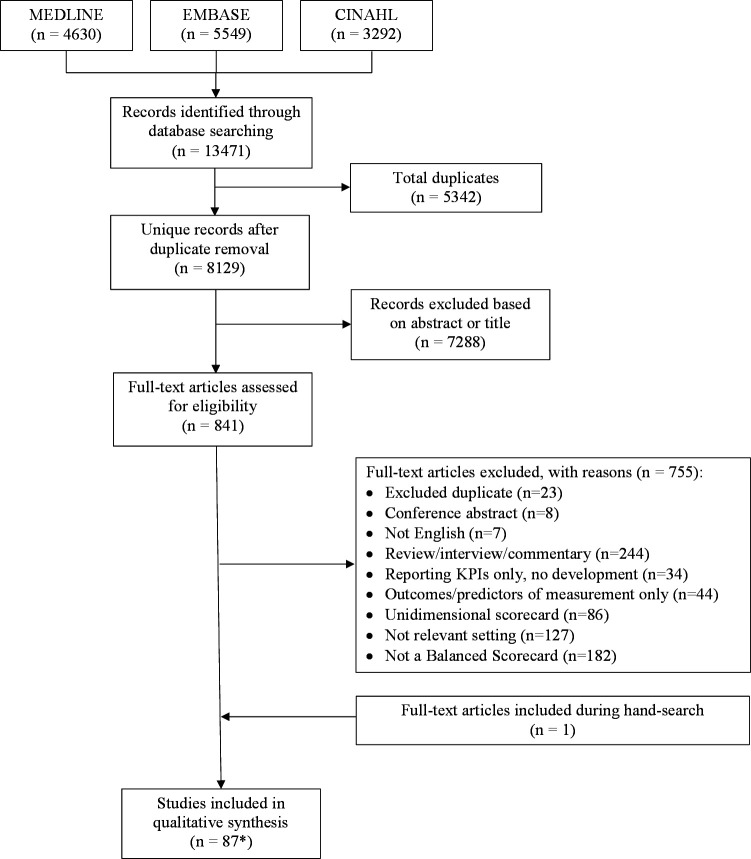
Objective: Balanced scorecards (BSCs) were developed in the early 1990s in corporate settings as a strategic performance management tool that emphasised measurement from multiple perspectives. Since their introduction, BSCs have been adapted for a variety of industries, including to healthcare settings. The aim of this scoping review was to describe the application of BSCs in healthcare. Methods: Medline, Embase and CINHAL databases were searched using keywords and medical subject headings for ‘balanced scorecard’ and related terms from 1992 to 17/04/2020. Title and abstract screening and full text review were conducted in duplicate by two reviewers. Studies describing the development and/or implementation of a BSC in a healthcare setting were included. Data were abstracted using pilot-tested forms and reviewed for key themes and findings. Results: 8129 records were identified and 841 underwent a full text review. 87 articles were included. Over 26 countries were represented and the majority of BSCs were applied at a local level (54%) in hospital settings (41%). While almost all discussed Kaplan and Norton’s original BSC (97%), only 69% described alignment with a strategic plan. Patients/family members were rarely involved in development teams (3%) which typically were comprised of senior healthcare leaders/administrators. Only 21% of BSCs included perspectives using identical formatting to the original BSC description. Lessons learnt during development addressed three main themes: scorecard design, stakeholder engagement and feasibility. Conclusions: BSC frameworks have been used in various healthcare settings but frequently undergo adaptation from the original description in order to suit a specific healthcare context. Future BSCs should aim to include patients/families to promote patient-centred healthcare systems. Considering the heterogeneity evident in development approaches, methodological guidance in this area is warranted.
Overview
The claims and statistics of this paper haven’t been checked yet.
Free: it reads the open-access text and checks the first 5 claims that cite a source we can check. Create a free account to check every claim.
Integrity signals
Registry
Cites
Statistics
Figures
Verification
Claims the paper makes
The claims and statistics of this paper haven’t been checked yet.
Free: it reads the open-access text and checks the first 5 claims that cite a source we can check. Create a free account to check every claim.
Claims other papers make about this one
Each is checked against this paper’s own text: does it say what the citing paper says it does?
The cited source says what the claim attributes to it.
In the citing paper
“a recent review [46] identifies that, even though needed, “the patients are not engaged to support patient and family-centered care”.”
From The Evolution of Balanced Scorecard in Healthcare: A Systematic Review of Its Design, Implementation, Use, and Review (2022) · cites this paper as [46]
The cited source says what the claim attributes to it.
In the citing paper
“Recently, other literature reviews [46,47] emphasized the importance of stakeholder engagement.”
From The Evolution of Balanced Scorecard in Healthcare: A Systematic Review of Its Design, Implementation, Use, and Review (2022) · cites this paper as [46]
The cited source says what the claim attributes to it.
In the citing paper
“papers based on review [36,46,47,71,72] represent 30.8% of the total in the last five years, whilst before (1999–2016) the papers analyzed based on review were the 11.5% of the total.”
From The Evolution of Balanced Scorecard in Healthcare: A Systematic Review of Its Design, Implementation, Use, and Review (2022) · cites this paper as [46]
The cited source says what the claim attributes to it.
In the citing paper
“Additionally, leadership has been identified by many studies as a driver for the implementation of the BSC [46,61].”
From The Evolution of Balanced Scorecard in Healthcare: A Systematic Review of Its Design, Implementation, Use, and Review (2022) · cites this paper as [46]
In the citing paper
“BSC is frequently used in healthcare as a framework for quality improvement (Bohm et al., 2021).”
From Systems Perspective of the Use of the Balanced Scorecard for Organization Development and Change (2023) · cites this paper as Bohm et al., 2021
1 more claim about this paper
Create a free account to see every claim other papers make about this one.
Self-check
Percentages, sums and reported differences re-computed from the paper’s own numbers.
The self-check needs the paper’s full text.
Citations
Cites
Using thematic analysis in psychology
Braun, V., & Clarke, V. (2006) · Qualitative Research in Psychology · doi:10.1191/1478088706qp063oa · Cited by 194,414
PRISMA Extension for Scoping Reviews (PRISMA-ScR): Checklist and Explanation
Tricco, A. C., Lillie, E., Zarin, W., O'Brien, K. K., Colquhoun, H., Levac, D., Moher, D., Peters, M. D. J., Horsley, T., Weeks, L., et al. (2018) · Annals of Internal Medicine · doi:10.7326/m18-0850 · Cited by 43,565
The balanced scorecard : measures that drive performance
Caplan, R. S. (1992) · Harvard business review · Cited by 12,085
Crossing the Quality Chasm: A New Health System for the 21st Century
Baker, A. (2001) · BMJ · doi:10.1136/bmj.323.7322.1192 · Cited by 10,736
The balanced scorecard: Translating strategy into action
(1997) · Long Range Planning · doi:10.1016/s0024-6301(97)80925-9 · Cited by 8,192
(1992) · PubMed · Cited by 7,979
(2020) · JBI Manual for Evidence Synthesis · doi:10.46658/jbimes-20-12 · Cited by 2,545
Peters, M., Godfrey, C., McInerney, P., Munn, Z., Tricco, A., & Khalil, H. (2019) · JBI Reviewer's Manual · doi:10.46658/jbirm-20-01 · Cited by 2,222
The Values and Value of Patient-Centered Care
Epstein, R. M., & Street, R. L. (2011) · The Annals of Family Medicine · doi:10.1370/afm.1239 · Cited by 1,956
Patient-Centered Approaches to Health Care: A Systematic Review of Randomized Controlled Trials
McMillan, S. S., Kendall, E., Sav, A., King, M. A., Whitty, J. A., Kelly, F., & Wheeler, A. J. (2013) · Medical Care Research and Review · doi:10.1177/1077558713496318 · Cited by 339
Research works printed but not linked: 3
- Sugarman PA, Watkins J. Balancing the scorecard: key performance indicators in a complex healthcare setting. Clinician in Management 2004; 12: 129– 32.
- McLean SR, Mahaffey SM. Implementing a surgical balanced scorecard. Surgical Services Management 2000; 6: 43– 7.
- What is Patient-Centered Care?: NEJM Catalyst Innovations in Healthcare; 2017. Available: https://catalyst.nejm.org/doi/full/10.1056/CAT.17.0559 [Accessed 3 July 2020]. · doi:10.1056/cat.17.0559
Cited by
Assessing Digital Transformation of Cost Accounting Tools in Healthcare
Vărzaru, A. A. (2022) · International Journal of Environmental Research and Public Health · doi:10.3390/ijerph192315572 · Cited by 68
Amer, F., Hammoud, S., Khatatbeh, H., Lohner, S., Boncz, I., & Endrei, D. (2022) · BMC Health Services Research · doi:10.1186/s12913-021-07452-7 · Cited by 63
Amer, F., Hammoud, S., Khatatbeh, H., Lohner, S., Boncz, I., & Endrei, D. (2022) · BMC Health Services Research · doi:10.1186/s12913-022-07863-0 · Cited by 58
Betto, F., Sardi, A., Garengo, P., & Sorano, E. (2022) · International Journal of Environmental Research and Public Health · doi:10.3390/ijerph191610291 · Cited by 49
“Recently, other literature reviews [46,47] emphasized the importance of stakeholder engagement.”
BackgroundInfluentialVărzaru, A. A. (2022) · International Journal of Environmental Research and Public Health · doi:10.3390/ijerph192215155 · Cited by 48
Metadata
- Authors
- Bohm, V., Lacaille, D., Spencer, N., & Barber, C. E.
- Affiliations
- University of Calgary (CA)
- University of British Columbia (CA)
- Corresponding author
- Barber, Claire EH
- Venue
- BMJ Open Quality
- Publisher
- BMJ
- Published
- 2021-07
- Volume
- 10
- Issue
- 3
- Pages
- e001293
- ISSN
- 2399-6641 (ISSN-L)
- PMC
- PMC8273481
- OpenAlex
- W3179812932
- Semantic Scholar
- 04a87df79698e51b761eb8a3545e3d3f82661ab5
- Cited by
- 59
- References
- 61
- Citations by year
- 2026: 9 · 2025: 7 · 2024: 16 · 2023: 11 · 2022: 15 · 2021: 1
- FWCI
- 3.07
- Type
- journal article
- Language
- en
- Open access
- gold
- doi.org
- Licence
- Locations
- BMJ Open Quality (publishedVersion, cc-by-nc)
- PubMed Central (publishedVersion, cc-by-nc)
- PubMed (publishedVersion)
- DOAJ (DOAJ: Directory of Open Access Journals) (submittedVersion, cc-by-sa)
- Funders
- Canadian Institutes of Health Research (Project Grant PJT 153265)
- Topics
- Social Sciences › Business, Management and Accounting › Accounting › Accounting and Organizational Management
- Health Sciences › Medicine › Public Health, Environmental and Occupational Health › Healthcare Quality and Management
- Health Sciences › Health Professions › General Health Professions › Patient Satisfaction in Healthcare
- Keywords
- balanced scorecard, strategic planning, stakeholder engagement, patient and family involvement, hospital management, patient-centered care, strategic alignment
- MeSH terms
- Stakeholder Participation, Delivery of Health Care, Hospitals, Humans
About these checks
Registry, retraction, Cites and statistics results are computed, not judged, with one exception: a printed reference that no index lists is read once by a model before it counts as a citation error. Claims are extracted by a model and kept only when their quote appears verbatim in the text; each cited source is then checked, with a model’s help, for whether it says what the claim relies on. Those verdicts can be wrong — read the claim’s quote and the cited source before relying on one.
Statistics and arithmetic are recomputed, not judged.
Confidence bands are shown only for fields calibrated on our annotated test set. None is calibrated yet, so no band is shown.
What counts as a claim ›How we measure confidence ›How we check this ›
Are you an author, or do you see a problem with this page? Request a review
Data sources
Bibliographic data: Semantic Scholar, OpenAlex, Crossref.
Contains information from the Semantic Scholar Academic Graph Datasets, made available under the ODC Attribution License (ODC-BY 1.0).
Semantic Scholar’s data is described in: Kinney, R., et al. (2023). The Semantic Scholar Open Data Platform. arXiv:2301.10140.
