

The DOI matches its Crossref record.
Effectiveness of an artificial intelligence clinical assistant decision support system to improve the incidence of hospital-associated venous thromboembolism: a prospective, randomised controlled study
Open accessPublished version of a preprint
Abstract
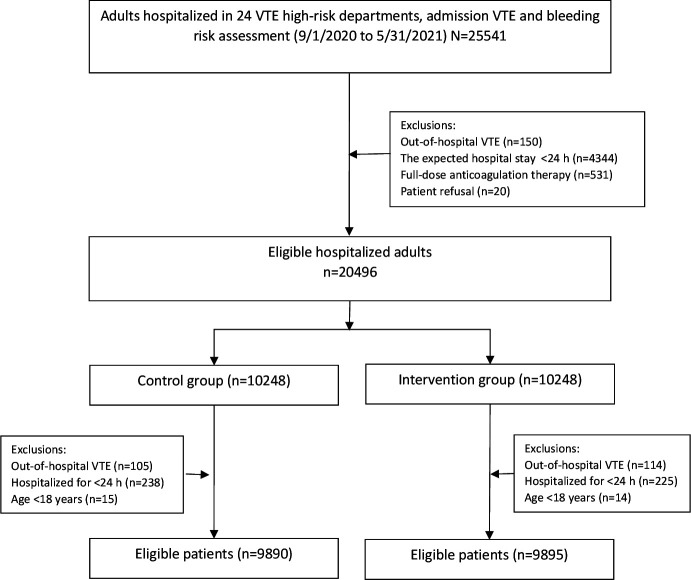
Background: Thromboprophylaxis has been determined to be safe, effective and cost-effective for hospitalised patients at venous thromboembolism (VTE) risk. However, Chinese medical institutions have not yet fully used or improperly used thromboprophylaxis. The effectiveness of information technology applied to thromboprophylaxis in hospitalised patients has been proved in many retrospective studies, lacking of prospective research evidence. Methods: All hospitalised patients aged >18 years not discharged within 24 hours from 1 September 2020 to 31 May 2021 were prospectively enrolled. Patients were randomly assigned to the control (9890 patients) or intervention group (9895 patients). The control group implemented conventional VTE prevention programmes; the intervention group implemented an Artificial Intelligence Clinical Assistant Decision Support System (AI-CDSS) on the basis of conventional prevention. Intergroup demographics, disease status, hospital length of stay (LOS), VTE risk assessment and VTE prophylaxis were compared using the χ 2 test, Fisher’s exact test, t-test or Wilcoxon rank-sum test. Univariate and multivariate logistic regressions were used to explore the risk factor of VTE. Results: The control and intervention groups had similar baseline characteristics. The mean age was 58.32±15.41 years, and mean LOS was 7.82±7.07 days. In total, 5027 (25.40%) and 2707 (13.67%) patients were assessed as having intermediate-to-high VTE risk and high bleeding risk, respectively. The incidence of hospital-associated VTE (HA-VTE) was 0.38%, of which 86.84% had deep vein thrombosis. Compared with the control group, the incidence of HA-VTE decreased by 46.00%, mechanical prophylaxis rate increased by 24.00% and intensity of drug use increased by 9.72% in the intervention group. However, AI-CDSS use did not increase the number of clinical diagnostic tests, prophylaxis rate or appropriate prophylaxis rate. Conclusions: Thromboprophylaxis is inadequate in hospitalised patients with VTE risk. The role of AI-CDSS in VTE risk management is unknown and needs further in-depth study. Trial registration number: ChiCTR2000035452.
Overview
The claims and statistics of this paper haven’t been checked yet.
Run the check — free, no account needed. It reads the open-access text and checks the sources it cites.
Integrity signals
Registry
Cites
Statistics
Figures
Verification
Claims the paper makes
The claims and statistics of this paper haven’t been checked yet.
Run the check — free, no account needed. It reads the open-access text and checks the sources it cites.
Claims other papers make about this one
Each is checked against this paper’s own text: does it say what the citing paper says it does?
The cited source doesn’t support the claim as written.
In the citing paper
“Huang et al. (78) proposed a system known as Artificial Intelligence Clinical Assistant Decision Support System (AI-CDSS) for preventing thromboembolic events; however, the tool was found to be ineffective.”
From Artificial intelligence in healthcare: transforming patient safety with intelligent systems—A systematic review (2025) · cites this paper as [78]
Checked by a reasoning model — may be wrong.
Experimental — accuracy not yet measured
Self-check
Percentages, sums and reported differences re-computed from the paper’s own numbers.
The self-check needs the paper’s full text.
Citations
Cites
No references could be resolved yet.
Research works printed but not linked: 29
- Kahn, 2018, Interventions for implementation of thromboprophylaxis in hospitalized patients at risk for venous thromboembolism, Cochrane Database Syst Rev, 4
- 10.1161/CIRCRESAHA.115.306841 · DOI
- 10.1136/bmjqs-2012-001748 · DOI
- 10.1097/01.sla.0000193959.44677.48 · DOI
- 10.1200/JCO.2005.04.2150 · DOI
- 10.1378/chest.11-2301 · DOI
- Khan, 2021, Venous thromboembolism, Lancet, 398, 64, 10.1016/S0140-6736(20)32658-1 · DOI
- Zhang, 2019, Trends in hospitalization and in-hospital mortality from VTE 2007 to 2016, Chest, 155, 342, 10.1016/j.chest.2018.10.040 · DOI
- 10.1001/archinte.162.11.1245 · DOI
- Chen, 2015, Prognostic significance of arterial and venous thrombosis in resected specimens for non-small cell lung cancer, Thromb Res, 136, 451, 10.1016/j.thromres.2015.06.014 · DOI
- Zhang, 2016, Hypertension associated with venous thromboembolism in patients with newly diagnosed lung cancer, Sci Rep, 6, 19603, 10.1038/srep19603 · DOI
- 10.1161/01.CIR.0000046771.12875.6C · DOI
- 10.1038/nrcardio.2015.83 · DOI · Paper page
- Liew, 2017, Asian venous thromboembolism guidelines: updated recommendations for the prevention of venous thromboembolism, Int Angiol, 36, 1, 10.23736/S0392-9590.16.03765-2 · DOI
- Hansrani, 2017, The prevention of venous thromboembolism in surgical patients, Adv Exp Med Biol, 906, 1
- 10.1378/chest.11-2404 · DOI
- 10.1378/chest.11-2296 · DOI
- 2018, Chinese guidelines for the prevention and treatment of thrombotic diseases, Chin Med J (Engl), 98, 2861
- Yang, 2011, Pulmonary embolism incidence and fatality trends in Chinese hospitals from 1997 to 2008: a multicenter registration study, PLOS ONE, 6, 10.1371/journal.pone.0026861 · DOI
- Zhou, 2021, A retrospective study on the effectiveness of artificial intelligence-based clinical decision support system (AI-CDSS) to improve the incidence of hospital-related venous thrombosis embolism (VTE), Ann Transl Med, 9, 10.21037/atm-21-1093 · DOI
- 10.1378/chest.11-2289 · DOI
- 10.1056/NEJMoa041533 · DOI
- Zhai, 2019, VTE risk profiles and prophylaxis in medical and surgical Inpatients: the identification of Chinese hospitalized patients' risk profile for venous thromboembolism (Dissolve-2)-a cross-sectional study, Chest, 155, 114, 10.1016/j.chest.2018.09.020 · DOI
- 10.1016/S0140-6736(08)60202-0 · DOI
- 10.1177/1076029612474840w · DOI
- Skeik, 2020, Recommendations for VTE prophylaxis in medically ill patients, Ann Vasc Dis, 13, 38, 10.3400/avd.ra.19-00115 · DOI
- Dong, 2020, Effect on thromboprophylaxis among hospitalized patients using a system-wide Multifaceted quality improvement intervention: rationale and design for a multicenter cluster randomized clinical trial in China, Am Heart J, 225, 44, 10.1016/j.ahj.2020.04.020 · DOI
- Parikh, 2012, Venous thromboembolism prophylaxis in medical ICU patients in Asia (VOICE Asia): a multicenter, observational, cross-sectional study, Thromb Res, 129, e152, 10.1016/j.thromres.2012.01.012 · DOI
- Wang, 2020, The effect of physician educational intervention on venous thromboembolism pharmacological prophylaxis in medical Inpatients from the respiratory department: a retrospective cohort study, Ann Palliat Med, 9, 3966, 10.21037/apm-20-1833 · DOI
Cited by
Sorted by citations
De Micco, F., Di Palma, G., Ferorelli, D., De Benedictis, A., Tomassini, L., Tambone, V., Cingolani, M., & Scendoni, R. (2025) · Frontiers in Medicine · doi:10.3389/fmed.2024.1522554 · Cited by 58
Metadata
- Authors
- Huang, X., Zhou, S., Ma, X., Jiang, S., Xu, Y., You, Y., Qu, J., Shang, H., & Lu, Y.
- Affiliations
- Shanghai Jiao Tong University (CN)
- National Health Commission of the People's Republic of China (CN)
- Solution Center For Quality Improvement, Beijing Huimei Cloud Technology Co. Ltd, Beijing, China
- Shanghai First People's Hospital (CN)
- Shanghai Venous Thromboembolism Alliance, Shanghai, China
- Corresponding author
- Shang, Hanbing
- Venue
- BMJ Open Quality
- Publisher
- BMJ
- Published
- 2023-10
- Volume
- 12
- Issue
- 4
- Pages
- e002267
- ISSN
- 2399-6641 (ISSN-L)
- PMC
- PMC10582876
- OpenAlex
- W4387618747
- Cited by
- 29
- References
- 0
- Citations by year
- 2026: 14 · 2025: 7 · 2024: 8
- FWCI
- 7.01
- Type
- journal article
- Language
- en
- Open access
- gold
- doi.org
- Licence
- Locations
- BMJ Open Quality (publishedVersion, cc-by-nc)
- Research Square (acceptedVersion, cc-by)
- PubMed Central (publishedVersion, cc-by-nc)
- PubMed (publishedVersion)
- DOAJ (DOAJ: Directory of Open Access Journals) (submittedVersion, cc-by-sa)
- HighWire Press Open Archive (submittedVersion)
- Funders
- Suzhou Cooperative Medical and Health Foundation Research Fund for Prevention and Treatment of Venous Thromboembolism (P089)
- the Science and Technology Innovation Project of Shanghai Jiao Tong University School of Medicine (WK2110)
- 2022 Huangpu District Health Commission policy research research projects (HLY202201)
- Hospital Management Research Project of Shanghai Hospital Association (X2022143 and Q2022063)
- 2022 Health Policy Research Project of Shanghai Municipal Health Commission (2022HP64)
- Shanghai 2023 "Science and Technology Innovation Action Plan" Science Popularization Special Project (23DZ2301400)
- Topics
- Health Sciences › Medicine › Internal Medicine › Venous Thromboembolism Diagnosis and Management
- Health Sciences › Health Professions › Health Information Management › Electronic Health Records Systems
- Health Sciences › Medicine › Health Informatics › Artificial Intelligence in Healthcare and Education
- Keywords
- artificial intelligence, clinical decision support systems, venous thromboembolism, thromboprophylaxis, hospital-acquired venous thromboembolism, deep vein thrombosis, hospitalized patients, mechanical prophylaxis, VTE risk assessment, bleeding risk, VTE risk factors, length of hospital stay, Chinese hospitals, information technology
- MeSH terms
- Adult, Aged, Anticoagulants, Artificial Intelligence, Hospitals, Humans, Middle Aged, Prospective Studies, Retrospective Studies, Incidence, Venous Thromboembolism
About these checks
Registry, retraction, Cites and statistics results are computed, not judged, with one exception: a printed reference that no index lists is read once by a model before it counts as a citation error. Claims are extracted by a model and kept only when their quote appears verbatim in the text; each cited source is then checked, with a model’s help, for whether it says what the claim relies on. Those verdicts can be wrong — read the claim’s quote and the cited source before relying on one.
Statistics and arithmetic are recomputed, not judged.
Confidence bands are shown only for fields calibrated on our annotated test set. None is calibrated yet, so no band is shown.
What counts as a claim ›How we measure confidence ›How we check this ›
Are you an author, or do you see a problem with this page? Request a review
How to cite
Cite CoChat for the checks on this page, and the paper for its own findings.
- This page
- CoChat. (2026). Citation check: Effectiveness of an artificial intelligence clinical assistant decision support system to improve the incidence of hospital-associated venous thromboembolism: a prospective, randomised controlled study. https://app.cochat.ai/papers/10.1136/bmjoq-2023-002267
- The paper
- Huang, X., Zhou, S., Ma, X., Jiang, S., Xu, Y., You, Y., Qu, J., Shang, H., & Lu, Y. (2023). Effectiveness of an artificial intelligence clinical assistant decision support system to improve the incidence of hospital-associated venous thromboembolism: a prospective, randomised controlled study. BMJ Open Quality. https://doi.org/10.1136/bmjoq-2023-002267
