

The DOI matches its Crossref record; 50 of the 51 references it cites were found in a registry or an index.
Determining the role of sport coaches in promoting athlete mental health: a narrative review and Delphi approach
Open accessAbstract
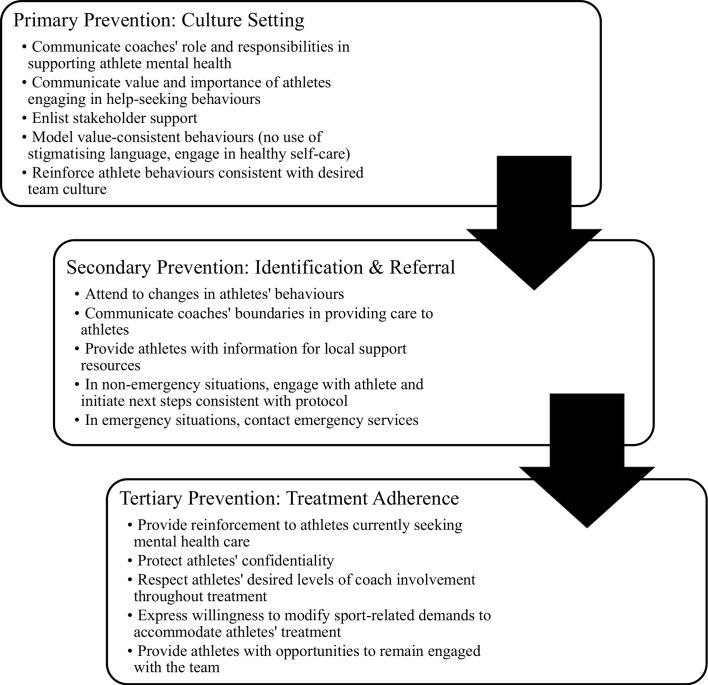
Background: Coaches have the potential to support athlete mental wellness, but many are unsure what to do and concerned they may unintentionally engage in behaviours that negatively impact their athletes. Education has the potential to help coaches engage in primary, secondary and tertiary preventive behaviours related to athlete mental health; however, there exists no empirical or consensus basis for specifying the target behaviours that should be included in such education. Objective: The aim of this research was to review extant literature about the role of sport coaches in mental health prevention and promotion, and obtain expert consensus about useful, appropriate and feasible coach behaviours. Design: Modified Delphi methodology with exploration (ie, narrative review) and evaluation phase. Data sources: Twenty-one articles from PubMed, PsycINFO and ProQuest, and grey literature published by prominent sport organisations. Eligibility criteria for selecting studies: All studies were English-language articles that focused on the role of coaches as they relate to (1) culture setting in sport, (2) addressing athlete mental health and (3) providing ongoing support to athletes with mental health concerns. No study design, publication date limits or sport characteristics were applied. Results: The coach’s role should include fostering team cultures that support athlete mental health, encouraging care-seeking and supporting athletes currently receiving mental healthcare. Summary/Conclusion: The behaviours specified herein have implications for coach education programme development. This study is the first to use a structured Delphi process to develop specific recommendations about the role coaches can play in supporting athlete mental health.
Overview
The claims and statistics of this paper haven’t been checked yet.
Run the check — free, no account needed. It reads the open-access text and checks the sources it cites.
Integrity signals
Registry
Cites
Statistics
Figures
Verification
Claims the paper makes
The claims and statistics of this paper haven’t been checked yet.
Run the check — free, no account needed. It reads the open-access text and checks the sources it cites.
Claims other papers make about this one
Each is checked against this paper’s own text: does it say what the citing paper says it does?
The source backs part of the claim, not all of it — or backs it for a different population, condition or comparison.
In the citing paper
“This may include a decisive role in shaping the cultural and institutional attitudes towards mental health in elite sports organisations (e.g. help-seeking) [26, 27].”
From The Mental Health of Elite-Level Coaches: A Systematic Scoping Review (2024) · cites this paper as [26]
Experimental — accuracy not yet measured
Self-check
Percentages, sums and reported differences re-computed from the paper’s own numbers.
The self-check needs the paper’s full text.
Citations
Cites
Organizational culture and leadership
(1993) · Long Range Planning · doi:10.1016/0024-6301(93)90120-5 · Cited by 16,530
A typology of reviews: an analysis of 14 review types and associated methodologies
Grant, M. J., & Booth, A. (2009) · Health Information & Libraries Journal · doi:10.1111/j.1471-1842.2009.00848.x · Cited by 10,817
The mental health continuum: from languishing to flourishing in life.
Keyes, C. L. M. (2002) · Journal of Health and Social Behavior · doi:10.2307/3090197 · Cited by 5,133
Eime, R. M., Young, J. A., Harvey, J. T., Charity, M. J., & Payne, W. R. (2013) · International Journal of Behavioral Nutrition and Physical Activity · doi:10.1186/1479-5868-10-98 · Cited by 2,366
Gazing into the oracle : the Delphi method and its application to social policy and public health
Ziglio, E., & Adler, M. E. (1996) · Jessica Kingsley Publishers eBooks · Cited by 1,429
Mental health in elite athletes: International Olympic Committee consensus statement (2019)
Reardon, C. L., Hainline, B., Aron, C. M., Baron, D., Baum, A. L., Bindra, A., Budgett, R., Campriani, N., Castaldelli-Maia, J. M., Currie, A., et al. (2019) · British Journal of Sports Medicine · doi:10.1136/bjsports-2019-100715 · Cited by 1,277
The Mental Health of Elite Athletes: A Narrative Systematic Review
Rice, S. M., Purcell, R., De Silva, S., Mawren, D., McGorry, P. D., & Parker, A. G. (2016) · Sports Medicine · doi:10.1007/s40279-016-0492-2 · Cited by 1,205 · cited 2×
“Once athletes have chosen to seek help for mental health concerns, encouraging treatment adherence should theoretically help limit morbidity.”
BackgroundYouth sport programs: An avenue to foster positive youth development
Fraser-Thomas, J. L., Côté, J., & Deakin, J. (2005) · Physical Education & Sport Pedagogy · doi:10.1080/1740898042000334890 · Cited by 1,162
Intervention Mapping: A Process for Developing Theory and Evidence-Based Health Education Programs
Bartholomew, L. K., Parcel, G. S., & Kok, G. (1998) · Health Education & Behavior · doi:10.1177/109019819802500502 · Cited by 1,102 · cited 1×
“23 Thus, there is a critical need to establish consensus about the role of the coach related to mental health promotion.”
BackgroundThe National Collegiate Athletic Association
Pierce, P. E. (1912) · American Physical Education Review · doi:10.1080/23267224.1912.10651691 · Cited by 768
Cited by
Sorted by citations
Items 101–146 of 146
Protecting and Promoting the Wellbeing of High-Performance Swimmers
Uzzell, K. S. (2023) · Cronfa (Swansea University) · doi:10.23889/suthesis.62923
You, K., & Chen, C. (2023) · Lecture notes of the Institute for Computer Sciences, Social Informatics and Telecommunications Engineering · doi:10.1007/978-3-031-28787-9_6
Kiens, K., Kask, K., & Jõgi, A. (2023) · International Sport Coaching Journal · doi:10.1123/iscj.2022-0065
Vu, V., & Reardon, C. L. (2023) · Springer eBooks · doi:10.1007/978-3-031-36864-6_10
AKGÖNÜL, E. K., & GÜÇLÜERLER, C. (2023) · International Journal of Disabilities Sports & Health Sciences · doi:10.33438/ijdshs.1361704
Mind or Medal: Elite Athletes’ Mental Health Management in Sports Events
Tsai, C.-H. K., & Steinmeyer, S. A. (2024) · Journal of Hospitality & Tourism Cases · doi:10.1177/21649987241241902 · Cited by 1
Direct and indirect assistance and motivation: How do they affect learning handstand skills?
Jasman, N., Syahara, S., Syahrastani, S., Padli, & Setiawan, Y. (2024) · JOURNAL SPORT AREA · doi:10.25299/sportarea.2024.vol9(2).15886
Perception of interpersonal relationships between students and sports coaches in Piura, Peru
Coronel-Chugden, J.-W., Moreno-Quispe, L. A., & Aguilar, G. F. V. (2024) · Journal of Human Sport and Exercise · doi:10.55860/rx0kjv71
“Bissett et al. (2020) based on the results, coaches and athletes can be trained to optimize sports performance.”
BackgroundRasheed, K., Petersen, J. M., Elliott, S., Drummond, M., & Prichard, I. J. (2025) · Qualitative Research in Sport Exercise and Health · doi:10.1080/2159676x.2025.2476151
The Dual-Factor Model of Female Volleyball Student Athlete Mental Health: A Scoping Review
Enderle, H., Ormiston, H. E., Lim, H. S., Koch, M., Spicer-Gordon, R., & Minix, A. L. (2025) · Journal of Clinical Sport Psychology · doi:10.1123/jcsp.2024-0048
Prabowo, T. A. (2025) · Pedagogy of Health · doi:10.15561/health.2025.0105
Barros, K., Lefebvre, A., Geidne, S., Bardid, F., Grieco, S., Johnson, S., Kokko, S. P., Lambe, B., Lane, A., Ooms, L., et al. (2025) · Health Promotion International · doi:10.1093/heapro/daaf099
Stimulant Norms and Prevalence 2 (SNAP2) Study Team, Brown, A., & Bravo, A. J. (2025) · Journal of Athlete Development and Experience · doi:10.25035/jade.07.02.03
Hideg, G., Mokaya, P. O., Elmadani, M., & Karácsony, I. (2025) · Research Square · doi:10.21203/rs.3.rs-7121082/v1
Sankey, C., Brockett, C., Slattery, K., Lederman, O., Warmenhoven, J., Menzies-Stegbauer, T., Langan, E., & Caperchione, C. M. (2025) · Journal of Sports Sciences · doi:10.1080/02640414.2025.2576311 · Cited by 1
“However, agreed guiding principles for coaches are yet to be broadly adopted, relying on coach discretion to dictate methods of assistance for athletes struggling with their mental health (Bissett et al., 2020; Purcell et al., 2022).”
InfluentialBreslin, G., Shannon, S., Cummings, M., & Leavey, G. (2022) · Figshare · doi:10.6084/m9.figshare.19802359
Additional file 2 of The Mental Health of Elite-Level Coaches: A Systematic Scoping Review
Frost, J., Walton, C. C., Purcell, R., Fisher, K., Gwyther, K., Kocherginsky, M., & Rice, S. M. (2024) · Figshare · doi:10.6084/m9.figshare.25203736
Breslin, G., Shannon, S., Cummings, M., & Leavey, G. (2022) · Figshare · doi:10.6084/m9.figshare.19802362
Additional file 4 of The Mental Health of Elite-Level Coaches: A Systematic Scoping Review
Frost, J., Walton, C. C., Purcell, R., Fisher, K., Gwyther, K., Kocherginsky, M., & Rice, S. M. (2024) · Figshare · doi:10.6084/m9.figshare.26679632
Additional file 6 of The Mental Health of Elite-Level Coaches: A Systematic Scoping Review
Frost, J., Walton, C. C., Purcell, R., Fisher, K., Gwyther, K., Kocherginsky, M., & Rice, S. M. (2024) · Figshare · doi:10.6084/m9.figshare.26679638
Additional file 1 of The Mental Health of Elite-Level Coaches: A Systematic Scoping Review
Frost, J., Walton, C. C., Purcell, R., Fisher, K., Gwyther, K., Kocherginsky, M., & Rice, S. M. (2024) · Figshare · doi:10.6084/m9.figshare.25203625
Additional file 3 of The Mental Health of Elite-Level Coaches: A Systematic Scoping Review
Frost, J., Walton, C. C., Purcell, R., Fisher, K., Gwyther, K., Kocherginsky, M., & Rice, S. M. (2024) · Figshare · doi:10.6084/m9.figshare.26679629
Additional file 5 of The Mental Health of Elite-Level Coaches: A Systematic Scoping Review
Frost, J., Walton, C. C., Purcell, R., Fisher, K., Gwyther, K., Kocherginsky, M., & Rice, S. M. (2024) · Figshare · doi:10.6084/m9.figshare.26679635
Stakeholder perception on public project failure in the Gambia: Causes and effects
Lee, C. W., & Sanyang, A. (2025) · Multidisciplinary Reviews · doi:10.31893/multirev.2026076
Youth Sport Coaches as Mentors: Formalizing the Training Processes
Coatsworth, J. D. (2026) · Springer eBooks · doi:10.1007/978-3-032-05580-4_36
Understanding Sports Injuries as Trauma: A Call to Action
Snyder, S. M., Morse, S. A., Wheeler, J., & Brown, R. (2026) · Substance Use & Misuse · doi:10.1080/10826084.2025.2606863
“Coaches play a critical role in either allowing team members to stigmatize mental health treat-ment or promoting a safe and supportive environment that is responsive to mental health needs (Beebe & Petrie, 2024; Bissett et al., 2020).”
Luguterah, A. W., & Kokoe, J. (2026) · Women in Sport and Physical Activity Journal · doi:10.1123/wspaj.2025-0086
Cho, Y., Hwang, D., Lam, A., Lee, J.-H., & Yip, J. C. (2026) · International Conference on Human Factors in Computing Systems · doi:10.1145/3772318.3791938 · Cited by 2
“Prior research shows that youth players frequently report limited emotional scaffolding from coaches, inconsistent peer support during stressful matches, and organizational programs that do not reliably foster psychological skill development [8, 29, 68].”
Utilizing a COMPASS to Navigate Coaching-Athlete Responsibilities
McDowell, J., & Brooks, D. D. (2026) · Strategies · doi:10.1080/08924562.2026.2631475
“This helps coaches show that they care about their athletes as people, not just as performers (Bissett et al., 2020; Davis et al., 2022; Jowett et al., 2017).”
InfluentialHebard, S. P., Weaver, G. M., Davoren, A. K., Milroy, J. J., Kelly, S., & Wyrick, D. L. (2026) · Journal for the Study of Sports and Athletes in Education · doi:10.1080/19357397.2026.2668989
Self-citationImplications for Policy, Practice, and Future Research
Noh, Y. (2026) · SpringerBriefs in religious studies · doi:10.1007/978-981-92-0278-2_6
Parrott, S., Kanthawala, S., & Feder, L. (2026) · Springer eBooks · doi:10.1007/978-3-032-18411-5_8
Smith, A. J., Graña, J., Bitterlich, N., Colangelo, J., Bigard, X. A., Buadze, A., & Liebrenz, M. (2026) · Discover Mental Health · doi:10.1007/s44192-026-00483-8
“Analogous patterns have been identified in sports beyond cycling, placing an onus on non-athlete staff (especially coaches) to safeguard vulnerable competitors, for which they may not have received adequate training in psychiatric symptom recognition and appropriate referral mechanisms [22, 23].”
Mental health in tennis: a cross-organisational hybrid summit-Delphi consensus process
Kroshus, E., Capel-Davies, J., Ellenbecker, T. S., Gouttebarge, V., Martin, K., Miller, S., Mountjoy, M. L., Reardon, C. L., Stroia, K. A., & Hainline, B. W. (2026) · British Journal of Sports Medicine · doi:10.1136/bjsports-2025-111479
Self-citationWang, F., & Mou, K.-R. (2026) · Frontiers in Public Health · doi:10.3389/fpubh.2026.1894961
“Coaches’ mental health not only directly affects their coaching performance, but also exerts an influence on athletes’ psychological states (6).”
Walton, C. C., Bowring, A., Purcell, R., Robinson, J., Vella, S. A., & Sala, L. L. (2026) · Journal of Applied Sport Psychology · doi:10.1080/10413200.2026.2703594
Wang, X., Zhou, Y., Li, L., & Wang, Q. (2026) · Frontiers in Psychology · doi:10.3389/fpsyg.2026.1884039
Lim, J. J., de Cruz, N. P., Lim, H. B. T., & Slater, M. J. (2026) · International Journal of Sports Science & Coaching · doi:10.1177/17479541261474868
Wang, G., & Meng, F. (2026) · Acta Psychologica · doi:10.1016/j.actpsy.2026.107720
Fajri, K., Ismail, M., Purwanto, D., Jumain, Rivalwan, Daipaha, T. M., & Ramli, I. P. (2026) · COMPETITOR Jurnal Pendidikan Kepelatihan Olahraga · doi:10.67322/cpjok.v18i3.1250
“The same issue was also raised by Whittaker et al. (2020) and Jumain et al. (2021) in their studies, which found that coaches lack in-depth knowledge of specific training methods, training design, and communication techniques.”
Zhai, W., Zhai, Q., & Peng, Y. (2026) · Frontiers in Psychology · doi:10.3389/fpsyg.2026.1971379
“…be distinguished from structured psychological intervention and from assessment or treatment of clinically relevant psychological distress, for which appropriately qualified sport-psychology or mental-health expertise and, where necessary, referral are required (Carr, 2006; Bissett et al., 2020).”
O’Rourke, R. H., Bundon, A., Sabiston, C. M., & Arbour‐Nicitopoulos, K. P. (2026) · Journal of Applied Sport Psychology · doi:10.1080/10413200.2026.2734455
Misurelli, J. M., & Durand‐Bush, N. (2026) · International Journal of Sport and Exercise Psychology · doi:10.1080/1612197x.2026.2740238
Metadata
- Authors
- Bissett, J. E., Kroshus, E., & Hebard, S.
- Affiliations
- University of Toronto (CA)
- University of Washington (US)
- University of North Carolina at Greensboro (US)
- Corresponding author
- Bissett, James E.
- Venue
- BMJ Open Sport & Exercise Medicine
- Publisher
- BMJ
- Published
- 2020-01
- Volume
- 6
- Issue
- 1
- Pages
- e000676
- ISSN
- 2055-7647 (ISSN-L)
- PMC
- PMC7011013
- OpenAlex
- W3003480518
- Cited by
- 147
- References
- 51
- Citations by year
- 2026: 26 · 2025: 31 · 2024: 32 · 2023: 24 · 2022: 23 · 2021: 7 · 2020: 4
- FWCI
- 3.09
- Type
- journal article
- Language
- en
- Open access
- gold
- doi.org
- Licence
- Locations
- BMJ Open Sport & Exercise Medicine (publishedVersion, cc-by-nc)
- PubMed Central (publishedVersion, cc-by-nc)
- PubMed (publishedVersion)
- DOAJ (DOAJ: Directory of Open Access Journals) (submittedVersion, cc-by-sa)
- Funders
- Social Sciences and Humanities Research Council of Canada (Michael Smith Foreign Study Supplement)
- Topics
- Social Sciences › Psychology › Developmental and Educational Psychology › Sport Psychology and Performance
- Social Sciences › Psychology › Clinical Psychology › Psychological Treatments and Assessments
- Social Sciences › Psychology › Clinical Psychology › COVID-19 and Mental Health
- Keywords
- sports coaches, athlete mental health, coach education, mental health prevention, mental health promotion, team culture, care seeking, athlete support, primary, secondary and tertiary prevention, expert consensus
About these checks
Registry, retraction, Cites and statistics results are computed, not judged, with one exception: a printed reference that no index lists is read once by a model before it counts as a citation error. Claims are extracted by a model and kept only when their quote appears verbatim in the text; each cited source is then checked, with a model’s help, for whether it says what the claim relies on. Those verdicts can be wrong — read the claim’s quote and the cited source before relying on one.
Statistics and arithmetic are recomputed, not judged.
Confidence bands are shown only for fields calibrated on our annotated test set. None is calibrated yet, so no band is shown.
What counts as a claim ›How we measure confidence ›How we check this ›
Are you an author, or do you see a problem with this page? Request a review
