

Do vigorous-intensity and moderate-intensity physical activities reduce mortality to the same extent? A systematic review and meta-analysis
Open accessThe DOI matches its Crossref record; 35 of the 35 references it cites were found in a registry or an index.
Abstract
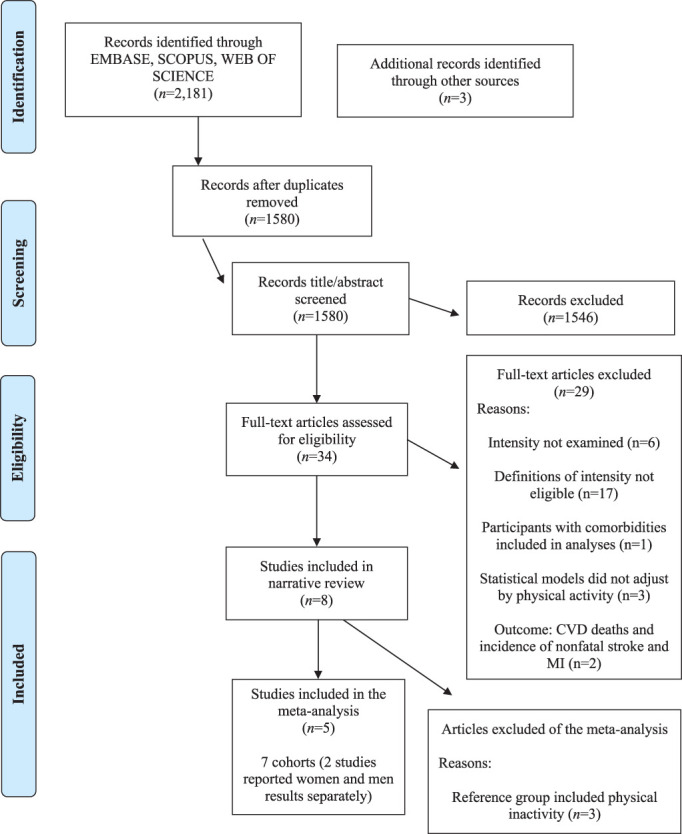
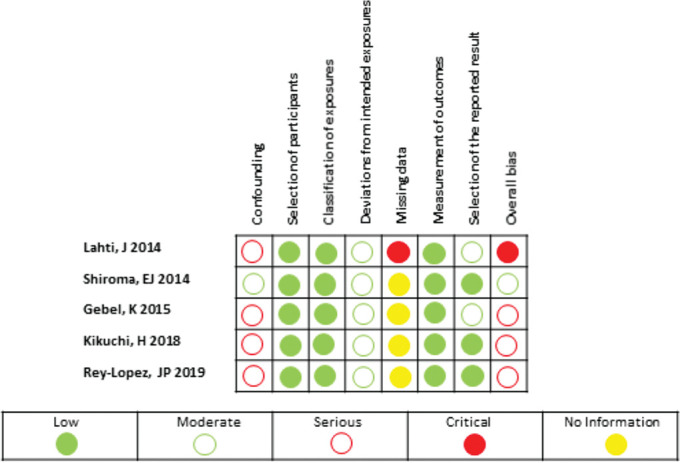
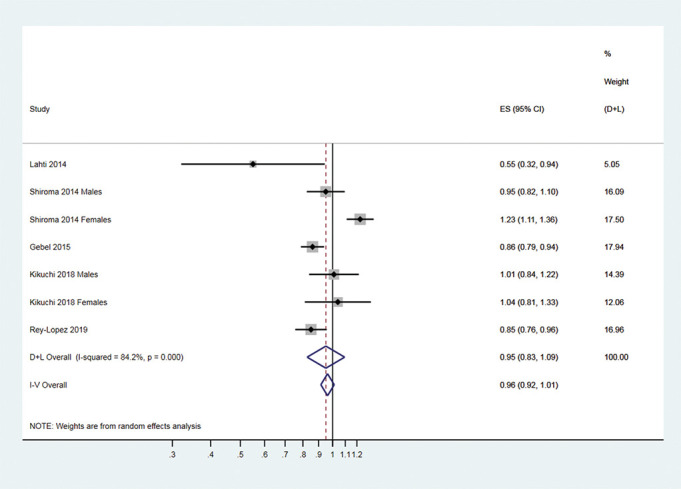
Objective: To examine whether vigorous-intensity physical activity confers additional reductions on all-cause and cause-specific mortality compared with moderate-intensity physical activity. Design: A systematic review (registered in PROSPERO CRD42019138995) and meta-analysis. Data sources: Three electronic databases up to April 14 2020. Eligibility criteria: Inclusion criteria were prospective studies that contained information about (1) moderate-intensity (3–5.9 metabolic equivalent tasks (METs)) and vigorous-intensity (≥6 METs) physical activities and (2) all-cause and/or cause-specific mortality. Exclusion criteria were prospective studies that (1) exclusively recruited diseased patients (eg, hypertensive patients and diabetics) or (2) did not account for total physical activity in their multivariable models (3) or did not adjust or exclude individuals with comorbidities at baseline or (4) used physically inactive participants as reference group. Results: Five studies (seven cohorts using sex-specific results) were pooled into a meta-analysis. For all-cause mortality and controlling by total physical activity, vigorous-intensity physical activity (vs moderate) was not associated with a larger reduction in mortality (HR 0.95, 95% CI 0.83 to 1.09). After the exclusion of one study judged with critical risk of bias (Risk Of Bias in Non randomized Studies, ROBINS tool) from meta-analysis, results remained similar (HR 0.98, 95% CI 0.85 to 1.12). Due to the limited number of studies, meta-analyses for cancer and cardiovascular mortality were not performed. Conclusions: Prospective studies suggest that, for the same total physical activity, both vigorous-intensity and moderate-intensity physical activities reduce all-cause mortality to the same extent. However, absence of evidence must not be interpreted as evidence of absence due to the existing methodological flaws in the literature.
Overview
The claims and statistics of this paper haven’t been checked yet.
Free: it reads the open-access text and checks the first 5 claims that cite a source we can check. Create a free account to check every claim.
Integrity signals
Registry
Cites
Statistics
Figures
Verification
Claims the paper makes
The claims and statistics of this paper haven’t been checked yet.
Free: it reads the open-access text and checks the first 5 claims that cite a source we can check. Create a free account to check every claim.
Claims other papers make about this one
Each is checked against this paper’s own text: does it say what the citing paper says it does?
The cited source doesn’t support the claim as written.
In the citing paper
“For a given volume of physical activity, higher contributions of VPA are associated with additional mortality risk reduction10–13.”
From Association of wearable device-measured vigorous intermittent lifestyle physical activity with mortality (2022) · cites this paper as [13]
Checked by a reasoning model — may be wrong.
Experimental — accuracy not yet measuredThe cited source says what the claim attributes to it.
In the citing paper
“The health effects of each time unit of physical activity are intensity dependent10–13.”
From Association of wearable device-measured vigorous intermittent lifestyle physical activity with mortality (2022) · cites this paper as [13]
Self-check
Percentages, sums and reported differences re-computed from the paper’s own numbers.
The self-check needs the paper’s full text.
Citations
Cites
Measuring inconsistency in meta-analyses
Higgins, J. P. T., Thompson, S. G., Deeks, J. J., & Altman, D. G. (2003) · BMJ · doi:10.1136/bmj.327.7414.557 · Cited by 63,139 · cited 1×
“28 The CI for the I 2 measure was derived using the Q statistic and the corresponding degrees of freedom.”
Liberati, A., Altman, D. G., Tetzlaff, J., Mulrow, C., Gøtzsche, P. C., Ioannidis, J. P. A., Clarke, M., Devereaux, P. J., Kleijnen, J., & Moher, D. (2009) · PLoS Medicine · doi:10.1371/journal.pmed.1000100 · Cited by 28,164
ROBINS-I: a tool for assessing risk of bias in non-randomised studies of interventions
Sterne, J. A., Hernán, M. A., Reeves, B. C., Savović, J., Berkman, N. D., Viswanathan, M., Henry, D., Altman, D. G., Ansari, M. T., Boutron, I., et al. (2016) · BMJ · doi:10.1136/bmj.i4919 · Cited by 20,329
Liberati, A., Altman, D. G., Tetzlaff, J., Mulrow, C., Gotzsche, P. C., Ioannidis, J. P. A., Clarke, M., Devereaux, P. J., Kleijnen, J., & Moher, D. (2009) · BMJ · doi:10.1136/bmj.b2700 · Cited by 17,648
Lee, I.-M., Shiroma, E. J., Lobelo, F., Puska, P., Blair, S. N., & Katzmarzyk, P. T. (2012) · The Lancet · doi:10.1016/s0140-6736(12)61031-9 · Cited by 8,215
Fit Yourself and Take Your Lungs to Heart
Palange, P., & Bonini, M. (2013) · Respiration · doi:10.1159/000350831 · Cited by 2,779
Peters, J. L., Sutton, A. J., Jones, D. R., Abrams, K. R., & Rushton, L. (2008) · Journal of Clinical Epidemiology · doi:10.1016/j.jclinepi.2007.11.010 · Cited by 2,053 · cited 2×
“29 Sensitivity analyses to determine whether a particular study largely accounted for heterogeneity were explored by removing one by one study from the meta-analysis.”
Wisløff, U., Støylen, A., Loennechen, J. P., Bruvold, M., Rognmo, Ø., Haram, P. M., Tjønna, A. E., Helgerud, J., Slørdahl, S. A., Lee, S. J., et al. (2007) · Circulation · doi:10.1161/circulationaha.106.675041 · Cited by 1,996
Endurance running and the evolution of Homo
Bramble, D. M., & Lieberman, D. E. (2004) · Nature · doi:10.1038/nature03052 · Cited by 1,743 · cited 1×
“Finally, a small number of cohorts were identified and pooled into the meta-analysis and subgroup or meta-regression analyses were discarded (due to low statistical power) to explore the sources of heterogeneity.”
Exercise Type and Intensity in Relation to Coronary Heart Disease in Men
Tanasescu, M. (2002) · JAMA · doi:10.1001/jama.288.16.1994 · Cited by 928 · cited 1×
“…larger risk reductions on all-cause 23 – 25 and cardiovascular disease (CVD) mortality in participants with higher vigorous-intensity activity, 21 another study observed inconsistent associations (of vigorous-intensity vs moderate-intensity activities) on CVD mortality between sexes and a…”
Research works printed but not linked: 1
- World Health Organization. Global recommendations on physical activity for health. Geneva, 2010. Available https://www.who.int/dietphysicalactivity/factsheet_recommendations/en/ (accessed 3 Oct 2018) 26180873
Cited by
Stamatakis, E., Ahmadi, M. N., Gill, J. M. R., Thøgersen-Ntoumani, C., Gibala, M. J., Doherty, A., & Hamer, M. (2022) · Nature Medicine · doi:10.1038/s41591-022-02100-x · Cited by 336
Lee, D. H., Rezende, L. F. M., Joh, H.-K., Keum, N., Ferrari, G., Rey-Lopez, J. P., Rimm, E. B., Tabung, F. K., & Giovannucci, E. L. (2022) · Circulation · doi:10.1161/circulationaha.121.058162 · Cited by 288
Vigorous physical activity, incident heart disease, and cancer: how little is enough?
Ahmadi, M. N., Clare, P. J., Katzmarzyk, P. T., del Pozo Cruz, B., Lee, I. M., & Stamatakis, E. (2022) · European Heart Journal · doi:10.1093/eurheartj/ehac572 · Cited by 175
“Examining the dose-response of short and intermittent VPA bursts requires device-based measurments.(9) Indeed, the World Health Organization Guidelines Development Group recently indicated the need for device-based studies to objectively assess the relationship of physical activity with mortality and disease risk as a…”
Backgrounddos Santos, M., Ferrari, G., Lee, D. H., Rey-López, J. P., Aune, D., Liao, B., Huang, W., Nie, J., Wang, Y., Giovannucci, E. L., et al. (2022) · JAMA Internal Medicine · doi:10.1001/jamainternmed.2022.2488 · Cited by 157
Self-citationDing, D., Buskirk, J. V., Nguyen, B., Stamatakis, E., Elbarbary, M., Veronese, N., Clare, P. J., Lee, I.-M. M., Ekelund, U., & Fontana, L. (2022) · British Journal of Sports Medicine · doi:10.1136/bjsports-2021-105195 · Cited by 96
Time- vs Step-Based Physical Activity Metrics for Health
Hamaya, R., Shiroma, E. J., Moore, C. C., Buring, J. E., Evenson, K. R., & Lee, I.-M. M. (2024) · JAMA Internal Medicine · doi:10.1001/jamainternmed.2024.0892 · Cited by 73
Monteiro, R. L., Ferreira, J. S. S. P., Silva, É. Q., Cruvinel-Júnior, R. H., Veríssimo, J. L., Bus, S. A., & Sacco, I. D. C. N. (2022) · Scientific Reports · doi:10.1038/s41598-022-11745-0 · Cited by 60
Skurvydas, A., Lisinskienė, A., Lochbaum, M. R., Majauskienė, D., Valančienė, D., Dadelienė, R., Fatkulina, N., & Šarkauskienė, A. (2021) · International Journal of Environmental Research and Public Health · doi:10.3390/ijerph182312809 · Cited by 38
“Introduction There is growing evidence-based research that various forms and doses of PA are effective in combating many chronic diseases [1–3], improving well-being and mental health [4–6], improving emotional well-being [7], and reducing all-cause mortality [8,9].”
BackgroundBiswas, R. K., Ahmadi, M. N., Bauman, A. E., Milton, K. E., Koemel, N. A., & Stamatakis, E. (2025) · Nature Communications · doi:10.1038/s41467-025-63475-2 · Cited by 41
“Studies examining the associations of physical activity volume with mortality and other long term health outcomes 8,9 have thus assumed that 1 min of vigorous activity produces similar ben-e fi ts to around 2 min of moderate activity.”
Gualdi‐Russo, E., Rinaldo, N., Toselli, S., & Zaccagni, L. (2020) · Sustainability · doi:10.3390/su13010335 · Cited by 32
Hua, J., Ren, C., Yin, S., & Chen, W. Y. (2025) · Urban forestry & urban greening · doi:10.1016/j.ufug.2025.128753 · Cited by 19
Skurvydas, A., Lisinskienė, A., Lochbaum, M. R., Majauskienė, D., Valančienė, D., Dadelienė, R., Fatkulina, N., & Šarkauskienė, A. (2021) · International Journal of Environmental Research and Public Health · doi:10.3390/ijerph182312405 · Cited by 17
“In addition, as others have observed, it is difficult to compare PA data between study groups because of the variety of methodologies used [2,22,28].”
Do Physical Activity, BMI, and Wellbeing Affect Logical Thinking?
Skurvydas, A., Lisinskienė, A., Majauskienė, D., Valančienė, D., Dadelienė, R., Fatkulina, N., & Šarkauskienė, A. (2022) · International Journal of Environmental Research and Public Health · doi:10.3390/ijerph19116631 · Cited by 17
Ahmadi, M. N., Holtermann, A., Tudor-Locke, C. E., Koster, A., Johnson, N. A., Chau, J. Y., WEI, L., Sabag, A., Maher, C. A., Thøgersen‐Ntoumani, C., et al. (2024) · Medicine & Science in Sports & Exercise · doi:10.1249/mss.0000000000003521 · Cited by 22
“The health effects of each time unit of physical activity are intensity dependent (6,7); for a given volume of physical activity, higher contributions of vigorous physical activity are associated with additional mortality risk reduction (8).”
Self-citationMa, T., Sirard, J. R., Yang, L., Li, Y., Tsang, S. M. H., & Fu, S. N. (2024) · International Journal of Behavioral Nutrition and Physical Activity · doi:10.1186/s12966-024-01631-5 · Cited by 16
Ren, R., Wang, W.-X., Liu, Q., Ye, X., Li, X., Zhang, R., Wang, L., Zhang, Y., Ma, Y., & Wang, D. (2025) · Journal of the American Heart Association · doi:10.1161/jaha.124.039852 · Cited by 13
Wei, J., Shen, M., Li, S., Xiao, Y., Luo, D., Ferrari, G., Lee, D. H., Rezende, L. F. M., Gill, J. M. R., Ahmadi, M. N., et al. (2026) · European Heart Journal · doi:10.1093/eurheartj/ehag168 · Cited by 16
“13,14 To fill these gaps, we utilized accelerometer-measured PA data from the UK Biobank to investigate the associations of %VPA with eight major chronic diseases—MACE, atrial fibrillation (AFib), type 2 diabetes (T2D), immune-mediated inflammatory diseases (IMIDs), metabolic dysfunction-associated…”
Self-citationPark, J., Nam, H.-K., & Cho, S. (2024) · BMJ Open · doi:10.1136/bmjopen-2023-078199 · Cited by 11
“30 31 Isotem-poral substitution analysis overcomes this limitation by allowing for a comparison of the effects of substituting one intensity of physical activity with another while keeping the total amount of time spent in physical activity constant.”
BackgroundRey-López, J. P., Lee, D. H., Ferrari, G., Giovannucci, E. L., & Rezende, L. F. M. (2023) · International Journal of Environmental Research and Public Health · doi:10.3390/ijerph20116027 · Cited by 11
Self-citationRole of Physical Activity in Lowering Risk of End-Stage Renal Disease
Tsai, M., Gao, W., Chien, K., Hsu, C., & Wen, C.-P. (2022) · Mayo Clinic Proceedings · doi:10.1016/j.mayocp.2021.10.027 · Cited by 9
Lifestyle and patterns of physical activity in Hadza foragers
Sayre, M. K., Anyawire, M., Paolo, B., Mabulla, A. Z. P., Pontzer, H., Wood, B. M., & Raichlen, D. A. (2023) · American Journal of Biological Anthropology · doi:10.1002/ajpa.24846 · Cited by 10
“Average daily minutes in moderate-to-vigorous physical activity (MVPA) : The health benefits of engaging in MVPA (activity at or above three METs; Norton et al., 2010) are well-established (Ekelund et al., 2015; Moore et al., 2012; Rey Lopez et al., 2020; Warburton et al., 2006).”
Park, H., Yang, P., Sung, J., Jin, M., Jang, E., Yu, H. T., Kim, T., Pak, H., Lee, M., & Joung, B. (2023) · Mayo Clinic Proceedings · doi:10.1016/j.mayocp.2023.04.017 · Cited by 8
Genetic Background of Acute Heart Rate Response to Exercise
Pikó, P., Ashkar, H. A., Kovács, N., Veres-Balajti, I., & Ádány, R. (2024) · International Journal of Molecular Sciences · doi:10.3390/ijms25063238 · Cited by 6
Alshahrani, N. Z. (2024) · Preventive Medicine Reports · doi:10.1016/j.pmedr.2024.102753 · Cited by 7
“Both moderate-and vigorous-intensity physical activities are beneficial for health (Rey Lopez et al., 2020).”
BackgroundWang, D., Wu, L., Yan, L., Yang, H., Huang, X., Wang, Z., & Guan, Y. (2025) · PeerJ · doi:10.7717/peerj.19538 · Cited by 7
“Beyond this specific range, increasing the proportion of VPA may lead to diminishing health benefits, while controversy exists regarding this specific range ( Lee et al., 2022 ; Lopez et al., 2019 ; Mu et al., 2022 ; Rey Lopez et al., 2020 ).”
Huang, B., Lin, C., Feng, Y., Cai, S., Zhao, M., Hu, C., & Wang, L. (2025) · Scientific Reports · doi:10.1038/s41598-025-19419-3 · Cited by 5
“To estimate total energy expenditure, vigorous-intensity physical activity was converted into an equivalent amount of moderate-intensity activity, with one minute of vigorous activity counted as two minutes of moderate activity, an approach supported by previous research 16 .”
Modern Trends, Examples and Methods for Assessing Physical Activity of City Residents
Andreev, D. A., & Камынина, Н. Н. (2024) · City Healthcare · doi:10.47619/2713-2617.zm.2024.v.5i2;125-139 · Cited by 6
Lian, Y., & Luo, P. (2024) · PLoS ONE · doi:10.1371/journal.pone.0308099 · Cited by 4
“Some previous studies suggest that 1 minute of vigorous-intensity PA can be simply converted into 2 minutes of moderate-intensity PA for easy calculation in terms of energy consumption [27, 28].”
BackgroundZhang, M., Wang, Z., Liu, W., Wang, M., Wu, H., & An, R. (2024) · Heliyon · doi:10.1016/j.heliyon.2024.e32884 · Cited by 7
“…nationally representative sample of US males, we demonstrated that compared with PA levels 150 min/week as moderate activity, PA volumes meeting or beyond the current recommendations were significantly associated with decreased odds of ED after fully adjusting for potential confounders [26,27].”
BackgroundSkurvydas, A., Lisinskienė, A., Majauskienė, D., Valančienė, D., Dadelienė, R., Istomina, N., & Šarkauskienė, A. (2022) · Sustainability · doi:10.3390/su141610091 · Cited by 3
“In addition, other researchers have noted that it is difficult to compare data from PA because different methods are used for measurement [4,45,48].”
BackgroundSkurvydas, A., Istomina, N., Dadelienė, R., Valančienė, D., Lisinskienė, A., Jamontaitė, I. E., Šarkauskienė, A., & Majauskienė, D. (2024) · BMC Public Health · doi:10.1186/s12889-024-20866-2 · Cited by 5
Kim, H.-J., Choi, H., Ahn, H.-J., Shin, S., Kim, C., Lee, S., Sohn, J., & Lee, J.-J. (2025) · JMIR Medical Informatics · doi:10.2196/74415 · Cited by 6
Nehme, M., Ridder, D. D., Kathari, G., Baysson, H., Schrempft, S., Bouhet, A. R., Lamour, J., Zaballa, M.-E., Joost, S., Stringhini, S., et al. (2025) · BMJ Public Health · doi:10.1136/bmjph-2024-001745 · Cited by 1
“17 While regular moderate exercise has traditionally been shown to be beneficial for health, 1 especially in individuals with chronic diseases, 18 high intensity intermittent training has recently received considerable attention.”
Impact of Moderate and Vigorous Physical Activity on Cardiovascular Health: A Review
Radonić, V. (2025) · Premier Journal of Cardiology · doi:10.70389/pjc.100012 · Cited by 1
zheng, F., Yuan, Y., Luo, J., Li, S., Xiong, S., Fu, B., Zhou, L., & Zeng, J. (2026) · Scientific Reports · doi:10.1038/s41598-026-47677-2 · Cited by 2
Wie viel Bewegung ist bei Typ-2-Diabetes wirklich gesundheitsfördernd?
Sontag, I., & Adamek, H. E. (2026) · Info Diabetologie · doi:10.1007/s15034-026-5280-y · Cited by 1
Physical activity and exercise in primary open-angle glaucoma: a scoping review
Schuhmann, V., Küttel, J., Eijgen, J. V., Gugleta, K., & Hanssen, H. (2026) · Frontiers in Physiology · doi:10.3389/fphys.2026.1834649 · Cited by 2
“…(Garcia-Hermoso et al., 2023), vigorous activity (typically ≥ 6 metabolic equivalents, such as high-intensity interval training or fast running) (Lopez et al., 2020), and sustained or habitual activity (regularly accumulated physical activity over time, such as daily walking or recreational…”
Prior Lifestyle and Survival Outcomes After Intensive Care Unit Admission
Song, I., & Oh, T. K. (2023) · Journal of Korean Medical Science · doi:10.3346/jkms.2023.38.e97 · Cited by 1
Factors on Affecting Engagement of Physical Activity: Anderson Behaviour ModelPreprint
Badarali, M., & Rungsihirunrat, K. (2024) · Research Square · doi:10.21203/rs.3.rs-5306155/v1 · Cited by 1
Monteiro, R. L. (2021) · Digital Library of Theses and Dissertations (Universidade de São Paulo) · doi:10.11606/t.5.2021.tde-04042022-155728
Skurvydas, A., Lisinskienė, A., Majauskienė, D., Valančienė, D., Dadelienė, R., Fatkulina, N., Mockevičienė, D., & Šarkauskienė, A. (2022) · Research Square · doi:10.21203/rs.3.rs-1746860/v1 · Cited by 1
Atividade física e sobrevida após uma síndrome coronariana aguda: dados do Estudo ERICO
Treff, C. A. (2023) · Digital Library of Theses and Dissertations (Universidade de São Paulo) · doi:10.11606/t.5.2023.tde-08122023-161622
Kim, H.-J., Choi, H., Ahn, H.-J., Shin, S., Kim, C., Lee, S., Sohn, J., & Lee, J. J. (2024) · Research Square · doi:10.21203/rs.3.rs-4838697/v1
Sales, D. R. L., Ferrari, G., da Silva, J. P., Bergamo, R. R., Moda, P. P. O., dos Santos, A., dos Santos, M., & Matsudo, V. K. R. (2025) · Scientific Reports · doi:10.1038/s41598-025-85601-2 · Cited by 2
Kim, H.-J., Choi, H., Ahn, H.-J., Shin, S., Kim, C., Lee, S., Sohn, J., & Lee, J. (2025) · doi:10.2196/preprints.74415
Oh, T. K., & Song, I. (2025) · Medicine & Science in Sports & Exercise · doi:10.1249/mss.0000000000003817 · Cited by 1
Ma, T., Sirard, J. R., Yang, L., Li, Y., Tsang, S., & Fu, A. (2024) · Figshare · doi:10.6084/m9.figshare.26755519
Ma, T., Sirard, J. R., Yang, L., Li, Y., Tsang, S., & Fu, A. (2024) · Figshare · doi:10.6084/m9.figshare.26401871
Ma, T., Sirard, J. R., Yang, L., Li, Y., Tsang, S., & Fu, A. (2024) · Figshare · doi:10.6084/m9.figshare.26755543
Ma, T., Sirard, J. R., Yang, L., Li, Y., Tsang, S., & Fu, A. (2024) · Figshare · doi:10.6084/m9.figshare.26402055
Ma, T., Sirard, J. R., Yang, L., Li, Y., Tsang, S., & Fu, A. (2024) · Figshare · doi:10.6084/m9.figshare.26755513
Ma, T., Sirard, J. R., Yang, L., Li, Y., Tsang, S., & Fu, A. S. (2024) · Figshare · doi:10.6084/m9.figshare.26755525
Ma, T., Sirard, J. R., Yang, L., Li, Y., Tsang, S., & Fu, A. (2024) · Figshare · doi:10.6084/m9.figshare.26755540
Ma, T., Sirard, J. R., Yang, L., Li, Y., Tsang, S., & Fu, A. (2024) · Figshare · doi:10.6084/m9.figshare.26755510
Ma, T., Sirard, J. R., Yang, L., Li, Y., Tsang, S., & Fu, A. (2024) · Figshare · doi:10.6084/m9.figshare.26755516
Ma, T., Sirard, J. R., Yang, L., Li, Y., Tsang, S., & Fu, A. (2024) · Figshare · doi:10.6084/m9.figshare.26755531
Ma, T., Sirard, J. R., Yang, L., Li, Y., Tsang, S., & Fu, A. (2024) · Figshare · doi:10.6084/m9.figshare.26755528
Ma, T., Sirard, J. R., Yang, L., Li, Y., Tsang, S., & Fu, A. (2024) · Figshare · doi:10.6084/m9.figshare.26755534
Ma, T., Sirard, J. R., Yang, L., Li, Y., Tsang, S., & Fu, A. (2024) · Figshare · doi:10.6084/m9.figshare.26755537
Ma, T., Sirard, J. R., Yang, L., Li, Y., Tsang, S., & Fu, A. (2024) · Figshare · doi:10.6084/m9.figshare.26755522
Saulicz, A., Abernethy, D. A., & Wraith, D. (2026) · European Journal of Epidemiology · doi:10.1007/s10654-025-01353-3 · Cited by 3
Pre-stroke Fulfilment of WHO Recommendations for Physical Activity: A Cross-Sectional Study
Krogh, D., Juhl, C. B., Kruuse, C., & Krawcyk, R. S. (2026) · Western Journal of Nursing Research · doi:10.1177/01939459261418465
“22 The proportion of patients fulfilling the WHO recommendations was calculated.”
Peng, L., Wang, K., You, M., Shen, B., & Li, J. H. (2026) · Medicine · doi:10.1097/md.0000000000050550
Metadata
- Authors
- Rey Lopez, J. P., Sabag, A., Martinez Juan, M., Rezende, L. F. M., & Pastor-Valero, M.
- Affiliations
- Prevention Research Collaboration, Sydney School of Public Health, University of Sydney, Sydney, Australia
- Western Sydney University (AU)
- Salud Pública, Historia de la Ciencia y Ginecología, Universidad Miguel Hernández, Elche, Spain
- Universidade Federal de São Paulo (BR)
- Venue
- BMJ Open Sport & Exercise Medicine
- Publisher
- BMJ
- Published
- 2020-10
- Volume
- 6
- Issue
- 1
- Pages
- e000775
- ISSN
- 2055-7647 (ISSN-L)
- PMC
- PMC7610342
- OpenAlex
- W3091386645
- Cited by
- 63
- References
- 35
- Citations by year
- 2026: 7 · 2025: 11 · 2024: 26 · 2023: 5 · 2022: 10 · 2021: 3 · 2020: 1
- FWCI
- 0.61
- Type
- journal article
- Language
- en
- Open access
- gold
- doi.org
- Licence
- Locations
- BMJ Open Sport & Exercise Medicine (publishedVersion, cc-by)
- PubMed Central (publishedVersion, cc-by)
- PubMed (publishedVersion)
- DOAJ (DOAJ: Directory of Open Access Journals) (submittedVersion, cc-by-sa)
- Funders
- University of Sydney
- Topics
- Health Sciences › Medicine › Public Health, Environmental and Occupational Health › Physical Activity and Health
- Health Sciences › Medicine › Physiology (medical) › Cardiovascular and exercise physiology
- Health Sciences › Medicine › Cardiology and Cardiovascular Medicine › Cardiovascular Effects of Exercise
- Keywords
- high-intensity exercise, moderate physical activity, all-cause mortality, cause-specific mortality, metabolic equivalent of task, total physical activity, cancer mortality, cardiovascular mortality, risk of bias
About these checks
Registry, retraction, Cites and statistics results are computed, not judged, with one exception: a printed reference that no index lists is read once by a model before it counts as a citation error. Claims are extracted by a model and kept only when their quote appears verbatim in the text; each cited source is then checked, with a model’s help, for whether it says what the claim relies on. Those verdicts can be wrong — read the claim’s quote and the cited source before relying on one.
Statistics and arithmetic are recomputed, not judged.
Confidence bands are shown only for fields calibrated on our annotated test set. None is calibrated yet, so no band is shown.
What counts as a claim ›How we measure confidence ›How we check this ›
Are you an author, or do you see a problem with this page? Request a review
Data sources
Bibliographic data: Semantic Scholar, OpenAlex, Crossref.
Contains information from the Semantic Scholar Academic Graph Datasets, made available under the ODC Attribution License (ODC-BY 1.0).
Semantic Scholar’s data is described in: Kinney, R., et al. (2023). The Semantic Scholar Open Data Platform. arXiv:2301.10140.
