

Do vigorous-intensity and moderate-intensity physical activities reduce mortality to the same extent? A systematic review and meta-analysis
Open accessThe DOI matches its Crossref record; 35 of the 35 references it cites were found in a registry or an index.
Abstract
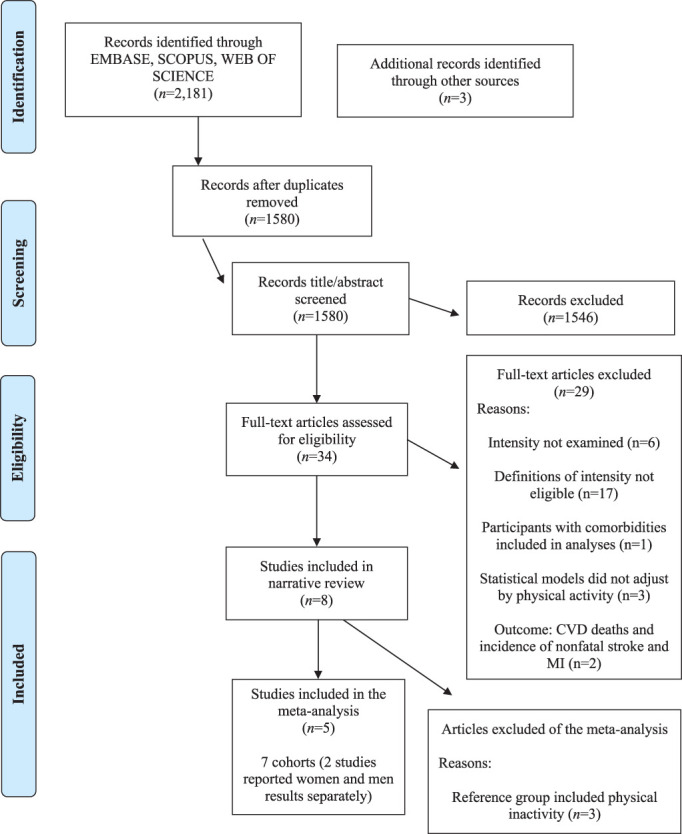
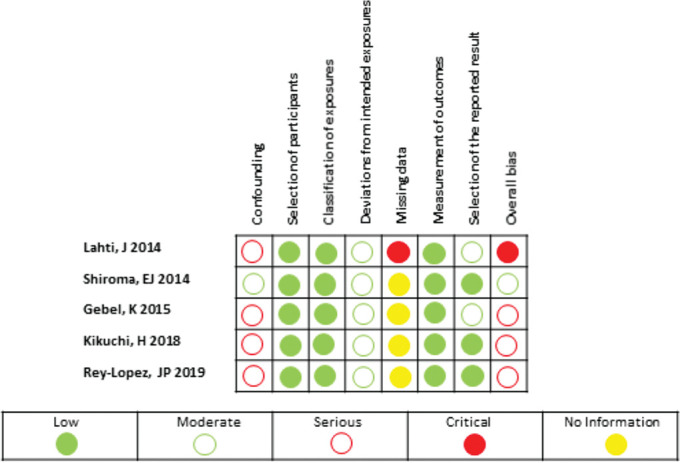
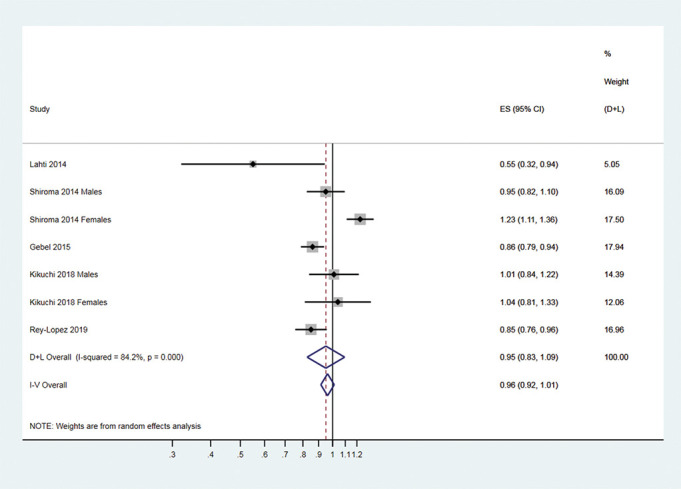
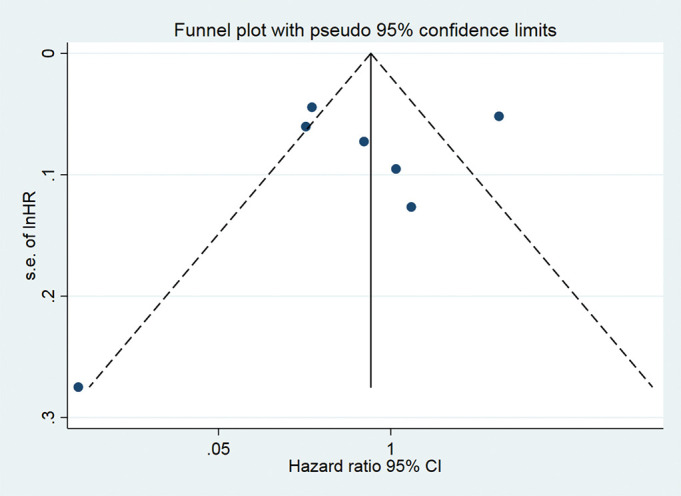
Objective: To examine whether vigorous-intensity physical activity confers additional reductions on all-cause and cause-specific mortality compared with moderate-intensity physical activity. Design: A systematic review (registered in PROSPERO CRD42019138995) and meta-analysis. Data sources: Three electronic databases up to April 14 2020. Eligibility criteria: Inclusion criteria were prospective studies that contained information about (1) moderate-intensity (3–5.9 metabolic equivalent tasks (METs)) and vigorous-intensity (≥6 METs) physical activities and (2) all-cause and/or cause-specific mortality. Exclusion criteria were prospective studies that (1) exclusively recruited diseased patients (eg, hypertensive patients and diabetics) or (2) did not account for total physical activity in their multivariable models (3) or did not adjust or exclude individuals with comorbidities at baseline or (4) used physically inactive participants as reference group. Results: Five studies (seven cohorts using sex-specific results) were pooled into a meta-analysis. For all-cause mortality and controlling by total physical activity, vigorous-intensity physical activity (vs moderate) was not associated with a larger reduction in mortality (HR 0.95, 95% CI 0.83 to 1.09). After the exclusion of one study judged with critical risk of bias (Risk Of Bias in Non randomized Studies, ROBINS tool) from meta-analysis, results remained similar (HR 0.98, 95% CI 0.85 to 1.12). Due to the limited number of studies, meta-analyses for cancer and cardiovascular mortality were not performed. Conclusions: Prospective studies suggest that, for the same total physical activity, both vigorous-intensity and moderate-intensity physical activities reduce all-cause mortality to the same extent. However, absence of evidence must not be interpreted as evidence of absence due to the existing methodological flaws in the literature.
Overview
The claims and statistics of this paper haven’t been checked yet.
Free: it reads the open-access text and checks the first 5 claims that cite a source we can check. Create a free account to check every claim.
Integrity signals
Registry
Cites
Statistics
Figures
Verification
Claims the paper makes
The claims and statistics of this paper haven’t been checked yet.
Free: it reads the open-access text and checks the first 5 claims that cite a source we can check. Create a free account to check every claim.
Claims other papers make about this one
Each is checked against this paper’s own text: does it say what the citing paper says it does?
The cited source doesn’t support the claim as written.
In the citing paper
“For a given volume of physical activity, higher contributions of VPA are associated with additional mortality risk reduction10–13.”
From Association of wearable device-measured vigorous intermittent lifestyle physical activity with mortality (2022) · cites this paper as [13]
Checked by a reasoning model — may be wrong.
Experimental — accuracy not yet measuredThe cited source says what the claim attributes to it.
In the citing paper
“The health effects of each time unit of physical activity are intensity dependent10–13.”
From Association of wearable device-measured vigorous intermittent lifestyle physical activity with mortality (2022) · cites this paper as [13]
Self-check
Percentages, sums and reported differences re-computed from the paper’s own numbers.
The self-check needs the paper’s full text.
Citations
Cites
Measuring inconsistency in meta-analyses
Higgins, J. P. T., Thompson, S. G., Deeks, J. J., & Altman, D. G. (2003) · BMJ · doi:10.1136/bmj.327.7414.557 · Cited by 63,139 · cited 1×
“28 The CI for the I 2 measure was derived using the Q statistic and the corresponding degrees of freedom.”
Liberati, A., Altman, D. G., Tetzlaff, J., Mulrow, C., Gøtzsche, P. C., Ioannidis, J. P. A., Clarke, M., Devereaux, P. J., Kleijnen, J., & Moher, D. (2009) · PLoS Medicine · doi:10.1371/journal.pmed.1000100 · Cited by 28,164
ROBINS-I: a tool for assessing risk of bias in non-randomised studies of interventions
Sterne, J. A., Hernán, M. A., Reeves, B. C., Savović, J., Berkman, N. D., Viswanathan, M., Henry, D., Altman, D. G., Ansari, M. T., Boutron, I., et al. (2016) · BMJ · doi:10.1136/bmj.i4919 · Cited by 20,329
Liberati, A., Altman, D. G., Tetzlaff, J., Mulrow, C., Gotzsche, P. C., Ioannidis, J. P. A., Clarke, M., Devereaux, P. J., Kleijnen, J., & Moher, D. (2009) · BMJ · doi:10.1136/bmj.b2700 · Cited by 17,648
Lee, I.-M., Shiroma, E. J., Lobelo, F., Puska, P., Blair, S. N., & Katzmarzyk, P. T. (2012) · The Lancet · doi:10.1016/s0140-6736(12)61031-9 · Cited by 8,215
Fit Yourself and Take Your Lungs to Heart
Palange, P., & Bonini, M. (2013) · Respiration · doi:10.1159/000350831 · Cited by 2,779
Peters, J. L., Sutton, A. J., Jones, D. R., Abrams, K. R., & Rushton, L. (2008) · Journal of Clinical Epidemiology · doi:10.1016/j.jclinepi.2007.11.010 · Cited by 2,053 · cited 2×
“29 Sensitivity analyses to determine whether a particular study largely accounted for heterogeneity were explored by removing one by one study from the meta-analysis.”
Wisløff, U., Støylen, A., Loennechen, J. P., Bruvold, M., Rognmo, Ø., Haram, P. M., Tjønna, A. E., Helgerud, J., Slørdahl, S. A., Lee, S. J., et al. (2007) · Circulation · doi:10.1161/circulationaha.106.675041 · Cited by 1,996
Endurance running and the evolution of Homo
Bramble, D. M., & Lieberman, D. E. (2004) · Nature · doi:10.1038/nature03052 · Cited by 1,743 · cited 1×
“Finally, a small number of cohorts were identified and pooled into the meta-analysis and subgroup or meta-regression analyses were discarded (due to low statistical power) to explore the sources of heterogeneity.”
Exercise Type and Intensity in Relation to Coronary Heart Disease in Men
Tanasescu, M. (2002) · JAMA · doi:10.1001/jama.288.16.1994 · Cited by 928 · cited 1×
“…larger risk reductions on all-cause 23 – 25 and cardiovascular disease (CVD) mortality in participants with higher vigorous-intensity activity, 21 another study observed inconsistent associations (of vigorous-intensity vs moderate-intensity activities) on CVD mortality between sexes and a…”
Physical fitness and activity as separate heart disease risk factors: a meta-analysis
WILLIAMS, P. T. (2001) · Medicine & Science in Sports & Exercise · doi:10.1097/00005768-200105000-00012 · Cited by 724
Comparison of cardioprotective benefits of vigorous versus moderate intensity aerobic exercise
Swain, D. P., & Franklin, B. A. (2006) · The American Journal of Cardiology · doi:10.1016/j.amjcard.2005.07.130 · Cited by 660
Lee, I.-M., & Paffenbarger, R. S. (2000) · American Journal of Epidemiology · doi:10.1093/oxfordjournals.aje.a010205 · Cited by 628 · cited 1×
“8 20 – 25 While some prospective studies reported larger risk reductions on all-cause 23 – 25 and cardiovascular disease (CVD) mortality in participants with higher vigorous-intensity activity, 21 another study observed inconsistent associations (of vigorous-intensity vs moderate-intensity…”
Association of Step Volume and Intensity With All-Cause Mortality in Older Women
Lee, I.-M., Shiroma, E. J., Kamada, M., Bassett, D. R., Matthews, C. E., & Buring, J. E. (2019) · JAMA Internal Medicine · doi:10.1001/jamainternmed.2019.0899 · Cited by 604
Fitness versus physical activity patterns in predicting mortality in men
Myers, J., Kaykha, A., George, S., Abella, J., Zaheer, N., Lear, S., Yamazaki, T., & Froelicher, V. (2004) · The American Journal of Medicine · doi:10.1016/j.amjmed.2004.06.047 · Cited by 521
Physical Activity Recommendations and Decreased Risk of Mortality
Leitzmann, M. F. (2007) · Archives of Internal Medicine · doi:10.1001/archinte.167.22.2453 · Cited by 438 · cited 4×
“A total of five studies measured habitual physical activity (over the span of a year, whereas W e c o n t ac t e d b y e m a il w i t h K i k u c h i e t a l 24 a s t h e y r e p o r t e d a m i s t a k e i n t h e i r p u b li ca t i o n .”
InfluentialDowd, K. P., Szeklicki, R., Minetto, M. A., Murphy, M. H., Polito, A., Ghigo, E., van der Ploeg, H., Ekelund, U., Maciaszek, J., Stemplewski, R., et al. (2018) · International Journal of Behavioral Nutrition and Physical Activity · doi:10.1186/s12966-017-0636-2 · Cited by 385 · cited 1×
“The epidemiological evidence available indicates that vig-orous-intensity and moderate-intensity physical activity may reduce mortality to the same extent, after controlling by the volume of physical activity.”
Kaminsky, L. A., Arena, R., Beckie, T. M., Brubaker, P. H., Church, T. S., Forman, D. E., Franklin, B. A., Gulati, M., Lavie, C. J., Myers, J., et al. (2013) · Circulation · doi:10.1161/cir.0b013e31827ee100 · Cited by 364
Gebel, K., Ding, D., Chey, T., Stamatakis, E., Brown, W. J., & Bauman, A. E. (2015) · JAMA Internal Medicine · doi:10.1001/jamainternmed.2015.0541 · Cited by 344 · cited 3×
“Finally, a small number of cohorts were identified and pooled into the meta-analysis and subgroup or meta-regression analyses were discarded (due to low statistical power) to explore the sources of heterogeneity.”
Influential&OV0312;O2 reserve and the minimal intensity for improving cardiorespiratory fitness
SWAIN, D. P., & FRANKLIN, B. A. (2002) · Medicine & Science in Sports & Exercise · doi:10.1097/00005768-200201000-00023 · Cited by 269
Hunter-gatherers as models in public health
Pontzer, H., Wood, B. M., & Raichlen, D. A. (2018) · Obesity Reviews · doi:10.1111/obr.12785 · Cited by 229 · cited 1×
“Finally, a small number of cohorts were identified and pooled into the meta-analysis and subgroup or meta-regression analyses were discarded (due to low statistical power) to explore the sources of heterogeneity.”
Association between domains of physical activity and all-cause, cardiovascular and cancer mortality
Autenrieth, C. S., Baumert, J., Baumeister, S. E., Fischer, B., Peters, A., Döring, A., & Thorand, B. (2011) · European Journal of Epidemiology · doi:10.1007/s10654-010-9517-6 · Cited by 195 · cited 2×
“Finally, a small number of cohorts were identified and pooled into the meta-analysis and subgroup or meta-regression analyses were discarded (due to low statistical power) to explore the sources of heterogeneity.”
Sassen, B., Cornelissen, V. A., Kiers, H., Wittink, H., Kok, G., & Vanhees, L. (2009) · European Journal of Cardiovascular Prevention & Rehabilitation · doi:10.1097/hjr.0b013e3283312e94 · Cited by 155
Stamatakis, E., Hamer, M., O'Donovan, G., Batty, G. D., & Kivimaki, M. (2013) · European Heart Journal · doi:10.1093/eurheartj/ehs097 · Cited by 138
Zhao, M., Veeranki, S. P., Li, S., Steffen, L. M., & Xi, B. (2019) · British Journal of Sports Medicine · doi:10.1136/bjsports-2018-099254 · Cited by 133
Shiroma, E. J., Sesso, H. D., Moorthy, M. V., Buring, J. E., & Lee, I. (2014) · Journal of the American Heart Association · doi:10.1161/jaha.114.000802 · Cited by 107
Leisure-Time Physical Activity and All-Cause Mortality
Lahti, J., Holstila, A., Lahelma, E. T., & Rahkonen, O. (2014) · PLoS ONE · doi:10.1371/journal.pone.0101548 · Cited by 68 · cited 2×
“Two studies 22 25 (three cohorts after using the results available by sex) evaluated the association between vigor-ous-intensity physical activity and CVD mortality.”
InfluentialShave, R. E., Lieberman, D. E., Drane, A. L., Brown, M. G., Batterham, A. M., Worthington, S., Atencia, R., Feltrer, Y., Neary, J., Weiner, R. B., et al. (2019) · Proceedings of the National Academy of Sciences · doi:10.1073/pnas.1906902116 · Cited by 61 · cited 1×
“Finally, a small number of cohorts were identified and pooled into the meta-analysis and subgroup or meta-regression analyses were discarded (due to low statistical power) to explore the sources of heterogeneity.”
Impact of Moderate-Intensity and Vigorous-Intensity Physical Activity on Mortality
KIKUCHI, H., INOUE, S., LEE, I.-M., ODAGIRI, Y., SAWADA, N., INOUE, M., & TSUGANE, S. (2018) · Medicine & Science in Sports & Exercise · doi:10.1249/mss.0000000000001463 · Cited by 58 · cited 1×
“Finally, a small number of cohorts were identified and pooled into the meta-analysis and subgroup or meta-regression analyses were discarded (due to low statistical power) to explore the sources of heterogeneity.”
Effects of moderate and vigorous physical activity on fitness and body composition
Drenowatz, C. J., Prasad, V. K., Hand, G. A., Shook, R. P., & Blair, S. N. (2016) · Journal of Behavioral Medicine · doi:10.1007/s10865-016-9740-z · Cited by 54
Interval Training for Cardiometabolic Health: Why Such A HIIT?
Gibala, M. J. (2018) · Current Sports Medicine Reports · doi:10.1249/jsr.0000000000000483 · Cited by 52 · cited 1×
“8 20 – 25 While some prospective studies reported larger risk reductions on all-cause 23 – 25 and cardiovascular disease (CVD) mortality in participants with higher vigorous-intensity activity, 21 another study observed inconsistent associations (of vigorous-intensity vs moderate-intensity…”
Rey Lopez, J. P., Gebel, K., Chia, D., & Stamatakis, E. (2019) · BMJ Open Sport & Exercise Medicine · doi:10.1136/bmjsem-2019-000596 · Cited by 52
Büttner, F., Winters, M., Delahunt, E., Elbers, R., Lura, C. B., Khan, K. M., Weir, A., & Ardern, C. L. (2020) · British Journal of Sports Medicine · doi:10.1136/bjsports-2019-100806 · Cited by 47
Relationship between physical activity and aerobic fitness.
Nokes, N. R. (2009) · PubMed · Cited by 36
Research works printed but not linked: 1
- World Health Organization. Global recommendations on physical activity for health. Geneva, 2010. Available https://www.who.int/dietphysicalactivity/factsheet_recommendations/en/ (accessed 3 Oct 2018) 26180873
Cited by
Stamatakis, E., Ahmadi, M. N., Gill, J. M. R., Thøgersen-Ntoumani, C., Gibala, M. J., Doherty, A., & Hamer, M. (2022) · Nature Medicine · doi:10.1038/s41591-022-02100-x · Cited by 336
Lee, D. H., Rezende, L. F. M., Joh, H.-K., Keum, N., Ferrari, G., Rey-Lopez, J. P., Rimm, E. B., Tabung, F. K., & Giovannucci, E. L. (2022) · Circulation · doi:10.1161/circulationaha.121.058162 · Cited by 288
Vigorous physical activity, incident heart disease, and cancer: how little is enough?
Ahmadi, M. N., Clare, P. J., Katzmarzyk, P. T., del Pozo Cruz, B., Lee, I. M., & Stamatakis, E. (2022) · European Heart Journal · doi:10.1093/eurheartj/ehac572 · Cited by 175
“Examining the dose-response of short and intermittent VPA bursts requires device-based measurments.(9) Indeed, the World Health Organization Guidelines Development Group recently indicated the need for device-based studies to objectively assess the relationship of physical activity with mortality and disease risk as a…”
Backgrounddos Santos, M., Ferrari, G., Lee, D. H., Rey-López, J. P., Aune, D., Liao, B., Huang, W., Nie, J., Wang, Y., Giovannucci, E. L., et al. (2022) · JAMA Internal Medicine · doi:10.1001/jamainternmed.2022.2488 · Cited by 157
Self-citationDing, D., Buskirk, J. V., Nguyen, B., Stamatakis, E., Elbarbary, M., Veronese, N., Clare, P. J., Lee, I.-M. M., Ekelund, U., & Fontana, L. (2022) · British Journal of Sports Medicine · doi:10.1136/bjsports-2021-105195 · Cited by 96
Metadata
- Authors
- Rey Lopez, J. P., Sabag, A., Martinez Juan, M., Rezende, L. F. M., & Pastor-Valero, M.
- Affiliations
- Prevention Research Collaboration, Sydney School of Public Health, University of Sydney, Sydney, Australia
- Western Sydney University (AU)
- Salud Pública, Historia de la Ciencia y Ginecología, Universidad Miguel Hernández, Elche, Spain
- Universidade Federal de São Paulo (BR)
- Venue
- BMJ Open Sport & Exercise Medicine
- Publisher
- BMJ
- Published
- 2020-10
- Volume
- 6
- Issue
- 1
- Pages
- e000775
- ISSN
- 2055-7647 (ISSN-L)
- PMC
- PMC7610342
- OpenAlex
- W3091386645
- Cited by
- 63
- References
- 35
- Citations by year
- 2026: 7 · 2025: 11 · 2024: 26 · 2023: 5 · 2022: 10 · 2021: 3 · 2020: 1
- FWCI
- 0.61
- Type
- journal article
- Language
- en
- Open access
- gold
- doi.org
- Licence
- Locations
- BMJ Open Sport & Exercise Medicine (publishedVersion, cc-by)
- PubMed Central (publishedVersion, cc-by)
- PubMed (publishedVersion)
- DOAJ (DOAJ: Directory of Open Access Journals) (submittedVersion, cc-by-sa)
- Funders
- University of Sydney
- Topics
- Health Sciences › Medicine › Public Health, Environmental and Occupational Health › Physical Activity and Health
- Health Sciences › Medicine › Physiology (medical) › Cardiovascular and exercise physiology
- Health Sciences › Medicine › Cardiology and Cardiovascular Medicine › Cardiovascular Effects of Exercise
- Keywords
- high-intensity exercise, moderate physical activity, all-cause mortality, cause-specific mortality, metabolic equivalent of task, total physical activity, cancer mortality, cardiovascular mortality, risk of bias
About these checks
Registry, retraction, Cites and statistics results are computed, not judged, with one exception: a printed reference that no index lists is read once by a model before it counts as a citation error. Claims are extracted by a model and kept only when their quote appears verbatim in the text; each cited source is then checked, with a model’s help, for whether it says what the claim relies on. Those verdicts can be wrong — read the claim’s quote and the cited source before relying on one.
Statistics and arithmetic are recomputed, not judged.
Confidence bands are shown only for fields calibrated on our annotated test set. None is calibrated yet, so no band is shown.
What counts as a claim ›How we measure confidence ›How we check this ›
Are you an author, or do you see a problem with this page? Request a review
Data sources
Bibliographic data: Semantic Scholar, OpenAlex, Crossref.
Contains information from the Semantic Scholar Academic Graph Datasets, made available under the ODC Attribution License (ODC-BY 1.0).
Semantic Scholar’s data is described in: Kinney, R., et al. (2023). The Semantic Scholar Open Data Platform. arXiv:2301.10140.
