

AI did not write this manuscript, or did it? Can we trick the AI text detector into generated texts? The potential future of ChatGPT and AI in Sports & Exercise Medicine manuscript generation
Open accessThe DOI matches its Crossref record; 4 of the 4 references it cites were found in a registry or an index.
Abstract
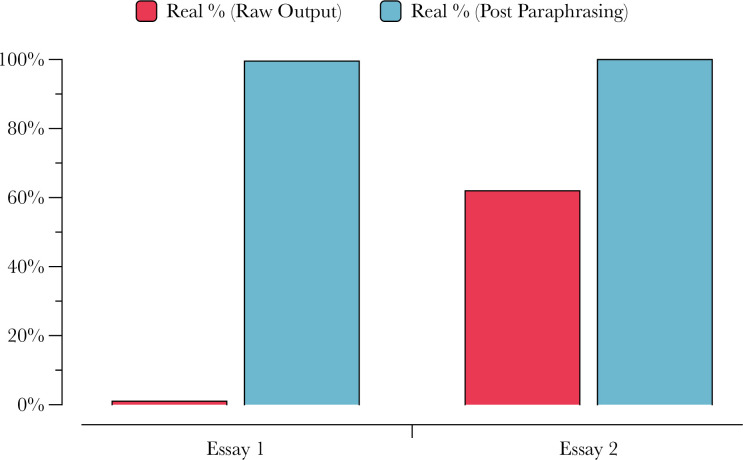
Correspondence to Dr Nash Anderson; nash. anderson@ gmail. com © Author(s) (or their employer(s)) 2023. Reuse permitted under CC BYNC. No commercial reuse. See rights and permissions. Published by BMJ. INTRODUCTION Researching a topic and generating an academic paper is a nuanced skill. It can take months or years to produce and publish one, if it is ever published at all. What if there were a way to make this happen instantly? Artificial intelligence (AI) may hold a flame to quickly analyse a research topic and generate an academic paper. There are many forms of AI; this editorial discusses natural language modelbased AI, such as ChatGPT, and their potential ability to generate academic papers. Natural language modelbased AI, in particular ChatGPT, is generating new content and a lot of controversies. This AI software is innovative. It generates, de novo, content that has a natural conversational flow. It can quickly answer questions and write poems, fan fiction and children’s books. ChatGPT has even passed the United States Medical Licensing Examination theory section with no additional training and/or years of studying medicine. Languagebased AI has already entered the scientific community. Nature reported that four manuscripts in preprint credit ChatGPT as an author. Also, an article reported that AI had been used to generate an academic paper. In this editorial, we discuss the pros and cons of AI for manuscript generation in sports and exercise medicine (SEM), generate an academic paper using AI and bypass AIgeneration detection, and discuss potential concerns regarding natural language modelbased AI. We aim to get insights on how AI, in particular ChatGPT and similar language modelbased AI, will impact the future of manuscript generation in SEM. To achieve such purpose, we ought to consider what is an academic paper, whether AI should write academic papers, what the issues are, what our stance should be on AIgenerated texts and how we deal with them.
Overview
The claims and statistics of this paper haven’t been checked yet.
Free: it reads the open-access text and checks the first 5 claims that cite a source we can check. Create a free account to check every claim.
Integrity signals
Registry
Cites
Statistics
Figures
Verification
Claims the paper makes
The claims and statistics of this paper haven’t been checked yet.
Free: it reads the open-access text and checks the first 5 claims that cite a source we can check. Create a free account to check every claim.
Claims other papers make about this one
Each is checked against this paper’s own text: does it say what the citing paper says it does?
The cited source says what the claim attributes to it.
In the citing paper
“Several studies have shown that paraphrasing can alter AI-generated texts to make them less susceptible to detection (Anderson et al., 2023;Krishna et al., 2023;Sadasivan et al., 2023;Weber-Wulff et al., 2023), but none have evaluated the effectiveness of the various paraphrasing techniques.”
From The Effectiveness of Software Designed to Detect AI-Generated Writing: A Comparison of 16 AI Text Detectors (2023) · cites this paper as Anderson et al., 2023
The cited source says what the claim attributes to it.
In the citing paper
“Our findings are consistent with previously published studies (Gao et al. 2022; Anderson et al. 2023; Elkhatat et al. 2023; Demers 2023; Gewirtz 2023; Krishna et al. 2023; Pegoraro et al. 2023; van Oijen 2023; Wang et al. 2023)”
From Testing of detection tools for AI-generated text (2023) · cites this paper as Anderson et al. 2023
In the citing paper
“Another concern, especially in academic circles, is the reliability of AI-generated text. Platforms like ChatGPT may produce content with inaccuracies or plagiarization, jeopardizing work credibility, especially if it includes false references or citation errors.11–13”
From Balancing innovation and integrity: the role of AI in research and scientific writing (2023) · cites this paper as [11]
Self-check
Percentages, sums and reported differences re-computed from the paper’s own numbers.
The self-check needs the paper’s full text.
Citations
Cites
ChatGPT listed as author on research papers: many scientists disapprove
Stokel-Walker, C. (2023) · Nature · doi:10.1038/d41586-023-00107-z · Cited by 868
Abstracts written by ChatGPT fool scientists
Else, H. (2023) · Nature · doi:10.1038/d41586-023-00056-7 · Cited by 611
Tools such as ChatGPT threaten transparent science; here are our ground rules for their use
(2023) · Nature · doi:10.1038/d41586-023-00191-1 · Cited by 605
Memon, A. R. (2020) · Journal of Korean Medical Science · doi:10.3346/jkms.2020.35.e217 · Cited by 39
Self-citation
Research works printed but not linked: 1
- Defining the role of authors and contributors [Internet]. International Committee of Medical Journal Editors ICMJE. 2023. Available: https://www.icmje.org/recommendations/browse/roles-and-responsibilities/defining-the-role-of-authors-and-contributors.html
Cited by
Items 201–245 of 245
Artificial Intelligence and Health Care: What's to Worry?
Doarn, C. R. (2023) · Telemedicine Journal and e-Health · doi:10.1089/tmj.2023.29095.editorial
Expanding our editorial capacity
de la Hunty, A. (2023) · Nutrition Bulletin · doi:10.1111/nbu.12631
Artificial intelligence (AI) in scientific publishing: Where should we draw the line?
Wijesinghe, M. S. D., Prathapan, S., & Arambepola, C. (2023) · Journal of the College of Community Physicians of Sri Lanka · doi:10.4038/jccpsl.v29i2.8634
The Interactive Web – ChatGPT as Writing Tool and Publisher Policies
Swogger, S. E. (2023) · Journal of Electronic Resources in Medical Libraries · doi:10.1080/15424065.2023.2244363
Hai-Jew, S. (2023) · Advances in educational technologies and instructional design book series · doi:10.4018/979-8-3693-0074-9.ch005
Li, H., Moon, J. T., Trivedi, H., & Gichoya, J. W. (2023) · Journal of the American College of Radiology · doi:10.1016/j.jacr.2023.12.009
From advancements to ethics: Assessing ChatGPT’s role in writing research paper
Gupta, V., Anamika, F., Parikh, K., Patel, M. A., Jain, R., & Jain, R. (2024) · Turkish Journal of Internal Medicine · doi:10.46310/tjim.1398093
Pangarso, A. (2024) · Elsevier eBooks · doi:10.1016/b978-0-443-13701-3.00327-3
ChatGPT’s Performance in Spreadsheets Modeling Assessments based on Revised Bloom’s Taxonomy
Cheong, M. L. F. (2023) · International Conference on Computers in Education · doi:10.58459/icce.2023.983
Navigating ChatGPT: Opportunities, Challenges, and Plagiarism in Student Writing
Asim, T., Shaheen, N., Tasneem, A., & Yousuf, M. M. (2024) · International Journal of English Literature and Social Sciences · doi:10.22161/ijels.96.65
Applications of artificial intelligence in science: a practical guide for editors and authors
Mesquita, C. T., Silva, M., Yahiro, D. S., Ribeiro-Coelho, B., & Silva, F. A. (2025) · Archivos de cardiolog�a de M�xico (English ed Internet) · doi:10.24875/acme.m25000576
Academic Buoyancy Supported by Artificial Intelligence among First-Year Students at Mutah University
Daban, S. D. (2025) · Jordanian Educational Journal · doi:10.46515/jaes.v10i2.1471
AI Content Self-Detection for Transformer-Based Large Language Models
Caiado, A. J. A., & Hahsler, M. (2025) · Lecture notes in networks and systems · doi:10.1007/978-3-031-99965-9_10
Multilingual AI-Generated Text Detection with BERT and LSTM Model
Kumar, J., Gupta, R., Sharma, S., Arora, J., Dangi, D., & Dixit, D. K. (2025) · International Conference on Networks, Multimedia and Information Technology (NMITCON) · doi:10.1109/nmitcon65824.2025.11188051
Internationalization of the Curriculum: How to Assess in the Era of ChatGPT – A Mexican Perspective
Álvarez, M. C. C., & Mendoza, M. P. (2025) · Emerald Group Publishing Limited eBooks · doi:10.1108/978-1-83549-788-320251026
Detection of AI-Generated texts with BERT variants
Balara, V., & Machová, K. (2025) · International Conference on Emerging eLearning Technologies and Applications (ICETA) · doi:10.1109/iceta67772.2025.11280096
Liu, J. Q., Hui, K. T., Zoubi, F. A., Zhou, Z. Z. X., Samartzis, D., Yu, C. C. H., Chang, J. R., & Wong, A. Y. L. (2024) · Figshare · doi:10.6084/m9.figshare.25857523
Scientific Enhancement: Zur Relevanz wissenschaftlichen Schreibens in Zeiten künstlicher Intelligenz
Märzinger, M. (2024) · zeitschrift für interdisziplinäre schreibforschung · doi:10.48646/zisch.241101
Additional file 1 of Testing of detection tools for AI-generated text
Weber-Wulff, D., Anohina-Naumeca, A., Bjelobaba, S., Foltýnek, T., Guerrero-Dib, J. G., Popoola, O., Šigut, P., & Waddington, L. (2024) · Figshare · doi:10.6084/m9.figshare.26651427
Att hantera det oundvikliga : En kvalitativ studie om disruptiv teknik i gymnasieskolan
Hedström, O., & Hansson, J. (2024) · DiVA at Umeå University (Umeå University)
¿ La tecnología es realmente necesaria en el camino hacia el éxito de la reahabilitación deportiva?
Alfonso-Mantilla, J. I. (2024) · Dialnet (Universidad de la Rioja)
Intelligenza artificiale e ricerca accademica: uno sguardo critico tra rischi e innovazione
Iemma, M. (2024) · Archivio Istituzionale della Ricerca (Universita Degli Studi Di Milano)
Artificial Intelligence In Learning English for Students of STIKOM Uyelindo Kupang
Heni, H. (2025) · Jurnal Onoma Pendidikan Bahasa dan Sastra · doi:10.30605/onoma.v11i4.6647
Trust and Social Robots: How can We Prevent Social Robots from Eroding Trust?
Strasser, A. (2026) · Social and cultural studies of robots and AI · doi:10.1007/978-3-031-99290-2_9
Bolaños-Carpio, A., & Solano, C. F. (2025) · Redalyc (Universidad Autónoma del Estado de México) · doi:10.15517/hhvhvg32
The challenges of developing AI text detectors, and their moral implications
Sharifzadeh, R. (2026) · Journal of Information Communication and Ethics in Society · doi:10.1108/jices-10-2025-0292
Ramírez, G., Dangovski, R., Nakov, P., & Soljacic, M. (2024) · Language Resources and Evaluation Conference (LREC) · doi:10.63317/2bj7yqvykabj
Sharma, V., & George, R. (2026) · Arab World English Journal · doi:10.24093/awej/vol17no1.7
The University Students’ Perceptions Using ChatGPT in Writing Skills
Hasanah, D. U., & Muamaroh, M. (2026) · LINGUA Jurnal Bahasa Sastra dan Pengajarannya · doi:10.30957/lingua.v21i1.947
Verification of AI-generated content
Hocenski, I., Jakopec, T., & Selthofer, J. (2026) · Information Research · doi:10.47989/ir31261629
An emerging AI4Academia model: exploring the ethical implications of GenAI in higher education
Hendal, B. A. (2026) · Information Discovery and Delivery · doi:10.1108/idd-01-2026-0024
Niemann, S., & Schmid, U. (2026) · International Conference on Information Technology Based Higher Education and Training (ITHET) · doi:10.1109/ithet69978.2026.11585137
Uyar, A. (2026) · Journal of Learning and Teaching in Digital Age · doi:10.53850/joltida.1825745
Tourism and Society 5.0: a conversation with ChatGPT and future research agenda
Koukopoulos, A. (2026) · Journal of Tourism Futures · doi:10.1108/jtf-08-2024-0173
Signs of machine generation in student works on higher mathematics
Kostrova, Y. S. (2026) · Pedagogy Theory & Practice · doi:10.30853/ped20260166
Khoshgoftar, Z., Ghaiyoomi, S., & Alaee, A. (2026) · Journal of Education and Health Promotion · doi:10.4103/jehp.jehp_719_25
Lecturers’ Perspectives on the Use of ChatGPT in Accountancy Education: Opportunities and Threats
Nwosu, L. I., Leendertz, V., & Marx, A. (2026) · Springer eBooks · doi:10.1007/978-981-95-9489-4_34
Enang, C. E. (2025) · Nigerian Journal of Business Education (NIGJBED)
AI4Scientist: Accelerating and democratizing scientific research lifecycle
Wang, Q. (2025) · Illinois Digital Environment for Access to Learning and Scholarship (University of Illinois at Urbana-Champaign)
Shebunchak, N. (2026) · Repository of the University of Ljubljana (University of Ljubljana)
The use of artificial intelligence in academic research: between risks and innovation
Iemma, M. (2026) · Archivio Istituzionale della Ricerca (Universita Degli Studi Di Milano)
Violini, L., & Ragone, G. (2026) · Archivio Istituzionale della Ricerca (Universita Degli Studi Di Milano)
Forkuo, G. O., Boatemaa, A., Osei, B., & Osei_Dwomoh, E. (2026) · Research Square · doi:10.21203/rs.3.rs-11614667/v1
Metadata
- Authors
- Anderson, N., Belavy, D. L., Perle, S. M., Hendricks, S., Hespanhol, L., Verhagen, E., & Memon, A. R.
- Affiliations
- Tuggeranong Chiropractic Centre, Canberra, Australian Capital Territory, Australia
- Department of Applied Health Sciences, Hochschule für Gesundheit, Bochum, Gesundheitscampus 6-8, Germany
- Murdoch University (AU)
- University of Cape Town (ZA)
- Universidade Cidade de São Paulo (BR)
- Amsterdam University Medical Centers (NL)
- Victoria University (AU)
- Corresponding author
- Anderson, Nash
- ORCID
- Venue
- BMJ Open Sport & Exercise Medicine
- Publisher
- BMJ
- Published
- 2023-02
- Volume
- 9
- Issue
- 1
- Pages
- e001568
- ISSN
- 2055-7647 (ISSN-L)
- PMC
- PMC9936276
- OpenAlex
- W4321116084
- Cited by
- 168
- References
- 4
- Citations by year
- 2026: 18 · 2025: 32 · 2024: 56 · 2023: 61
- Type
- journal article
- Language
- en
- Open access
- gold
- doi.org
- Licence
- Locations
- BMJ Open Sport & Exercise Medicine (publishedVersion, cc-by-nc)
- PubMed Central (publishedVersion, cc-by-nc)
- PubMed (publishedVersion)
- Pure Amsterdam UMC (publishedVersion, other-oa)
- Amsterdam UMC (VU Amsterdam) - Institutional Repository (publishedVersion, other-oa)
- VUBIR (Vrije Universiteit Brussel) (submittedVersion)
- DOAJ (DOAJ: Directory of Open Access Journals) (submittedVersion, cc-by-sa)
- Data Archiving and Networked Services (DANS) (submittedVersion, other-oa)
- Topics
- Social Sciences › Education › Academic integrity and plagiarism
- Social Sciences › Library and Information Sciences › Academic Writing and Publishing
- Physical Sciences › Computer Science › Artificial Intelligence › Authorship Attribution and Profiling
- Keywords
- AI-generated text detection, ChatGPT, artificial intelligence, research ethics, authorship, sports medicine
About these checks
Registry, retraction, Cites and statistics results are computed, not judged, with one exception: a printed reference that no index lists is read once by a model before it counts as a citation error. Claims are extracted by a model and kept only when their quote appears verbatim in the text; each cited source is then checked, with a model’s help, for whether it says what the claim relies on. Those verdicts can be wrong — read the claim’s quote and the cited source before relying on one.
Statistics and arithmetic are recomputed, not judged.
Confidence bands are shown only for fields calibrated on our annotated test set. None is calibrated yet, so no band is shown.
What counts as a claim ›How we measure confidence ›How we check this ›
Are you an author, or do you see a problem with this page? Request a review
Data sources
Bibliographic data: Semantic Scholar, OpenAlex, Crossref.
Contains information from the Semantic Scholar Academic Graph Datasets, made available under the ODC Attribution License (ODC-BY 1.0).
Semantic Scholar’s data is described in: Kinney, R., et al. (2023). The Semantic Scholar Open Data Platform. arXiv:2301.10140.
