

AI did not write this manuscript, or did it? Can we trick the AI text detector into generated texts? The potential future of ChatGPT and AI in Sports & Exercise Medicine manuscript generation
Open accessThe DOI matches its Crossref record; 4 of the 4 references it cites were found in a registry or an index.
Abstract
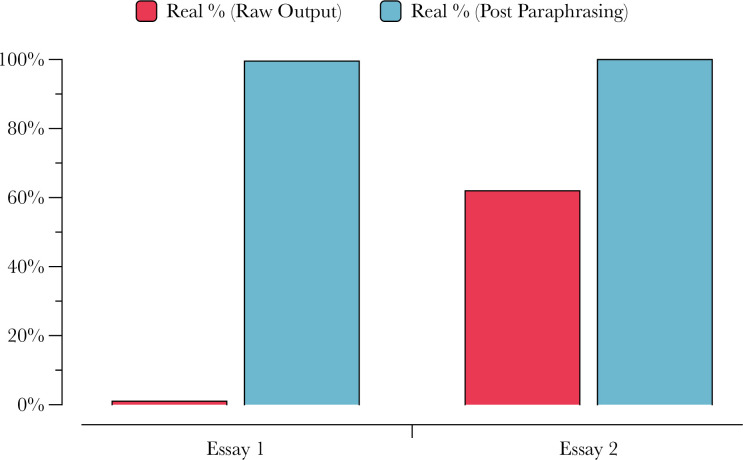
Correspondence to Dr Nash Anderson; nash. anderson@ gmail. com © Author(s) (or their employer(s)) 2023. Reuse permitted under CC BYNC. No commercial reuse. See rights and permissions. Published by BMJ. INTRODUCTION Researching a topic and generating an academic paper is a nuanced skill. It can take months or years to produce and publish one, if it is ever published at all. What if there were a way to make this happen instantly? Artificial intelligence (AI) may hold a flame to quickly analyse a research topic and generate an academic paper. There are many forms of AI; this editorial discusses natural language modelbased AI, such as ChatGPT, and their potential ability to generate academic papers. Natural language modelbased AI, in particular ChatGPT, is generating new content and a lot of controversies. This AI software is innovative. It generates, de novo, content that has a natural conversational flow. It can quickly answer questions and write poems, fan fiction and children’s books. ChatGPT has even passed the United States Medical Licensing Examination theory section with no additional training and/or years of studying medicine. Languagebased AI has already entered the scientific community. Nature reported that four manuscripts in preprint credit ChatGPT as an author. Also, an article reported that AI had been used to generate an academic paper. In this editorial, we discuss the pros and cons of AI for manuscript generation in sports and exercise medicine (SEM), generate an academic paper using AI and bypass AIgeneration detection, and discuss potential concerns regarding natural language modelbased AI. We aim to get insights on how AI, in particular ChatGPT and similar language modelbased AI, will impact the future of manuscript generation in SEM. To achieve such purpose, we ought to consider what is an academic paper, whether AI should write academic papers, what the issues are, what our stance should be on AIgenerated texts and how we deal with them.
Overview
The claims and statistics of this paper haven’t been checked yet.
Free: it reads the open-access text and checks the first 5 claims that cite a source we can check. Create a free account to check every claim.
Integrity signals
Registry
Cites
Statistics
Figures
Verification
Claims the paper makes
The claims and statistics of this paper haven’t been checked yet.
Free: it reads the open-access text and checks the first 5 claims that cite a source we can check. Create a free account to check every claim.
Claims other papers make about this one
Each is checked against this paper’s own text: does it say what the citing paper says it does?
The cited source says what the claim attributes to it.
In the citing paper
“Several studies have shown that paraphrasing can alter AI-generated texts to make them less susceptible to detection (Anderson et al., 2023;Krishna et al., 2023;Sadasivan et al., 2023;Weber-Wulff et al., 2023), but none have evaluated the effectiveness of the various paraphrasing techniques.”
From The Effectiveness of Software Designed to Detect AI-Generated Writing: A Comparison of 16 AI Text Detectors (2023) · cites this paper as Anderson et al., 2023
The cited source says what the claim attributes to it.
In the citing paper
“Our findings are consistent with previously published studies (Gao et al. 2022; Anderson et al. 2023; Elkhatat et al. 2023; Demers 2023; Gewirtz 2023; Krishna et al. 2023; Pegoraro et al. 2023; van Oijen 2023; Wang et al. 2023)”
From Testing of detection tools for AI-generated text (2023) · cites this paper as Anderson et al. 2023
In the citing paper
“Another concern, especially in academic circles, is the reliability of AI-generated text. Platforms like ChatGPT may produce content with inaccuracies or plagiarization, jeopardizing work credibility, especially if it includes false references or citation errors.11–13”
From Balancing innovation and integrity: the role of AI in research and scientific writing (2023) · cites this paper as [11]
Self-check
Percentages, sums and reported differences re-computed from the paper’s own numbers.
The self-check needs the paper’s full text.
Citations
Cites
ChatGPT listed as author on research papers: many scientists disapprove
Stokel-Walker, C. (2023) · Nature · doi:10.1038/d41586-023-00107-z · Cited by 868
Abstracts written by ChatGPT fool scientists
Else, H. (2023) · Nature · doi:10.1038/d41586-023-00056-7 · Cited by 611
Tools such as ChatGPT threaten transparent science; here are our ground rules for their use
(2023) · Nature · doi:10.1038/d41586-023-00191-1 · Cited by 605
Memon, A. R. (2020) · Journal of Korean Medical Science · doi:10.3346/jkms.2020.35.e217 · Cited by 39
Self-citation
Research works printed but not linked: 1
- Defining the role of authors and contributors [Internet]. International Committee of Medical Journal Editors ICMJE. 2023. Available: https://www.icmje.org/recommendations/browse/roles-and-responsibilities/defining-the-role-of-authors-and-contributors.html
Cited by
Ray, P. P. (2023) · Internet of Things and Cyber-Physical Systems · doi:10.1016/j.iotcps.2023.04.003 · Cited by 2,463
Lund, B. D., Wang, T., Mannuru, N. R., Nie, B., Shimray, S., & Wang, Z. (2023) · Journal of the Association for Information Science and Technology · doi:10.1002/asi.24750 · Cited by 919
Dergaa, I., Chamari, K., Zmijewski, P., & Ben Saad, H. (2023) · Biology of Sport · doi:10.5114/biolsport.2023.125623 · Cited by 796
“Only two editorials were found [23, 24].”
Large Language Models in Medical Education: Opportunities, Challenges, and Future Directions
Abd-alrazaq, A., AlSaad, R., Alhuwail, D., Ahmed, A., Healy, P. M., Latifi, S., Aziz, S., Damseh, R., Alabed Alrazak, S., & Sheikh, J. (2023) · JMIR Medical Education · doi:10.2196/48291 · Cited by 722
“LLMs have the potential to significantly impact all phases of medical education programs, offering numerous benefits in various aspects, including curriculum planning, delivery, assessments, programmatic enhancements, and research [8-30].”
Background(2023) · doi:10.2196/preprints.48291 · Cited by 722
Haleem, A., Javaid, M., & Singh, R. P. (2022) · BenchCouncil Transactions on Benchmarks, Standards and Evaluations · doi:10.1016/j.tbench.2023.100089 · Cited by 694
Testing of detection tools for AI-generated text
Weber-Wulff, D., Anohina-Naumeca, A., Bjelobaba, S., Foltýnek, T., Guerrero-Dib, J., Popoola, O., Šigut, P., & Waddington, L. (2023) · International Journal for Educational Integrity · doi:10.1007/s40979-023-00146-z · Cited by 582
“The results of the above-mentioned studies suggest that detecting AI-generated text passages is still challenging for existent detection tools for AI-generated text, whereas human-written texts are usually identified quite accurately (accuracy above 80%).”
ResultChatGPT in healthcare: A taxonomy and systematic review
Li, J., Dada, A., Puladi, B., Kleesiek, J., & Egger, J. (2024) · Computer Methods and Programs in Biomedicine · doi:10.1016/j.cmpb.2024.108013 · Cited by 452
Perkins, M., Furze, L., Roe, J., & MacVaugh, J. (2024) · Journal of University Teaching and Learning Practice · doi:10.53761/q3azde36 · Cited by 291
Academic integrity and artificial intelligence: is ChatGPT hype, hero or heresy?
Currie, G. M. (2023) · Seminars in Nuclear Medicine · doi:10.1053/j.semnuclmed.2023.04.008 · Cited by 283
Use of ChatGPT at University as a Tool for Complex Thinking: Students’ Perceived Usefulness
Romero-Rodríguez, J.-M., Ramírez-Montoya, M.-S., Buenestado-Fernández, M., & Lara-Lara, F. (2023) · Journal of New Approaches in Educational Research · doi:10.7821/naer.2023.7.1458 · Cited by 277
“The reality of education today includes addressing the digital transformation affecting universities and other educational institutions (Anderson et al., 2023).”
BackgroundResultInfluentialHow to harness the potential of ChatGPT in education?
(2023) · Knowledge Management & E-Learning: An International Journal · doi:10.34105/j.kmel.2023.15.008 · Cited by 151
Using ChatGPT in academic writing is (not) a form of plagiarism: What does the literature say?
Jarrah, A. M., Wardat, Y., & Fidalgo, P. (2023) · Online Journal of Communication and Media Technologies · doi:10.30935/ojcmt/13572 · Cited by 220
Garg, R. K., Urs, V. L., Agrawal, A. A., Chaudhary, S. K., Paliwal, V., & Kar, S. K. (2023) · Health Promotion Perspectives · doi:10.34172/hpp.2023.22 · Cited by 202
“Key Findings: The review identified eight main themes: (1) medical writing, (2) medical education, (3) diagnostic decision-making, (4) public health, (5) scientific research, (6) ethical considerations of ChatGPT use, (7) ChatGPT's potential to automate medical tasks, and (8) criticism of ChatGPT's usage.”
BackgroundSohail, S. S., Farhat, F., Himeur, Y., Nadeem, M., Madsen, D. Ø., Singh, Y., Atalla, S., & Mansoor, W. (2023) · Journal of King Saud University - Computer and Information Sciences · doi:10.1016/j.jksuci.2023.101675 · Cited by 192
“(2023), Anderson et al. (2023), Farhat et al. (2023), or fetching references for particular subjects Gravel et al. (2023), Alkaissi & McFarlane (2023), Farhat et al. (2023). The potential of ChatGPT to make a contribution to the field of education from the perspectives of learners Gašević”
InfluentialA systematic literature review of empirical research on ChatGPT in education
Albadarin, Y., Saqr, M., Pope, N., & Tukiainen, M. (2024) · Discover Education · doi:10.1007/s44217-024-00138-2 · Cited by 191
Artificial intelligence in scientific writing: a friend or a foe?
Altmäe, S., Sola-Leyva, A., & Salumets, A. (2023) · Reproductive BioMedicine Online · doi:10.1016/j.rbmo.2023.04.009 · Cited by 174
ChatGPT for Future Medical and Dental Research
Fatani, B. (2023) · Cureus · doi:10.7759/cureus.37285 · Cited by 121
Chakraborty, C., Pal, S., Bhattacharya, M., Dash, S., & Lee, S.-S. (2023) · Frontiers in Artificial Intelligence · doi:10.3389/frai.2023.1237704 · Cited by 152
Eger, S., Cao, Y., D'Souza, J., Geiger, A., Greisinger, C., Gross, S., Hou, Y.-F., Krenn, B., Lauscher, A., Li, Y.-Z., et al. (2025) · ACM Computing Surveys · doi:10.1145/3845596 · Cited by 67
ChatGPT in Dentistry: A Comprehensive Review
Alhaidry, H. M., Fatani, B., Alrayes, J. O., Almana, A. M., & Alfhaed, N. K. (2023) · Cureus · doi:10.7759/cureus.38317 · Cited by 126
Academic publisher guidelines on AI usage: A ChatGPT supported thematic analysis
Perkins, M., & Roe, J. (2024) · F1000Research · doi:10.12688/f1000research.142411.2 · Cited by 123
Opportunities, Challenges, and Strategies for Using ChatGPT in Higher Education: A Literature Review
Sok, S., & Heng, K. (2024) · Journal of Digital Educational Technology · doi:10.30935/jdet/14027 · Cited by 120
“Many researchers have raised concern about academic integrity among students due to the potential misuse or unethical use of ChatGPT (see Anderson et al., 2023; Atlas, 2023; Crawford et al., 2023; Cotton et al., 2023; Eke, 2023; Sallam, 2023; Sok & Heng, 2023; Sullivan et al., 2023; Thurzo et al.,…”
BackgroundSimple techniques to bypass GenAI text detectors: implications for inclusive education
Perkins, M., Roe, J., Vu, B. H., Postma, D., Hickerson, D., McGaughran, J., & Khuat, H. Q. (2024) · International Journal of Educational Technology in Higher Education · doi:10.1186/s41239-024-00487-w · Cited by 117
“Existing research points to a lack of holistic understanding of the interplay between AI text detectors, GenAI models, and adversarial techniques (Anderson et al., 2023; Chaka, 2023b; Elali & Rachid, 2023; Elkhatat et al., 2023; Liang et al., 2023; Orenstrakh et al., 2023; Perkins, Roe, et al.,…”
BackgroundGenAI Detection Tools, Adversarial Techniques and Implications for Inclusivity in Higher Education
Perkins, M., Roe, J., Vu, B. H., Postma, D., Hickerson, D., McGaughran, J., & Khuat, H. Q. (2024) · arXiv · doi:10.48550/arxiv.2403.19148 · Cited by 116
Walters, W. H. (2023) · Open Information Science · doi:10.1515/opis-2022-0158 · Cited by 109
Washif, J. A., Pagaduan, J. C., James, C., Dergaa, I., & Beaven, C. M. (2023) · Biology of Sport · doi:10.5114/biolsport.2024.132987 · Cited by 109
Development and validation of ChatGPT literacy scale
Lee, S., & Park, G. (2024) · Current Psychology · doi:10.1007/s12144-024-05723-0 · Cited by 100
“The continuous evolution of ChatGPT and its ability to converse with users almost authentically have prompted both excitement and concern in various fields, such as medicine, healthcare, and education (Anderson et al., 2023; Cascella et al., 2023; Hachman, 2022).”
Kendall, G., & Teixeira da Silva, J. A. (2024) · Learned Publishing · doi:10.1002/leap.1578 · Cited by 100
Odri, G.-A., & Yoon, D. J. Y. (2023) · Orthopaedics & Traumatology: Surgery & Research · doi:10.1016/j.otsr.2023.103706 · Cited by 61
Luo, X., Tham, Y. C., Giuffrè, M., Ranisch, R., Daher, M., Lam, K., Eriksen, A. V., Hsu, C.-W., Ozaki, A., Moraes, F. Y. D., et al. (2025) · BMJ Evidence-Based Medicine · doi:10.1136/bmjebm-2025-113825 · Cited by 97
A scoping review of ChatGPT's role in healthcare education and research
Shorey, S., Mattar, C., Pereira, T. L.-B., & Choolani, M. (2024) · Nurse Education Today · doi:10.1016/j.nedt.2024.106121 · Cited by 96
Spennemann, D. H. R. (2023) · Knowledge · doi:10.3390/knowledge3030032 · Cited by 93
AI-generated text detection and classification based on BERT deep learning algorithm
Wang, H., Li, J., & Li, Z. (2024) · Theoretical and Natural Science · doi:10.54254/2753-8818/39/20240625 · Cited by 51
The AI Assessment Scale (AIAS) in action: A pilot implementation of GenAI supported assessment
Furze, L., Perkins, M., Roe, J., & MacVaugh, J. (2024) · Australasian Journal of Educational Technology · doi:10.14742/ajet.9434 · Cited by 92
“…work, a growing body of empirical research has shown that these claims are not entirely accurate and that detection tools can be easily evaded (Anderson et al., 2023; Chaka, 2023; Chakraborty et al., 2023; Elkhatat et al., 2023; Perkins, Roe, et al., 2023; Weber-Wulff et al., 2023), with…”
Aydın, Ö., Karaarslan, E., Erenay, F. S., & Bačanin, N. (2026) · Turkish Journal of Engineering · doi:10.31127/tuje.1838765 · Cited by 77
Large language models for science and medicine
Telenti, A., Auli, M., Hie, B. L., Maher, C., Saria, S., & Ioannidis, J. P. A. (2024) · European Journal of Clinical Investigation · doi:10.1111/eci.14183 · Cited by 54
The use of Generative AI in qualitative analysis: Inductive thematic analysis with ChatGPT
(2024) · Journal of Applied Learning & Teaching · doi:10.37074/jalt.2024.7.1.22 · Cited by 70
Watters, C., & Lemański, M. K. (2023) · Frontiers in Big Data · doi:10.3389/fdata.2023.1224976 · Cited by 71
Deepfakes and Higher Education: A Research Agenda and Scoping Review of Synthetic Media
Roe, J., Perkins, M., & Furze, L. (2024) · Journal of University Teaching and Learning Practice · doi:10.53761/2y2np178 · Cited by 69
Oravec, J. A. (2023) · Journal of Interactive Learning Research · doi:10.70725/304731gmmvhw · Cited by 65
Pengaruh ChatGPT Terhadap Proses Pembelajaran Mahasiswa di Institut Teknologi Sepuluh Nopember
Risnina, N. N., Permatasari, S. T. I., Nurulhusna, A. Z., Anjelita, F. M., Wulaningtyas, C., & Rakhmawati, N. A. (2023) · Jurnal Pendidikan Bahasa dan Budaya · doi:10.55606/jpbb.v2i4.2364 · Cited by 59
Naughton, M. R., Salmon, P. M., Compton, H. R., & McLean, S. G. (2024) · Frontiers in Sports and Active Living · doi:10.3389/fspor.2024.1332427 · Cited by 59
Liu, J. Q. J., Hui, K. T. K., Al Zoubi, F., Zhou, Z. Z. X., Samartzis, D., Yu, C. C. H., Chang, J. R., & Wong, A. Y. L. (2024) · International Journal for Educational Integrity · doi:10.1007/s40979-024-00155-6 · Cited by 56
“Importantly, the accuracy of universal AI detectors has shown inconsistencies across studies in different domains (Gao et al. 2023; Anderson et al. 2023; Walters 2023).”
BackgroundAbi-Rafeh, J., Xu, H. H., Kazan, R., Tevlin, R., & Furnas, H. (2024) · Aesthetic Surgery Journal · doi:10.1093/asj/sjad260 · Cited by 49
Embrace responsible ChatGPT usage to overcome language barriers in academic writing
Kayaalp, M. E., Ollivier, M. P., Winkler, P. W., Dahmen, J., Musahl, V., Hirschmann, M. T., & Karlsson, J. (2023) · Knee Surgery Sports Traumatology Arthroscopy · doi:10.1002/ksa.12014 · Cited by 54
Patterns and Purposes: A Cross-Journal Analysis of AI Tool Usage in Academic WritingPreprint
Xu, Z. (2025) · arXiv (Cornell University) · doi:10.48550/arxiv.2502.00632 · Cited by 56
You, Y., Chen, Y., You, Y., Zhang, Q., & Cao, Q. (2023) · Sustainability · doi:10.3390/su15129355 · Cited by 53
Bob or Bot: Exploring ChatGPT's Answers to University Computer Science Assessment
Richards, M., Waugh, K., Slaymaker, M., Petre, M., Woodthorpe, J., & Gooch, D. (2024) · ACM Transactions on Computing Education · doi:10.1145/3633287 · Cited by 52
An Opinion on ChatGPT in Health Care—Written by Humans Only
Kleesiek, J., Wu, Y., Stiglic, G., Egger, J., & Bian, J. (2023) · Journal of Nuclear Medicine · doi:10.2967/jnumed.123.265687 · Cited by 52
The importance of human supervision in the use of ChatGPT as a support tool in scientific writing
Castillo‐González, W. (2023) · Metaverse Basic and Applied Research · doi:10.56294/mr202329 · Cited by 52
A Systematic Review of Using Machine Learning and Natural Language Processing in Smart Policing
Sarzaeim, P., Mahmoud, Q. H., Azim, A., Bauer, G., & Bowles, I. (2023) · Computers · doi:10.3390/computers12120255 · Cited by 51
Popkov, A. A., & Barrett, T. S. (2024) · Accountability in Research · doi:10.1080/08989621.2024.2331757 · Cited by 51
Balancing innovation and integrity: the role of AI in research and scientific writing
BaHammam, A. (2023) · Nature and Science of Sleep · doi:10.2147/nss.s455765 · Cited by 50
“11–13 Additionally, although AI instruments can aid in task automation and streamline the writing process, it is important to acknowledge that these tools cannot replace the unique creativity and insight inherent in humans.”
BackgroundBisi, T., Risser, A., Clavert, P., Migaud, H., & Dartus, J. (2023) · Orthopaedics & Traumatology: Surgery & Research · doi:10.1016/j.otsr.2023.103694 · Cited by 37
Kar, S. K., Bansal, T., Modi, S., & Singh, A. (2025) · Indian Journal of Psychological Medicine · doi:10.1177/02537176241247934 · Cited by 49
AI-Generated Text Detector for Arabic Language Using Encoder-Based Transformer Architecture
Alshammari, H., El-Sayed, A., & Elleithy, K. (2024) · Big Data and Cognitive Computing · doi:10.3390/bdcc8030032 · Cited by 35
ChatGPT in Academia: University Students’ Attitudes Towards the use of ChatGPT and Plagiarism
Fajt, B., & Schiller, E. (2025) · Journal of Academic Ethics · doi:10.1007/s10805-025-09603-5 · Cited by 47
“…to use ChatGPT, as indicated by a systematic literature review by Jarrah et al. ( 2023 ), which highlights concerns raised by several stud - ies (Anderson et al., 2023; Bom, 2023; Gao et al., 2023; Kumar, 2023 ; Mijwil et al., 2023; Perkins, 2023 ) about the potential for AI to facilitate…”
Assessing the Current Limitations of Large Language Models in Advancing Health Care Education
Kim, J., & Vajravelu, B. N. (2025) · JMIR Formative Research · doi:10.2196/51319 · Cited by 46
Assessing the Performance of GPT-3.5 and GPT-4 on the 2023 Japanese Nursing Examination
Kaneda, Y., Takahashi, R., Kaneda, U., Akashima, S., Okita, H., Misaki, S., Yamashiro, A., Ozaki, A., & Tanimoto, T. (2023) · Cureus · doi:10.7759/cureus.42924 · Cited by 45
Mahama, I., Baidoo-Anu, D., Eshun, P. A., Ayimbire, B., & Eggley, V. E. (2023) · Indonesian Journal of Innovation and Applied Sciences (IJIAS) · doi:10.47540/ijias.v3i3.1005 · Cited by 45
Clinical, Research, and Educational Applications of ChatGPT in Dentistry: A Narrative Review
Puleio, F., Giudice, G. L., Bellocchio, A. M., Boschetti, C. E., & Giudice, R. L. (2024) · Applied Sciences · doi:10.3390/app142310802 · Cited by 44
Kim, S.-J. (2024) · Science Editing · doi:10.6087/kcse.343 · Cited by 42
AI-generated text detection: A comprehensive review of methods, datasets, and applications
Kehkashan, T., Riaz, R. A., Al-Shamayleh, A. S., Akhunzada, A., Ali, N., Hamza, M., & Akbar, F. (2025) · Computer Science Review · doi:10.1016/j.cosrev.2025.100793 · Cited by 21
Generative Artificial Intelligence in Education, Part Two: International Perspectives
Hsu, Y., & Ching, Y. (2023) · TechTrends · doi:10.1007/s11528-023-00913-2 · Cited by 36
Yoo, K., Haenlein, M., & Hewett, K. (2025) · Journal of the Academy of Marketing Science · doi:10.1007/s11747-025-01097-2 · Cited by 36
Global retractions due to randomly generated content: Characterization and trends
Lei, F., Du, L., Dong, M., & Liu, X. (2024) · Scientometrics · doi:10.1007/s11192-024-05172-3 · Cited by 35
“These LLMs can fabricate data, cite references that do not exist or are inconsistent with the content of the paper, and write some seemingly plausible papers (Anderson et al., 2023; Kendall & da Silva, 2024).”
Testing of Detection Tools for AI-Generated Text
Weber-Wulff, D., Anohina-Naumeca, A., Bjelobaba, S., Foltýnek, T., Guerrero-Dib, J., Popoola, O., Šigut, P., & Waddington, L. (2023) · arXiv · doi:10.48550/arxiv.2306.15666 · Cited by 32
ChatGPT applications in Academic Research: A Review of Benefits, Concerns, and Recommendations
AlZaabi, A., ALAmri, A., Albalushi, H., Aljabri, R., & AalAbdulsalam, A. (2023) · doi:10.1101/2023.08.17.553688 · Cited by 32
“Moreover, researchers expressed apprehension that the use of ChatGPT could exacerbate existing disparities and inequalities, potentially leading to natural selection of certain research directions [20], [24], [67], [91], [130], [173], [177], [178] where people with access to the tool will be able to use it and speed t…”
BackgroundToward Robust Arabic AI-Generated Text Detection: Tackling Diacritics Challenges
Alshammari, H., & Elleithy, K. (2024) · Inf. · doi:10.3390/info15070419 · Cited by 26
Artificial intelligence and academic integrity: The role of academic librarians
Filson, C. K., & Atuase, D. (2024) · Information Development · doi:10.1177/02666669241284230 · Cited by 33
Bringula, R. P. (2023) · AI and Ethics · doi:10.1007/s43681-023-00354-w · Cited by 32
Sharma, D. (2024) · Business and Professional Communication Quarterly · doi:10.1177/23294906241254780 · Cited by 31
Detecting ChatGPT: A Survey of the State of Detecting ChatGPT-Generated Text
Dhaini, M., Poelman, W., & Erdoğan, E. (2023) · Student Research Workshop .../Proceedings of the Student Research Workshop ... · doi:10.26615/issn.2603-2821.2023_001 · Cited by 31
Ferrati, F., Kim, P. H., & Muffatto, M. (2024) · Foundations and Trends® in Entrepreneurship · doi:10.1561/0300000121 · Cited by 31
Stadler, R. D., Sudah, S. Y., Moverman, M. A., Denard, P. J., Duralde, X. A., Garrigues, G. E., Klifto, C. S., Levy, J. C., Namdari, S., Sánchez‐Sotelo, J., et al. (2024) · Arthroscopy The Journal of Arthroscopic and Related Surgery · doi:10.1016/j.arthro.2024.06.045 · Cited by 32
Toward non-human-centered design: designing an academic article with ChatGPT
LİVBERBER, T. (2023) · El Profesional de la Informacion · doi:10.3145/epi.2023.sep.12 · Cited by 33
Detection of ChatGPT fake science with the xFakeSci learning algorithm
Hamed, A. A., & Wu, X. (2024) · Scientific Reports · doi:10.1038/s41598-024-66784-6 · Cited by 31
ChatGPT: El dilema sobre la autoría de las actividades evaluables en educación universitaria
Consuegra‐Fernández, M., Aznar, J. S., Serra, J. G. B., & Caballero-Molina, J. J. (2024) · Revista de Investigación Educativa · doi:10.6018/rie.565391 · Cited by 30
Scientific Article Writing: Will ChatGPT Help?
Zashikhina, I. M. (2023) · Высшее образование в России · doi:10.31992/0869-3617-2023-32-8-9-24-47 · Cited by 31
A hybrid framework for creating artificial intelligence-augmented systematic literature reviews
Malik, F. S., & Terzidis, O. (2026) · Management Review Quarterly · doi:10.1007/s11301-025-00522-8 · Cited by 28
“…by Fisch and Block (2018), requires clarity and adaptability, while advancements in AI tools like ChatGPT and Llama enhance efficiency by synthesizing literature and identifying research gaps, reducing time-intensive efforts (Alshami et al. 2023; Anderson et al. 2023; Deepa et al. 2024).”
Can we trust academic AI detective? Accuracy and limitations of AI-output detectors
Erol, G., Ergen, A., Gülşen Erol, B., Kaya Ergen, Ş., Bora, T. S., Çölgeçen, A. D., Araz, B., Şahin, C., Bostancı, G., Kılıç, İ., et al. (2025) · Acta Neurochirurgica · doi:10.1007/s00701-025-06622-4 · Cited by 28
Huespe, I. A., Echeverri, J., Khalid, A., Carboni Bisso, I., Musso, C. G., Surani, S., Bansal, V., & Kashyap, R. (2023) · Critical Care Explorations · doi:10.1097/cce.0000000000000975 · Cited by 27
AI chatbots: A disguised enemy for academic integrity?
Niloy, A. C., Hafiz, R., Hossain, B. M., Gulmeher, F., Sultana, N., Islam, K. F., Bushra, F., Islam, S., Hoque, S. I., Rahman, M., et al. (2024) · International Journal of Educational Research Open · doi:10.1016/j.ijedro.2024.100396 · Cited by 26
Fettiplace, M. R., Bhatia, A., Chen, Y., Orebaugh, S. L., Gofeld, M., Gabriel, R. A., Sessler, D. I., Lonsdale, H., Bungart, B. L., Cheng, C., et al. (2025) · Regional Anesthesia & Pain Medicine · doi:10.1136/rapm-2025-106852 · Cited by 26
Detection of fake papers in the era of artificial intelligence
Dadkhah, M., Oermann, M. H., Hegedüs, M., Raman, R., & Dávid, L. D. (2023) · Diagnosis · doi:10.1515/dx-2023-0090 · Cited by 24
Reader, A., & Drum, M. (2025) · Journal of Endodontics · doi:10.1016/j.joen.2025.02.002 · Cited by 24
Al-Qudimat, A. R., Fares, Z. E., Elaarag, M., Osman, M., Al‐Zoubi, R. M., & Aboumarzouk, O. M. (2025) · Health Science Reports · doi:10.1002/hsr2.70200 · Cited by 23
AI-Generated Content Detectors: Boon or Bane for Scientific Writing
Ladha, N., Yadav, K., & Rathore, P. (2023) · Indian Journal of Science and Technology · doi:10.17485/ijst/v16i39.1632 · Cited by 23
Farangi, M. R., & Nejadghanbar, H. (2024) · System · doi:10.1016/j.system.2024.103427 · Cited by 22
Examining the Accuracy of AI Detection Software Tools in Education
Halaweh, M., & Refae, G. A. E. (2024) · International Conference on Intelligent Data Science Technologies and Applications (IDSTA) · doi:10.1109/idsta62194.2024.10747004 · Cited by 22
ChatGPT in medical writing: A game-changer or a gimmick?
Ahaley, S. S., Pandey, A., Juneja, S. K., Gupta, T., & Vijayakumar, S. (2023) · Perspectives in Clinical Research · doi:10.4103/picr.picr_167_23 · Cited by 21
Using the Chat Generative Pre-trained Transformer in academic writing in health: a scoping review
Costa, I. C. P., do Nascimento, M. C., Treviso, P., Chini, L. T., Roza, B. D. A., Barbosa, S. D. F. F., & Mendes, K. D. S. (2024) · Revista Latino-Americana de Enfermagem · doi:10.1590/1518-8345.7133.4194 · Cited by 20
Can ChatGPT Pass the 2023 Japanese National Medical Licensing Examination?Preprint
Kaneda, Y., Tanimoto, T. E., Ozaki, A., Sato, T., & Takahashi, K. (2023) · Preprints.org · doi:10.20944/preprints202303.0191.v1 · Cited by 19
Jairoun, A. A., El‐Dahiyat, F., Refae, G. A. E., Al‐Hemyari, S. S., Shahwan, M. J., Zyoud, S. H., Hammour, K. A., & Babar, Z. (2024) · Journal of Pharmaceutical Policy and Practice · doi:10.1080/20523211.2024.2303759 · Cited by 18
New evidence-based practice: Artificial intelligence as a barrier breaker
Ferreira, R. M. (2023) · World Journal of Methodology · doi:10.5662/wjm.v13.i5.384 · Cited by 17
Karafil, B., & Uyar, A. (2025) · Education and Information Technologies · doi:10.1007/s10639-024-13291-w · Cited by 17
Role of chatbots on gastroenterology: Let's chat about the future
Li, L. (2023) · Gastroenterology & Endoscopy · doi:10.1016/j.gande.2023.06.002 · Cited by 17
A Framework for Detecting AI-Generated Text in Research Publications
Sarzaeim, P., Doshi, A. M., & Mahmoud, Q. H. (2023) · Proceedings of the International Conference on Advanced Technologies · doi:10.58190/icat.2023.28 · Cited by 16
Schneider, K., Tomchuk, D., Snyder, B., Bisch, T., & Koch, G. (2024) · Athletic Training Education Journal · doi:10.4085/1062-6050-028.23 · Cited by 16
Metadata
- Authors
- Anderson, N., Belavy, D. L., Perle, S. M., Hendricks, S., Hespanhol, L., Verhagen, E., & Memon, A. R.
- Affiliations
- Tuggeranong Chiropractic Centre, Canberra, Australian Capital Territory, Australia
- Department of Applied Health Sciences, Hochschule für Gesundheit, Bochum, Gesundheitscampus 6-8, Germany
- Murdoch University (AU)
- University of Cape Town (ZA)
- Universidade Cidade de São Paulo (BR)
- Amsterdam University Medical Centers (NL)
- Victoria University (AU)
- Corresponding author
- Anderson, Nash
- ORCID
- Venue
- BMJ Open Sport & Exercise Medicine
- Publisher
- BMJ
- Published
- 2023-02
- Volume
- 9
- Issue
- 1
- Pages
- e001568
- ISSN
- 2055-7647 (ISSN-L)
- PMC
- PMC9936276
- OpenAlex
- W4321116084
- Cited by
- 168
- References
- 4
- Citations by year
- 2026: 18 · 2025: 32 · 2024: 56 · 2023: 61
- Type
- journal article
- Language
- en
- Open access
- gold
- doi.org
- Licence
- Locations
- BMJ Open Sport & Exercise Medicine (publishedVersion, cc-by-nc)
- PubMed Central (publishedVersion, cc-by-nc)
- PubMed (publishedVersion)
- Pure Amsterdam UMC (publishedVersion, other-oa)
- Amsterdam UMC (VU Amsterdam) - Institutional Repository (publishedVersion, other-oa)
- VUBIR (Vrije Universiteit Brussel) (submittedVersion)
- DOAJ (DOAJ: Directory of Open Access Journals) (submittedVersion, cc-by-sa)
- Data Archiving and Networked Services (DANS) (submittedVersion, other-oa)
- Topics
- Social Sciences › Education › Academic integrity and plagiarism
- Social Sciences › Library and Information Sciences › Academic Writing and Publishing
- Physical Sciences › Computer Science › Artificial Intelligence › Authorship Attribution and Profiling
- Keywords
- AI-generated text detection, ChatGPT, artificial intelligence, research ethics, authorship, sports medicine
About these checks
Registry, retraction, Cites and statistics results are computed, not judged, with one exception: a printed reference that no index lists is read once by a model before it counts as a citation error. Claims are extracted by a model and kept only when their quote appears verbatim in the text; each cited source is then checked, with a model’s help, for whether it says what the claim relies on. Those verdicts can be wrong — read the claim’s quote and the cited source before relying on one.
Statistics and arithmetic are recomputed, not judged.
Confidence bands are shown only for fields calibrated on our annotated test set. None is calibrated yet, so no band is shown.
What counts as a claim ›How we measure confidence ›How we check this ›
Are you an author, or do you see a problem with this page? Request a review
Data sources
Bibliographic data: Semantic Scholar, OpenAlex, Crossref.
Contains information from the Semantic Scholar Academic Graph Datasets, made available under the ODC Attribution License (ODC-BY 1.0).
Semantic Scholar’s data is described in: Kinney, R., et al. (2023). The Semantic Scholar Open Data Platform. arXiv:2301.10140.
