

Managing Cancer And Living Meaningfully (CALM): randomised feasibility trial in patients with advanced cancer
Open accessThe DOI matches its Crossref record, with a small difference in title or year; 39 of the 39 references it cites were found in a registry or an index; 5 of the 14 sources its claims cite were checked for support.
Abstract
Background Managing Cancer And Living Meaningfully (CALM) is a brief individual psychotherapy for patients with advanced cancer. In an intervention-only phase 2a trial, CALM showed promising results, leading to the present 2b pilot, which introduces procedures for randomisation and improved rigour in preparation for a phase 3 randomised controlled trial (RCT). Aims To test trial methodology and assess feasibility of a confirmatory RCT. Design A parallel-arm RCT (intervention vs usual care) with 3 and 6-month follow-ups. Assessment of feasibility included rates of consent, randomisation, attrition, intervention non-compliance and usual care contamination. Primary outcome: Depressive symptoms (Patient Health Questionnaire-9; PHQ-9). Secondary outcomes: Major depressive disorder (MDD), generalised anxiety, death anxiety, spiritual well-being, attachment anxiety and avoidance, self-esteem, experiential avoidance, quality of life and post-traumatic growth. Bayesian conjugate analysis was used in this lowpowered setting. Setting/participants 60 adult patients with advanced cancer from the Princess Margaret Cancer Centre. Results Rate of consent was 32%, randomisation 78%, attrition 25%, noncompliance 37% and contamination 17%. There was support for potential treatment effects on: PHQ-9, OR=1.48, 95% Credible Interval (CRI.95) (0.65, 3.38); MDD, OR=1.56, CRI.95 (0.50, 4.84); attachment anxiety, OR=1.72, CRI.95 (0.73, 4.03); and attachment avoidance, OR=1.58, CRI.95 (0.67, 3.71). There was no support for effects on the seven remaining secondary outcomes. Conclusions A phase 3 CALM RCT is feasible and should aim to detect effect sizes of d=0.40, with greater attention to issues of compliance and contamination. © 2019 Author(s).
Overview
CoChat Summary
TL;DR
This phase 2b randomized feasibility trial found that a phase 3 CALM trial in advanced cancer patients is feasible, with 32% consent, 78% randomization, 25% attrition, 37% intervention non-compliance, and 17% contamination of usual care. The study was not powered for efficacy, but it showed possible benefit for depressive symptoms and attachment outcomes, with the authors recommending a future trial powered to detect effect sizes of d = 0.40.
Key findings
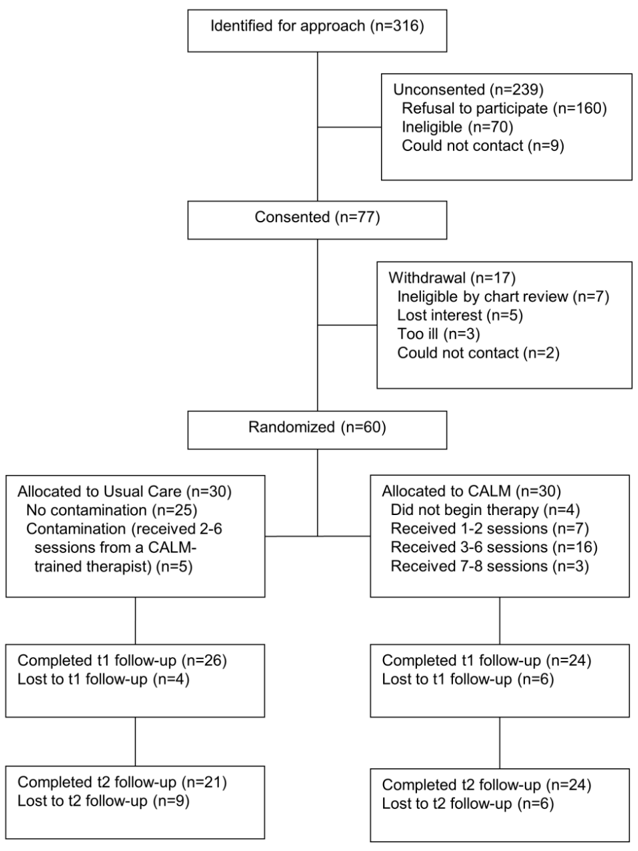
- Recruitment/feasibility metrics: 75% (237/316) of screened individuals were eligible, 32% (77/237) consented, 78% (60/77) were randomized, 25% (15/60) were lost to attrition by study end, 37% (11/30) of CALM participants were non-compliant (<3 sessions), and 17% (5/30) of usual care participants had contamination.
- Primary outcome (PHQ-9): the posterior mean odds ratio for improvement was 1.48, with a 95% credible interval of 0.65 to 3.38, and a 66% probability of OR > 1.25.
- Secondary outcomes: there was support for effects on MDD diagnosis (OR 1.56, 95% credible interval 0.50 to 4.84; 65% probability of OR > 1.25), attachment anxiety (OR 1.72, 0.73 to 4.03; 76% probability), and attachment avoidance (OR 1.58, 0.67 to 3.71; 71% probability).
- No support was found for the other 7 secondary outcomes; their probabilities of OR > 1.25 ranged from 8% to 34%.
Methods
- Parallel-arm randomized controlled pilot trial (phase 2b) comparing CALM vs usual care, with assessments at baseline, 3 months, and 6 months.
- Sample: 60 adult outpatients with advanced or metastatic cancer from the Princess Margaret Cancer Centre in Toronto; eligibility required English fluency and specific advanced cancer diagnoses, and excluded cognitive impairment or active inpatient psychiatric/psychological treatment.
- Main analysis: feasibility was assessed via consent, randomization, attrition, non-compliance, and contamination; outcomes were analyzed with Bayesian conjugate analyses focusing on the 6-month endpoint, using improvement thresholds roughly corresponding to effect sizes of d = 0.40.
Limitations
- The paper states the study was not powered to confirm treatment efficacy and that caution is warranted in interpreting effects.
- The study was limited by small sample size and representativeness: most participants were married, well-educated, English-speaking, Caucasian, and female with advanced gastrointestinal cancer.
- The study was unblinded, which may have affected outcomes, and participants were not selected for elevated distress, which may have limited detectable benefit.
Model-written summary. Check it against the paper before relying on it.
Integrity signals
Registry
Cites
Statistics
Figures
Verification
Claims the paper makes
5 Valid · 3 Not valid · 4 Not checked · 48 Own results and interpretations
Every source the paper cites for this claim was checked and supports it.
In the paper
“As a result of recruitment earlier in the course of disease and of more systematic follow-up, the attrition rate of 25%, was substantially less than the attrition rate of 68% observed in our previous intervention-only pilot trial. 21”
What the sources say
- Supportedcites [21] 21. Lo C, Hales S, Jung J, et al. Managing Cancer And Living Meaningfully (CALM): phase 2 trial of a brief individual psychotherapy in advanced cancer. Palliat Med 2014; 28: 234-242. source
The Results report that 34 of 50 patients (68%) were lost to follow-up at the six-month assessment, and the Discussion identifies this as an intervention-only study. The cited paper supports the previous-trial figure; the 25% figure describes the citing authors’ current study, not this source. (LLM, conf=0.93)
plain- Asserted: passes — The authors put it forward as true.
- Checkable: passes — It can be checked against evidence.
- Load-bearing: passes — The paper’s conclusions depend on it.
- Based: passes — The paper gives a reason why it holds.
- Supported
A result the paper reports from its own data — it cites no other source for it, so there is none to check. The quote shows it is in the paper.
In the paper
“Usual care participants were estimated to have 1.56 times greater odds of MDD diagnosis than intervention participants.”
hedgedstates an associationn = 8- Asserted: passes — The authors put it forward as true.
- Checkable: passes — It can be checked against evidence.
- Load-bearing: passes — The paper’s conclusions depend on it.
- Based: passes — The paper gives a reason why it holds.
A result the paper reports from its own data — it cites no other source for it, so there is none to check. The quote shows it is in the paper.
In the paper
“Intervention participants were estimated to have 1.72 times greater odds of improvement than usual care participants.”
hedgedstates an association- Asserted: passes — The authors put it forward as true.
- Checkable: passes — It can be checked against evidence.
- Load-bearing: unclear — It is unclear whether the paper’s conclusions depend on it.
- Based: passes — The paper gives a reason why it holds.
A result the paper reports from its own data — it cites no other source for it, so there is none to check. The quote shows it is in the paper.
In the paper
“The posterior distributions offered support for potential effects on 3 of 10 secondary outcomes: MDD diagnosis, attachment anxiety and attachment avoidance”
hedgedstates a possible causen = 8- Asserted: passes — The authors put it forward as true.
- Checkable: passes — It can be checked against evidence.
- Load-bearing: passes — The paper’s conclusions depend on it.
- Based: passes — The paper gives a reason why it holds.
A result the paper reports from its own data — it cites no other source for it, so there is none to check. The quote shows it is in the paper.
In the paper
“75% (237/316) of individuals were eligible for study”
plain- Asserted: passes — The authors put it forward as true.
- Checkable: passes — It can be checked against evidence.
- Load-bearing: unclear — It is unclear whether the paper’s conclusions depend on it.
- Based: passes — The paper gives a reason why it holds.
21 more claims
Create a free account to see all 60 claims and to verify the 1 reference still open.
- It may state two separate claims as one. 21
- Probably not a substantial claim. 20
Self-check
Percentages, sums and reported differences re-computed from the paper’s own numbers.
Self-check results appear here once an independent check has confirmed them.
Cited works that were retracted
Works this paper cites that were later retracted, from the retraction notices publishers deposit. Major when the notice came out before this paper was published.
A note, not an issue: for example, a cited work that was retracted only after this paper was published, which its authors could not have known.
In the paper
“Akechi T , Okuyama T , Onishi J , et al . Psychotherapy for depression among incurable cancer patients. Cochrane Database Syst Rev 2008;(2):CD005537. doi:10.1002/14651858.CD005537.pub2”
Cited work 10.1002/14651858.cd005537.pub2 · retracted 2018-11-22 · notice 10.1002/14651858.cd005537.pub3 · this paper published 2016-01-19
Citations
Cites
1 retracted
Psychotherapy for depression among incurable cancer patients
Akechi, T., Okuyama, T., Onishi, J., Morita, T., & Furukawa, T. A. (2008) · Cochrane Database of Systematic Reviews · doi:10.1002/14651858.cd005537.pub2 · Cited by 198
RetractedThe PHQ-9: Validity of a brief depression severity measure
Kroenke, K., Spitzer, R. L., & Williams, J. B. W. (2001) · Journal of General Internal Medicine · doi:10.1046/j.1525-1497.2001.016009606.x · Cited by 44,910
A Brief Measure for Assessing Generalized Anxiety Disorder: The GAD-7
Spitzer, R. L., Kroenke, K., Williams, J. B. W., & Löwe, B. (2006) · Archives of Internal Medicine · doi:10.1001/archinte.166.10.1092 · Cited by 31,765 · cited 1×
“Generalized anxiety was assessed with the Generalized Anxiety Disorder-7 (GAD-7).(28)”
MethodSociety and the Adolescent Self-Image
Rosenberg, M. (1965) · doi:10.1515/9781400876136 · Cited by 30,126
The posttraumatic growth inventory: measuring the positive legacy of trauma
Tedeschi, R. G., & Calhoun, L. G. (1996) · Journal of Traumatic Stress · doi:10.1002/jts.2490090305 · Cited by 7,061
Bond, F. W., Hayes, S. C., Baer, R. A., Carpenter, K. M., Guenole, N., Orcutt, H. K., Waltz, T., & Zettle, R. D. (2011) · Behavior Therapy · doi:10.1016/j.beth.2011.03.007 · Cited by 3,950 · cited 2×
“Self-esteem was measured using the 10-item Rosenberg Self-esteem Scale.31 Experiential avoidance refers to the tendency to avoid and reject negative emotions and was measured using the 10-item Acceptance and Action Questionnaire-II.32 Quality of life was measured with the 14-item Quality of Life at the End of Life-Can…”
MethodAffect Regulation, Mentalization, and the Development of the Self
Fonagy, P., Gergely, G., Jurist, E. L., & Target, M. (2018) · doi:10.4324/9780429471643 · Cited by 3,886
Considerations in determining sample size for pilot studies
Hertzog, M. A. (2008) · Research in Nursing & Health · doi:10.1002/nur.20247 · Cited by 2,337
Validation of a short Orientation-Memory-Concentration Test of cognitive impairment
(1983) · American Journal of Psychiatry · doi:10.1176/ajp.140.6.734 · Cited by 2,117
Peterman, A. H., Fitchett, G., Brady, M. J., Hernandez, L., & Cella, D. (2002) · Annals of Behavioral Medicine · doi:10.1207/s15324796abm2401_06 · Cited by 1,751 · cited 2×
“Generalised anxiety was assessed with the Generalized Anxiety Disorder-7 (GAD-7).28 Death anxiety was measured using the 15-item Death and Dying Distress Scale.29 Spiritual well-being was measured with the 12-item Functional Assessment of Chronic Illness Therapy-Spiritual Well-being Scale.30 Attachment security refers…”
Method
Research works printed but not linked: 1
- 27. First MB, Spitzer RL, Gibbon M, et al. Structured Clinical Interview for DSM-IV-TR Axis I DisordersPatient Edition (SCID-I/P, 1/2010 revision) . New York, NY: New York State Psychiatric Institute, 2010.
Cited by
Rodin, G., Lo, C., Rydall, A., Shnall, J., Malfitano, C., Chiu, A., Panday, T., Watt, S., An, E., Nissim, R., et al. (2018) · Journal of Clinical Oncology · doi:10.1200/jco.2017.77.1097 · Cited by 338
“provement in depression, death anxiety, spiritual well-being, and attachment security.(18,19) In qualitative interviews, participants reported that CALM provides a “safe place” that helped them to “be seen as a whole person by the medical system,” “grow as a person,” and “be able to handle death in a peaceful way.”
BackgroundSelf-citationPsychosocial interventions for advanced cancer patients: a systematic review
Teo, I., Krishnan, A., & Lee, G. L. (2019) · Psycho-Oncology · doi:10.1002/pon.5103 · Cited by 205
Bauereiß, N., Obermaier, S., Özünal, S. E., & Baumeister, H. (2018) · Psycho-Oncology · doi:10.1002/pon.4829 · Cited by 149
Death anxiety interventions in patients with advanced cancer: a systematic review
Grossman, C. H., Brooker, J., Michael, N., & Kissane, D. (2018) · Palliative Medicine · doi:10.1177/0269216317722123 · Cited by 144
Menzies, R. E., Zuccala, M., Sharpe, L., & Dar-Nimrod, I. (2018) · Journal of Anxiety Disorders · doi:10.1016/j.janxdis.2018.09.004 · Cited by 140
“Other therapy interventions used included a manualized individual psychotherapy designed for adults with cancer (Lo et al., 2016), relaxation training (Rasmussen et al.”
BackgroundMethodInfluentialGuerrero-Torrelles, M., Monforte-Royo, C., Rodríguez-Prat, A., Porta-Sales, J., & Balaguer, A. (2017) · Palliative Medicine · doi:10.1177/0269216316685235 · Cited by 119
Arends, J. (2018) · Annals of Oncology · doi:10.1093/annonc/mdy093 · Cited by 121
“Double awareness” in psychotherapy for patients living with advanced cancer.
Colosimo, K., Nissim, R., Pos, A. E., Hales, S., Zimmermann, C., & Rodin, G. (2018) · Journal of Psychotherapy Integration · doi:10.1037/int0000078 · Cited by 70
Self-citationExistential distress and meaning-focused interventions in cancer survivorship
Vehling, S., & Philipp, R. (2018) · Current Opinion in Supportive & Palliative Care · doi:10.1097/spc.0000000000000324 · Cited by 79
Depressive Spectrum Disorders in Cancer: Diagnostic Issues and Intervention. A Critical Review
Caruso, R., GiuliaNanni, M., Riba, M. B., Sabato, S., & Grassi, L. (2017) · Current Psychiatry Reports · doi:10.1007/s11920-017-0785-7 · Cited by 71
The meaning of self-reported death anxiety in advanced cancer
Tong, E., Deckert, A., Gani, N., Nissim, R., Rydall, A., Hales, S., Rodin, G., & Lo, C. (2016) · Palliative Medicine · doi:10.1177/0269216316628780 · Cited by 63
Self-citationFear of cancer recurrence and death anxiety: unaddressed concerns for adult neuro-oncology patients
Loughan, A. R., Lanoye, A., Aslanzadeh, F. J., Villanueva, A. A. L., Boutte, R., Husain, M., & Braun, S. (2021) · Journal of Clinical Psychology in Medical Settings · doi:10.1007/s10880-019-09690-8 · Cited by 60
“For example, Managing Cancer and Living Meaningfully, a psychotherapy for advanced cancer patients and their caregivers, has been shown to be effective when delivered by providers from several disciplines (e.g., psychiatrists, psychologists, social workers, and nurses; Lo et al., 2016).”
BackgroundBraun, S. E., Aslanzadeh, F. J., Thacker, L., & Loughan, A. R. (2021) · Psycho-Oncology · doi:10.1002/pon.5659 · Cited by 55
Rodin, G., Malfitano, C., Rydall, A. C., Schimmer, A. D., Marmar, C. R., Mah, K., Lo, C., Nissim, R. S., & Zimmermann, C. (2019) · Supportive Care in Cancer · doi:10.1007/s00520-019-04723-2 · Cited by 65
“intervention in patients with advanced cancer [42] and similar to those of individual psychotherapies, such as dignity therapy [40] and meaning-centered psychotherapy [41].”
BackgroundResultSelf-citationLiving with Metastatic Cancer: A Roadmap for Future Research
Tometich, D. B., Hyland, K. A., Soliman, H. H., Jim, H., & Oswald, L. B. (2020) · Cancers · doi:10.3390/cancers12123684 · Cited by 54
“, meaning-centered psychotherapy, supportive expressive therapy) for improving PROs such as spiritual well-being, sense of meaning, and quality of life [149,204,205].”
BackgroundXu, K., Hu, D., Liu, Y., Han, Y., Guo, X., Teng, F., & Zhou, Y. (2019) · The Journal of Nervous and Mental Disease · doi:10.1097/nmd.0000000000000974 · Cited by 56
Mehnert, A., Koranyi, S., Philipp, R., Scheffold, K., Kriston, L., Lehmann‐Laue, A., Engelmann, D., Vehling, S., Eisenecker, C., Oechsle, K., et al. (2020) · Psycho-Oncology · doi:10.1002/pon.5521 · Cited by 47
Self-citationEngelmann, D., Scheffold, K., Friedrich, M., Hartung, T. J., Schulz‐Kindermann, F., Lordick, F., Schilling, G., Lo, C., Rodin, G., & Mehnert-Theuerkauf, A. (2016) · Journal of Pain and Symptom Management · doi:10.1016/j.jpainsymman.2016.07.002 · Cited by 55
Self-citationZhang, X., Yao, S., Wang, M., Yin, X., Bi, Z., Jing, Y., & Cheng, H. (2022) · Journal of Oncology · doi:10.1155/2022/1012813 · Cited by 58
Ding, K., Zhang, X., Zhao, J., Zuo, H., Bi, Z., & Cheng, H. (2020) · Integrative Cancer Therapies · doi:10.1177/1534735420938450 · Cited by 55
A concept map of death-related anxieties in patients with advanced cancer
Vehling, S., Malfitano, C., Shnall, J., Watt, S., Panday, T., Chiu, A., Rydall, A. C., Zimmermann, C., Hales, S., Rodin, G., et al. (2017) · BMJ Supportive & Palliative Care · doi:10.1136/bmjspcare-2016-001287 · Cited by 68
Self-citationFrom evidence to implementation: The global challenge for psychosocial oncology
Rodin, G. (2018) · Psycho-Oncology · doi:10.1002/pon.4837 · Cited by 55
Self-citationCaruso, R., Sabato, S., Nanni, M. G., Hales, S., Rodin, G., Malfitano, C., Tiberto, E., De Padova, S., Bertelli, T., Belvederi Murri, M., et al. (2020) · Psychotherapy and Psychosomatics · doi:10.1159/000505875 · Cited by 42
Self-citationInsecure attachment predicts depression and death anxiety in advanced cancer patients
Scheffold, K., Philipp, R., Koranyi, S., Engelmann, D., Schulz‐Kindermann, F., Härter, M. C., & Mehnert-Theuerkauf, A. (2017) · Palliative & Supportive Care · doi:10.1017/s1478951517000281 · Cited by 63
“The results of the CALM study will supply further answers about the specific processes of attachment in psychotherapeutic settings (Scheffold et al., 2015).”
BackgroundInfluentialCheung, D. S. T., Yeung, W., Chau, P. H., Lam, T., Yang, M., Lai, K., Ip, C. Y., Lao, L., & Lin, C. (2020) · European Journal of Cancer Care · doi:10.1111/ecc.13314 · Cited by 46
Review of Psychological Interventions in Oncology: Current Trends and Future Directions
Anghel, T., MELANIA, B. L., Costea, I., Albai, O., Marinca, A., Levai, C. M., & Hogea, L. (2025) · Medicina · doi:10.3390/medicina61020279 · Cited by 57
“Managing Cancer and Living Meaningfully (CALM) was investigated twice [41,42].”
Death talk and relief of death-related distress in patients with advanced cancer
An, E., Wennberg, E., Nissim, R. S., Lo, C., Hales, S., & Rodin, G. (2017) · BMJ Supportive & Palliative Care · doi:10.1136/bmjspcare-2016-001277 · Cited by 48
Self-citationKissane, D. W., Lethborg, C. E., Brooker, J., Hempton, C., Burney, S., Michael, N. G., Staples, M., Osicka, T. M., Sulistio, M., Shapiro, J., et al. (2019) · Palliative & Supportive Care · doi:10.1017/s1478951518000883 · Cited by 41
The DEsire to DIe in Palliative care: Optimization of Management (DEDIPOM) – a study protocol
Kremeike, K., Galushko, M., Frerich, G., Romotzky, V., Hamacher, S., Rodin, G., Pfaff, H., & Voltz, R. (2018) · BMC Palliative Care · doi:10.1186/s12904-018-0279-3 · Cited by 40
“This may be done in a manualized way (see Managing Cancer and Living Meaningfully; CALM) [22, 23].”
BackgroundSelf-citationPsychological Symptoms in Advanced Cancer
Bail, J. R., Traeger, L., Pirl, W. F., & Bakitas, M. A. (2018) · Seminars in Oncology Nursing · doi:10.1016/j.soncn.2018.06.005 · Cited by 34
Psychological Aspects of Care in Cancer Patients in the Last Weeks/Days of Life
Ann‐Yi, S., & Bruera, E. D. (2022) · Cancer Research and Treatment · doi:10.4143/crt.2022.116 · Cited by 46
Supporting Family Caregivers of Advanced Cancer Patients: A Focus Group Study
Nissim, R. S., Hales, S., Zimmermann, C., Deckert, A., Edwards, B. Q., & Rodin, G. (2017) · Family Relations · doi:10.1111/fare.12291 · Cited by 38
Self-citationLoughan, A. R., Willis, K. D., Braun, S. E., Rodin, G., Lanoye, A., Davies, A. E., Svikis, D., Mazzeo, S., Malkin, M., & Thacker, L. (2022) · Journal of Neuro-Oncology · doi:10.1007/s11060-022-03988-8 · Cited by 29
“Feasibility and Acceptability were operationalized based on published guidelines for Phase IIa proof-of-concept trials and previous peer-reviewed studies adhering to these recommendations, see Table 1 [19, 21, 22, 25, 27].”
BackgroundMethodResultSelf-citationCharacteristics and Outcomes of Psychology Referrals in a Palliative Care Department
Ann‐Yi, S., Bruera, E. D., Wu, J., Liu, D. D., Agosta, M. T., Williams, J. L., Balankari, V. R., & Carmack, C. L. (2018) · Journal of Pain and Symptom Management · doi:10.1016/j.jpainsymman.2018.05.022 · Cited by 30
Cottingham, A. H., Beck-Coon, K., Bernat, J. K., Helft, P. R., Schmidt, K., Shields, C. G., Torke, A. M., & Johns, S. A. (2019) · Palliative and Supportive Care · doi:10.1017/s1478951518000354 · Cited by 24
Wang, Z., Xu, D., Yu, S., Liu, Y., Han, Y., Zhao, W., & Zhang, W. (2024) · Worldviews on Evidence-Based Nursing · doi:10.1111/wvn.12752 · Cited by 29
Nursing, psychotherapy and advanced cancer: A scoping review
Malakian, A., Mohammed, S., Fazelzad, R., Ajaj, R., Artemenko, A., & Mayo, S. J. (2021) · European Journal of Oncology Nursing · doi:10.1016/j.ejon.2021.102090 · Cited by 25
Zimmermann, F. F., Jordan, J., & Burrell, B. (2020) · European Journal of Oncology Nursing · doi:10.1016/j.ejon.2019.101715 · Cited by 21
“, 2010) and with numerous studies in this field (Breitbart et al., 2010, 2012, 2015; Ellis et al., 2017; Henry et al., 2010; Lethborg et al., 2012; Lo et al., 2019; Rost et al., 2012).”
Systematic Review of Interventions for Demoralization in Patients With Cancer
Wang, Y., Sun, H., Ji, Q., Wei, J., & Zhu, P. (2023) · The Journal of Nervous and Mental Disease · doi:10.1097/nmd.0000000000001615 · Cited by 23
“In addition, in the CALM study, 12 sessions produced large effects compared with 6 sessions (Caruso et al., 2014; Lo et al., 2019).”
Kaasa, S., Knaul, F. M., Mwangi-Powell, F. N., & Rodin, G. (2018) · The Lancet Global Health · doi:10.1016/s2214-109x(18)30086-x · Cited by 17
Self-citationMah, K., Tran, K., Gauthier, L. R., Rodin, G., Zimmermann, C., Warr, D. G., Librach, S. L., Moore, M. J., Shepherd, F. A., & Gagliese, L. (2017) · Journal of Pain · doi:10.1016/j.jpain.2017.11.002 · Cited by 17
Self-citationCaruso, R., Nanni, M. G., Rodin, G., Hales, S., Malfitano, C., Padova, S. D., Bertelli, T., Murri, M. B., Bovero, A., Miniotti, M., et al. (2020) · Contemporary Clinical Trials Communications · doi:10.1016/j.conctc.2020.100661 · Cited by 20
“The encouraging results in preliminary studies [25,27] and in a large randomized controlled trial in Toronto [28] suggest that CALM is a promising intervention for patients with advanced or metastatic cancer.”
BackgroundResultSelf-citationWang, T., Cheung, K., & Cheng, H. (2024) · Palliative Medicine · doi:10.1177/02692163241238900 · Cited by 16
A developmental perspective on existential distress and adaptation to advanced disease
Lo, C. (2018) · Psycho-Oncology · doi:10.1002/pon.4767 · Cited by 16
“attachment insecurities.(10) However, it also suggests that the effectiveness of these interventions may be dependent on a patient's life stage and developmental history, which affect the readiness to face the end of life.”
BackgroundSelf-citationManaging cancer and living meaningfully (CALM): Implementation in Dutch cancer care
Kool, M. B., Hafkamp, E., Gol, J. M., Aukema, E. J., Malfitano, C., Reyners, A. K. L., Hales, S., van de Poll, L., Rodin, G., & de Vries, F. (2023) · Psycho-Oncology · doi:10.1002/pon.6281 · Cited by 14
Self-citationCore and bridge symptoms of demoralization in Chinese female cancer patients: a network analysis
Gong, Y., Shang, B., Tan, J., Luo, C., Bian, Z., Wu, X., Fan, T., Zhao, Q., Liu, L., & Sun, W. (2024) · Frontiers in Psychiatry · doi:10.3389/fpsyt.2024.1273411 · Cited by 11
Miyamoto, S., Yamazaki, T., Shimizu, K., Matsubara, T., Kage, H., Watanabe, K., Kobo, H., Matsuyama, Y., Rodin, G., & Yoshiuchi, K. (2022) · BMJ Open · doi:10.1136/bmjopen-2021-056136 · Cited by 16
Self-citationJing, Y., Zhao, J., Yang, Z., Yao, S., Tang, L., Li, W., Yu, S., & Cheng, H. (2022) · PubMed Central · Cited by 10
Wang, M., Chen, G., Zhao, J., Li, W., Yu, S., Yao, S., Tang, L., Xu, J., & Cheng, H. (2023) · PubMed Central · Cited by 12
Austin, P., Siddall, P. J., & Lovell, M. R. (2024) · Palliative Medicine · doi:10.1177/02692163231222773 · Cited by 13
Krok, D., Telka, E., Falewicz, A., & Szczęśniak, M. (2024) · Journal of Clinical Medicine · doi:10.3390/jcm13071974 · Cited by 6
“Given that both psychological flexibility and mentalization are increasingly recognized as playing a significant role in emotional well-being among cancer patients [42,43], it is highly plausible that they may also attenuate the negative symptoms of total pain and the fear of recurrence.”
Background„Managing Cancer and Living Meaningfully“
Scheffold, K., Engelmann, D., Schulz‐Kindermann, F., Rosenberger, C., Krüger, A., Rodin, G., Härter, M. C., & Mehnert-Theuerkauf, A. (2017) · Psychotherapeut · doi:10.1007/s00278-017-0179-7 · Cited by 8
Self-citationTroncoso-Escudero, P., Rydall, A. C., Hales, S., & Rodin, G. (2019) · American Journal of Psychiatry and Neuroscience · doi:10.11648/j.ajpn.20190704.15 · Cited by 8
Self-citationPsychological Support for Cancer Patients
Khalid, S., Abbas, I., & Javed, S. (2023) · Cancer treatment and research · doi:10.1007/978-3-031-27156-4_13 · Cited by 12
Psychosocial Interventions for End‐of‐Life Care: An Invited Commentary
Ftanou, M., Pascoe, M. C., & Ellen, S. (2017) · Australian Psychologist · doi:10.1111/ap.12305 · Cited by 6
“The individual-based interventions (CALM & DT) can be tailored to a person’s psychological, physical, and practical needs and can also be adapted to meet the needs of individuals whom are too ill to leave their hospital beds (LeMay & Wilson, 2008).”
BackgroundInfluentialPsicooncología en cáncer avanzado. Terapia CALM, una intervención canadiense
Paulina Troncoso, G., Rydall, A. C., & Rodin, G. (2019) · Revista chilena de neuro-psiquiatría · doi:10.4067/s0717-92272019000300238 · Cited by 12
Self-citationA scoping review of psychosocial oncology interventions promoting posttraumatic growth
Wong, K. L., McClure, K. S., & Psillos, D. E. (2022) · Journal of Psychosocial Oncology Research and Practice · doi:10.1097/or9.0000000000000071 · Cited by 5
Shapiro, G. K., Mah, K., de Vries, F. E., Zimmermann, C., Li, M., Hales, S., & Rodin, G. (2022) · Journal of Psychosocial Oncology Research and Practice · doi:10.1097/or9.0000000000000076 · Cited by 5
Self-citationChai, J., Chen, G., Jia, Y., Huang, R., Li, A., Ge, H., Zheng, X., Liu, L., Xu, J., Cheng, L. J., et al. (2024) · Future Oncology · doi:10.1080/14796694.2024.2428586 · Cited by 5
Lynch, F., Rodin, G., Jefford, M., Duffy, M., Lai-Kwon, J. E., Heynemann, S., Mileshkin, L., Briggs, L., Burke, J. M., Leigh, L., et al. (2023) · BMJ Open · doi:10.1136/bmjopen-2023-072322 · Cited by 6
Self-citationSitter, K. C., Gamboa, J., & de Groot, J. (2025) · Current Oncology · doi:10.3390/curroncol32020061 · Cited by 4
Gautama, M. S. N., Huang, T., Haryani, H., Khalish, G., Liu, A.-I., & Wibawa, Y. A. (2025) · Journal of Clinical Nursing · doi:10.1111/jocn.17754 · Cited by 5
Firkins, J. L., Tomic, I., Hansen, L., & Woodrell, C. D. (2025) · Supportive Care in Cancer · doi:10.1007/s00520-025-09306-y · Cited by 6
Wong, K. S. S., Ho, M., Hou, T., & Lin, C. (2025) · Journal of Pain and Symptom Management · doi:10.1016/j.jpainsymman.2025.08.014 · Cited by 4
Li, Y., Liu, Z., Lu, X., Chai, X., Bai, N., & Chen, Y. (2025) · Patient Preference and Adherence · doi:10.2147/ppa.s535288 · Cited by 3
Depression, demoralization, and suicidality
Kissane, D. W. (2021) · doi:10.1093/med/9780198821328.003.0072 · Cited by 2
Mortality Salience, Fears of Death, and Their Treatment in Anxiety-Related Disorders
Menzies, R. E. (2020) · The Sydney eScholarship Repository (The University of Sydney) · Cited by 3
Bertolucci, I. (2023) · Journal of Psychology and Psychotherapy Research · doi:10.12974/2313-1047.2023.10.07 · Cited by 1
Loughan, A. R., Lanoye, A. M., Willis, K. D., Braun, S. E., Davies, A., Rodin, G., Thacker, L. R., Fox, A. M., Kleva, C. S., Zarrella, G. V., et al. (2024) · Neuro-Oncology Practice · doi:10.1093/nop/npae097 · Cited by 4
Self-citationLoughan, A. R., Braun, S. E., Lanoye, A. M., Davies, A., Kleva, C. S., Fox, A. M., & Zarrella, G. V. (2025) · Neuro-Oncology Practice · doi:10.1093/nop/npaf038 · Cited by 2
Lovell, M. R., Warner, K. N., Archer, P., McCabe, R., & Siddall, P. J. (2025) · Patient Education and Counseling · doi:10.1016/j.pec.2025.109297 · Cited by 3
Meaning and Psychedelics in Palliative Care: A Narrative Review
Alexander, W. B., Hansen, E., Anderson, B. T., Zarrabi, A. J., Rogers, A. H., Loewen, G., Ficcaro, Z. R., Alexander, M. H., Schaefer, D., & Case, A. A. (2025) · Journal of Pain and Symptom Management · doi:10.1016/j.jpainsymman.2025.10.015 · Cited by 4
Weißflog, G., & Mehnert-Theuerkauf, A. (2017) · Der Klinikarzt · doi:10.1055/s-0043-121534 · Cited by 1
“Eine manualisierte individuelle psychoonkologische Kurzzeittherapie ist das Programm „Managing Cancer and Living Meaningfully“ (CALM [23, 24]).”
BackgroundPsychosocial issues in cancer patients with neurological complications
Loughan, A. R., Willis, K. D., Lanoye, A. M., Allen, D. H., Reid, M. P., Ravyts, S. G., Boutté, R. L., & Brechbeil, J. (2022) · Elsevier eBooks · doi:10.1016/b978-0-12-821976-8.00036-0 · Cited by 3
Existential distress in neuro-oncology
Lanoye, A. M., Willis, K. D., & Loughan, A. R. (2024) · Elsevier eBooks · doi:10.1016/b978-0-443-15663-2.00037-7 · Cited by 1
Jia, Y., Gan, C., Chai, J., Huang, R., Li, A., Ge, H., Zheng, X., Liu, L., Xu, J., Cheng, L. J., et al. (2025) · Clinical Breast Cancer · doi:10.1016/j.clbc.2025.01.007 · Cited by 3
Caron, M., & Bergeron, D. A. (2019) · Evidence-Based Nursing · doi:10.1136/ebnurs-2019-103180 · Cited by 1
Interventionen zur Stützung der Sinnhaftigkeit
Schnell, T. (2020) · Springer eBooks · doi:10.1007/978-3-662-61120-3_12 · Cited by 1
Interventionen zur Stützung der Sinnhaftigkeit
Schnell, T. (2016) · Springer eBooks · doi:10.1007/978-3-662-48922-2_11
Parker, R. A. (2020) · Clinical Trials · doi:10.1177/1740774520974976
“Similarly, Lo et al.(6) used a Bayesian method to estimate the probability of a treatment effect greater than a clinically meaningful difference (odds ratio of 1.”
MethodFrom Our Clinic, Across the Globe: CALM Training, Research, and Advocacy
Rodin, G., & Hales, S. (2021) · Oxford University Press eBooks · doi:10.1093/med/9780190236427.003.0013
Self-citationMerckaert, I., Waroquier, P., Delvaux, N., Marchal, S., Moucheux, A., & Razavi, D. (2019) · Elsevier eBooks · doi:10.1016/b978-2-294-75811-9.00017-9
Managing Cancer and Living Meaningfully (CALM) Therapy
Malfitano, C., Hales, S., & Rodin, G. (2022) · Oxford University Press eBooks · doi:10.1093/med/9780197583838.003.0037 · Cited by 1
Self-citationScheiner, R., Burner-Fritsch, I., Fegg, M. J., Feddersen, B., & Bausewein, C. (2026) · BMC Palliative Care · doi:10.1186/s12904-026-02041-z
“…79]); (e) use of psychological interventions to address spiritual/ existential distress (e.g. integration of spiritual aspects, meaning [53, 80, 81]- and dignity-centred interventions [82, 83], narrative approach [84], life review approaches [43, 85] and logotherapy/existential analysis…”
Validation of the Japanese version of the death and dying distress scale
Miyamoto, S., Yamazaki, T., Matsubara, T., Yamagata, H., Harashima, S., Kobo, H., Abe, H., Sumitani, M., Shimizu, K., Rodin, G., et al. (2026) · BioPsychoSocial Medicine · doi:10.1186/s13030-026-00362-2
“Higher levels of death-related distress in this study were associated with higher levels of depression and anxiety and a poorer quality of life, “emotional well-being,” “preparation for end-of-life,” and “spiritual well-being,” which confirmed the findings of previous research [9–11, 70, 71].”
Self-citationPsychological interventions for death anxiety and distress: Systematic review and meta-analysis
Yazd, S. A. R. (2026) · Death Studies · doi:10.1080/07481187.2026.2724107
Death anxiety in advanced cancer patients and family caregivers: A scoping review
Sun, Q., Yorke, J., Loong, H. H. F., Luo, H., Xuexun, X. I. A. O., Liu, Q., Mao, T., & Ho, K. Y. (2026) · European Journal of Oncology Nursing · doi:10.1016/j.ejon.2026.103334
Metadata
- Authors
- Lo, C., Hales, S., Chiu, A., Panday, T., Malfitano, C., Jung, J., Rydall, A., Li, M., Nissim, R., Zimmermann, C., & Rodin, G.
- Affiliations
- University Health Network (CA)
- Corresponding author
- Rodin, Gary
- ORCID
- Venue
- BMJ Supportive & Palliative Care
- Publisher
- BMJ
- Published
- 2016-01-19
- Volume
- 9
- Issue
- 2
- Pages
- 209-218
- ISSN
- 2045-435X (ISSN-L)
- 2045-4368
- OpenAlex
- W2299951753
- Cited by
- 87
- References
- 39
- Citations by year
- 2026: 4 · 2025: 10 · 2024: 8 · 2023: 6 · 2022: 9 · 2021: 4 · 2020: 9 · 2019: 10 · 2018: 11 · 2017: 13 · 2016: 3
- FWCI
- 6.64
- Type
- journal article
- Language
- en
- Open access
- green
- hdl.handle.net
- Licence
- cc-by-nc-nd
- Locations
- BMJ Supportive & Palliative Care (publishedVersion)
- PubMed (publishedVersion)
- ResearchOnline at James Cook University (James Cook University) (submittedVersion)
- TSpace (University of Toronto) (submittedVersion, cc-by-nc-nd)
- HighWire Press Open Archive (submittedVersion)
- Funders
- Cancer Research Institute
- Princess Margaret Cancer Foundation
- University of Toronto
- Canadian Institutes of Health Research (MOP106473)
- Topics
- Health Sciences › Medicine › Oncology › Cancer survivorship and care
- Health Sciences › Medicine › Public Health, Environmental and Occupational Health › Palliative and Oncologic Care
- Health Sciences › Medicine › Public Health, Environmental and Occupational Health › Palliative Care and End-of-Life Issues
- Keywords
- CALM, advanced cancer, feasibility trial, depressive symptoms, major depressive disorder, attachment anxiety, attachment avoidance, spiritual well-being, quality of life, posttraumatic growth, intervention adherence, attrition
- MeSH terms
- Adaptation, Psychological, Adult, Aged, Bayes Theorem, Cost-Benefit Analysis, Female, Humans, Male, Middle Aged, Neoplasms, Ontario, Pilot Projects, Psychotherapy, Brief, Quality of Life, Stress, Psychological
About these checks
Registry, retraction, Cites and statistics results are computed, not judged, with one exception: a printed reference that no index lists is read once by a model before it counts as a citation error. Claims are extracted by a model and kept only when their quote appears verbatim in the text; each cited source is then checked, with a model’s help, for whether it says what the claim relies on. Those verdicts can be wrong — read the claim’s quote and the cited source before relying on one.
The claim verdicts this report counts are experimental: their accuracy is not yet measured.
A language model drew the claims from the paper on 2026-10-11, under version 3 of the claim definition (model deepseek-v4.1-flash, prompt extract-v3).
A second model labelled each claim on 2026-10-11 (model jev-1.13-20260917, definition revision gold-guideline-v0.2).
Cited sources are checked with a language model’s help (gpt-6-sol).
Statistics and arithmetic are recomputed, not judged.
Confidence bands are shown only for fields calibrated on our annotated test set. None is calibrated yet, so no band is shown.
What counts as a claim ›How we measure confidence ›How we check this ›
Are you an author, or do you see a problem with this page? Request a review
Data sources
Bibliographic data: Semantic Scholar, OpenAlex, Crossref.
Contains information from the Semantic Scholar Academic Graph Datasets, made available under the ODC Attribution License (ODC-BY 1.0).
Semantic Scholar’s data is described in: Kinney, R., et al. (2023). The Semantic Scholar Open Data Platform. arXiv:2301.10140.
