

Using electronic health record’s data to assess daily dose of opioids prescribed for outpatients with chronic non-cancer pain
Open accessThe DOI matches its Crossref record; 15 of the 15 references it cites were found in a registry or an index.
Abstract
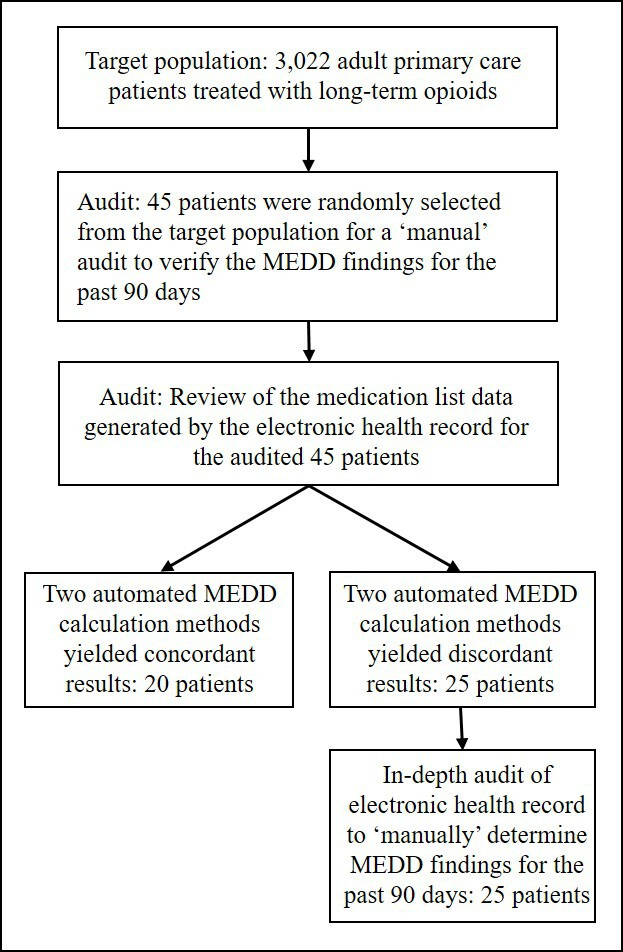
This research intended to examine electronic health record (EHR) based methods for automated estimation of morphine equivalent daily dose (MEDD) of prescribed opioids in primary care research and practice. The study leveraged the health system’s audit of adults treated with long-term opioids for chronic non-cancer pain to compare two EHR-based automated MEDD calculation methods: RxSignature (active prescriptions’ signature information) and RxQuantity (quantity dispensed for prescriptions issued within the past 90 days). Prescribed opioid EHR data were extracted from the target population at a large US academic health system in a 2-year assessment period. Forty-five ‘target patients’ were selected by the health system for a manual audit by an expert physician who then ‘manually’ calculated the actual MEDD over the past 90 days (RxAudit) for those with discrepancies in the MEDD calculated with RxSignature and RxQuantity. Paired samples t-test compared the MEDD generated by the RxSignature and RxQuantity methods by opioid type in the target population. The audit (n=45) revealed the RxSignature and RxQuantity methods yielded comparable MEDD results for 20 patients and discrepant results for 25 patients. The former group had opioid prescriptions issued at regular intervals for stable, scheduled doses of opioids; the latter group had opioid prescriptions issued irregularly or for changed daily dosing regimen, for as-needed use, or had changes in the dosing regimen or inactive prescriptions mislabeled as active. RxAudit of the EHR of those with discrepant MEDD results (n=25) produced consistent results with those yielded by the RxQuantity, but not the RxSignature, method. Significant differences in MEDD were found for most opioid types when the MEDD was calculated for the target population using the RxSignature and RxQuantity methods. In conclusion, different EHR-based methods for MEDD calculation can lead to vastly different estimates, with implications for research and clinical care outcomes. Standardising data extraction and MEDD calculation algorithms could overcome these challenges, enabling a more accurate and reproducible approach to the dose calculation for prescribed opioids, improving the quality of research and patient safety.
Overview
The claims and statistics of this paper haven’t been checked yet.
Free: it reads the open-access text and checks the first 5 claims that cite a source we can check. Create a free account to check every claim.
Integrity signals
Registry
Cites
Statistics
Figures
Verification
Claims the paper makes
The claims and statistics of this paper haven’t been checked yet.
Free: it reads the open-access text and checks the first 5 claims that cite a source we can check. Create a free account to check every claim.
Claims other papers make about this one
Each is checked against this paper’s own text: does it say what the citing paper says it does?
The check wasn’t confident either way, so it gives no verdict — never disputed.
In the citing paper
“This is a reliable screening tool with high sensitivity, specificity, and positive predictive accuracy, with higher scores indicating more of a neuropathic component of pain”
From Risk Factors for Self-Harm Ideation among Persons Treated with Opioids for Chronic Low Back Pain (2023) · cites this paper as [39]
Experimental — accuracy not yet measured
Self-check
Percentages, sums and reported differences re-computed from the paper’s own numbers.
The self-check needs the paper’s full text.
Citations
Cites
CDC Guideline for Prescribing Opioids for Chronic Pain — United States, 2016
Dowell, D., Haegerich, T. M., & Chou, R. (2016) · MMWR. Recommendations and Reports · doi:10.15585/mmwr.rr6501e1 · Cited by 2,697
Prevalence of Chronic Pain and High-Impact Chronic Pain Among Adults — United States, 2016
Dahlhamer, J., Lucas, J., Zelaya, Nahin, R., Mackey, S., DeBar, L., Kerns, R., Von Korff, M., Porter, L., & Helmick, C. (2018) · MMWR. Morbidity and Mortality Weekly Report · doi:10.15585/mmwr.mm6736a2 · Cited by 2,598
De Facto Long-term Opioid Therapy for Noncancer Pain
Korff, M. V., Saunders, K., Thomas Ray, G., Boudreau, D., Campbell, C., Merrill, J., Sullivan, M. D., Rutter, C. M., Silverberg, M. J., Banta-Green, C., et al. (2008) · The Clinical Journal of Pain · doi:10.1097/ajp.0b013e318169d03b · Cited by 662
Opioids for Back Pain Patients: Primary Care Prescribing Patterns and Use of Services
Deyo, R. A., Smith, D. H. M., Johnson, E. S., Donovan, M., Tillotson, C. J., Yang, X., Petrik, A. F., & Dobscha, S. K. (2011) · The Journal of the American Board of Family Medicine · doi:10.3122/jabfm.2011.06.100232 · Cited by 182
Liebschutz, J. M., Xuan, Z., Shanahan, C. W., LaRochelle, M., Keosaian, J., Beers, D., Guara, G., O’Connor, K., Alford, D. P., Parker, V., et al. (2017) · JAMA Internal Medicine · doi:10.1001/jamainternmed.2017.2468 · Cited by 139
Rogers, A. H., Bakhshaie, J., Buckner, J. D., Orr, M. F., Paulus, D. J., Ditre, J. W., & Zvolensky, M. J. (2018) · Journal of Addiction Medicine · doi:10.1097/adm.0000000000000493 · Cited by 93
Quanbeck, A., Brown, R., Zgierska, A. E., Jacobson, N. A., Robinson, J. M., Johnson, R. A., Deyo, B. M. F., Madden, L. M., Tuan, W., & Alagöz, E. (2018) · Implementation Science · doi:10.1186/s13012-018-0713-1 · Cited by 81
Self-citationVariability in Opioid Equivalence Calculations
Rennick, A., Atkinson, T. J., Cimino, N. M., Strassels, S. A., McPherson, M. L., & Fudin, J. (2015) · Pain Medicine · doi:10.1111/pme.12920 · Cited by 71
Dunn, K. E., Barrett, F. S., Fingerhood, M., & Bigelow, G. E. (2016) · Pain Medicine · doi:10.1093/pm/pnw228 · Cited by 43
Dasgupta, N., Wang, Y., Bae, J., Kinlaw, A. C., Chidgey, B. A., Cooper, T., & Delcher, C. (2021) · Clinical Journal of Pain · doi:10.1097/ajp.0000000000000948 · Cited by 37
Cited by
Zgierska, A. E., Edwards, R. R., Barrett, B. P., Burzinski, C. A., Jamison, R. N., Nakamura, Y., Henningfield, M. F., Tuan, W., Shen, C., Sehgal, N., et al. (2025) · JAMA Network Open · doi:10.1001/jamanetworkopen.2025.3204 · Cited by 29
Self-citationSingh, K. E., Tsang, S., Zvara, J., Roach, J. K., Walters, S. M., McNeil, J. S., Jossart, S., Abdel-Malek, A., Yount, K. W., & Mazzeffi, M. A. (2024) · Journal of Cardiothoracic and Vascular Anesthesia · doi:10.1053/j.jvca.2024.05.012 · Cited by 15
Risk Factors for Self-Harm Ideation among Persons Treated with Opioids for Chronic Low Back Pain
Jamison, R. N., Edwards, R. R., Brown, R., Barrett, B. P., Burzinski, C. A., Lennon, R. P., Nakamura, Y., Schiefelbein, T., Garland, E. L., & Zgierska, A. E. (2023) · The Clinical Journal of Pain · doi:10.1097/ajp.0000000000001161 · Cited by 6
Self-citationEffect of a targeted quality improvement education on opioid prescribing
Kaley, A., Brenner, J. M., Prince, A. M., & Wojcik, S. M. (2023) · BMJ Open Quality · doi:10.1136/bmjoq-2022-001915 · Cited by 6
Preoperative Alcohol Use, Postoperative Pain, and Opioid Use After Coronary Artery Bypass Surgery
Stombaugh, D. K., Singh, K. E., Malek, A., Kleiman, A. M., Walters, S. M., Zaaqoq, A. M., Dawson, M., McNeil, J. S., Kern, J. A., & Mazzeffi, M. A. (2024) · Journal of Cardiothoracic and Vascular Anesthesia · doi:10.1053/j.jvca.2024.01.010 · Cited by 5
Metadata
- Authors
- Tuan, W.-J., Sehgal, N., & Zgierska, A. E.
- Affiliations
- Pennsylvania State University (US)
- University of Wisconsin–Madison (US)
- Corresponding author
- Tuan, Wen-Jan
- Venue
- Family Medicine and Community Health
- Publisher
- BMJ
- Published
- 2021-11
- Volume
- 9
- Issue
- Suppl 1
- Pages
- e001277
- ISSN
- 2009-8774 (ISSN-L)
- 2305-6983
- PMC
- PMC8614133
- OpenAlex
- W3217302493
- Cited by
- 9
- References
- 15
- Citations by year
- 2026: 1 · 2025: 2 · 2024: 3 · 2023: 3
- Type
- conference abstract
- Language
- en
- Open access
- diamond
- doi.org
- Licence
- Locations
- Family Medicine and Community Health (publishedVersion, cc-by-nc)
- PubMed Central (publishedVersion, cc-by-nc)
- PubMed (publishedVersion)
- DOAJ (DOAJ: Directory of Open Access Journals) (submittedVersion, cc-by-sa)
- Funders
- Patient-Centered Outcomes Research Institute (OPD-1601-33860)
- Topics
- Health Sciences › Medicine › Public Health, Environmental and Occupational Health › Opioid Use Disorder Treatment
- Health Sciences › Health Professions › Health Information Management › Electronic Health Records Systems
- Health Sciences › Medicine › Anesthesiology and Pain Medicine › Pain Management and Opioid Use
- Keywords
- morphine equivalent daily dose, opioid prescribing, chronic non-cancer pain, electronic health records, primary care, patient safety
- MeSH terms
- Adult, Analgesics, Opioid, Humans, Morphine, Outpatients, Electronic Health Records, Chronic Pain
About these checks
Registry, retraction, Cites and statistics results are computed, not judged, with one exception: a printed reference that no index lists is read once by a model before it counts as a citation error. Claims are extracted by a model and kept only when their quote appears verbatim in the text; each cited source is then checked, with a model’s help, for whether it says what the claim relies on. Those verdicts can be wrong — read the claim’s quote and the cited source before relying on one.
Statistics and arithmetic are recomputed, not judged.
Confidence bands are shown only for fields calibrated on our annotated test set. None is calibrated yet, so no band is shown.
What counts as a claim ›How we measure confidence ›How we check this ›
Are you an author, or do you see a problem with this page? Request a review
How to cite
Cite CoChat for the checks on this page, and the paper for its own findings.
- This page
- CoChat. (2026). Citation check: Using electronic health record’s data to assess daily dose of opioids prescribed for outpatients with chronic non-cancer pain. https://app.cochat.ai/papers/10.1136/fmch-2021-001277
- The paper
- Tuan, W.-J., Sehgal, N., & Zgierska, A. E. (2021). Using electronic health record’s data to assess daily dose of opioids prescribed for outpatients with chronic non-cancer pain. Family Medicine and Community Health. https://doi.org/10.1136/fmch-2021-001277
Data sources
Bibliographic data: Semantic Scholar, OpenAlex, Crossref.
Contains information from the Semantic Scholar Academic Graph Datasets, made available under the ODC Attribution License (ODC-BY 1.0).
Semantic Scholar’s data is described in: Kinney, R., et al. (2023). The Semantic Scholar Open Data Platform. arXiv:2301.10140.
