

The DOI matches its Crossref record; 50 of the 50 references it cites were found in a registry or an index.
Increased capsaicin receptor TRPV1-expressing sensory fibres in irritable bowel syndrome and their correlation with abdominal pain
Open accessAbstract
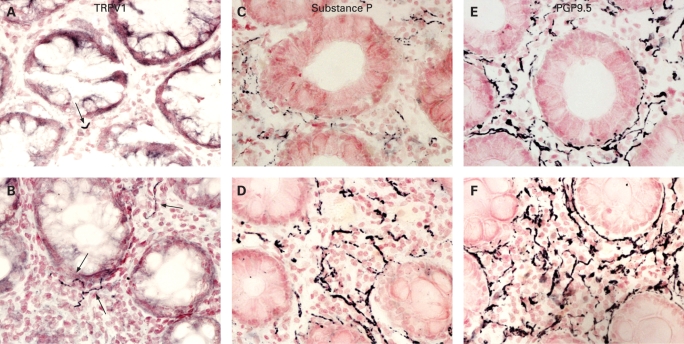
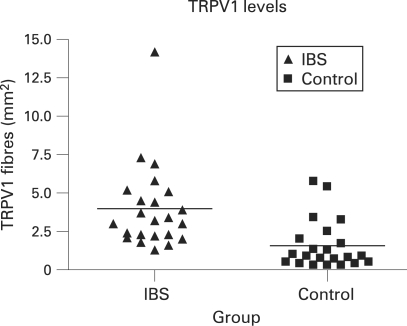
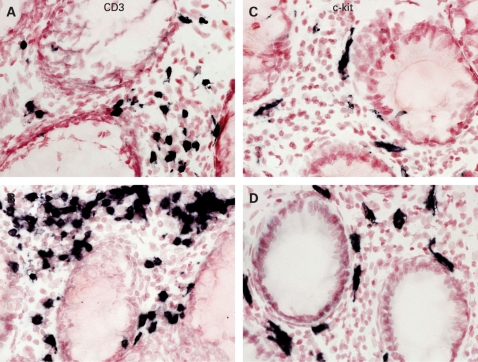
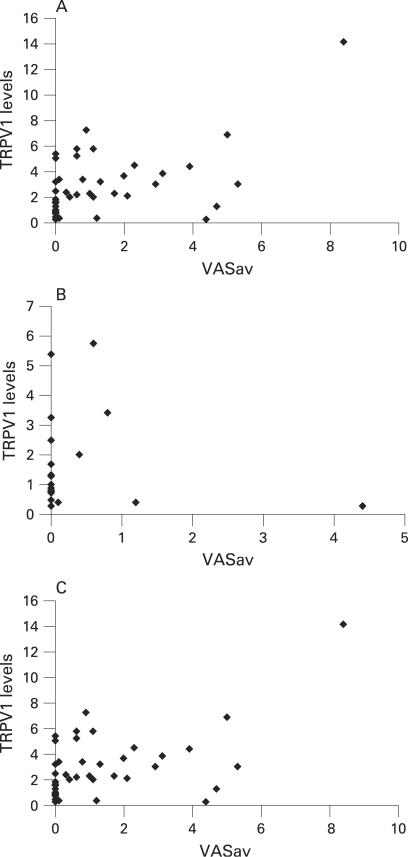
OBJECTIVE: The capsaicin receptor TRPV1 (transient receptor potential vanilloid type-1) may play an important role in visceral pain and hypersensitivity states. In irritable bowel syndrome (IBS), abdominal pain is a common and distressing symptom where the pathophysiology is still not clearly defined. TRPV1-immunoreactive nerve fibres were investigated in colonic biopsies from patients with IBS, and this was related to abdominal pain. METHODS: Rectosigmoid biopsies were collected from 23 IBS patients fulfilling Rome II criteria, and from 22 controls. Abdominal pain scores were recorded using a validated questionnaire. TRPV1-, substance P- and neuronal marker protein gene product (PGP) 9.5-expressing nerve fibres, mast cells (c-kit) and lymphocytes (CD3 and CD4) were quantified, following immunohistochemistry with specific antibodies. The biopsy findings were related to the abdominal pain scores. RESULTS: A significant 3.5-fold increase in median numbers of TRPV1-immunoreactive fibres was found in biopsies from IBS patients compared with controls (p<0.0001). Substance P-immunoreactive fibres (p = 0.01), total nerve fibres (PGP9.5) (p = 0.002), mast cells (c-kit) (p = 0.02) and lymphocytes (CD3) (p = 0.03) were also significantly increased in the IBS group. In multivariate regression analysis, only TRPV1-immuno-reactive fibres (p = 0.005) and mast cells (p = 0.008) were significantly related to the abdominal pain score. CONCLUSIONS: Increased TRPV1 nerve fibres are observed in IBS, together with a low-grade inflammatory response. The increased TRPV1 nerve fibres may contribute to visceral hypersensitivity and pain in IBS, and provide a novel therapeutic target.
Overview
The claims and statistics of this paper haven’t been checked yet.
Run the check — free, no account needed. It reads the open-access text and checks the sources it cites.
Integrity signals
Registry
Cites
Statistics
Figures
Verification
Claims the paper makes
The claims and statistics of this paper haven’t been checked yet.
Run the check — free, no account needed. It reads the open-access text and checks the sources it cites.
Claims other papers make about this one
Each is checked against this paper’s own text: does it say what the citing paper says it does?
In the citing paper
“The abundance of mast cells in patients with IBS may correlate with some symptoms of IBS, including bloating and abdominal pain (2, 46).”
From Intestinal microbiota and immune function in the pathogenesis of irritable bowel syndrome (2013) · cites this paper as [2]
In the citing paper
“At the peripheral level, the close interaction between the immune system and the ENS in IBS is demonstrated by the increased infiltration of mast cells in the colonic mucosa in close proximity to enteric nerve fibers and by the increased number of sensory nerve fibers surrounding the mast cells (2, 11, 13).”
From Intestinal microbiota and immune function in the pathogenesis of irritable bowel syndrome (2013) · cites this paper as [2]
In the citing paper
“In addition, human and animal studies have shown anatomical changes in the enteric nervous system (ENS) around inflammatory infiltrates in the gut wall (2, 11, 13).”
From Intestinal microbiota and immune function in the pathogenesis of irritable bowel syndrome (2013) · cites this paper as [2]
Self-check
Percentages, sums and reported differences re-computed from the paper’s own numbers.
The self-check needs the paper’s full text.
Citations
Cites
The Hospital Anxiety and Depression Scale
Zigmond, A. S., & Snaith, R. P. (1983) · Acta Psychiatrica Scandinavica · doi:10.1111/j.1600-0447.1983.tb09716.x · Cited by 47,139
An inventory for measuring depression
BECK, A. T. (1961) · Archives of General Psychiatry · doi:10.1001/archpsyc.1961.01710120031004 · Cited by 38,032
The capsaicin receptor: a heat-activated ion channel in the pain pathway
Caterina, M. J., Schumacher, M. A., Tominaga, M., Rosen, T. A., Levine, J. D., & Julius, D. J. (1997) · Nature · doi:10.1038/39807 · Cited by 9,132
The short-form McGill pain questionnaire
Melzack, R. (1987) · Pain · doi:10.1016/0304-3959(87)91074-8 · Cited by 4,368
Vanilloid (Capsaicin) Receptors and Mechanisms
SZALLASI, A., & Blumberg, P. M. (1999) · Pharmacological Reviews · doi:10.1016/s0031-6997(24)01403-0 · Cited by 1,903
Barbara, G., Stanghellini, V., De Giorgio, R., Cremon, C., Cottrell, G. S., Santini, D., Pasquinelli, G., Morselli-Labate, A. M., Grady, E. F., Bunnett, N. W., et al. (2004) · Gastroenterology · doi:10.1053/j.gastro.2003.11.055 · Cited by 1,475
O’Mahony, L., McCarthy, J., Kelly, P., Hurley, G., Luo, F., Chen, K., O’Sullivan, G. C., Kiely, B., Collins, J. K., Shanahan, F., et al. (2005) · Gastroenterology · doi:10.1053/j.gastro.2004.11.050 · Cited by 1,448
Ji, R., Samad, T. A., Jin, S., Schmoll, R., & Woolf, C. J. (2002) · Neuron · doi:10.1016/s0896-6273(02)00908-x · Cited by 1,239
Spiller, R. C., Jenkins, D., Thornley, J. P., Hebden, J. M., Wright, T., Skinner, M., & Neal, K. R. (2000) · Gut · doi:10.1136/gut.47.6.804 · Cited by 1,155
Postinfectious Irritable Bowel Syndrome
Spiller, R., & Garsed, K. (2009) · Gastroenterology · doi:10.1053/j.gastro.2009.02.074 · Cited by 1,024
Cited by
Sorted by citations
Postinfectious Irritable Bowel Syndrome
Spiller, R., & Garsed, K. (2009) · Gastroenterology · doi:10.1053/j.gastro.2009.02.074 · Cited by 1,024
Anand, P., & Bley, K. R. (2011) · British Journal of Anaesthesia · doi:10.1093/bja/aer260 · Cited by 708
Self-citationPathogenesis of IBS: role of inflammation, immunity and neuroimmune interactions
Öhman, L., & Simrén, M. (2010) · Nature Reviews Gastroenterology & Hepatology · doi:10.1038/nrgastro.2010.4 · Cited by 617
Nilius, B., & SZALLASI, A. (2014) · Pharmacological Reviews · doi:10.1124/pr.113.008268 · Cited by 510
Fattori, V., Hohmann, M. S., Rossaneis, A. C., Pinho-Ribeiro, F. A., & Verri, W. A., Jr. (2016) · Molecules · doi:10.3390/molecules21070844 · Cited by 512
Metadata
- Authors
- Akbar, A., Yiangou, Y., Facer, P., Walters, J. R. F., Anand, P., & Ghosh, S.
- Affiliations
- Imperial College London (GB)
- Hammersmith Hospital (GB)
- Corresponding author
- Ghosh, S
- Venue
- Gut
- Publisher
- BMJ
- Published
- 2008-02-27
- Volume
- 57
- Issue
- 7
- Pages
- 923-929
- ISSN
- 0017-5749 (ISSN-L)
- PMC
- PMC2564830
- OpenAlex
- W2165979101
- Cited by
- 526
- References
- 49
- Citations by year
- 2026: 19 · 2025: 16 · 2024: 34 · 2023: 25 · 2022: 21 · 2021: 36 · 2020: 28 · 2019: 27 · 2018: 30 · 2017: 30 · 2016: 41 · 2015: 25 · 2014: 36 · 2013: 39 · 2012: 26
- FWCI
- 29.02
- Type
- journal article
- Language
- en
- Open access
- bronze
- doi.org
- Locations
- Gut (publishedVersion)
- PubMed Central (publishedVersion, cc-by)
- PubMed (publishedVersion)
- HighWire Press Open Archive (submittedVersion)
- Spiral (Imperial College London) (submittedVersion)
- Funders
- GlaxoSmithKline
- London School of Hygiene and Tropical Medicine
- Topics
- Health Sciences › Medicine › Gastroenterology › Gastrointestinal motility and disorders
- Life Sciences › Neuroscience › Sensory Systems › Ion Channels and Receptors
- Health Sciences › Medicine › Physiology (medical) › Pain Mechanisms and Treatments
- Keywords
- irritable bowel syndrome, TRPV1, capsaicin receptor, visceral pain, visceral hypersensitivity, abdominal pain, sensory nerve fibers, substance P, mast cells, lymphocytes, colonic mucosa, low-grade inflammation
- MeSH terms
- Adult, Aged, Anxiety, Depression, Female, Humans, Immunoenzyme Techniques, Intestinal Mucosa, Male, Middle Aged, Nerve Fibers, Neurons, Afferent, Pain Measurement, Abdominal Pain, Inflammation Mediators, Irritable Bowel Syndrome, TRPV Cation Channels
About these checks
Registry, retraction, Cites and statistics results are computed, not judged, with one exception: a printed reference that no index lists is read once by a model before it counts as a citation error. Claims are extracted by a model and kept only when their quote appears verbatim in the text; each cited source is then checked, with a model’s help, for whether it says what the claim relies on. Those verdicts can be wrong — read the claim’s quote and the cited source before relying on one.
Statistics and arithmetic are recomputed, not judged.
Confidence bands are shown only for fields calibrated on our annotated test set. None is calibrated yet, so no band is shown.
What counts as a claim ›How we measure confidence ›How we check this ›
Are you an author, or do you see a problem with this page? Request a review
