

Assessing telephone-delivered cognitive–behavioural therapy (CBT) and web-delivered CBT versus treatment as usual in irritable bowel syndrome (ACTIB): a multicentre randomised trial
Open accessThe DOI matches its Crossref record; 31 of the 32 references it cites were found in a registry or an index.
Abstract
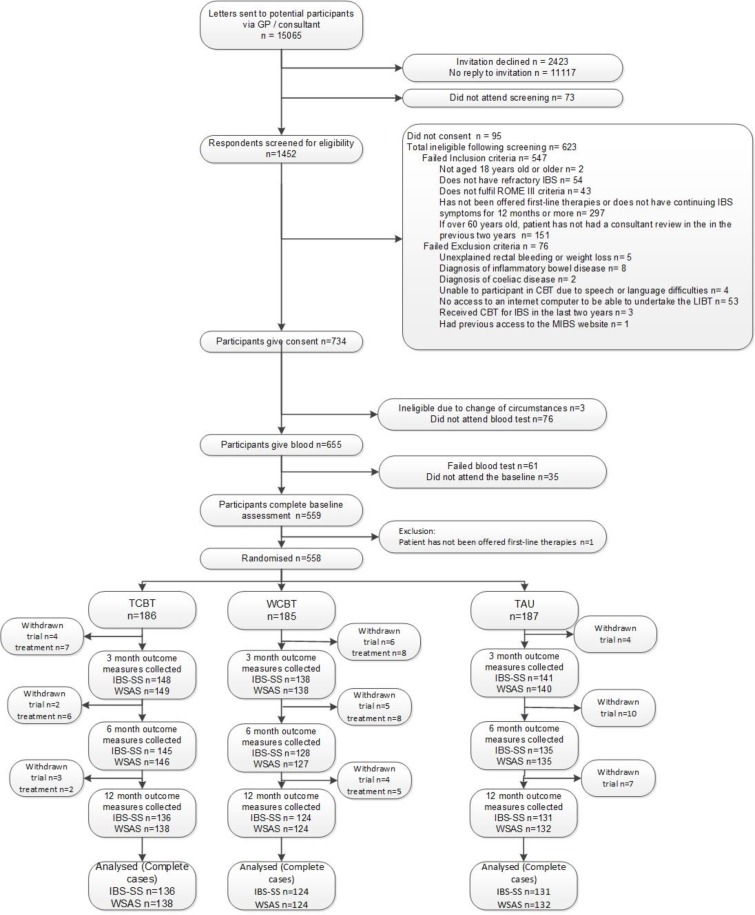
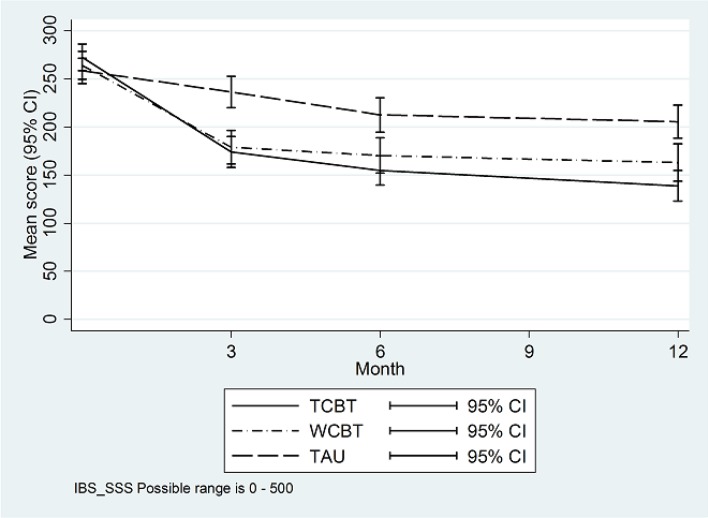
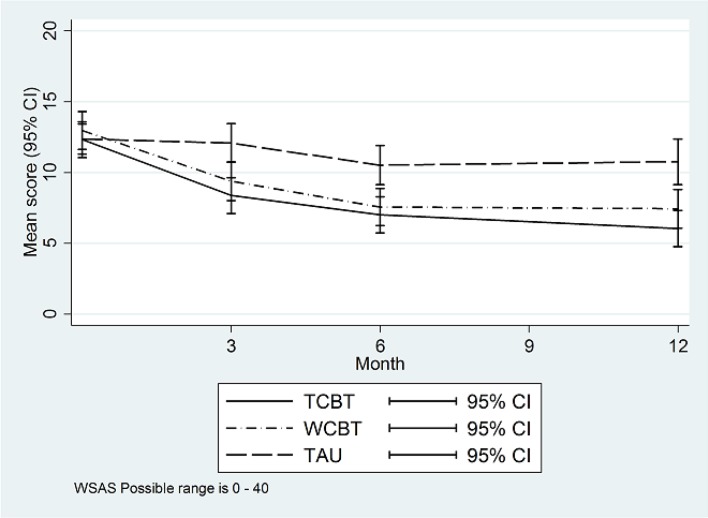
Objective: To evaluate the clinical effectiveness of two modes of cognitive–behavioural therapy (CBT) for IBS compared with treatment as usual (TAU) in refractory IBS. Design: A three-arm randomised controlled trial assessing telephone-delivered CBT (TCBT), web-based CBT (WCBT) with minimal therapist support, and TAU. Blinding participants and therapists was not possible. Chief investigator, assessors and statisticians were blinded. Participants were adults with refractory IBS (clinically significant symptoms for ≥12 months despite first-line therapies), recruited by letter and opportunistically from 74 general practices and three gastroenterology centres in London and South of England between May 2014 to March 2016. Co-primary outcomes were IBS Symptom Severity Score (IBS-SSS) and Work and Social Adjustment Scale (WSAS) at 12 months. Results: 558/1452 (38.4%) patients screened for eligibility were randomised: 76% female: 91% white: mean age 43 years. (391/558) 70.1% completed 12 months of follow-up. Primary outcomes: Compared with TAU (IBS-SSS 205.6 at 12 months), IBS-SSS was 61.6 (95% CI 33.8 to 89.5) points lower (p<0.001) in TCBT and 35.2 (95% CI 12.6 to 57.8) points lower (p=0.002) in WCBT at 12 months. Compared with TAU (WSAS score 10.8 at 12 months) WSAS was 3.5 (95% CI 1.9 to 5.1) points lower (p<0.001) in TCBT and 3.0 (95% CI 1.3 to 4.6) points lower (p=0.001) in WCBT. All secondary outcomes showed significantly greater improvement (p≤0.002) in CBT arms compared with TAU. There were no serious adverse reactions to treatment. Conclusion: Both CBT interventions were superior to TAU up to 12 months of follow-up. Trial registration number: ISRCTN44427879 .
Overview
The claims and statistics of this paper haven’t been checked yet.
Free: it reads the open-access text and checks the first 5 claims that cite a source we can check. Create a free account to check every claim.
Integrity signals
Registry
Cites
Statistics
Figures
Verification
Claims the paper makes
The claims and statistics of this paper haven’t been checked yet.
Free: it reads the open-access text and checks the first 5 claims that cite a source we can check. Create a free account to check every claim.
Claims other papers make about this one
Each is checked against this paper’s own text: does it say what the citing paper says it does?
The source backs part of the claim, not all of it — or backs it for a different population, condition or comparison.
In the citing paper
“General practitioners provide the majority of long-term medical care for people with IBS, referring only a minority of patients to specialist clinics.86”
From British Society of Gastroenterology guidelines on the management of irritable bowel syndrome (2021) · cites this paper as [86]
Experimental — accuracy not yet measuredThe source backs part of the claim, not all of it — or backs it for a different population, condition or comparison.
In the citing paper
“In a primary care study of patients with refractory IBS, only 10% had ever had a secondary care referral.86”
From British Society of Gastroenterology guidelines on the management of irritable bowel syndrome (2021) · cites this paper as [86]
Experimental — accuracy not yet measuredThe source backs part of the claim, not all of it — or backs it for a different population, condition or comparison.
In the citing paper
“in the largest trial of CBT for IBS conducted to date at least 50% of patients met cutoffs for probable common mental disorders at baseline, and both therapist-delivered CBT over the telephone and web-based CBT using IBS-specific protocols reduced anxiety and depression scores at all follow-up points.86”
From British Society of Gastroenterology guidelines on the management of irritable bowel syndrome (2021) · cites this paper as [86]
Experimental — accuracy not yet measuredThe source backs part of the claim, not all of it — or backs it for a different population, condition or comparison.
In the citing paper
“Therapist competency can be developed online [50], and therapeutic alliance required for CBT to be effective does not diminish with the web-based delivery of CBT [51].”
From Development and usability testing of a web-based and therapist-assisted coping skills program for managing psychosocial problems in individuals with hand and upper limb injuries: Mixed methods study (2020) · cites this paper as [51]
Experimental — accuracy not yet measuredThe source backs part of the claim, not all of it — or backs it for a different population, condition or comparison.
In the citing paper
“Group CBT and CBT via the telephone performed similarly, but based on only two small trials for group CBT, [85, 90] and one trial for CBT via the telephone, [87] although the latter included 558 patients. [87]”
From Efficacy of psychological therapies for irritable bowel syndrome: systematic review and network meta-analysis (2020) · cites this paper as [87]
Experimental — accuracy not yet measured
3 more claims about this paper
Create a free account to see every claim other papers make about this one.
Self-check
Percentages, sums and reported differences re-computed from the paper’s own numbers.
The self-check needs the paper’s full text.
Citations
Cites
The Hospital Anxiety and Depression Scale
Zigmond, A. S., & Snaith, R. P. (1983) · Acta Psychiatrica Scandinavica · doi:10.1111/j.1600-0447.1983.tb09716.x · Cited by 47,139
Multiple imputation using chained equations: Issues and guidance for practice
White, I. R., Royston, P., & Wood, A. M. (2011) · Statistics in Medicine · doi:10.1002/sim.4067 · Cited by 9,792
The functional gastrointestinal disorders and the Rome III process
Drossman, D. A. (2006) · Gastroenterology · doi:10.1053/j.gastro.2006.03.008 · Cited by 2,416
Global Prevalence of and Risk Factors for Irritable Bowel Syndrome: A Meta-analysis
Lovell, R. M., & Ford, A. C. (2012) · Clinical Gastroenterology and Hepatology · doi:10.1016/j.cgh.2012.02.029 · Cited by 2,155
FRANCIS, C. Y., MORRIS, J., & WHORWELL, P. J. (1997) · Alimentary Pharmacology & Therapeutics · doi:10.1046/j.1365-2036.1997.142318000.x · Cited by 1,708
Guidelines on the irritable bowel syndrome: mechanisms and practical management
Spiller, R., Aziz, Q., Creed, F., Emmanuel, A., Houghton, L., Hungin, P., Jones, R., Kumar, D., Rubin, G., Trudgill, N., et al. (2007) · Gut · doi:10.1136/gut.2007.119446 · Cited by 818
Howie, J. G., Heaney, D. J., Maxwell, M., & Walker, J. J. (1998) · Family Practice · doi:10.1093/fampra/15.2.165 · Cited by 487
van Ballegooijen, W., Cuijpers, P., van Straten, A., Karyotaki, E., Andersson, G., Smit, J. H., & Riper, H. (2014) · PLoS ONE · doi:10.1371/journal.pone.0100674 · Cited by 409
The Hospital Anxiety and Depression Scale: A meta confirmatory factor analysis
Norton, S., Cosco, T., Doyle, F., Done, J., & Sacker, A. (2013) · Journal of Psychosomatic Research · doi:10.1016/j.jpsychores.2012.10.010 · Cited by 405
Adjusting for partially missing baseline measurements in randomized trials
White, I. R., & Thompson, S. G. (2005) · Statistics in Medicine · doi:10.1002/sim.1981 · Cited by 378
Research works printed but not linked: 2
- Hellier M, Sanderson J, Morris A, et al Care of patients with gastrointestinal disorders in the United Kingdom: A strategy for the future. Brit Soc Gastroenterol 2006.
- NICE. Irritable bowel syndrome in adults: diagnosis and management of irritable bowel syndrome in primary care. NICE 2015.
Cited by
Ford, A. C., Sperber, A. D., Corsetti, M., & Camilleri, M. (2020) · The Lancet · doi:10.1016/s0140-6736(20)31548-8 · Cited by 818
British Society of Gastroenterology guidelines on the management of irritable bowel syndrome
Vasant, D. H., Paine, P. A., Black, C. J., Houghton, L. A., Everitt, H. A., Corsetti, M., Agrawal, A., Aziz, I., Farmer, A. D., Eugenicos, M. P., et al. (2021) · Gut · doi:10.1136/gutjnl-2021-324598 · Cited by 592
Self-citationThe Handbook of Behavior Change
(2020) · Cambridge University Press eBooks · doi:10.1017/9781108677318 · Cited by 407
Black, C. J., Thakur, E. R., Houghton, L. A., Quigley, E. M. M., Moayyedi, P., & Ford, A. C. (2020) · Gut · doi:10.1136/gutjnl-2020-321191 · Cited by 299
Changing Behavior Using the Theory of Planned Behavior
Ajzen, I., & Schmidt, P. (2020) · The Handbook of Behavior Change · doi:10.1017/9781108677318.002 · Cited by 266
A Rome Working Team Report on Brain-Gut Behavior Therapies for Disorders of Gut-Brain Interaction
Keefer, L., Ballou, S. K., Drossman, D. A., Ringstrom, G., Elsenbruch, S., & Ljótsson, B. (2022) · Gastroenterology · doi:10.1053/j.gastro.2021.09.015 · Cited by 213
Behavioral and Diet Therapies in Integrated Care for Patients With Irritable Bowel Syndrome
Chey, W. D., Keefer, L., Whelan, K., & Gibson, P. R. (2021) · Gastroenterology · doi:10.1053/j.gastro.2020.06.099 · Cited by 154
Ford, A. C., Wright-Hughes, A., Alderson, S. L., Ow, P.-L., Ridd, M. J., Foy, R., Bianco, G., Bishop, F. L., Chaddock, M., Cook, H., et al. (2023) · The Lancet · doi:10.1016/s0140-6736(23)01523-4 · Cited by 146
Self-citationChanging Behavior Using the Model of Action Phases
Keller, L., Gollwitzer, P. M., & Sheeran, P. (2020) · The Handbook of Behavior Change · doi:10.1017/9781108677318.006 · Cited by 147
Savarino, E., Zingone, F., Barberio, B., Marasco, G., Akyuz, F., Akpinar, H., Barboi, O., Bodini, G., Bor, S., Chiarioni, G., et al. (2022) · United European Gastroenterology Journal · doi:10.1002/ueg2.12259 · Cited by 146
Morriss, R., Briley, P. M., Webster, L., Abdelghani, M., Barber, S., Bates, P., Brookes, C., Hall, B., Ingram, L., Kurkar, M., et al. (2024) · Nature Medicine · doi:10.1038/s41591-023-02764-z · Cited by 122
“…greater than minimum clinically important improvements in Generalized Anxiety Disorder Assessment (GAD-7) 31 (≥3.3 points 32 ), Work and Social Adjustment Scale (WSAS 33 , >3.7 points 34 ) and the Euroqol-5D-5L visual analog scale of overall perceived health (EQ-5D-5L VAS 35 , ≥8.0 points 36 ).”
InfluentialEveritt, H. A., Landau, S., O'Reilly, G., Sibelli, A., Hughes, S., Windgassen, S., Holland, R., Little, P., McCrone, P., Bishop, F. L., et al. (2019) · The Lancet Gastroenterology & Hepatology · doi:10.1016/s2468-1253(19)30243-2 · Cited by 116
Self-citationChanging Behavior Using the Health Action Process Approach
Schwarzer, R., & Hamilton, K. (2020) · The Handbook of Behavior Change · doi:10.1017/9781108677318.007 · Cited by 102
Impact of Rome IV irritable bowel syndrome on work and activities of daily living
Goodoory, V. C., Ng, C. E., Black, C. J., & Ford, A. C. (2022) · Alimentary Pharmacology & Therapeutics · doi:10.1111/apt.17132 · Cited by 101
Carco, C., Young, W., Gearry, R. B., Talley, N. J., McNabb, W. C., & Roy, N. C. (2020) · Frontiers in Cellular and Infection Microbiology · doi:10.3389/fcimb.2020.00468 · Cited by 99
Hunt, M., Miguez, S., Dukas, B., Onwude, O., & White, S. (2021) · JMIR mHealth and uHealth · doi:10.2196/26152 · Cited by 98
Black, C. J., Yiannakou, Y., Guthrie, E. A., West, R., Houghton, L. A., & Ford, A. C. (2021) · American Journal of Gastroenterology · doi:10.14309/ajg.0000000000000975 · Cited by 94
Lutz, J., Offidani, E., Taraboanta, L., Lakhan, S. E., & Campellone, T. R. (2022) · Frontiers in Digital Health · doi:10.3389/fdgth.2022.823977 · Cited by 89
Best management of irritable bowel syndrome
Black, C. J., & Ford, A. C. (2020) · Frontline Gastroenterology · doi:10.1136/flgastro-2019-101298 · Cited by 102
Italian guidelines for the management of irritable bowel syndrome
Barbara, G., Cremon, C., Bellini, M., Corsetti, M., Nardo, G. D., Falangone, F., Fuccio, L., Galeazzi, F., Iovino, P., Sarnelli, G., et al. (2022) · Digestive and Liver Disease · doi:10.1016/j.dld.2022.11.015 · Cited by 88
Gardner, B., Rebar, A. L., & Lally, P. J. (2020) · Cambridge University Press eBooks · doi:10.1017/9781108677318.041 · Cited by 85
Ma, C., Congly, S. E., Novak, K. L., Belletrutti, P. J., Raman, M., Woo, M. M. K., Andrews, C. N., & Nasser, Y. (2020) · Gastroenterology · doi:10.1053/j.gastro.2020.09.041 · Cited by 72
Impact of Psychological Comorbidity on the Prognosis of Irritable Bowel Syndrome
Goodoory, V. C., Mikocka-Walus, A., Yiannakou, Y., Houghton, L. A., Black, C. J., & Ford, A. C. (2021) · American Journal of Gastroenterology · doi:10.14309/ajg.0000000000001247 · Cited by 64
Goodoory, V. C., Guthrie, E., Ng, C. E., Black, C. J., & Ford, A. C. (2022) · Alimentary Pharmacology & Therapeutics · doi:10.1111/apt.17356 · Cited by 75
Basnayake, C., Kamm, M. A., Stanley, A., Wilson-O'Brien, A. L., Burrell, K., Lees-Trinca, I., Khera, A. J., Kantidakis, J., Wong, O., Fox, K., et al. (2021) · Clinical Gastroenterology and Hepatology · doi:10.1016/j.cgh.2021.12.005 · Cited by 70
Changing Behavior Using Social Cognitive Theory
Łuszczyńska, A., & Schwarzer, R. (2020) · Cambridge University Press eBooks · doi:10.1017/9781108677318.003 · Cited by 104
Goodoory, V. C., Khasawneh, M., Thakur, E. R., Everitt, H., Gudleski, G. D., Lackner, J. M., Moss-Morris, R. E., Simrén, M., Vasant, D. H., Moayyedi, P., et al. (2024) · Gastroenterology · doi:10.1053/j.gastro.2024.05.010 · Cited by 76
Self-citationSex as a biological variable in irritable bowel syndrome
Camilleri, M. (2020) · Neurogastroenterology & Motility · doi:10.1111/nmo.13802 · Cited by 64
Warner, L. M., & French, D. (2020) · Cambridge University Press eBooks · doi:10.1017/9781108677318.032 · Cited by 79
Changing Behavior Using Ecological Models
Salmon, J., Hesketh, K. D., Arundell, L., Downing, K. L., & Biddle, S. (2020) · Cambridge University Press eBooks · doi:10.1017/9781108677318.017 · Cited by 90
Hypnosis and Cognitive Behavioral Therapies for the Management of Gastrointestinal Disorders
Palsson, O. S., & Ballou, S. (2020) · Current Gastroenterology Reports · doi:10.1007/s11894-020-00769-z · Cited by 56
Sharpe, L., Todd, J., Scott, A. J., Gatzounis, R., Menzies, R. E., & Meulders, A. (2022) · Clinical Psychology Review · doi:10.1016/j.cpr.2022.102126 · Cited by 63
Changing Behavior Using Self-Determination Theory
Hagger, M. S., Hankonen, N. E., Chatzisarantis, N. L. D., & Ryan, R. M. (2020) · Cambridge University Press eBooks · doi:10.1017/9781108677318.008 · Cited by 87
Development and Current State of Digital Therapeutics for Irritable Bowel Syndrome
Brenner, D. M., Kassebaum-Ladewski, A., & Kinsinger, S. W. (2023) · Clinical Gastroenterology and Hepatology · doi:10.1016/j.cgh.2023.09.013 · Cited by 52
Norton, C. S., Syred, J., Kerry, S., Artom, M., Sweeney, L., Hart, A. L., Czuber‐Dochan, W., Taylor, S. J., Mihaylova, B., Roukas, C., et al. (2021) · Trials · doi:10.1186/s13063-021-05466-4 · Cited by 43
Self-citationPlanning and Implementation Intention Interventions
Rhodes, R. E., Grant, S. J., & de Bruijn, G. (2020) · Cambridge University Press eBooks · doi:10.1017/9781108677318.039 · Cited by 49
Attitudes and Persuasive Communication Interventions
Hamilton, K., & Johnson, B. T. (2020) · Cambridge University Press eBooks · doi:10.1017/9781108677318.031 · Cited by 61
Changing Behavior Using Habit Theory
Orbell, S., & Verplanken, B. (2020) · Cambridge University Press eBooks · doi:10.1017/9781108677318.013 · Cited by 64
Changing Behavior: A Theory- and Evidence-Based Approach
Hagger, M. S., Cameron, L. D., Hamilton, K., Hankonen, N. E., & Lintunen, T. (2020) · Cambridge University Press eBooks · doi:10.1017/9781108677318.001 · Cited by 63
Tarrant, M., Haslam, C., Carter, M., Calitri, R., & Haslam, S. A. (2020) · Cambridge University Press eBooks · doi:10.1017/9781108677318.044 · Cited by 43
Shiha, M. G., Asghar, Z., Thoufeeq, M., Kurien, M., Ball, A. J., Rej, A., Tai, F. W. D., Afify, S., & Aziz, I. (2021) · Neurogastroenterology & Motility · doi:10.1111/nmo.14121 · Cited by 43
Black, C. J., Ng, C. E., Goodoory, V. C., & Ford, A. C. (2023) · Clinical Gastroenterology and Hepatology · doi:10.1016/j.cgh.2023.02.016 · Cited by 40
Changing Behavior Using Integrated Theories
Hagger, M. S., & Hamilton, K. (2020) · Cambridge University Press eBooks · doi:10.1017/9781108677318.015 · Cited by 51
Sweeney, L., Moss-Morris, R. E., Czuber‐Dochan, W., Murrells, T., & Norton, C. S. (2019) · European Journal of Gastroenterology & Hepatology · doi:10.1097/meg.0000000000001615 · Cited by 33
Self-citationChanging Behavior Using the Transtheoretical Model
DiClemente, C. C., & Graydon, M. M. (2020) · Cambridge University Press eBooks · doi:10.1017/9781108677318.010 · Cited by 39
Autonomic dysfunction in autism: the roles of anxiety, depression, and stress
Taylor, E. C., Livingston, L. A., Callan, M. J., Ashwin, C., & Shah, P. (2021) · Autism · doi:10.1177/1362361320985658 · Cited by 30
Changing Behavior Using the Health Belief Model and Protection Motivation Theory
Orbell, S., Zahid, H., & Henderson, C. J. (2020) · Cambridge University Press eBooks · doi:10.1017/9781108677318.004 · Cited by 41
Lackner, J. M., Gudleski, G. D., Radziwon, C. D., Krasner, S. S., Firth, R. S., Naliboff, B. D., Vargovich, A. M., Borden, A. B., & Mayer, E. A. (2022) · Behaviour Research and Therapy · doi:10.1016/j.brat.2022.104033 · Cited by 31
Changing Behavior by Changing Environments
Marteau, T. M., Fletcher, P. C., Hollands, G. J., & Munafo, M. R. (2020) · Cambridge University Press eBooks · doi:10.1017/9781108677318.014 · Cited by 35
Lackner, J. M., & Jaccard, J. J. (2021) · Journal of Consulting and Clinical Psychology · doi:10.1037/ccp0000648 · Cited by 33
Kim, H., Oh, Y., & Chang, S. J. (2022) · Journal of Medical Internet Research · doi:10.2196/35260 · Cited by 32
An evidence-based update on the diagnosis and management of irritable bowel syndrome
Black, C. J., & Ford, A. C. (2025) · Expert Review of Gastroenterology & Hepatology · doi:10.1080/17474124.2025.2455586 · Cited by 27
“Consequently, studies have evaluated minimal-contact approaches, or CBT delivered over the telephone or via the internet [132].”
2025 Seoul Consensus on Clinical Practice Guidelines for Irritable Bowel Syndrome
Choi, Y., Youn, Y. H., Kang, S. J., Shin, J. E., Cho, Y. S., Jung, Y. S., Shin, S. Y., Huh, C. W., Lee, Y. J., Koo, H. S., et al. (2025) · Journal of Neurogastroenterology and Motility · doi:10.5056/jnm25007 · Cited by 33
Design, Implementation, and Evaluation of Behavior Change Interventions: A Ten-Task Guide
Abraham, C., & Denford, S. (2020) · Cambridge University Press eBooks · doi:10.1017/9781108677318.019 · Cited by 35
Changing Behavior Using the Reflective-Impulsive Model
Deutsch, R., & Strack, F. (2020) · Cambridge University Press eBooks · doi:10.1017/9781108677318.012 · Cited by 36
Personalisation of therapy in irritable bowel syndrome: a hypothesis
Black, C. J., & Ford, A. C. (2024) · The Lancet. Gastroenterology & hepatology · doi:10.1016/s2468-1253(24)00245-0 · Cited by 30
Dyadic Behavior Change Interventions
Scholz, U., Berli, C., Lüscher, J., & Knoll, N. (2020) · Cambridge University Press eBooks · doi:10.1017/9781108677318.043 · Cited by 29
Prevalence and impact of faecal incontinence among individuals with Rome IV irritable bowel syndrome
Goodoory, V. C., Ng, C. E., Black, C. J., & Ford, A. C. (2023) · Alimentary Pharmacology & Therapeutics · doi:10.1111/apt.17465 · Cited by 27
Developing Behavior Change Interventions
Hankonen, N. E., & Hardeman, W. (2020) · Cambridge University Press eBooks · doi:10.1017/9781108677318.021 · Cited by 42
Thakur, E. R., Khasawneh, M., Moayyedi, P., Black, C. J., & Ford, A. C. (2025) · The Lancet. Gastroenterology & hepatology · doi:10.1016/s2468-1253(25)00238-9 · Cited by 27
Rothman, A. J., Klein, W. M. P., & Sheeran, P. (2020) · Cambridge University Press eBooks · doi:10.1017/9781108677318.020 · Cited by 30
Imagery, Visualization, and Mental Simulation Interventions
Hagger, M. S., & Conroy, D. (2020) · Cambridge University Press eBooks · doi:10.1017/9781108677318.033 · Cited by 25
Changing Behavior Using the Common-Sense Model of Self-Regulation
Cameron, L. D., Fleszar‐Pavlović, S. E., & Khachikian, T. (2020) · Cambridge University Press eBooks · doi:10.1017/9781108677318.005 · Cited by 34
Engagement of Stakeholders in the Design, Evaluation, and Implementation of Complex Interventions
Hudson, J. L., Moon, Z., Hughes, L. D., & Moss-Morris, R. E. (2020) · Cambridge University Press eBooks · doi:10.1017/9781108677318.024 · Cited by 28
Self-citationOwusu, J. T., Sibelli, A., Moss-Morris, R. E., van Tilburg, M. A. L., Levy, R. L., & Oser, M. L. (2021) · Neurogastroenterology & Motility · doi:10.1111/nmo.14108 · Cited by 23
Self-citationChalder, T., Patel, M., Hotopf, M., Moss-Morris, R., Ashworth, M., Watts, K., David, A. S., McCrone, P., Husain, M., Garrood, T., et al. (2021) · Psychological Medicine · doi:10.1017/s0033291721001793 · Cited by 20
Self-citationKhasawneh, M., Shaikh, F. A., Ng, C. E., Black, C. J., Goodoory, V. C., & Ford, A. C. (2024) · Neurogastroenterology & Motility · doi:10.1111/nmo.14756 · Cited by 23
Gneezy, U., Kajackaite, A., & Meier, S. (2020) · Cambridge University Press eBooks · doi:10.1017/9781108677318.036 · Cited by 28
Sweeney, L., Windgassen, S., Artom, M., Norton, C. S., Fawson, S., & Moss-Morris, R. E. (2022) · JMIR Formative Research · doi:10.2196/33001 · Cited by 25
Self-citationAxelsson, E., Kern, D., Hedman‐Lagerlöf, E., Lindfors, P., Palmgren, J., Hesser, H., Andersson, E., Johansson, R., Olén, O., Bonnert, M., et al. (2023) · Cognitive Behaviour Therapy · doi:10.1080/16506073.2023.2225745 · Cited by 28
Hughes, S. F., Sibelli, A., Everitt, H., Moss-Morris, R. E., Chalder, T., Harvey, J. M., Falcao, A. V., Landau, S., O’Reilly, G., Windgassen, S., et al. (2020) · Journal of Medical Internet Research · doi:10.2196/18691 · Cited by 23
Self-citationRuiter, R. A. C., Crutzen, R., de Leeuw, E., & Kok, G. (2020) · Cambridge University Press eBooks · doi:10.1017/9781108677318.018 · Cited by 23
Digital health for functional gastrointestinal disorders
Pathipati, M. P., Shah, E. D., Kuo, B., & Staller, K. D. (2021) · Neurogastroenterology & Motility · doi:10.1111/nmo.14296 · Cited by 21
Behavioral Therapy Preferences in People With Migraine
Minen, M. T., Jalloh, A., de Dhaem, O. B., & Seng, E. K. (2020) · Headache The Journal of Head and Face Pain · doi:10.1111/head.13790 · Cited by 17
Recent advances in diagnosis and management of irritable bowel syndrome
den Houte, K. V., Colomier, E., Schol, J., Carbone, F., & Tack, J. F. (2020) · Current Opinion in Psychiatry · doi:10.1097/yco.0000000000000628 · Cited by 21
Zhao, J., Chen, M., Wang, X., Ye, K., Shi, S., Li, H., Wang, J., Chen, X., Ni, J., Wei, Q., et al. (2021) · BMJ Open · doi:10.1136/bmjopen-2020-045655 · Cited by 18
Knowles, C. H., Booth, L., Brown, S. R., Cross, S., Eldridge, S. M., Emmett, C., Grossi, U., Jordan, M., Lacy‐Colson, J., Mason, J. M., et al. (2021) · Programme Grants for Applied Research · doi:10.3310/pgfar09140 · Cited by 20
Self-citationHasan, S. S., Ballou, S., Keefer, L., & Vasant, D. H. (2023) · Neurogastroenterology & Motility · doi:10.1111/nmo.14554 · Cited by 17
Reporting of PPI and the MCID in phase III/IV randomised controlled trials—a systematic review
Brennan, J., Poon, M. T. C., Christopher, E., Fulton, O., Porteous, C., & Brennan, P. M. (2023) · Trials · doi:10.1186/s13063-023-07367-0 · Cited by 14
Changing Behavior Using Social Identity Processes
Reynolds, K. J., Branscombe, N. R., Subašić, E., & Willis, L. (2020) · Cambridge University Press eBooks · doi:10.1017/9781108677318.016 · Cited by 24
Anderson, E. J., Peters, S., Gibson, P. R., & Halmos, E. P. (2024) · The American Journal of Gastroenterology · doi:10.14309/ajg.0000000000002921 · Cited by 23
Shalaby, R., Vuong, W., Eboreime, E., Surood, S., Greenshaw, A. J., & Agyapong, V. I. O. (2022) · JMIR Formative Research · doi:10.2196/33438 · Cited by 16
Wright-Hughes, A. M., Ow, P.-L., Alderson, S. L., Ridd, M. J., Foy, R., Bishop, F. L., Chaddock, M., Fernandez, C., Guthrie, E., Muir, D., et al. (2025) · Gut · doi:10.1136/gutjnl-2024-334490 · Cited by 17
Self-citationCurrent Applications of Telemedicine in Gastroenterology
Fung, B. M., Markarian, E., Serper, M., & Tabibian, J. H. (2022) · The American Journal of Gastroenterology · doi:10.14309/ajg.0000000000001761 · Cited by 15
Lackner, J. M. (2020) · Expert Review of Gastroenterology & Hepatology · doi:10.1080/17474124.2020.1780118 · Cited by 17
Webb, T. L., & de Bruin, M. (2020) · Cambridge University Press eBooks · doi:10.1017/9781108677318.037 · Cited by 17
Pathipati, M. P., Scott, L. L., Griser, A. C., & Staller, K. D. (2024) · Neurogastroenterology & Motility · doi:10.1111/nmo.14811 · Cited by 19
Non-pharmaceutical treatments for irritable bowel syndrome
Wang, X., Thakur, E. R., & Shapiro, J. M. (2024) · BMJ · doi:10.1136/bmj-2023-075777 · Cited by 17
Babatunde, F. O., MacDermid, J., Grewal, R., Macedo, L., & Szekeres, M. (2020) · JMIR Human Factors · doi:10.2196/17088 · Cited by 12
“Therapist competency can be developed online [50], and therapeutic alliance required for CBT to be effective does not diminish with the web-based delivery of CBT [51].”
Critical and Qualitative Approaches to Behavior Change
Chamberlain, K., & Lyons, A. C. (2020) · Cambridge University Press eBooks · doi:10.1017/9781108677318.030 · Cited by 16
Maximizing User Engagement with Behavior Change Interventions
Yardley, L., Morrison, L. G., Müller, I., & Bradbury, K. J. (2020) · Cambridge University Press eBooks · doi:10.1017/9781108677318.025 · Cited by 13
Alderson, S. L., Wright-Hughes, A. M., Ford, A. C., Farrin, A. J., Hartley, S., Fernandez, C., Taylor, C., Ow, P. L., Teasdale, E. J., Howdon, D., et al. (2022) · Trials · doi:10.1186/s13063-022-06492-6 · Cited by 12
Self-citationDunlap, L. J., Jaccard, J. J., & Lackner, J. M. (2021) · Annals of Behavioral Medicine · doi:10.1093/abm/kaaa119 · Cited by 11
Szigethy, E., Tansel, A., Pavlick, A. N., Marroquín, M. A. E., Serio, C. D., Silfee, V., Wallace, M. L., Kingsley, M. J., & Levinthal, D. J. (2021) · Clinical and Translational Gastroenterology · doi:10.14309/ctg.0000000000000436 · Cited by 12
Seaton, N., Moss-Morris, R. E., Hulme, K., Macaulay, H., & Hudson, J. L. (2023) · BJPsych Open · doi:10.1192/bjo.2023.519 · Cited by 13
Self-citationThe Science of Behavior Change: The Road Ahead
Hagger, M. S., Cameron, L. D., Hamilton, K., Hankonen, N. E., & Lintunen, T. (2020) · Cambridge University Press eBooks · doi:10.1017/9781108677318.046 · Cited by 16
Honig, G., Larkin, P. B., Heller, C. A., & Hurtado‐Lorenzo, A. (2021) · Inflammatory Bowel Diseases · doi:10.1093/ibd/izab230 · Cited by 11
Irritable bowel syndrome: a spotlight on future research needs
Black, C. J., & Ford, A. C. (2021) · The Lancet. Gastroenterology & hepatology · doi:10.1016/s2468-1253(21)00131-x · Cited by 9
Murray, H. B., Weeks, I., Thurler, A. H., Calabrese, S., Lapinel, M. K., Madva, E. N., Staller, K. D., Keefer, L., & Kuo, B. (2023) · Neurogastroenterology & Motility · doi:10.1111/nmo.14526 · Cited by 10
Autonomy-Supportive Interventions
Reeve, J., & Cheon, S. H. (2020) · Cambridge University Press eBooks · doi:10.1017/9781108677318.035 · Cited by 15
Metadata
- Authors
- Everitt, H. A., Landau, S., O’Reilly, G., Sibelli, A., Hughes, S., Windgassen, S., Holland, R., Little, P., McCrone, P., Bishop, F., Goldsmith, K., Coleman, N., Logan, R., Chalder, T., & Moss-Morris, R.
- Affiliations
- University of Southampton (GB)
- King's College London (GB)
- University Hospital Southampton NHS Foundation Trust (GB)
- King's College Hospital (GB)
- Corresponding author
- Everitt, Hazel Anne
- ORCID
- Venue
- Gut
- Publisher
- BMJ
- Published
- 2019-04-10
- Volume
- 68
- Issue
- 9
- Pages
- gutjnl-2018-317805
- ISSN
- 0017-5749 (ISSN-L)
- 1468-3288
- PMC
- PMC6709776
- OpenAlex
- W2938697113
- Cited by
- 198
- References
- 32
- Citations by year
- 2026: 14 · 2025: 20 · 2024: 18 · 2023: 18 · 2022: 19 · 2021: 29 · 2020: 66 · 2019: 12
- FWCI
- 28.70
- Type
- journal article
- Language
- en
- Open access
- hybrid
- doi.org
- Licence
- cc-by-nc
- Locations
- Gut (publishedVersion, cc-by-nc)
- Europe PMC (PubMed Central) (publishedVersion, cc-by-nc)
- PubMed Central (publishedVersion, cc-by-nc)
- PubMed (publishedVersion)
- Research Portal (King's College London) (publishedVersion, cc-by-nc)
- ePrints Soton (University of Southampton) (acceptedVersion)
- HighWire Press Open Archive (submittedVersion)
- Funders
- Health Technology Assessment Programme
- Topics
- Health Sciences › Medicine › Gastroenterology › Gastrointestinal motility and disorders
- Social Sciences › Psychology › Applied Psychology › Digital Mental Health Interventions
- Social Sciences › Psychology › Experimental and Cognitive Psychology › Anxiety, Depression, Psychometrics, Treatment, Cognitive Processes
- Keywords
- irritable bowel syndrome, refractory irritable bowel syndrome, cognitive behavioral therapy, telephone-delivered therapy, online therapy, digital mental health interventions, symptom severity, work and social functioning, usual care, Work and Social Adjustment Scale, general practice recruitment, cost-effectiveness, quality of life
- MeSH terms
- Adult, Female, Follow-Up Studies, Humans, Male, Middle Aged, Patient Compliance, Severity of Illness Index, Telephone, Cognitive Behavioral Therapy, Treatment Outcome, Remote Consultation, Internet, Irritable Bowel Syndrome
About these checks
Registry, retraction, Cites and statistics results are computed, not judged, with one exception: a printed reference that no index lists is read once by a model before it counts as a citation error. Claims are extracted by a model and kept only when their quote appears verbatim in the text; each cited source is then checked, with a model’s help, for whether it says what the claim relies on. Those verdicts can be wrong — read the claim’s quote and the cited source before relying on one.
Statistics and arithmetic are recomputed, not judged.
Confidence bands are shown only for fields calibrated on our annotated test set. None is calibrated yet, so no band is shown.
What counts as a claim ›How we measure confidence ›How we check this ›
Are you an author, or do you see a problem with this page? Request a review
Data sources
Bibliographic data: Semantic Scholar, OpenAlex, Crossref.
Contains information from the Semantic Scholar Academic Graph Datasets, made available under the ODC Attribution License (ODC-BY 1.0).
Semantic Scholar’s data is described in: Kinney, R., et al. (2023). The Semantic Scholar Open Data Platform. arXiv:2301.10140.
