

Role of brain imaging in disorders of brain–gut interaction: a Rome Working Team Report
Open accessThe DOI matches its Crossref record; 174 of the 176 references it cites were found in a registry or an index.
Abstract
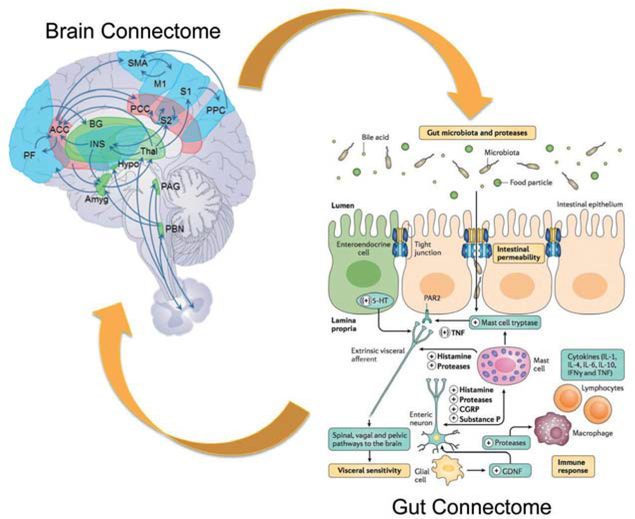
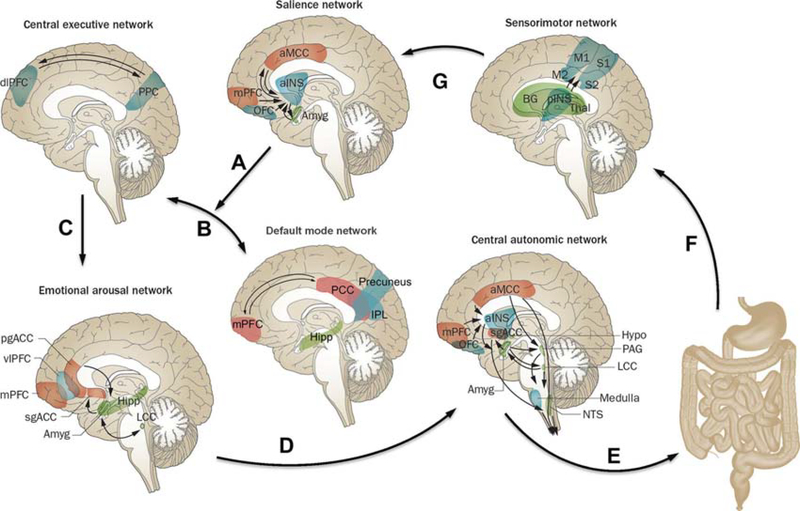
Imaging of the living human brain is a powerful tool to probe the interactions between brain, gut and microbiome in health and in disorders of brain–gut interactions, in particular IBS. While altered signals from the viscera contribute to clinical symptoms, the brain integrates these interoceptive signals with emotional, cognitive and memory related inputs in a non-linear fashion to produce symptoms. Tremendous progress has occurred in the development of new imaging techniques that look at structural, functional and metabolic properties of brain regions and networks. Standardisation in image acquisition and advances in computational approaches has made it possible to study large data sets of imaging studies, identify network properties and integrate them with non-imaging data. These approaches are beginning to generate brain signatures in IBS that share some features with those obtained in other often overlapping chronic pain disorders such as urological pelvic pain syndromes and vulvodynia, suggesting shared mechanisms. Despite this progress, the identification of preclinical vulnerability factors and outcome predictors has been slow. To overcome current obstacles, the creation of consortia and the generation of standardised multisite repositories for brain imaging and metadata from multisite studies are required.
Overview
The claims and statistics of this paper haven’t been checked yet.
Free: it reads the open-access text and checks the first 5 claims that cite a source we can check. Create a free account to check every claim.
Integrity signals
Registry
Cites
Statistics
Figures
Verification
Claims the paper makes
The claims and statistics of this paper haven’t been checked yet.
Free: it reads the open-access text and checks the first 5 claims that cite a source we can check. Create a free account to check every claim.
Claims other papers make about this one
Each is checked against this paper’s own text: does it say what the citing paper says it does?
The cited source says what the claim attributes to it.
In the citing paper
“Symptoms are generated by interoceptive signals from the gut, and memories of such signals, and are modulated by emotional (anxiety, depression), cognitive (attention, beliefs and expectation) and motivational factors.33”
From British Society of Gastroenterology guidelines on the management of irritable bowel syndrome (2021) · cites this paper as [33]
Self-check
Percentages, sums and reported differences re-computed from the paper’s own numbers.
The self-check needs the paper’s full text.
Citations
Cites
Complex brain networks: graph theoretical analysis of structural and functional systems
Bullmore, E., & Sporns, O. (2009) · Nature Reviews Neuroscience · doi:10.1038/nrn2575 · Cited by 11,820
Complex network measures of brain connectivity: Uses and interpretations
Rubinov, M., & Sporns, O. (2010) · NeuroImage · doi:10.1016/j.neuroimage.2009.10.003 · Cited by 11,522
The Brain's Default Network: Anatomy, Function, and Relevance to Disease
Buckner, R. L., Andrews‐Hanna, J. R., & Schacter, D. L. (2008) · Annals of the New York Academy of Sciences · doi:10.1196/annals.1440.011 · Cited by 9,761
Dissociable intrinsic connectivity networks for salience processing and executive control
Seeley, W. W., Menon, V., Schatzberg, A. F., Keller, J., Glover, G. H., Kenna, H., Reiss, A. L., & Greicius, M. D. (2007) · The Journal of Neuroscience · doi:10.1523/jneurosci.5587-06.2007 · Cited by 7,426
Functional connectivity in the resting brain: a network analysis of the default mode hypothesis
Greicius, M. D., Krasnow, B., Reiss, A. L., & Menon, V. (2003) · Proceedings of the National Academy of Sciences · doi:10.1073/pnas.0135058100 · Cited by 6,358
The WU-Minn Human Connectome Project: An overview
Van Essen, D. C., Smith, S. M., Barch, D. M., Behrens, T. E. J., Yacoub, E., & Ugurbil, K. (2013) · NeuroImage · doi:10.1016/j.neuroimage.2013.05.041 · Cited by 5,651
The minimal preprocessing pipelines for the Human Connectome Project
Glasser, M. F., Sotiropoulos, S. N., Wilson, J. A., Coalson, T. S., Fischl, B., Andersson, J. L., Xu, J., Jbabdi, S., Webster, M., Polimeni, J. R., et al. (2013) · NeuroImage · doi:10.1016/j.neuroimage.2013.04.127 · Cited by 5,253
The economy of brain network organization
Bullmore, E., & Sporns, O. (2012) · Nature Reviews Neuroscience · doi:10.1038/nrn3214 · Cited by 3,284
TREM2 Variants in Alzheimer's Disease
Guerreiro, R., Wojtas, A., Bras, J., Carrasquillo, M., Rogaeva, E., Majounie, E., Cruchaga, C., Sassi, C., Kauwe, J. S. K., Younkin, S., et al. (2013) · New England Journal of Medicine · doi:10.1056/nejmoa1211851 · Cited by 3,020
Structure and function of the brain serotonin system
Jacobs, B. L., & Azmitia, E. C. (1992) · Physiological Reviews · doi:10.1152/physrev.1992.72.1.165 · Cited by 2,576
Research works printed but not linked: 2
- Gupta A, Kilpatrick L, Labus J, Early Adverse Life Events and Resting State Neural Networks in Patients With Chronic Abdominal Pain. Psychosom Med 2014; 76: 404– 12. 25003944 PMC4113723 · DOI · Paper page
- Hong JY, Kilpatrick LA, Labus JS, Sex and disease-related alterations of anterior insula functional connectivity in chronic abdominal pain. J Neurosci 2014; 34: 14252– 9. 25339739 PMC4205551 · DOI · Paper page
Cited by
Items 101–138 of 138
Visceral Pain: From Bench to Bedside
Elsenbruch, S., & Benson, S. (2020) · Elsevier eBooks · doi:10.1016/b978-0-12-805408-6.00019-1 · Cited by 3
Self-citationFujii, R., Awaga, Y., Nozawa, K., Matsushita, M., Hama, A. T., Natsume, T., & Takamatsu, H. (2022) · FASEB BioAdvances · doi:10.1096/fba.2022-00048 · Cited by 2
Zhang, P., Mao, Y., Gao, L., Tian, Z., Sun, R., He, Y., Ma, P., Dou, B., Chen, Y., Zhang, X., et al. (2024) · Appetite · doi:10.1016/j.appet.2024.107317 · Cited by 1
Similarities and Differences in Resting‐State Brain Activity Changes of Distinct Chronic Pain Types
Chen, X., Tang, R., Jin, Y., Wu, L., Liang, Y., Xu, K., He, P., Guo, Y., & Li, J. (2025) · Oral Diseases · doi:10.1111/odi.15271 · Cited by 2
“As common visceral and somatic pain disorders, IBS and TMD have been widely reported to involve abnormal spontaneous activity and functional connectivity in multiple regions associated with resting networks (Mayer et al. 2019; Mills et al. 2021).”
Duan, R., Zhang, T., Lu, S., Zhu, L., Zhang, Q., Bai, Y., Wang, K., & Duan, L. (2025) · Journal of Translational Internal Medicine · doi:10.1016/s0016-5085(25)01023-6 · Cited by 1
Application of neuromodulation techniques in irritable bowel syndrome
Zhang, Y., Gao, L., Zhang, X., Sun, W., Wang, M., Zhang, T. T., & Wang, X. (2026) · Frontiers in Neuroscience · doi:10.3389/fnins.2026.1792685 · Cited by 1
“This leads to visceral hypersensitivity and emotional disturbances (Mayer et al., 2019).”
Norlin, A. (2020) · Linköping University medical dissertations · doi:10.3384/diss.diva-170320 · Cited by 1
Wang, C., Kong, Y., & Liu, J. (2024) · Chinese Science Bulletin (Chinese Version) · doi:10.1360/tb-2024-0377 · Cited by 1
Li, P., Tang, Y., Liu, L., Yang, L., Li, Y., Sun, Z., & Gong, Y. (2025) · BMC Gastroenterology · doi:10.1186/s12876-025-03726-0 · Cited by 2
“Potential contributing factors include imbalances in intestinal microbiota, abnormal gastrointestinal motility, mucosal immune responses, increased visceral sensitivity, and central nervous system dysfunction[4–6].”
Xiang, Y., Li, Y., Xu, C., Ji, Y. J., Wang, C., Ma, C., Wu, X., Wang, Z., Liu, F., Li, P., et al. (2025) · Neurogastroenterology & Motility · doi:10.1111/nmo.70050 · Cited by 2
OBSOLETE: Visceral Pain: From Bench to Bedside
Elsenbruch, S. (2020) · Elsevier eBooks · doi:10.1016/b978-0-12-809324-5.00019-5
Self-citationThe Role of the Gut in the Neurobiology of Functional Somatic Symptoms
Kozlowska, K., Scher, S., & Helgeland, H. (2020) · Palgrave texts in counselling and psychotherapy · doi:10.1007/978-3-030-46184-3_10
“Or, in a nutshell, the reader can think of functional gut disorders as emerging from a ‘combination of irritable bowel, [activated communication pathways,] and irritable brain’ (Qin et al. 2014, p. 14126; Mayer et al. 2019).”
BackgroundQuinzacara, E. C. (2004) · Anuario. Universidad Antofagasta. Facultad de Ciencias Jurídicas
The Role of Epigenetics in Psychosis
Ananloo, E. S. (2022) · IntechOpen eBooks · doi:10.5772/intechopen.99231
Editorial: meal‐induced symptoms in irritable bowel syndrome—“all in the mind”?
Fox, M. R. (2022) · Alimentary Pharmacology & Therapeutics · doi:10.1111/apt.16858
Integration of Biomedical and Psychosocial Issues in Pediatric Disorders of Gut-Brain Interaction
van Tilburg, M. A. L. (2022) · Springer eBooks · doi:10.1007/978-3-031-15229-0_7
Neto, I. J. F. C., Silva, A. D. L., Tajiri, R. C. D. M., Theis, C., Schelle, G., Pinto, R. A., Nishiyama, V. K. G., & Robles, L. (2023) · Journal of Coloproctology · doi:10.1055/s-0043-1764193
Lacy, B. E., & Cangemi, D. J. (2023) · Elsevier eBooks · doi:10.1016/b978-0-443-13911-6.00029-3
Ribeiro, M. (2023) · Annals of Gastroenterology · doi:10.20524/aog.2023.0818
Abdominal pain syndrome in patients with irritable bowel syndrome: features of selection of therapy
Pakhomova, I. G. (2023) · Meditsinskiy sovet = Medical Council · doi:10.21518/ms2023-360 · Cited by 1
Ness, T. J., & Gebhart, G. F. (2024) · Elsevier eBooks · doi:10.1016/b978-0-323-95702-1.00107-x
Schmerzmedizin bei internistischen Erkrankungen
(2024) · Elsevier eBooks · doi:10.1016/b978-3-437-21545-2.00012-4
Role of microbiota-gut-brain axis in Huntington’s disease and possible interventions
Kumar, S., & Yadav, L. (2025) · Elsevier eBooks · doi:10.1016/b978-0-443-21680-0.00004-3 · Cited by 1
Bjørkevoll, S. M. G., Hillestad, E. M. R., Lied, G. A., Teige, E. S., Steinsvik, E. K., Berentsen, B., & Lundervold, A. J. (2025) · Current Developments in Nutrition · doi:10.1016/j.cdnut.2025.107483 · Cited by 2
“…improvement on the subscale of cognitive fatigue and symptoms of anxiety and depression, our fi ndings suggest that dietary management with LFD may both directly and indirectly affect cognitive health, and this further emphasizes the importance of interconnections between the gut and brain [33].”
Mirghani, H. O. (2025) · World Journal of Methodology · doi:10.5662/wjm.v15.i4.99785 · Cited by 1
Pakhomova, I. G. (2025) · Meditsinskiy sovet = Medical Council · doi:10.21518/ms2025-391
Galvão, M. C., Galvão, N. A., da Silva, V. S. A., Rocha, T. V., Santos, D. N. L., Carvalho, L. B., da Silva, R. A., & Kirsten, T. B. (2025) · Scientific Reports · doi:10.1038/s41598-025-26166-y
“For instance, when an inflammatory process occurs in abdominal organs, clinical symptoms manifest, and the brain integrates these interoceptive signals with emotional, cognitive, and memory-related inputs 43 .”
Tryptophan metabolites are associated with gut-brain alterations in functional dyspepsiaPreprint
Ceulemans, M., Wauters, L. I., Weltens, N., Vandermeulen, G., de Loor, H., Evenepoel, P., Tito, R. Y., Vila, A. V., Derrien, M., Dalile, B., et al. (2025) · medRxiv · doi:10.1101/2025.11.23.25340799
Jacobs, J. P., Gupta, A., Bhatt, R. R., Brawer, J., Gao, K., Tillisch, K., Lagishetty, V., Firth, R. S., Gudleski, G. D., Ellingson, B. M., et al. (2021) · Figshare · doi:10.6084/m9.figshare.17104071
Self-citationTurek, A., Śmierciak, N., Szwajca, M., Karcz, P., Krzyściak, W., Batko, B., Magacz, M. R., Donicz, P., Furman, K., Bryll, A., et al. (2026) · Brain Behavior & Immunity - Health · doi:10.1016/j.bbih.2026.101206 · Cited by 1
“There is limited evidence in professional literature showing associations between intestinal permeability traits and neuroimaging findings (Scheurink et al., 2023; Witt et al., 2019; Mayer et al., 2019; Moreno-Navarrete et al., 2017).”
Positional Prompts-Enhanced Brain–Heart–Gut Interactions for Mild Cognitive Impairment Diagnosis
Li, F., Zhao, S., Bai, S., Jia, D., Xie, F., Liang, J., Zhang, H., Zhang, Y., Ding, Z., Xu, Y., et al. (2026) · IEEE Transactions on Medical Imaging · doi:10.1109/tmi.2026.3681075 · Cited by 1
“Our findings are in line with the previous work [14], [48], [49], [50].”
The Gut-Brain Axis—From Science to Clinical Practice
Quigley, E. M. M. (2026) · Gastro Hep Advances · doi:10.1016/j.gastha.2026.100975
“In 66–68 Of particular interest have been observations using fMRI that revealed that areas of the brain involved in the processing of visceral sensations and the generation of emotional responses, such as the anterior cingulate gyrus, insular gyrus, occipital cortex, thalamus, brainstem, and…”
Wu, X., Xiang, Y., Liu, F., Li, Y., C, C., Ji, Y., Wang, C., Wang, Z., Fan, X., & 郑霏霏 (2026) · Biomedical Signal Processing and Control · doi:10.1016/j.bspc.2026.110912
Efficacy of gut-brain neuromodulators in functional esophageal disorders: a systematic review
Wang, Z., Zheng, Z., Wei, X. C., Li, X. M., Xin, C., Tian, D., Zhang, H., Liu, X., Lingyue, D., Li, A., et al. (2026) · BMC Gastroenterology · doi:10.1186/s12876-026-05089-6
Liang, Y., Hou, R., Wu, L., Jin, Y., Tang, R., Guo, Y., Chen, X., & Li, J. (2026) · Neural Plasticity · doi:10.1155/np/7203336
Chang, L., Corsetti, M., Chey, W. D., Ford, A. C., Schmulson, M. J., Shin, A., Barbara, G., Ballou, S., Mayer, E. A., Siah, K. T. H., et al. (2026) · Nature Reviews Disease Primers · doi:10.1038/s41572-026-00741-7 · Cited by 1
“The default mode network, which supports self-referential processing, demonstrates disrupted intrinsic connectivity, whereas the sensorimotor network shows increased cortical thickness and enhanced connectivity in regions processing visceral afferent input 11,93 .”
InfluentialSelf-citationComorbid patient with abdominal pain: Selecting a management strategy based on a clinical case
Pakhomova, I. G., & Knorring, G. Y. (2026) · Meditsinskiy sovet = Medical Council · doi:10.21518/ms2026-412
Irritable bowel syndrome and related disorders of gut–brain interaction
Black, C. J., Chuah, K. H., Nasser, Y., Remes-Troche, J. M., Shin, A., & Ford, A. C. (2026) · The Lancet · doi:10.1016/s0140-6736(26)01500-x
Metadata
- Authors
- Mayer, E. A., Labus, J., Aziz, Q., Tracey, I., Kilpatrick, L., Elsenbruch, S., Schweinhardt, P., Van Oudenhove, L., & Borsook, D.
- Affiliations
- University of California, Los Angeles (US)
- Queen Mary University of London (GB)
- University of North Carolina at Pembroke (US)
- Essen University Hospital (DE)
- McGill University (CA)
- Translational Research in GastroIntestinal Disorders, KU Leuven Department of Clinical and Experimental Medicine, University of Leuven, Leuven, Belgium
- Harvard University (US)
- Corresponding author
- Mayer, Emeran A
- ORCID
- Venue
- Gut
- Publisher
- BMJ
- Published
- 2019-06-07
- Volume
- 68
- Issue
- 9
- Pages
- 1701-1715
- ISSN
- 0017-5749 (ISSN-L)
- 1468-3288
- PMC
- PMC6999847
- OpenAlex
- W2955883382
- Semantic Scholar
- b2d6f549154d02433d60714d20ec6da5ab72a89b
- Cited by
- 138
- References
- 176
- Citations by year
- 2026: 13 · 2025: 18 · 2024: 13 · 2023: 24 · 2022: 18 · 2021: 29 · 2020: 21 · 2019: 1
- FWCI
- 3.13
- Type
- journal article
- Language
- en
- Open access
- hybrid
- doi.org
- Licence
- cc-by-nc
- Locations
- Gut (publishedVersion, cc-by-nc)
- PubMed (publishedVersion)
- PubMed Central (acceptedVersion, cc-by-nc)
- Lirias (KU Leuven) (submittedVersion, cc-by-nc)
- eScholarship (California Digital Library) (submittedVersion)
- eScholarship (California Digital Library) (submittedVersion, cc-by-nc)
- HighWire Press Open Archive (submittedVersion)
- Funders
- National Institute of Diabetes and Digestive and Kidney Diseases (DK048351, R01DK048351, DK 064539, DK096606, P50DK064539, R01DK096606)
- Topics
- Health Sciences › Medicine › Gastroenterology › Gastrointestinal motility and disorders
- Life Sciences › Neuroscience › Cognitive Neuroscience › Functional Brain Connectivity Studies
- Health Sciences › Medicine › Psychiatry and Mental health › Psychosomatic Disorders and Their Treatments
- Keywords
- neuroimaging, brain-gut interaction, irritable bowel syndrome, gut microbiota, interoception, brain signatures, chronic pain, pelvic pain syndrome, vulvodynia, brain networks, prognostic factors
- MeSH terms
- Big Data, Brain, Humans, Nerve Net, Sex Characteristics, Irritable Bowel Syndrome, Neuroimaging
About these checks
Registry, retraction, Cites and statistics results are computed, not judged, with one exception: a printed reference that no index lists is read once by a model before it counts as a citation error. Claims are extracted by a model and kept only when their quote appears verbatim in the text; each cited source is then checked, with a model’s help, for whether it says what the claim relies on. Those verdicts can be wrong — read the claim’s quote and the cited source before relying on one.
Statistics and arithmetic are recomputed, not judged.
Confidence bands are shown only for fields calibrated on our annotated test set. None is calibrated yet, so no band is shown.
What counts as a claim ›How we measure confidence ›How we check this ›
Are you an author, or do you see a problem with this page? Request a review
Data sources
Bibliographic data: Semantic Scholar, OpenAlex, Crossref.
Contains information from the Semantic Scholar Academic Graph Datasets, made available under the ODC Attribution License (ODC-BY 1.0).
Semantic Scholar’s data is described in: Kinney, R., et al. (2023). The Semantic Scholar Open Data Platform. arXiv:2301.10140.
