

The DOI matches its Crossref record; 30 of the 32 references it cites were found in a registry or an index.
Effects and costs of real-time cardiac telerehabilitation: randomised controlled non-inferiority trial
Open accessAbstract
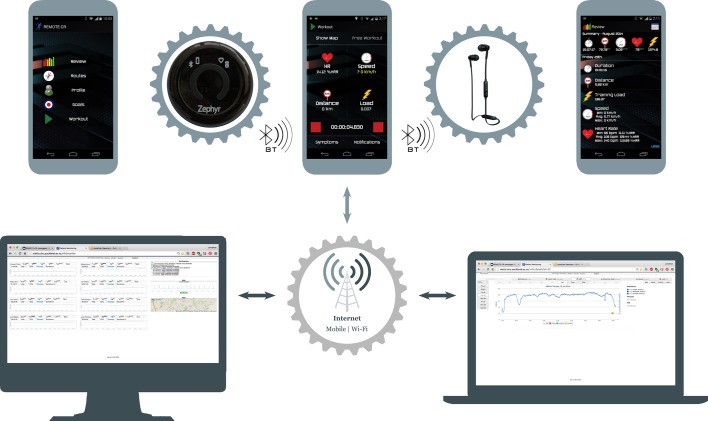
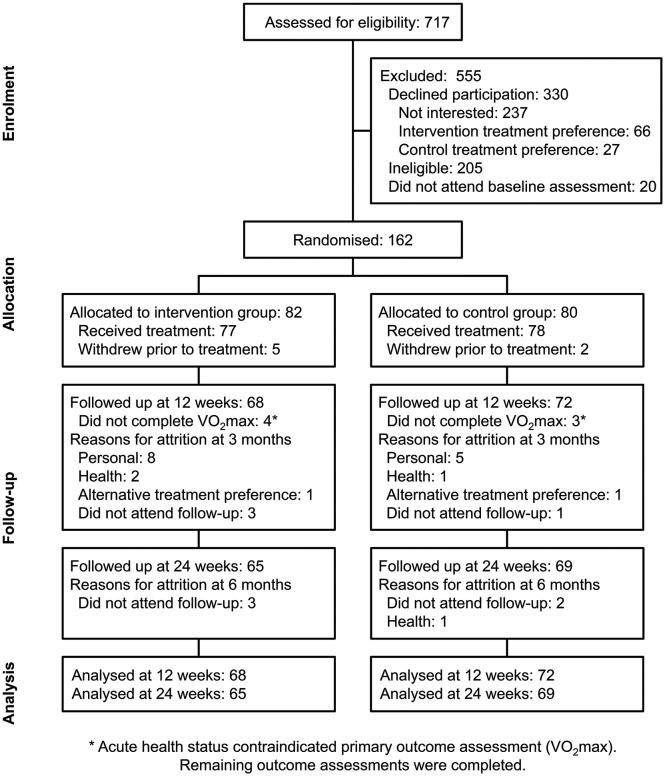
Objective: Compare the effects and costs of remotely monitored exercise-based cardiac telerehabilitation (REMOTE-CR) with centre-based programmes (CBexCR) in adults with coronary heart disease (CHD). Methods: Participants were randomised to receive 12 weeks of telerehabilitation or centre-based rehabilitation. REMOTE-CR provided individualised exercise prescription, real-time exercise monitoring/coaching and theory-based behavioural strategies via a bespoke telerehabilitation platform; CBexCR provided individualised exercise prescription and coaching via established rehabilitation clinics. Outcomes assessed at baseline, 12 and/or 24 weeks included maximal oxygen uptake (V̇O 2 max, primary) modifiable cardiovascular risk factors, exercise adherence, motivation, health-related quality of life and programme delivery, hospital service utilisation and medication costs. The primary hypothesis was a non-inferior between-group difference in V̇O 2 max at 12 weeks (inferiority margin=−1.25 mL/kg/min); inferiority margins were not set for secondary outcomes. Results: 162 participants (mean 61±12.7 years, 86% men) were randomised. V̇O 2 max was comparable in both groups at 12 weeks and REMOTE-CR was non-inferior to CBexCR (REMOTE-CR-CBexCR adjusted mean difference (AMD)=0.51 (95% CI −0.97 to 1.98) mL/kg/min, p=0.48). REMOTE-CR participants were less sedentary at 24 weeks (AMD=−61.5 (95% CI −117.8 to −5.3) min/day, p=0.03), while CBexCR participants had smaller waist (AMD=1.71 (95% CI 0.09 to 3.34) cm, p=0.04) and hip circumferences (AMD=1.16 (95% CI 0.06 to 2.27) cm, p=0.04) at 12 weeks. No other between-group differences were detected. Per capita programme delivery (NZD1130/GBP573 vs NZD3466/GBP1758) and medication costs (NZD331/GBP168 vs NZD605/GBP307, p=0.02) were lower for REMOTE-CR. Hospital service utilisation costs were not statistically significantly different (NZD3459/GBP1754 vs NZD5464/GBP2771, p=0.20). Conclusion: REMOTE-CR is an effective, cost-efficient alternative delivery model that could—as a complement to existing services—improve overall utilisation rates by increasing reach and satisfying unique participant preferences.
Overview
The claims and statistics of this paper haven’t been checked yet.
Run the check — free, no account needed. It reads the open-access text and checks the sources it cites.
Integrity signals
Registry
Cites
Statistics
Figures
Verification
Claims the paper makes
The claims and statistics of this paper haven’t been checked yet.
Run the check — free, no account needed. It reads the open-access text and checks the sources it cites.
Claims other papers make about this one
Each is checked against this paper’s own text: does it say what the citing paper says it does?
The cited source says what the claim attributes to it.
In the citing paper
“Home-based cardiac telerehabilitation using wearable sensors is equivalent or better than centre-based rehabilitation and can increase access to cardiac rehabilitation and reduce the cost”
From Smart wearable devices in cardiovascular care: Where we are and how to move forward (2021) · cites this paper as [85]
In the citing paper
“A non-inferiority, randomized trial comparing REMOTE-CR — a real-time, remote telerehabilitation platform that includes the use of a chest-worn wearable sensor (BioHarness 3, Zephyr Technology, USA) — with a centre-based programme showed that REMOTE-CR was associated with less sedentary time at 24 weeks and was more cost-effective than the centre-based programme85.”
From Smart wearable devices in cardiovascular care: Where we are and how to move forward (2021) · cites this paper as [85]
In the citing paper
“The authors demonstrated that the intervention was an effective and cost-effective delivery model that could potentially improve overall CR utilisation rates by increasing reach and satisfying unique participant preferences.30”
Self-check
Percentages, sums and reported differences re-computed from the paper’s own numbers.
The self-check needs the paper’s full text.
Citations
Cites
Self-efficacy: Toward a unifying theory of behavioral change
Bandura, A. (1977) · Psychological Review · doi:10.1037/0033-295x.84.2.191 · Cited by 43,925
Intrinsic Motivation and Self-Determination in Human Behavior
Deci, E. L., & Ryan, R. M. (1985) · doi:10.1007/978-1-4899-2271-7 · Cited by 26,772
Intrinsic Motivation and Self-Determination in Human Behavior
Miller, K. A. J., Deci, E. L., & Ryan, R. M. (1988) · Contemporary Sociology A Journal of Reviews · doi:10.2307/2070638 · Cited by 15,406
Self-efficacy: Toward a unifying theory of behavioral change
Bandura, A. (1978) · Advances in Behaviour Research and Therapy · doi:10.1016/0146-6402(78)90002-4 · Cited by 10,586
(2014) · Medical Entomology and Zoology · Cited by 9,400
Michie, S., Richardson, M., Johnston, M., Abraham, C., Francis, J., Hardeman, W., Eccles, M. P., Cane, J., & Wood, C. E. (2013) · Annals of Behavioral Medicine · doi:10.1007/s12160-013-9486-6 · Cited by 7,629
Piaggio, G., Elbourne, D. R., Pocock, S. J., Evans, S. J. W., Altman, D. G., & CONSORT Group, F. T. (2012) · JAMA · doi:10.1001/jama.2012.87802 · Cited by 2,428
Exercise-based cardiac rehabilitation for coronary heart disease
Heran, B. S., Chen, J. M., Ebrahim, S., Moxham, T., Oldridge, N., Rees, K., Thompson, D. R., & Taylor, R. S. (2011) · Cochrane Database of Systematic Reviews · doi:10.1002/14651858.cd001800.pub2 · Cited by 1,844
ACSM's guidelines for exercise testing and prescription
Kenney, W. L., Humphrey, R. H., Bryant, C. X., & Mahler, D. A. (1995) · Williams & Wilkins eBooks · Cited by 1,475
Advances in sport and exercise psychology measurement
Duda, J. L. (1998) · University of Birmingham Research Portal (University of Birmingham) · Cited by 1,324
Cited by
Sorted by citations
2023 ESC Guidelines for the management of acute coronary syndromes
Byrne, R. A., Rossello, X., Coughlan, J. J., Barbato, E., Berry, C., Chieffo, A., Claeys, M. J., Dan, G.-A., Dweck, M. R., Galbraith, M., et al. (2023) · European Heart Journal · doi:10.1093/eurheartj/ehad191 · Cited by 5,333
Smart wearable devices in cardiovascular care: Where we are and how to move forward
Bayoumy, K., Gaber, M., Elshafeey, A., Mhaimeed, O., Dineen, E. H., Marvel, F. A., Martin, S. S., Muse, E. D., Turakhia, M. P., Tarakji, K. G., et al. (2021) · Nature Reviews Cardiology · doi:10.1038/s41569-021-00522-7 · Cited by 829
Promoting Physical Activity and Exercise
Fletcher, G. F., Landolfo, C. K., Niebauer, J., Ozemek, C., Arena, R. A., & Lavie, C. J. (2018) · Journal of the American College of Cardiology · doi:10.1016/j.jacc.2018.08.2141 · Cited by 550
2023 ESC Guidelines for the management of acute coronary syndromes
Byrne, R. A., Rosselló, X., Coughlan, J. J., Barbato, E., Berry, C., Chieffo, A., Claeys, M. J., Dan, G., Dweck, M. R., Galbraith, M., et al. (2023) · European Heart Journal Acute Cardiovascular Care · doi:10.1093/ehjacc/zuad107 · Cited by 373
Wearable Devices in Cardiovascular Medicine
Hughes, A. N., Shandhi, M. M. H., Master, H., Dunn, J., & Brittain, E. L. (2023) · Circulation Research · doi:10.1161/circresaha.122.322389 · Cited by 341
Metadata
- Authors
- Maddison, R., Rawstorn, J. C., Stewart, R. A. H., Benatar, J., Whittaker, R., Rolleston, A., Jiang, Y., Gao, L., Moodie, M., Warren, I., Meads, A., & Gant, N.
- Affiliations
- Deakin University (AU)
- Auckland City Hospital (NZ)
- University of Auckland (NZ)
- The Centre for Health (New Zealand) (NZ)
- Corresponding author
- Rawstorn, Jonathan Charles
- ORCID
- Venue
- Heart
- Publisher
- BMJ
- Published
- 2018-08-27
- Volume
- 105
- Issue
- 2
- Pages
- 122-129
- ISSN
- 1355-6037 (ISSN-L)
- 1468-201X
- PMC
- PMC6352408
- OpenAlex
- W2889374857
- Cited by
- 320
- References
- 32
- Citations by year
- 2026: 27 · 2025: 47 · 2024: 52 · 2023: 55 · 2022: 59 · 2021: 36 · 2020: 25 · 2019: 14 · 2018: 5
- FWCI
- 15.13
- Type
- journal article
- Language
- en
- Open access
- hybrid
- doi.org
- Licence
- cc-by-nc
- Locations
- Heart (publishedVersion, cc-by-nc)
- Europe PMC (PubMed Central) (publishedVersion, cc-by-nc)
- PubMed Central (publishedVersion, cc-by-nc)
- PubMed (publishedVersion)
- Own your potential (DEAKIN) (submittedVersion)
- Figshare (submittedVersion, cc-by-nc)
- HighWire Press Open Archive (submittedVersion)
- Funders
- Auckland Medical Research Foundation
- Topics
- Health Sciences › Medicine › Cardiology and Cardiovascular Medicine › Cardiac Health and Mental Health
- Health Sciences › Medicine › Public Health, Environmental and Occupational Health › Telemedicine and Telehealth Implementation
- Health Sciences › Health Professions › General Health Professions › Mobile Health and mHealth Applications
- Keywords
- cardiac telerehabilitation, coronary artery disease, exercise-based cardiac rehabilitation, VO2max, sedentary behavior, cardiovascular risk factors, health-related quality of life, drug costs, non-inferiority, behavioral strategies, exercise adherence, motivation, New Zealand
- MeSH terms
- Coronary Disease, Cost-Benefit Analysis, Exercise Therapy, Female, Humans, Male, Middle Aged, New Zealand, Quality of Life, Rehabilitation Centers, Treatment Outcome, Telemedicine, Internet
About these checks
Registry, retraction, Cites and statistics results are computed, not judged, with one exception: a printed reference that no index lists is read once by a model before it counts as a citation error. Claims are extracted by a model and kept only when their quote appears verbatim in the text; each cited source is then checked, with a model’s help, for whether it says what the claim relies on. Those verdicts can be wrong — read the claim’s quote and the cited source before relying on one.
Statistics and arithmetic are recomputed, not judged.
Confidence bands are shown only for fields calibrated on our annotated test set. None is calibrated yet, so no band is shown.
What counts as a claim ›How we measure confidence ›How we check this ›
Are you an author, or do you see a problem with this page? Request a review
