

Advanced Body Composition Assessment: From Body Mass Index to Body Composition Profiling
Open accessThe DOI matches its Crossref record; 78 of the 78 references it cites were found in a registry or an index.
Abstract
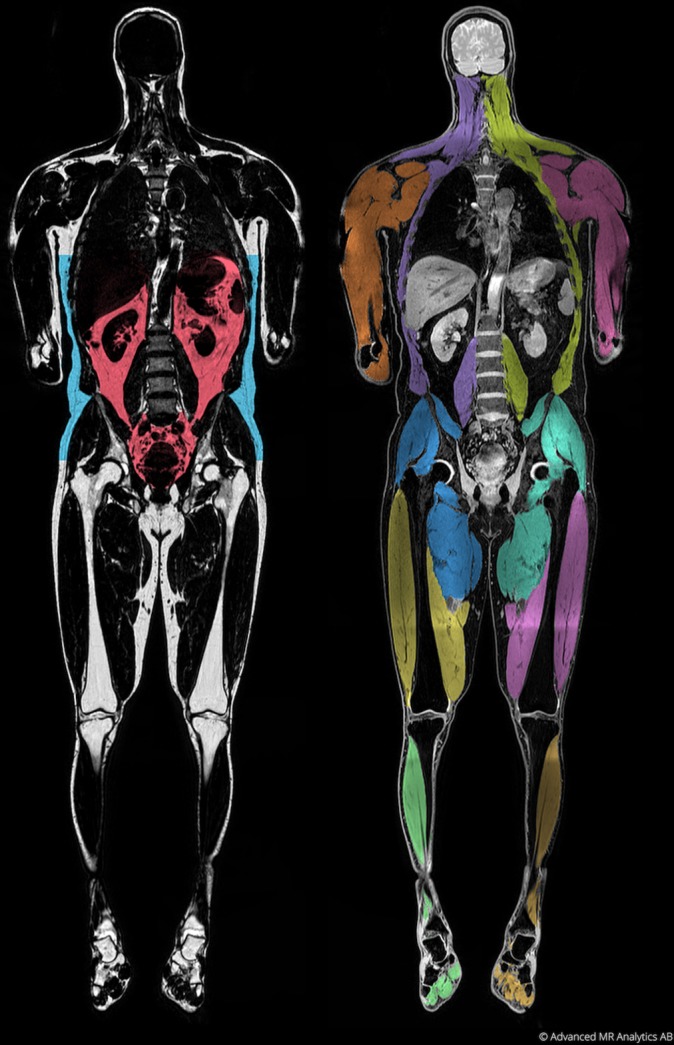
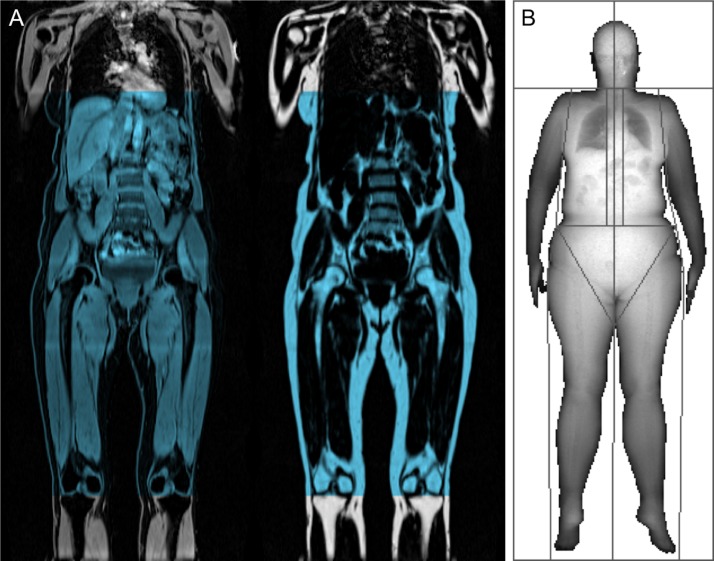
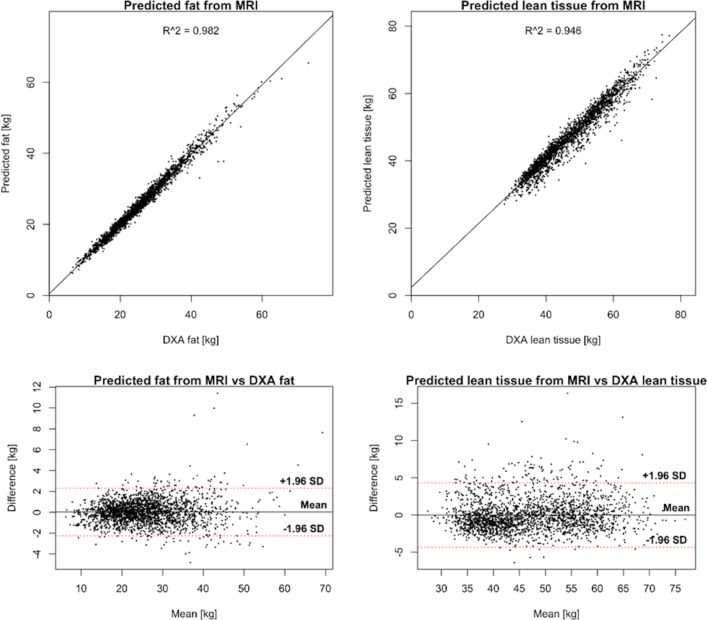
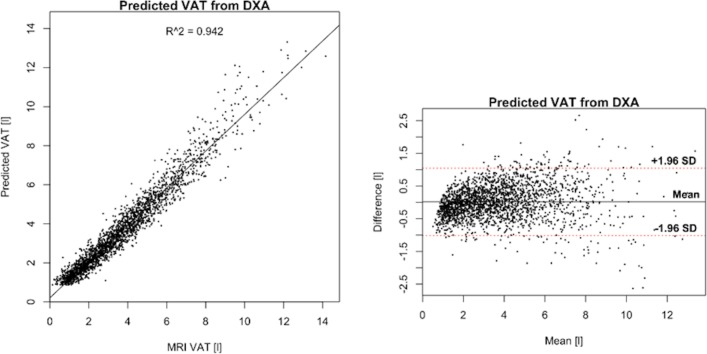
This paper gives a brief overview of common non-invasive techniques for body composition analysis and a more in-depth review of a body composition assessment method based on fat-referenced quantitative MRI. Earlier published studies of this method are summarized, and a previously unpublished validation study, based on 4753 subjects from the UK Biobank imaging cohort, comparing the quantitative MRI method with dual-energy X-ray absorptiometry (DXA) is presented. For whole-body measurements of adipose tissue (AT) or fat and lean tissue (LT), DXA and quantitative MRIs show excellent agreement with linear correlation of 0.99 and 0.97, and coefficient of variation (CV) of 4.5 and 4.6 per cent for fat (computed from AT) and LT, respectively, but the agreement was found significantly lower for visceral adipose tissue, with a CV of >20 per cent. The additional ability of MRI to also measure muscle volumes, muscle AT infiltration and ectopic fat, in combination with rapid scanning protocols and efficient image analysis tools, makes quantitative MRI a powerful tool for advanced body composition assessment.
Overview
The claims and statistics of this paper haven’t been checked yet.
Free: it reads the open-access text and checks the first 5 claims that cite a source we can check. Create a free account to check every claim.
Integrity signals
Registry
Cites
Statistics
Figures
Verification
Claims the paper makes
The claims and statistics of this paper haven’t been checked yet.
Free: it reads the open-access text and checks the first 5 claims that cite a source we can check. Create a free account to check every claim.
Claims other papers make about this one
Each is checked against this paper’s own text: does it say what the citing paper says it does?
In the citing paper
“Scan measurements (DXA, MRI and CT) are more accurate than other types [16], which suggests body composition assessment methods must be considered in meta-analyses of exercise (and possibly other intervention types).”
From The Effect of Resistance Training in Healthy Adults on Body Fat Percentage, Fat Mass and Visceral Fat: A Systematic Review and Meta-Analysis (2022) · cites this paper as [16]
Self-check
Percentages, sums and reported differences re-computed from the paper’s own numbers.
The self-check needs the paper’s full text.
Citations
Cites
Sudlow, C., Gallacher, J., Allen, N., Beral, V., Burton, P., Danesh, J., Downey, P., Elliott, P., Green, J., Landray, M., et al. (2015) · PLOS Medicine · doi:10.1371/journal.pmed.1001779 · Cited by 12,728
Sarcopenia: European consensus on definition and diagnosis
Cruz-Jentoft, A. J., Baeyens, J. P., Bauer, J. M., Boirie, Y., Cederholm, T., Landi, F., Martin, F. C., Michel, J.-P., Rolland, Y., Schneider, S. M., et al. (2010) · Age and Ageing · doi:10.1093/ageing/afq034 · Cited by 11,601
Definition and classification of cancer cachexia: an international consensus
Fearon, K., Strasser, F., Anker, S. D., Bosaeus, I., Bruera, E., Fainsinger, R. L., Jatoi, A., Loprinzi, C., MacDonald, N., Mantovani, G., et al. (2011) · The Lancet Oncology · doi:10.1016/s1470-2045(10)70218-7 · Cited by 5,767
Bioelectrical impedance analysis?part I: review of principles and methods
KYLE, U. (2004) · Clinical Nutrition · doi:10.1016/j.clnu.2004.06.004 · Cited by 3,200
Long-term follow-up of patients with NAFLD and elevated liver enzymes
Ekstedt, M., Franzén, L. E., Mathiesen, U. L., Thorelius, L., Holmqvist, M., Bodemar, G., & Kechagias, S. (2006) · Hepatology · doi:10.1002/hep.21327 · Cited by 2,302
Simple proton spectroscopic imaging.
Dixon, W. T. (1984) · Radiology · doi:10.1148/radiology.153.1.6089263 · Cited by 2,276
Healthy percentage body fat ranges: an approach for developing guidelines based on body mass index
Gallagher, D., Heymsfield, S. B., Heo, M., Jebb, S. A., Murgatroyd, P. R., & Sakamoto, Y. (2000) · The American Journal of Clinical Nutrition · doi:10.1093/ajcn/72.3.694 · Cited by 2,139
Self-citationThe Gross Composition of the Body
SIRI, W. E. (1956) · Advances in Biological and Medical Physics · doi:10.1016/b978-1-4832-3110-5.50011-x · Cited by 1,765
Prentice, A. M., & Jebb, S. A. (2001) · Obesity Reviews · doi:10.1046/j.1467-789x.2001.00031.x · Cited by 1,240
Goodpaster, B. H., Kelley, D. E., Thaete, F. L., He, J., & Ross, R. (2000) · Journal of Applied Physiology · doi:10.1152/jappl.2000.89.1.104 · Cited by 947
Research works printed but not linked: 3
- Cruz-Jentoft AJ, Sarcopenia, 2012
- Romu T, 2011, Proceedings of the annual meeting of the International Society for Magnetic Resonance in Medicine (ISMRM 2011)
- Thunón P, 2014, ISMRM 22nd Annual Meeting & Exhibition, 10 - 16 May 2014, Milan, Italy
Cited by
Littlejohns, T. J., Holliday, J., Gibson, L. M., Garratt, S., Oesingmann, N., Alfaro-Almagro, F., Bell, J. D., Boultwood, C., Collins, R., Conroy, M. C., et al. (2020) · Nature Communications · doi:10.1038/s41467-020-15948-9 · Cited by 812
Self-citationObesity and the risk of cardiometabolic diseases
Valenzuela, P. L., Carrera-Bastos, P., Castillo-García, A., Lieberman, D. E., Santos-Lozano, A., & Lucia, A. (2023) · Nature Reviews Cardiology · doi:10.1038/s41569-023-00847-5 · Cited by 452
Reassessing human adipose tissue
Cypess, A. M. (2022) · New England Journal of Medicine · doi:10.1056/nejmra2032804 · Cited by 404
Malnutrition Screening and Assessment
Serón-Arbeloa, C., Labarta-Monzón, L., Puzo-Foncillas, J., Mallor-Bonet, T., Lafita-López, A., Bueno-Vidales, N., & Montoro-Huguet, M. (2022) · doi:10.20944/preprints202205.0071.v1 · Cited by 312
Malnutrition Screening and Assessment
Serón-Arbeloa, C., Labarta-Monzón, L., Puzo-Foncillas, J., Mallor-Bonet, T., Lafita-López, A., Bueno-Vidales, N., & Montoro-Huguet, M. (2022) · Nutrients · doi:10.3390/nu14122392 · Cited by 310
Metadata
- Authors
- Borga, M., West, J., Bell, J. D., Harvey, N. C., Romu, T., Heymsfield, S. B., & Dahlqvist Leinhard, O.
- Venue
- Journal of Investigative Medicine
- Publisher
- SAGE Publications
- Published
- 2018-06
- Volume
- 66
- Issue
- 5
- Pages
- 1-9
- ISSN
- 1081-5589 (ISSN-L)
- 1708-8267
- PMC
- PMC5992366
- OpenAlex
- W2793413123
- Cited by
- 606
- References
- 77
- FWCI
- 24.20
- Type
- journal article
- Language
- en
- Open access
- hybrid
- Funders
- Pfizer
About these checks
Registry, retraction, Cites and statistics results are computed, not judged, with one exception: a printed reference that no index lists is read once by a model before it counts as a citation error. Claims are extracted by a model and kept only when their quote appears verbatim in the text; each cited source is then checked, with a model’s help, for whether it says what the claim relies on. Those verdicts can be wrong — read the claim’s quote and the cited source before relying on one.
Statistics and arithmetic are recomputed, not judged.
Confidence bands are shown only for fields calibrated on our annotated test set. None is calibrated yet, so no band is shown.
What counts as a claim ›How we measure confidence ›How we check this ›
Are you an author, or do you see a problem with this page? Request a review
Data sources
Bibliographic data: Semantic Scholar, OpenAlex, Crossref.
Contains information from the Semantic Scholar Academic Graph Datasets, made available under the ODC Attribution License (ODC-BY 1.0).
Semantic Scholar’s data is described in: Kinney, R., et al. (2023). The Semantic Scholar Open Data Platform. arXiv:2301.10140.
