

Vaccine efficacy against primary and metastatic cancer with in vitro-generated CD103 + conventional dendritic cells
Open accessThe DOI matches its Crossref record; 47 of the 48 references it cites were found in a registry or an index.
Abstract
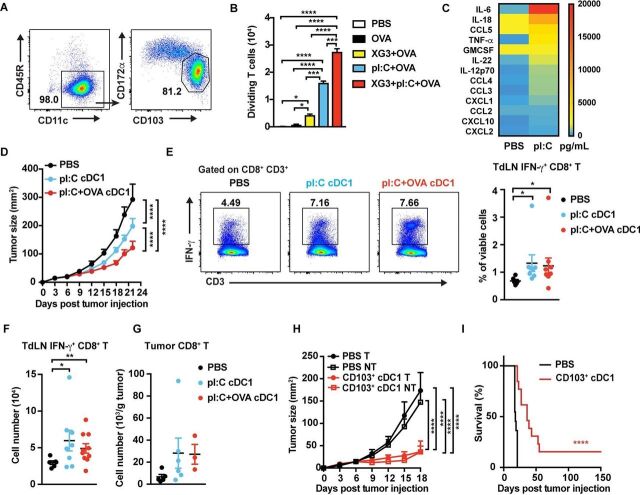
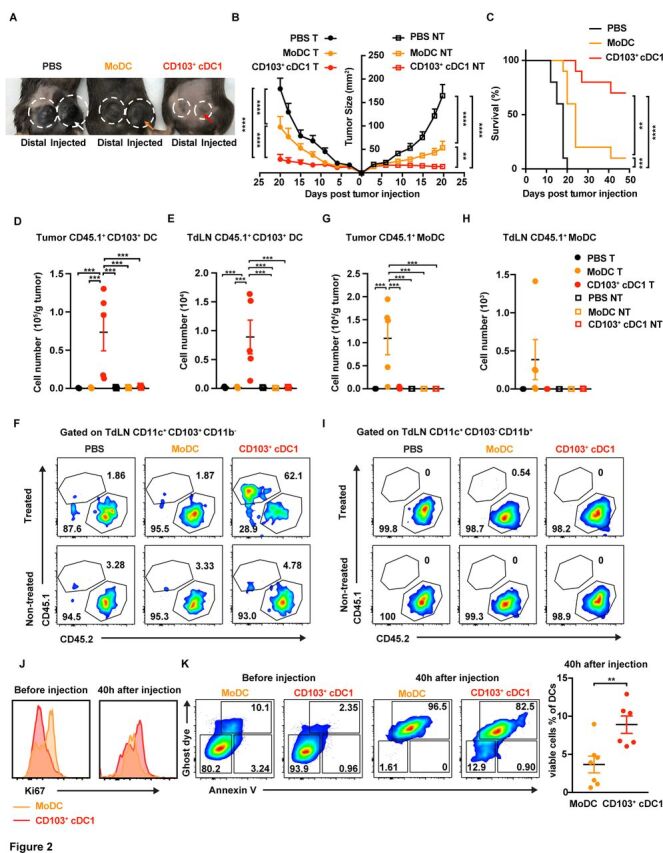
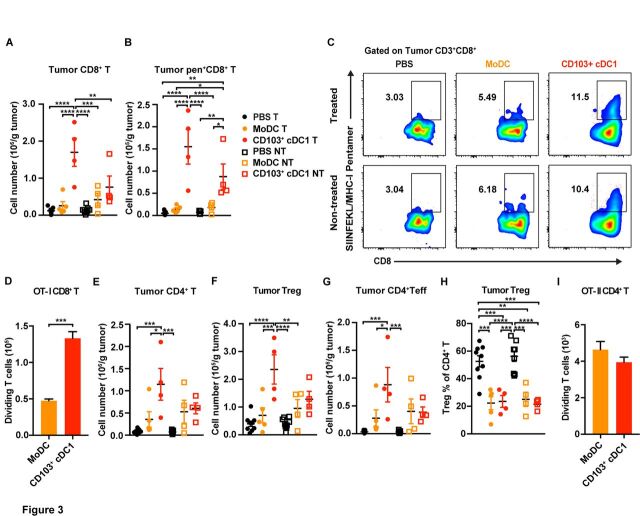
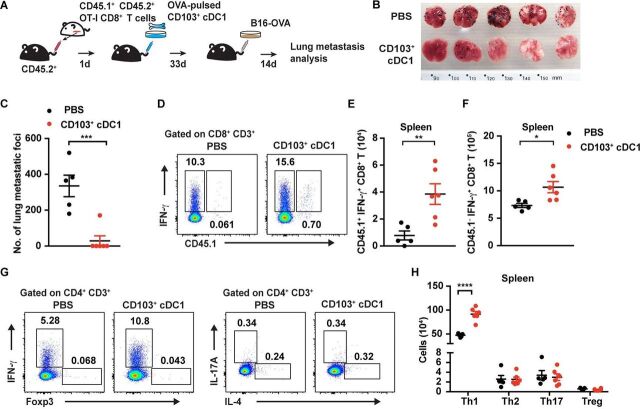
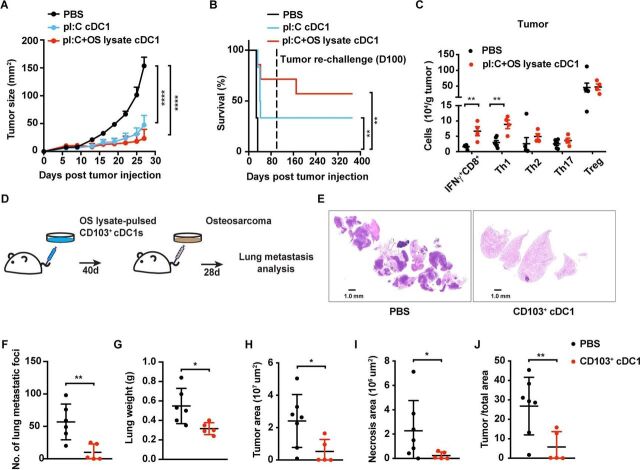
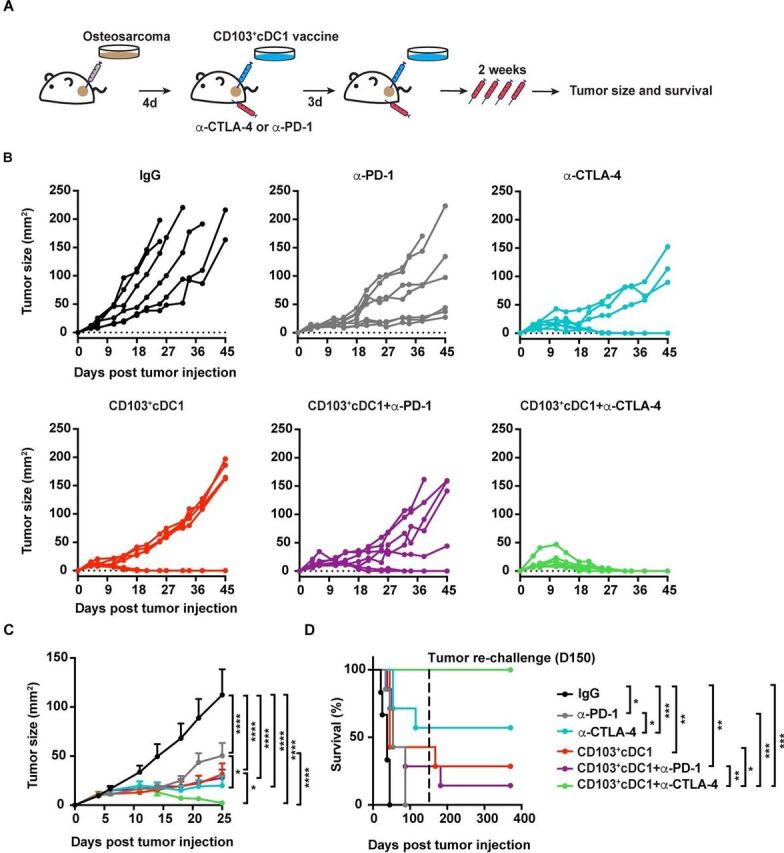
Background Type 1 conventional dendritic cells (cDC1s) possess efficient antigen presentation and cross-presentation activity, as well as potent T cell priming ability. Tissue-resident cDC1s (CD103 + cDC1s in mice, CD141 + cDC1s in humans) are linked with improved tumor control, yet the efficacy of immunotherapy using this population is understudied. Methods We generated murine CD103 + cDC1s in vitro and examined their expression of cDC1-related factors, antigen cross-presentation activity, and accumulation in tumor-draining lymph nodes (TdLNs). The antitumor efficacy of the in vitro-generated CD103 + cDC1s was studied in murine melanoma and osteosarcoma models. We evaluated tumor responses on vaccination with CD103 + cDC1s, compared these to vaccination with monocyte-derived DCs (MoDCs), tested CD103 + cDC1 vaccination with checkpoint blockade, and examined the antimetastatic activity of CD103 + cDC1s. Results In vitro-generated CD103 + cDC1s produced cDC1-associated factors such as interleukin-12p70 and CXCL10, and demonstrated antigen cross-presentation activity on stimulation with the toll-like receptor 3 agonist polyinosinic:polycytidylic acid (poly I:C). In vitro-generated CD103 + cDC1s also migrated to TdLNs following poly I:C treatment and intratumoral delivery. Vaccination with poly I:C-activated and tumor antigen-loaded CD103 + cDC1s enhanced tumor infiltration of tumor antigen-specific and interferon-γ + CD8 + T cells, and suppressed melanoma and osteosarcoma growth. CD103 + cDC1s showed superior antitumor efficacy compared with MoDC vaccination, and led to complete regression of 100% of osteosarcoma tumors in combination with CTLA-4 antibody-mediated checkpoint blockade. In vitro-generated CD103 + cDC1s effectively protected mice from pulmonary melanoma and osteosarcoma metastases. Conclusions Our data indicate an in vitro-generated CD103 + cDC1 vaccine elicits systemic and long-lasting tumor-specific T cell-mediated cytotoxicity, which restrains primary and metastatic tumor growth. The CD103 + cDC1 vaccine was superior to MoDCs and enhanced response to immune checkpoint blockade. These results indicate the potential for new immunotherapies based on use of cDC1s alone or in combination with checkpoint blockade.
Overview
The claims and statistics of this paper haven’t been checked yet.
Free: it reads the open-access text and checks the first 5 claims that cite a source we can check. Create a free account to check every claim.
Integrity signals
Registry
Cites
Statistics
Figures
Verification
Claims the paper makes
The claims and statistics of this paper haven’t been checked yet.
Free: it reads the open-access text and checks the first 5 claims that cite a source we can check. Create a free account to check every claim.
Claims other papers make about this one
Each is checked against this paper’s own text: does it say what the citing paper says it does?
The source backs part of the claim, not all of it — or backs it for a different population, condition or comparison.
In the citing paper
“This treatment activates and loads tumor antigens onto CD103+ myeloid/conventional DC1s, enhancing the immune system’s capacity to target cancer cells [151].”
From Advances on immunotherapy for osteosarcoma (2024) · cites this paper as [151]
Experimental — accuracy not yet measuredThe source backs part of the claim, not all of it — or backs it for a different population, condition or comparison.
In the citing paper
“A variety of vaccines have shown encouraging results, including the CD1c+ DC vaccine, which harnesses the power of antigen-presenting DCs, and the innovative approach of vaccinating with polyinosinic: polycytidylic acid (poly I: C).”
From Advances on immunotherapy for osteosarcoma (2024) · cites this paper as [151]
Experimental — accuracy not yet measuredIn the citing paper
“Recent preclinical studies have shown that vaccination with CD103+ cDC1s in combination with CTLA-4 blockade were highly effective in inducing tumor regression in murine models of osteosarcoma and melanoma (Zhou et al., 2020).”
From Hallmarks of response, resistance, and toxicity to immune checkpoint blockade (2021) · cites this paper as Zhou et al., 2020
Self-check
Percentages, sums and reported differences re-computed from the paper’s own numbers.
The self-check needs the paper’s full text.
Citations
Cites
The future of immune checkpoint therapy
Sharma, P., & Allison, J. P. (2015) · Science · doi:10.1126/science.aaa8172 · Cited by 4,878
Melanoma-intrinsic β-catenin signalling prevents anti-tumour immunity
Spranger, S., Bao, R., & Gajewski, T. F. (2015) · Nature · doi:10.1038/nature14404 · Cited by 2,830
CTLA-4 and PD-1 Pathways: Similarities, Differences, and Implications of Their Inhibition
Buchbinder, E. I., & Desai, A. (2016) · American Journal of Clinical Oncology · doi:10.1097/coc.0000000000000239 · Cited by 2,360
Tumor metastasis: mechanistic insights and clinical challenges
Steeg, P. S. (2006) · Nature Medicine · doi:10.1038/nm1469 · Cited by 2,134
Batf3 Deficiency Reveals a Critical Role for CD8α + Dendritic Cells in Cytotoxic T Cell Immunity
Hildner, K., Edelson, B. T., Purtha, W. E., Diamond, M., Matsushita, H., Kohyama, M., Calderon, B., Schraml, B. U., Unanue, E. R., Diamond, M. S., et al. (2008) · Science · doi:10.1126/science.1164206 · Cited by 2,081
Tawbi, H. A., Burgess, M., Bolejack, V., Van Tine, B. A., Schuetze, S. M., Hu, J., D'Angelo, S., Attia, S., Riedel, R. F., Priebat, D. A., et al. (2017) · The Lancet Oncology · doi:10.1016/s1470-2045(17)30624-1 · Cited by 1,452
Spranger, S., Dai, D., Horton, B., & Gajewski, T. F. (2017) · Cancer Cell · doi:10.1016/j.ccell.2017.04.003 · Cited by 1,441
Distinct cellular mechanisms underlie anti-CTLA-4 and anti-PD-1 checkpoint blockade
Wei, S. C., Levine, J. H., Cogdill, A. P., Zhao, Y., Anang, N.-A. A. S., Andrews, M. C., Sharma, P., Wang, J., Wargo, J. A., Pe’er, D., et al. (2017) · Cell · doi:10.1016/j.cell.2017.07.024 · Cited by 1,302
Salmon, H., Idoyaga, J., Rahman, A., Leboeuf, M., Remark, R., Jordan, S., Casanova-Acebes, M., Khudoynazarova, M., Agudo, J., Tung, N., et al. (2016) · Immunity · doi:10.1016/j.immuni.2016.03.012 · Cited by 1,201
Engineered T cells: the promise and challenges of cancer immunotherapy
Fesnak, A. D., June, C. H., & Levine, B. L. (2016) · Nature Reviews Cancer · doi:10.1038/nrc.2016.97 · Cited by 1,074
Cited by
Items 101–117 of 117
Therapeutic dendritic cell cancer vaccines in hematologic malignancies
Bindal, P., Rosenblatt, J. M., & Avigan, D. (2021) · ImmunoMedicine · doi:10.1002/imed.1022 · Cited by 1
Sorteberg, A. L., Ek, L., Lilienthal, I., & Herold, N. (2025) · Springer eBooks · doi:10.1007/978-3-032-00769-8_236 · Cited by 1
Overcoming barriers in primary bone cancer: Nanomaterial-enabled immunotherapy
Liu, Z., Fan, L., Wang, Y., Zhuo, X., & Yu, D. (2025) · Materials Today Bio · doi:10.1016/j.mtbio.2025.102530 · Cited by 2
“…activate CD8 + T-cells and induce them to secrete IFN-γ , thus inhibiting the growth of the OS K7M3 cell line, increasing the survival rate of mice to over 50 %, preventing secondary attack, and resulting in complete tumor clearance within two weeks if combined with CTLA-4 or PD-1 antibodies [40].”
Combinatorial Strategies for T Lymphocyte-Based Cancer Immunotherapy
Hargadon, K. M., & Wall, J. B. (2025) · Springer eBooks · doi:10.1007/978-3-032-00767-4_211 · Cited by 1
Zheng, Z. (2026) · International Journal of Nanomedicine · doi:10.2147/ijn.s612549 · Cited by 1
“30,31 Beyond conventional subsets, the identification of “Killer dendritic cells” (KDCs) offers a paradigm-shifting approach by merging innate tumoricidal activity with adaptive antigen presentation.”
dos Santos, T. B., Gomes, D. D. S., de Sousa, A. B. F., Rodrigues, Í. S. G., Padilha, F. F., & Droppa‐Almeida, D. (2021) · Research Society and Development · doi:10.33448/rsd-v10i17.23015 · Cited by 2
COVID-19: The vaccine development strategies
Yan, Z., Yang, M., & Lai, C. (2025) · Elsevier eBooks · doi:10.1016/b978-0-443-19170-1.00036-x
Antigen presentation requirements for effective cDC1-based cancer immunotherapy
Pineda, J. E., Minowa, T., Shen, L., Zhou, Y., Dyevoich, A. M., Patel, B., Schneider, S. M., Keshari, S., Saha, A., Riba, M., et al. (2026) · The Journal of Immunology · doi:10.1093/jimmun/vkag198
Self-citationDendritic Cell Vaccines in Ovarian Cancer: Have We Reached Their Potential?
Rowley, J. E. (2023) · Harvard Medical Student Review · doi:10.65539/f020tm68
“However, from a functional standpoint, MoDCs have been shown to be inferior to cDCs in inducing long-lasting immune responses through T-cell activation, raising questions of their appropriateness as the DC subtype used in many EOC vaccines (17).”
CD8+ T cell differentiation towards exhaustion in human cancer
Metoikidou, C. (2022) · theses.fr (ABES) · doi:10.70675/a9c41d93z98c7z40e0z80eczc8c778ad87ac
DYRK1A enhances antitumor immunity in type 1 conventional dendritic cells via mTORC1 activation
Wang, H., Jiang, H., He, S., Ren, S., Li, H., 刘汪楠, Zhou, C., Zhu, P., Chen, K., Cao, W., et al. (2026) · Journal of Clinical Investigation · doi:10.1172/jci199108
“…on DYRK1A activity may reflect divergent mechanisms for sensing Our study further reveals that DYRK1A potentiates the antitumor immune response of cDC1s by modulating mTORC1 signaling, offering mechanistic insights into cDC1-based cancer immunotherapy, a promising therapeutic approach (3, 10, 58).”
Self-citationKnowledge mapping of DNGR-1 on dendritic cells in immunotherapy: a review and bibliometric study
Liu, F., Xingkai, Y., Sun, Y., Zhao, W., & Yan, Z. (2026) · Frontiers in Immunology · doi:10.3389/fimmu.2026.1748597
Li, B., Su, C., Liu, B., Zhang, Y., Liu, J. H., Tang, Q., Peng, Z., Xu, G., Liu, L., & Ai, F. (2026) · Quantitative Imaging in Medicine and Surgery · doi:10.21037/qims-2025-1-2568
“Finally, other immunotherapies, including bispecific antibodies and vaccines, are being investigated (16,17).”
Rodrigues, D. S., Saeed, B. I., Alkhathami, A. G., Kareem, A. K., Tillyashaykhov, M., Al-Khafaji, Z., Al‐Mashhadani, Z. I., Kadhum, W. R., Bokhoor, S. N., & Mustafa, Y. F. (2026) · Current Research in Translational Medicine · doi:10.1016/j.retram.2026.103604
Dendritic cells as programmable platforms for cancer immunotherapy
Liu, Y., Marcandalli, E., Liu, Y., Bayerl, F., Pittet, M. J., & Palma, M. D. (2026) · Trends in Immunology · doi:10.1016/j.it.2026.08.013
Palacios, L. M., Dho, N. D., Furlan, C. L. A., Menichetti, G. L., Moreno, F. R., Guantay, L., Castell, S. D., Felici, M. E., Soria, G., Maletto, B. A., et al. (2026) · Frontiers in Immunology · doi:10.3389/fimmu.2026.1946712
Metadata
- Authors
- Zhou, Y., Slone, N., Chrisikos, T. T., Kyrysyuk, O., Babcock, R. L., Medik, Y. B., Li, H. S., Kleinerman, E. S., & Watowich, S. S.
- Affiliations
- The University of Texas MD Anderson Cancer Center (US)
- Corresponding author
- Watowich, Stephanie S
- ORCID
- Venue
- Journal for ImmunoTherapy of Cancer
- Publisher
- BMJ
- Published
- 2020-04
- Volume
- 8
- Issue
- 1
- Pages
- e000474
- ISSN
- 2051-1426 (ISSN-L)
- PMC
- PMC7254126
- OpenAlex
- W3015270738
- Cited by
- 112
- References
- 48
- Citations by year
- 2026: 9 · 2025: 26 · 2024: 14 · 2023: 22 · 2022: 22 · 2021: 11 · 2020: 7
- FWCI
- 5.43
- Type
- journal article
- Language
- en
- Open access
- gold
- doi.org
- Licence
- Locations
- Journal for ImmunoTherapy of Cancer (publishedVersion, cc-by-nc)
- PubMed Central (publishedVersion, cc-by-nc)
- PubMed (publishedVersion)
- DOAJ (DOAJ: Directory of Open Access Journals) (submittedVersion, cc-by-sa)
- Funders
- National Institute of Allergy and Infectious Diseases (3R01AI109294-04S1, R01AI109294)
- Cancer Prevention and Research Institute of Texas (RP170067)
- National Cancer Institute (P30CA016672)
- Topics
- Life Sciences › Immunology and Microbiology › Immunology › Immunotherapy and Immune Responses
- Health Sciences › Medicine › Oncology › Cancer Immunotherapy and Biomarkers
- Life Sciences › Immunology and Microbiology › Immunology › T-cell and B-cell Immunology
- Keywords
- dendritic cell vaccine, cancer immunotherapy, cross-presentation, tumor-draining lymph nodes, melanoma, osteosarcoma, metastasis, CTLA-4 blockade, immune checkpoint blockade, monocyte-derived dendritic cells, IL-12, CXCL10, tumor-specific T cells, poly(I:C)
- MeSH terms
- Animals, Antigens, Neoplasm, Bone Neoplasms, Dendritic Cells, Immunotherapy, Lung Neoplasms, Melanoma, Experimental, Mice, Inbred C57BL, Sarcoma, Experimental, Osteosarcoma, Tumor Cells, Cultured, Vaccines, Antigens, CD, Antigen Presentation, Integrin alpha Chains, Cross-Priming, Mice, In Vitro Techniques
About these checks
Registry, retraction, Cites and statistics results are computed, not judged, with one exception: a printed reference that no index lists is read once by a model before it counts as a citation error. Claims are extracted by a model and kept only when their quote appears verbatim in the text; each cited source is then checked, with a model’s help, for whether it says what the claim relies on. Those verdicts can be wrong — read the claim’s quote and the cited source before relying on one.
Statistics and arithmetic are recomputed, not judged.
Confidence bands are shown only for fields calibrated on our annotated test set. None is calibrated yet, so no band is shown.
What counts as a claim ›How we measure confidence ›How we check this ›
Are you an author, or do you see a problem with this page? Request a review
Data sources
Bibliographic data: Semantic Scholar, OpenAlex, Crossref.
Contains information from the Semantic Scholar Academic Graph Datasets, made available under the ODC Attribution License (ODC-BY 1.0).
Semantic Scholar’s data is described in: Kinney, R., et al. (2023). The Semantic Scholar Open Data Platform. arXiv:2301.10140.
