

Practical, epistemic and normative implications of algorithmic bias in healthcare artificial intelligence: a qualitative study of multidisciplinary expert perspectives
Open accessThe DOI matches its Crossref record; 46 of the 46 references it cites were found in a registry or an index.
Abstract
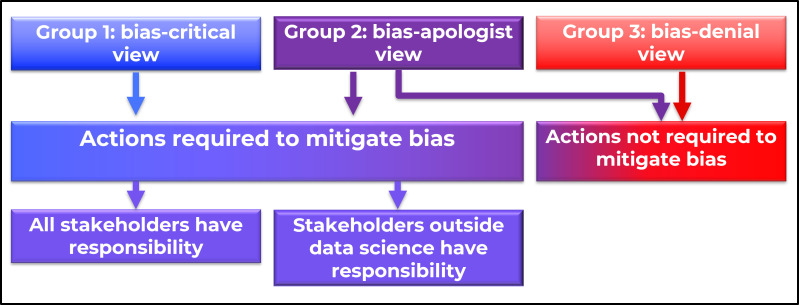
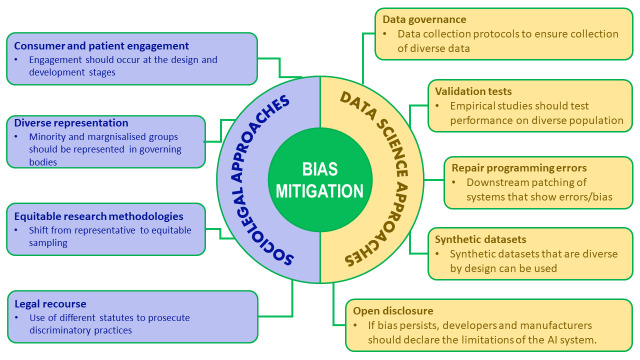
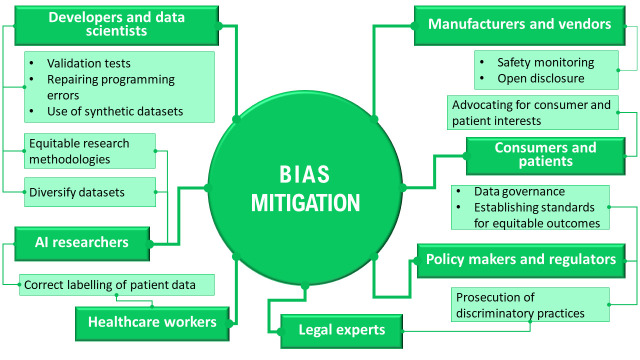
Background: There is a growing concern about artificial intelligence (AI) applications in healthcare that can disadvantage already under-represented and marginalised groups (eg, based on gender or race). Objectives: Our objectives are to canvas the range of strategies stakeholders endorse in attempting to mitigate algorithmic bias, and to consider the ethical question of responsibility for algorithmic bias. Methodology: The study involves in-depth, semistructured interviews with healthcare workers, screening programme managers, consumer health representatives, regulators, data scientists and developers. Results: Findings reveal considerable divergent views on three key issues. First, views on whether bias is a problem in healthcare AI varied, with most participants agreeing bias is a problem (which we call the bias-critical view), a small number believing the opposite (the bias-denial view), and some arguing that the benefits of AI outweigh any harms or wrongs arising from the bias problem (the bias-apologist view). Second, there was a disagreement on the strategies to mitigate bias, and who is responsible for such strategies. Finally, there were divergent views on whether to include or exclude sociocultural identifiers (eg, race, ethnicity or gender-diverse identities) in the development of AI as a way to mitigate bias. Conclusion/significance: Based on the views of participants, we set out responses that stakeholders might pursue, including greater interdisciplinary collaboration, tailored stakeholder engagement activities, empirical studies to understand algorithmic bias and strategies to modify dominant approaches in AI development such as the use of participatory methods, and increased diversity and inclusion in research teams and research participant recruitment and selection.
Overview
The claims and statistics of this paper haven’t been checked yet.
Free: it reads the open-access text and checks the first 5 claims that cite a source we can check. Create a free account to check every claim.
Integrity signals
Registry
Cites
Statistics
Figures
Verification
Claims the paper makes
The claims and statistics of this paper haven’t been checked yet.
Free: it reads the open-access text and checks the first 5 claims that cite a source we can check. Create a free account to check every claim.
Claims other papers make about this one
Each is checked against this paper’s own text: does it say what the citing paper says it does?
The cited source says what the claim attributes to it.
In the citing paper
“Issues such as amplification of biases present in the training data, failure to generalize effectively beyond specific populations, or errors in classification can affect reliability [ 2 - 7 ].”
In the citing paper
“The generative AI models, that naturally have elevated data bias risks due to their pre-training on massive datasets, should not exacerbate this inequity for marginalized, under-represented, socioeconomically disadvantaged, low education, or low health literacy groups98, but rather incorporate their unique social situations into future AI models to insure equity.”
From Adopting and expanding ethical principles for generative artificial intelligence from military to healthcare (2023) · cites this paper as [98]
Self-check
Percentages, sums and reported differences re-computed from the paper’s own numbers.
The self-check needs the paper’s full text.
Citations
Cites
Gale, N. K., Heath, G., Cameron, E., Rashid, S., & Redwood, S. (2013) · BMC Medical Research Methodology · doi:10.1186/1471-2288-13-117 · Cited by 10,865
Dissecting racial bias in an algorithm used to manage the health of populations
Obermeyer, Z., Powers, B., Vogeli, C., & Mullainathan, S. (2019) · Science · doi:10.1126/science.aax2342 · Cited by 7,137 · cited 3×
“16 For other participants who denied the existence of algorithmic bias, the denial concerned the relevance of the issue rather than the absence of bias itself, holding that these knowledge systems are biased, but this is normatively acceptable.”
BackgroundMethodPROBAST: A Tool to Assess the Risk of Bias and Applicability of Prediction Model Studies
Wolff, R. F., Moons, K. G. M., Riley, R. D., Whiting, P. F., Westwood, M., Collins, G. S., Reitsma, J. B., Kleijnen, J., Mallett, S., & for the PROBAST Group† (2019) · Annals of Internal Medicine · doi:10.7326/m18-1376 · Cited by 2,984 · cited 1×
“18 These solutions are yet to be widely implemented.”
Algorithms of Oppression: How Search Engines Reinforce Racism
Noble, S. U. (2020) · doi:10.2307/j.ctt1pwt9w5 · Cited by 2,709
Atlas of AI: Power, Politics, and the Planetary Costs of Artificial Intelligence
Crawford, K. (2021) · doi:10.12987/9780300252392 · Cited by 1,361
Reducing and meta-analysing estimates from distributed lag non-linear models
Gasparrini, A., & Armstrong, B. (2013) · BMC Medical Research Methodology · doi:10.1186/1471-2288-13-1 · Cited by 1,081
Seyyed-Kalantari, L., Zhang, H., McDermott, M. B. A., Chen, I. Y., & Ghassemi, M. (2021) · Nature Medicine · doi:10.1038/s41591-021-01595-0 · Cited by 928 · cited 1×
“14 15 Similar problems of biased results have been demonstrated in AI systems used for radiography-based disease diagnosis 15 and health resource allocations.”
Decolonial AI: Decolonial Theory as Sociotechnical Foresight in Artificial Intelligence
Mohamed, S., Png, M.-T., & Isaac, W. (2020) · Philosophy & Technology · doi:10.1007/s13347-020-00405-8 · Cited by 912
Addressing bias in big data and AI for health care: A call for open science
Norori, N., Hu, Q., Aellen, F. M., Faraci, F. D., & Tzovara, A. (2021) · Patterns · doi:10.1016/j.patter.2021.100347 · Cited by 903
Algorithmic bias: review, synthesis, and future research directions
Kordzadeh, N., & Ghasemaghaei, M. (2022) · European Journal of Information Systems · doi:10.1080/0960085x.2021.1927212 · Cited by 770 · cited 1×
“12 For example, a US-based classification algorithm for skin cancer diagnosis, 13 which was trained using mainly images of skin lesions in light-skinned patients, has been found to have approximately half the diagnostic accuracy when used on images of lesions among African-American patients.”
Method
Research works printed but not linked: 2
- Noble SU Algorithms of oppression New York University Press 2018
- Institute of Medicine (US) Committee on Understanding and Eliminating Racial and Ethnic Disparities in Health Care Unequal treatment Smedley BD Stith AY Nelson AR Confronting racial and ethnic disparities in health care Washington DC National Academics of Sciences, Engineering and Medicine 2003 25032386
Cited by
Nouis, S. C., Uren, V. S., & Jariwala, S. (2025) · BMC Medical Ethics · doi:10.1186/s12910-025-01243-z · Cited by 187
Algorithmic bias in public health AI: a silent threat to equity in low-resource settings
Joseph, J. (2025) · Frontiers in Public Health · doi:10.3389/fpubh.2025.1643180 · Cited by 146
Oniani, D., Hilsman, J., Peng, Y., Poropatich, R. K., Pamplin, J. C., Legault, G. L., & Wang, Y. (2023) · npj Digital Medicine · doi:10.1038/s41746-023-00965-x · Cited by 143
Ratti, E., Morrison, M. C., & Jakab, I. (2025) · BMC Medical Ethics · doi:10.1186/s12910-025-01198-1 · Cited by 139
Li, F., Wang, S., Gao, Z., Qing, M., Pan, S. L., Liu, Y., & Hu, C. (2025) · Frontiers in Medicine · doi:10.3389/fmed.2024.1510792 · Cited by 122
A Comprehensive Survey and Guide to Multimodal Large Language Models in Vision–Language Tasks
Liang, C. X., Tian, P., Yin, C. H., Yua, Y., An-Hou, W., Ming, L., Song, X., Wang, T., Bi, Z., Liu, M., et al. (2026) · Computation · doi:10.3390/computation14060125 · Cited by 96
Publics’ views on ethical challenges of artificial intelligence: a scoping review
Machado, H., Silva, S., & Neiva, L. (2023) · AI and Ethics · doi:10.1007/s43681-023-00387-1 · Cited by 86
Biases in AI: acknowledging and addressing the inevitable ethical issues
Hofmann, B. (2025) · Frontiers in Digital Health · doi:10.3389/fdgth.2025.1614105 · Cited by 63
Bragazzi, N. L., Crapanzano, A., Converti, M., Zerbetto, R., & Khamisy-Farah, R. (2023) · Journal of Medical Internet Research · doi:10.2196/52091 · Cited by 54
The Ethics of AI in Healthcare: An Updated Mapping Review
Morley, J., & Floridi, L. (2025) · The International Library of Bioethics · doi:10.1007/978-3-031-94690-5_2 · Cited by 45
Hussain, S. A., Bresnahan, M., & Zhuang, J. (2025) · Ethnicity & Health · doi:10.1080/13557858.2024.2422848 · Cited by 44
Maccaro, A., Stokes, K., Statham, L., He, L., Williams, A., Pecchia, L., & Piaggio, D. (2024) · Journal of Personalized Medicine · doi:10.3390/jpm14050443 · Cited by 44
Artificial intelligence for dementia prevention
Newby, D., Orgeta, V., Marshall, C. R., Lourida, I., Albertyn, C. P., Tamburin, S., Raymont, V., Veldsman, M., Koychev, I., Bauermeister, S., et al. (2023) · Alzheimer's & Dementia · doi:10.1002/alz.13463 · Cited by 42
“160”
Segate, R. V., & Daly, A. (2023) · European Journal of Risk Regulation · doi:10.1017/err.2023.72 · Cited by 40
Orenuga, S., Jordache, P., Mirzai, D. A., Monteros, T., Gonzalez, E., Madkoor, A., Hirani, R., Tiwari, R. K., & Etienne, M. (2025) · Life · doi:10.3390/life15030424 · Cited by 39
Aquino, Y. S. J., Rogers, W., Jacobson, S. S., Richards, B. J., Houssami, N., Woode, M. E., Frazer, H. M. L., & Carter, S. M. (2024) · Health Policy and Technology · doi:10.1016/j.hlpt.2024.100892 · Cited by 38
Self-citationArtificial Intelligence in Health Promotion and Disease Reduction: Rapid Review
Yousefi, F., Naye, F., Ouellet, S., Yameogo, A. R., Sasseville, M., Bergeron, F., Ozkan, M., Cousineau, M., Amil, S., Rhéaume, C., et al. (2025) · Journal of Medical Internet Research · doi:10.2196/70381 · Cited by 34
Küper, A., Lodde, G. C., Livingstone, E., Schadendorf, D., & Krämer, N. (2025) · Journal of Medical Internet Research · doi:10.2196/58660 · Cited by 31
Artificial intelligence: Applications in cardio-oncology and potential impact on racial disparities
Echefu, G. C., Shah, R., Sanchez, Z., Rickards, J., & Brown, S.-A. N. (2024) · American Heart Journal Plus Cardiology Research and Practice · doi:10.1016/j.ahjo.2024.100479 · Cited by 31
Trustworthy and Responsible AI for Human-Centric Autonomous Decision-Making Systems
Dehghani, F., Dibaji, M., Anzum, F., Dey, L., Basdemir, A., Bayat, S., Boucher, J.-C., Drew, S., Eaton, S. E., Frayne, R., et al. (2025) · Transactions on machine learning research · doi:10.48550/arxiv.2408.15550 · Cited by 30
Carter, S. M., Aquino, Y. S. J., Carolan, L., Frost, E. K., Degeling, C., Rogers, W., Scott, I. A., Bell, K., Fabrianesi, B., & Magrabi, F. (2024) · The Medical Journal of Australia · doi:10.5694/mja2.52283 · Cited by 29
Self-citationEthics in the world of automated algorithmic decision-making – A Posthumanist perspective
Ćećez-Kecmanović, D. (2025) · Information and Organization · doi:10.1016/j.infoandorg.2025.100587 · Cited by 28
Lee, Y., & Lee, S. (2025) · Sustainability · doi:10.3390/su17177682 · Cited by 22
Desafios Sociais e Éticos da Inteligência Artificial no Século XXI
Machado, H., & Silva, S. (2024) · UMinho Editora eBooks · doi:10.21814/uminho.ed.130 · Cited by 17
Relational Ethics and Structural Epistemic Injustice of AI in Medicine
Herzog, C., & Branford, J. (2025) · Philosophy & Technology · doi:10.1007/s13347-025-00987-1 · Cited by 15
How to read a paper involving artificial intelligence (AI)
Dijkstra, H. P., Greenhalgh, T., Mekki, Y. M., & Morley, J. (2025) · BMJ Medicine · doi:10.1136/bmjmed-2025-001394 · Cited by 13
Chou, Y.-H., Hsiao, K., Lu, Y.-T., & Su, Y.-S. (2025) · Chinese Management Studies · doi:10.1108/cms-10-2024-0746 · Cited by 13
Baillie, L., Stewart-Lord, A., Thomas, N., & Frings, D. (2025) · Digital Health · doi:10.1177/20552076251328578 · Cited by 13
The Impact Of Artificial Intelligence On Accounting Information Systems
Sanjiwani, P. D. A., Wulandari, A. A. I., Dewi, G. A., & Renta, M. P. P. (2024) · Jurnal Ekonomi · Cited by 12
Adaptive Intelligence Revolutionizing Learning and Sustainability in Higher Education
Chigbu, B. I., Umejesi, I., & Makapela, S. L. (2024) · Advances in higher education and professional development book series · doi:10.4018/979-8-3693-3559-8.ch006 · Cited by 12
Philosophy of Science for Machine Learning: Core Issues and New Perspectives
Durán, J. M., & Pozzi, G. (2025) · Synthese Library/Synthese library · doi:10.1007/978-3-032-03083-2 · Cited by 11
Al-Raeei, M. (2025) · Exploratory Research and Hypothesis in Medicine · doi:10.14218/erhm.2025.00034 · Cited by 10
Llinares, R. P., Sánchez-Tormo, J., Wanden-Berghe, C., & Sanz‐Valero, J. (2023) · Nutrients · doi:10.3390/nu15163575 · Cited by 9
Fairness analysis of machine learning predictions of aggression in acute psychiatric care
Wang, Y., Sikstrom, L., Xiao, R., Findlay, Z., Zaheer, J., Hill, S., & Maslej, M. M. (2026) · npj Mental Health Research · doi:10.1038/s44184-026-00194-6 · Cited by 8
AI for Personalized Learning in Medical Education
Niazai, H., & Monib, W. K. (2025) · IGI Global eBooks · doi:10.4018/979-8-3373-1519-5.ch004 · Cited by 8
Artificial Intelligence in Medicine: the need to see beyond
Bortolini, V. S., & Colombo, C. (2024) · Brazilian Journal of Law Technology and Innovation · doi:10.59224/bjlti.v2i1.71-89 · Cited by 8
Integrating Machine Learning With Human Decision Making in HR
Ravikumar, R. N., & Aarthi, S. (2025) · IGI Global eBooks · doi:10.4018/979-8-3373-1676-5.ch005 · Cited by 7
Matas, J. D. (2025) · Emerging Media · doi:10.1177/27523543251371839 · Cited by 7
The evolution of scientific evidence between artificial intelligence and legal validity
Ottaviani, M., Spadazzi, F., Bubbico, T., Paola, L. D., & RUSSA, R. L. (2026) · Legal Medicine · doi:10.1016/j.legalmed.2026.102852 · Cited by 7
Artificial Intelligence in Medicine: A systematic literature review of emerging risks and challenges
Bortolini, V. S., Engelmann, W., & Garcia, A. D. S. (2024) · Brazilian Journal of Law Technology and Innovation · doi:10.59224/bjlti.v2i2.1-18 · Cited by 7
Algorithmic Bias and Fairness in Biomedical and Health Research
Jones, R. K. (2025) · Advances in computational intelligence and robotics book series · doi:10.4018/979-8-3373-4252-8.ch008 · Cited by 5
Herskovits, A. Z., Newman, T., Nicholas, K. J., Colorado-Jimenez, C., Perry, C. E., Valentino, A., Wagner, I., Egan, B. C., Gorenshteyn, D., Vickers, A. J., et al. (2024) · Applied Clinical Informatics · doi:10.1055/s-0044-1787185 · Cited by 5
Leveraging imperfection with MEDLEY: a multi-model approach harnessing bias in medical AI
Abtahi, F., Astaraki, M., & Seoane, F. (2026) · Frontiers in Artificial Intelligence · doi:10.3389/frai.2026.1701665 · Cited by 5
Public Perceptions of Algorithmic Bias and Fairness in Cloud-Based Decision Systems
Alhosban, A., Gaire, R., & Al-Ababneh, H. A. (2025) · Standards · doi:10.3390/standards6010002 · Cited by 4
Can AI train the next generation of counsellors? Ethical challenges and opportunities
Athanassopoulos, L. (2026) · Journal of Psychology and AI · doi:10.1080/29974100.2025.2606673 · Cited by 4
Machine Learning-Induced Epistemic Injustice in Medicine and Healthcare
Pozzi, G. (2024) · Research Repository (Delft University of Technology) · doi:10.4233/uuid:78be5850-2df9-40fe-973d-e537d0d172c0 · Cited by 4
Mitigating Algorithmic Bias in Cancer Site Classification Models
Shivanna, A., Spannaus, A., Tschida, J., Gounley, J. P., Krawczuk, P., & Hanson, H. A. (2026) · JCO Clinical Cancer Informatics · doi:10.1200/cci-25-00250 · Cited by 4
Sood, D., Dadwal, S., Jain, S., Mazhar, I., Goyal, B., Garapati, C. A. W., Patel, S., RIAZ, Z. M., Buzaboon, N., Mendiratta, A., et al. (2026) · Cancers · doi:10.3390/cancers18020340 · Cited by 4
Lim, Y. X., Ming, L. C., Ng, N. C., Leow, S., & Ingle, R. G. (2026) · Discover Computing · doi:10.1007/s10791-026-10205-x · Cited by 3
FastUGI-Net: Enhanced Real-Time Endoscopic Diagnosis with Efficient Multi-task Learning
Chan, I. N., Wong, P. K., Yan, T., Hu, Y., Chan, C. I., Ge, P., Li, Z., Hu, Y., Gao, S., & Yu, H. H. (2025) · Expert Systems with Applications · doi:10.1016/j.eswa.2025.127444 · Cited by 3
Hindhede, A. L., & Andersen, V. (2026) · AI & Society · doi:10.1007/s00146-025-02832-7 · Cited by 3
Loebis, I. A., & Lim, S. (2025) · Journal of Multidisciplinary Sustainability Asean. · doi:10.70177/ijmsa.v2i2.2240 · Cited by 3
Algorithmic Bias from the Perspectives of Healthcare Professionals
Xu, J., & Babaian, T. (2025) · International Joint Conference on Biomedical Engineering Systems and Technologies (BIOSTEC) · doi:10.5220/0013076500003911 · Cited by 3
Ethical considerations in artificial intelligence-powered patient counseling
Patne, A. Y., & Suryawanshic, M. (2025) · Elsevier eBooks · doi:10.1016/b978-0-443-43823-3.00011-x · Cited by 2
Inteligência Artificial na medicina: é preciso ver além
Bortolini, V. S., & Colombo, C. (2023) · Casa Leiria eBooks · doi:10.29327/5321162.1-11 · Cited by 3
Who decides what is healthy? Algorithmic classification and medical normativity
Peng, W. (2026) · Health An Interdisciplinary Journal for the Social Study of Health Illness and Medicine · doi:10.1177/13634593261458873 · Cited by 2
The moral determinants of health in South Africa: Diversity and inclusion in medicine
Kubheka, B. (2024) · Journal of the Colleges of Medicine of South Africa · doi:10.4102/jcmsa.v2i1.80 · Cited by 2
Data over dialogue: Why artificial intelligence is unlikely to humanise medicine
Hatherley, J. J. (2024) · arXiv (Cornell University) · doi:10.26180/24955371 · Cited by 2
Osagie, E. R., Ayo-Ogbor, S., & Balasundaram, R. J. (2026) · Journal of Data Science and Intelligent Systems · doi:10.47852/bonviewjdsis62027678 · Cited by 2
Personalised Medicine: A Critical Approach to Data-Driven Medicine
Morrison, M. C., & Kelly, S. (2021) · Routledge eBooks · doi:10.4324/9781003279556 · Cited by 2
Vasileiou, M., Wakefield, V., Dadswell, C., & Edwards, S. J. (2026) · Health Technology Assessment · doi:10.3310/gjse4912 · Cited by 1
Styger, S. A., Kloots, M. D. H., van der Wal, O., & Russo, F. (2025) · Synthese Library/Synthese library · doi:10.1007/978-3-032-03083-2_15 · Cited by 1
Medical artificial intelligence and the right to health
Prince, S., Ong, S., Muyskens, K., Savulescu, J., & Mann, S. P. (2026) · BMC Medical Ethics · doi:10.1186/s12910-026-01536-x · Cited by 1
AI Algorithms in Sustainable Healthcare
Vișan, A. I., & Neguț, I. (2025) · Advances in computational intelligence and robotics book series · doi:10.4018/979-8-3693-9725-1.ch001 · Cited by 1
Ethical Considerations in AI-Enabled Healthcare
Mishra, V., Lurie, Y., & Mark, S. (2025) · Studies in computational intelligence · doi:10.1007/978-3-031-80813-5_18 · Cited by 1
Diversity and Inclusion from an Organizational Behavior Perspective: Can AI Play a Role?
Honerud, J. H., Seierstad, C., Jonasson, C., & Lauring, J. (2025) · Springer eBooks · doi:10.1007/978-3-031-85803-1_24 · Cited by 1
Responsible Use of AI in Healthcare
Gupta, S. (2026) · Wiley eBooks · doi:10.1002/9781394355471.ch13 · Cited by 1
Navigating the Political, Ethical, and Epistemological Landscape of Foundation Models
Durán, J. M., Maas, J., & Jonker, C. M. (2026) · Springer eBooks · doi:10.1007/978-3-031-61050-9_29-1 · Cited by 1
Ethical Challenges of AI: Nurturing Life-Care Perspectives in ECSIT Students
Castillo-González, M. C., & Castillo-González, A. M. D. P. (2024) · IEEE International Symposium on Technology and Society (ISTAS) · doi:10.1109/istas61960.2024.10732170 · Cited by 1
Flores, O. J. J., Centeno, S. E. P., Mejia-Sanchez, O., & Flores-Palacios, R. (2025) · International Journal of Advanced Computer Science and Applications · doi:10.14569/ijacsa.2025.0160855 · Cited by 1
Scientific and Technological Convergence in AI: From Data-Driven Science to Medical Applications
Olya, F. N. (2025) · Spectrum Research Repository (Concordia University) · Cited by 1
Bias by Design? How Data Practices Shape Fairness in AI Healthcare SystemsPreprint
Arias-Duart, A., Cardello, M. E., & Cortés, À. (2025) · arXiv (Cornell University) · doi:10.48550/arxiv.2510.20332 · Cited by 1
Data-Informed, Not Data-Driven: Leadership Practices for Responsible AI Integration in K-12 Schools
Ragab, K. (2026) · Advances in computational intelligence and robotics book series · doi:10.4018/979-8-3373-4908-4.ch011
Uncanny Human Kinds: the Problematic Social Life of Deep Learning-Generated Health Categories
Postan, E. (2026) · Philosophy & Technology · doi:10.1007/s13347-026-01125-1
Bias in AI applications for audiology: cultural, linguistic and ethical considerations in Africa
Khoza‐Shangase, K. (2026) · International Journal of Health Care Quality Assurance · doi:10.1108/ijhcqa-05-2026-0128
Belmejdoub, N., Rektouti, M., Benkayba, W., Mouniane, Y., Belomaria, M., Ouardi, B. E., Ouaaziz, N. A., Elkhlifi, F., Njili, S., Hmouni, D., et al. (2026) · Advances in computational intelligence and robotics book series · doi:10.4018/979-8-2600-0939-0.ch008
Personalized Surgery: Innovations, Ethics, and Equity
Cinà, C. S. (2025) · Springer eBooks · doi:10.1007/978-3-032-04866-0_13
Guardians of Integrity: Establishing an Independent Artificial Intelligence Monitoring Board
Charvadeh, Y. K., Chen, Y., & Panageas, K. S. (2026) · JCO Clinical Cancer Informatics · doi:10.1200/cci-26-00036
Papers on artificial intelligence in healthcare
Greenhalgh, T., & Dijkstra, P. (2024) · Wiley eBooks · doi:10.1002/9781394206933.ch17
Perspectives of Healthcare Professionals on Using AI and Algorithmic Bias
Xu, J., & Babaian, T. (2026) · Communications in computer and information science · doi:10.1007/978-3-032-34459-5_1
Bartram, T., Cavanagh, J. M., Currie, G., Fu, N., & Wilkinson, A. J. (2026) · Human Resource Management Journal · doi:10.1111/1748-8583.70069
Cohen, E., Adler, Y., & Gannot, R. N. (2026) · Healthcare · doi:10.3390/healthcare14162642
Lange, M., Koutsouleris, N., Carter, B., & Twumasi, R. (2026) · Healthcare Technology Letters · doi:10.1049/htl2.70058
Teaching AI, teaching bias: addressing gender inequality in public health education
Dietrich, A., Czok, K., & Ilskens, K. (2026) · Frontiers in Public Health · doi:10.3389/fpubh.2026.1952627
Baburao, C., Rajyalakshmi, D., Lalitha, M. P., & Bontha, H. (2026) · Elsevier eBooks · doi:10.1016/b978-0-443-34135-9.00012-x
Giampieri, P., & Leonardi, V. (2026) · Routledge eBooks · doi:10.4324/9781003750581
Exploring Strategies to Reduce Physician Turnover and Costs During the COVID-19 Pandemic
Brabham, N. P. (2024) · ScholarWorks (Walden University)
Karcıoğlu, U. B. (2025) · DergiPark
Artificial intelligence and medical futility
Prince, S., Wilkinson, D. J. C., Schaefer, G. O., Lip, F., Earp, B. D., & Savulescu, J. (2026) · BMC Medical Informatics and Decision Making · doi:10.1186/s12911-026-03635-6
Artificial Intelligence in Healthcare
Jansari, V. G. (2025) · Wiley eBooks · doi:10.1002/9781394257096.ch05
Evaluating Pre-Training Bias on Severe Acute Respiratory Syndrome DatasetPreprint
Rodrigues, D. D. (2024) · arXiv (Cornell University) · doi:10.48550/arxiv.2408.15398
Stirling, M., Bowler, L., Morgan, J., Yang, D., Nowlan, L., Millberry, K., Buckreus, K., Hagen, J., Naveed, J., McGrail, K. M., et al. (2026) · International Journal for Population Data Science · doi:10.23889/ijpds.v11i1.3429
Good bioethics and a good bioethicist: John McMillan’s contributions to JME ’s legacy
Fritz, Z. B. M., Earp, B. D., Shahvisi, A., Suleman, M., Frith, L., & Boyd, K. M. (2025) · Journal of Medical Ethics · doi:10.1136/jme-2025-111020
Colombo, C., & Bortolini, V. S. (2024) · Casa Leiria eBooks · doi:10.29327/5457536.1-10
Oladimeji, T. (2024) · TRAP@NCI (National College of Ireland)
INTELIGÊNCIA ARTIFICIAL NA SAÚDE E O PRINCÍPIO DA PRECAUÇÃO
Bortolini, V. S., Wedy, C. T., & Silveira, M. E. P. S. (2024) · Revista de Direito da Empresa e dos Negócios
Sustainability in Participatory Digital Health: Identifying Key Influencing Factors Across Contexts
Denecke, K., Rivera-Romero, O., Eriksen, J., Gabarrón, E., Grainger, R., Martin-Sanchez, F. J., Tan, I. T., Miron‐Shatz, T., Wynn, R., & Petersen, C. C. (2025) · Yearbook of Medical Informatics · doi:10.1055/s-0046-1816591
Sabag, J. S. A. (2021) · Repositorio del Tecnológico de Monterrey (Tecnológico de Monterrey)
Yu, L., Pan, M., & Chen, Y. (2026) · Methods in molecular biology · doi:10.1007/978-1-0716-5695-2_10
Metadata
- Authors
- Aquino, Y. S. J., Carter, S. M., Houssami, N., Braunack-Mayer, A., Win, K. T., Degeling, C., Wang, L., & Rogers, W. A.
- Affiliations
- University of Wollongong (AU)
- The University of Sydney (AU)
- Macquarie University (AU)
- Corresponding author
- Aquino, Yves Saint James
- ORCID
- Venue
- Journal of Medical Ethics
- Publisher
- BMJ
- Published
- 2023-02-23
- Volume
- 51
- Issue
- 6
- Pages
- 420-428
- ISSN
- 0306-6800 (ISSN-L)
- 1473-4257
- PMC
- PMC12171461
- OpenAlex
- W4321610264
- Cited by
- 62
- References
- 44
- Citations by year
- 2026: 16 · 2025: 28 · 2024: 11 · 2023: 7
- FWCI
- 15.47
- Type
- journal article
- Language
- en
- Open access
- hybrid
- doi.org
- Locations
- Journal of Medical Ethics (publishedVersion, cc-by)
- PubMed Central (publishedVersion, cc-by)
- PubMed (publishedVersion)
- Research Online (University of Wollongong) (submittedVersion)
- Figshare (submittedVersion)
- The Sydney eScholarship Repository (The University of Sydney) (submittedVersion, cc-by)
- Funders
- National Health and Medical Research Council (1181960)
- Topics
- Physical Sciences › Computer Science › Artificial Intelligence › Ethics and Social Impacts of AI
- Health Sciences › Medicine › Health Informatics › Artificial Intelligence in Healthcare and Education
- Physical Sciences › Computer Science › Artificial Intelligence › Explainable Artificial Intelligence (XAI)
- Keywords
- algorithmic bias, artificial intelligence in healthcare, bias mitigation strategies, stakeholder perspectives, underrepresented groups, screening programs, ethical implications of AI
- MeSH terms
- Algorithms, Artificial Intelligence, Attitude of Health Personnel, Delivery of Health Care, Female, Health Personnel, Humans, Interviews as Topic, Male, Bias, Qualitative Research
About these checks
Registry, retraction, Cites and statistics results are computed, not judged, with one exception: a printed reference that no index lists is read once by a model before it counts as a citation error. Claims are extracted by a model and kept only when their quote appears verbatim in the text; each cited source is then checked, with a model’s help, for whether it says what the claim relies on. Those verdicts can be wrong — read the claim’s quote and the cited source before relying on one.
Statistics and arithmetic are recomputed, not judged.
Confidence bands are shown only for fields calibrated on our annotated test set. None is calibrated yet, so no band is shown.
What counts as a claim ›How we measure confidence ›How we check this ›
Are you an author, or do you see a problem with this page? Request a review
Data sources
Bibliographic data: Semantic Scholar, OpenAlex, Crossref.
Contains information from the Semantic Scholar Academic Graph Datasets, made available under the ODC Attribution License (ODC-BY 1.0).
Semantic Scholar’s data is described in: Kinney, R., et al. (2023). The Semantic Scholar Open Data Platform. arXiv:2301.10140.
