

The role of alexithymia in the development of functional motor symptoms (conversion disorder)
Open accessThe DOI matches its Crossref record; 49 of the 49 references it cites were found in a registry or an index.
Abstract
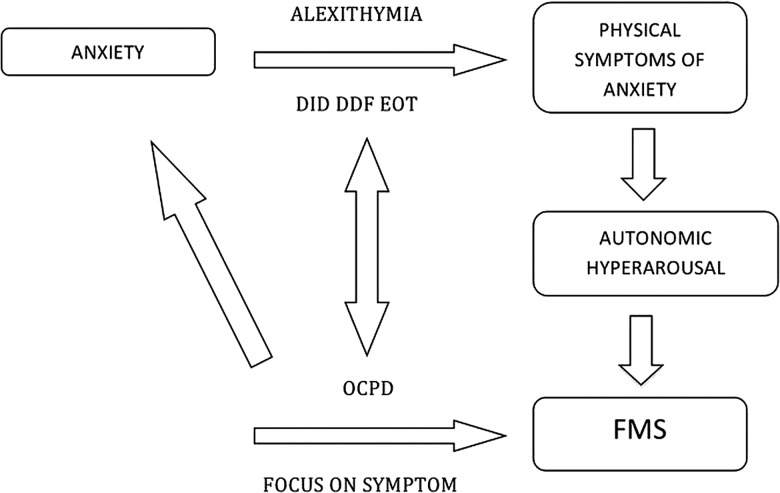
BACKGROUND: The mechanisms leading to the development of functional motor symptoms (FMS) are of pathophysiological and clinical relevance, yet are poorly understood. AIM: The aim of the present study was to evaluate whether impaired emotional processing at the cognitive level (alexithymia) is present in patients affected by FMS. We conducted a cross-sectional study in a population of patients with FMS and in two control groups (patients with organic movement disorders (OMD) and healthy volunteers). METHODS: 55 patients with FMS, 33 patients affected by OMD and 34 healthy volunteers were recruited. The assessment included the 20-item Toronto Alexithymia Scale (TAS-20), the Montgomery-Asberg Depression Rating Scale, the Reading the Mind in the Eyes' Test and the Structured Clinical Interview for Personality Disorders. RESULTS: Alexithymia was present in 34.5% of patients with FMS, 9.1% with OMD and 5.9% of the healthy volunteers, which was significantly higher in the FMS group (χ(2) (2)=14.129, p<0.001), even after controlling for the severity of symptoms of depression. Group differences in mean scores were observed on both the difficulty identifying feelings and difficulty describing feelings dimensions of the TAS-20, whereas the externally orientated thinking subscale score was similar across the three groups. Regarding personality disorder, χ(2) analysis showed a significantly higher prominence of obsessive-compulsive personality disorder (OCPD) in the FMS group (χ(2) (2)=16.217, p<0.001) and 71.4% of those with OCPD also reached threshold criteria for alexithymia. CONCLUSIONS: Because alexithymia is a mental state denoting the inability to identify emotions at a cognitive level, one hypothesis is that some patients misattribute autonomic symptoms of anxiety, for example, tremor, paraesthesiae, paralysis, to that of a physical illness. Further work is required to understand the contribution of OCPD to the development of FMS.
Overview
The claims and statistics of this paper haven’t been checked yet.
Free: it reads the open-access text and checks the first 5 claims that cite a source we can check. Create a free account to check every claim.
Integrity signals
Registry
Cites
Statistics
Figures
Verification
Claims the paper makes
The claims and statistics of this paper haven’t been checked yet.
Free: it reads the open-access text and checks the first 5 claims that cite a source we can check. Create a free account to check every claim.
Claims other papers make about this one
Each is checked against this paper’s own text: does it say what the citing paper says it does?
The cited source says what the claim attributes to it.
In the citing paper
“Alexithymia, a characteristic described as difficulties identifying/ describing feelings and having externally oriented thinking, is found in many people with FND.18,[185][186][187]”
From A new science of emotion: implications for functional neurological disorder (2022) · cites this paper as [186]
Self-check
Percentages, sums and reported differences re-computed from the paper’s own numbers.
The self-check needs the paper’s full text.
Citations
Cites
Diagnostic and Statistical Manual of Mental Disorders
American Psychiatric Association (2013) · doi:10.1176/appi.books.9780890425596 · Cited by 116,369
Diagnostic and Statistical Manual of Mental Disorders
Williams, J. B. W., & First, M. (2013) · Encyclopedia of Social Work · doi:10.1093/acrefore/9780199975839.013.104 · Cited by 109,519
The Prevalence of ‘Alexithymic’ Characteristics in Psychosomatic Patients
Sifneos, P. E. (2010) · Psychotherapy and Psychosomatics · doi:10.1159/000286529 · Cited by 2,818
The twenty-item Toronto Alexithymia scale—II. Convergent, discriminant, and concurrent validity
Bagby, R. M., Taylor, G. J., & Parker, J. D. A. (1994) · Journal of Psychosomatic Research · doi:10.1016/0022-3999(94)90006-x · Cited by 2,427
(1997) · Medical Entomology and Zoology · Cited by 1,407
Lobbestael, J., Leurgans, M., & Arntz, A. (2011) · Clinical Psychology & Psychotherapy · doi:10.1002/cpp.693 · Cited by 1,124
Disorders of Affect Regulation: Alexithymia in Medical and Psychiatric Illness
Taylor, G. J., Bagby, R. M., Parker, J. D. A., & Grotstein, J. (1997) · Cambridge University Press eBooks · doi:10.1017/cbo9780511526831 · Cited by 1,110
A Bayesian account of ‘hysteria’
Edwards, M. J., Adams, R. A., Brown, H., Parees, I., & Friston, K. J. (2012) · Brain · doi:10.1093/brain/aws129 · Cited by 825
Self-citationAlexithymia : a view of the psychosomatic process
Nemiah, J. C. (1976) · Medical Entomology and Zoology · Cited by 626
Who is referred to neurology clinics?—The diagnoses made in 3781 new patients
Stone, J., Carson, A., Duncan, R., Roberts, R., Warlow, C., Hibberd, C., Coleman, R., Cull, R., Murray, G., Pelosi, A., et al. (2010) · Clinical Neurology and Neurosurgery · doi:10.1016/j.clineuro.2010.05.011 · Cited by 536
Cited by
Items 101–147 of 147
Cole, R. H., Smythe, L., Edwards, M. J., Happe, F. G. E., & Nicholson, T. R. (2025) · Autism · doi:10.1177/13623613251393504 · Cited by 4
Self-citationPaleari, V., Nisticò, V., Nardocci, N., Canevini, M. P., Priori, A., Gambini, O., Zorzi, G. S., & Demartini, B. (2021) · Clinical Child Psychology and Psychiatry · doi:10.1177/13591045211055084 · Cited by 3
Self-citationNováková, L., Anýž, J., Forejtová, Z., Rošíková, T., Věchetová, G., Sojka, P., Růžička, E., & Serranová, T. (2023) · Movement Disorders Clinical Practice · doi:10.1002/mdc3.13812 · Cited by 5
de Vroege, L., van Dijl, T. L., Jong, J. E. W.-D., Videler, A. C., & Kop, W. J. (2023) · Journal of Clinical and Experimental Neuropsychology · doi:10.1080/13803395.2024.2335599 · Cited by 3
Content analysis of views on the nature of functional neurological disorders
Carruthers, E., Fernandes, L. A., Agrawal, N., & Poole, N. A. (2020) · Journal of Psychosomatic Research · doi:10.1016/j.jpsychores.2020.110303 · Cited by 3
Interoceptive disruption in functional neurological disorder: a multimodal brain imaging studyPreprint
Sojka, P., Serranová, T., Khalsa, S. S., Perez, D. L., & Diez, I. P. (2024) · medRxiv · doi:10.1101/2024.03.13.24303546 · Cited by 7
Gabay, Z., Eliav, T., Hammerman, O., Elkana, O., Epstein, M., Yaakobi, E., & Ezra, Y. (2025) · OBM Integrative and Complementary Medicine · doi:10.21926/obm.icm.2502019 · Cited by 2
Sleep in Functional Motor Disorders: A Case–Control Polysomnographic Study
Nepožitek, J., Dostálová, S., Jirásek, M., Chaloupková, G., Forejtová, Z., Nováková, L., Rottová, V., Konvičná, V., Šonka, K., Edwards, M. J., et al. (2025) · Journal of Sleep Research · doi:10.1111/jsr.70163 · Cited by 4
Self-citationPersonality Profiles Among People With Functional Motor Disorders
Cuoco, S., Nisticò, V., Bisogno, R., Tedesco, R., Aiello, M., Civilotti, C., Barone, P., Demartini, B., & Erro, R. (2025) · Journal of Neuropsychiatry · doi:10.1176/appi.neuropsych.20250021 · Cited by 2
Self-citationBühler, J., Schwab, N., Messmer, F., Weber, S., van der Meer, J., & Aybek, S. (2026) · Journal of Psychosomatic Research · doi:10.1016/j.jpsychores.2026.112634 · Cited by 2
Vinciguerra, C., Gandolfi, M., Sandri, A., Russo, M., Ricciardi, C., Romano, M., Vico, I. A. D., Squintani, G. M., Piscosquito, G., Biasi, G. D., et al. (2026) · Journal of Neural Transmission · doi:10.1007/s00702-026-03151-x · Cited by 3
Developing a Treatment Plan for Functional Movement Disorder
Edwards, M. J. (2022) · Current clinical neurology · doi:10.1007/978-3-030-86495-8_20 · Cited by 2
Self-citationA Reconsideration of Premorbid Factors in Conversion Disorders
Stroink, L. (2023) · Psychology and Psychotherapy Research Study · doi:10.31031/pprs.2023.07.000655 · Cited by 2
Eccles, C., Malik, O., & Hedderly, T. J. (2023) · Paediatrics and Child Health · doi:10.1016/j.paed.2023.07.004 · Cited by 2
Deficit in the Emotional Embodiment in Alexithymia
Scarpazza, C. (2015) · AMS Dottorato Institutional Doctoral Theses Repository (University of Bologna) · doi:10.6092/unibo/amsdottorato/6840 · Cited by 5
Self-Awareness Disorders in Conversion Hysteria
Aybek, S., & Vuilleumier, P. O. (2015) · Elsevier eBooks · doi:10.1016/b978-0-12-800948-2.00019-4 · Cited by 5
Autonomy-Related Personality Factors in Patients with Functional Neurological Symptom Disorder
Stroink, L. (2024) · IntechOpen eBooks · doi:10.5772/intechopen.1004200 · Cited by 2
Revisiting psychopathological hand as a functional neurological disorder: Time to reframe?
Julien, F., Bigorre, N., Degez, F., & Celerier, S. (2025) · Hand surgery & rehabilitation · doi:10.1016/j.hansur.2025.102563 · Cited by 1
Eatz, T. A., Margolesky, J. H., & Cocores, A. N. (2026) · Current Pain and Headache Reports · doi:10.1007/s11916-026-01480-w · Cited by 1
Millman, L. S. M., Bhuma, S., Basamh, Y., Uloyok-Job, J., Davies, J., Blunstone, L., Manoharan, A., Coebergh, J. A., David, A. L., Edwards, M. J., et al. (2026) · Journal of Neurology Neurosurgery & Psychiatry · doi:10.1136/jnnp-2025-337694 · Cited by 2
Self-citationHedonicity in functional motor disorders: a chemosensory study assessing taste
Cecchini, M. P., Tamburin, S., Zanini, A., Boschi, F., Demartini, B., Goeta, D., Dallocchio, C., Marotta, A., Fiorio, M., & Tinazzi, M. (2020) · Journal of Neural Transmission · doi:10.1007/s00702-020-02244-5 · Cited by 1
Self-citationMainka, T., & Ganos, C. (2022) · Current clinical neurology · doi:10.1007/978-3-030-86495-8_12 · Cited by 3
Neurological Bedside Examination: “Can I Confirm My Anatomical Hypothesis?”
Kondziella, D., & Waldemar, G. (2017) · Springer eBooks · doi:10.1007/978-3-319-55991-9_3 · Cited by 1
New insights into the neural basis of functional movement disorders
Planetta, P. J., & Miyasaki, J. M. (2016) · Neurology · doi:10.1212/wnl.0000000000002957 · Cited by 1
Fominykh, V., Jaholkowski, P. P., Shadrin, A. A., Koch, E. M., Luitva, L. B., Mikkelsen, D. H., Lundberg, M., Pedersen, O. B., Ostrowski, S. R., Erikstrup, C., et al. (2025) · medRxiv · doi:10.1101/2025.07.16.25331639 · Cited by 3
Leone, F. G. D. (2015) · IPNOSI · doi:10.3280/ipn2015-002001
Willis, M. D. (2017) · The Brown University Child and Adolescent Behavior Letter · doi:10.1002/cbl.30222
Alexithymia governing neurosis: A comparative study between patients and caregivers
Aggarwal, A., Kalra, D., Kataria, D. K., & Verma, R. (2018) · Journal of Mental Health and Human Behaviour · doi:10.4103/jmhhb.jmhhb_58_17
Demartini, B., Goeta, D., Benedetto, D. D., Casiraghi, A., Mazza, D., Priori, A., & Gambini, O. (2020) · Journal of Clinical Psychopharmacology · doi:10.1097/jcp.0000000000001217
Self-citationObjective and subjective movement symptoms in (functional) tremor
Kramer, G. (2020) · University of Groningen research database (University of Groningen / Centre for Information Technology) · doi:10.33612/diss.136731740
Morgante, F. (2022) · Current clinical neurology · doi:10.1007/978-3-030-86495-8_7
Non‐Parkinsonian movement disorders in the elderly
Amlang, C. J., & Kompoliti, K. (2022) · Wiley eBooks · doi:10.1002/9781119484288.ch54 · Cited by 1
Khan, T., & Benbadis, S. R. (2019) · Cambridge University Press eBooks · doi:10.1017/9781108754200.010
Functional Neurological Symptoms: A Potential Sentinel of Neurological and Mental Health Disorders
Sajin, V., & Macerollo, A. (2022) · Springer eBooks · doi:10.1007/978-3-030-97906-5_15 · Cited by 1
Dumitrascu, N. (2023) · Oxford University Press eBooks · doi:10.1093/oxfordhb/9780190092689.013.26
Neurological Bedside Examination: “Can I Confirm My Anatomical Hypothesis?”
Kondziella, D., & Waldemar, G. (2023) · Springer eBooks · doi:10.1007/978-3-031-43335-1_3
Baumann‐Vogel, H. (2025) · Cambridge University Press eBooks · doi:10.1017/9781108989855.055
Ayache, J., Stevenson, N. J., Patel, E., Sumich, A. L., Dumas, G., & Heym, N. (2025) · Personality and Individual Differences · doi:10.1016/j.paid.2025.113279
Mechanisms and Vulnerabilities in Functional Neurological Disorder
Prudente, E., Savioz, V., Concetti, C., & Aybek, S. (2026) · Seminars in Neurology · doi:10.1055/a-2772-7100 · Cited by 1
Gestaltung therapeutischer Allianzen bei Menschen mit zwanghafter Persönlichkeitsstörung
Beiling, P., & Noack, R. (2026) · PTT - Persönlichkeitsstörungen: Theorie und Therapie · doi:10.21706/ptt-30-1-60
Boone, K. B. (2026) · Springer eBooks · doi:10.1007/978-3-032-07777-6_19
Personality Disorders in Functional and Idiopathic Dystonia
Tolmacheva, V. A., Parfenov, V. A., Romanov, D. V., Дмитриевна, С. Е., Альбертовна, В. Б., & Владимировна, С. Е. (2026) · Journal of Clinical Medicine · doi:10.3390/jcm15093544
Stroink, L., Huijbregts, K., Rakic, A., de Vries, M. R., Rijkeboer, M. M., & Bekker, M. H. J. (2026) · Frontiers in Psychiatry · doi:10.3389/fpsyt.2026.1788675
Personality disorders: what the neurologist should know
Farakish, L., Arun, A., Browne, C., Thornley, T., Joyce, D. W., & Mbizvo, G. K. (2026) · Practical Neurology · doi:10.1136/pn-2026-005213
Danhofer, P., Vyhnalová, M., Stroupková, L., Všianská, P., Knedlíková, L., Kolář, S., & Ošlejšková, H. (2026) · Frontiers in Psychiatry · doi:10.3389/fpsyt.2026.1952291
Pathophysiology of functional (psychogenic) movement disorders
Pareés, I. (2015) · UCL Discovery (University College London)
Neurological Bedside Examination: “Can I Confirm My Anatomical Hypothesis?”
Kondziella, D., & Waldemar, G. (2013) · Springer eBooks · doi:10.1007/978-1-4471-5251-4_3
Metadata
- Authors
- Demartini, B., Petrochilos, P., Ricciardi, L., Price, G., Edwards, M. J., & Joyce, E.
- Affiliations
- University of Milan (IT)
- National Hospital for Neurology and Neurosurgery (GB)
- University of Messina (IT)
- Corresponding author
- Joyce, Eileen
- Venue
- Journal of Neurology, Neurosurgery & Psychiatry
- Publisher
- BMJ
- Published
- 2014-03-07
- Volume
- 85
- Issue
- 10
- Pages
- 1132-1137
- ISSN
- 0022-3050 (ISSN-L)
- 1468-330X
- PMC
- PMC4173967
- OpenAlex
- W2142415528
- Semantic Scholar
- 119b12a694e27b7297b78ffddbf7fc36a7452ae6
- Cited by
- 147
- References
- 49
- Citations by year
- 2026: 12 · 2025: 13 · 2024: 10 · 2023: 13 · 2022: 17 · 2021: 7 · 2020: 15 · 2019: 12 · 2018: 13 · 2017: 12 · 2016: 9 · 2015: 11 · 2014: 1
- FWCI
- 8.39
- Type
- journal article
- Language
- en
- Open access
- hybrid
- doi.org
- Licence
- cc-by-nc
- Locations
- Journal of Neurology Neurosurgery & Psychiatry (publishedVersion, cc-by-nc)
- PubMed Central (publishedVersion, cc-by-nc)
- PubMed (publishedVersion)
- St George's Online Research Archive (St George's University of London) (acceptedVersion)
- Archivio Istituzionale della Ricerca (Universita Degli Studi Di Milano) (submittedVersion, other-oa)
- UCL Discovery (University College London) (submittedVersion)
- HighWire Press Open Archive (submittedVersion)
- Funders
- National Institute for Health and Care Research
- University College London Hospitals NHS Foundation Trust
- Topics
- Health Sciences › Medicine › Psychiatry and Mental health › Psychosomatic Disorders and Their Treatments
- Health Sciences › Medicine › Psychiatry and Mental health › Fibromyalgia and Chronic Fatigue Syndrome Research
- Health Sciences › Medicine › Clinical Neurology › Deep Brain Stimulation and Movement Disorders
- Keywords
- alexithymia, conversion disorder, emotional processing, obsessive-compulsive personality disorder, Toronto Alexithymia Scale, depression, tremor, paraesthesiae, paralysis
- MeSH terms
- Adult, Affective Symptoms, Compulsive Personality Disorder, Conversion Disorder, Cross-Sectional Studies, Female, Humans, Male, Middle Aged, Movement Disorders, Psychiatric Status Rating Scales, Case-Control Studies
About these checks
Registry, retraction, Cites and statistics results are computed, not judged, with one exception: a printed reference that no index lists is read once by a model before it counts as a citation error. Claims are extracted by a model and kept only when their quote appears verbatim in the text; each cited source is then checked, with a model’s help, for whether it says what the claim relies on. Those verdicts can be wrong — read the claim’s quote and the cited source before relying on one.
Statistics and arithmetic are recomputed, not judged.
Confidence bands are shown only for fields calibrated on our annotated test set. None is calibrated yet, so no band is shown.
What counts as a claim ›How we measure confidence ›How we check this ›
Are you an author, or do you see a problem with this page? Request a review
Data sources
Bibliographic data: Semantic Scholar, OpenAlex, Crossref.
Contains information from the Semantic Scholar Academic Graph Datasets, made available under the ODC Attribution License (ODC-BY 1.0).
Semantic Scholar’s data is described in: Kinney, R., et al. (2023). The Semantic Scholar Open Data Platform. arXiv:2301.10140.
