

Defining functional brain networks underlying obsessive–compulsive disorder (OCD) using treatment-induced neuroimaging changes: a systematic review of the literature
Open accessThe DOI matches its Crossref record; 60 of the 61 references it cites were found in a registry or an index.
Abstract
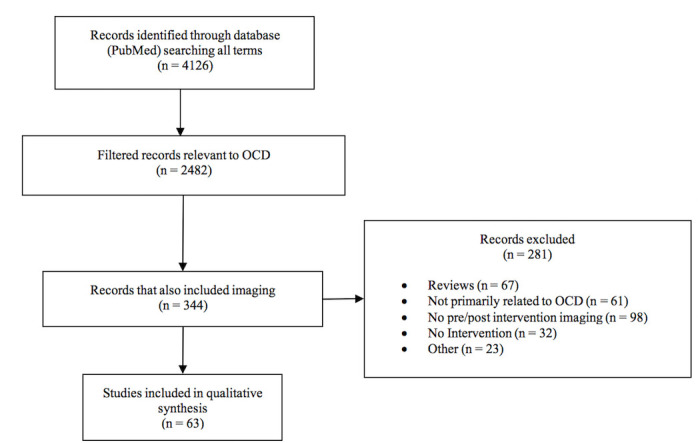
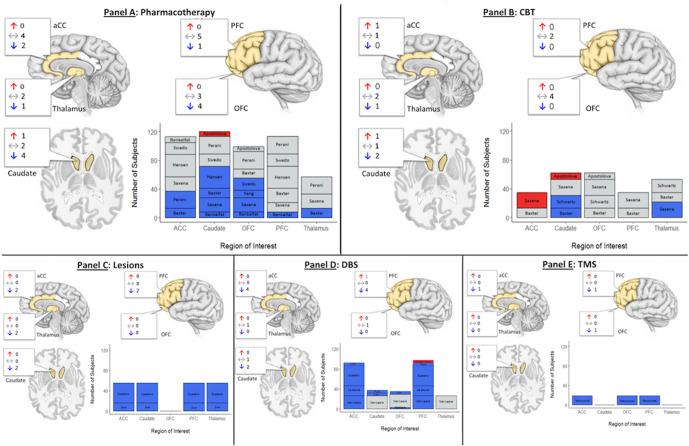
Approximately 2%–3% of the population suffers from obsessive–compulsive disorder (OCD). Several brain regions have been implicated in the pathophysiology of OCD, but their various contributions remain unclear. We examined changes in structural and functional neuroimaging before and after a variety of therapeutic interventions as an index into identifying the underlying networks involved. We identified 64 studies from 1990 to 2020 comparing pretreatment and post-treatment imaging of patients with OCD, including metabolic and perfusion, neurochemical, structural, functional and connectivity-based modalities. Treatment class included pharmacotherapy, cognitive–behavioural therapy/exposure and response prevention, stereotactic lesions, deep brain stimulation and transcranial magnetic stimulation. Changes in several brain regions are consistent and correspond with treatment response despite the heterogeneity in treatments and neuroimaging modalities. Most notable are decreases in metabolism and perfusion of the caudate, anterior cingulate cortex, thalamus and regions of prefrontal cortex (PFC) including the orbitofrontal cortex (OFC), dorsolateral PFC (DLPFC), ventromedial PFC (VMPFC) and ventrolateral PFC (VLPFC). Modulating activity within regions of the cortico-striato-thalamo-cortical system may be a common therapeutic mechanism across treatments. We identify future needs and current knowledge gaps that can be mitigated by implementing integrative methods. Future studies should incorporate a systematic, analytical approach to testing objective correlates of treatment response to better understand neurophysiological mechanisms of dysfunction.
Overview
The claims and statistics of this paper haven’t been checked yet.
Free: it reads the open-access text and checks the first 5 claims that cite a source we can check. Create a free account to check every claim.
Integrity signals
Registry
Cites
Statistics
Figures
Verification
Claims the paper makes
The claims and statistics of this paper haven’t been checked yet.
Free: it reads the open-access text and checks the first 5 claims that cite a source we can check. Create a free account to check every claim.
Claims other papers make about this one
Each is checked against this paper’s own text: does it say what the citing paper says it does?
The cited source says what the claim attributes to it.
In the citing paper
“In other domains of OCD research, there is evidence that treatment can normalize aberrant brain activity [4].”
From Neural correlates of response inhibition following cognitive behavioral therapy in obsessive–compulsive disorder: a randomized controlled EEG study (2026) · cites this paper as [4]
The check wasn’t confident either way, so it gives no verdict — never disputed.
In the citing paper
“However, interventions addressing downstream regions alone, such as thalamic DBS, have shown limited efficacy in some studies, potentially due to secondary alterations arising from disrupted upstream CSTC input (239)”
From Neural mechanisms underlying cognitive inflexibility in obsessive-compulsive disorder: a review (2026) · cites this paper as [239]
Experimental — accuracy not yet measuredThe check wasn’t confident either way, so it gives no verdict — never disputed.
In the citing paper
“have shown limited efficacy in some studies, potentially due to secondary alterations arising from disrupted upstream CSTC input (239)”
From Neural mechanisms underlying cognitive inflexibility in obsessive-compulsive disorder: a review (2026) · cites this paper as [239]
Experimental — accuracy not yet measured
Self-check
Percentages, sums and reported differences re-computed from the paper’s own numbers.
The self-check needs the paper’s full text.
Citations
Cites
Bardo, M. T., & Hammer, R. P. (1991) · Neuroscience · doi:10.1016/0306-4522(91)90226-e · Cited by 3,219
The epidemiology of obsessive-compulsive disorder in the National Comorbidity Survey Replication
Ruscio, A. M., Stein, D. J., Chiu, W. T., & Kessler, R. C. (2010) · Molecular Psychiatry · doi:10.1038/mp.2008.94 · Cited by 2,771
Baxter, L. R. (1992) · Archives of General Psychiatry · doi:10.1001/archpsyc.1992.01820090009002 · Cited by 1,293
Schwartz, J. M. (1996) · Archives of General Psychiatry · doi:10.1001/archpsyc.1996.01830020023004 · Cited by 693
Benkelfat, C. (1990) · Archives of General Psychiatry · doi:10.1001/archpsyc.1990.01810210048007 · Cited by 539
Deep brain stimulation for refractory obsessive-compulsive disorder
Abelson, J. L., Curtis, G. C., Sagher, O., Albucher, R. C., Harrigan, M., Taylor, S. F., Martis, B., & Giordani, B. (2005) · Biological Psychiatry · doi:10.1016/j.biopsych.2004.11.042 · Cited by 522
Deep brain stimulation restores frontostriatal network activity in obsessive-compulsive disorder
Figee, M., Luigjes, J., Smolders, R., Valencia-Alfonso, C.-E., van Wingen, G., de Kwaasteniet, B., Mantione, M., Ooms, P., de Koning, P., Vulink, N., et al. (2013) · Nature Neuroscience · doi:10.1038/nn.3344 · Cited by 466
Swedo, S. E. (1992) · Archives of General Psychiatry · doi:10.1001/archpsyc.1992.01820090018003 · Cited by 417
Saxena, S. (1999) · Neuropsychopharmacology · doi:10.1016/s0893-133x(99)00082-2 · Cited by 379
ROSENBERG, D. R., MacMASTER, F. P., KESHAVAN, M. S., FITZGERALD, K. D., STEWART, C. M., & MOORE, G. J. (2000) · Journal of the American Academy of Child & Adolescent Psychiatry · doi:10.1097/00004583-200009000-00008 · Cited by 377
Cited by
Current interpretations of the I-PACE model of behavioral addictions
Brand, M., Müller, A., Wegmann, E., Antons, S., Brandtner, A., Müller, S. M., Stark, R., Steins-Loeber, S., & Potenza, M. N. (2025) · Journal of Behavioral Addictions · doi:10.1556/2006.2025.00020 · Cited by 190
Gadot, R., Najera, R., Hirani, S., Anand, A., Storch, E., Goodman, W. K., Shofty, B., & Sheth, S. A. (2022) · Journal of Neurology, Neurosurgery & Psychiatry · doi:10.1136/jnnp-2021-328738 · Cited by 148
Self-citationLiu, J., Cao, L., Li, H., Gao, Y., Bu, X., Liang, K., Bao, W., Zhang, S., Qiu, H., Li, X., et al. (2022) · Neuroscience & Biobehavioral Reviews · doi:10.1016/j.neubiorev.2022.104574 · Cited by 109
Deep Brain Stimulation for Obsessive-Compulsive Disorder and Depression
Sheth, S. A., & Mayberg, H. S. (2023) · Annual Review of Neuroscience · doi:10.1146/annurev-neuro-110122-110434 · Cited by 94
Self-citationBiria, M., Banca, P., Healy, M. P., Keser, E., Sawiak, S. J., Rodgers, C. T., Rua, C., de Souza, A. M. F. L. P., Marzuki, A. A., Sule, A., et al. (2023) · Nature Communications · doi:10.1038/s41467-023-38695-z · Cited by 125
Advances in Deep Brain Stimulation: From Mechanisms to Applications
Sandoval-Pistorius, S. S., Hacker, M. L., Waters, A. C., Wang, J., Provenza, N. R., de Hemptinne, C., Johnson, K. A., Morrison, M. A., & Cernera, S. (2023) · Journal of Neuroscience · doi:10.1523/jneurosci.1427-23.2023 · Cited by 72
Brain–computer interfaces for neuropsychiatric disorders
Oganesian, L. L., & Shanechi, M. M. (2024) · Nature Reviews Bioengineering · doi:10.1038/s44222-024-00177-2 · Cited by 58
Moreau, A. L., Hansen, I. S., & Bogdan, R. (2025) · Frontiers in Psychiatry · doi:10.3389/fpsyt.2024.1432253 · Cited by 37
Kršek, A., Jagodic, A., & Batičić, L. (2024) · Medicina · doi:10.3390/medicina60091384 · Cited by 38
Yan, H., Shan, X., Li, H., Liu, F., & Guo, W. (2022) · Journal of Affective Disorders · doi:10.1016/j.jad.2022.04.125 · Cited by 34
Closed-loop recruitment of striatal interneurons prevents compulsive-like grooming behaviors
Mondragón-González, S. L., Schreiweis, C., & Burguière, E. (2024) · Nature Neuroscience · doi:10.1038/s41593-024-01633-3 · Cited by 32
Sethi, P., Mehan, S., Khan, Z., & Chhabra, S. (2023) · NeuroToxicology · doi:10.1016/j.neuro.2023.08.001 · Cited by 31
Mao, L., Hu, M., Luo, L., Wu, Y., Lu, Z., & Zou, J. (2022) · Frontiers in Psychiatry · doi:10.3389/fpsyt.2022.973838 · Cited by 29
“The reduction of obsessive-compulsive symptoms in patients treated with SSRIs medications is associated with reduced metabolic levels in the right caudate nucleus, bilateral orbitofrontal cortex, and bilateral anterior cingulate cortex, and with increased activation in the left thalamus and right insula (41).”
BackgroundYan, H., Shan, X., Li, H., Liu, F., & Guo, W. (2022) · Frontiers in Cellular Neuroscience · doi:10.3389/fncel.2022.906534 · Cited by 28
Becker, H. C., Beltz, A. M., Himle, J. A., Abelson, J. L., Block, S. R., Taylor, S. F., & Fitzgerald, K. D. (2023) · Biological Psychiatry Cognitive Neuroscience and Neuroimaging · doi:10.1016/j.bpsc.2023.09.009 · Cited by 23
Structural and functional deficits and couplings in severe and moderate OCD
Xu, Y., Zheng, R., Guo, H., Wei, Y., Wen, B., Dai, S., Han, S., Cheng, J., & Zhang, Y. (2023) · Journal of Psychiatric Research · doi:10.1016/j.jpsychires.2023.02.022 · Cited by 23
Mujahidah, S., Zahra, S., & Hariyadi, R. (2024) · Journal of Islamic Communication and Counseling · doi:10.18196/jicc.v4i1.96 · Cited by 18
Saccenti, D., Lauro, L. J. R., Crespi, S. A., Moro, A. S., Vergallito, A., Grgič, R. G., Pretti, N., Lamanna, J., & Ferro, M. (2024) · Neural Plasticity · doi:10.1155/np/7853199 · Cited by 18
Noda, Y., Fujii, K., Tokura, F., Nakajima, S., & Kitahata, R. (2023) · Journal of Personalized Medicine · doi:10.3390/jpm13050875 · Cited by 17
High intensity approaches to exposure and response prevention for obsessive-compulsive disorder
Trent, E. S., Zhou, R. J., Mammo, L., Goodman, W. K., & Storch, E. A. (2025) · Behavioural Brain Research · doi:10.1016/j.bbr.2025.115427 · Cited by 14
Self-citationReddy, S., Shreekantiah, U., Goyal, N., & Roy, C. (2022) · CNS Spectrums · doi:10.1017/s1092852922000803 · Cited by 14
Wang, J., Hua, G., Wang, S., Guo, G., Quan, D., Yao, S., & Zheng, H. (2023) · Journal of Affective Disorders · doi:10.1016/j.jad.2023.01.064 · Cited by 11
Stephenson, C., Philipp-Muller, A., Moghimi, E., Nashed, J. Y., Cook, D. J., Shirazi, A., Milev, R., & Alavi, N. (2025) · European Archives of Psychiatry and Clinical Neuroscience · doi:10.1007/s00406-024-01852-6 · Cited by 10
“These decreases fall in congruence with a recent review looking across intervention types, citing decreased activity in the orbitofrontal cortex, prefrontal cortex, caudate nucleus, nucleus accumbens, and prefrontal cortex [7].”
Allam, A. K., Giridharan, N., Hasen, M., Banks, G. P., Reyes, G., Dang, H., Kabotyanski, K. E., Hertz, A. G., Heilbronner, S. R., Provenza, N. R., et al. (2024) · Journal of Neurosurgery Case Lessons · doi:10.3171/case24289 · Cited by 10
Self-citationLieneman, C. C., Guastello, A. D., Munson, M. S., Barthle-Herrera, M. A., Bailey, B. A., Higham, M., Druskin, L. R., & McNeil, C. B. (2024) · Journal of Indian Association for Child and Adolescent Mental Health · doi:10.1177/09731342241252560 · Cited by 10
Wang, J., Huang, C., Luo, G., Xiao, Y., Guo, G., Quan, D., & Zheng, H. (2024) · Journal of Psychiatric Research · doi:10.1016/j.jpsychires.2024.03.006 · Cited by 8
Xu, Y., & Zhang, Y. (2023) · European Journal of Neuroscience · doi:10.1111/ejn.16117 · Cited by 8
Advances in DTI studies for diagnoses and treatment of obsessive-compulsive disorder
Masjoodi, S., Farrokhi, M. R., Afkham, B. V., & Koohsar, J. S. (2024) · Psychiatry Research Neuroimaging · doi:10.1016/j.pscychresns.2024.111794 · Cited by 8
Neurosurgical Approaches for Treatment-Resistant Obsessive-Compulsive Disorder
Shofty, B., Gadot, R., Provenza, N. R., Storch, E. A., Goodman, W. K., & Sheth, S. A. (2022) · Psychiatric Clinics of North America · doi:10.1016/j.psc.2022.11.002 · Cited by 8
Self-citationAberrant orbitofrontal cortical activation interferes with encoding of Pavlovian fear conditioning
Sun, C.-F., & Chang, C. (2022) · Frontiers in Behavioral Neuroscience · doi:10.3389/fnbeh.2022.981041 · Cited by 8
Spatola, G., Triebkorn, P., Richieri, R. M., Baunez, C., Farisse, J., Cretol, A., Guedj, É., Jirsa, V., & Régis, J. M. (2024) · Heliyon · doi:10.1016/j.heliyon.2024.e34699 · Cited by 6
Abdallah, C. G., Sheth, S. A., Storch, E. A., & Goodman, W. K. (2023) · American Journal of Psychiatry · doi:10.1176/appi.ajp.20220907 · Cited by 6
Self-citationDong, C., Zheng, H., Shen, H., Wan, Y., Xu, Y., Li, Y., Ping, L., Yu, H., Liu, C., Cui, J. G., et al. (2025) · Brain Imaging and Behavior · doi:10.1007/s11682-025-01010-z · Cited by 5
Hurwitz, T. A., Avecillas-Chasin, J. M., Bogod, N. M., & Honey, C. R. (2024) · Journal of Affective Disorders · doi:10.1016/j.jad.2024.01.176 · Cited by 5
Serra-Blasco, M., Miquel-Giner, N., Vicent-Gil, M., Casteràs, D. P., Martínez‐Zalacaín, I., Cano, M., la Peña‐Arteaga, V. D., Mar‐Barrutia, L., Alemany-Navarro, M., Soriano‐Mas, C., et al. (2025) · Psychotherapy and Psychosomatics · doi:10.1159/000548961 · Cited by 5
Reddy, S., Goyal, N., & Shreekantiah, U. (2026) · Journal of Ect · doi:10.1097/yct.0000000000001145 · Cited by 4
Psychiatric Applications of Psychedelics
Tiwari, P., Ehrenkranz, R. C., & Yaden, D. B. (2024) · Advances in Psychiatry and Behavioral Health · doi:10.1016/j.ypsc.2024.04.005 · Cited by 2
Chen, H., Zhang, H., Li, W., Zhang, X., Xu, Z., Wang, Z., Jiang, W., Liu, N., & Zhang, N. (2024) · Journal of Affective Disorders · doi:10.1016/j.jad.2024.06.110 · Cited by 2
Ülker, S. V., Çınaroğlu, M., Yılmazer, E., & Tarlacı, S. (2025) · Journal of Clinical Medicine · doi:10.3390/jcm14238341 · Cited by 2
Stimulating the brain: a primer
Opri, E., & Cernera, S. (2025) · Elsevier eBooks · doi:10.1016/b978-0-443-24824-5.00007-7 · Cited by 2
The Role of Immune-Inflammatory Factors in the Pathophysiology of Obsessive–Compulsive Disorder
Xu, X., Li, Z., Wan, S., & Xiao, C. (2024) · Integrated science · doi:10.1007/978-3-031-72079-6_10 · Cited by 2
Electrical deep neuromodulation in psychiatry
Polosan, M., & Figee, M. (2021) · International review of neurobiology · doi:10.1016/bs.irn.2021.06.007 · Cited by 2
Bilateral Anterior Capsulotomy for Treatment-Resistant Obsessive-Compulsive Disorder
Hurwitz, T. A., Ching, G., Bogod, N. M., & Honey, C. R. (2024) · Stereotactic and Functional Neurosurgery · doi:10.1159/000540503 · Cited by 2
Deep brain stimulation for obsessive-compulsive disorder
Karaszewska, D., Bergfeld, I. O., van Eijck, R., Graat, I., Vulink, N. C. C., de Koning, P. P., Denys, D. A. J. P., & Mocking, R. J. T. (2024) · Elsevier eBooks · doi:10.1016/b978-0-443-18496-3.00018-5 · Cited by 2
Classic psychedelics in obsessive–compulsive disorder: a circuit-based framework
Ali, S. A. M., Carhart-Harris, R. L., & Sieg, K. G. (2026) · Nature Mental Health · doi:10.1038/s44220-026-00626-4 · Cited by 2
Shafaghi, L., Arbabi, M., Tehrani‐Doost, M., Batouli, S. A. H., Ziaa, M. J., & Hadjighassem, M. (2024) · Archives of Neuroscience · doi:10.5812/ans-152403 · Cited by 1
Neurobiology of deep brain stimulation for psychiatric disorders
Gadot, R., Giridharan, N., Rajesh, S. V., Provenza, N. R., Banks, G. P., Storch, E. A., Goodman, W. K., & Sheth, S. A. (2024) · Elsevier eBooks · doi:10.1016/b978-0-443-18496-3.00023-9 · Cited by 1
Self-citationThe Physiologic Basis of Neuromodulation
Wilson, T. J., & Butala, A. (2024) · Advances in Psychiatry and Behavioral Health · doi:10.1016/j.ypsc.2024.05.001 · Cited by 1
Çınaroğlu, M., Ülker, S. V., Yılmazer, E., & Sayar, G. H. (2026) · BMC Psychology · doi:10.1186/s40359-026-05201-1
“In other domains of OCD research, there is evidence that treatment can normalize aberrant brain activity [4].”
Neural mechanisms underlying cognitive inflexibility in obsessive-compulsive disorder: a review
Guo, W., Neo, P. S.-H., & McNaughton, N. (2026) · Frontiers in Psychiatry · doi:10.3389/fpsyt.2026.1795436
Wang, J., Lin, Y., Xiao, Y., Zhu, Y., Gao, J., & Zheng, H. (2026) · Sleep Medicine · doi:10.1016/j.sleep.2025.108685
Dufault, S., Potvin, S., & Patry, S. (2026) · Brain Sciences · doi:10.3390/brainsci16080789
Mari, M., Stingl, M., Hanewald, B., & Mulert, C. (2026) · Journal of Clinical Medicine · doi:10.3390/jcm15187155
al Mohaddesin, F. R., Moghimi, A., Kobravi, H. R., Yaghoubian, E., & Fadardi, J. S. (2026) · BMC Psychiatry · doi:10.1186/s12888-026-07934-0
Flannelly, K. J., & Silton, N. R. (2025) · Springer eBooks · doi:10.1007/978-3-031-38971-9_2038-1
Flannelly, K. J., & Silton, N. R. (2025) · Springer eBooks · doi:10.1007/978-3-031-38971-9_2038-2
Next-Generation Neuromodulation for Anxiety: Circuit-Based and Personalized Approaches
O’Rourke, C. M., Selheimer, R. L., Halpern, C. H., & Oathes, D. J. (2026) · Current Psychiatry Reports · doi:10.1007/s11920-026-01702-3
Huang, Y., Luo, H., Huang, J., & Hou, X. (2025) · Journal of Molecular Neuroscience · doi:10.1007/s12031-025-02391-y
Chtibi, M., & DEMİR, Ö. Ö. (2026) · Psikiyatride Guncel Yaklasimlar - Current Approaches in Psychiatry · doi:10.18863/pgy.1618945
Doolub, D., Wassouf, I., Langbour, N., Delbreil, A., Page, P., Jaafari, N., & Harika‐Germaneau, G. (2022) · Psychiatry Research Case Reports · doi:10.1016/j.psycr.2022.100013
Neuroscience-informed psychoeducation for OCD
McLaughlin, N. C. R., Fedorenko, E. J., & Kulak, M. J. (2026) · Progress in brain research · doi:10.1016/bs.pbr.2026.10.002
Vandevelde, A., Dollfus, S., & Gagnepain, P. (2026) · Psychiatry and Clinical Neurosciences · doi:10.1111/pcn.70155
(2026) · Elsevier eBooks · doi:10.1016/b978-0-443-27446-6.00019-4
Chen, H., Gu, R., Jia, X., Liu, X., Yao, G., Wang, X., He, X., Qiao, R., & Li, J. (2026) · Psychiatry Research · doi:10.1016/j.psychres.2026.117379
Deep TMS in Psychiatric Disorders: Current Evidence
Thakur, A., Biswas, T., & Mishra, B. R. (2026) · Current Behavioral Neuroscience Reports · doi:10.1007/s40473-026-00336-2
Jh, F., Wang, L., Lv, Z., Li, C., Pan, Y., Wang, Y., Li, S., Wang, Y., Gao, Y., & Sun, X. (2026) · Behavioral and Brain Functions · doi:10.21203/rs.3.rs-8925154/v1
Imagerie cérébrale des mécanismes de contrôle inhibiteur dans le trouble obsessionnel compulsif
Vandevelde, A. (2023) · theses.fr (ABES) · doi:10.70675/0586af24z2d22z437ezb9a2zf584a3a0fe75
Study of the involvement of cortico-striatal loops in obsessive and compulsive phenomena
Lamothe, H. (2024) · theses.fr (ABES) · doi:10.70675/a2191e1bze935z488ezba6dzbc425cf8a072
Morse, L. (2023) · Oxford University Research Archive (ORA) (University of Oxford) · doi:10.5287/ora-nrpbgyrro
OCD:n digitaalinen hoitopolku : Rakenteinen malli kokemukselliseen säätelyyn
Lindroos, E. (2026) · Theseus (Ammattikorkeakoulujen)
Yan, H., Shan, X., Li, H., Liu, F., & Guo, W. (2022) · doi:10.3389/fncel.2022.906534.s003
Aval, Y. H., Narimani, M., Basharpor, S., اول, ی. ه., نریمانی, م., & بشرپور, س. (n.d.) · Psychology of Motivation Behavior and Health
Metadata
- Authors
- Bijanki, K. R., Pathak, Y. J., Najera, R. A., Storch, E. A., Goodman, W. K., Simpson, H. B., & Sheth, S. A.
- Affiliations
- Baylor College of Medicine (US)
- Columbia University Irving Medical Center (US)
- Corresponding author
- Sheth, Sameer A.
- ORCID
- Venue
- Journal of Neurology, Neurosurgery & Psychiatry
- Publisher
- BMJ
- Published
- 2021-04-27
- Volume
- 92
- Issue
- 7
- Pages
- 776-786
- ISSN
- 0022-3050 (ISSN-L)
- 1468-330X
- PMC
- PMC8223624
- OpenAlex
- W3157636124
- Cited by
- 68
- References
- 61
- Citations by year
- 2026: 14 · 2025: 13 · 2024: 20 · 2023: 10 · 2022: 10 · 2021: 1
- FWCI
- 1.36
- Type
- journal article
- Language
- en
- Open access
- hybrid
- doi.org
- Licence
- Locations
- Journal of Neurology Neurosurgery & Psychiatry (publishedVersion, cc-by-nc)
- PubMed Central (publishedVersion, cc-by-nc)
- PubMed (publishedVersion)
- Funders
- National Institute of Neurological Disorders and Stroke (R21-NS104953)
- National Institute of Mental Health (K01-MH116364)
- Topics
- Social Sciences › Psychology › Clinical Psychology › Obsessive-Compulsive Spectrum Disorders
- Health Sciences › Medicine › Clinical Neurology › Deep Brain Stimulation and Movement Disorders
- Life Sciences › Neuroscience › Cognitive Neuroscience › Neural and Behavioral Psychology Studies
- Keywords
- obsessive-compulsive disorder, functional brain networks, treatment response, caudate nucleus, anterior cingulate cortex, thalamus, prefrontal cortex, orbitofrontal cortex, deep brain stimulation, transcranial magnetic stimulation, stereotactic lesioning, exposure and response prevention, pharmacotherapy, brain metabolism, cerebral perfusion
- MeSH terms
- Brain, Humans, Nerve Net, Obsessive-Compulsive Disorder, Deep Brain Stimulation, Transcranial Magnetic Stimulation, Neuroimaging
About these checks
Registry, retraction, Cites and statistics results are computed, not judged, with one exception: a printed reference that no index lists is read once by a model before it counts as a citation error. Claims are extracted by a model and kept only when their quote appears verbatim in the text; each cited source is then checked, with a model’s help, for whether it says what the claim relies on. Those verdicts can be wrong — read the claim’s quote and the cited source before relying on one.
Statistics and arithmetic are recomputed, not judged.
Confidence bands are shown only for fields calibrated on our annotated test set. None is calibrated yet, so no band is shown.
What counts as a claim ›How we measure confidence ›How we check this ›
Are you an author, or do you see a problem with this page? Request a review
Data sources
Bibliographic data: Semantic Scholar, OpenAlex, Crossref.
Contains information from the Semantic Scholar Academic Graph Datasets, made available under the ODC Attribution License (ODC-BY 1.0).
Semantic Scholar’s data is described in: Kinney, R., et al. (2023). The Semantic Scholar Open Data Platform. arXiv:2301.10140.
