

Defining functional brain networks underlying obsessive–compulsive disorder (OCD) using treatment-induced neuroimaging changes: a systematic review of the literature
Open accessThe DOI matches its Crossref record; 60 of the 61 references it cites were found in a registry or an index.
Abstract
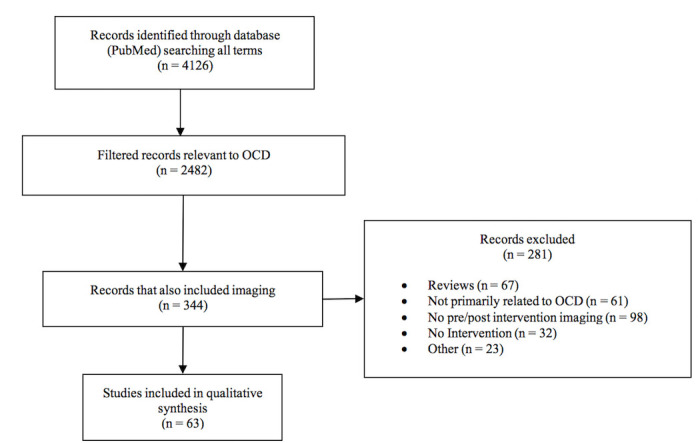
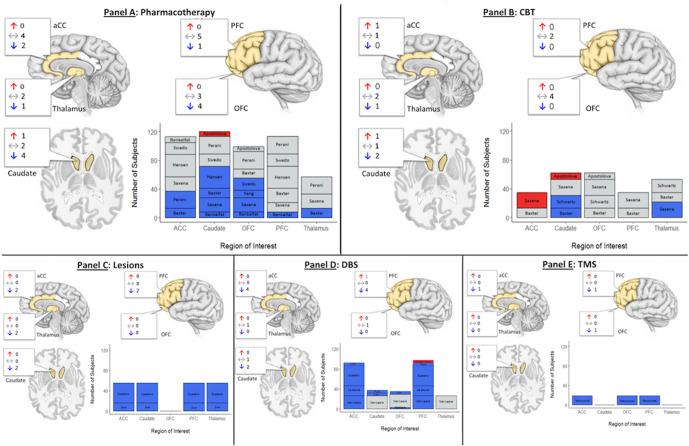
Approximately 2%–3% of the population suffers from obsessive–compulsive disorder (OCD). Several brain regions have been implicated in the pathophysiology of OCD, but their various contributions remain unclear. We examined changes in structural and functional neuroimaging before and after a variety of therapeutic interventions as an index into identifying the underlying networks involved. We identified 64 studies from 1990 to 2020 comparing pretreatment and post-treatment imaging of patients with OCD, including metabolic and perfusion, neurochemical, structural, functional and connectivity-based modalities. Treatment class included pharmacotherapy, cognitive–behavioural therapy/exposure and response prevention, stereotactic lesions, deep brain stimulation and transcranial magnetic stimulation. Changes in several brain regions are consistent and correspond with treatment response despite the heterogeneity in treatments and neuroimaging modalities. Most notable are decreases in metabolism and perfusion of the caudate, anterior cingulate cortex, thalamus and regions of prefrontal cortex (PFC) including the orbitofrontal cortex (OFC), dorsolateral PFC (DLPFC), ventromedial PFC (VMPFC) and ventrolateral PFC (VLPFC). Modulating activity within regions of the cortico-striato-thalamo-cortical system may be a common therapeutic mechanism across treatments. We identify future needs and current knowledge gaps that can be mitigated by implementing integrative methods. Future studies should incorporate a systematic, analytical approach to testing objective correlates of treatment response to better understand neurophysiological mechanisms of dysfunction.
Overview
The claims and statistics of this paper haven’t been checked yet.
Free: it reads the open-access text and checks the first 5 claims that cite a source we can check. Create a free account to check every claim.
Integrity signals
Registry
Cites
Statistics
Figures
Verification
Claims the paper makes
The claims and statistics of this paper haven’t been checked yet.
Free: it reads the open-access text and checks the first 5 claims that cite a source we can check. Create a free account to check every claim.
Claims other papers make about this one
Each is checked against this paper’s own text: does it say what the citing paper says it does?
The cited source says what the claim attributes to it.
In the citing paper
“In other domains of OCD research, there is evidence that treatment can normalize aberrant brain activity [4].”
From Neural correlates of response inhibition following cognitive behavioral therapy in obsessive–compulsive disorder: a randomized controlled EEG study (2026) · cites this paper as [4]
The check wasn’t confident either way, so it gives no verdict — never disputed.
In the citing paper
“However, interventions addressing downstream regions alone, such as thalamic DBS, have shown limited efficacy in some studies, potentially due to secondary alterations arising from disrupted upstream CSTC input (239)”
From Neural mechanisms underlying cognitive inflexibility in obsessive-compulsive disorder: a review (2026) · cites this paper as [239]
Experimental — accuracy not yet measuredThe check wasn’t confident either way, so it gives no verdict — never disputed.
In the citing paper
“have shown limited efficacy in some studies, potentially due to secondary alterations arising from disrupted upstream CSTC input (239)”
From Neural mechanisms underlying cognitive inflexibility in obsessive-compulsive disorder: a review (2026) · cites this paper as [239]
Experimental — accuracy not yet measured
Self-check
Percentages, sums and reported differences re-computed from the paper’s own numbers.
The self-check needs the paper’s full text.
Citations
Cites
Bardo, M. T., & Hammer, R. P. (1991) · Neuroscience · doi:10.1016/0306-4522(91)90226-e · Cited by 3,219
The epidemiology of obsessive-compulsive disorder in the National Comorbidity Survey Replication
Ruscio, A. M., Stein, D. J., Chiu, W. T., & Kessler, R. C. (2010) · Molecular Psychiatry · doi:10.1038/mp.2008.94 · Cited by 2,771
Baxter, L. R. (1992) · Archives of General Psychiatry · doi:10.1001/archpsyc.1992.01820090009002 · Cited by 1,293
Schwartz, J. M. (1996) · Archives of General Psychiatry · doi:10.1001/archpsyc.1996.01830020023004 · Cited by 693
Benkelfat, C. (1990) · Archives of General Psychiatry · doi:10.1001/archpsyc.1990.01810210048007 · Cited by 539
Deep brain stimulation for refractory obsessive-compulsive disorder
Abelson, J. L., Curtis, G. C., Sagher, O., Albucher, R. C., Harrigan, M., Taylor, S. F., Martis, B., & Giordani, B. (2005) · Biological Psychiatry · doi:10.1016/j.biopsych.2004.11.042 · Cited by 522
Deep brain stimulation restores frontostriatal network activity in obsessive-compulsive disorder
Figee, M., Luigjes, J., Smolders, R., Valencia-Alfonso, C.-E., van Wingen, G., de Kwaasteniet, B., Mantione, M., Ooms, P., de Koning, P., Vulink, N., et al. (2013) · Nature Neuroscience · doi:10.1038/nn.3344 · Cited by 466
Swedo, S. E. (1992) · Archives of General Psychiatry · doi:10.1001/archpsyc.1992.01820090018003 · Cited by 417
Saxena, S. (1999) · Neuropsychopharmacology · doi:10.1016/s0893-133x(99)00082-2 · Cited by 379
ROSENBERG, D. R., MacMASTER, F. P., KESHAVAN, M. S., FITZGERALD, K. D., STEWART, C. M., & MOORE, G. J. (2000) · Journal of the American Academy of Child & Adolescent Psychiatry · doi:10.1097/00004583-200009000-00008 · Cited by 377
Perani, D., Colombo, C., Bressi, S., Bonfanti, A., Grassi, F., Scarone, S., Bellodi, L., Smeraldi, E., & Fazio, F. (1995) · British Journal of Psychiatry · doi:10.1192/bjp.166.2.244 · Cited by 320
Nakao, T., Nakagawa, A., Yoshiura, T., Nakatani, E., Nabeyama, M., Yoshizato, C., Kudoh, A., Tada, K., Yoshioka, K., Kawamoto, M., et al. (2005) · Biological Psychiatry · doi:10.1016/j.biopsych.2004.12.039 · Cited by 307 · cited 1×
“27 ► PFC/ACC: Studies using Stroop, 31 32 and symptom provo-cation.”
Gilbert, A. R., Moore, G. J., Keshavan, M. S., Paulson, L. A. D., Narula, V., Mac Master, F. P., Stewart, C. M., & Rosenberg, D. R. (2000) · Archives of General Psychiatry · doi:10.1001/archpsyc.57.5.449 · Cited by 266
Rauch, S. L., Dougherty, D. D., Malone, D., Rezai, A., Friehs, G., Fischman, A. J., Alpert, N. M., Haber, S. N., Stypulkowski, P. H., Rise, M. T., et al. (2006) · Journal of Neurosurgery · doi:10.3171/jns.2006.104.4.558 · Cited by 260
Consensus on guidelines for stereotactic neurosurgery for psychiatric disorders
Nuttin, B., Wu, H., Mayberg, H., Hariz, M., Gabriels, L., Galert, T., Merkel, R., Kubu, C., Vilela-Filho, O., Matthews, K., et al. (2014) · Journal of Neurology, Neurosurgery & Psychiatry · doi:10.1136/jnnp-2013-306580 · Cited by 198
Saxena, S., Gorbis, E., O'Neill, J., Baker, S. K., Mandelkern, M. A., Maidment, K. M., Chang, S., Salamon, N., Brody, A. L., Schwartz, J. M., et al. (2009) · Molecular Psychiatry · doi:10.1038/sj.mp.4002134 · Cited by 159
(2006) · PubMed · Cited by 159
Yoo, S. Y., Jang, J. H., Shin, Y. ‐., Kim, D. J., Park, H. ‐., Moon, W. ‐., Chung, E. C., Lee, J. ‐., Kim, I. Y., Kim, S. I., et al. (2007) · Acta Psychiatrica Scandinavica · doi:10.1111/j.1600-0447.2007.01046.x · Cited by 151
Effects of behavior therapy on regional cerebral blood flow in obsessive–compulsive disorder
Nakatani, E., Nakgawa, A., Ohara, Y., Goto, S., Uozumi, N., Iwakiri, M., Yamamoto, Y., Motomura, K., Iikura, Y., & Yamagami, T. (2003) · Psychiatry Research Neuroimaging · doi:10.1016/s0925-4927(03)00069-6 · Cited by 150
Szeszko, P. R., MacMillan, S., McMeniman, M., Lorch, E., Madden, R., Ivey, J., Banerjee, S. P., Moore, G. J., & Rosenberg, D. R. (2004) · Neuropsychopharmacology · doi:10.1038/sj.npp.1300399 · Cited by 141
Nabeyama, M., Nakagawa, A., Yoshiura, T., Nakao, T., Nakatani, E., Togao, O., Yoshizato, C., Yoshioka, K., Tomita, M., & Kanba, S. (2008) · Psychiatry Research: Neuroimaging · doi:10.1016/j.pscychresns.2007.11.001 · Cited by 137 · cited 1×
“32 45 paradigms showed decreased activation in the ACC (n=10 adults), 32 (n=31 adults) 45 and OFC, 32 (n=11 adults), 31 following CBT that did not correlate with Y-BOCS.”
BackgroundHoexter, M. Q., de Souza Duran, F. L., D'Alcante, C. C., Dougherty, D. D., Shavitt, R. G., Lopes, A. C., Diniz, J. B., Deckersbach, T., Batistuzzo, M. C., Bressan, R. A., et al. (2012) · Neuropsychopharmacology · doi:10.1038/npp.2011.250 · Cited by 123 · cited 2×
“[ S5,10,S67-S68, S79-S81]”
Kang, D. ‐., Kwon, J. S., Kim, J. ‐., Youn, T., Park, H. ‐., Kim, M. S., Lee, D. S., & Lee, M. C. (2003) · Acta Psychiatrica Scandinavica · doi:10.1034/j.1600-0447.2003.00070.x · Cited by 120
Effects of fluoxetine on regional cerebral blood flow in obsessive- compulsive patients
(1991) · American Journal of Psychiatry · doi:10.1176/ajp.148.9.1243 · Cited by 119
Le Jeune, F., Vérin, M., N'Diaye, K., Drapier, D., Leray, E., Du Montcel, S. T., Baup, N., Pelissolo, A., Polosan, M., Mallet, L., et al. (2010) · Biological Psychiatry · doi:10.1016/j.biopsych.2010.06.033 · Cited by 116
Hansen, E. S., Hasselbalch, S., Law, I., & Bolwig, T. G. (2002) · The International Journal of Neuropsychopharmacology · doi:10.1017/s1461145701002681 · Cited by 114
Correlates of occupational disability in a clinical sample of obsessive-compulsive disorder
Mancebo, M. C., Greenberg, B. D., Grant, J. E., Pinto, A., Eisen, J. L., DYCK, I. R., & Rasmussen, S. A. (2007) · Comprehensive Psychiatry · doi:10.1016/j.comppsych.2007.05.016 · Cited by 110
Freyer, T., Klöppel, S., Tüscher, O., Kordon, A., Zurowski, B., Kuelz, A.-K., Speck, O., Glauche, V., & Voderholzer, U. (2011) · Psychological Medicine · doi:10.1017/s0033291710000309 · Cited by 105
Rauch, S. L., Kim, H., Makris, N., Cosgrove, G. R., Cassem, E. H., Savage, C. R., Price, B. H., Nierenberg, A. A., Shera, D., Baer, L., et al. (2000) · Journal of Neurosurgery · doi:10.3171/jns.2000.93.6.1019 · Cited by 100
Lázaro, L., Bargalló, N., Castro‐Fornieles, J., Falcón, C., Andrés, S., Calvo, R. M., & Junqué, C. (2009) · Psychiatry Research Neuroimaging · doi:10.1016/j.pscychresns.2008.12.007 · Cited by 96
CLINICAL FEATURES OF OBSESSIVE-COMPULSIVE DISORDER
Attiullah, N., Eisen, J. L., & Rasmussen, S. A. (2000) · Psychiatric Clinics of North America · doi:10.1016/s0193-953x(05)70175-1 · Cited by 94
Rubín, R. T., Ananth, J., Villanueva‐Meyer, J., Trajmar, P. G., & Mena, I. (1995) · Biological Psychiatry · doi:10.1016/0006-3223(94)00305-m · Cited by 94
Rosenberg, D. R., Benazon, N. R., Gilbert, A., Sullivan, A., & Moore, G. J. (2000) · Biological Psychiatry · doi:10.1016/s0006-3223(00)00902-1 · Cited by 87
O'Neill, J., Gorbis, E., Feusner, J. D., Yip, J. C., Chang, S., Maidment, K. M., Levitt, J. G., Salamon, N., Ringman, J. M., & Saxena, S. (2013) · Journal of Psychiatric Research · doi:10.1016/j.jpsychires.2012.11.010 · Cited by 84
Carey, P. D., Warwick, J., Niehaus, D. J., van der Linden, G., van Heerden, B. B., Harvey, B. H., Seedat, S., & Stein, D. J. (2004) · BMC Psychiatry · doi:10.1186/1471-244x-4-30 · Cited by 83
Huyser, C., Veltman, D. J., Wolters, L. H., de Haan, E., & Boer, F. (2010) · Journal of the American Academy of Child & Adolescent Psychiatry · doi:10.1016/j.jaac.2010.08.007 · Cited by 81
Morgiève, M., N'Diaye, K., Haynes, W. I. A., Granger, B., Clair, A.-H., Pelissolo, A., & Mallet, L. (2014) · Psychological Medicine · doi:10.1017/s0033291713002237 · Cited by 74 · cited 2×
“32 45 paradigms showed decreased activation in the ACC (n=10 adults), 32 (n=31 adults) 45 and OFC, 32 (n=11 adults), 31 following CBT that did not correlate with Y-BOCS.”
BackgroundYamanishi, T., Nakaaki, S., Omori, I. M., Hashimoto, N., Shinagawa, Y., Hongo, J., Horikoshi, M., Tohyama, J., Akechi, T., Soma, T., et al. (2009) · Psychiatry Research Neuroimaging · doi:10.1016/j.pscychresns.2008.07.004 · Cited by 65
Suetens, K., Nuttin, B., Gabriëls, L., & Van Laere, K. (2014) · Journal of Nuclear Medicine · doi:10.2967/jnumed.113.126409 · Cited by 64
Jang, J. H., Kwon, J. S., Jang, D. P., Moon, W.-J., Lee, J.-M., Ha, T. H., Chung, E. C., Kim, I. Y., & Kim, S. I. (2006) · American Journal of Psychiatry · doi:10.1176/ajp.2006.163.7.1202 · Cited by 63
Lissemore, J. I., Sookman, D., Gravel, P., Berney, A., Barsoum, A., Diksic, M., Nordahl, T. E., Pinard, G., Sibon, I., Cottraux, J., et al. (2018) · Translational Psychiatry · doi:10.1038/s41398-018-0128-4 · Cited by 60
Benazon, N. R., Moore, G. J., & Rosenberg, D. R. (2003) · Journal of the American Academy of Child & Adolescent Psychiatry · doi:10.1097/01.chi.0000087562.01900.de · Cited by 59
Decreased thalamic blood flow in obsessive-compulsive disorder patients responding to fluvoxamine
Pian, K. L. H., van Megen, H. J. G. M., Ramsey, N. F., Mandl, R. C. W., van Rijk, P. P., Wynne, H. J. A., & Westenberg, H. G. M. (2005) · Psychiatry Research Neuroimaging · doi:10.1016/j.pscychresns.2004.12.003 · Cited by 59
Brain reactivity to specific symptom provocation indicates prospective therapeutic outcome in OCD
Hendler, T., Goshen, E., Zwas, S. T., Sasson, Y., Gal, G., & Zohar, J. (2003) · Psychiatry Research Neuroimaging · doi:10.1016/s0925-4927(03)00091-x · Cited by 58
Zuo, C., Ma, Y., Sun, B., Peng, S., Zhang, H., Eidelberg, D., & Guan, Y. (2013) · Journal of Cerebral Blood Flow & Metabolism · doi:10.1038/jcbfm.2013.23 · Cited by 56
Li, P., Yang, X., Greenshaw, A. J., Li, S., Luo, J., Han, H., Liu, J., Zhong, Z., Guo, Z., Xiong, H., et al. (2018) · Brain and Behavior · doi:10.1002/brb3.963 · Cited by 52
Yin, D., Zhang, C., Lv, Q., Chen, X., Zeljic, K., Gong, H., Zhan, S., Jin, H., Wang, Z., & Sun, B. (2018) · Biological Psychiatry · doi:10.1016/j.biopsych.2018.04.006 · Cited by 50
Apostolova, I. I., Block, S., Buchert, R., Osen, B., Conradi, M., Tabrizian, S., Gensichen, S., Schroeder-Hartwig, K., Fricke, S., Rufer, M., et al. (2010) · Psychiatry Research Neuroimaging · doi:10.1016/j.pscychresns.2010.08.012 · Cited by 47
Huyser, C., van den Heuvel, O. A., Wolters, L. H., de Haan, E., Boer, F., & Veltman, D. J. (2013) · The World Journal of Biological Psychiatry · doi:10.3109/15622975.2012.674215 · Cited by 45
Cyr, M., Pagliaccio, D., Yanes-Lukin, P. K., Fontaine, M., Rynn, M. A., & Marsh, R. (2020) · Neuropsychopharmacology · doi:10.1038/s41386-020-0613-3 · Cited by 43
Cecconi, J. P., Lopes, A. C., Duran, F., Santos, L. C., Hoexter, M. Q., Gentil, A. F., Canteras, M. M., de Castro, C. C., Norén, G., Greenberg, B. D., et al. (2008) · Neuroscience Letters · doi:10.1016/j.neulet.2008.09.061 · Cited by 40
Buchsbaum, M. S., Hollander, E., Pallanti, S., Baldini Rossi, N., Platholi, J., Newmark, R., Bloom, R., & Sood, E. (2006) · Neuropsychobiology · doi:10.1159/000093342 · Cited by 40
Zhong, Z., Yang, X., Cao, R., Li, P., Li, Z., Lv, L., & Zhang, D. (2019) · Brain and Behavior · doi:10.1002/brb3.1201 · Cited by 39
Han, J. Y., Kang, D.-H., Gu, B.-M., Jung, W. H., Choi, J.-S., Choi, C.-H., Jang, J. H., & Kwon, J. S. (2011) · Journal of Korean Medical Science · doi:10.3346/jkms.2011.26.5.665 · Cited by 32
Whiteside, S. P. H., Abramowitz, J. S., & Port, J. D. (2012) · Psychiatry Research Neuroimaging · doi:10.1016/j.pscychresns.2011.04.004 · Cited by 31
Whiteside, S. P. H., Abramowitz, J. S., & Port, J. D. (2012) · Psychiatry Research: Neuroimaging · doi:10.1016/j.pscychresns.2011.11.010 · Cited by 27
Karadağ, F., Oğuzhanoğlu, N. K., Yüksel, D., Kıraç, S., Cura, Ç., Özdel, O. İ., & Ateşçi, F. Ç. (2012) · Psychiatry Research Neuroimaging · doi:10.1016/j.pscychresns.2012.07.005 · Cited by 16
Atmaca, M., Yıldırım, H., Yilmaz, S., Caglar, N., Mermi, O., Korkmaz, S., Akaslan, Ü., Gürok, M. G., Kekilli, Y., & Türkçapar, M. H. (2016) · The International Journal of Psychiatry in Medicine · doi:10.1177/0091217415621038 · Cited by 16
Kim, M., Lee, T.-K., Son, B.-C., Choi, C. R., & Lee, C. (2001) · Stereotactic and Functional Neurosurgery · doi:10.1159/000066727 · Cited by 15
Hypoactivity in the Paraterminal Gyrus Following Bilateral Anterior Capsulotomy
Hurwitz, T. A., Honey, C. R., McLeod, K. R., Poologaindran, A., & Kuan, A. J. (2019) · The Canadian Journal of Psychiatry · doi:10.1177/0706743719874181 · Cited by 7
Cited by
Current interpretations of the I-PACE model of behavioral addictions
Brand, M., Müller, A., Wegmann, E., Antons, S., Brandtner, A., Müller, S. M., Stark, R., Steins-Loeber, S., & Potenza, M. N. (2025) · Journal of Behavioral Addictions · doi:10.1556/2006.2025.00020 · Cited by 190
Gadot, R., Najera, R., Hirani, S., Anand, A., Storch, E., Goodman, W. K., Shofty, B., & Sheth, S. A. (2022) · Journal of Neurology, Neurosurgery & Psychiatry · doi:10.1136/jnnp-2021-328738 · Cited by 148
Self-citationLiu, J., Cao, L., Li, H., Gao, Y., Bu, X., Liang, K., Bao, W., Zhang, S., Qiu, H., Li, X., et al. (2022) · Neuroscience & Biobehavioral Reviews · doi:10.1016/j.neubiorev.2022.104574 · Cited by 109
Deep Brain Stimulation for Obsessive-Compulsive Disorder and Depression
Sheth, S. A., & Mayberg, H. S. (2023) · Annual Review of Neuroscience · doi:10.1146/annurev-neuro-110122-110434 · Cited by 94
Self-citationBiria, M., Banca, P., Healy, M. P., Keser, E., Sawiak, S. J., Rodgers, C. T., Rua, C., de Souza, A. M. F. L. P., Marzuki, A. A., Sule, A., et al. (2023) · Nature Communications · doi:10.1038/s41467-023-38695-z · Cited by 125
Metadata
- Authors
- Bijanki, K. R., Pathak, Y. J., Najera, R. A., Storch, E. A., Goodman, W. K., Simpson, H. B., & Sheth, S. A.
- Affiliations
- Baylor College of Medicine (US)
- Columbia University Irving Medical Center (US)
- Corresponding author
- Sheth, Sameer A.
- ORCID
- Venue
- Journal of Neurology, Neurosurgery & Psychiatry
- Publisher
- BMJ
- Published
- 2021-04-27
- Volume
- 92
- Issue
- 7
- Pages
- 776-786
- ISSN
- 0022-3050 (ISSN-L)
- 1468-330X
- PMC
- PMC8223624
- OpenAlex
- W3157636124
- Cited by
- 68
- References
- 61
- Citations by year
- 2026: 14 · 2025: 13 · 2024: 20 · 2023: 10 · 2022: 10 · 2021: 1
- FWCI
- 1.36
- Type
- journal article
- Language
- en
- Open access
- hybrid
- doi.org
- Licence
- Locations
- Journal of Neurology Neurosurgery & Psychiatry (publishedVersion, cc-by-nc)
- PubMed Central (publishedVersion, cc-by-nc)
- PubMed (publishedVersion)
- Funders
- National Institute of Neurological Disorders and Stroke (R21-NS104953)
- National Institute of Mental Health (K01-MH116364)
- Topics
- Social Sciences › Psychology › Clinical Psychology › Obsessive-Compulsive Spectrum Disorders
- Health Sciences › Medicine › Clinical Neurology › Deep Brain Stimulation and Movement Disorders
- Life Sciences › Neuroscience › Cognitive Neuroscience › Neural and Behavioral Psychology Studies
- Keywords
- obsessive-compulsive disorder, functional brain networks, treatment response, caudate nucleus, anterior cingulate cortex, thalamus, prefrontal cortex, orbitofrontal cortex, deep brain stimulation, transcranial magnetic stimulation, stereotactic lesioning, exposure and response prevention, pharmacotherapy, brain metabolism, cerebral perfusion
- MeSH terms
- Brain, Humans, Nerve Net, Obsessive-Compulsive Disorder, Deep Brain Stimulation, Transcranial Magnetic Stimulation, Neuroimaging
About these checks
Registry, retraction, Cites and statistics results are computed, not judged, with one exception: a printed reference that no index lists is read once by a model before it counts as a citation error. Claims are extracted by a model and kept only when their quote appears verbatim in the text; each cited source is then checked, with a model’s help, for whether it says what the claim relies on. Those verdicts can be wrong — read the claim’s quote and the cited source before relying on one.
Statistics and arithmetic are recomputed, not judged.
Confidence bands are shown only for fields calibrated on our annotated test set. None is calibrated yet, so no band is shown.
What counts as a claim ›How we measure confidence ›How we check this ›
Are you an author, or do you see a problem with this page? Request a review
Data sources
Bibliographic data: Semantic Scholar, OpenAlex, Crossref.
Contains information from the Semantic Scholar Academic Graph Datasets, made available under the ODC Attribution License (ODC-BY 1.0).
Semantic Scholar’s data is described in: Kinney, R., et al. (2023). The Semantic Scholar Open Data Platform. arXiv:2301.10140.
